


Introduction
A recent focus of research has been the notion of positive outcomes in the face of adversity, an approach that attempts to redress the imbalance of the relatively exclusive focus on the negative sequelae of stressful life experiences to a focus towards understanding positive traits and subjective experiences (e.g. Seligman and Csikszentmihalyi, Reference Seligman and Csikszentmihalyi2000). For example, it has been noted that exposure to stress does not inevitably lead to disorders and impairment, but rather can produce specific psychological benefits in some individuals (e.g. Affleck and Tennen, Reference Affleck and Tennen1996). Positive outcomes have been noted in the context of stressful life experiences as well as in coping with traumatic conditions, in both males and females (e.g. Tedeschi and Calhoun, Reference Tedeschi and Calhoun1996), across the life-span (e.g. Bellizzi, Reference Bellizzi2004), as well as across cultural divides (e.g. Powell, Rosner, Butollo, Tedeschi and Calhoun, Reference Powell, Rosner, Butollo, Tedeschi and Calhoun2003).
One focus of such work has been to understand the cognitive-behavioural processes involved in positive experiences of caregiving. So far, much of the literature has emphasized the difficulties of caregiving in general, solely referring to concepts such as caregiver burden (e.g. Zarit, Reever and Bach-Peterson, Reference Zarit, Reever and Bach-Peterson1980) or caregiver stress (Nolan, Grant and Ellis, Reference Nolan, Grant and Ellis1990). In stroke caregivers, for example, studies have commonly investigated strain (e.g. Blake and Lincoln, Reference Blake and Lincoln2000) and the negative emotional impact of caregiving (e.g. Dennis, O'Rourke, Lewis, Sharpe and Warlow, Reference Dennis, O'Rourke, Lewis, Sharpe and Warlow1998). While the caregiver role undoubtedly carries factors associated with stress, at the same time there is increasing recognition that it is also a role that can be potentially transformative (Yamashita, Reference Yamashita1998) and can entail significant rewards and positive features for the caregiver, including an enhanced sense of meaning (Ayres, Reference Ayres2000), increased self-efficacy and mastery (Berg-Weger, Rubio and Tebb, Reference Berg-Weger, Rubio and Tebb2001), and/or relationship improvement (López, López-Arrieta and Crespo, Reference López, López-Arrieta and Crespo2005). An emerging body of literature has focused specifically on positive caregiving experiences (e.g. Cadell, Reference Cadell2007; Kim, Schulz and Carver, Reference Kim, Schulz and Carver2007; Robertson, Stephens, Femia, Zarit and Braungart, Reference Robertson, Stephens, Femia, Zarit and Braungart2004), and some models of caregiving experiences have been developed (e.g. Brannen and Petite, Reference Brannen and Petite2008). A review of studies of coping and quality of life in stroke caregivers (Low, Payne and Roderick, Reference Low, Payne and Roderick1999) seemed encouraging, as it identified six longitudinal studies (Anderson, Linto and Stewart-Wynne, Reference Anderson, Linto and Stewart-Wynne1995; Hodgson, Wood and Langton-Hewer, Reference Hodgson, Wood and Langton-Hewer1996; Matson, Reference Matson1994; Schulz and Tompkins, Reference Schulz and Tompkins1990; Schulz, Tompkins and Rau, Reference Schulz, Tompkins and Rau1988; Wade, Legh-Smith and Langton-Hewer, Reference Wade, Legh-Smith and Langton-Hewer1986). However, none of these studies explored the coping process and associated mechanisms in detail, and so there remains a need to investigate how caregiving experiences change over time (Han and Haley, Reference Han and Hanley1999), given the evidence that stroke caregivers' adjustment can have an important impact on patients' quality of life (Anderson et al., Reference Anderson, Linto and Stewart-Wynne1995; Draper, Poulos, Cole, Poulos and Ehrlich, Reference Draper, Poulos, Cole, Poulous and Ehrlich1992). Moreover, stroke caregivers face a multitude of specific problems, such as the demand for physical care of the survivor, the high risk of dementia after stroke onset, and a number of cognitive impairments (such as aphasia).
With regards to this specific population, the literature again largely focuses on negative aspects, although some incidental findings of gain have been reported (e.g. Draper et al., Reference Draper, Poulos, Cole, Poulous and Ehrlich1992; Thompson, Bundek and Sobolew-Shubin, Reference Thompson, Bundek and Sobolew-Shubin1990). Others have purported to investigate caregiver well-being, but instead referred to the absence of negative outcomes such as depression (Kinney, Stephens, Franks and Norris, Reference Kinney, Stephens, Franks and Norris1995; Schulz et al., Reference Schulz, Tompkins and Rau1988; Williams, Reference Williams1993) or social restriction (Stephens, Norris, Kinney, Ritchie and Grotz, Reference Stephens, Norris, Kinney, Ritchie and Grotz1988). Some studies have used a wider conceptualization of gain that included positive psychological well-being (Forsberg-Wärleby, Möller and Blomstrand, Reference Forsberg-Wärleby, Möller and Blomstrand2001), impressions of caregiving and morale (Purk and Richardson, Reference Purk and Richardson1994), and perceptions of caregiving (Silliman, Earp Fletcher and Wagner, Reference Silliman, Earp, Fletcher and Wagner1988). However, the existing literature is limited in its consideration of the full range of potential social, emotional, cognitive, and behavioural benefits of stroke caregiving. The present study aimed to have a wider conceptualization.
Transactional stress model
Many of the studies of caregiving experiences have been based on the transactional stress model (TSM; Lazarus and Folkman, Reference Lazarus and Folkman1984). In general terms, Lazarus and Folkman (Reference Lazarus and Folkman1984) defined psychological stress as “a relationship between the person and the environment that is appraised by the person as taxing his or her resources and endangering his or her well-being” (p. 23). The model proposes that individuals respond to a potentially stressful situation by appraising the likelihood for harm or benefit (primary appraisal), and evaluate their ability to deal successfully with the situation (secondary appraisal) by means of either problem-focused coping (directed at altering or managing the problem, including changing personal or social resources) or emotion-focused coping (directed at regulating the emotional response to the problem). While each form of coping is considered adaptive under different circumstances (Zeidner and Saklofske, Reference Zeidner, Saklofske, Zeidner and Endler1996), problem-focused coping is conducive to psychological well-being when the stressor is seen as changeable, and emotion-focused more conducive when the stressor is perceived as uncontrollable (Vitaliano, DeWolfe, Maiuro, Russo and Katon, Reference Vitaliano, DeWolfe, Maiuro, Russo and Katon1990). Stroke caregiving may present with both types of stressors; therefore both forms of coping would be adaptive in different situations. For example, problem-focused coping (e.g. making a plan of action and following through) may be adaptive when faced with the physical demands of caregiving, while emotion-focused coping (e.g. acceptance, rediscovering priorities in life) may be most adaptive when facing unchangeable aspects.
The process of appraisal and coping is thought to be a fluctuating process, with adaptations being made both in response to environmental changes but also due to the success or failure of coping methods used. These feedback loops mean that an outcome of one encounter can become a causal factor in the next encounter, and coping is thus seen as an ongoing and ever-changing process. Depending on the effectiveness of the coping response, individuals either experience positive outcomes, such as a sense of mastery, or negative outcomes, such as depression.
Central to this model are individual appraisals and beliefs, which determine coping responses. Appraisals do not apply to a person or to their environment alone, but to their interaction, or transaction. Coping is therefore seen as occurring via the central process of appraisal, which addresses both the potentially threatening situation, and available coping responses – the person-environment transaction. Appraisals are necessarily subjective, and the model therefore has an individual basis, which allows it to address both between- and within-person changes over time. It is clear that this dynamic process is conceptually very different from the previous structural linear models (e.g. behavioural, psychodynamic), with feedback and consequent individual change being the two new key concepts. These contribute to the model's main strengths, its ability to account for individual differences, and changes in coping over time.
Criticisms of coping research have led to the development of a daily coping paradigm (Stone and Neale, Reference Stone and Neale1984), in which coping is assessed daily, as it occurs in response to real-life stressors. Repeated measurement provides detailed longitudinal data, facilitating in-depth understanding of individual fluctuations in coping. The daily coping paradigm addresses Lazarus and Folkman's (Reference Lazarus and Folkman1984) call for ipsative-normative research that allows a meaningful investigation of the between- and within-personal factors involved in the coping process. Within-subject designs have been used to investigate, for example, the impact of daily coping on end-of-day mood in a general population (Stone, Kennedy-Moore and Neale, Reference Stone, Kennedy-Moore and Neale1995). To our knowledge, there has as yet been no investigation of positive caregiving experiences on a daily basis, either regarding stroke caregivers or in general. This study therefore aims to address this gap, by focusing on patterns of positive caregiving experiences, in terms of interactions between gains, appraisals and daily coping. It aims to describe daily fluctuations in positive experiences of stroke caregiving, using a broad conceptualization of gain. The study uses a longitudinal design – specifically using repeated measurements with a small number of participants – to explain both between- and within-individual changes across time (Franklin, Allison and Gorman, Reference Franklin, Allison, Gorman, Franklin, Allison and Gorman1996). Such designs are “uniquely suited to understanding an individual's coping process over time” (Jensen, Turner, Romano and Karoly, Reference Jensen, Turner, Romano and Karoly1991; p. 280). The exploratory nature of single case designs makes them highly relevant to the hypothesis-generation and model-building stages of the research cycle (Barlow and Hersen, Reference Barlow and Hersen1984).
The specific aims of the study are to address the following three research questions: (1) What positive caregiving experiences are reported by stroke caregivers? (2) How do gains change from day to day? (3) Can individual patterns of gains be explained by the TSM, through associations with appraisals and daily coping?
Method
Participants
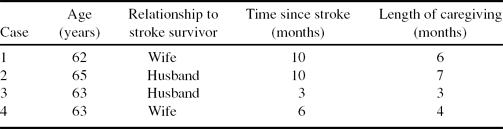
Potential participants were identified via local stroke teams, and assessed according to two inclusion criteria: (1) main daily unpaid caregiver to a stroke survivor; and (2) likely to have experienced some positive caregiving experiences, as assessed by the lead researcher (EH) in an initial interview. This assessment was based on the carers' accounts of experiencing benefits in the recent past. A total of 26 caregivers were approached over an 8-week period. Of these, 14 either declined or did not meet inclusion criteria, and one withdrew from the study after one week. This left four usable sets of data. The study sample was therefore highly selected, as caregivers only participated if they reported positive caregiving experiences. Therefore, participants were selected on the basis of self-report with regards to positive experiences specifically in order to study the phenomenon in question. This was appropriate given the study's exploratory nature and its aim of suggesting explanations for positive experiences. This study did not aim to differentiate, for instance, between caregivers who experienced gains and those who did not. Table 1 displays participant characteristics. All participants had experienced an ischemic stroke, which had resulted in a significant impact on speech, mobility, and independent living. These difficulties (especially in speech) had improved greatly by the time of the study; mobility, however, was still restricted and all participants reported needing assistance with daily self-care tasks.
Participant characteristics

Procedures
The study was approved by the Local Research Ethics Committee for ethical considerations. Participants were receiving healthcare services during the time of the study. Informed consent was sought from participants prior to conducting interviews. Participants were informed that participation, or withdrawal from participation, in the study would not affect services provided. Information with regards to confidentiality of data (e.g. anonymity, storage of data) was provided to all participants prior to conducting interviews.
Initial interviews with participants were arranged to discuss the study and to obtain participant background information. They were then asked to complete a daily caregiving diary (DCD) every day, ideally for 6 weeks. Strategies to minimize forgetting were discussed and implemented. For example, participants completed two practice diaries before the start of study, and they were encouraged to complete diaries at the same time each day as part of a routine. Moreover, once the study period began, diaries were collected weekly and discussed with participants. Feedback on individual results was provided after the study period.
Measures
Published measures were considered for use in this study according to their compatibility with, or foundation in, the TSM, and their suitability for daily use. Due to difficulties in finding suitable measures of stress and positive caregiving experiences that covered the full range of variables measured in the present study, a measure, the Daily Caregiving Diary (DCD), was developed specifically for these variables.
Development of the DCD
The DCD is derived from variables within the TSM. It was piloted to assess its clarity and time demands, using a non-caregiving volunteer. This provided feedback regarding item presentation, workload feasibility, and face validity. The DCD was also subjected to expert review, which provided content validity. Expert review comprised circulation of a draft version of the DCD to a small number of professionals who worked currently with carers. They commented on the content validity of the DCD.
The DCD consisted of four subscales: (1) Stress, (2) Appraisals, (3) Daily Coping, and (4) Caregiving Gains. Each scale is described below.
Stress
Participants briefly described each day's most stressful event or situation and rated how “bothersome” this had been on a single 0–9 Likert scale (0 = Not at all bothersome, 9 = As bothersome as possible). This was based on the initial question of the Daily Coping Questionnaire (DCQ; Stone and Neale, Reference Stone and Neale1984).
Appraisals
This section consisted of six items regarding appraisal of the bothersome event, taken from the Stress Appraisal Measure (SAM; Peacock and Wong, Reference Peacock and Wong1990). All items were rated on a 0–9 point Likert scale (0 = not at all, 9 = extremely) in response to questions regarding appraisals (e.g. “Did you think that the event or situation had important consequences for you?” and “Did you think you had the ability to do well in the situation?”). The possible score range was from 0 to 54. Frequencies of appraisals were calculated on the basis of number of days that a particular item was endorsed.
Three items were included regarding primary appraisal, and three regarding secondary appraisals, from the SAM's total of 28 items. Items chosen loaded most strongly onto the SAM's six main dimensions (threat, challenge, centrality, control-self, control-others, and uncontrollably-by-anyone). Peacock and Wong defined the first three dimensions as primary appraisals. They defined threat appraisals as those involving the potential for harm or loss in the future; challenge appraisals involve the anticipation of gain or growth from the experience; and centrality refers to the perceived importance of an event for one's well-being. The remaining three dimensions are considered to be secondary appraisals. On the basis of research findings that different secondary appraisals relate to different coping mechanisms, Peacock and Wong argued that individuals assess the controllability of a situation in terms of three independent dimensions relating to whether the situation is (a) controllable by self; (b) controllable by others; and (c) uncontrollable-by-anyone.
Daily coping
This variable was based on the DCQ and included eight coping categories, which are based on Lazarus and Folkman's (Reference Lazarus and Folkman1984) transactional stress model, as well as a general question regarding whether other coping methods were used. The nine coping strategies include: distraction, situation redefinition, direct action, catharsis, acceptance, social support, relaxation, and religion. The general question asked “Did you do or think anything else while trying to handle this event?” Participants indicated how much they had used a coping strategy from each category on a 10-point scale (0 = didn't use this method at all, 5 = used this method quite a lot, 9 = used this method a lot). The possible score range was from 0 to 81. At the end of this section, participants were asked to indicate which method was found most useful.
Caregiving gains
These six diary items were taken from a review of caregivers' positive experiences (Kramer, Reference Kramer1997), in which they were cited as items used across several studies. Specifically, these items assessed the consequences of the bothersome event or situation on six aspects of experience: relationship with the person being cared for or other family members; increased self-esteem; feeling appreciated; enhanced sense of meaning or purpose; feelings of pleasure; and prevention of further deterioration of the person being cared for. All items were rated on a 0–9 point scale (0 = didn't happen at all, 9 = happened a lot) in response to questions regarding possible consequences of caregiving experiences (e.g. “Improved relationship with the person you care for or other family members” and “Increased self-esteem”). The possible score range was from 0 to 54.
Scoring
Details of scoring of individual sections are given above. The total range of scores was from 0 to 189. This gave superior sensitivity to daily variability for the purposes of this study, as compared to the dichotomous response format of some of the original scales (e.g. DCQ). At the end of each section, participants were invited to state whether they would like to provide further detail but were informed that this was optional. Participants' responses provided descriptive statements that further highlighted specific aspects of the caregiving experience (details of which are presented shortly). The content and format of the diary therefore facilitated a fine-grained analysis of positive caregiving patterns, and associated stress, appraisal, and coping on a daily basis.
Results
Results were analysed using visual inspection of graphs combined with supplementary statistical analyses. This combination of visual and statistical analysis techniques are the primary data evaluation method for single-case research designs (for details, see Kazdin, Reference Kazdin and Kazdin1982; Franklin, Gorman, Beasley and Allison, Reference Franklin, Gorman, Beasley, Allison, Franklin, Allison and Gorman1996; Brossart, Parker, Olson and Mahadevan, Reference Brossart, Parker, Olson and Mahadevan2006;), and have been used in other disciplines within psychology, such as developmental (e.g. Moran, Dumas and Symons, Reference Moran, Dumas and Symons1992). Initial visual inspection aids in the detection of effects, while further statistical analyses offer more stringent methods in order to control possible confounds.
In the present study, to investigate trend (slope), raw data were supplemented with regression lines, to indicate linear tendency. A positive slope of a regression line indicates an increase in the variable over time, with a steeper slope indicating greater increase. A non-parametric smoothing technique was used. This was done by calculating a running median line across all data points and then establishing a smoothed curve. Smoothing reduces the influence of outliers and therefore removes day-to-day “noise”. The smoothed lines were graphed and visually inspected, looking at peaks (increases) and troughs (decreases). The TSM's ability to explain patterns of caregiver gain was investigated by comparison of relevant smoothed lines (e.g. problem-focused coping compared to total gains). Simultaneous peaks in two smoothed lines indicate a possible association.
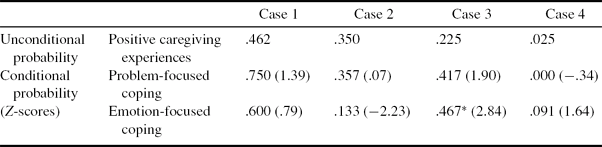
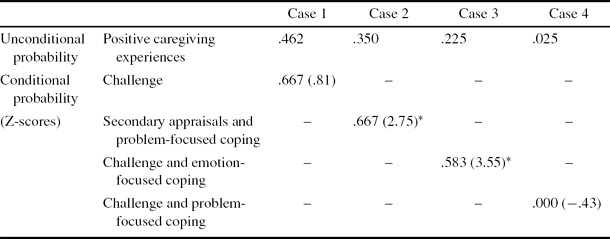
Visual inspection techniques were supported by analysis of covariation (as defined by co-occurrence of high data points, relative to trend in both variables), which investigates the degree to which two variables vary together. The likelihood of positive caregiving experiences (unconditional probability) was compared with the likelihood of the various appraisal and coping variables (conditional probability). For example, the calculation involved the number of times each appraisal and coping variable was reported as well as a gain, in relation to the total number of times each appraisal and coping variable was reported. This allowed an assessment of whether peaks occurred on the same day merely through chance, or due to an association between the variables. The statistical significance of association was tested using Z-scores. As multiple tests were performed, a Bonferroni correction was made to limit Type I error within each case.
Missing data
Participants sometimes completed the DCDs regarding non-caregiving bothersome events (e.g. difficulties with transport). These data were removed from the analysis, as preliminary visual inspection showed that they were markedly different to the caregiving data, were reported as unrelated to caregiving, and could not be meaningfully included in the study data. Case 1 completed diaries over 4 weeks, rather than 6, and did not complete a diary on 13 of these days, so this dataset consisted of 15 days. The datasets for cases 2, 3, and 4 consisted of 42 days. For all participants, missing data (five datapoints in total) were replaced with medians (chosen as they are more related to variability than means).
The results will be presented according to the three research questions in turn, with further assessment of appraisals and coping in relation to gains.
Positive caregiving experiences reported by stroke caregivers
While participants reported a variety of caregiving-related and non-caregiving-related stressors (e.g. disagreement with partner, worries about partner's health, balancing caregiving and other duties), nevertheless participants did reveal a variety of aspects of their lives that they felt had been positively influenced as a result of taking on a caregiving role. These included improved relationships, increased self-esteem, feeling appreciated, enhanced sense of meaning or purpose, pleasure, and prevention of further deterioration. Table 2 shows the frequencies of gains, appraisals, and coping strategies, with percentage of days in parentheses. The results indicate that all four participants reported several caregiving gains, with each gain being experienced regularly. The most common gain was “felt appreciated”, following by “enhanced sense of meaning or purpose” and “increased self-esteem”. The least commonly reported gain was “pleasure”, but even this was experienced on at least 43% of days.
Frequencies of gains, appraisals, and coping strategies
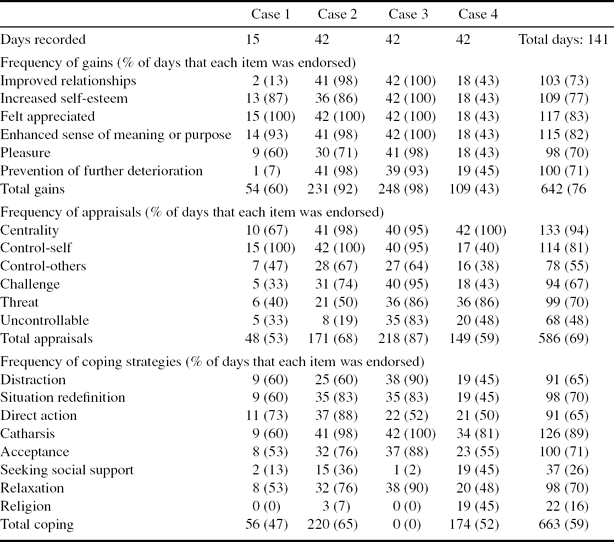
The following examples of participants' written (in the free-response section of the DCD) and verbal comments (in initial interview) illustrate the different types of caregiving gains that were experienced. One participant talked about now being part of a “loving team” (improved relationship), and described his/her happiness at seeing his/her spouse enjoy days out (pleasure). Some described increased confidence through managing their difficulties: “this must be the most stressful time in my life (but) I will ride the storm” (increased self-esteem, active engagement with stressor). Participants frequently mentioned rewards associated with physical therapy or exercise (prevention of further deterioration) – for example, helping their spouses to go swimming for the first time. Participants talked about now having a useful and meaningful role (enhanced sense of meaning or purpose), and knowing that their spouses were grateful for their efforts: “(caregiving) makes me feel appreciated and loved and this makes me very happy” (feel appreciated).
Changes in gains from day to day
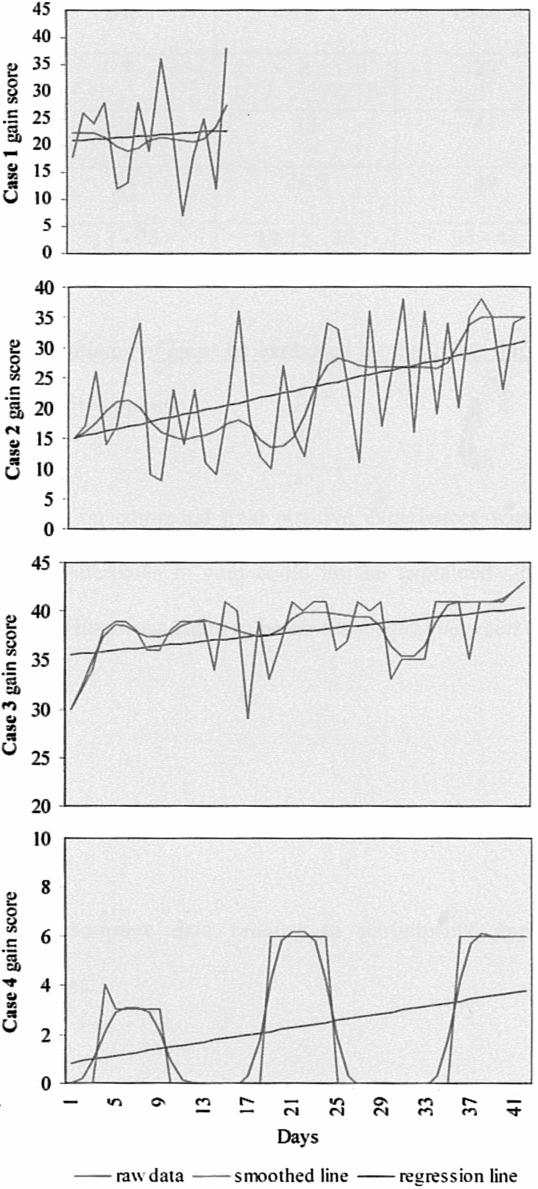
Reliability analyses showed that the six positive experience variables correlated with each other adequately, for each case (alpha = .59 to .95), so these variables were summed on each day to give a total gain score (maximum score = 54). These data were then graphed and analysed using visual inspection of regression lines (Figure 1). In all cases, there was an increase in gains over the study period, as indicated by the positive slope of the regression lines, with the greatest increase shown by the steepest slope of Case 2.
Daily variation in total gain scores

The data were investigated regarding within-individual variability, and between-individual differences, using smoothed lines (Figure 1) in conjunction with descriptive data regarding total gain scores. For instance, the peaks and troughs in the smoothed lines show variability in total gains reported by Cases 1 and 2. Case 3 reported consistently high levels of gain, although with some day-to-day variation. Case 4 reported consistently few benefits, and the differences from the other three cases in total gain scores are apparent. In the instances where Case 4 reported no gains, this was within the context of reported stressors. Therefore, the zero values reflect no gain on days when stressors were reported. Moreover, increases in gains were not related to decreases in stressors. The positive caregiving experiences reported by participants therefore varied markedly, both in terms of total gains and day-to-day variability.
Individual patterns of gains in the context of the TSM
Initial visual inspection compared total positive experiences with “bothersomeness” in order to check that increases in gain could not be explained simply by simultaneous decreases in stress. No association was found between these variables across cases.
Appraisals
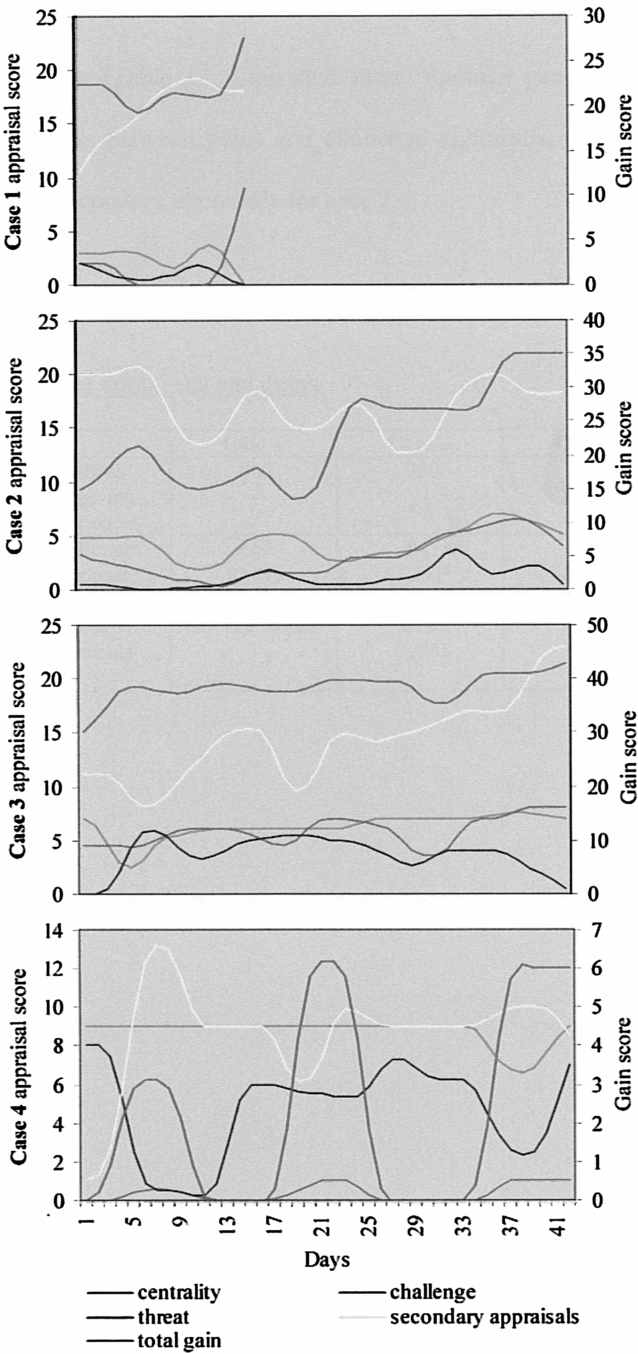
Table 2 shows descriptive data relating to participants' appraisals of the daily bothersome situations. Frequencies of appraisals were obtained by summing the number of occasions. The most common appraisal was centrality (reported on at least 67% of days), followed by control-self (reported on at least 40% of days, and on every day by two participants). Visual inspection of the primary appraisal variables (threat, challenge, and centrality) showed some association between challenge and positive experiences, in all four cases (Figure 2). Neither threat nor centrality showed any clear association with caregiving gain in any of the cases. As none of the single secondary appraisals (control-self, control-others, and uncontrollable) seemed associated with caregiving gains, they were combined into an overall secondary appraisal variable.Footnote 1 Secondary appraisals did not show association with caregiving gains in Cases 1, 3, or 4. For Case 2, however, secondary appraisals seemed to be more closely associated with positive experiences than challenge appraisals (Figure 2).
Appraisal and total gain scores

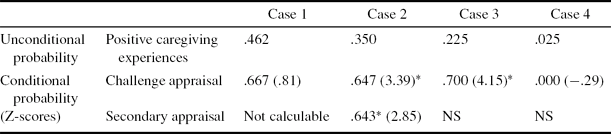
Covariation analysis (Table 3) supported these findings generally, showing a significant association between gains and challenge appraisals, for Cases 2 and 3, and between gains and secondary appraisals for Case 2.
Relationships between appraisals and gains
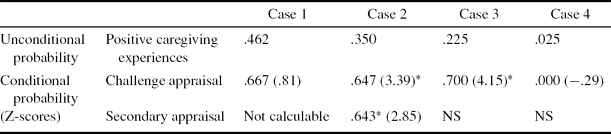
Note: *p < .05/5; NS = not significant.
Daily coping
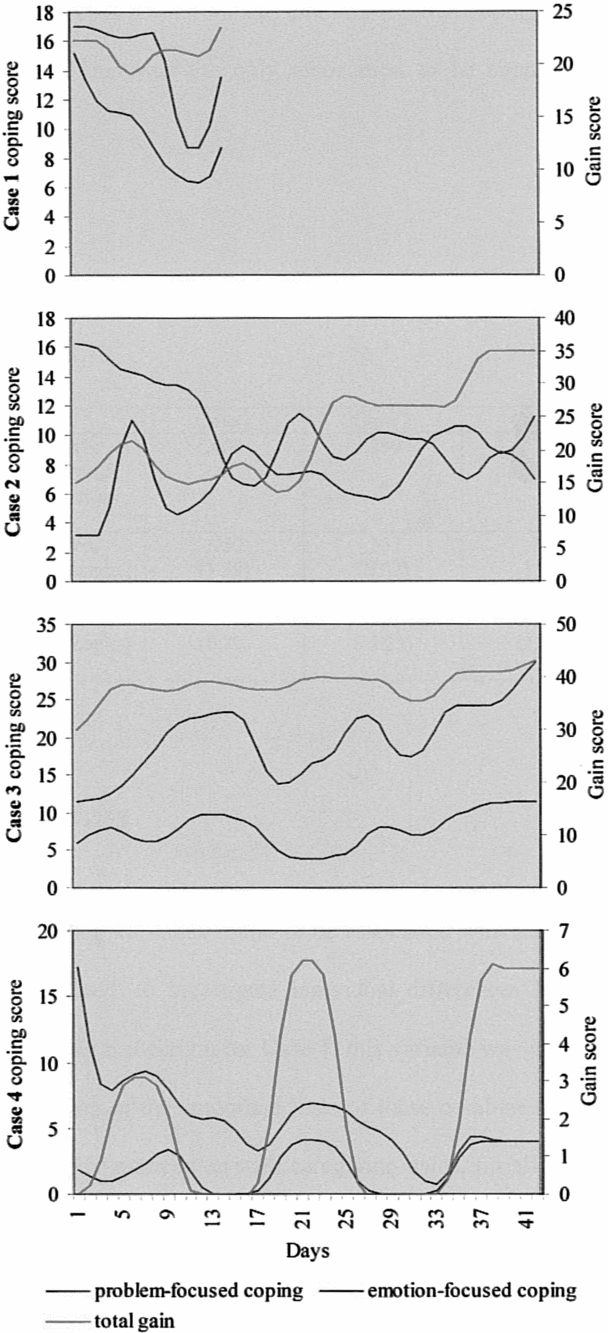
Table 2 shows clear variation in the use of coping strategies, with catharsis being the most commonly used and religion the least. There were individual differences in coping strategies. For example, Case 4 reported using each coping strategy on at least 45% of days, whereas Case 1 did not use religion at all, but used direct action on 73% of days. As initial visual inspection showed that none of these single variables explained the pattern of caregiving across all participants, coping strategies were grouped, following the TSM, into emotion-focused coping (distraction, situation redefinition, catharsis, and acceptance) and problem-focused coping (direct action, seeking social support, relaxation, and religion). Visual inspection of the smoothed lines (Figure 3) showed considerable between-individual variation. Neither coping style was associated with caregiver gain in Case 1, while problem-focused coping had a slight association with gain in Case 2, and a marked association with Case 4. In contrast, emotion-focused coping was more associated with gain in Case 3. This was the only association to be supported by covariation analyses (Table 4).
Emotion-focused coping, problem-focused coping, and total gain scores

Relationships between coping and gains

Note: *p < .05/5.
Appraisals and coping
The appraisal and coping variables found to be associated with caregiving gains in each case were then combined in order to further investigate individual differences. Visual inspection of the smoothed lines of these combined appraisal and coping variables (Figure 4) showed association with caregiving gains for all cases. Appraisals and coping interacted differently across the four cases. Figure 4 shows some variation in caregiving benefits that is not matched with similar changes in the appraisal and coping variables, but the model can explain positive caregiving experiences to a large extent for Cases 2, 3, and 4. Covariation analyses showed that these combined appraisal and coping variables were significant in Cases 2 and 3, but not Case 4 (Table 5).
Appraisals, coping, and total gain scores

Relationships between appraisal, coping, and gains

Note: *p < .05/5.
Discussion
Consistent with prior research and our predictions, all participants reported significant caregiving gains, with total positive experiences increasing with time in all cases. Patterns of variability in positive experiences were also found, as well as associations with challenge appraisals (in all cases), secondary appraisals (Case 2), problem-focused coping (Cases 2 and 4), and emotion-focused coping (Case 3). This pattern of results provides evidence of between-individual differences in gains and associated variables, as well as intra-individual variability over the study period.
Reports of positive experiences associated with caregiving are not surprising, given that participants were selected on the basis that they were likely to experience some caregiving gains. Where benefits such as enhanced sense of meaning (Ayres, Reference Ayres2000), increased self-efficacy (Berg-Weger et al., Reference Berg-Weger, Rubio and Tebb2001), and relationship improvement (López et al., Reference López, López-Arrieta and Crespo2005) have been previously noted, this study supports those findings, and moreover extends the literature by identifying additional specific benefits such as increased self-esteem, feeling appreciated, feelings of pleasure, and prevention of further deterioration in the person being cared for. Participants revealed a variety of aspects of their lives that they felt had been positively influenced as a result of taking on a caregiving role. These various aspects seem consistent, and indeed overlap with, the dimensions of posttraumatic growth that Tedeschi and Calhoun (Reference Tedeschi and Calhoun1996) have reported, including appreciation of life, improved relationships, change in life priorities, change in philosophy of life, and spiritual change, all of which were reported by participants in this study. Moreover, participants reported an enhanced sense of meaning or purpose, extending other findings relating to the importance of meaning-making in caregivers populations such as AIDS caregivers (Folkman, Reference Folkman1997) and caregivers of a family member with Alzheimer's disease (Butcher and Buckwalter, Reference Butcher and Buckwalter2002). The current study is the first in which meaningfulness has been reported by stroke caregivers as a positive experience in itself. Overall, “pleasure” was the least frequently reported gain, although it still occurred on at least 14% of days.
The use of a case series design in exploring an increase in gains in relation to coping is a novel approach to studying positive experiences among stroke caregivers. It could be argued that increases in caregiver benefit were due to improvements in the care recipient's condition, leading to an enhancement of caregiver morale (e.g. Silliman et al., Reference Silliman, Earp, Fletcher and Wagner1988). Although unmeasured, it seems unlikely that significant improvements were made by the four stroke survivors in the course of the 6-week study period. It would be interesting to determine whether similar increases in positive experiences are reported by caregivers who are unlikely to see such improvements (e.g. dementia caregivers). It is possible that increases in reports of positive experiences may be, in part, an effect of participation in the study. Participants may have become aware of previously unnoticed positive experiences, and/or daily recording in a diary may have prompted a reframing of a situation previously perceived to be negative, thus accounting for the positive trend in gain over the study period. Indeed, one participant commented that the questions had made him aware of the many benefits associated with his caregiving role.
Challenge was the only primary appraisal found to be associated with positive caregiving experiences, across all cases. Challenge appraisals involve the perceived potential for gain or growth in stressful situations, so it is unsurprising that such appraisals were associated with positive experiences. In contrast, secondary appraisals were associated with positive experience in only one case. This was unexpected, as both primary and secondary appraisals are considered relevant to the coping process. Problem-focused strategies were found to be more associated with caregiving gain in this study than were emotion-focused strategies in two cases, but the reverse was true in one case. As caregiving involves both emotional and practical tasks, it seems logical that caregivers used both types of coping. This is consistent with findings reported by López et al. (Reference López, López-Arrieta and Crespo2005) who found that positive aspects of caregiving were related primarily to caregiver characteristics (e.g. appraisals, coping strategies), rather than to aspects of the stressor (e.g. degree of impairment in care recipient), emphasizing the role of appraisals and personal resources. The present findings may support Lazarus's (Reference Lazarus2000) suggestion that the distinction between emotion-focused and problem-focused coping should not be made too rigidly, as the strategies are interdependent. Certainly, participants did not use particular coping strategies to the exclusion of others, although reasons for their different preferences remain unclear. It is likely that differences in participant characteristics and circumstances influenced their caregiving experience. For instance, more experienced caregivers may have learned more effective coping strategies.
The findings can therefore be understood from a cognitive-behavioural perspective, within the context of the TSM, given the interaction between appraisals of gain and use of problem-focused strategies in addressing perceived stressors. It appears that for positive experiences to occur, a perception of the potential for gain or mastery is important, followed by a combination of problem-focused and emotion-focused strategies. In this study, the TSM therefore does account for positive growth experiences, and these results extend the applicability of the TSM to the domain of posttraumatic growth.
In summary, the TSM appears helpful in explaining daily changes in caregiving gains and in associated appraisal and coping variables. Graphical representation shows that the associations are not perfect, as there was some association in caregiving benefits that was not matched with a similar pattern in the combined appraisal and coping variables. In general, however, the findings can be understood within the context of the TSM, and supporting both between- and within-individual differences in caregiving gain and associated variables over time.
Limitations
A case-series methodology facilitated an in-depth investigation of positive experiences, and considerable fluctuations were found on all measures, illustrating the importance of a longitudinal methodology, rather than cross-sectional designs that would have missed such changes. Still, a number of limitations of the study must be noted. Participants were selected on the basis of having positive experiences with regards to caregiving. While one participant (case 4) reported few benefits, the remaining participants reported more gains, and there is a likelihood of a skewed sample. While this skew may be helpful in initially studying a phenomenon, it may risk losing important insights about the full degree of positive experiences and the relations to coping along that range. While the current sample size was too small to make generalized claims about positive experiences in caregiving, the study does contribute towards understanding the relationship of appraisal and coping variables to the occurrence of positive experience.
The study did not utilize a comparative design and therefore an analysis of between-subject differences (such as gender, duration of caregiving, and other variables) was not feasible. Larger studies may systematically replicate across men and women with different duration characteristics, utilizing a group comparison design. Perhaps a sample of caregivers could be utilized towards the development of questions to further understand the qualities of the caregiving experience.
Participants were similar in terms of age and relationship to the stroke survivor, and this homogeneity limits the generalizability of this study to other caregiver populations. Due to the absence of experimental controls, the current study can make no claims regarding causality. However, the TSM considers linear causality to be an inappropriate concept with respect to coping, which is instead viewed as a dynamic process.
Conclusions: clinical implications
The current study has implications for clinical work with caregivers. The DCD could be used to identify caregivers who are experiencing few gains, and who may benefit from therapeutic input – for example, aimed at altering appraisals. From a positive psychology perspective, those carers who already cope successfully could be applauded for their skill or invited to act as models for others, further boosting self-esteem and coping.
If it is indeed the case that the increase in caregiving rewards was actually the result of participation in the study, this has implications for clinical use of the DCD. However, further research would be needed in order to assess the significance of the DCD as a clinical intervention.
From a strengths-based practice perspective (e.g. Berg-Weger et al., Reference Berg-Weger, Rubio and Tebb2001), interventions may also include identifying caregivers' assets, resources, effective coping strategies, and a plan for self-care, in order to optimize well-being in this population. Clinicians can assist caregivers in developing a balanced view of the caregiving role – i.e. as one that can carry losses and compromises as well as one that holds potential for personal growth. In this sense, interventions can parallel the positive psychology approach of integrating negative and positive aspects of stress, embodying a holistic stance, and thereby sensitively facilitating personal growth at appropriate stages within a strengths-based intervention approach.
Future research
The current study was an initial attempt to investigate positive experiences in stroke caregivers, and it suggests many future research questions. Does the reported increase in caregiver gains continue at later stages of caregiving? Why are positive experiences more associated with emotion-focused coping in some caregivers, but problem-focused coping in others? Do positive experiences still occur when stressful events are appraised as more threatening than challenging? The successful application of the daily coping paradigm, in a case series design, illustrates an appropriate methodology to answer such questions.
The current work also suggests potential hypotheses for experimental case studies. Coping preferences may mean that intervention aimed at increasing particular types of coping will be more successful for some caregivers than for others. Finally, the current work suggests potential questions for large-scale studies. Are challenge appraisals associated with positive experiences in all caregivers? What distinguishes caregivers who report high level of gain from those who do not? The current study provided initial findings regarding associations between appraisals, daily coping, and positive experiences in stroke caregivers, and highlights the potential of the longitudinal approach in addressing the plethora of research questions that arise.
Acknowledgements
The authors would like to thank Susan Brown for her support throughout this work.




Comments
No Comments have been published for this article.