Introduction
Depressive symptoms were associated with increased hospitalization and nursing home admissions (Harris, Reference Harris2007; Givens et al., Reference Givens, Jones and Inouye2009), increased length of stay (Lin et al., Reference Lin, Wang, Chen, Wu and Portwood2005), and increased risk of premature death (Lavretsky et al., Reference Lavretsky2010). There is extensive evidence that contextual factors, such as socioeconomic disadvantages (e.g., lower income, older age, and female), being disabled (chronic diseases, functional impairment, and hearing impairment), impaired cognitive status, and poor psychosocial well-being (feelings of loneliness and poor perceived social support), contributed to developing depressive symptoms that negatively influenced health and well-being of the elderly living in a long-term care community (e.g., Tsai et al., Reference Tsai, Chung, Wong and Huang2005; Lin et al., Reference Lin, Wang and Huang2007; Damián et al., Reference Damián, Pastor-Barriuso and Valderrama-Gama2010; Kwok et al., Reference Kwok, Yeung and Chung2011; Prieto-Flores et al., Reference Prieto-Flores, Forjaz, Fernandez-Mayoralas, Rojo-Perez and Martinez-Martin2011; Boorsma et al., Reference Boorsma2012). The prevalence of depressive symptoms identified by the Geriatric Depression Scale in Taiwan's older adults who reside in long-term care institutions was high (43.6%–52.05%; Liu, Reference Liu2005; Lin et al., Reference Lin, Wang, Chen, Wu and Portwood2005). Cultural factors that may relate or contribute to depressive symptoms in older adults have not been well researched, in particular the Chinese cultural factor of filial piety (Lin et al., Reference Lin, Wang, Chen, Wu and Portwood2005). Filial piety, a core traditional Chinese/Taiwan family norm deeply influenced by Confucianism, is the belief that children should provide for the material and psycho–social–spiritual well-being of one's aged parents and keep aged parents away from harm (Ho, Reference Ho1994). Examples of filial responsibility behaviors include obedience and respect for parental authority, co-residing with older parents, supplying living funds, and taking care of daily needs for aged parents (Ho, Reference Ho1994). Respect from children was reported as a predictor of psychological well-being in well community-dwelling Chinese (Cheng and Chan, Reference Cheng and Chan2006). However, institutional placement is often viewed as a non-filial practice among Chinese (Chang and Schneider, Reference Chang and Schneider2010). Interestingly, there have been few studies that have examined filial piety from the perspective of elderly individuals who are living in long-term care communities as a contributor to depression.
Regardless of the elder's preference of not to be institutionalized (Scocco et al., Reference Scocco, Rapattoni and Fantoni2006; Somme et al., Reference Somme, Thomas, Stampa, Lahjibi-Paulet and Saint-Jean2008), his/her deterioration of health and cognitive impairment and lack of available caregivers may require admission to long-term care (Hsieh, Reference Hsieh2002; Chang and Schneider, Reference Chang and Schneider2010). Studies about elders’ decisions to move into a long-term care setting found that Chinese elders (7.2%; Huang et al., Reference Huang2003) had a lower rate of involvement than Western elders (27% in the United States, Reinardy and Kane (Reference Reinardy and Kane1999) and 38.1% in France (Somme et al., Reference Somme, Thomas, Stampa, Lahjibi-Paulet and Saint-Jean2008)). These differences may be reflected in Chinese elders’ higher reliance on their adult children's decisions compared to Western elders who demonstrate greater autonomy (Huang et al., Reference Huang2003). Given that there are cultural differences that exist in rates of willingness to be institutionalized, exploration of the association between willingness to remain institutionalized and depression would be valuable. In addition, previous studies suggested that elders who viewed nursing home placement as a stressor were associated with increased rates of depression (Keister, Reference Keister2006; Choi et al., Reference Choi, Ransom and Wyllie2008). Despite these findings, little is known about the relationship between institutionalization-related stress and depression in Taiwanese elders.
Activities such as self-motivating engagement in treatment and other means of expanding one's boundaries that are relevant for specific cultural groups played a protective role in reducing depression (Wittink et al., Reference Wittink, Joo, Lewis and Barg2009). Self-transcendence is defined as one's capability to expand self-boundaries in three dimensions: intrapersonally, interpersonally, and transpersonally (Reed, Reference Reed2009). Self-transcendence has been considered as a psychosocial resource of personal maturity to promote individuals’ mental health (Reed, Reference Reed, Smith and Liehr2008). The relationship between self-transcendence and depression has been inconsistently demonstrated in diverse ethnic groups. Self-transcendence has been usually shown to have a significantly negative relationship to depression among American elders living in communities and long-term care settings (Klaas, Reference Klaas1998; Reed, Reference Reed2009) as well as in hospitalized Japanese elders (Hoshi, Reference Hoshi2008). However, self-transcendence was a positive predictor of depression in Korean elder family caregiver dyads (Kim, Reference Kim2008), but there was no significant relationship between self-transcendence and depression among African Americans who had lost a loved one to acquired immune deficiency syndrome (AIDS) (Kausch and Amer, Reference Kausch and Amer2007). Recently, in one study conducted in Norway, cognitively intact nursing home elders demonstrated that interpersonal self-transcendence (such as involvement with others, connectedness, and sharing their wisdom) and intrapersonal self-transcendence (such as self-acceptance of growing older, adjusting well to the present situation, and finding meaning in past experiences) were significantly negatively correlated with depression (Haugan and Innstrand, Reference Haugan and Innstrand2012). However, the relationship between depression and self-transcendence in institutionalized Chinese elders has not been well researched.
As the world experiences dramatic rise in elderly population, it is crucial to understand factors that contribute to well-being, as well as those that may prevent depression among institutionalized elders. Thus, our study examined culturally based factors as potential predictors that may contribute to depressive symptoms in a sample of institutionalized Taiwanese elders.
Methods
Sample and setting
This was an exploratory cross-sectional study. Inclusion criteria consisted of participants (1) older than 65 years, (2) having at least one child, (3) ambulatory, and (4) fluent in either Mandarin Chinese or Taiwanese dialect. In addition, the elder had to score ≤3 incorrect answers on the Short Portable Mental Status Questionnaire (SPMSQ) based on educational level to indicate no functional cognitive impairment that would preclude participation (Pfeiffer, Reference Pfeiffer1975). Exclusion criteria were those who had been diagnosed with dementia, had any psychiatric disorder, including depression prior to admission, or demonstrated severe speech or hearing impairments, determined by the ease of communication with research assistant after the purpose of study was explained once. Of the 196 participants, 40 participants who were childless were excluded as they would not be able to provide answers related to filial responsibility expectations. Thus, the final sample size was 156 Taiwanese elders. Data were collected from southern Taiwan's eight long-term care institutions with a resident population of at least 50 elders.
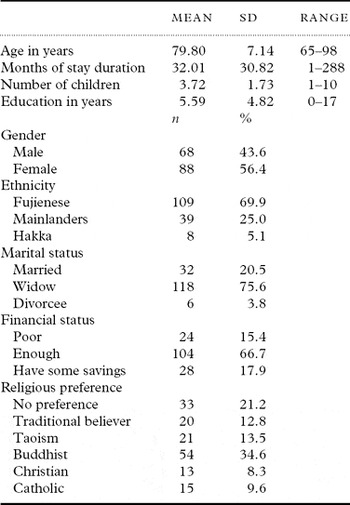
The sample characteristics are presented in Table 1. The mean age was 79.80 years (SD = 7.14). More women (56.4%) than men (43.6%) were recruited. The participants were predominately widowed and satisfied with their financial status. After correcting for five length of stay outliers (162–288 months), the average length of stay was 32 months (SD = 30.82).
Demographic characteristics

Instruments
Demographic characteristics included age, length of stay in the institution by months, number of children, education in years, gender, ethnicity, marital status, financial status, and religious preference. At the beginning of the study, participants were assessed for age and how long they had lived in the institution.
Filial responsibility expectation as a cultural factor was measured by assessing elderly parents’ expectancy for receiving care from their children through a series of questions. Filial piety consists of multidimensional virtues, including attributes of respecting, caring for, and loving the parents (Dai and Dimond, Reference Dai and Dimond1998), but our study focused on the single domain of the elders’ sense of being cared for. Questions were created by the first author based on a validated questionnaire used in Seelbach's study (Reference Seelbach1978) of aged parents’ filial responsibility expectations. Questions were as follows: (1) “In your opinion, in general, do you think it is necessary for your children to care for you at home when you get old?” (2) “After admission, do you expect your children come to visit you?” and (3) “If yes, how often do you expect your children come to visit you?” The response options for the first question ranged from 1 = not necessary to 10 = extremely necessary, and higher scores were indicative of greater expectation of filial responsibility. Because of the high rate of illiteracy in the generation of our sample (29.54% in 1997 and 12.30% in 2011; Ministry of the Interior, 2011), a picture of a ladder was used to illustrate the concept of 0 being a small quantity and 10 being a “high” quantity.
Degrees of participant's acceptance of institutionalization were measured by the following two questions created by the first author, also using a visual analogue scale of 1 to 7: (1) At the time they were admitted to the facility, how willingly did they agree to come in as a resident, and (2) now that they have been in the facility for a time, how willing are they to stay there? Both questions were assessed at the beginning of the study. Score of 7 indicated the strongest level of willingness to be/remain institutionalized and score of 4 indicated a neutral option, “neither opposed nor willingly agreed to institutionalization.” Reliability based on the present sample was acceptable (Cronbach's α = 0.67).
Institution-related stress was measured by the 10-item Perceived Stress Scale (PSS), which provided a global self-rating of event stressfulness in the past month (Cohen and Williamson, Reference Cohen, Williamson, Spacapam and Oskamp1988). Validation of the Chinese version had demonstrated good reliability and concurrent validity (Leung et al., Reference Leung, Lam and Chan2010). Cronbach's α was acceptable at 0.73 in this study.
Self-transcendence was measured by the 15-item Self-Transcendence Scale (STS; Reed, Reference Reed2009) using a 4-point rating scale (1 = not at all to 4 = very much). Examples of STS questions were “adjusting well to my present life situation,” “sharing my wisdom or experience with others,” and “accepting death as a part of life.” Validation of the Chinese version demonstrated very good reliability and content validity in community elders in Taiwan (Hsu, Reference Hsu2009), and Cronbach's α was 0.78 in this sample.
Depressive symptoms were measured by the 15-item Geriatric Depression Scale Short Version (GDS-S). The GDS-S had been used in many studies in Taiwan's elderly population with evidence of satisfactory reliability (Cronbach's α = 0.82; Liu, Reference Liu2005). Cronbach's α was satisfactory at 0.79 in this sample.
Procedure
After being approved by the University of Arizona's Institutional Review Board and obtaining permission from each of the facility's directors, participants were approached by the facility's director and asked if they would be voluntary participants. Explanation of the study was given to those who agreed to participate, and each elder approached was assured that they were free to not participate, or they could withdraw from the study without any effect on their care. After giving an informed verbal consent, in addition to disclosure consent, participants were screened with the SPMSQ for cognitive impairment. One participant was withdrawn from the study based upon the SPMSQ score. All questionnaires were read to the participants by the research assistant in appropriate dialect and responses were recorded.
Data analysis
Data were analyzed using Statistical Package for Social Sciences version 17.0 for Window (SPSS Inc., 2008). Demographic factors included age, length of admission, and years of education to control for confounding factors to reduce suppressor effect, and were examined for significant associations with depressive symptoms using Pearson's correlations. Prior to processing regressions, the assumptions underlying regression, including normality, multicollinearity, linearity, and homoscedasticity, were confirmed. Model adequacy was examined by using standardized residuals. Independent variables with significant correlations at p < 0.05 were entered into a stepwise regression analysis and in the order of the strongest correlation coefficients to the weakest.
Results
Descriptions of predictors and depressive symptoms
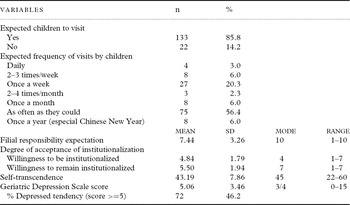
Predictors of depression are presented in Table 2. The majority of the sample (85.8%) expected their children to visit as often as they could (56.6%). For elderly parents’ beliefs about children's filial responsibility, the most frequent score was 10 (extremely necessary to care for elderly parents) with a mean of 7.44, indicating strong filial expectations of children about caring for elderly parents. For the degree of acceptance of institutionalization, there appeared to have an increase in participants’ willingness to be in the long-term care institutions between the time of admission (estimated as 4.84 on a 0–10 scale) and their current willingness to stay there (recorded as 5.50 on the same scale).The sample experienced mild stress (M = 11.84, SD = 7.16) out of a total possible score of 40 and a moderate level of self-transcendence (M = 43.19, SD = 7.86) out of a total possible score of 60. In this sample, 72 participants (46.2%) met criteria for the presence of depressive symptoms at a cut-off point of 5 (Sheikh and Yesavage, Reference Sheikh and Yesavage1986).
Description of independent variables (predictors) and depressive symptoms (n = 156)

Relationships of four predictive factors and depressive symptoms
Interestingly, in this study sample, none of the demographic factors were significantly associated with depressive symptoms. On the other hand, among four predictive factors, depressive symptoms were significantly negatively correlated with an elder's willingness to be institutionalized (r = –0.34, p < 0.01), an elder's willingness to remain institutionalized (r = –0.47, p < 0.01), and self-transcendence (r = –0.67, p < 0.01). Depressive symptoms were significantly positively correlated with perceived stress (r = 0.60, p < 0.01). Surprisingly, expectations of filial responsibility were not significantly correlated with depressive symptoms.
Predictors of depressive symptoms in Taiwanese elders
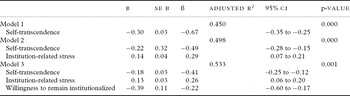
After ensuring nonsignificant relationships between demographic factors and depressive symptoms, multiple linear regression with stepwise selection was used to identify the predictors of depressive symptoms (Table 3). In the first model, self-transcendence explained 45% of the variance in depressive symptoms. In the second model, perceived stress explained an additional 4.8% of variance in depressive symptoms. Willingness to remain institutionalized in the third model explained an additional 3.5% of variance in depressive symptoms. All three predictors had significant beta weights. Altogether, the variables of self-transcendence, perceived stress, and willingness to remain institutionalized explained a significant 53.3% of variance in depressive symptoms (Table 3).
Stepwise regression analysis of depressive symptoms

Note: B = unstandardized coefficients; SE = standard error estimates; ß = standardized coefficients.
Discussion
The relationships between acceptance of institutionalization, cultural and spiritual factors and depressive symptoms in institutionalized Taiwanese elders were examined in this study. Demographic characteristics of this sample were quite similar to previous samples from long-term care institutions in Taiwan (e.g., Lin et al., Reference Lin, Wang, Chen, Wu and Portwood2005; Reference Lin, Wang and Huang2007). The present study demonstrated that elders were ambivalent about institutionalization and relocation decisions made by their adult children. This is congruent with prior studies in which 5.9%–38.1% of elderly residents made their own decisions to be institutionalized (Huang et al., Reference Huang2003; Somme et al., Reference Somme, Thomas, Stampa, Lahjibi-Paulet and Saint-Jean2008; Chang and Schneider, Reference Chang and Schneider2010). In addition, Mattimore et al. (Reference Mattimore1997) found that patients from five university medical centers expressed attitudes that ranged from 26% who were “very unwilling” to 7% who were “very willing” to live permanently in a nursing home.
In contrast, this study found that the degree of acceptance of institutionalization improved after admission. This finding may be indicating that the elderly residents’ initial unwillingness to accept institutionalization changed after recognizing benefits such as companionship, good care in the institution, and not being a burden to their children. Generating a realistic sense of physical or mental abilities needed to sustain independent living contributed to the acceptance of life in a nursing home as a coping strategy to deal with stressors in depressed nursing home residents (Choi et al., Reference Choi, Ransom and Wyllie2008). Although a shift in attitude related to an increased willingness to remain in an institution was found in this study, the elderly residents still verbally expressed a deep desire to return home during data collection. This reflects an extremely important traditional value of Taiwanese culture, of which being home is paramount no matter under what conditions. However, this may not be culturally specific, but further investigation of generalized finding across cultures is warranted.
Results of this study suggest that a lower degree of acceptance of institutionalization, both before and after admission, was negatively associated with depressive symptoms. Interestingly, Chau et al. (Reference Chau, Kwok, Woo, Chan, Hui and Chan2010) reported that cognitively intact elders living in the community were more likely to have a decreased incidence of depression when given the option of institutional living as opposed to impaired elders who had a greater incidence of depression. These discrepant findings may be due to different points of evaluation time and settings. Although both studies recruited cognitively competent elders, the community-dwelling elders in Chau et al. might have experienced less stress from living in a familiar environment with intact social networks. These factors may have led to less functional dependency than institutionalized elders who co-resided with residents who often had a great need of assistance in daily activities. As a consequence of depression, elders with a low acceptance of institutionalization may lead to more difficulties adjusting to institutional life. Further studies will be needed to better understand the relationship between attitudes and adjustment toward institutionalization which are related to general life satisfaction and well-being.
With respect to family visits, over 56% elders in this study expected their children to visit them as often as they could. Only 3% elders expected daily visits and 20.3% expected visits once a week. This is in contrast to Tseng and Wang's study (Reference Tseng and Wang2001) of quality of nursing home life, in which the most common response was “once a week.” These different findings might be due to the elders’ increased empathy toward their children that we found in this study. For example, our elderly participants described their recognition of the difficulties their children experienced as a result of the negative impacts of the global economic crisis and the increasing rate of unemployment. During data collection, most elders explained that their children needed to delegate their time and energy to meet their nuclear family and job responsibilities. The expectations for their children to “keep a job and survive” were more important than “visiting an aged person.” As a result, institutionalized elders found that it was more acceptable to be visited as much as their children were able to, rather than burdening them with scheduled or more frequent visits. Therefore, this empathy for adult children might be a protective mechanism to reduce depression in this elderly population. Importantly, 20.5% of this elderly sample reported a married status, but we did not analyze the effects of marital status on the elders’ expectations of filial visits. This association should be evaluated in future studies.
Unexpectedly, cultural expectations of filial responsibility did not demonstrate significant relationship with depression. This finding contradicted prior findings, e.g., Li et al. (Reference Li, Pang, Chen, Song, Zhang and Zheng2011), in which community-dwelling elderly adults in Beijing, China, who perceived that their children failed to demonstrate filial piety, tended to be depressed. Li et al. (Reference Li, Pang, Chen, Song, Zhang and Zheng2011) assert that this depression may have been a result of “loss of face” or shame, as a consequence of negative emotions surrounding lack of filial piety. In addition, our findings stand in contrast to previous studies that have predominately focused on adult children's perspective (Cheng and Chan, Reference Cheng and Chan2006; Ng et al., Reference Ng, Bhugra, McManus and Fennell2011). Filial piety as a protective factor against depression had been found in adult survivors of childhood maltreatment (Ng et al., Reference Ng, Bhugra, McManus and Fennell2011). Two possible explanations for these discrepant findings include first, the elders in this sample had a strong expectation (M = 7.44) and desire to be cared for in their own or their child's home. Second, in our sample of institutionalized elders, the majority (85.8%) expressed their expectation of filial piety from their children to be demonstrated through frequent visits rather than co-residing with children. Alternative behaviors associated with filial piety, such as supportive parental care, have been sought to adjust for the effect of modern social changes on traditional filial attitudes to decrease discrepant expectations between aged parents and their children (Hsu et al., Reference Hsu, Ting and Wu2001; Cheng and Chan, Reference Cheng and Chan2006). New filial behaviors may be replacing traditional day-to-day, tangible, material, and household assistance provided by co-residing children. Our sample of institutionalized Taiwanese may have had their expectations shifted to include emotional and financial support, such as frequent visiting or calling and paying for all living expenses. With shifted expectations, it would be logical that we would not see disappointment or depression.
These explanations demonstrated that filial piety is still a central family value deeply engrained in Taiwanese elders’ beliefs, whether they felt depressed or not. The nonsignificant correlation between expectations of filial responsibility and depression may be because there was so little variability in expectation scores. This could be a measurement problem or it may mean that there is truly little variance in filial responsibility expectations among Taiwanese elders. Development of a multidimensional measure or a broader concept may be necessary to understand these relationships more fully.
Finally, as predicted, institution-related stress was positively correlated with depression. This was consistent with the psychological impact of environmental stress found in other studies (Choi et al., Reference Choi, Ransom and Wyllie2008). In addition, the inverse relationship between self-transcendence and depressive symptoms was consistent with previous findings (e.g., Klaas, Reference Klaas1998; Haugan and Innstrand, Reference Haugan and Innstrand2012). This study expanded the analysis to cultural and spiritual contributions of depressive symptoms. Among the three significant predictors (self-transcendence, institution-related stress, and willingness to remain institutionalized), self-transcendence was the strongest predictor of depressive symptoms. Institution-related stress and lack of willingness to remain institutionalized positively correlated with depressive symptoms. Previous studies indicate that interaction with and receiving support from staff and residents in the institution as a stress-coping strategy could facilitate the nursing home residents to accept their unfavorable institutionalization subsequently decreasing depression (Choi et al., Reference Choi, Ransom and Wyllie2008; Cheng et al., Reference Cheng, Lee and Chow2010). Although this study did not evaluate the relationship between the degree of willingness to remain in the institution and stress, it is reasonable to assume that institutionalized elders who had an increased assimilation into the institution by accomplishing daily activities through paid-staff assistances could improve their willingness to stay in the institution longer, alleviate institution-related stress, and thus lead to reduced development of depression. Even continuing use of similar modes of coping to deal with well-being at an advanced age (Coleman et al., Reference Coleman, Ivani-Chalian and Robinson1999), institutionalized elders might have their own individualized wisdom accumulated from past experiences that allow them to overcome life's difficulties. Besides a number of routine nursing activities, there are diverse planned activities that take place in the institutional setting. These activities might facilitate interpersonal relationships and therefore promote self-transcendence with a resultant decrease in depression. Thus, these results suggested that self-transcendence might be a healthy manifestation of a late-life developmental stage (Erikson, Reference Erikson1950) and thus be protective against negative states of mind such as despair and depression.
Implications and recommendations
At the time of or before admission, in addition to routine screening for depression, the healthcare practitioner should routinely assess for the elderly adult's readiness to move into an institution, with regular, ongoing reassessment. Providing timely and appropriate interventions for those who express resistance to institutionalization and who may be at risk for developing depressive symptoms may improve adjustment after relocation. Effective interventions may include support meetings where residents can actively express their concerns related to relocation as well as share successful adjustment to institutional life. Healthcare providers and staff may improve an elder's willingness to remain institutionalized and reduce institution-related stress by creating a home-like, warm, stress-free, and pleasurable environment. Efforts that provided residents an avenue to express their discontent may lead to a more positive experience. Although no evidence of a relationship between filial responsibility and depressive symptoms was found in this study, there was evidence that filial responsibility was highly valued and should be supported when possible.
Limitations
Limitations of this study include the use of a convenient sample of southern Taiwanese, which may limit generalizability. In addition, the data of the degree of acceptance of being institutionalized were retrospective, which might not accurately assess an elder's willingness. In future studies longitudinal designs that start at pre-admission would be preferable. Moreover, the majority of risk factors associated with depressive symptoms in institutionalized elders have been controlled for increasing the study results of internal validity. However, while partial or complete physical dependence is a major characteristic of residents in long-term care community (Jones et al., Reference Jones, Dwyer, Bercovitz and Strahan2009), lack of valid instruments to measure elder's physical dependency as a confounding effect on depressive symptoms may threaten the findings. Finally, this study used three self-reported questions about filial responsibility to measure a multidimensional concept that may have led to under- or overestimation of perceptions of filial responsibility. Use of a well-established measure of filial piety to strengthen measurement of this construct is highly recommended.
Conflict of interest
None.
Description of authors’ roles
This study was completed as part of the requirements for a doctoral degree in nursing. Y. Hsu designed the study, collected and analyzed data, and wrote the manuscript. Dr. T. Badger supervised the study and assisted with writing the paper. Dr. P. Reed read the manuscript and made important scholarly contributions with regard to predictors. Dr. E. Jones provided expertise in cultural competence and ethical considerations necessary for IRB approval.
Acknowledgments
The authors thank all of the elderly participants who spent time completing questionnaires. A special appreciation is offered to Dr. Cheryl L. Wright for assistance with English grammar.