Introduction
The collapse of the Soviet Union and the emergence of sixteen newly independent states not only marked the sovereignty of the former Soviet republics, but also by default expanded the membership of a nuclear ‘club’. The Soviet inheritance of nuclear weapons and nuclear technology by Belarus, Kazakhstan and Ukraine caused a great deal of concern among policymakers, academics and analysts.Footnote 1 In this article, I investigate Kazakhstan's decision to give up its nuclear status and enter the international system as a non-nuclear, sovereign state. Throughout the years of Kazakhstan's independence, Nursultan Nazarbayev, the first and currently the only president of Kazakhstan, consolidated his regime, which enabled him to enjoy great power and control in all aspects of the country. Consequently, the leader and his chosen political elite are those who take responsibility in constructing and directing all forms of official state policy. The political power is centralised in Kazakhstan to such an extent that analysing unofficial discourse, for example, would offer rather different set of insights. Although I neither assume transparency of meaning in this article, nor attribute intentionality to the actors concerned, it is for the reasons described above that I choose to on the official statements issuing from the political elite regarding security and identity of Kazakhstan.
It has been argued that Kazakhstan's decision was reached due to ‘a combination of international pressure, a desire to integrate into the international community, and assured Western assistance’ resulting from the dismantling of nuclear weapons and facilities.Footnote 2 These reasons are certainly persuasive. However, the conventional view of nuclear weaponry represents the technology as ‘the possibility of security at a reasonable cost’.Footnote 3 For example, Ukraine was one of the newly emergent states that inherited a proportion of the ex-Soviet nuclear arsenal and technology. At this time, Mearsheimer argued that to ‘press Ukraine to become a non-nuclear state [would be] a mistake’.Footnote 4 He explained further that it would be strategically beneficial for Ukraine to keep its nuclear arsenal, since Ukraine would not be able to defend itself against a nuclear-armed Russia with conventional weapons.Footnote 5 Similar arguments could be made with regard to Kazakhstan, which also borders Russia and has a significant number of ethnic Russians living on its territory. In his memoirs, the former Minister of Foreign Affairs, Kassymzhomart Tokaev wrote that ‘many people criticized the decision of Kazakhstan to become a non-nuclear state, arguing that Kazakhstan voluntary disarmed itself and hence weakened its positions in the face of new threats’.Footnote 6
In this article, I offer a critical analysis of the Kazakhstani government's decision to dismantle its nuclear weapons facilities and to discontinue its investment in weapons technology.Footnote 7 I explore the ways in which the possession of Nuclear Weapons Technology (NWT) was represented as a threat to the state's national security, rather than ‘its security safeguard’.Footnote 8 Before proceeding to the subsequent sections, I outline the analytical framework that structures the main analysis of this article.
Analytical framework
The main claim of this analysis is that in order to understand how it became possible that NWT were represented as a threat to the national security of Kazakhstan, one needs to go beyond the distinction between material and ideational factors, and explore the ways in which this particular aspect of the social – non-nuclear Kazakhstan – come to be meaningful. To this end, I explore the official discourse of the Kazakhstani political elite about security, with specific regard to NWT. I examine official discursive practices that have attempted to fix the meaning of NWT and security for Kazakhstan.
The concept of discourse that informs this analysis is Foucauldian.Footnote 9 On this view, discourses constitute social reality in that they do not simply designate meaning, but rather discourses bring into being particular phenomena as that phenomena and not something else.Footnote 10 In other words, social reality is not a passive reflection of a pre-existing social position, but rather a result of particular discursive formations. That is, processes of constitution delineate the ‘possibility for the existence of the phenomena’.Footnote 11 Discursive constitution refers to a process through which something is produced as real, identifiable, knowable and therefore meaningful.Footnote 12 In this view, understanding discourse as being productive of knowledge entails that discourse is constitutive of meaningful reality. As noted above, discourse does not refer just to language. Discourse is a system which ‘delineates the terms of intelligibility whereby a particular reality can be “known” and acted upon’.Footnote 13 One way in which it is possible to analyse the production of meaning (or, that which can be known) is to focus on discursive practices.
Discursive practices are ‘social acts enabled by discourse, through which some relevant aspect of the world is actively defined and constituted’.Footnote 14 In this sense, discursive practices incorporate both linguistic and non-linguistic activities. Linguistic practices are understood to be interpretative practices in which individuals engage in order both to constitute particular subjects, objects and social relationships as meaningful. Non-linguistic practices are actual physical activities in which people, states, organisations and others engage. Both linguistic and non-linguistic practices are analytically distinguishable, but both work together in the constitution of Kazakhstan's identity and its security.
In this article, I take identities not as given – that is, as being unproblematic or natural phenomena – but as discursively constituted, and therefore meaningfully understood only through discursive practices, which create the possibilities of what we are/are not and what we can/do not want to become. Neither identities nor meanings are stable, fixed entities. Rather, both meanings and identities are temporarily fixed, historically contingent, unstable and multiple, appearing fixed only through the practices that constitute their being. It is through analysing these practices that one can get to the complex mechanism of identity constitution, articulation and performance. Furthermore, it must be noted that processes of identity constitution function to draw distinguishable lines between one particular identity and another, and to strengthen this identity against otherness and opposition. Once identities are constructed they are represented and performed in and through particular actions. Weldes convincingly argues that:
[t]he representations created by state officials make clear both to those officials and themselves and to others who and what ‘we’ are, who and what ‘our enemies’ are, in what ways ‘we’ are threatened by ‘them’, and how ‘we’ might best deal with those ‘threats’.Footnote 15
Following this, then, in the process of identity construction the relevant subjects and objects acquire meaning and are invested with identities. As stated above, subscribing to the notion that everything is discursive leads to the claim that discursive practices produce the subjects and objects of reality and define subject-positions from which knowledge proceeds and is represented.
The construction of state identity, in this case, involves an array of complex (re)productions, where certain identities become meaningful and where other identities become alien or/and threatening. Furthermore, the process of establishing a particular identity necessarily involves the mechanism of inclusion and exclusion. In other words, (re)producing the identity of subjects such as Kazakhstan (the state) is done by contrasting it to that which this subject is not. In referring to identity (re)production as complex, I wish to draw attention to the analytical claim that no identity is fully and entirely established. In other words, identities are partially and temporarily fixed and necessarily include processes of reproduction as time proceeds and certain circumstances occur. However, establishing stability through ‘difference’ is a challenging task, because ‘difference can, but need not, be transformed into otherness’.Footnote 16 Consequently, when difference turns into otherness it becomes a source of insecurity.Footnote 17 The notion of ‘otherness’ is not understood as an existential threat to identity but rather as discursive cognition in which Kazakhstan as a state with its people and territories acquires identity. Thus the ‘constant articulation of threat’,Footnote 18 as Campbell demonstrates, is not ‘a threat to a state's identity or existence: it is its condition of possibility’.Footnote 19
In the following sections, I interrogate the official practices which can be named as the de-Sovietisation of Kazakhstan, without which claims to sovereignty of state would be meaningless. This is exemplified in discussions of NWT and the importance of becoming a non-nuclear state. I argue that Kazakhstan's rejection of NWT was a crucial component of its performance of sovereignty and use this case to suggest that those seeking to understand denuclearisation programmes may wish to consider these in the light of claims to sovereign, independent state identity. I conclude that, it is not that one identity is automatically replaced by another due to changes in historical circumstances, whatever the formal or legal predicate: the reproduction of identities necessarily involves a complex web of processes and practices.
Sovereignty as discursively produced
Kazakhstan's identity as a state, first and foremost, has been constructed around the central signifiers ‘sovereign’ and ‘non-nuclear’. Formally acquiring independence and recognising Kazakhstan as a sovereign state does not, however, endow the words of ‘sovereign’ and ‘independent’ with substance. In other words, it is not enough to proclaim sovereignty of the state, nor is it enough for a state to be recognised as sovereign entity. But rather, it is essential to understand how the state performs sovereign identity and hence preserves its utmost value of national security, that is, sovereignty. In this regard, I understand sovereignty as the product of various discursive practices.Footnote 20 Conceiving of sovereignty as discursively constituted allows me to examine the discursive production of Kazakhstan's identity as a sovereign state. In other words, I take the state (Kazakhstan) as ‘an agent or identity that may have specific roles designated to it by sovereignty’.Footnote 21 I do not claim that sovereignty is the only signifier that constitutes Kazakhstan's identity. That is, just as sovereignty is constituted through various discourses of territory, communities, and ethnicity, Kazakhstan's identity is similarly produced through, but not determined by, signifiers such as sovereignty, ethnicity and history. However, since in the preservation of its national security the official political elite conceives of sovereignty as one of the integral values of Kazakhstan to be preserved and attaches great historic importance to identity of Kazakhstan as a ‘sovereign state’, I argue that it is necessary to examine the understanding of sovereignty and not bracket it or take it as given.
In order to establish and fix Kazakhstan's identity as a sovereign and independent state, the government pursued what can be named practices of ‘de-Sovietization’ in the political and social organisation of the new state. In other words, certain linguistic and non-linguistic practices were employed in order to distance the identity of Kazakhstan from that of the Soviet Republic. Non-linguistic practices (involving the changing of state attributes, such as the flag, the national emblem, the national hymn and the renaming of regions, large and small cities, villages and streets) most certainly carry with them symbolic importance in the construction of Kazakhstan's new state identity. Linguistic practices incorporated in themselves the search for new ways of governing and the desire to construct an ideological platform distinct from that underpinning the Soviet regime. A great range of issues was brought to the attention of the public, those issues which, in the words of Kuttikadam, ‘never existed and did not matter before’.Footnote 22 Being one of the republics of the former Soviet Union, Kazakhstan had at its disposal an absolute security guarantee provided by the forces of the Soviet Union. Henceforth, as the collapse of the Union took place, one of the most pressing issues, among many others, was the preservation of national security of the state independently of Russia and construction, performance and hence preservation of Kazakhstan's sovereign identity.
From the outset of independence, the acquired status of Kazakhstan as a sovereign state is continuously represented in the official discourse as serving a particular function hailed as an ‘historic opportunity’. However, along with the status of ‘sovereign’, Kazakhstan also gained the de facto status of a ‘Nuclear State’. With regard to inherited nuclear arsenal and nuclear status of the state, recollecting the memories of the first days, weeks, months and years of Kazakhstan's existence as a sovereign state, Nazarbayev highlights an ‘excruciating dilemma’,Footnote 23 with which both the government and the people of Kazakhstan were not faced, but rather ‘collided’.Footnote 24 It is important to emphasise the use of the word ‘collide’ with the dilemma of being a ‘nuclear’ or ‘non-nuclear’ state, instead of being ‘faced with’ this dilemma. The former embodies a degree of conflict – clash, drama or violence – in contrast to the latter, which does not necessarily incorporate as acute a degree of negativity. This collision is represented as a clash, defined in terms of a ‘struggle’ between the people of Kazakhstan and nuclear weapons, on the one hand, and the state (Kazakhstan) and the nuclear status on the other. It is in this particular ‘struggle’, as I illustrate later, that the political elite founded the construction of identity of Kazakhstan as a sovereign state. In other words, investigating the discursive structuring of the ‘struggle’ allows me to understand how it became possible that NWT and the status of a nuclear state – both of which can at the same time be seen as ‘treasure’ and ‘guaranties of security’Footnote 25 – were represented, in fact, as ‘dangers’ to sovereign Kazakhstan. Furthermore, this analysis illuminates an intimate link between the construction of these ‘dangers’ as mutually constitutive of both what Kazakhstan is not (a Soviet republic) and what Kazakhstan is (a sovereign state).
Kazakhstan experienced substantial changes in all areas of the social sphere in the period from 1991, when the government first began to deliberate whether or not the state should remain nuclear, to 1997 when the decision to become non-nuclear state was marked by the final elimination of remaining nuclear arsenal. The newly established government had to gain experience and define not only internal but also external political processes. However, in constructing the state and defining foreign policy, the governing elite did not start building a new state, as it is conventionally accepted to believe, from scratch, but rather the political elite already had at their disposal what Weldes calls ‘cultural raw materials’,Footnote 26 in other words those concepts and ideas that were familiar both to the newly established government and to the people of Kazakhstan. The cultural raw materials that the government utilised were an historical past that included the potent ‘Soviet Legacy’, which, in turn, had deep roots not only in economic, transport, military and political intra-structures, but also in the consciousness of the people living on the territory of the ‘young’, ‘independent’ and ‘sovereign’ state. These elements were central to discussion of Kazakhstan's nuclear status. It must be also noted that in the official discourse, both predicates of Kazakhstan – ‘sovereign’ and ‘independent’ – are used interchangeably and are represented as ‘those values, which do not carry in them a competitive or conflictual character for representatives of a multi-national society’.Footnote 27 Furthermore, these values constitute the understanding of security of Kazakhstan as the ‘survival of an independent state’.Footnote 28
The representation of ‘survival’ does not signify the continuing existence of ‘sovereign and independent’ Kazakhstan free of external military threats. Nazarbayev points out that ‘all possible potential troubles threatening the national security of Kazakhstan at present and in the nearest future do not imply and will never imply a direct military invasion or threat’.Footnote 29 The exclusion of ‘potential’, ‘direct’, ‘military’ threats is of paramount importance here, since it invites space for an analysis that identifies what kind of ‘potential’ or ‘actual’ threats to the national security of Kazakhstan Nazarbayev is implying. Implicitly, there are threats other than direct military invasion facing the newly sovereign state, and I argue in the following section that NWT was rendered as one such threat.
Nuclear way’ or ‘Kazakhstani way’: constructing and performing sovereign identity
The central signifier, of newly acquired independence from Soviet rule, is represented as an ‘historic opportunity’ to create an inherently different state. What followed was that in constructing a state identity, the ‘new’ identity of the subject (Kazakhstan) was contrasted to the former subject (the Soviet Union) in terms of binary opposition. Kazakhstan is represented as ‘democratic’, ‘peace loving’ ‘non-nuclear’ in opposition to the Soviet rule which was ‘totalitarian’, ‘cruel’, ‘aggressive’ and ‘nuclear’.Footnote 30 Sovereignty is understood as the value which provides ‘us, the people of Kazakhstan’ with an ‘historic opportunity’ to be ‘free and independent’ in pursuing ‘exclusively peaceful way’ in Kazakhstan's domestic and foreign politics.Footnote 31 The exclusiveness of the predicate ‘peaceful’, as discussed later in the article, is attached not only to Kazakhstan as a ‘state’ in relation to other states, but also to the Kazakhs, as the core nation in forming the multinational state. Simultaneously, it is the kind of value without which ‘our [Kazakhstani]way would be unpredictable, and the result would be grievous’,Footnote 32 which is not only gained but also must be preserved, strengthened, and passed over to ‘descendants’.Footnote 33 In this sense sovereignty is not only understood as something that is today and temporary, but as is also represented in terms of ‘the future, which can only be preserved exclusively by us’ – the united Kazakhstani state.Footnote 34 In the following section, I explore debates over the nuclear status of Kazakhstan, to highlight the discursive mechanisms through which the denuclearisation practices became meaningful, in that denuclearisation came to be synonymous with security rather than insecurity, and, ultimately, came to represent the performance of sovereign statehood.
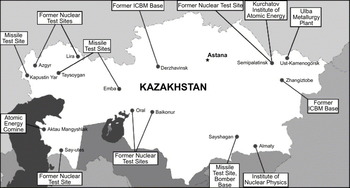
At the advent of independence, 1216 nuclear warheads were stationed on the territory of Kazakhstan.Footnote 35 Among nuclear warheads, Kazakhstan possessed 104 functional SS-18 Satan intercontinental ballistic missiles stored in Derzhavik and Zhangiz-Tobe, 40 Bear-H bombers (27 Bear-H6 and 13 Bear-H16) positioned in Semipalatinsk and 370 AS-15 air-launched cruise missile warheads. In sum, taken together, the nuclear warheads of UK (264–296), France (512) and China (284) in 1995 barely comprised the whole nuclear capability of Kazakhstan. This in turn made Kazakhstan the fourth largest in its nuclear capability after the US, Russia and Ukraine. Furthermore, just the stationing of warheads on the territory of Kazakhstan does not complete the whole picture. Kazakhstan inherited the necessary military-technological infrastructure and resources for testing, modernisation and production of the weapons of mass destruction. For example, the state possessed 25 per cent of the world's uranium deposits, provided 85 per cent of nuclear fuel for the whole of the Soviet Union and 5 per cent of uranium ore mining of the world and housed scientific research bases for the production and modernisation of NWT, such as the Nuclear Physics Institute (Almaty), and nuclear and missile test sites.
Showing the location of NWT Sites in Kazakhstan, 1991
Source: Nuclear Threat Initiative: {www.nti.org/db/disarmament/country_kazakhstan.html}.

This specific area, in which an immense number of high-capability nuclear warheads were stationed, together with the associated military-technological infrastructure, is represented in the official discourse as a ‘monstrous state’ located within the newly emergent Kazakhstani state.Footnote 36 In this sense, Kazakhstan is represented not only possessing the NWT, but this very possession of NWT serves as a site where another, ‘monstrous’ identity is automatically granted to the newly emergent Kazakhstan. In order to distance this ‘monstrous’ identity of Kazakhstan, the government argued that it is necessary to rid Kazakhstan of the NWT, where NWT is granted a life of its own and is represented in the form of a ‘monster’. By ‘banishing the monster’,Footnote 37 as Nazarbayev argues, the government:
[c]arried out the will of the people. It was one of the first steps of independent Kazakhstan. We realised and we have begun to correct mistakes of totalitarian, soviet past. We have begun a new democratic way. And the foundation of this way is laid exactly in this historical decision to become a non-nuclear Kazakhstan.Footnote 38
The act of ‘banishing the monster’ serves three simultaneous functions. First, it is a representation of danger to Kazakhstan as a sovereign state. Second, it fixes the identity of newly independent Kazakhstan through the practices of distancing from the identity of the ‘totalitarian’, ‘soviet’ and ‘aggressive’ former regime. Finally, it positions the people of Kazakhstan (subjects) within what Schwichtenberg calls a ‘shifty shifter’ … that is a referentially ambiguous pronoun that allows authorship to slip between and amongFootnote 39 – ‘We, the government of Kazakhstan’ and ‘We, the people of Kazakhstan’ – peace-lovers and peace-makers – started to correct mistakes of totalitarian and soviet past by ‘casting ourselves off nuclear chains’.Footnote 40 In turn, all three functions contribute to the stabilisation of the meaning of the concept sovereignty/independence, and are themes to which I return in my analysis below.
In the very first years of independence, intensive debates regarding whether to sustain or refuse an accidental nuclear status took place. In general terms, two camps were created; on the one side were those who argued for NWT, included ‘Kazakhstani Hawks’, members of nationalistic social movements, such as Alash and Azat, and nuclear scientists, to name just a few. On the other side, there was a group arguing against NWT, which included various progressive social movements, such as Nevada-Semipalatinsk under the leadership of Olzhas Suleimenov, journalists (the most outspoken among them was Chasnikov), and certain government officials. Although both camps had essentially differing opinions regarding the NWT, their debates shared common ground, which can be narrowly defined in terms of being organised according to three themes: security, the state and the people. It is also important to emphasise that the official political elite did not immediately warm to the idea of refusing NWT. Nazarbayev points out that the arguments provided by the ‘Kazakhstani Hawks’ and nuclear scientists, albeit weak points, were relatively persuasive and ‘concealed a myriad of diabolic temptations’.Footnote 41
The proponents of sustaining NWT represented this possession as a guarantee of Kazakhstan's national security.Footnote 42 They conceived of national security in traditional terms, that is, as the protection of the state (Kazakhstan) from ‘external enemies’.Footnote 43 Kazakhstani Hawks take a state as a given entity that can only protect itself via military means. So for example, Mukhin fiercely argues that:
While Kazakhstan was under the protection of the Soviet military system, thoughts to have a war with our Republic could not even cross the mind of an idiot. And today […] Today, no matter how much we strut out our sovereignty for our neighbours we are becoming more of a place which is rich in mineral recourses and the population of only 17 million. Without an adequate military protection, Kazakhstan, instead of being a true sovereign state, is just a territory, which can be easily conquered by our neighbours.Footnote 44
Pointing out the lack of military power of the former Soviet Union, which used to protect Kazakhstan's security, Mukhin situates the state as one that became ‘sovereign’. However, he states simultaneously that it is not only important to ‘become’ a sovereign state, it needs to be ‘a true sovereign’ state and for this Kazakhstan ‘needs an adequate military’ in order to protect itself from ‘neighbours’ – the potential enemies. He emphasises the size of the population – one of the typical indicators of power in traditional accounts – stating that ‘with only 17 million in population, we cannot create an adequate army to protect the state’.Footnote 45 Accordingly, Mukhin sees NWT as the only possible way to protect Kazakhstan from ‘external adventures’.Footnote 46 Abraimov shares this opinion and further argues that through the voluntary refusal of NWT, Kazakhstan automatically would become ‘vulnerable and open to all kinds of external threats’,Footnote 47 situating this decision within a broader framework of the international and regional systems. Abraimov argues that believing in the establishment of a ‘non-nuclear world’ is the ‘utopia’.Footnote 48 Since, according to him, the international system is unstable and hence:
[s]tates such as the US, Great Britain, France and China will not give up their arsenal, especially when considering that states such as Israel, Iraq, and Pakistan are striving to pursue their nuclear dream.Footnote 49
Therefore, Abraimov proposes that instead of ‘brainwashing the social consciousness’ with ‘utopian ideals’ and ‘dangers of nuclear weapons’, it is necessary to explain to the society that ‘unfortunately we still have to live in a nuclear world for a very long time’.Footnote 50 In addition to the issues of the ‘unstable’ international system, Ayaganov, in a similar vein, pays particular attention to ‘unstable’ regional and internal context and the significance of Kazakhstan's ‘nuclear status’ within the region.Footnote 51 In this sense, he brings to the fore an issue regarding the future relationship of Kazakhstan with Russia, arguing that ‘due to political instability in Russia’ defined in terms of struggle for power ‘there is a great degree of uncertainty’, due to which for ‘the time being Kazakhstan must keep its nuclear arsenal’.Footnote 52 Specifically, questioning and forecasting the possible leadership of Russia, Ayaganov reinforces his claim for sustaining the ‘nuclear status’ as a ‘nuclear bat’ in future negotiations with a possible future ‘military leadership of Russia under Rutskoi and Burbulis’.Footnote 53 In this possible scenario the ‘nuclear status’ of Kazakhstan would, in the words of Ayaganov, ‘position the state on an equal footing with Russia’.Footnote 54 Stemming from this, the possession of nuclear weapons was seen as a ‘special’ and ‘stabilizing’ factor in the unstable process of Soviet Union collapse and the beginning of establishing ‘qualitatively’ new relationships between former ‘united’ republics.Footnote 55 Therefore, the righteousness of preserving the ‘nuclear status’ of Kazakhstan would be evident when and if the ‘older brother’ and ‘younger brothers’ would turn out to be ‘deadly enemies’.Footnote 56
Another and related argument for sustaining the ‘nuclear status’ of Kazakhstan is not only seen as a ‘bargaining chip’ or ‘nuclear bat’ in possible conflicting negotiations, but also as a psychological reassurance that one still belongs to a ‘strong state’. So for example Petrushenko, propagating the ‘nuclear status’ of Kazakhstan, argued:
Foreign critiques used to call the Soviet Union the Upper Volta with Nuclear Rockets. And now in addition to the collapse of the Union, we want to deprive ourselves of this privilege. And hence position our state in one economic and political row with African states.Footnote 57
In this sense, adhering to the ‘non-nuclear’ status, Kazakhstan does not only leave itself ‘open’ and ‘vulnerable’Footnote 58 to the ‘external enemies/neighbours’,Footnote 59 but also through this act, ‘traitors’ position the newly independent state along those states which are generally perceived as underdeveloped ‘African States’.Footnote 60 The impossibility of overcoming the psychological barrier of being an independent ‘republic’, but not a ‘great state’ transgressed the boundaries of ‘nuclear’ and were clearly expressed in the sphere of the ‘civic belonging’.
Among the numerous arguments against retaining NWT were those based on so called economic or financial factors. In other words, taking into account the collapsing centralised economic and financial system of the Soviet Union, the economic hardships created by keeping NWT would be unbearable for the population. This was a fact often used by the government officials, although it was challenged by the Kazakhstani Hawks, who argued that ‘it is not necessary to keep the entire nuclear arsenal’.Footnote 61 In other words, they suggested that the government decrease the amount of NWT instead of entirely denuclearising the state. So for example, instead of keeping all 1216 nuclear warheads, the state would maintain only 20 or 50 and so sustain one or two efficient subdivisions out of the entire rocket-aviation complex of the republic.Footnote 62
Furthermore, the President outlines that from economic and organisational points of view ‘Kazakhstan could afford to maintain and control those remaining nuclear forces’.Footnote 63 He also adds that, although this would include immense expenditure – since to keep the proposed nuclear arsenal would cost the same as to maintain the entire military forces of Kazakhstan in the early 1990s – Kazakhstan spent only 1 per cent of the republican Gross Domestic Product (GDP) on its military, so to add another 1 per cent, in the words of Nazarbayev, ‘seemed plausible, what we needed to do was tighten our belts – but what kind of prospect was awaiting us!’.Footnote 64 This is particularly important, since as one Kazakhstani Hawk argued that:
Nuclear weapon is a peculiar homoeopathic apparatus: even in small measures it is able to cause an impact of adequate deterrent.Footnote 65
Taking into account a certain degree of persuasiveness, represented as inducing ‘a myriad of diabolictemptations’,Footnote 66 in the arguments for keeping NWT and sustaining the ‘nuclear status’ of Kazakhstan – the preservation of Kazakhstan's existence as a ‘sovereign’ state, deterring the ‘neighbour-enemies’, negotiating on ‘equal’ terms with other states (in particular Russia), avoiding to overcome the ‘painful’ ‘psychological barrier’, remaining to be a ‘strong state’ and not one of the ‘African states’, developing further nuclear science, and not leaving without work four hundred thousand personnel – how did it become possible that something which is seen as a ‘guarantor’ of Kazakhstan's sovereignty, in fact, turned out to be a ‘threat’, a ‘destabilizing factor’ in the processes of becoming a ‘sovereign state’?Footnote 67
Although it is generally accepted that refusing NWT and giving up nuclear status should be referred to as a denuclearisation, in the case of Kazakhstan, this practice is intimately linked with the de-Sovietisation of the state. To be more specific the two practices are mutually constitutive, where the construction of one particular identity – the ‘peaceful’ state (Kazakhstan) could not have been done without the deconstruction of another identity, the ‘aggressive’ state (the Soviet Union). The predicate peaceful, verbs peace-loving and peace-making are attached to nouns the state and the people, which in turn together form an indispensable part of Kazakhstan's identity as a ‘new’, ‘independent’ and ‘sovereign’ state. In establishing a special link between deconstructive and constructive practices, it is possible to illuminate the performance of a discursive ideological function, that is marginalising the discourse of being ‘Soviet’ by reappraising the ‘Soviet’, ‘nuclear’ values as the ones inherent to ‘dangerous diktat’, and legitimising the discourse of being ‘sovereign’ by praising the ‘Kazakhstani’, ‘non-nuclear’ values, which are fundamental to a ‘new’ ‘sovereign’ state and citizens of which are ‘free’ rather than hostages of ‘dangerous diktat’ and ‘nuclear weapons’.
This in turn, also, allocates a certain identity to people residing on the territory of Kazakhstan, who are positioned as ‘free citizens’, and not ‘hostages’ of the totalitarian regime with its nuclear weapons.Footnote 68 However, when hailing a people as ‘citizens of a peaceful state’, the people need to respond with ‘yes, we are’. A survey was conducted in 1992 in Pavlodar city, today's regional centre of Northern Region of Kazakhstan. The main question of the survey was whether respondents agree with keeping the NWT in Kazakhstan. The survey showed that 12.4 per cent of respondents were indifferent to this issue, 13.8 per cent answered ‘yes’, and staggering 73.8 per cent of respondents answered ‘no’.Footnote 69 The answer ‘no’ represents, in the words of Bugaev, ‘the Kazakhstani citizens’ will to live in independent, non-nuclear Kazakhstan’.Footnote 70 The general wish of the people and the (re)production of the newly independent Kazakhstan is articulated as follows:
The peace-loving politics of Kazakhstan must be consistent. Closing down old polygon, we must not open new one. Kazakhstanis must not become once again the hostages of totalitarian and nuclear monsters.Footnote 71
At the centre of linking the ‘monstrous’ totalitarian regime and ‘monstrous’ nuclear state lies the relationship between the state and the people, and the practices of the former regime as those which:
[u]sed to treat its own people as only cheap raw materials. It was the regime, which annihilated millions of its citizens in the years of human repressions of 1930s. Hence, it is the kind of the regime which would never take into account lives and health of several thousands of people, living in the close radius of active polygon. It is the regime which consciously sacrificed the lives of people in the military-political interests of the state.Footnote 72
It is these practices, ‘treating’ people as ‘raw materials’ in the name of the state's interests, which are identified as foreign, not different, to the real identity of the sovereign Kazakhstan. In the newly independent Kazakhstan, people comprise the foundation instead of ‘raw material’ of the state, and it is the kind of state that does not ‘sacrifice’ its own citizens for the sake of national interests, but rather the kind of state ‘whose highest values are an individual, his life, rights and freedoms’.Footnote 73 Furthermore, the practices of deconstruction of the Soviet/Nuclear identity of Kazakhstan and representing this identity as ‘other/foreign’, have served as a discursive terrain in which the political elite started producing what is referred to as the ‘Kazakhstani idea’, an intrinsic characteristic of which is civic unity and accord of the people of Kazakhstan independently of their ethnic affiliation, where the state is metaphorically represented as ‘Common Home’.Footnote 74
So for example, the official elite, and in particular Nazarbayev personally, offered a great support to the social movement Nevada-Semiplatinsk, which was formed on 28 February 1989, and among many aims of this movement the most noteworthy for this project are shutting down the Semipalatinsk polygon, banning nuclear tests in Kazakhstan all together and lobbying for the non-nuclear status of Kazakhstan.Footnote 75 The organisers of the movement, under the leadership of Suleimenov, the writer and poet, famous for his ‘Eurasianist’ views, and staunch supporter of the president in the early 1990s, drew on the discourse of ‘Universal Human Rights’, representing nuclear weapons as a threat which ‘does not differentiate people in accordance with their ethnic background’Footnote 76 and hailing their organisation as the one which ‘unites various ethnic groups of Kazakhstan’Footnote 77 and hence does not only ‘fight’ the ‘nuclear threat’ but also ‘does its bit’ in strengthening ‘intra-national stability’.Footnote 78 Drawing on the discourse of Nevada-Semipalatinsk, the political elite further represents the ‘fight against’ ‘nuclear threat’ as the practice of the ‘multi-national’ peoples of Kazakhstan.Footnote 79 Linking the refusal of ‘nuclear status’ with the representation of Kazakhstan as a ‘multinational’ state performs another function, that is, protecting sovereign identity of Kazakhstan from ‘negative association of Kazakhstan as an Islamic state possessing nuclear weapon’.Footnote 80 This function allowed the government of Kazakhstan not only to create an ideological platform for the new state where all religious beliefs are tolerated and practices, but also to distance the identity of Kazakhstan from being a strictly Islamic state.
Furthermore, the official decision and act of refusing ‘Nuclear Status’ and removing NWT articulated in the popular phrase ‘No – To Nuclear Kazakhstan!’, which in turn unites the people of Kazakhstan as citizens, who are independently of ethnic background ‘suffered’ the ‘barbarian treatment of the former totalitarian regime’.Footnote 81 The deconstruction of the former identity (Soviet) simultaneously opens up a wide discursive space for construction for ‘new’ ‘sovereign’ identity of the state and its subjects. So for example, non-linguistic practices ranging from shutting nuclear polygons, exterminating rather than exploding the last nuclear cartridge in 1995, the removal of NWT and 558 kilograms of Uranium from the territory of Kazakhstan,Footnote 82 and becoming a party to the START-I Treaty (1992) and the Nuclear Non-Proliferation Treaty (1994) are all represented as ‘first wills of Kazakhstani people’ and ‘first steps of independent Kazakhstan’ in making an ‘historic decision’ in becoming a non-nuclear, sovereign state, where:
The real strength and power […] are not in the common demonstration of nuclear weapons, but in their non-use. This is a core of our statehood, peoples' wisdom and of our national idea: Permanent Peace – the foundation of socio-economic progress, inter-ethnic loyalty, global and regional integration. There will be no happy future in the state without stable and founding peace, which is the necessary element in the formation of national economy, traditional intra-national accord, good-neighbourly and mutually beneficial relationship with other states.Footnote 83
In the process of deconstructing the ‘old’ identity of Kazakhstan and constructing the ‘new’ identity of Kazakhstan, the NWT and ‘nuclear status’ are both represented as posing a threat to security of Kazakhstan, of which sovereignty is a constitutive component. So establishing a discursive link between the practices of the Soviet Union where in the treatment of ‘its own citizens’ as ‘cheap raw material’, Soviet rule was ‘particularly harmful’ in addressing the national question, which was based on the ‘simple rationalism and rejection of God’, engaged in ‘conscious distraction’ of national histories, and used ‘repressive’ methods of contradictory ideas.Footnote 84 In contrast, the new Kazakhstani political structure is imbued with guarantees of:
[h]uman rights and liberties, political and ideological pluralism, ensures a stable secular state, inter-national peace, reliable defence and security, and holds a worthy, full-fledged position in the international community of nations.Footnote 85
Practices of the government such as the adherence to and protection of human rights and liberties in political, cultural and religious pluralism serve as a foundation for the construction of a ‘new’ and ‘independent’ Kazakhstani state. This juxtaposition of the ‘new’ and ‘peace loving’ Kazakhstan with a ‘cruel’ and ‘harmful’ Soviet Union brings to the fore another part of the process of distancing the identity of the state from the Soviet totalitarian regime, that is, the revival of the ‘national’. At this point it is possible to observe the first representations of danger in the official discourse, in the form of falling under the controlled, old style governing characterised by restraining the cultural foundations of a nation and engagement with the practices of standardisation of all the people of Kazakhstan. These kinds of practices are represented by the political elite as dangerous and detrimental to the new realities of acquired independence.Footnote 86 In this sense, what is understood by independence is not located within what is known as ‘de facto’ independence. Instead, the meaning of independence is located within the social fabric of the state, where the people of Kazakhstan gained freedom from a ‘totalitarian regime’. In other words, the people of Kazakhstan are granted freedom to revive their cultures, traditions and historical memories, and in doing so they are free to decide upon their civic belonging.
In this vein, the deployment of ‘forceful’ practices by the former regime, referred to as ‘hammering like nails into the wall, the ideas of the new state into the people's minds’,Footnote 87 is represented as the cause of possible instabilities and conflicts not only between the government and the people, but also among the people. In this sense, the central signifier – the ‘independent and sovereign Kazakhstan’ – starts incurring specific meaning, which is understood in terms of ‘freedom to choose’ and ‘freedom to self-determine’. It is this freedom that needs to be protected from falling into the ‘backward’ and ‘detrimental’ totalitarian regime, under which the very foundations – culture, traditions and historic memory – of the people were consistently suppressed. The negative ‘effects’ of being under the Soviet regime in terms of the erosion of the national basis of ethnic groups were experienced equally by all ethnic groups living on the territory of Kazakhstan. The forum of the people of Kazakhstan, which took place on the eve of the celebration of the first year of independence in 1992, where six hundred and fifty representatives of all nationalities participated, was hailed as ‘the truthful celebration of all the people freed from diktat and pressure’.Footnote 88 The reduction to non-existence of people's culture, traditions and historical memories by the Soviet regime and the revival of the ‘national’ cultures in new Kazakhstan endow with meaning the signifier the ‘sovereign’ Kazakhstan, which was, at the beginning of independence, empty and alien to the people of Kazakhstan. Furthermore, differing from the ‘old’, the newly acquired sovereignty as officially represented, is preserved through ‘stable’ and ‘founding’ peace, which is a core element of ‘Kazakhstani idea’, the ‘Kazakhstani way’, which intrinsically incorporates official internal and external practices based on the ‘principals of integration’.Footnote 89
Conclusion
In this article, I investigated the process of discursive construction of the identity of Kazakhstan as a sovereign and non-nuclear state. Here I argued that in order for Kazakhstan to become, perform and secure its sovereign identity there were two complementary sets of discursive practices: de-Sovietisation and the denuclearisation of the state. In this analysis, I showed an inherent link between the construction of sovereign Kazakhstan and the deconstruction of Soviet Kazakhstan. The analysis of these practices, in turn, allowed me to understand how it became meaningfully possible that NWT and the nuclear status of Kazakhstan are both represented as threats to sovereign and independent Kazakhstan. In this sense, I came to the conclusion that when we talk of practices of security, we cannot legitimately treat security as synonymous with military studies, which understands security by calculating advantages and disadvantages in terms of possible gains (be they relative or absolute) and assumes that power is easily quantified in terms of bombs, guns, tanks and troops. If this were the case, then it would be unwise – and perhaps irrational – for Kazakhstan to get rid of nuclear weapons in the way that it did, for with nuclear weapons comes status, power and ultimately security. However, as illustrated in this article, the possession of nuclear weapons was not seen in this way by the Kazakhstani political elite and the very process of getting rid of nuclear weapons served an important role in the construction of an identity for the state that differed in crucial ways from the historic Soviet identity. Without understanding identity as discursively constituted, and without taking the processes of discursive practices seriously, it would not be possible to see how such valued weapons (on a conventional view) fall out of the scope of what is understood as a secure Kazakhstan.