Introduction
Otomycosis, also known as fungal otitis externa, is a common infectious ear disease caused by various fungi. Its main symptoms include pruritis, otalgia, a feeling of blockage or fullness, otorrhea, hearing impairment and tinnitus.Reference Ho, Vrabec, Yoo and Coker1, Reference Anwar and Gohar2 Otomycosis is more prevalent in the high-humidity environments of tropical and subtropical regions.Reference Prasad, Kotigadde, Shekhar, Thada, Prabhu and D’Souza3 Due to a lack of sufficient understanding of the disease and the fact that many patients do not exhibit typical symptoms such as itching or visible fungal hyphae upon examination, otomycosis is often misdiagnosed. According to Muglistom et al., if not adequately addressed, the initial misdiagnosis rate can be as high as 90 per cent,Reference Mugliston and O’Donoghue4 leading to unnecessary burden and suffering for patients due to incorrect treatment. There are many treatments for otomycosis. Khurshid Anwar used 1 per cent clotrimazole and 2 per cent salicylic acid, but 38 per cent of patients experienced recurrence.Reference Anwar and Gohar2 We have noticed some doctors correctly diagnose otomycosis and prescribe triamcinolone acetonide econazole cream to patients, but many patients still experience recurrence.
This study comprehensively collected data from 200 confirmed cases of otomycosis, recording main symptoms, clinical signs, specific types of fungal infection, and comparing the efficacy of various treatment plans. The primary goal of the research is to improve the accuracy of diagnosis and the success rate of treatment for otomycosis using the simplest and most effective methods, while also striving to reduce the frequency of patient visits to optimize their medical experience and treatment outcomes.
Patients and methods
This study was approved by the ethics committee of Zhongshan Hospital of Xiamen University and all participants were fully briefed on its purpose, procedures, risks, and benefits, with each required to sign an informed consent form. This trial is registered at ClinicalTrials.gov (NCT06431542).
Study design
This study selected patients diagnosed with otomycosis at the Department of Otolaryngology of Zhongshan Hospital of Xiamen University between June 2024 and October 2024. To balance representation across bacterial culture outcomes, subjects were allocated using stratified blocked randomisation to two groups: the patient-applied medication group and the physician-applied medication group (Fig. 1).
Trial flowchart.

The inclusion criteria were (1) the chief complaint was ear discomfort, including tinnitus, a feeling of blockage or fullness, pruritis, otalgia, otorrhea and decreased hearing; (2) physical examination findings including presence of fungal hyphae or accumulations that appear creamy or cheese-like or resembling abnormal earwax (crusts, films), skin redness, erosion, swelling, or granulation tissue within the ear canal (see Fig. 2); (3) positive results in fungal culture; and (4) the patient’s age ≥ 18 years. The exclusion criteria were otitis media and tympanic membrane perforation and post-radiotherapy.
Clinical examinations of otomycosis patients. Images labelled with capital letters show the initial clinical findings; images labelled with lowercase letters show the corresponding follow-up examinations after two weeks of treatment. (A) White fungal hyphae on coagulated secretions; (B) creamy secretions in the external auditory canal; (C) scattered punctate erosions on the skin of the external auditory canal; (D) crusting attached to the ear canal wall; (E) granulation tissue in the external auditory canal with congested skin.

Treatment methods
Before receiving their specific treatments, all patients were treated with 5 per cent sodium bicarbonate ear drops. The procedure involved administering 3–5 drops into the ear, 5 times daily, allowing each application to soak for 10 minutes. After three days, the ear canal was rinsed with saline solution until it was essentially free of any secretions or clumps.
For the patient-applied medication group, after cleaning the external ear canal, patients were prescribed triamcinolone acetonide econazole cream (brand name: pevisone, Xi’an Janssen Pharmaceutical, Beijing). Doctors provided detailed instructions on how to apply pevisone to the external ear canal, once daily for 10 days.
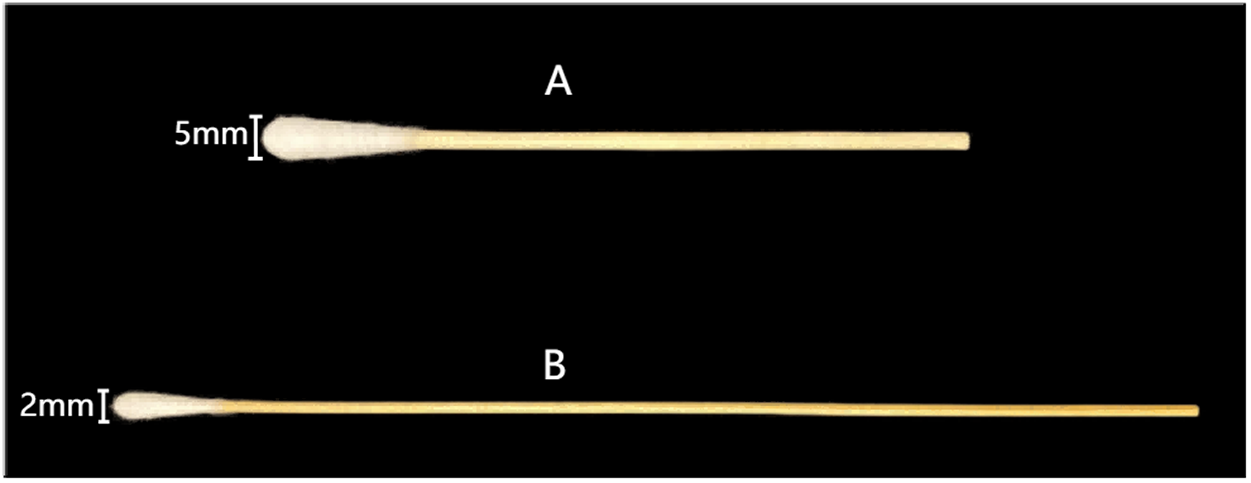
For the physician-applied medication group, after cleaning the external auditory canal, the cream was applied evenly on a fine-tip cotton swab (Fig. 3), which was gently inserted deep into the ear canal and spread evenly around the walls of the external auditory canal. The medication was applied once every 2 to 3 days, for a total of three times.
(A) Thick cotton tip swab; (B) fine cotton tip swab.

Two weeks after the use of medication, all patients were re-examined to assess effectiveness of the treatment. The criteria for effective treatment included the disappearance of symptoms, clean skin of the external auditory canal and tympanic membrane, and the absence of visible hyphae, secretions, or accumulation. If these criteria were not met, the treatment was considered ineffective. If the treatment was judged effective at the two-week follow up, a further check-up was conducted after three months to assess for recurrence, using the same evaluation criteria as mentioned before.
Statistical methods
Data analysis was conducted using SPSS 27.0 software (IBM SPSS, Armonk, NY, USA). Differences in sex and the side of the affected ear among patients with otomycosis were evaluated using the chi-square test for goodness of fit in frequency distribution. The age and sex difference between the two groups was determined using an independent samples t-test and chi-square test, respectively. For differences in fungal types between the two groups, the Fisher’s exact probability method was used for the chi-square test. Comparisons of efficacy and recurrence rates were conducted using Pearson’s and Fisher’s exact probability method chi-square test, respectively. A p-value <0.05 was considered statistically significant.
Results and analysis
Patient general information
Of 316 patients diagnosed with otomycosis that were studied, 246 (77.8 per cent) tested positive for fungal culture. The demographic distribution of the positive cases included 104 males and 96 females, with infection sites as follows: 78 in the left ear, 76 in the right ear, and 46 affecting both ears (Table 1). Patient age ranged from 18 to 94 years, with a mean of 47 years (SD ± 16 years). Chi-square analysis revealed no significant sex difference in infection rates (χ2 = 0.32, p >0.05) or in laterality (χ2 = 0.026, p >0.05).
Incidences of otomycosis by sex and laterality; differences in the incidence of otomycosis between male and female, and between right ear and left ear were not statistically significant

The physician-applied medication group (100 patients) consisted of 48 males and 52 females, with an age range of 18 to 94 years and a mean age of 48 years (SD ± 15 years). The patient-applied medication group (100 patients) consisted of 56 males and 44 females, with ages ranging from 18 to 81 years and a mean age of 46 years (SD ± 16 years). No significant differences were observed between the two groups in terms of age (F = 0.915, p = 0.308) and sex distribution (χ2 = 1.282, p = 0.258).
Fungal culture
The results of fungal cultures in patients with otomycosis are shown in Table 2. The predominant fungi are Aspergillus (79.5 per cent) and Candida (18.5 per cent), with a small portion being others (2 per cent). Aspergillus includes Aspergillus terreus, Aspergillus niger, Aspergillus fumigatus, Aspergillus flavus, and Aspergillus versicolor, with Aspergillus terreus being the most common. Candida includes Candida parapsilosis, Candida albicans, and Candida ciferrii, with Candida parapsilosis being the most common. There was no statistical difference in fungal culture between the two groups (p >0.05).
Fungal cultures in patients with otomycosis; here was no statistically significant difference in the types of fungi between the patient-applied medication group and physician-applied medication group (p > 0.05)

Clinical manifestations
The statistics of chief complaints reported by patients with otomycosis are shown in Table 3. The most common complaints were a feeling of blockage.
Chief complaints of patients with otomycosis

In 58.0 per cent of the patients, examination revealed a buildup in the external auditory canal of creamy-like, cheese-like, or abnormal earwax, without the presence of fungal hyphae, while 24.0 per cent of patients showed visible white or black fungal hyphae. In 13.0 per cent of the patients, the skin of the external auditory canal exhibited redness or flaking, while 1.5 per cent had visible granulation tissue within the ear canal. Other patients presented with clinical findings such as swelling or narrowing of the external auditory canal upon examination.
Treatment efficacy and recurrence rate
In the patient-applied medication group, treatment was effective in 44.7 per cent of cases (34/76) and ineffective in 55.3 per cent (42/76), with a recurrence rate of 35.3 per cent (12/34) and a non-recurrence rate of 64.7 per cent (22/34). Conversely, the physician-applied medication group showed a 98.6 per cent efficacy rate (71/72) and ineffective in 1.4 per cent (1/72), and a significantly lower recurrence rate of 2.8 per cent (2/71), with a non-recurrence rate of 97.2 per cent (69/71) (Table 4). The differences in treatment efficacy between the two groups were statistically significant, with chi-square values of 47.706 (p <0.01). There was also a statistically significant difference in recurrence rates (p <0.01).
Treatment efficacy and recurrence rates comparison between two groups; the differences in treatment efficacy and recurrence rates between the two groups were statistically significant (p <0.01), respectively

Discussion
In our study, we found that there is no significant difference in the incidence of otomycosis between males and females. Similarly, there is no statistical difference in the rate of infection occurring in the left or right ear. This finding is consistent with the results of other related studies.Reference Kaur, Mittal, Kakkar, Aggarwal and Mathur5
In diagnosing otomycosis, we have observed that fungal cultures are not always successful and often time-consuming. Even when hyphae are clinically visible, culture results may be negative. In our cases, successful fungal culture was obtained in 77.8 per cent of instances. The most prevalent fungus identified was Aspergillus, followed by Candida, with a minority comprising Penicillium species and Scedosporium apiospermum. Within the Aspergillus group, Aspergillus terreus was the most common (50.5 per cent), followed by Aspergillus niger (12.5 per cent) and Aspergillus flavus (8.0 per cent). Among the Candida species, Candida parapsilosis was the predominant strain (15.5 per cent), with Candida ciferrii (1.0 per cent) and Candida albicans (4.0 per cent) also being notable.
Global studies indicate regional variations in the causative fungi of otomycosis. In Spain, research by García-Agudo et al. found the most common Aspergillus species to be Aspergillus flavus, Aspergillus niger, and Aspergillus fumigatus, while among Candida, Candida parapsilosis and Candida albicans were most common.Reference Garcia-Agudo, Aznar-Marin, Galán-Sánchez, García-Martos, P and Rodríguez-Iglesias6 In Egypt, a study by Ali et al. reported that among 122 patients with otomycosis, 102 samples showed positive fungal infection, predominantly Aspergillus niger (51 per cent) and Candida albicans.Reference Ali, Hamed, Hassan, Esmail and Sheneef7 In Iran, research reported by Nemati et al. included 100 patients with external ear mycosis/otitis, confirming otomycosis in 43 per cent of cases, also primarily due to Aspergillus niger.Reference Nemati, Hassanzadeh, Khajeh Jahromi and Delkhosh Nasrollah Abadi8
Regional differences are likely one of the major factors contributing to significant variations in fungal culture results. Climatic conditions in different regions, such as humidity, temperature, and seasonal changes, directly affect fungal survival and proliferation. Additionally, differences in hygiene practices, health status, and cultural customs among populations in different regions can indirectly affect the incidence and types of fungal infections.
In our study, given that not all medical institutions, especially in underdeveloped areas and small clinics, have the capability to perform fungal cultures, relying on clinical presentation and physical examination for accurate diagnosis of otomycosis is particularly crucial. Based on the analysis of data from the 200 cases we collected, the most common chief complaint reported by patients was a feeling of ear blockage (35.2 per cent) followed by itching (26.7 per cent), which is consistent with the findings reported by Kaur R et al. Reference Kaur, Mittal, Kakkar, Aggarwal and Mathur5 Additional complaints included ear discharge (13.6 per cent), ear pain (10.4 per cent), tinnitus (8.0 per cent) and hearing loss (6.1 per cent). The sensation of blockage and the reduction in hearing are primarily caused by the obstruction of the external auditory canal due to secretions or buildup. Inflammation of the skin within the ear canal can manifest as itching and pain in the ear.
It is noteworthy that the symptom statistics reported in different studies vary.Reference Anwar and Gohar2, Reference Jia, Liang, Chi and Cao9, Reference Kurnatowski and Filipiak10 We chose to record the chief complaints of the patients (i.e. the primary symptoms reported by the patients at the time of seeking medical care). This differs from the passive responses obtained by doctors during consultation, which can often be leading and may result in ambiguous answers. For instance, in our data, hearing loss as a chief complaint accounted for only 4.3 per cent, while the sensation of ear blockage was as high as 35.2 per cent, but directly asking patients whether they experience hearing loss might elicit more affirmative responses, even though it might not be their primary reason for seeking medical attention.
Clinical examination findings revealed that only 24.0 per cent of patients exhibited visible white or black fungal hyphae. Meanwhile, 58.0 per cent of the patients demonstrated a buildup in the external auditory canal resembling creamy-like, cheese-like substances or abnormal earwax without the presence of fungal hyphae. Candida infections reportedly are predominantly characterized by secretions.Reference Enoz, Sevinc and Lapeña11 It is particularly important to note that a minority of cases presented with granulation tissue, which can easily lead to misdiagnosis in clinical practice. In fact, granulation tissue often resolves after correct diagnosis and treatment with triamcinolone acetonide econazole. Cleaning the ear canal and discovering erosion of the ear canal skin can also be helpful in diagnosing otomycosis.
Various medications have been reported in the literature, such as clotrimazole cream,Reference Dundar and Iynen12 ciclopiroxolamine cream and solution,Reference del Palacio, Cuétara, López-Suso, Amor and Garau13 terbinafine hydrochloride sprayReference Xu, Li, Ding, Gao, Xie and Han14 and 3 per cent boric acid alcohol.Reference Romsaithong, Tomanakan, Tangsawad and Thanaviratananich15 The efficacy of these treatments varies significantly. Boric acid or alcohol coming into contact with inflamed skin can cause significant ear pain and other skin-irritant reactions. Furthermore, antifungal aqueous solutions have shortcomings, such as short duration of action and greater skin irritation. Cream formulations overcome these drawbacks, causing less local irritation and having longer duration of action, thus providing better antifungal effects.
Among various cream formulations, triamcinolone acetonide econazole is rarely reported in the literature. Chen et al. described a procedure involving the administration of triamcinolone acetonide econazole injections into the ear canal, conducted once weekly over a span of two weeks;Reference Chen, Chu, Tao, Peng, Zhou and Liu16 however, this treatment method is time-consuming and difficult to administer. Pevisone is a compound preparation containing 10 mg of econazole nitrate and 1.0 mg of triamcinolone acetonide per gram. Econazole, an imidazole antifungal drug, inhibits the biosynthesis of ergosterol, a key component of fungal cell membranes, causing cell membrane damage. This leads to the leakage of ions (mainly K+ and H+) and other molecules from the cell, resulting in cell death and thus exerting an antifungal effect. It is not only effective against dermatophytes, Candida, and Aspergillus but also acts on some gram-positive bacteria.Reference Munguia and Daniel17
Triamcinolone is a corticosteroid with anti-inflammatory, antipruritic, and antiallergic effects. Thus, triamcinolone acetonide econazole cream has dual components of antifungal and antiallergic properties, is gentle in nature, and minimally irritates the skin. It is clinically suitable for dermatitis, eczema, and mixed skin infections caused by fungi and bacteria, making this medication highly appropriate. This drug has minimal side effects and is safe for use in pregnant women, breastfeeding mothers, and children when necessary. Typically, some patients may experience mild itching upon initial application. Despite these advantages, the clinical efficacy of treating otomycosis with triamcinolone acetonide econazole cream sometimes falls short of expectations. This leads us to suspect that inadequate application of the medication may play a significant role in these outcomes.
In our study, the physician-applied medication group that received three applications exhibited a 98.6 per cent efficacy rate at the two-week follow-up visit. In fact, following just a single application, 95 per cent of the patients reported significant relief of symptoms and improvements in physical examination findings (specific data not provided), with only a few still showing small amounts of hyphae, possibly due to parts of the skin not being fully covered with the cream during application. In contrast, the patient-applied medication group had an efficacy of 44.7 per cent, despite having more frequent applications (once daily for 10 days).
It is important to note that even with initial symptom alleviation, some patients experienced a recurrence of the condition at the three-month follow-up examination. The recurrence rate was lowest in the physician-applied medication group at only 2.8 per cent, Recurrent patients all exhibited narrowing of the external auditory canal, to such an extent that even thin cotton swabs had difficulty passing through. The recurrence rate in the patient-applied medication group was 35.3 per cent, likely because the tips of the cotton swabs used were too thick (Fig. 3), or patients were concerned about damaging the eardrum, leading to an inaccurate application of the cream deep in the ear canal. It is important to note that the cream applied within the ear canal is generally absorbed and disappears within 48 hours after application, which means the interval between applications should not be overly prolonged. Based on our observations, we recommend a treatment duration of about 9 days, with the cream being applied every 2 to 3 days, amounting to a total of three applications. Coupled with the initial ear-canal cleaning, this regimen requires patients to make only four visits to achieve a high efficacy rate and a low rate of recurrence.
A potential limitation of this study was the inherent bias arising from different medication application frequencies and dosages between the physician-applied and patient-applied groups. However, we think that the observed difference in treatment efficacy between the two groups was not primarily due to variations in frequency and dosage. Rather, the key factor was likely the accuracy of medication placement (specifically, whether the medication was properly applied to reach the affected areas of the ear canal). Precisely applied medication to the required location appears to be more crucial for treatment success than the total amount or frequency of medication used.
In summary, ear cleansing coupled with physician-applied application of triamcinolone acetonide econazole cream proves to be an effective and safe treatment. It minimises patient visits and is worthy of broader adoption, especially in impoverished areas lacking otoscope and fungal-culture facilities.
• Common types of fungal infections are Aspergillus spp. and Candida spp.
• Besides ear itching, many patients present with purulent discharge, blockage sensation, ear pain and so on
• Most otomycosis does not show fungal filaments, leading to high misdiagnosis rates
• Even with a correct diagnosis of otomycosis, if patients apply medication themselves, treatment can be ineffective and prone to recurrence
• Using a fine-tip cotton swab to apply triamcinolone acetonide econazole cream to patients three times, with each application lasting 2–3 days, can effectively treat otomycosis and reduce recurrence
Financial support
This project did not receive any financial support.
Competing interests
The authors report there are no competing interests to declare.
Ethical standards
The authors assert that all procedures contributing to this work comply with the ethical standards of the China guidelines on human experimentation and with the Helsinki Declaration of 1975, as revised in 2008.This study was approved by the ethics committee of Zhongshan Hospital of Xiamen University and registered at ClinicalTrials.gov (NCT06431542). Informed consent was obtained from all individual participants included in the study.