Introduction
The coastal and shelf seabed in Argentina's Buenos Aires province consists of soft bottoms made up of sands, loess (consolidated sedimentary rocks originated in the Pleistocene) and muds (Parker et al., Reference Parker, Paterlini, Violante and Boschi1997). However, off the coast of Mar del Plata, several quarzitic outcrops can be detected close to the coast. These outcrops have a geological origin that dates back to 550 million years and are part of the Tandilia mountain system (Genzano et al., Reference Genzano, Giberto, Madirolas, Bremec, Bremec and Giberto2017). These natural hard bottoms, along with several artificial reefs (e.g., sunken ships ‘James Clunies’, ‘Cristo Rey’ and ‘Khronometer’), provide hard substrata suitable for the recruitment of benthic species and serve as refuge for fish (Genzano et al., Reference Genzano, Giberto and Bremec2011, Reference Genzano, Giberto, Madirolas, Bremec, Bremec and Giberto2017). Various anthropogenic activities, such as commercial and recreational fishing, as well as SCUBA diving, take place in these coastal environments. In particular, one of these outcrops is named ‘Banco de Afuera’. The area is affected by a littoral current (south to north), semidiurnal tidal currents and high-energy waves; storms and winds from the SE are frequent, mainly in autumn and winter. Water visibility ranges between 0.5 and 6 m, average 3 m. Water temperature is variable through the year; in general, maximum summer values reach 18–19°C and minimum winter values of 7–8°C were recorded (Genzano et al., Reference Genzano, Giberto and Bremec2011), although higher values were recorded in the past years (Berghoff et al., Reference Berghoff, Epherra, Silva, Fernández Acuña, Baldoni, Maenza, Hozbor, Albornoz, Menna, Cascallares and Moreira2023). Besides the quartzitic outcrop, it has a ridge formed by sedimentary rocks (sandstones) that rise up to 1.5 m above the seabed. Some floristic and faunistic characterization studies have been developed in this region focusing mainly on the dominant groups (algae, cnidarians, molluscs and echinoderms) (Genzano et al., Reference Genzano, Giberto and Bremec2009). However, information on the sponge species of these habitats is still scarce and incomplete. This study reports the finding of the sponge Clathria (Clathria) unica Cuartas, 1992 recorded in the ‘Banco de Afuera’ (Figure 1). Until now, this species was only known from its type locality, in Río Negro province. Additionally, two other common sponge species, Cliona aff. celata Grant, 1826 and Spongia (Spongia) magellanica Thiele, 1905 are reported for the same habitat.
Records of Clathria (Clathria) unica. Red circle (○): type locality in San Antonio Bay, Río Negro province; blue diamond (◇): new record and range extension, at ‘Banco de Afuera’, Mar del Plata, Buenos Aires province.

Materials and methods
On February 27 of 2022, as part of the studies conducted under the BiodA Project (Biodiversity of Reefs [Biodiversidad de Arrecifes, in Spanish], @biodiversidaddearrecifes), filming and collections of different biota were carried out through SCUBA diving at ‘Banco de Afuera’, located at 38°14′24″S, 57°27′30″W, off Mar del Plata, at a depth of 19–20 m (Figure 1). During these dives, transects of approximately 70 m long were filmed using a GoPro 7 camera, documenting the nature of the rocky bottom and the most conspicuous biota in this habitat. In particular, sponges were filmed and identified with a number, and then some fragments were detached from the substrate and collected using nylon bags. In this way, in situ images of the collected material were obtained prior to transportation to the Benthos Laboratory of the National Institute of Fisheries Research and Development (INIDEP), where it was stored in the freezer until further studies. Then, sponges were dried or preserved in 70% ethanol.
The identification of the sponge species was carried out using classical taxonomic techniques, which involve the description and quantification of the types of spicules and fibres and their arrangement in the skeleton (following Hajdu et al., Reference Hajdu, Peixinho and Fernández2011) using a Leica DM 1000 stereomicroscope equipped with a Leica ICC50 HD camera for the acquisition of the images. Thirty spicules of each category were measured to obtain range and average length and width values (as minimum–mean–maximum length × minimum–mean–maximum width). Determination at species level was performed following Hooper and Van Soest (Reference Hooper and van Soest2002) and Morrow and Cárdenas (Reference Morrow and Cárdenas2015), also available at the website ‘World Porifera Database’ (de Voogd et al., Reference de Voogd, Alvarez, Boury-Esnault, Cárdenas, Díaz, Dohrmann, Downey, Goodwin, Hajdu, Hooper, Kelly, Klautau, Lim, Manconi, Morrow, Pinheiro, Pisera, Ríos, Rützler, Schönberg, Turner, Vacelet, van Soest and Xavier2024) and using local bibliography.
The studied material was deposited at the Museo Argentino de Ciencias Naturales ‘Bernardino Rivadavia’.
Results
One specimen of the sponge Clathria (Clathria) unica, one specimen of Cliona aff. celata Grant, 1826 and one specimen of Spongia (Spongia) magellanica Thiele, 1905 were recorded in the study area. Below, we provide brief descriptions of the studied specimens, highlighting the new record of C. (C.) unica for the region and noting some other peculiarities.
Systematics
Phylum Porifera
Class Demospongiae
Order Poecilosclerida
Family Microcionidae
Genus Clathria
Sub-genus Clathria (Clathria)
Clathria (Clathria) unica Cuartas, 1992
(Figure 2)
Synonymy: Clathria unica Cuartas, 1992
Material examined: 1 dried specimen deposited at the Museo Argentino de Ciencias Naturales ‘Bernardino Rivadavia’ MACN-In 44454, ‘Banco de Afuera’ 38°14′24″S, 57°27′30″W, off Mar del Plata, 19–20 m depth, collected by G. Genzano and P. Meretta, 27/02/2022.
Clathria (Clathria) unica Cuartas, 1992. (A) Overall morphology of the studied specimen. (B) Photo of the living specimen in its habitat. (C) Main styles (2 and 3) and auxiliary subtylostyles (1). (D) Detail of the subtylostyles ends (1 y 3) and styles (2). (E) Acanthostyles. (F) Palmate isochelaes. (G) Toxa. Scales: A = 3 cm; C, E = 50 μm; D, F = 12.5 μm; G = 25 μm.

Description: The sponge has an upright, lobed, and branched morphology, resembling a bush. The specimen measures approximately 6 cm in height, and its colour in life is orange. The surface is slightly rough to the touch and has a bristly texture, with numerous pores scattered throughout its length. The sponge has a firm, but soft consistency.
Skeleton: The choanosomal skeleton aligns with the description provided by Cuartas (Reference Cuartas1992a) and Gastaldi et al. (Reference Gastaldi, De Paula, Narvarte, Lobo-Hajdú and Hajdú2018), with fibres made of styles and acanthostyles running towards the surface; echinating acanthostyles are observed on the nodes. The ectosomal part is formed by auxiliary subtylostyles that appear to arrange themselves with their sharp ends towards the external part, causing a micro-hispidation at the surface. Isochelaes are evenly dispersed throughout the skeleton, and toxas are very scarce.
Spiculation: Megascleres. Primary styles, 290–358–410 × 7.5–9.4–10 μm (Figure 2C, D), auxiliary subtylostyles of 120–284.4–450 × 2.5–4.6–7.5 μm (Figure 2C, D), acanthostyles of 110–139–160 × 5–8.6–10 μm (Figure 1E). Microscleres. Palmate isochelaes of 15–17.5–20 μm (Figure 2F) and thin toxas of 50–95–140 μm (Figure 2G).
Distribution and ecology: The species was only known from its type locality in the intertidal of San Antonio Oeste (San Antonio Bay), Río Negro Province, at 40°45′S, 65°W (Figure 1). It was described by Cuartas (Reference Cuartas1992a) and then reported by Gastaldi et al. (Reference Gastaldi, De Paula, Narvarte, Lobo-Hajdú and Hajdú2018) in the same location. At the ‘Banco de Afuera’, Buenos Aires province, C. (C.) unica coexists with the mussel Mytilus platensis d'Orbigny 1842, which is dominant in the region, and with several species of algae, ascidians, hydrozoans, the coral Tripalea clavaria (Studer, 1878) and at least two other sponge species mentioned below.
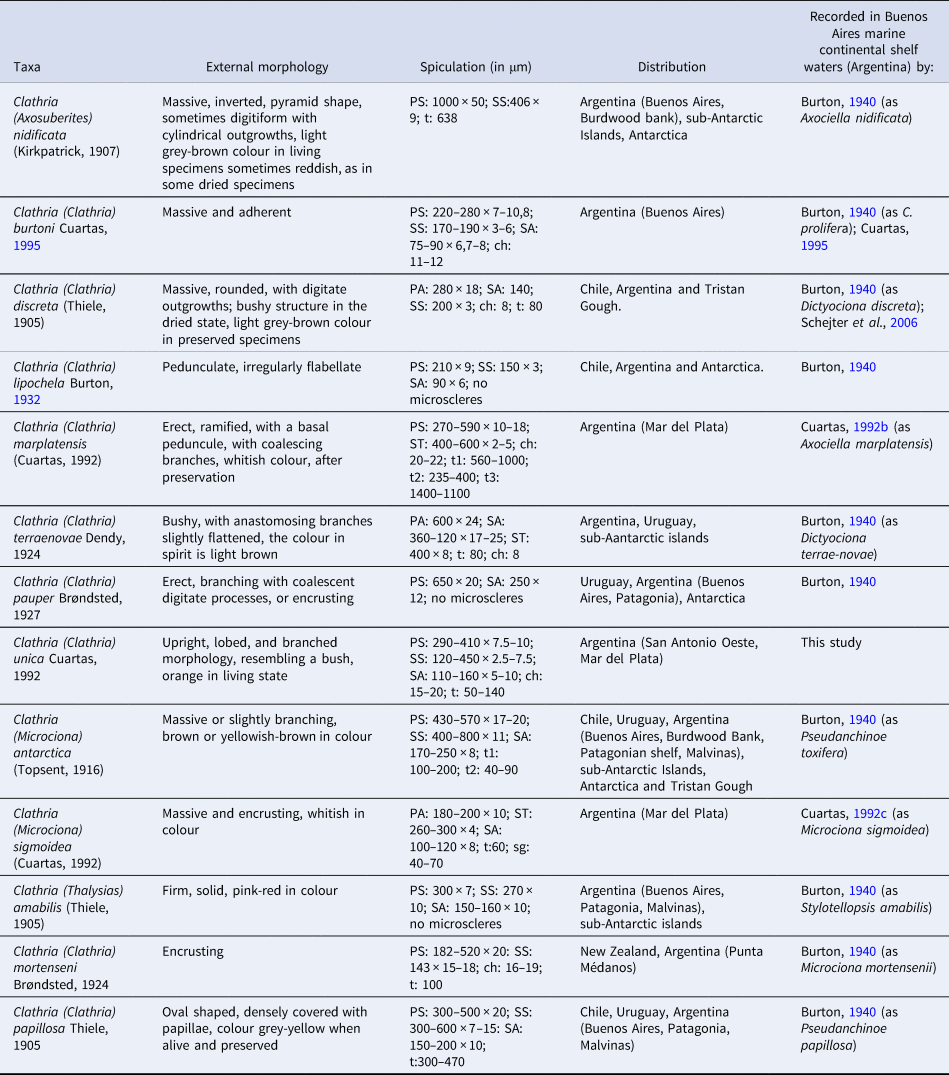
Remarks: Assignment of the above material to Clathria (Clathria) unica is supported by the upright form, orange colour, spiculation (see Tables 1 and 2 for comparisons), and skeletal description provided by Cuartas (Reference Cuartas1992a) and Gastaldi et al. (Reference Gastaldi, De Paula, Narvarte, Lobo-Hajdú and Hajdú2018), with fibres made of styles and acanthostyles running towards the surface; echinating acanthostyles are observed in the nodes.
Comparative measurements (in μm) of the spicules of Clathria (Clathria) unica of this study with other specimens recorded in literature

Comparison of external morphology, spiculation and distribution of the Clathria species recorded in Buenos Aires continental shelf waters, Argentina

References: PS, principal (subtylo) styles; PA, principal acanthostyles; SS, auxiliary styles; SA, auxiliary acanthostyles; ST, auxiliary tylostyles; t, toxas; ch, chelae; sg, sigmas.
Subclass Heteroscleromorpha
Order Clionaida
Family Clionaidae
Genus Cliona
Cliona aff. celata Grant, 1826
(Figure 3A, B, C)
Synonymy: see de Voogd et al. (Reference de Voogd, Alvarez, Boury-Esnault, Cárdenas, Díaz, Dohrmann, Downey, Goodwin, Hajdu, Hooper, Kelly, Klautau, Lim, Manconi, Morrow, Pinheiro, Pisera, Ríos, Rützler, Schönberg, Turner, Vacelet, van Soest and Xavier2024)
Material examined: 1 dried specimen deposited at the Museo Argentino de Ciencias Naturales ‘Bernardino Rivadavia’ MACN-In 44700, ‘Banco de Afuera’ 38°14′24″S, 57°27′30″W, off Mar del Plata, 19–20 m depth, collected by G. Genzano and P. Meretta, 27/02/2022.
Cliona aff. celata Grant, 1826 (A–C) and Spongia (Spongia) magellanica Thiele, 1905 (D–F). (A) Photo of the specimen in its habitat. (B) Overall morphology. (C) Tylostyles. (D) Photo of the specimen in its habitat. (E) General morphology. (F) Section skeleton of S. (S.) magellanica showing fibres of spongin. Scales = B = 2.5 cm; C = 50 μm; E = 4 cm; F = 500 μm.

Description: The specimen is rounded, cushion-shape, attached to the substrate, of 7 cm diameter and about 3 cm in height. The living specimen was yellow, but became brown when preserved (Figure 3A, B). The sponge has a hard and incompressible consistency and feels smooth to the touch. The surface has numerous papillae of 2.5–4.5 mm.
Skeleton: The ectosomal skeleton is a dense layer of tylostyles, while in the choanosome the tylostyles may conform bundles extending from the substrate, but are mainly disordered. Aquiferous canals are evident.
Spiculation: The specimen presented only tylostyles slightly curved in a single category of 220–339–400 × 5–7.6–10 μm (Figure 3C).
Distribution: The type locality of this species is Firth of Forth, Scotland. However, the distribution of this species is usually reported as ‘cosmopolitan’. Xavier et al. (Reference Xavier, Rachello-Dolmen, Parra-Velandia, Breeuwer and van Soest2010) and de Paula et al. (Reference De Paula, Zilberberg, Hajdu and Lôbo-Hajdu2012) confirmed that this is a cryptic species complex, with several morphotypes recorded worldwide, and that cannot be differentiated via morphological characters. In this sense, Gastaldi et al. (Reference Gastaldi, De Paula, Narvarte, Lobo-Hajdú and Hajdú2018) reported C. aff. celata in San Antonio Oeste, Argentina, and confirmed its identity using genetic studies. Cuartas (Reference Cuartas1991) previously reported this species from Mar del Plata, collected at a concrete pile.
Remarks: Our specimen is in accordance with the descriptions provided earlier by Cuartas (Reference Cuartas1991) and Gastaldi et al. (Reference Gastaldi, De Paula, Narvarte, Lobo-Hajdú and Hajdú2018).
Subclass Keratosa
Order Dictyoceratida
Family Spongiidae
Genus Spongia
Subgenus Spongia (Spongia)
Spongia (Spongia) magellanica Thiele, 1905
(Figure 3D–F)
Synonymy: Spongia magellanica Thiele, 1905, Spongia zimocca magellanica (Thiele, 1905)
Material examined: 1 specimen preserved in alcohol 70%, deposited at the Museo Argentino de Ciencias Naturales ‘Bernardino Rivadavia’ MACN-In 44701, ‘Banco de Afuera’ 38°14′24″S, 57°27′30″W, off Mar del Plata, 19–20 m depth, collected by G. Genzano and P. Meretta, 27/02/2022.
Description: The sponge measures approximately 9 cm in diameter and 3 cm in height, and has an irregular shape, very soft and compressible, with a common base attached to mussels, from which various tubes rise, more or less fused and with terminal oscula that range from 1.5 to 3 mm (Figure 3D, E). The colour is beige in live state and becomes brown in ethanol. It has a microhispid surface.
Skeleton: The skeleton is an irregular mesh of primary fibres rich in sand inclusions, with uncored secondary fibres as well (Figure 3F). Main fibres are about 70–80 μm in diameter, while thinner fibres ranged between 40 and 50 while there are others of 20–30 μm.
Distribution: This species was previously reported off Mar del Plata by Burton (Reference Burton1940). Also, it was recorded for the Malvinas (Falkland) region by Burton (Reference Burton1932, Reference Burton1934) and for the shelf-break front by Schejter et al. (Reference Schejter, Calcinai, Cerrano, Bertolino, Pansini, Giberto and Bremec2006) and Schejter et al. (Reference Schejter, Bremec, Cerrano, Bertolino and Calcinai2025).
Remarks: Our specimen is in accordance with the descriptions provided by Burton (Reference Burton1932) and Schejter et al. (Reference Schejter, Calcinai, Cerrano, Bertolino, Pansini, Giberto and Bremec2006, Reference Schejter, Bremec, Cerrano, Bertolino and Calcinai2025).
Discussion
Burton (Reference Burton1940) and Cuartas (Reference Cuartas1985, Reference Cuartas1987, Reference Cuartas1988, Reference Cuartas1991, Reference Cuartas1992b, Reference Cuartas1992c, Reference Cuartas1995) have previously examined the sponge fauna in Mar del Plata intertidal and subtidal zones. There are around 25 species in this coastal area; however, some are currently considered inaccurate records (de Voogd et al., Reference de Voogd, Alvarez, Boury-Esnault, Cárdenas, Díaz, Dohrmann, Downey, Goodwin, Hajdu, Hooper, Kelly, Klautau, Lim, Manconi, Morrow, Pinheiro, Pisera, Ríos, Rützler, Schönberg, Turner, Vacelet, van Soest and Xavier2024) and need to be reviewed to determine if they are new records and species. The recent finding of Clathria (Clathria) unica expands the distributional range of this species from 40°45′S, 65°W to 38°14′24″S, 57°27′30″W, covering intertidal to 20 m depth. This record adds to the Clathria genus' diversity in the Buenos Aires Province, which now has 12 species. Previously, only 11 species of the genus Clathria have been documented along the coast and shelf waters of Buenos Aires Province, belonging to four subgenera: Clathria (Axosuberites) nidificata (Kirkpatrick, 1907), Clathria (Clathria) burtoni Cuartas, Reference Cuartas1995, Clathria (Clathria) discreta (Thiele, 1905), Clathria (Clathria) lipochela Burton, Reference Burton1932, Clathria (Clathria) marplatensis (Cuartas, 1992), Clathria (Clathria) mortenseni Brøndsted, 1924, Clathria (Clathria) terraenovae Dendy, 1924, Clathria (Clathria) pauper Brøndsted, 1927, Clathria (Microciona) antarctica (Topsent, 1916), Clathria (Microciona) sigmoidea (Cuartas, 1992), and Clathria (Thalysias) amabilis (Thiele, 1905) (Table 2, see also López Gappa and Landoni, Reference López Gappa and Landoni2005; Schejter et al., Reference Schejter, Bremec, Cerrano, Bertolino and Calcinai2025). All the mentioned species differ in their overall morphology, spicule composition and the arrangement of spicules in the skeleton (Table 2).
On the other hand, Cliona aff. celata and Spongia (S.) magellanica were previously reported in the area (see Cuartas, Reference Cuartas1991 and Burton, Reference Burton1940) and in this study we only confirmed its presence in the coastal waters of Mar del Plata, recording its presence in the particular habitat of ‘Banco de Afuera’. Future studies and samplings will probably increase our knowledge on the sponge fauna of the outcrops, banks and wrecks located in the vicinity of Mar del Plata city, as the only coastal records of sponges in this area came from the intertidal strip and tidal pools.
Acknowledgements
The authors express their gratitude to the anonymous reviewers, whose valuable comments significantly enhanced the quality of the manuscript. This is INIDEP Contribution No 2397.
Author contributions
M. P. N. identified the species, wrote and reviewed the article; G. G. and P. M. collected the samples, provided data on the study area and reviewed the article. L. S. proposed the idea for the article, identified the species, provided the conceptual framework, and wrote and reviewed the article.
Financial support
This study was partially supported by PICT 2019-4233 and EXA 1093/22.
Competing interest
None.
Data availability
Data are available from the corresponding author upon request.