




No CrossRef data available.
Information, Uncertainty, and the Decision to Secede
Published online by Cambridge University Press: 04 January 2006
Abstract
Since 1980 almost half of all armed conflicts have been fought between governments and ethnic minority groups over self-determination, yet surprisingly little is known about when and why these conflicts occur. The few studies that do exist focus on the deep injustices and structural conditions that may cause some groups to seek greater autonomy or independence and others not. I argue that ethnic groups are much more strategic than current theories allow. Ethnic groups decide whether to challenge based in part on whether the government has made concessions in the past, and whether the government can be expected to do so again in the future. Data on all ethnic groups for the years 1940 to 2000 reveal that ethnic groups are significantly more likely to seek self-determination if the government has acquiesced to an earlier group of separatists, and if the government is unlikely to encounter additional ethnic challengers in the future. Grievances and opportunity matter, but so does the larger strategic environment in which the government and its ethnic groups operate.I thank Jon Caverley, Rui de Figueiredo Jr., Tanisha Fazal, Zoltan Hajnal, Oliver Kaplan, Jack Snyder, and participants at the Program on International Politics, Economics and Security at the University of Chicago for their very helpful comments and suggestions; Ted Gurr and David Quinn for their detailed information about the CIDCM data set; and Kathleen Cunningham and Idean Salehyan for excellent research assistance. Finally, I wish to thank the National Science Foundation for their support in funding this research.
Information
- Type
- Research Article
- Information
- Copyright
- © 2006 The IO Foundation and Cambridge University Press
Since 1980 almost half of all armed conflicts have been fought between governments and ethnic minority groups over self-determination.1
Yet surprisingly little is known about when and why these conflicts occur. The few studies that do exist focus almost exclusively on the political, economic, and social conditions that may provide the motive and opportunity for groups to secede. Ethnic groups seek self-determination because they feel aggrieved by the central government, because they have the resources to mobilize their members for action, and/or because the government is weak and unable to prevent a challenge. Gurr, for example, has argued that rebellion is more likely when groups feel disadvantaged relative to other groups in a country and when they are powerless to achieve desired economic goals.2 Marshall and Gurr have found that groups are more likely to seek self-determination if they lost political autonomy in the past, and if they are materially disadvantaged compared to other groups.3 Bartkus has argued that groups are more inclined to break away if their members' lives, livelihood, or cultural autonomy are in jeopardy and central government authority is in decline.4Existing studies have identified a number of important causal factors influencing the decision to seek self-determination. But the heavy focus of this research on the underlying structural conditions surrounding ethnic groups has overlooked a big part of the story. In this article I argue that the larger strategic environment in which the government and its many ethnic groups operate plays an important role in the decision to seek greater autonomy or independence. Grievances and opportunity matter, but what is missing is a more dynamic model that takes into account a larger number of ethnic groups interacting with the government over a longer period of time, and the information this provides to potential separatists about if and when to act.
In this article, I lay out a theory of armed self-determination challenges that focuses on the role of information and uncertainty in the outbreak of violence. I argue that a contributing factor in the outbreak of violence is a government's private information about its willingness to negotiate with separatists, and the incentives a government has to misrepresent this information when numerous potential challengers exist. Governments, especially those presiding over multiethnic populations, would very much like ethnic groups living within their borders to believe that obtaining self-determination will be costly and unproductive. Would-be separatists, on the other hand, would very much like to determine if the government will make deals when faced with a violent challenge. The result is a complex strategic interaction where governments are actively seeking to deter separatists, and separatists are carefully seeking to uncover if and when the government will grant concessions.
The article is divided into four sections. The first section briefly describes existing hypotheses that focus on the motives and opportunities ethnic groups have to seek self-determination. The second section suggests ways in which strategic interaction may be incorporated into our existing understanding of this phenomenon and lays out the mechanism by which information about a government's past behavior and about its likely future behavior may affect the decision to challenge the government at any point in time. The third section discusses the data set used to test the hypotheses and describes how each of the proposed causal variables was operationalized for testing. The fourth section presents and interprets the findings. The final section concludes.
I show that treating ethnic groups as strategic actors who carefully observe how the government behaved in the past and how it is likely to behave in the future adds to our understanding of when violent conflict over self-determination may occur. Regardless of how aggrieved a group was, how many resources it had at its disposal, or how strong the government, ethnic groups were significantly more likely to seek self-determination if the government had made concessions to an earlier challenger and if the government was unlikely to encounter additional challengers in the future. Relative political and cultural disadvantages, a previous loss of autonomy, geographic concentration, and an unstable government were also significantly related to the decision to secede, but the behavior of a government toward past challengers, and the number of challengers a government could encounter in the future were also important.
Existing Explanations
Motive
Much of the literature on self-determination movements focuses on an ethnic group's underlying motivation to seek separation from the central government.5
See, for example, Gurr 1970 and 2000; Gurr and Moore 1997; Azar and Burton 1986; Bolton, Roland, and Spolaore 1996; Horowitz 1985; Muller and Seligson 1987; Rudolph and Thompson 1985.
See Gurr 1970 and 2000; Horowitz 1985.
Other studies cite deliberate discrimination on the part of the state as a key factor. Gurr, and Gurr and Moore have argued that ethnic groups may rebel when their access to economic opportunities or political positions within the existing state are systematically limited, or when they are restricted from following important cultural, linguistic, or religious practices.7
See Gurr 1993a and 1993b; Gurr and Moore 1997.
A final set of studies highlights severe economic conditions that jeopardize the lives and limit the opportunities of a group. In this case, poverty, poor public health, or other features related to low levels of human development can incite violence by creating anger and resentment against the state. At least five hypotheses can be drawn from these theories.
H1: The greater the differences in political, economic, and cultural status between a group and other groups in society, the more likely it is to seek self-determination.
H2: The greater the absolute political, economic, and cultural discrimination a group experiences, the more likely it is to seek self-determination.
H3: Groups that enjoyed autonomy in the past but lost it should be more likely to seek self-determination.
H4: The greater the government repression against an ethnic group, the more likely it is to seek self-determination.
H5: The lower a group's living standard, the more likely it is to seek self-determination.
Opportunity Costs
Theories that focus on underlying grievances are often complemented by those that focus on the ability of ethnic groups to mobilize and sustain an organization over time.8
See Tilly 1978; and Hechter 1992.
See Smith 1991; and Gurr 1993a.
Organization, however, also requires resources to mobilize individuals into an effective fighting force. The second set of arguments, therefore, concentrates on the money and supplies needed to build an organization, entice individuals to join, and pay for the materials used during active resistance. Moller, Choucri, and Huntington have all argued that ethnic groups with a large pool of young men should have an easier time recruiting soldiers and thus be better able to challenge the government.10
Rebellion under these conditions should be more likely. In addition, Collier and Hoeffler have argued that a group's access to finance in the form of extractable natural resources and donations from diasporas make rebellion more feasible.11The final set of arguments focuses on the government and its ability to police and control peripheral areas, which then affect the costs a group must pay to pursue violence. Fearon and Laitin, for example, have argued that countries with rough terrain, large populations, or weak central governments are more likely to experience rebellion because groups are better able to evade government repression and maintain the movement over time.12
Theories that focus on opportunity costs, therefore, give us three additional hypotheses for testing:
H6: The less difficult it is to organize group members, the more likely a group is to seek self-determination.
H7: The greater the availability of soldiers and resources, the more likely a group is to seek self-determination.
H8: The weaker the central government, the more likely a group is to seek self-determination.
The Strategic Environment
I argue, however, that a more intricate game is being played between governments and ethnic groups that has to do with the private information a government has about its willingness to give up territory in the face of a violent challenge.13
Throughout the article I refer to ethnic groups as if they were unitary actors composed of individuals with similar preferences. This is a simplification of reality because there is almost always a range of interests advocated by members of a group, as well as competition among subsets of groups over questions of means and goals. I do not explain differences in preferences among group members, or why some preferences are promoted over others. I simply suggest that under certain circumstances group actions will coalesce in certain predictable ways even if divisions exist at the subgroup level.
Note that this argument is derived from work on entry-deterrence and advertising in the economics literature, and readers familiar with the chain store paradox will see that I have applied its logic to the question of secession. See especially Spence 1973; Selten 1978; Rosenthal 1981; Kreps and Wilson 1982; Milgrom and Roberts 1982; Dixit 1982; Schmalensee 1981 and 1983; Kennan and Wilson 1993.
In practice, however, ethnic groups can never be sure what type of government they are facing. On the one hand, they could face a government willing to part with some territory in return for peace, as the Czechoslovakian government was with Slovakia. On the other hand, they could face a government that is unwilling to part with territory under any conditions, as Lincoln's was during the U.S. Civil War.15
The theory also treats governments as if they were unitary actors where governments represent a particular “type” and remain this type forever. Empirically, however, we know that leadership changes, and that one administration might have quite different views toward separatists than another. While I do not explain why some leaders might be more or less conciliatory than others, I do suggest that certain strategic environments (such as the one discussed in this article) will cause leaders to behave in similar ways. In this case, the desire to deter future challengers should create strong incentives for most leaders to fight against early challengers, regardless of that leader's type.
Note that governments are also likely to take into account the combined value (economic, strategic, symbolic) of all territory that could come under dispute in the future, as well as the relative strength of all future challengers when deciding how to respond to a given opponent. Ethnic groups, therefore, should take into account these nonstrategic factors when determining whether or not to seek self-determination.
Walter 2003 and 2004a.
It also found that governments were significantly less likely to accommodate if the value of the land that could come under dispute in the future was also high.
Ethnic groups that observe a government fighting against one ethnic opponent, therefore, cannot tell whether the government is truly resolute, or whether it is conciliatory but bluffing to avoid triggering a rash of successive challenges. The trick for ethnic groups is to attempt to gauge the likelihood that they are facing a government that is not only conciliatory but also has no incentive to bluff at a particular point in time. These are the times when an ethnic group's demands are most likely to be rewarded with the desired concessions.
Ethnic groups can attempt to estimate whether a government is likely to offer concessions when faced with a violent challenge in at least two ways. First they can examine a government's past behavior and use this information to update their beliefs about what the government is likely to do if they themselves secede. If the government granted autonomy or independence to a separatist group in the past, it has revealed itself to be conciliatory, and a second group can launch its self-determination movement strongly suspecting that it will be rewarded with concessions as well. This appears to be what happened in Indonesia in 1999. Less than a month after the government declared that it would offer independence to East Timor, the traditional chiefs in West Papua demanded the same concessions. According to John Ondawame, international spokesperson for the Free Papua Movement, “we would like to see the Indonesian government's new policy towards East Timor be repeated again in West Papua.”19
“Irian Jaya Gains Hope from Timor Turnaround.” Courier Mail (Queensland, Australia), 20 February 1999.
Ethnic groups can also attempt to gauge a government's response based on the number of challengers a government is likely to encounter in the future. Ethnic groups know that conciliatory governments only have incentives to fight if they believe numerous additional challengers exist, all of whom are waiting to see if the government will reveal itself to be irresolute. Basque leaders, for example, have consistently acknowledged that Madrid is unlikely to agree to a self-determination referendum because this would “lead to similar demands from other autonomous regions, like Catalonia and Galicia.”20
Anderson 2001, 43.
The fact that ethnic groups can gather information about the government's likely response does not mean that this information will always allow them to avoid costly battles with irresolute opponents. The Chechens, for example, have been fighting a lengthy war against the Russians with no sign that Moscow will eventually compromise. There are three reasons why this may occur. First, ethnic groups know that conciliatory governments have declining incentives to fight costly wars as the number of potential separatists drops, but they do not know at what point in the sequence the government will begin to grant concessions. The decision by the government will likely depend on the costs the government believes it will have to expend to fight the remaining opponents and whether a continuing strategy of deterrence makes sense. Ethnic groups can attempt to estimate when a government will give in, but they can never be certain when this will occur. All they know is that the greater the number of groups, the less likely a government is to negotiate.
Second, potential separatists will not always be able to anticipate correctly a government's response. Leaders and their respective administrations change over time and one leader's commitment to territory will not necessarily be passed on to his or her successor. The fact that one leader fought tenaciously against one separatist group does not mean that the next leader will do the same. President Suharto, for example, resisted all efforts to find a political compromise to the conflict in East Timor, but his successor, President B. J. Habibie did not. Even though President Habibie was willing to offer a referendum to the East Timorese, his successors have not been equally conciliatory toward Aceh or West Papua. New administrations, therefore, bring new uncertainties.
Finally, even under the best conditions, ethnic groups cannot know exactly how a government will respond to any given challenge. A government's behavior is influenced by a variety of factors that are difficult for would-be separatists to gauge, such as the costs and risks a government believes it would pay for future fights. Governments, for example, might choose to acquiesce to one strong challenger to conserve resources so that they can better fight a series of lesser opponents in the future.21
See especially Treisman 2004.
The fact that information is imperfect does not mean that it will not factor into decisions to secede. Information about how a government behaved in the past, and on how many challengers it is likely to encounter in the future should still be valuable to ethnic groups operating in an otherwise uncertain environment. The theory, therefore, provides two additional hypotheses for testing:
H9: Ethnic groups should be more likely to seek self-determination if they observe government accommodation toward an earlier challenger.
H10: Ethnic groups will be more likely to seek self-determination as the number of potential future challengers decreases.
Data and Methodology
Case Selection
Is an ethnic group's decision to seek self-determination simply a function of its current situation, or does it also consider a government's interaction with past and future challengers? In order to answer this question, I tested the competing hypotheses using a cross-sectional time series format with annual observations for every ethnic group in every country as identified by the Minorities at Risk (MAR) data project from 1940 through 2000.22
MAR IV data project is available at 〈http://www.cidcm.umd.edu/inscr/mar/〉. Accessed 30 September 2005. Not all ethnic groups and all countries exist for the entire time period. If a country became independent after 1940, as Eritrea did in 1991, or Bangladesh in 1971, data were limited to the time frame when the group/country existed.
To help ensure that one country (or a small number of countries) with many potential challengers did not have an undue influence on the results, countries were sequentially deleted from the analysis. Also, standard errors for potential nonindependence within countries were corrected using the cluster option in Stata. In no case did this appreciably affect the substantive findings.
As with any selection of cases, this list is not problem-free. MAR only includes ethnic groups that are discriminated against by the government or organized in support of their interests, and then only those groups that reside in countries with a population of half a million or more. Including only this subset of ethnic groups could affect the results of empirical analyses in a number of ways. The causal factors that are related to government discrimination, for example, could be strongly related to the decision to secede, biasing these potentially important estimates toward zero. In addition, excluding ethnic groups that reside in countries with low populations could create a selection bias. I did not choose the list of MAR cases lightly. Three different comprehensive lists of ethnic groups were considered in addition to the MAR list—the Encyclopedia Britannica, the World Factbook, and Fearon24
—but were passed over because they included many ethnic groups for which no group-level data are available. In fact, even basic figures such as population size are difficult or impossible to acquire for many of the ethnic groups not listed in MAR. One alternative would have been to test the competing hypotheses using only country-level data, but this option would have made it nearly impossible to assess the individual group-level decisions that are the heart of this article. Thus, while MAR's list of ethnic groups is not ideal, it allows me to move away from national aggregate data and focus on the individual attributes of ethnic groups that may be driving behavior. Relying on MAR's list of ethnic groups, however, means that the results cannot be generalized to explain the behavior of all ethnic groups in all countries, only those that are politically active or discriminated against in all but the smallest countries.Measuring the Dependent Variable
The main dependent variable is the initial decision by an ethnic group to launch an armed movement for self-determination against the central government. The list of armed self-determination movements was obtained from the Center for International Development and Conflict Management (CIDCM), a group headed by Ted Robert Gurr at the University of Maryland. CIDCM defines an armed self-determination movement as one whose leaders or organization publicly state that they want greater political autonomy, association with kin in neighboring states, and/or independence.25
For greater elaboration of the coding rules, see Marshall and Gurr, 2003.
This is the same Rebellion Index used in MAR Phase IV, and includes the following seven-point scale: (0) no rebellion; (1) political banditry, sporadic terrorism; (2) campaigns of terrorism; (3) local rebellions; (4) small-scale guerrilla activity; (5) intermediate guerrilla activity; (6) large-scale guerrilla activity; (7) protracted civil war. For specific descriptions of these categories see the MAR codebook. MAR chronologies and the sources identified in footnote 27 were used to do historical research on the start and end dates of these phases. I thank David Quinn, Amy Pate, Deepa Khosla, and Ted Gurr for their lengthy correspondence on the coding of these variables.
Violent self-determination movements occurred in every decade and were only slightly more common in the 1990s. Most of these movements occurred in Asia, Africa, or the Middle East, but no single country accounted for more than 10 percent of the cases.
Note that the dependent variable takes on only two values and nothing in between (no challenge = 0, violent challenge = 1). The decision to focus only on explaining the violent phase of conflict is driven by theoretical, empirical, and practical considerations. Theoretically, there are good reasons to believe that groups willing to use force and suffer its costs are qualitatively different than those that are not.28
This is supported by a number of empirical studies that have found that the violent phase of conflict is driven by a fairly distinct set of causal factors.29See, for example, Gurr and Moore 1997; Cetinyan 2002; Fearon and Laitin 2003.
Researchers are beginning the lengthy process of collecting information on the pre-violence phase and important work is likely to emerge as a result (see especially Sambanis and Zinn 2004). These data, however, are currently unavailable.
Obviously, some of the factors that do not appear to be related to the decision to launch a violent challenge in this particular study could be relevant in earlier interactions between the government and a particular ethnic group, and thus indirectly related to ethnic group behavior at this latter stage.
Measuring the Independent Variables
Three sets of hypotheses were proposed for when ethnic groups are likely to seek self-determination. The newest set is drawn from the information theory discussed above. To test whether a government's past behavior affected the likelihood that an ethnic group would launch its own territorial challenge in the present, I created a dummy variable, past accommodation, indicating whether the government in question had previously granted either political autonomy or independence to another armed separatist group.32
In practice, few governments offered ethnic groups full-scale independence (only three groups were granted independence) and most were instead offered some lesser form of greater territorial autonomy (sixteen groups).
Note that accommodation was only coded as having occurred if the terms were implemented. If a government offered autonomy or independence but these terms were never put into practice, it was coded as if no accommodation had taken place. This is an important distinction to make because ethnic groups considering secession are not only observing whether a government is willing to grant concessions, but if it is then willing to faithfully implement these terms.
Political autonomy was operationalized to include any instance where the government agreed to constitutional or statutory reforms that created regional governments whose leaders were directly elected and not appointed by the central government. I restricted the coding to political forms of autonomy and to full independence because these were the most frequently stated objectives of groups seeking self-determination. Thus if a government only granted autonomy over cultural issues such as language policy or religious practices, or only offered autonomy over economic policies such as the right to tax, it was not coded as accommodation. Unless a group had the right to make decisions about how resources would be allocated and rules enforced, it was not considered sufficient autonomy to escape central government control.
To see if ethnic group decision making was also a function of the regularity with which a government offered accommodation in the past, I created two additional variables that highlighted the number of previous accommodations and the proportion of previous challenges accommodated. The former was simply a count of the number of times a government had offered a previous challenger either political autonomy or independence; the latter was that count divided by the number of groups that had challenged the government between 1940 and the year under observation.
To see if the decision to challenge was affected by a government's incentive to deter potential future challenges, I included a measure of the number of ethnic groups in a country. The measure employed was the total number of ethnic groups in each country identified by Fearon.34
Note that this hypothesis assumes that both the government and ethnic groups can determine who the futures challengers are likely to be. Although no one can know exactly how many groups will seek self-determination in the future, both the government and its ethnic groups are likely to have some knowledge about potential troublemakers because all inhabit the same confined geographical space. To test the robustness of this relationship, I substituted three different measures for the number of ethnic groups (the number of ethnic groups identified by the Encyclopedia Britannica, the number of ethnopolitical groups identified by MAR, and the number of geographically concentrated groups in the country). These tests led to similar results.The second set of hypotheses claimed that perceived grievances were the driving force behind the decision to secede. A range of measures was included to assess a group's dissatisfaction with the central government. Three measures from the MAR data set were used to measure the political, cultural, and economic status of the group relative to others in the country. relative political status assessed the degree to which an ethnic group had fewer political rights and power than the dominant group in society. It focused on access to power, voting rights, and legal protection. relative cultural status measured a group's ability to use its own language and practice its religion and social customs, and the degree to which it had freedom of residential choice relative to the dominant group in society. Finally, relative economic status assessed the income, property holdings, educational status, and professional and commercial positions of group members compared to members of the dominant group.
Since there is some disagreement about whether groups are motivated more by relative inequality or by absolute levels of discrimination, in alternate tests, I included three measures of the absolute level of economic, political, and religious discrimination faced by each ethnic group. economic discrimination and political discrimination were both measured using five-point indexes that ranged from no discrimination to almost total exclusion and the absence of basic rights along each dimension. religious discrimination was a three-point scale that measured how concerned group representatives were with religious freedom. Because these three measures are available in less than one half of the group-years, they are not included in the main model.
Some researchers have argued that loss of rights, repression, or declines in well-being are a more important source of grievance than either absolute well-being or well-being relative to other groups in society. To see if a loss of autonomy would increase the likelihood that an ethnic group attempts to regain control over a piece of territory, I included a measure of whether the central government had ever taken away fundamental political control from a given ethnic group.35
While this variable is frequently included in analyses of civil war and ethnic rebellion, a healthy dose of skepticism is warranted as to the direction of causality. Since MAR codes things such as remembered kingdoms from the prenationalist era, it is possible that groups with active separatist movements deliberately reconstruct and emphasize past “independence” as a means to mobilize support. If this is true, then it is the desire for self-determination that is causing groups to define territory as having been “lost” rather than the other way around.
Groups suffering from low living standards were also hypothesized to be more apt to seek self-determination and two commonly used measures were included. The first was per capita income36
Gross domestic product can also be seen as an indicator of government strength. Because statistical analysis cannot determine which of these interpretations is more accurate, a significant relationship can be interpreted as potentially supporting either theory.
Because infant mortality is only available for about half of the group-years, it is not included in the final model. Male secondary school education is sometimes used to measure human development. I did not include it in this analysis because it is highly correlated with infant mortality and is available for a significantly smaller number of group-years included in this data set.
A third set of hypotheses focused on the opportunity costs ethnic groups faced in organizing and sustaining an armed self-determination movement over time. Hypothesis 6 predicted that a group's ability to organize would determine whether a challenge is launched. Two measures were used to determine how easy it would be for groups to overcome difficult collective action problems. The first was a measure of geographic concentration indicating whether a group was widely dispersed (0), primarily urban or a minority in one region (1), a majority in one region (2), or concentrated in one region (3). The second was a five-point index of group cohesion that ranged from no significant collective identity to a strong group identity.38
Cohesion was not included in the final model because it is only available for less than a quarter of the group-years. Data exist only for 1980–95.
Hypothesis 7 predicted that the availability of soldiers and resources should affect the decision to seek self-determination. The availability of soldiers was measured using three indicators: the size of the ethnic group population, the proportion of the national population identified as members of the ethnic group, and the presence of a youth bulge. Youth bulge was measured as the ratio of the youth population (age fifteen to twenty-four) relative to the adult population of a country.39
I also used a measure of the ratio of the youth population to the total population of the country in alternate tests. The results were the same.
Hypothesis 8 predicted that the government's ability to control and police peripheral areas was likely to play a role in the decision to secede. Presumably, the weaker a government and the less control it has over its territory, the more able ethnic groups would be to organize armed movements. Several proxies were employed to assess government capacity. The first was government instability. In line with Fearon and Laitin's interpretation, governments that had experienced rapid regime change (defined as a three of more change in their Polity IV score in any year) were viewed as more susceptible to challenge than those that were more stable.40
Fearon and Laitin 2003. Note, however, that a three-or-more point change in a country's polity score may not necessarily imply weakness or instability, simply institutional change. This variable, therefore, may be a better measure of the quality of institutional relationships than government capacity.
A measure of the log of the country population was also included. It led to the same substantive conclusions.
In alternate tests I also included measures of the number of military personnel and annual military spending (per capita), as well as a measure of the geographic size of a country.
Controls
Two additional variables were included as controls. The first has to do with the type of political regime in power. A range of studies have demonstrated that democracies are more likely to accommodate demands for greater self-rule than nondemocracies, and are less likely to experience violent challenge as a result.44
See, especially, Gurr 1993a.
A second control was included to capture any spatial clustering of internal wars that may be occurring. Ward and Gleditsch, for example, have found that conflict in one state was strongly dependent on the extent of conflict in neighboring states.46
In order to ensure that violence in one country is not simply driven by violence in a second or third country, I included a measure of international contagion in the model. The exact measurement and coding of all of these variables, as well as details on data sources, are included in the Appendix.Empirical Analysis
Factors Related to the Decision to Secede
Table 1 shows the results of a rare event logistic regression with challenge as the dependent variable.47
Multicollinearity is not a problem with this model. The only variables that are even moderately highly correlated (0.3 to 0.5) are the three relative status variables. When I reran the analysis with each relative status variable separately, the results did not change in any significant way.
Analysis of factors affecting the likelihood of a violent self-determination challenge (rare event logistic regression)

Past accommodation by the government
Table 1 illustrates that the decision to launch a violent self-determination movement is strongly influenced by two types of information hypothesized above. Even after controlling for a range of ethnic group grievances, country resources, government and ethnic group capabilities, and government repression, there is a strong and significant relationship between government accommodation in the past and a group's decision to launch an armed challenge in the present. Ethnic groups that face governments that had offered territorial autonomy or independence to a previous armed group are more likely to seek self-determination as a result. As Horowitz observed in his influential work on ethnic conflict, “[T]he creation of Pakistan in 1947 gave great impetus to the demand for Sikhistan, a Sikh state in the truncated Indian Punjab. If the Punjab could be divided once, why not twice? The same was true in post-Biafra Nigeria. Once twelve states had been created, a flood of movements sprung up to demand still more ethnically based states.”48
Horowitz 1985, 280.
Because there is some concern related to the coding of some of the MAR variables, I reran the analysis dropping all MAR variables. I also reran the analysis dropping all of the nonsignificant variables in Table 1. Finally, I tried a range of other specifications of the model with different combinations of variables. The basic results are robust and did not change under these different specifications.
The potential number of future challengers
Table 1 also shows that information about the number of potential future challengers matters as well. Ethnic groups are increasingly less likely to seek self-determination as the number of ethnic groups in a country increases. This finding is quite striking because it runs counter to what many researchers might predict. One may expect countries with many ethnic groups, such as Indonesia, Kenya, Iran, or India, to experience proportionally more violent self-determination movements than those with few ethnic groups, yet the opposite is true. Some of the most multiethnic countries in the world have never experienced a violent separatist challenge, while some of the most homogeneous countries have.
These two findings suggest that previous accounts of armed secession have overlooked a key factor in ethnic group decision making. The decision to challenge a government does not merely include the motivations of the two immediate actors and the opportunities they have to mobilize. Instead, it is the result of a more complex set of calculations that considers how many ethnic groups the government faces and how this number may affect the incentives a government has to accommodate or fight any given group.50
Three other factors that had no clear effect on the decision to launch a challenge were the level of democracy, the geographic size of a country, and international contagion. The latter two measures were dropped from the final model because they were available for half or less of the years/cases.
Group motivations
A government's past and future behavior, however, are not the only factors affecting an ethnic group's decision to seek self-determination. The decision to challenge is also strongly related to ethnic group motivations. Table 1 shows that relative status, as Marshall and Gurr claimed, is an important force motivating groups to seek separation.51
In particular, ethnic groups whose political rights were more limited than the dominant group were significantly more likely to challenge. Denying a group access to power, voting rights, and other aspects of equal legal protection inflamed group members and tended to provoke violence.Cultural differentials against a particular group in a country also appeared to affect decisions to engage in violence. The effect in Table 2 does not quite reach standard levels of statistical significance; however, results in a more complete model in Table 4 (shown later in the article) suggest that relative cultural status does play an important role. Limiting a group's language rights, putting restrictions on their religious practices and social customs, and/or restricting residential choices relative to the dominant group served to marginally increase the likelihood that a group would seek greater self-rule.52
Interestingly, economic discrimination did not appear to be a factor here. Groups that had lower incomes, less access to education, and who were generally economically disadvantaged compared to other groups in their country were not particularly likely to try to secede.
Relative risk of a violent self-determination challenge

Since there is some dispute in the literature concerning whether absolute or relative discrimination is more influential in determining ethnic group behavior, I performed a series of additional tests on measures of the absolute level of economic, political, and religious discrimination a group faced. The results (not shown) suggest that one's standing relative to other groups in society was more important than discrimination per se. This offers additional evidence that groups are more motivated to secede when they are doing poorly relative to other groups in society and not on more absolute measures of group well-being.
Two other measures of a group's grievances were also clearly related to its decision to secede. Loss of autonomy or rights, as Marshall and Gurr found in their 2003 study, also appeared to motivate groups to seek self-determination.53
Alternate tests also suggested that changes in economic conditions influenced ethnic group decision making. Ethnic groups in countries facing negative economic growth, as measured by growth in the gross domestic product, were more likely to enter into violent conflict with the government.
For more details on the coding of this variable, see the Appendix. Also note that because these data are only available for a handful of the groups considered here, repression measures were not included in the model. The inclusion of repression measure had little substantive impact on the other relationships in Table 1.
All of this reveals that certain types of grievances play a critical role in shaping ethnic group behavior. Groups whose relative political status was low, who were concerned about religious freedom, and who had lost power to the central government and were repressed were especially prone to seek autonomy or independence and to use violence to do so.55
One measure of grievances that was not significantly related to the initiation of violence was per capita income. In alternate tests, infant mortality also did not significantly affect the decision to launch a challenge. These findings reinforce the belief that absolute conditions are less critical than relative well-being in determining a group's decision to separate.
Opportunity costs
Ethnic groups also seemed to be affected by opportunity costs and were more likely to initiate challenges when collective action problems were reduced and when they faced a relatively weak central government. As Table 1 shows, four measures of costs were significantly or nearly significantly related to the decision to secede: geographic concentration, government instability, anocracies, and the presence of neighboring ethnic groups. Confirming previous findings by Toft, groups that are more geographically concentrated are significantly more likely to launch a challenge.56
Government instability was also significantly related to the onset of violent self-determination challenges. As Table 1 indicates, governments that have experienced rapid regime change in the last few years are more apt to face a challenge. Although not quite significant, anocracies also appear to be more likely to face a challenge57Although the relationship between anocracy and independence movements is not quite significant in Table 1, most alternate specifications reveal a significant and substantively meaningful relationship.
One final measure of opportunity costs was significant. Groups with ethnic brethren in neighboring countries were significantly less likely to use violence to seek self-determination. Although some have argued that neighboring ethnic brethren should increase the resources available to a group and, therefore, their propensity to rebel, the negative relationship here suggests that ethnically similar neighbors outside the country could represent a viable exit option for members of persecuted groups. If a government discriminates against an ethnic group or is unwilling to accommodate any of its demands, members of that group may choose to migrate rather than fight a costly war.
None of the other factors related to opportunity costs were significant. The base from which political entrepreneurs could recruit soldiers was unrelated to its willingness to challenge the government. Countries facing large ethnic groups and those whose population had a large proportion of men between ages fifteen and twenty-four were no more or less apt to face violent self-determination movements than those facing small groups or older populations. The Oromo, who make up 40 percent of Ethiopia's population, for example, were no less likely to challenge for independence than the Chittagong Hills Tribes, who make up less than 1 percent of Bangladesh's population. Two measures of government strength were also not significant. As Table 1 shows, the total population of the country is unrelated to the initiation of violence. Even though one could argue that countries with large populations are harder to control, neither total population nor total population logged were significantly correlated with the decision to challenge. Finally, ethnic group decisions also did not appear to be linked to the presence of mountainous terrain in the country as a whole, although more region-specific data would be needed before this variable could be definitively ruled out.59
Also, in alternate tests, I found that military strength (either measured as the number of military personnel/population or the proportion of GDP spent on the military), and the geographic size of a country were not significantly tied to the decision to challenge the government.
In addition, ethnic groups in countries with significant extractable resources are no more likely to rebel than groups in countries with more limited resources. This is true if one considers actual oil reserves, as is the case in Table 1, and is also true if economic resources are measured by the presence of valuable mineral deposits in the country and by potential oil reserves. Economic resources, at least as they are currently measured, do not appear to be at the heart of secessionist movements.
Assessing Relative Risk Under Different Conditions
Since it is difficult to interpret the magnitude of these effects from the logit coefficients, Table 2 converts the significant coefficients from Table 1 into relative risks.60
The relative risk figures represent the relative change in risk of a violent self-determination movement occurring in a single year as one particular independent variables moves from low to high (from the 10th to the 90th percentile). For each calculation, all other independent variables are held constant at a hypothetical median case using a simulation procedure developed by King, Tomz, and Wittenberg.61The relative risk figures in Table 2 confirm the importance of information in a group's decision to challenge. Information about a government's past behavior can greatly increase or decrease the likelihood that a group will seek self-determination using violent means. The odds of initiating conflict with the government in any given year are almost six times higher if an ethnic group observed the government granting concessions in the past than if no accommodation was ever observed. Similarly, information about the number of challengers a government could face in the future greatly shapes ethnic group actions. Ethnic groups that reside in countries with a large number of ethnic groups (and thus a higher number of future challengers) are roughly one-third as likely to seek self-determination in any given year than are groups who reside in countries with few ethnic groups. In short, information about the behavior of a range of possible actors in the past and about their potential behavior in the future appears critical to any particular group's decision to secede.
Ethnic group grievances have a similarly strong effect on the decision to seek self-determination. Groups that face the greatest discrepancy in political status are almost ten times more likely to engage in violent conflict than groups that face no differences. Taking away a group's autonomy mattered almost as much. In any given year, the odds of initiating conflict were twice as high for groups that had lost autonomy than they were for groups who had not.
Opportunity costs also clearly factored in group decision making. More concentrated groups were nine times more likely to launch a challenge than ethnic groups that were almost evenly distributed around the country. Government instability in the form of recent rapid regime change increased the odds of a challenge twofold. To the extent that ethnic brethren in a neighboring country mattered, they decreased the odds of seeking territorial autonomy.
What Behaviors of the Government Are Most Salient?
The results to this point strongly suggest that ethnic groups consider a government's past behavior before they initiate violence. It is still unclear, however, what types of government behavior are most likely to cause groups to activate their demands. Is offering territorial concessions even once enough to encourage groups to secede, or must governments consistently acquiesce in the face of violence to encourage a challenge? Similarly, does it matter what types of groups are granted concessions? Is a territorial concession to a small, relatively weak ethnic group a bigger sign of weakness than a concession in the face of a major challenge from a large, powerful ethnic group?
Table 3 attempts to determine which aspects of government behavior are most closely related to the decision to challenge; it does this by adding two measures of a government's past behavior to the model in Table 1. The first measure is the proportion of times a government has offered autonomy in the past.62
In alternate tests, I also included a measure of the number of times a government had offered accommodation in the past. It was not significantly related to ethnic group challenges in the present.
In alternate tests, I employed a range of cutoffs for group size. Did the government ever offer accommodation to a relatively small or even tiny group? Was the government resolute even in the face of all but the largest groups? I also included an interaction between accommodation and the size of the smallest group accommodated. None of these tests revealed a significant relationship between who was accommodated in the past and the actions of ethnic groups in the future.
The determinants of violent self-determination: Additional measures of a government's past behavior (rare event logistic regression)

The results presented in Table 3 indicate that potential separatists appear to look only at past accommodation when deciding whether to challenge, and not at the proportion of times concessions were made, or the size of the groups that were accommodated. This supports predictions made by the strategic information theory that any signal indicating that a government is irresolute should be sufficient to trigger additional challenges because resolute governments are unlikely to make concessions at all. A single act of accommodation, therefore, is enough to trigger a sharp reaction. Still, given somewhat high levels of correlation between different measures of accommodation, one cannot definitively claim that both group size and the regularity of accommodation are irrelevant to ethnic group decision making.64
Ever accommodated and the proportion of groups accommodated are correlated at 0.61. The other measures are significantly less correlated.
Which Groups Are Relevant?
It is known that ethnic groups contemplating rebellion care about the number of ethnic groups in the country. Each additional ethnic group acts as an added incentive for the government to fight a separatist challenge and thus should act as a disincentive for any ethnic group to pursue this path. But governments and possible separatists should not weigh all ethnic groups equally.65
Another distinction that governments could be making and thus that ethnic groups should consider is between groups that are likely to want independence and those that may not. If all groups are not equally likely to initiate a challenge and a government can identify those groups, then a government should alter its strategy depending on which types of groups it faces. I attempted to test this distinction by adding measures of the number of geographically concentrated groups and the number of disaffected groups within a given country. Theoretically, both of these measures should be a better approximation of the number of legitimate challengers than the total number of ethnic groups in the country. In practice, however, each of these measures was highly correlated and all were negatively related to an ethnic group's decision to launch a violent independence movement. Thus it was impossible to determine which of the three most closely shapes ethnic group decision making.
The determinants of violent self-determination: Alternative measures of ethnic group challengers (rare event logistic regression)

The results indicate that potential separatist groups are particularly concerned with those groups that have not yet challenged the government. The greater the number of ethnic groups still waiting in the wings, the more reluctant any ethnic group is to initiative violent conflict with the government. Table 4 does, however, reveal a somewhat surprising pattern. Ethnic groups are more willing to initiative their challenge as the number of groups that have already challenged the government increases. It is not immediately clear why there is a positive relationship here. It may be that ethnic groups are deciding to challenge after they observe a government expending its resources across many active challenges in a single country. In this case, ethnic groups may initiate a challenge knowing that they are facing a weakened opponent from whom they are more likely to obtain concessions. A second possibility is that both the current challengers and the groups that have already challenged are picking up on some measure of government weakness not detected in the model. More detailed analyses of individual cases are required to discern which of these competing explanations may be operating.66
Either way, the fact that ethnic groups distinguish between the number of active challengers and the number of potential challengers confirms the complex strategic thinking that occurs when groups consider using violence to gain greater autonomy or independence.Conclusion
This article demonstrates the power of looking beyond the immediate structural conditions surrounding secessionist movements to view the larger game that is being played between the government and its many ethnic groups over time. Existing studies have correctly pointed out that ethnic groups are more likely to secede if they are disadvantaged relative to other groups in society, if they are able to overcome difficult collective action problems, and if the state is relatively weak. But this research cannot explain the large number of cases where disadvantaged groups in similar situations never choose to rebel. The Nuba in Sudan, the Tamil Tigers of Sri Lanka, and the Baluchis in Pakistan were all targets of discrimination by the central state and all rose up violently against their respective governments. Brazil's Amazonian Indians, Botswana's San Bushmen, and the Baluchis in Iran were also targets of discrimination, but they did not rebel.
Thus this article offers an important complement to existing theories of ethnic rebellion. Theories that focus on rebel motivations and government capacity expose the underlying conditions that make rebellion more likely, but these theories explain little about the larger strategic environment in which decisions are made. Ethnic groups consider not just their circumstances when deciding whether to secede, but also the circumstances of those groups who have challenged the government in the past and those that could challenge the government in the future.
Much additional work needs to be done, but the research to date represents a significant first step on the road to incorporating strategic thinking into our explanations of self-determination movements. It also offers important insights for scholars interested in the causes of these movements, as well as of violent conflict more generally. A burst of new scholarship has suggested that private information may play a key role in the outbreak and resolution of violent conflict.67
For a review of this literature, see Powell 2002.
Still, a number of important questions are left unanswered. The first has to do with how confident a group must be about obtaining concessions before it is willing to attempt to secede. Empirically, it is known that some ethnic groups choose to initiate violence even with limited information about government behavior. The Ibos in Nigeria, the Uzbeks in Afghanistan, and the Hmong in Laos were all the first ethnic groups in their respective countries to challenge their governments, while other ethnic groups have turned to violence even though the probability of obtaining concessions was low. The Zomis, Mons, Shans, Kachins, and Karens of Burma have all launched armed challenges against a government that has granted no meaningful concessions to any of its many ethnic opponents. Why is it that some ethnic groups challenge despite low odds of success, while others require much greater certainty? Part of the answer, I believe, is that some groups value independence more than others and are willing to incur greater risks and costs as a result. Determining why this is the case, and determining what relationship, if any, exists between the underlying structural conditions and the amount of information a group requires before it is willing to take action is cause for future research.
Finally, this study assumes that ethnic groups obtain information about a government's resolve from two sources: a government's willingness to accommodate past challengers, and the number of potential challengers in the future. In reality, however, there are almost certainly numerous information sources an ethnic group uses to assess future government behavior. One of the challenges for students of civil war is to begin to identify the precise behaviors that potential rebels observe, and determine which are most salient in encouraging or discouraging violence. Once we understand this, we will be one step closer to a more complete, and more strategically informed, explanation of violent conflict.
Appendix
Dependent Variable
Challenge: A binary variable coded 1 in the first year violence was used to obtain greater political autonomy, association with kin in neighboring states, and/or independence, and 0 for all other years. Source: Center for International Development and Conflict Management's list of armed self-determination movements (CIDCM), University of Maryland, 2003.
Independent Variables
past accommodation: A dummy variable coded 1 if the government in question had previously granted either political autonomy or independence to another armed separatist group and 0 if the government had not (either because it never faced a previous challenge or because it was unyielding in the face of such a challenge). Concessions that were obtained because of military conquest, such as Eritrea's attainment of independence, were not coded as accommodation. Source: Keesings Record of World Events; Encyclopedia Britannica; Lexis/Nexus; New York Times; The Economist; Agence France Presse; CNN; BBC; group profiles provided by the MAR data project;69
See 〈http://www.cidcm.umd.edu/inscr/mar/assessments.asp?regionId=99〉. Accessed 30 September 2005.
number of previous accommodations: The number of times a government had granted a previous challenger either political autonomy or independence. Source: see past accommodation variable above.
proportion of previous challenges accommodated: The number of previous accommodations divided by the number of groups that had challenged the government between 1940 and the year under observation. Source: see past accommodation variable above.
number of ethnic groups. The total number of ethnic groups in a country as listed by Fearon 2003. Source: World Factbook; Encyclopedia Britannica; Library of Congress Country Study; MAR data set; Organization for Economic Cooperation and Development (OECD) census data;70
OECD census data is available at 〈http://www.census.gov/ipc/www/cendates/cenall.xls〉. Accessed 30 September 2005.
number of ethnopolitical groups. A variable indicating the total number of ethnopolitical groups in a given country. To be coded as an ethnopolitical group a group had to meet one of two criteria. It had to be disadvantaged in comparison to other groups in its society, usually because of discriminatory practices, or it had to be politically organized to promote or defend its collective interests. Source: MAR IV data set.
number of concentrated groups. The total number of ethnopolitical groups that were either a majority in one region, or concentrated in one region. Based on the MAR coding of group spatial concentration. Source: MAR IV data set, variable groupcon.
relative political status: A seven-point scale indicating the differentials in political status between the group in question and the dominant group(s) in the country. The scale ranges from −2 (the group is advantaged compared to other groups in society) to 4 (where there are extreme differences in political status and positions between the groups and the dominant group). Differentials are objective differences between groups as best as MAR can judge. They are not necessarily the result of deliberate discrimination. Note that these variables are coded for the period immediately preceding the inclusion of the group in the MAR data set and were not updated by MAR thereafter. Source: MAR IV data set, variable poldifxx 1940–2000.
relative cultural status: A five-point scale ranging from 0 (no differences) to 4 (extreme differences) that indicates the differentials in cultural status or traits between the ethnic group in question and the dominant group(s) in the country. Once again, differentials are objective differences between groups as best as MAR can judge them. They are not necessarily the result of deliberate discrimination. Note that these variables are coded for the period immediately preceding the inclusion of the group in the MAR data set and are not updated. Source: MAR IV data set, variable culdifxx 1940–2000.
relative economic status: A seven-category scale of intergroup differentials in economic status and positions. This scale ranges from −2 (the group is advantaged) to 4 (there are socially significant differences in five or six of the following qualities: income, land/property, higher education, presence in commerce, presence in professions, and presence in official positions. Differentials are objective differences between groups as best as MAR can judge them. They are not necessarily the result of deliberate discrimination. Note that these variables are coded for the period immediately preceding the inclusion of the group in the MAR data base, and are not updated. Source: MAR IV data set, variable ecdifxx 1940–2000.
political discrimination: A five-point index of political discrimination that ranged from no discrimination to a measure of public policies that substantially restricted the group's political participation by comparison with other groups. Source: MAR IV data set, variable poldis 1980–2000.
economic discrimination: A five-point index of economic discrimination that ranged from no discrimination to a measure of formal exclusion and/or recurring repression that substantially restrict the group's economic opportunities compared to other groups. Source: MAR IV data set, variable ecdis 1980–2000.
religious discrimination: Three-point scale indicating the degree to which group representatives aired grievances about freedom of religion. Source: MAR IV data set, variable culgr1 1985–95.
lost autonomy: A composite index for groups who have lost autonomy or undergone a transfer of control from one country to another. Values range from 0 (no historical autonomy) to 6 (loss of long-term autonomy after 1980). This indicator gives greatest weight to more recent and substantial political changes in group status. Source: MAR IV data set, variable autlost.
autonomy. A dummy variable coded 1 = the group was historically autonomous at some point in time, and 0 if it was never historically autonomous. Source: MAR IV data set, variable auton.
per capita income: Real GDP per capita in 1996 US dollars and lagged one year. Source: Penn World Table Version 6, with missing values imputed. For details on how this was done, see Gleditsch 2002.
infant mortality rate: Measured in deaths of infants reported per 1,000 live births in each country in each year, and lagged one year. Source: World Bank, International Economics Department, Socio-Economic Data Division.
economic growth: To measure the rate of economic growth, I used yearly change in the real gross domestic product. Source: World Bank.
geographic concentration: A four-point index indicating the degree to which groups are spatially distributed within a country. The index ranges from 0 (widely dispersed), to 3 (concentrated in one region). Source: MAR IV data set, variable groupcon.
group cohesion: A five-point index that measures the extent to which group members have an active, self-conscious sense of group identity based on their defining traits (common history, ethnicity, culture, language, religion, territory, and so on). This index ranges from no evidence of significant collective identity among those who share the defining traits (1) to a situation where most members share highly important values and objectives (5). Source: MAR IV data set, variable cohesx 1980–95.
size of ethnic group population: The best estimate of the population of the group in 1990 (in thousands). Source: MAR IV data set, variable gpop.
proportion of national population: Group proportion of country population in 1998. Source: MAR IV data set, variable GPRO. Readers should be aware of the following concerns noted by MAR in their codebook: “Few countries provide census data that distinguishes people according to mutually exclusive group identities. Even when this is attempted, the resulting figures remain somewhat speculative as identity boundaries remain “fuzzy” and, therefore, somewhat “fluid.” Estimates are used from 1998 because these are considered the most reliable.
youth bulge: Measured as the ratio of the youth population (age fifteen to twenty-four) relative to the adult population of a country, and lagged by one year. Source: Urdal 2004.71
Also available at 〈http://www.prio.no/cwp/datasets.asp〉. Accessed 1 September 2005.
primary commodity exports/gdp: The ratio of primary commodity exports to GDP which proxies the abundance of natural resources. The data on primary commodity exports and GDP were obtained from the World Bank. Export and GDP data are measured in current US dollars.
oil and natural gas: A dummy variable coded 1 if a country derived at least one-third of its export revenues from oil or natural gas, 0 otherwise. Source: Fearon and Laitin 2003 data set on civil wars.72
Data can be accessed at 〈http://www.stanford.edu/group/ethnic/publicdata/publicdata.html〉. Accessed 1 September 2005.
fuel exports: Source: World Bank, World Development Indicators.
government instability: A dummy variable indicating whether the country in question had experienced a three or more change in its Polity IV combined democracy/autocracy score in any of the three years prior to the group-year in question. Source: Polity IV data set, Marshall and Jaggers 2003.
anocracy: A dummy variable indicating whether a government scored between −5 or 5 on Polity IV's democracy/autocracy measure, and lagged by one year. Source: Polity IV data set, Marshall and Jaggers 2003.
mountainous terrain: The proportion of the country that is “mountainous” according to the codings of geographer A. J. Gerard. Source: Fearon and Laitin 2003.73
Data can be accessed at 〈http://www.stanford.edu/group/ethnic/publicdata/publicdata.html〉. Accessed 1 September 2005.
country population: Source: Gleditsch 2002.
neighboring ethnic groups. The total number of adjoining countries where segments of the ethnopolitical group also resided. Source: MAR IV data set, variable numsegx.
democracy: A measure derived from a government's autocratic features and its democratic features. The incumbent government's autocracy score was subtracted from its democracy score to produce a net democracy number that ranges in value from very autocratic (−10) to very democratic (+10), and is lagged by one year. Source: Polity IV data set, variable polity, Marshall and Jaggers 2003.
international contagion: An index that reflects the contagion of rebellion by kindred groups across borders and the diffusion of rebellion through a region. Source: MAR IV data set, variable iconreb, 1970–95.
government repression: Nine separate measures were used. They included indexes indicating the presence of the following behavior: ethnic leaders were arrested, disappeared, or detained; systematic killings by paramilitaries occurred; restrictions on movement; saturation of police or military; limited use of force against protestors; unrestrained force against protesters; military campaigns against armed rebels; military targets and destroys rebel areas. Source: MAR IV data set, variables rep03; rep09; rep11; rep17; rep18; rep19; rep20; rep21; and rep22. MAR includes data for the years 1996–2000 only.
Appendix: Descriptive Statistics

References
REFERENCES
Anderson, Jon Lee.
2001.
Home Fires: The Basque Separatists Are Escalating Their War Against
Spain.
New Yorker, 12 February,
40–47.
Azar, Edward, and
John Burton, eds.
1986.
International Conflict Resolution: Theory and Practice.
Boulder, Colo.:
Lynne Rienner.
Bartkus, Viva Ona.
1999.
The Dynamic of Secession.
Cambridge:
Cambridge University Press.
Bolton, Patrick,
Gerard Roland, and
Enrico Spolaore.
1996.
Economic Theories of the Break-Up and Integration of Nations.
European Economic Review
40 (3–5):697–705.Google Scholar
Cetinyan, Rupen.
2002.
Ethnic Bargaining in the Shadow of Third-Party Intervention.
International Organization
56 (3):645–78.Google Scholar
Choucri, Nazli.
1974.
Population Dynamics and International Violence: Propositions,
Insights and Evidence.
Lexington, Mass.:
Lexington Books.
Collier, Paul, and
Anke Hoeffler.
2000.
Greed and Grievance in Civil War.
Research Working Paper 2355.
Washington, D.C.:
World Bank.
Dixit, Avinash.
1982.
Recent Developments in Oligopoly Theory.
American Economic Review
72 (2):12–17.Google Scholar
Doyle, Michael.
1986.
Empires.
Ithaca, N.Y.:
Cornell University Press.
Encyclopedia Britannica.
1994.
New York:
Simon and Schuster.
Fearon, James D.
1995.
Rationalist Explanations for War.
International Organization
49 (3):379–414.Google Scholar
Fearon, James D.
2003.
Ethnic and Cultural Diversity by Country.
Journal of Economic Growth
8 (2):195–222.Google Scholar
Fearon, James D., and
David D. Laitin.
2003.
Ethnicity, Insurgency, and Civil War.
American Political Science Review
97 (1):75–90.Google Scholar
Gleditsch, Kristian S.
2002.
Expanded Trade and GDP Data.
Journal of Conflict Resolution
46 (5):712–24.Google Scholar
Gleditsch, Nils Petter,
Peter Wallensteen,
Mikael Eriksson,
Margareta Sollenberg, and
Havard Strand.
2002.
Armed Conflict 1946–2001: A New Dataset.
Journal of Peace Research
39 (5):615–37.Google Scholar
Goemans, Henk Erich.
2000.
War and Punishment: The Causes of War Termination and the First
World War.
Princeton, N.J.:
Princeton University Press.
Gurr, Ted Robert.
1970.
Why Men Rebel.
Princeton, N.J.:
Princeton University Press.
Gurr, Ted Robert.
1993a.
Why Minorities Rebel: A Global Analysis of Communal Mobilization and
Conflict Since 1945.
International Political Science Review
14 (2):161–201.Google Scholar
Gurr, Ted Robert.
1993b.
Minorities at Risk: A Global View of Ethnopolitical
Conflicts.
Washington, D.C.:
U.S. Institute of Peace.
Gurr, Ted Robert.
2000.
Peoples Versus States: Minorities at Risk in the New Century.
Washington, D.C.:
U.S. Institute of Peace.
Gurr, Ted Robert, and
Will H. Moore.
1997.
Ethnopolitical Rebellion: A Cross-Sectional Analysis of the 1980s
with Risk Assessments for the 1990s.
American Journal of Political Science
41 (4):1079–103.Google Scholar
Horowitz, Donald.
1985.
Ethnic Groups in Conflict.
Berkeley:
University of California Press.
Kennan, John, and
Robert Wilson.
1993.
Bargaining with Private Information.
Journal of Economic Literature
31 (1):45–104.Google Scholar
Keesings Record of World Events.
1940–2000.
London,
Longman.
King, Gary,
Michael Tomz, and
Jason Wittenberg.
2000.
Making the Most of Statistical Analyses: Improving Interpretation
and Presentation.
American Journal of Political Science
44 (2):347–61.Google Scholar
King, Gary, and
Langche Zeng.
2001.
Explaining Rare Events in International Relations.
International Organization
55 (3):693–715.Google Scholar
Kreps, David M., and
Robert Wilson.
1982.
Reputation and Imperfect Information.
Journal of Economic Theory
27 (2):253–279.Google Scholar
Levinson, David H.
1998.
Ethnic Groups Worldwide: A Ready Reference Handbook.
Phoeniz, Ariz.:
Onyx Press.
Marshall, Monty G., and
Ted Robert Gurr.
2003.
Peace and Conflict, 2003: A Global Survey of Armed Conflicts,
Self-Determination Movements, and Democracy.
Baltimore:
Center for International Development and Conflict Management,
University of Maryland.
Marshall, Monty G., and
Keith Jaggers.
2003.
Polity IV Project: Political Regime Characteristics and
Transitions,
1800–2003. Available at 〈http://www.cidcm.umd.edu/inscr/polity/〉.
Accessed 30 September 2005.
Milgrom, Paul, and
John Roberts.
1982.
Predation, Reputation, and Entry Deterrence.
Journal of Economic Theory
27 (2):280–312.Google Scholar
Moller, Herbert.
1968.
Youth as a Force in the Modern World.
Comparative Studies in Society and History
10 (3):237–60.Google Scholar
Morgan, T. Clifton, and
Sally H. Campbell.
1991.
Domestic Structure, Decisional Constraints, and War: So Why Kant
Democracies Fight?
Journal of Conflict Resolution
35 (2):187–211.Google Scholar
Morrison, Donald,
Robert Mitchell, and
John Paden.
1989.
Black Africa: A Comparative Handbook.
2d ed.
New York:
Paragon Press.
Muller, Edward N., and
Mitchell A. Seligson.
1987.
Inequality and Insurgency.
American Political Science Review
81 (2):425–52.Google Scholar
Powell, Robert.
2002.
Bargaining Theory and International Conflict.
Annual Review of Political Science
5 (1):1–30.Google Scholar
Rosenthal, Robert W.
1981.
Games of Perfect Information, Predatory Pricing and the Chain-Store
Paradox.
Journal of Economic Theory
25 (1):92–100.Google Scholar
Rudolph, Joseph R., and
Robert J. Thompson.
1985.
Ethnoterritorial Movements and the Policy Process: Accommodating
Nationalist Demands in the Developed World.
Comparative Politics
17 (3):291–311.Google Scholar
Sambanis, Nicholas, and
Annalisa Zinn.
2004.
From Protest to Violence: An Analysis of Conflict Escalation with an
Application to Self-Determination Movements.
Unpublished manuscript,
Yale University,
New Haven, Conn.
Scarritt, James R., and
Shaheen Mozaffar.
1999.
The Specification of Ethnic Cleavages and Ethnopolitical Groups for
the Analysis of Democratic Competition in Africa.
Nationalism and Ethnic Politics
5 (1):82–117.Google Scholar
Schmalensee, Richard.
1981.
Economies of Scale and Barriers to Entry.
Journal of Political Economy
89 (6):1228–38.Google Scholar
Schmalensee, Richard.
1983.
Advertising and Entry Deterrence: An Exploratory Model.
Journal of Political Economy
91 (4):636–53.Google Scholar
Selten, Richard.
1978.
The Chain-Store Paradox.
Theory and Decision
9 (April):127–159.Google Scholar
Slantchev, Branislav.
2003.
The Principle of Convergence in Wartime Negotiations.
American Political Science Review
97 (4):621–32.Google Scholar
Smith, Anthony D.
1991.
National Identity.
Reno:
University of Nevada Press.
Spence, Michael.
1973.
Job Market Signaling.
Quarterly Journal of Economics
87 (3):355–74.Google Scholar
Tilly, Charles.
1978.
From Mobilization to Revolution.
Reading, Mass.:
Addison-Wesley.
Toft, Monica Duffy.
2003.
The Geography of Ethnic Conflict.
Princeton, N.J.:
Princeton University Press.
Treisman, Daniel.
2004.
Rational Appeasement.
International Organization
58 (2):345–74.Google Scholar
Urdal, Henrik.
2004.
The Effect of Youth Bulges on Domestic Armed Conflict,
1950–2000.
Social Development Paper 14.
Washington, D.C.:
World Bank.
Walter, Barbara F.
2003.
Explaining the Intractability of Territorial Conflict.
International Studies Review
5 (4):137–53.Google Scholar
Walter, Barbara F.
2004a.
Why Governments Accommodate Some Ethnic Separatists but Not
Others. Unpublished manuscript,
University of California, San Diego.
Walter, Barbara F.
2004b.
The Strategic Logic of Secession.
Unpublished manuscript,
University of California, San Diego.
Ward, Michael D., and
Kristian Gleditsch.
2002.
Location, Location, Location: An MCMC Approach to Modeling the
Spatial Context of War and Peace.
Political Analysis
10 (3):244–60.Google Scholar
World Development Indicators.
1990–2000.
Washington, D.C.:
World Bank. Available at 〈http://www.worldbank.org/data/wdi2005/index.html〉.
Accessed 30 September 2005.
World Factbook.
Various years.
Washington, D.C.:
Central Intelligence Agency.
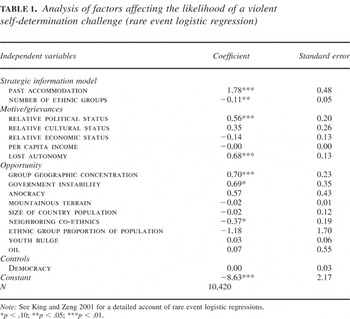
Analysis of factors affecting the likelihood of a violent self-determination challenge (rare event logistic regression)
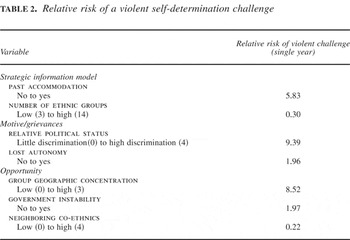
Relative risk of a violent self-determination challenge
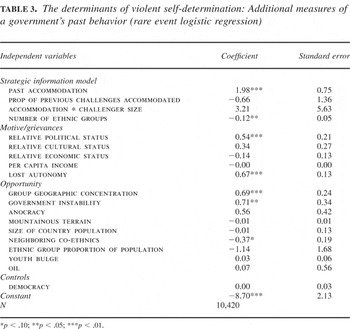
The determinants of violent self-determination: Additional measures of a government's past behavior (rare event logistic regression)
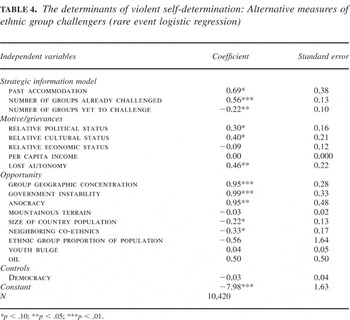
The determinants of violent self-determination: Alternative measures of ethnic group challengers (rare event logistic regression)
 You have
Access
- 92
- Cited by