Introduction
Obese and overweight children and adolescents present one of the biggest challenges to public health in the 21st century and are greatly affecting many low- and middle-income countries (LMICs) (De Onis et al., Reference De Onis, Blössner and Borghi2010; Peng et al., Reference Peng, Goldsmith and Berry2017). The prevalence of obesity across the world has nearly trebled since 1975 (WHO, 2018). In 2016, over 1.9 billion adults and 340 million adolescents worldwide, including children, were found to be overweight or obese (WHO, 2018). A high risk of obesity has been observed, particularly for Asians and Pacific Islanders (Young et al., Reference Young, Koebnick and Hsu2017), although in South Asian countries malnutrition (stunting, wasting and underweight) among children is a more hazardous situation. Problems with obesity are also a matter of vital concern in many developing countries, including Bangladesh due to its flourishing economy (Shafique et al., Reference Shafique, Akhter, Stallkamp, de Pee, Panagides and Bloem2007). Since the year 2000, the increase in Body Mass Index (BMI) has swiftly accelerated for both sexes, particularly in East and South Asian countries (Collaboration NRF, Reference Collaboration2017). Rapid urbanization and industrialization, plus economic development and the globalization of food production, are some of the important causal factors for this situation emerging in the developing world.
Previous research has identified the many negative aspects of being overweight or obese on the health and growth of children and adolescents, which can extend into adulthood and increase the risk of developing chronic diseases such as cardiovascular disease (Singh et al., Reference Singh, Danaei, Farzadfar, Stevens, Woodward and Wormser2013), chronic kidney disease (Singh et al., Reference Singh, Danaei, Farzadfar, Stevens, Woodward and Wormser2013), diabetes, many cancers (Lauby-Secretan et al., Reference Lauby-Secretan, Scoccianti, Loomis, Grosse, Bianchini and Straif2016) and disabilities (Dereń et al., Reference Dereń, Nyankovskyy, Nyankovska, Łuszczki and Wyszyńska2018). Furthermore, being overweight or obese has been shown to be significantly related to mortality (Flegal et al., Reference Flegal, Kit, Orpana and Graubard2013; Di Angelantonio et al., Reference Di Angelantonio, Bhupathiraju, Wormser, Gao and Kaptoge2016).
Although there is a growing body of studies that have examined the various risk factors for being overweight or obese, no specific study has focused on the gender differential of obesity as a whole. Some have suggested that the diverse eating habits and physical activities of children have a significant impact on their weight (Virtanen et al., Reference Virtanen, Kivimäki, Ervasti, Oksanen, Pentti and Kouvonen2015), as do other metabolic and socio-demographic factors (Hossain et al., Reference Hossain, Islam, Sarker, Khan and Taneepanichskul2018). These include insufficient physical activity (Li et al., Reference Li, Xue, Wen, Wang and Wang2017), shortened duration of sleep at night (Brug et al., Reference Brug, van Stralen, te Velde, Chinapaw and De Bourdeaudhuij2012), physical education (PE) classes in school (Naiman et al., Reference Naiman, Leatherdale, Gotay and Mâsse2015) and the availability of physical activity (PA) facilities (Hood et al., Reference Hood, Colabianchi, Terry‐McElrath, O’Malley and Johnston2014). Eating habits such as the consumption of fast food (Rosenheck, Reference Rosenheck2008; Davis & Carpenter, Reference Davis and Carpenter2009), low level of fruit and vegetable intake and high fat and sugar intake (Epstein et al., Reference Epstein, Gordy, Raynor, Beddome, Kilanowski and Paluch2012), food insecurity (Lyons et al., Reference Lyons, Park and Nelson2008; Robaina & Martin, Reference Robaina and Martin2013) and poor diet quality (Robaina & Martin, Reference Robaina and Martin2013) have also been found to be important determinants of overweight and obesity in children and adolescents.
In most developing countries, epidemiological studies on school-level risk factors for obesity are still inadequate and any differences in terms of gender are unknown. Males and females display differences in fat stores, anatomical fat distribution and also in high food intake and low physical activity (Reue, Reference Reue2017). In Bangladesh, gender discrimination exists in all sectors, including health and nutrition (Shafique et al., Reference Shafique, Akhter, Stallkamp, de Pee, Panagides and Bloem2007; Hossain et al., Reference Hossain, Islam, Sarker, Khan and Taneepanichskul2018). A number of attempts have been made to uncover the risk factors for being overweight or obese but there has not been any research on the gender differential risk factors among children and adolescents. This study focuses on the determination of the prevalence of overweight and obesity and the gender differential effects of eating habits and physical activity on overweight and obesity in school-aged adolescents in Bangladesh.
Methods
Study design and sampling procedure
The study used data extracted from the Global School-based Student Health Survey (GSHS) 2014, which collected data from school-age adolescents (usually aged 11–17 years) in 43 developing countries, including Bangladesh, and was administered by the World Health Organization (WHO) in collaboration with the Center for Disease Control (CDC). Data were collected using a clustered sampling technique and a standardized scientific sample selection process. Conventional school-based methodology and a combination of core questionnaire modules with expanded questions plus country-specific questionnaires were utilized by the survey. The school response rate was 90–100% with the student response rate ranging between 76 and 96% and the overall response rate being 69–96% for all countries. In Bangladesh, information related to dietary behaviours, hygiene, drug, tobacco and alcohol use, sexual behaviours, mental health, physical activity and so on were collected by the GSHS in 2014 from 2989 adolescents. A full description of the study methods, including the core questionnaire used with items selected from pertinent modules, is available on the WHO websites (WHO, 2017).
Calculation of BMI
The respondent’s BMI was calculated as weight (kg)/height(m)2. As all the respondents were less than 18 years of age, they were classed as being overweight if their calculated BMI exceeded the standardized value for age and sex at +1SD of Z scores of BMI (equivalent to a BMI of 25 kg/m2 at 19 years of age). They were classed as being obese if their calculated BMI exceeded the standardized value for age and sex at +2SD of Z scores of BMI (equivalent to BMI 30 kg/m2 at 19 years of age) on the basis of BMI interpretation provided by the WHO (Onis et al., Reference Onis, Onyango, Borghi, Siyam, Nishida and Siekmann2007; WHO, 2015).
Outcome and explanatory variables
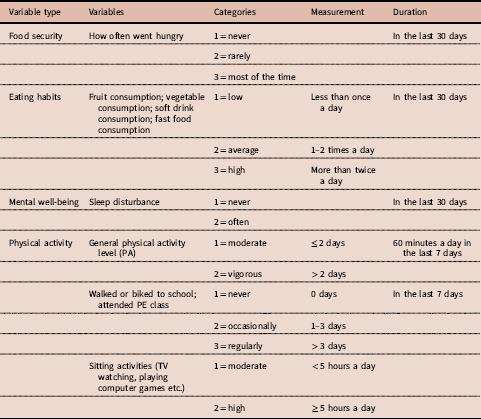
Being overweight or obese was considered as the dependent or outcome variable, dichotomized as Yes=1 and No=0. Several explanatory variables related to food insecurity, eating habits, mental well-being and physical activity were treated as risk factors for being overweight and obese, with variables selected in accordance to their importance based on previous research. Information was categorized according to WHO recommendations (WHO, 2012). A complete list of the explanatory variables is given in Table 1.
Description of the explanatory variables

Statistical analysis
Any associations between the state of being overweight and obese and different explanatory variables were assessed using χ 2 tests (usually set at p<0.05 level of significance). As the outcome variable had two categories, a binary logistic regression model was fitted to measure the impact of selected explanatory variables on the outcome variable. Odds ratios (ORs) were estimated to assess the strength of association between the outcome variable and explanatory variables, and 95% confidence intervals (CIs) were exerted to examine the level of significance. The data were analysed using SPSS for Windows version 23.0 (SPSS Inc., Chicago, IL).
Results
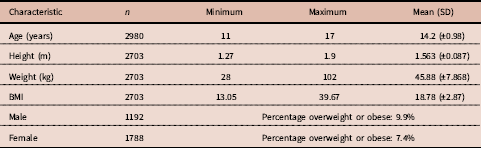
Table 2 presents the characteristics of the study respondents. Their mean age was 14.2 (±0.98) years, mean height 1.563 m (±0.087), mean weight 45.88 kg (±7.868) and mean calculated BMI 18.78 kg/m2 (±2.87). The prevalence of overweight and obesity was 9.9% for males and 7.4% for females.
Characteristics of the respondents

All percentages are weighted.
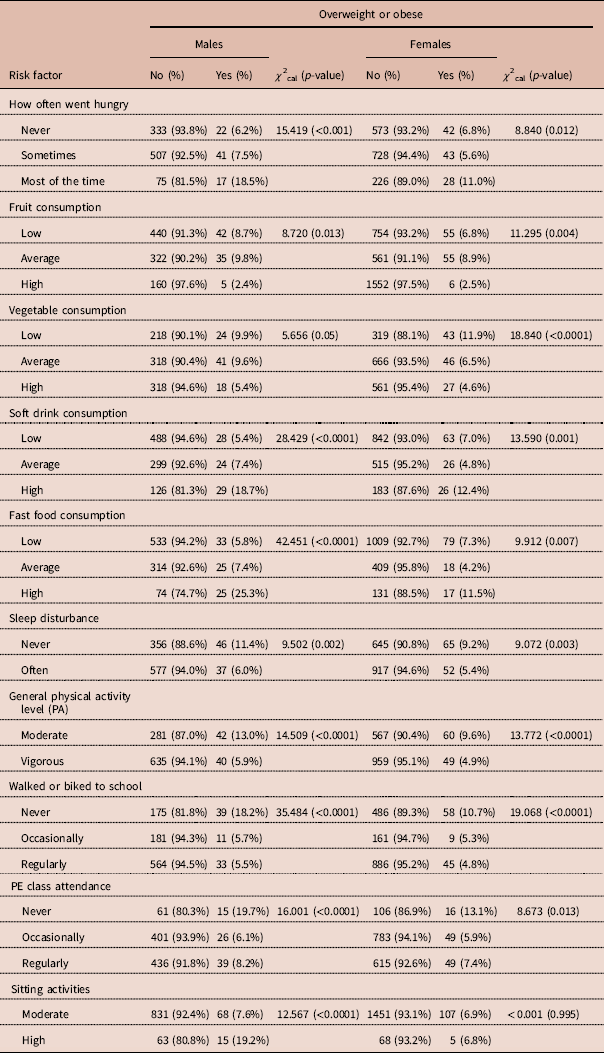
Table 3 shows the association between being overweight or obese and selected explanatory variables, assessed by applying a χ 2 test to observe the significance. The frequency of respondents experiencing hunger, their consumption of fruit and vegetables, soft drinks and fast food, sleep disturbance, general level of physical activity (PA) and physical education (PE) class attendance were found to be significantly related to being overweight or obese for adolescents of both sexes. A high consumption of fast food was related to the highest prevalence of overweight and obesity for males (25.3%), while the highest prevalence for females (13.1%) was observed among those who never attended PE classes. Male respondents with high fruit and vegetable consumption displayed a low prevalence of overweight and obesity (2.4% and 5.4% for fruit and vegetables, respectively). Similarly, overweight and obesity rates were only 2.5% and 4.6% for females with high fruit and vegetable consumption. However, 18.7% of males and 12.4% of females who consumed soft drinks at a high frequency were overweight or obese. Only 5.9% of male and 4.9% of female respondents who were vigorously physically active were found to be overweight or obese. The frequency of overweight and obesity was lower among male and female respondents who walked or cycled to school (males: 5.5%; females: 4.8%) or who attended PE classes regularly (males: 8.2%; females: 7.4%). There was a significant positive association among male respondents between a high amount of time sitting or undertaking sedentary activities and overweight and obesity (19.2%).
Percentage distribution of overweight/obesity among school-aged adolescents in Bangladesh by eating habits and physical activities

Significance taken at p<0.05.
Effect of eating habits and physical activity on overweight and obesity
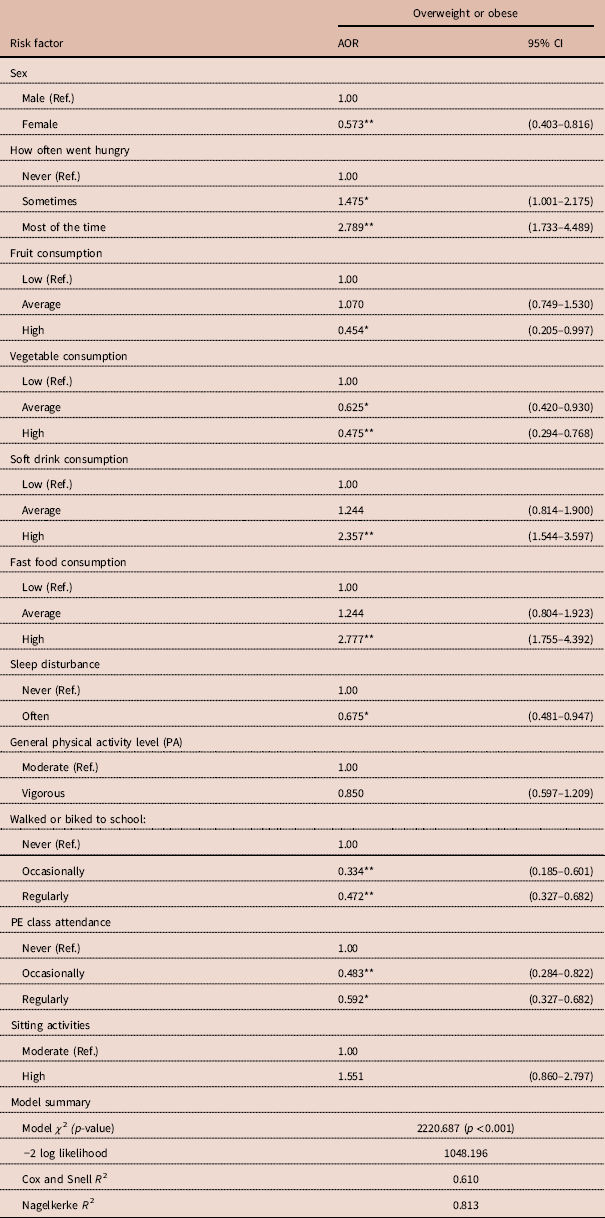
Table 4 illustrates the effects of adolescents’ eating habits and different physical activities on the prevalence of overweight and obesity. The overall prevalence of overweight or obesity was less for females (AOR=0.573, CI: 0.403–0.816) than for males. Those with regular feelings of hunger had 2.789 times (AOR=2.789, CI: 1.733–4.489) greater risk of being overweight or obese compared with those who never felt hungry. A high consumption of fruit (AOR=0.454, CI: 0.205–0.997) or vegetables (AOR=0.475, CI: 0.294–0.768) significantly diminished the risk of adolescents being overweight or obese. However, a high consumption of soft drinks (AOR=2.357, CI: 1.544–3.597) and fast food (AOR=2.777, CI: 1.755–4.392) significantly increased the risk. Adolescents with frequent sleep disturbances (AOR=0.675, CI: 0.481–0.947) were found to be less likely to be overweight or obese. This was also the case for adolescents who walked or cycled to school (AOR=0.472, CI: 0.327–0.682) or who attended regular PE classes (AOR=0.592, CI: 0.327–0.682) compared with those who never walked or cycled or attended PE classes.
Logistic regression analysis of the effect of adolescents’ eating habits and physical activity on overweight/obesity, Bangladesh, 2014

Sample are weighted and controlled by age.
Ref.: reference category; AOR: adjusted odds ratio.
**p<0.01; *p<0.05.
In the fitted model the Cox and Snell R 2 and Nagelkerke R 2 were 61.0% and 81.3%, respectively; these were estimated from the linear relationship between the independent variables. The overall model was significant when all independent variables were controlled for age.
Gender differential effect of eating habits on overweight and obesity
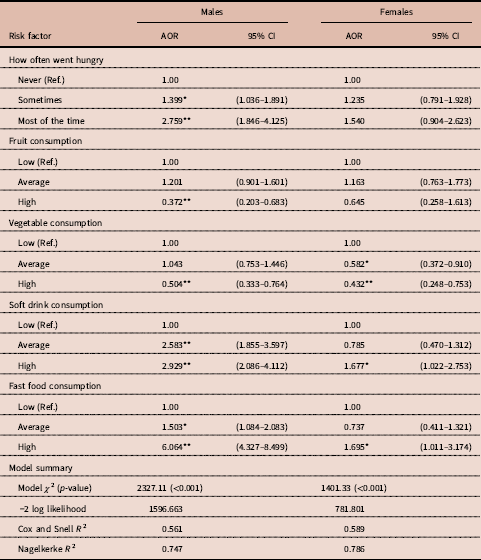
Table 5 shows the results of the logistic regression model of the gender differential influence of food patterns on overweight and obesity among the adolescents. The likelihood of either of these states was less for males who sometimes went hungry (AOR=1.399, CI: 1.036–1.891) or who went hungry most of the time (AOR=2.759, CI: 1.846–4.125) than it was for respondents who never went hungry. The risk of being overweight or obese was also less for males who ate a lot of fruit (AOR=0.372, CI: 0.203–0.683). The prevalence of overweight and obesity was less for males with a high frequency of vegetable intake (AOR=0.504, CI: 0.333–0.764), and also for females with an average (AOR=0.582, CI: 0.372–0.910) or high vegetable diet (AOR=0.432, CI: 0.248–0.753) compared with males and females with a low vegetable diet. However, males with average soft drink consumption were at a higher risk of being overweight or obese (AOR=2.583, CI: 1.855–3.597), as were adolescents with high soft drink consumption (males: AOR=2.929, CI: 2.086–4.112; females: AOR=1.677, CI: 1.022–2.753) compared with adolescents whose weekly consumption of soft drinks was lower. High consumption of fast food significantly increased the chances of ending up overweight or obese for both sexes (males: AOR=6.064, CI: 4.327–8.499; females: AOR=1.695, CI: 1.011–3.174), as it was for males with average fast food consumption (AOR=1.503, CI: 1.084–2.083).
Logistic regression analysis of the gender differential effect of eating habits on adolescent overweight/obesity in Bangladesh, 2014

Sample are weighted and controlled by age.
Ref.: reference category; AOR: adjusted odds ratio.
**p<0.01; *p<0.05.
In the fitted model the Cox and Snell R 2 and Nagelkerke R 2 were 56.1% and 74.7% respectively of the variance for males, and 58.9% and 78.6% respectively of the variance for females, and was estimated from the linear relationship between the independent variables. The overall model was significant when all independent variables were controlled for age.
Gender differential effect of physical activity on overweight or obesity
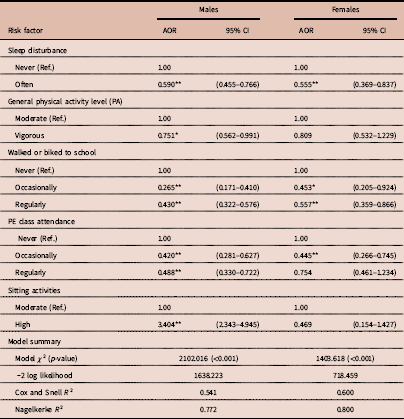
The results of the logistic regression model shown in Table 6 illustrate the effect of physical activity on being overweight or obesity among the school-aged adolescents. It was observed that sleep disturbance significantly decreased the chance of obesity (males: AOR=0.590, CI: 0.455–0.766; females: AOR=0.555, CI: 0.369–0.837). As expected, the rate of overweight and obesity was lower among vigorously physically active males (AOR=0.751, CI: 0.592–0.991) compared with those who only took part in moderate physical activity. The risk of being overweight or obese was less for both males and females who occasionally walked or cycled to school (males: AOR=0.265, CI: 0.171–0.410; females: AOR=0.453, CI: 0.205–0.924) or who regularly walked or cycled to school (males: AOR=0.430, CI: 0.322–0.576; females: AOR=0.557, CI: 0.359–0.866) compared with respondents that never walked or cycled to school. The likelihood of being overweight or obese decreased among males and females who occasionally attended PE classes (males: AOR=0.420, CI: 0.281–0.627; females: AOR=0.445, CI: 0.266–0.745) or for males who regularly attended such classes (male: AOR=0.488, CI: 0.330–0.722) compared with males and females who never attended PE classes. The risk of being overweight or obese was increased by 3.404 times (AOR=3.404, CI: 2.343–4.945) for males with high levels of sitting or sedentary activity compared with males with moderate sitting.
Logistic regression analysis of the gender differential effect of physical activity on adolescents’ overweight/obesity in Bangladesh, 2014

Sample are weighted and controlled by age.
Ref.: reference category; AOR: adjusted odds ratio.
**p<0.01; *p<0.05.
In the fitted model the Cox and Snell R 2 and Nagelkerke R 2 were 54.1% and 77.2% respectively. The variances for males and females were 60.0% and 80.0% respectively, estimated from the linear relationship between the independent variables. The overall model was significant when all explanatory variables were included.
Discussion
The prevalence of overweight and obesity is increasing in Bangladesh (Biswas et al., Reference Biswas, Uddin, Mamun, Pervin and Garnett2017). It has not yet become an alarming situation for adolescents but it is increasing day-by-day. The findings of this study indicate that the risk of males being overweight or obese is notably higher than it is for females. They also show that male adolescents with high food insecurity are at an increased risk of being overweight or obese, which is consistent with the findings of earlier studies (Robaina & Martin, Reference Robaina and Martin2013; Sanjeevi et al., Reference Sanjeevi, Freeland-Graves and Hersh2018). Sanjeevi et al. (Reference Sanjeevi, Freeland-Graves and Hersh2018) concluded that food insecurity was associated with a ‘less conducive multidimensional home environmental subscale score’ and poor diet quality which, in turn, was related to greater BMI. Lohman et al. (Reference Lohman, Gillette and Neppl2016) also identified a gender differential outcome of household food insecurity for being overweight or obese. In Bangladesh, less importance is generally given to female children than to males in all sectors.
Dietary behaviour and different food patterns have diverse impacts on being overweight or obese (Rautiainen et al., Reference Rautiainen, Wang, Lee, Manson, Buring and Sesso2015; Virtanen et al., Reference Virtanen, Kivimäki, Ervasti, Oksanen, Pentti and Kouvonen2015). The present study identified a significantly lower risk of both overweight and obesity in adolescents with a high fruit and vegetable diet, but there was a gender differential effect. Although both high fruit and high vegetable diets significantly decreased the risk of overweight and obesity in males, in females no significant effect was found for fruit-eating, but a highly significant effect was identified for average to higher vegetable consumption. Previous research by Epstein et al. (Reference Epstein, Gordy, Raynor, Beddome, Kilanowski and Paluch2012) and Field et al. (Reference Field, Gillman, Rosner, Rockett and Colditz2003) showed that regular fruit and vegetable intake among children and adolescents reduced their risk of overweight and obesity. According to Rohde et al. (Reference Rohde, Larsen, Ängquist, Olsen, Stougaard and Mortensen2017), ‘responsible’ intake of macronutrients, energy, fruit and vegetables can help restrain excessive weight gain among children. More precisely, fruit and vegetables provide fibre and are low in calories and rich in minerals and vitamins, which helps to keep a person healthy and correctly energized.
This study shows that a high consumption of soft drinks and fast food increases the risk of becoming overweight or obese among male and female adolescents. As a consequence, adolescents are at a high risk of experiencing problems with their weight regardless of their intake of junk food. Previous studies have shown that a high consumption of soft drinks and fast food greatly increases the risk of obesity in adolescents and young children (Rosenheck, Reference Rosenheck2008; Davis & Carpenter, Reference Davis and Carpenter2009; Moore et al., Reference Moore, Diez Roux, Nettleton, Jacobs and Franco2009). These types of food and drink contain more fat and sugar, and fewer vitamins and minerals than healthier alternatives and therefore can lead to poor weight management and body metabolism leading to a higher risk of obesity (Lucan & DiNicolantonio, Reference Lucan and DiNicolantonio2015). In recent experiments, researchers have shown that reducing soft drink and fast food consumption in adolescents successfully lessens the prevalence of obesity (Hu, Reference Hu2013; Laxy et al., Reference Laxy, Malecki, Givens, Walsh and Nieto2015; Cantoral et al., Reference Cantoral, Téllez‐Rojo, Ettinger, Hu, Hernández‐Ávila and Peterson2016). In addition, a high intake of artificially sweetened soft beverages enhances the risk of obesity-related cancers (Hodge et al., Reference Hodge, Bassett, Milne, English and Giles2018). In Bangladesh, the quality of soft drinks and fast food is much poorer than in developed countries, and is perhaps the case in other developing countries.
The study results show there is a lower risk of obesity among adolescents of both sexes who often experience sleep problems, which is inconsistent with the findings of several previous studies (Nielsen et al., Reference Nielsen, Danielsen and Sørensen2011; Brug et al., Reference Brug, van Stralen, te Velde, Chinapaw and De Bourdeaudhuij2012; Mannan et al., Reference Mannan, Mamun, Doi and Clavarino2016). In addition, Neilsen et al. (Reference Nielsen, Danielsen and Sørensen2011) observed a significant link between short duration of sleep and being overweight or obesity among young adults, including children. A meta-analysis and systematic review of longitudinal studies conducted by Mannan et al. (Reference Mannan, Mamun, Doi and Clavarino2016) revealed a 70% greater risk of depressed male and female adolescents being overweight or obese.
Physical activity is an emerging determinant of weight for both children and adults. The present study found that there was a much lower risk of male adolescents being overweight or obese if they were vigorously active compared with if they were only moderately active. This has also been shown by a few earlier studies such as Ogden et al. (Reference Ogden, Carroll and Lawman2016). Chaput et al. (Reference Chaput, Barnes, Tremblay, Fogelholm and Hu2018) noticed there was a lower risk of obesity in children who were vigorously physically active, but found no significant effect of physical activity in the case of overweight or obese males or females. Males and females who regularly walked or cycled to school were at a very low risk of being overweight or obese. Walking and cycling have a two-fold advantage: they help protect the environment and prevent excessive weight gain by increasing body metabolism. Responsible parents should therefore encourage their children to regularly walk or cycle to school.
The attendance of adolescents at PE classes has also been identified as a feasible predictor of being overweight and obesity in Bangladesh. The respondents of both sexes who regularly attended PE classes had a very low risk of developing weight problems compared with those who never attended PE classes (Naiman et al., Reference Naiman, Leatherdale, Gotay and Mâsse2015). Physical education classes can help reduce the gap between actual and recommended physical activity for children and adolescents (Fernandes & Sturm, Reference Fernandes and Sturm2010) and help increase the number of days per week spent in vigorous exercise (Jinsook, Reference Jinsook2012). Unfortunately, PE facilities in Bangladesh are very poor and there is poor awareness of the benefits of PE among parents, plus a lack of strict regulations. This study found that sedentary activities increased the chance of overweight and obesity in male adolescents, but showed no significant effects among female adolescents. Those male adolescents with high levels of sitting activity per day were almost at three times higher risk of becoming overweight or obese. This finding is supported by previous research with adults (Chau et al., Reference Chau, van der Ploeg, Merom, Chey and Bauman2012; Ng et al., Reference Ng, Santosa and Kowal2017). In Australia, the risk of being overweight or obese has been found to be significantly higher among workers with mostly sitting jobs compared with workers with mostly standing jobs (Chau et al., Reference Chau, van der Ploeg, Merom, Chey and Bauman2012). However, there are no studies that describe the effect of sitting behaviours as a cause of weight problems or obesity among children and adolescents. Adolescent leisure time activities such as watching TV, gossiping and playing computer games increase the risk of becoming overweight or obese, especially for male adolescents.
This study has several limitations. For example, a secondary source of data was used for analysis and thus some important variables in relation to being overweight and obesity were missing. Nevertheless, an attempt has been made to provide a compact description of the effect of adolescent eating behaviours and physical activity on being overweight and obesity. Future studies could be undertaken to collect data covering variables involved in differences between rural and urban areas.
In conclusion, the study findings suggest that the levels of overweight and obesity among school-aged adolescents in Bangladesh need to be decreased. Gender differences in food practice and physical activity among adolescents which affect their overweight and obesity levels have been demonstrated. The regular consumption of healthy food, particularly a diet rich in fruit and vegetables, and the avoidance of soft drinks and fast food, especially for males, are necessary to lessen the risk of adolescents in Bangladesh being overweight or obese. Increasing levels of physical activity, cutting back on high levels of leisure time sitting activities, especially among males, and encouraging adolescents of both sexes to regularly walk or cycle to school, can all help to cut the risk of developing weight problems. Policy in this area should focus on the need for regular attendance at PE classes to help improve the health of school-age adolescents. The implementation of such policies would help decrease the risk of adolescent obesity in Bangladesh and, in turn, help promote their good health.
Acknowledgments
The authors thank the Office of the Global School-based Student Health Survey (GSHS), Department of Chronic Diseases and Health Promotion, World Health Organization, along with the Center for Disease Control (CDC), for granting permission to use the datasets for this analysis.
Ethical Approval
The study was ethically approved by the Ministry of Health and Family Welfare, Dhaka, Bangladesh. Written permission was obtained from each participating school and from all classroom teachers.
Conflicts of Interest
The authors have no competing interests to declare.
Funding
The World Health Organization (WHO) financially and technically supported this survey with the collaboration of the Center for Disease Control (CDC).