Early caregiving experiences have been shown to play a critical role in shaping brain and behavioral development and physical health (Cicchetti, Hetzel, Rogosch, Handley, & Toth, Reference Cicchetti, Hetzel, Rogosch, Handley and Toth2016a, Reference Cicchetti, Hetzel, Rogosch, Handley and Toth2016b; DeBellis, Reference DeBellis2001; Doyle & Cicchetti, Reference Doyle and Cicchetti2017; Hertzman & Boyce, Reference Hertzman and Boyce2010; Rutter, Reference Rutter2012, Reference Rutter2016; Weaver et al., Reference Weaver, Cervoni, Champagne, D'Alessio, Sharma, Seckl and Meaney2004). Thus, children whose early experiences are marred by absent or abusive caregiving are denied opportunities for healthy development (Cicchetti, Reference Cicchetti2016; Cicchetti & Lynch, Reference Cicchetti, Lynch, Cicchetti and Cohen1995; Cicchetti & Toth, Reference Cicchetti, Toth and Cicchetti2016; McGowan et al., Reference McGowan, Sasaki, D'Alessio, Dymov, Labonte, Szyf and Meaney2009; Tyrka, Price, Marsit, Walters, & Carpenter, Reference Tyrka, Price, Marsit, Walters and Carpenter2012; Tyrka, Ridout, & Parade, Reference Tyrka, Ridout and Parade2016). Instead, adverse caregiving environments can usher in motion probabilistic developmental pathways that are characterized by an increased risk for atypical brain development, relationship difficulties, maladaptive behavior, and psychopathology across the life span (Cicchetti, Reference Cicchetti2002; Cicchetti & Toth, Reference Cicchetti, Toth and Cicchetti2016; Essex et al., Reference Essex, Boyce, Hertzman, Lam, Armstrong, Neumann and Kobor2013; Szyf & Bick, Reference Szyf and Bick2013; Turecki & Meaney, Reference Turecki and Meaney2016; Vachon, Krueger, Rogosch, & Cicchetti, Reference Vachon, Krueger, Rogosch and Cicchetti2015; Zhang & Meaney, Reference Zhang and Meaney2010). Child maltreatment sensitizes neural function and neuroendocrine responses to stress exposure, thereby bringing about a vulnerability to psychopathology, such as depression and internalizing and externalizing problems (Caspi et al., Reference Caspi, McClay, Moffitt, Mill, Martin, Craig and Poulton2002, Reference Caspi, Sugden, Moffitt, Taylor, Craig and Harrington2003; Hart, Gunnar, & Cicchetti, Reference Hart, Gunnar and Cicchetti1996; Kaplow & Widom, Reference Kaplow and Widom2007; Thibodeau, Cicchetti, & Rogosch, Reference Thibodeau, Cicchetti and Rogosch2015; Toth, Manly, & Cicchetti, Reference Toth, Manly and Cicchetti1992; Turecki & Meaney, Reference Turecki and Meaney2016).
In order to understand the processes through which early adversity imparts maladaptive development and/or psychopathology, it is essential that both genotypic variation and epigenetic alterations are examined. Early childhood caregiving environments work together with genotypic variation and epigenetic regulation to affect biological and psychological development throughout the life course (Hertzman, Reference Hertzman2012). Epigenetics has been conceived as a potential mechanism for how adversity in early life confers risk for lifelong biological and psychological problems (Lester, Conradt, & Marsit, Reference Lester, Conradt and Marsit2016; Szyf & Bick, Reference Szyf and Bick2013; Tyrka et al., Reference Tyrka, Ridout and Parade2016). Epigenetics involves functionally relevant changes to the genome that do not eventuate in alterations in the nucleotide sequence. Epigenetic modifications can impart changes in gene expression and neural function without bringing about alterations in the underlying DNA sequence (Zhang & Meaney, Reference Zhang and Meaney2010). Research with rhesus macaque monkeys raised maternally support the hypothesis that the response to maternal care is not limited to one tissue or one brain region, but indicated that the impact of early life adversity is system-wide and genome-wide.
Epigenetic mechanisms such as DNA methylation interfere with gene transcription (“gene silencing”) or enable gene transcription (“gene turned on”; Mill, Reference Mill, Kendler, Jaffee and Romer2011; Szyf & Bick, Reference Szyf and Bick2013). Moreover, epigenetic processes are responsive to changes in the environment (Meaney, Reference Meaney2010). Furthermore, these processes may be reversible, depending on the gene and location of methylation sites. Environmental influences are modulated by sensitive periods in development, when neurobiological circuitry is particularly responsive to experience and plasticity is most accessible (Cicchetti, Reference Cicchetti2015).
Although they are often long lasting, some epigenetic modifications may be transmitted across generations (Gapp, von Ziegler, Tweedie-Cullen, & Mansuy, Reference Gapp, von Ziegler, Tweedie-Cullen and Mansuy2014; Mill, Reference Mill, Kendler, Jaffee and Romer2011; Roth, Reference Roth2013; Szyf & Bick, Reference Szyf and Bick2013). Research findings document the utility of peripheral DNA methylation measures (Bick et al., Reference Bick, Naumova, Hunter, Barbot, Lee, Luthar and Grigorenko2012; Cicchetti et al., Reference Cicchetti, Hetzel, Rogosch, Handley and Toth2016a; Szyf & Bick, Reference Szyf and Bick2013). Methylation is the best investigated and most stable form of epigenetic modification involved in gene silencing. Consequently, DNA methylation is usually associated with decreased gene expression. DNA methylation predominantly takes place at discrete cytosine nucleotide–phosphate–guanine nucleotide (CpG) sites in the genome regions where cytosine nucleotides occur next to guanine nucleotides (Cecil, Walton, & Viding, Reference Cecil, Walton and Viding2015).
The glucocorticoid receptor (GR) gene, also known as nuclear receptor subfamily 3, group C, member 1 (NR3C1), is the receptor that binds with cortisol and other glucocorticoids. Early adversity and methylation of NR3C1 has been the focus of much epigenetic research (e.g., see reviews by Daskalaski & Yehuda, Reference Daskalaski and Yehuda2014; Palma-Gudiel, Cordova-Palomera, Leza, & Fananas, Reference Palma-Gudiel, Cordova-Palomera, Leza and Fananas2015; Turecki & Meaney, Reference Turecki and Meaney2016; Tyrka et al., Reference Tyrka, Ridout and Parade2016). Negative early life environments have been found to be associated with hypermethylation of NR3C1 exon 1F promoter in 70% of animal studies and 89% of human early life adversity studies (Turecki & Meaney, Reference Turecki and Meaney2016). In addition, all of the human parental stress investigations that examined NR3C1 at exon 1F were found to be characterized by hypermethylation (Turecki & Meaney, Reference Turecki and Meaney2016).
Epigenetic investigations have demonstrated that stress exposure in childhood is linked with methylation of NR3C1 in adults and children. For example, Tyrka et al. (Reference Tyrka, Ridout, Parade, Paquette, Marsit and Seifer2015) have found hypermethylation of NR3C1 at the exon 1F promoter in association with early child maltreatment in preschool-age children from low socioeconomic backgrounds. Likewise, in a study of 11- to 14-year-old children, Romens, McDonald, Svaren, and Pollak (Reference Romens, McDonald, Svaren and Pollak2015) also found that children who experienced physical maltreatment had greater methylation within exon 1F in the NR3C1 promoter region of the gene in comparison to nonmaltreated children.
Moreover, Parade et al. (Reference Parade, Ridout, Seifer, Armstrong, Marsit, McWilliams and Tyrka2016) found that preschool-aged children who had been maltreated within the past 6 months exhibited methylation of NR3C1 at exon 1D and 1F that was positively correlated with internalizing, but not with externalizing behavior problems. The findings of Parade et al. (Reference Parade, Ridout, Seifer, Armstrong, Marsit, McWilliams and Tyrka2016) provide corroborative evidence that early adversity is associated with methylation of NR3C1, an important regulator of the hypothalamus–pituitary–adrenal axis. Perroud et al. (Reference Perroud, Paoloni-Giacobino, Prada, Olie, Salzmann, Nicastro and Malafosse2011) also discovered increased methylation of NR3C1 in adults with a history of child maltreatment. Child sexual abuse, the number of maltreatment subtypes, and the severity of abuse and neglect all were associated with NR3C1 hypermethylation (Perroud et al., Reference Perroud, Paoloni-Giacobino, Prada, Olie, Salzmann, Nicastro and Malafosse2011).
Studies investigating the outcomes of NR3C1 methylation have focused on psychopathology and behavioral problems. Although most studies suggest a link between increased methylation and internalizing symptomatology (see Dadds, Moul, Hawes, Mendoza Diaz, & Brennan, Reference Dadds, Moul, Hawes, Mendoza Diaz and Brennan2015; Dammann et al., Reference Dammann, Teschler, Haag, Altmuller, Tuczek and Dammann2011; Parade et al., Reference Parade, Ridout, Seifer, Armstrong, Marsit, McWilliams and Tyrka2016; van der Knap et al., Reference van der Knaap, Riese, Hudziak, Verbiest, Verhulst, Oldenhinkel and van Oort2015; Wang et al., Reference Wang, Feng, Ji, Mu, Ma, Fan and Zhu2017; Yehuda et al., Reference Yehuda, Pratchett, Elmes, Lehrner, Daskalakis, Koch and Bierer2014), Heinrich et al. (Reference Heinrich, Buchmann, Zohsel, Dukal, Frank, Treutlein and Rietschel2015) found that NR3C1 hypomethylation was associated with externalizing problems. Specifically, Heinrich et al. (Reference Heinrich, Buchmann, Zohsel, Dukal, Frank, Treutlein and Rietschel2015) found that the group of young adults with a lifetime diagnosis of an externalizing disorder exhibited significantly lower NR3C1 methylation levels than the depressive disorder group and the healthy controls. Heinrich et al. (Reference Heinrich, Buchmann, Zohsel, Dukal, Frank, Treutlein and Rietschel2015) interpreted the lower methylation levels in NR3C1 as a possible mechanism through which the differential development of externalizing disorders, as opposed to depressive disorders, may take place.
The studies reported in the literature suggest that methylation of NR3C1 may be a mechanism underlying the development of psychopathology among adults and children who experience early adversity (Tyrka et al., Reference Tyrka, Ridout and Parade2016). In the present epigenetic investigation, we examined the effect of various dimensions of child maltreatment (including the developmental timing of maltreatment, the number of maltreatment subtypes, and the chronicity of maltreatment) on methylation of NR3C1. In addition, we investigated the association between NR3C1 methylation and child outcomes. Our hypotheses are delineated below.
NR3C1 Hypotheses
-
1. Maltreated children will evidence significant hypermethylation of exon 1F of the NR3C1 gene compared to nonmaltreated children.
-
2. The developmental timing of children's maltreatment experience will influence NR3C1 methylation such that those children with early onset maltreatment will be significantly hypermethylated compared to their late onset maltreated and nonmaltreated peers.
-
3. The more maltreatment subtypes a child has experienced, and the more chronic the maltreatment experience, the greater the hypermethylation of NR3C1.
-
4. Hypermethylation of the NR3C1 gene will be associated with increased risk for a number of negative psychological outcomes and will mediate the effect of child maltreatment on these outcomes.
Method
Participants
Participants included 534 children who attended a research summer camp program for school-aged low-income maltreated (n = 285) and nonmaltreated children (n = 249). Children were on average 9.41 years old (SD = 0.88) and approximately half were female (n = 259, 48.5%). The sample was racially and ethnically diverse (61.2% Black, 9.9% White, 20.6% Latino, and 8.2% biracial or other race). Informed consent was obtained from parents of maltreated and nonmaltreated children for their child's participation in the summer camp program and for examination of any Department of Human Services (DHS) records pertaining to the family.
Children in the maltreated group were recruited through a DHS liaison who examined Child Protective Services reports to identify children who had been maltreated and/or were part of a family with a history of maltreatment. Children living in foster care often experience early and extreme maltreatment. They were not recruited for the current investigation to reduce heterogeneity among the maltreated sample. The DHS liaison contacted eligible families and explained the study. Parents who were interested in having their child participate provided signed permission for their contact information to be shared with project staff. These families were representative of those receiving services through DHS. Comprehensive reviews of all DHS records for each family were conducted. Maltreatment information was coded by trained research staff and a clinical psychologist, using the Barnett, Manly, and Cicchetti (Reference Barnett, Manly, Cicchetti, Cicchetti and Toth1993) nosological system for classifying child maltreatment. Coding is based on all available information and does not rely on DHS determinations.
Because maltreating families primarily have low socioeconomic status (National Incidence Study; Sedlak et al., Reference Sedlak, Mettenburg, Basena, Petta, McPherson, Greene and Li2010), nonmaltreating families were recruited from those receiving Temporary Assistance to Needy Families in order to ensure socioeconomic comparability between maltreated and nonmaltreated families. A DHS liaison contacted eligible nonmaltreating families and described the project. Parents who were interested in participating signed a release allowing their contact information to be given to project staff for recruitment. The families were recruited as nonmaltreated families after comprehensive DHS record searches confirmed the absence of any documented child maltreatment. Families who received preventative DHS services due to concerns over risk for maltreatment were not included within the nonmaltreated comparison group. In order to further verify a lack of DHS involvement, trained research assistants interviewed the mothers of children recruited for the nonmaltreatment group using the Maternal Child Maltreatment Interview (Cicchetti, Toth, & Manly, Reference Cicchetti, Toth and Manly2003) and reviewed records in the year following camp participation to assure that all information had been assessed.
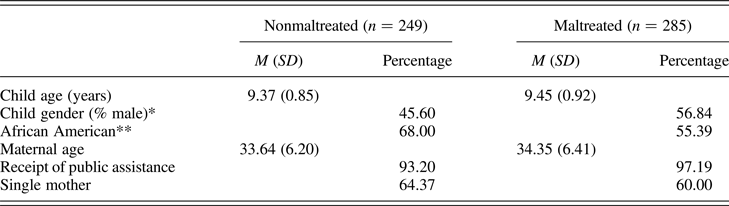
Maltreated and nonmaltreated children were compared on a number of demographic characteristics (see Table 1). Groups did not differ in terms of maternal marital status, χ2 (1, N = 531) = 1.21, ns, maternal age, t (530) = –1.28, ns, child age, t (533) = –1.215, ns, and family history of receiving public assistance, χ2 (1, N = 530) = 0.86, ns. Nonmaltreated children were more likely to be African American, χ2 (1, N = 534) = 8.86, p < .01, and female, χ2 (1, N = 534) = 6.74, p < .05.
Comparison of maltreated and nonmaltreated children on demographic characteristics
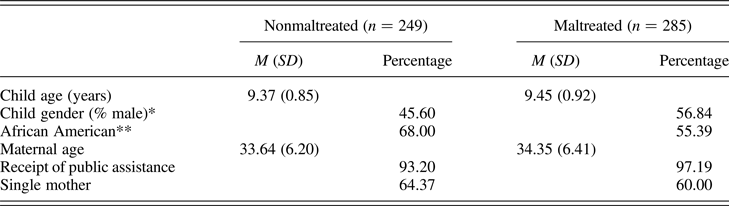
*p < .05. **p < .01.
Procedures
Day camp procedures
Maltreated and nonmaltreated children were randomly assigned to groups of 10 same-sex and same-age peers. Within these groups five children were maltreated and five were nonmaltreated. Each group was led by three trained camp counselors who were unaware of child maltreatment status and study hypotheses. Children participated in recreational activities throughout the week. After child assent was obtained, children participated in research assessments conducted by trained research assistants. The intensive staff to child ratio allowed for counselors to closely interact with children. During the 35 hr of interaction throughout the camp week, counselors got to know children well. DNA samples via saliva also were obtained from children, as described below. All research assistants were unaware of child maltreatment status and study hypotheses. (For camp procedures see Cicchetti & Manly, Reference Cicchetti, Manly, Brody and Sigel1990.)
Measures
Maltreatment classification system (MCS)
The MCS (Barnett et al., Reference Barnett, Manly, Cicchetti, Cicchetti and Toth1993; Cicchetti & Barnett, Reference Cicchetti, Barnett, Grove and Cicchetti1991) is designed to assess individual children's maltreatment experiences. The MCS utilizes DHS records to make independent determinations of maltreatment. The MCS classifies the subtypes that each child experienced, frequency of occurrence, subtype severity, and developmental periods of occurrence, in order to designate the recency, onset, and chronicity of maltreatment. Subtypes of maltreatment include neglect, emotional maltreatment, physical abuse, and sexual abuse. Neglect refers to failure to provide for the child's basic physical needs for adequate food, clothing, shelter, and medical treatment. Neglect also includes lack of supervision, moral–legal neglect, and educational neglect. Emotional maltreatment involves extreme thwarting of children's basic emotional needs for psychological safety and security. Examples include belittling and ridiculing the child, extreme negativity and hostility, child abandonment, suicidal or homicidal threats, and extreme negativity and hostility. Physical abuse involves nonaccidental physical injury to the child such as bruises, welts, burns, chocking, and broken bones. Sexual abuse involves attempted or actual sexual contact between the child and caregiver for purposes of the caregiver's sexual satisfaction or financial benefit. Examples of sexual abuse range from exposure to pornography or adult sexual activity to sexual touching and fondling to forced intercourse with the child.
The MCS has demonstrated reliability and validity in classifying maltreatment in a number of studies (Bolger, Patterson, & Kupersmidt, Reference Bolger, Patterson and Kupersmidt1998; Dubowitz et al., Reference Dubowitz, Pitts, Litrownik, Cox, Runyan and Black2005, English et al., Reference English, Upadhyaya, Litrownik, Marshall, Runyan, Graham and Dubowitz2005, Manly, Reference Manly2005; Smith & Thornberry, Reference Smith and Thornberry1995). DHS records were coded using the MCS by trained research staff and a clinical psychologist. All coders achieved adequate reliability before coding records used for the study. Kappas for the presence of each of the maltreatment subtypes ranged from 0.90 to 1.00; intraclass correlations for severity ratings of individual subtypes of maltreatment ranged from 0.83 to 1.0.
Regarding maltreatment subtype, 75.4% of the maltreated children experienced neglect, 62.5% experienced emotional maltreatment, 28.4% physical abuse, and 8.8% experienced sexual abuse. Consistent with other samples of maltreatment, the majority of children in this study experienced more than one subtype of maltreatment. Specifically, 58.9% of maltreated children had experienced two or more subtypes of maltreatment (M = 0.93, SD = 1.02). Developmental timing of maltreatment was determined by an investigation of discrete developmental periods, including infancy, toddlerhood, preschool, early school age, and later school age. This information was used to calculate the number of developmental periods in which each child experienced maltreatment. Nonmaltreated children were coded 0 in this chronicity variable. Among maltreated children, 57.2% experienced maltreatment during one developmental period (M = 1.57, SD = 0.75). Developmental timing information was also used to determine the age of onset of maltreatment. The following groups were created: 0 = nonmaltreated, 1 = early onset maltreatment (maltreatment originating in infancy or toddlerhood), and 2 = later onset maltreatment (maltreatment originating in the preschool years or later). In the current investigation, 42.8% of the maltreated children had an age of onset in infancy or toddlerhood.
DNA methylation
Salivary DNA samples were collected from participants using Oragene DNA collection tubes (DNA Genotek®). DNA was later isolated from 450 μl of Oragene-DNA/saliva solution using the PrepIT-L2P protocol. The diluted DNA samples were submitted to the BioMedical Genomics Center (BMGC) at the University of Minnesota for quality analysis and testing of whole-genome methylation analysis using the HumanMethylation450 BeadChip (Illumina). The samples were assayed for quality by determining the concentration, using the Quant-iT PicoGreen dsDNA Assay Kit (Invitrogen, Item P7589) and real time polymerase chain reaction (TaqMan) quantification of human DNA concentration. All samples passed BMGC quality-control standards, and a normalized 0.5 μg human DNA for each participant was utilized in the subsequent methylation analyses.
Each 0.5 μg DNA sample was subjected to bisulfite conversion using the EZ-96 DNA Methylation Kit (Zymo Research, D5003) that converts unmethylated cytosine bases to uracils. This method utilizes the methyl group attached to a cytosine as a protecting group to deamination and subsequent conversion to a uracil. After bisulfite conversion, the total amount of DNA was increased by methylation specific amplification using a whole-genome amplification process thar copies the converted uracils to thymine bases. The DNA was then enzymatically fragmented in an end-point fragmentation process.
Microarray processing and analysis of the Illumina Infinium HumanMethylation 450K BeadChip was also done by the University of Minnesota's BMGC. This covers over 485,000 individual sites with single nucleotide resolution of CpG sites both inside and outside CpG islands. The 450K BeadChip offers comprehensive genome-wide coverage including 99% of RefSeq genes with high quality by using more than 600 negative controls. Bisulfite converted samples were then hybridized to these BeadChips followed by washing and staining per protocols prescribed by Illumina. The microarray bead chips were then imaged using a HiScan SQ system.
The fluorescence data were subsequently analyzed using the Methylation Module Version 1.9.0 of the GenomeStudio software package Version 2011.1 (Illlumia). All data were background corrected and negative control normalized producing average beta values. This average beta value represents the relative quantity of methylation at an individual site ranging from 0 to 1 (unmethylated to completely methylated). Tests that produced different results from technical replicates, originating from the same source individual and collection type, of study participant samples were identified as poor and removed from subsequent analyses. This was accomplished by using differential methylation analysis of replicate sample average beta. Criteria for exclusion of CpG loci based on lack of precision within technical replicates was identified by selecting sites with |DiffScore| > 13, which is equivalent to a p < .01. Tests corresponding to these suspect loci (N = 5,244), those tests with p values greater than .01 (N = 1,603), and single nucleotide polymorphism (SNP) tests (N = 65) were excluded (N = 6,638, 1.4%). Beta values were analyzed using principle component analysis in Partek Genomics Suite, Partek Inc. software. Review of the data distribution identified two samples as outliers that were subsequently removed from further analyses.
DNA collection, extraction, and genotyping
Saliva was collected using the Oragene-DNA collection kit from DNA Genotek Inc., and then DNA isolated using the manufactures protocol for 0.5 ml of Oragene-saliva material. The DNA was diluted to a working concentration and genotyping was completed in Cicchetti's University of Minnesota molecular biology lab for the polymorphism in the NR3C1 gene commonly known as BClI (NT_029289.11:g.3942244T>C) using previously reported primer and probe sequences (Wust et al., Reference Wüst, van Rossum, Federenko, Koper, Kumsta and Hellhammer2004). Individual allele determinations were made using TaqMan Genotyping Master Mix (Applied Biosystems, Catalog 4371357) with amplification on an GeneAmp 9700 (Applied Biosystems) and analyzing the endpoint fluorescence using a Tecan M200 and data analyzed with JMP 8.0 (SAS, Inc.). Human DNA from cell lines was purchased from Coriell Cell Repositories for all representative genotypes in duplicate and genotypes confirmed by sequencing using dye terminator cycle sequencing on an ABI 3130xl. These and no-template controls were run alongside study samples representing 9% of the total data output. Any samples that were not able to be genotyped to a 95% or greater confidence were repeated under the same conditions. The call rate for the GR SNP was 99.8%. GR SNP distribution did not deviate from Hardy–Weinberg equilibrium, χ2 (1) = 0.04, ns. The frequency distribution of the GR SNP was as follows: CC = 56.6%, CG = 37.1%, and GG = 6.4%. Genotypes CG and GG were combined in these analyses because of the low frequency of GG. Maltreated and nonmaltreated children did not differ in GR SNP distribution, χ2 (1) = 0.05, ns. In addition, there was no difference in GR SNP distribution between African American children and non–African American children, χ2 (1) = 1.18, ns.
Ego undercontrol
Children's ego undercontrol was measured using the California Child Q-Set (Block & Block, Reference Block and Block1980), which consists of 100 items about children's personality, social, and cognitive functioning. At the end of each week, following intensive observations and interactions with the child, two camp counselors independently completed the Califormia Child Q-Set. Items were sorted into nine categories ranging from most to least descriptive of a particular child, according to a forced-choice method. Interrater agreement based on average intraclass correlations ranged from 0.80 to 0.87.
To generate ratings of ego control, the Q-Set descriptions were correlated with the criterion sorts for prototypical children demonstrating ideal levels of ego control. Each child's correlation with the criterion was calculated, and those correlations were averaged to yield an ego control score for each child. The resulting scores represented how similar or different the individual child was to the prototypical ego-controlled child. High scores indicate high ego undercontrol and low scores indicate high ego overcontrol.
Emotional lability–negativity
The Emotion Regulation Checklist (ERC; Shields & Cicchetti, Reference Shields and Cicchetti1997, Reference Shields and Cicchetti1998) is a 24-item measure that may be completed by adults familiar with a child, including camp counselors, teachers, and parents. The ERC includes both positively and negatively weighted items regarding emotionality and emotion regulation. The ERC yields two subscales: emotion regulation and emotional lability/negativity. Emotional lability/negativity was used in the current study. This subscale is composed of items related to mood swings, angry reactivity, emotional intensity, and dysregulated positive emotions. Two camp counselors completed the ERC after a week of intensive interactions and observations with the child. Interrater reliability for the emotional lability/negativity scale was 0.80.
Externalizing and internalizing behavior
Children's internalizing and externalizing symptoms were assessed at the end of the week through completion of the Teacher Report Form (TRF; Achenbach, Reference Achenbach1991). The TRF is an extensively used and well-validated measure of a wide range of child symptomatology. On the TRF, camp counselors rated the frequency of occurrence of a list of problem behaviors that form the broadband externalizing factor (e.g., aggressive behaviors and delinquent behaviors) and the broadband internalizing factor (e.g., withdrawal, somatic complaints, and anxiety-depression). Children were each rated by two camp counselors, and the scores for internalizing symptoms were averaged across raters, as were the scores for externalizing symptoms. Interrater reliabilities based on average interclass correlations among pairs of raters ranged from 0.70 to 0.88 for internalizing symptoms and 0.83 to 0.91 for externalizing symptoms.
Depressive symptoms
Children self-reported their depressive symptoms in the past 2 weeks using the Children's Depression Inventory (Kovacs, Reference Kovacs1982, Reference Kovacs1992), which is widely used for this purpose among school-aged children. The validity of the measure has been well established (Kovacs, Reference Kovacs1982, Reference Kovacs1992) and internal consistency for the total score has ranged from 0.71 to 0.89.
Anxiety symptoms
Child anxiety symptoms were assessed using the Revised Child Manifest Anxiety Scale (Reynolds & Richmond, Reference Reynolds and Richmond1985), a 37-item self-report measure used to assess anxiety in children and adolescents aged 6 to 19. Response options are “yes” or “no” and items are summed for a total anxiety score. Reliability and validity of the scale have been demonstrated (Reynolds & Richmond, Reference Reynolds and Richmond1985).
Data analytic plan
Prior to conducting analyses, beta values for the 3 CpG sites in the NR3C1 exon 1F (cg04111177, cg15910486, and cg18068240) were transformed using the M-value method. The M values have been shown to be more statistically valid for differential analyses of methylation levels compared to beta values (Du et al., Reference Du, Wu, Zhang, Wang, Tan and Guo2010). The first set of analyses of variance (ANOVAs) examined the effect of maltreatment on NR3C1 methylation for each individual CpG site and the mean NR3C1 methylation score and included GR genotype variation as well as the interaction of methylation and genotype. To conduct a comprehensive investigation of the effect of dimensions of child maltreatment on NR3C1 methylation at this region, we tested the effect of maltreatment status (0 = nonmaltreated, 1 = maltreated, as described above), the number of maltreatment subtypes experienced, the number of developmental periods in which maltreatment occurred, and the age of onset of maltreatment.
Preliminary analyses indicated that child age was not significantly correlated with mean NR3C1 methylation or individual CpG sites. Moreover, t tests indicated the lack of significant differences between boys and girls on methylation (mean score and individual CpG sites), and lack of significant differences between African American and non–African American children on methylation (mean score and individual CpG sites). Therefore, for analyses examining associations between maltreatment parameters and methylation, these variables were not included as covariates. GR genotype variation was included as a covariate in all analyses.
To examine associations between NR3C1 methylation and child outcomes, a series of partial correlations were tested. Preliminary analyses indicated that older children evidenced less ego undercontrol (r = –.10, p = .02), less emotional lability/negativity (r = –.15, p = .001), less depressive symptoms (r = –.17, p < .001) and less overall internalizing symptoms (r = –.10, p = .03). In addition, boys were viewed as having higher ego undercontrol, t (527) = –2.02, p = .04, and higher emotional lability/negativity, t (527) = –5.09, p < .001, compared to girls. Boys self-reported higher depressive symptoms, t (514) = –2.51, p = .01, and anxiety symptoms, t (516) = –3.03, p = .003, compared to girls. Preliminary analyses also indicated that African American children evidenced significantly higher externalizing behaviors, t (528) = –2.38, p = .02, compared to non–African American children. There were no other racial differences found on child outcomes. Therefore, child age, sex, and race were included in analyses with outcome variables when appropriate. GR genotype was included in all analyses.
A path analysis was estimated in Mplus Version 7.11 (Muthen & Muthen, Reference Muthén and Muthén1998–2017) to examine whether NR3C1 exon 1F methylation represents a mechanism by which maltreatment experiences affect the following outcomes: children's overall externalizing symptoms (counselor report), ego undercontrol (counselor report), emotional lability–negativity (counselor report), depressive symptoms (child self-report), anxiety symptoms (child self-report), and overall internalizing behavior symptoms (counselor report). We used full information maximum likelihood estimation to handle missing data, which handles missing data under the assumption that the data were missing at random. Methylation values are often not normally distributed. To address the nonnormality, the maximum likelihood estimator in Mplus was employed. Model fit was evaluated with the maximum likelihood χ2 statistic, comparative fit index (CFI), root mean square error of approximation (RMSEA), and the standardized root mean square residual (SRMR). CFI values >0.95, RMSEA values <0.06, SRMR values <0.08, and a nonsignificant χ2 statistic were used as indicators of good model fit (Hu & Bentler, Reference Hu and Bentler1999; Yu & Muthen, Reference Yu and Muthén2002). RMediation was used to test the indirect effect of child maltreatment on the outcomes via NR3C1 methylation (Tofighi & MacKinnon, Reference Tofighi and MacKinnon2011). In addition, 95% asymmetric confidence limits that do not include the value zero indicate significant mediation.
Results
Maltreatment and NR3C1 exon 1F methylation
Maltreatment status
A series of ANOVAs were conducted to examine the effect of maltreatment status on each of the three NR3C1 CpG sites, as well as the mean score. GR genotype variation and the interaction of maltreatment status and GR genotype were also included in the model. See Table 2 for results. The results indicated that for CpG sites cg15910486, F (1) = 4.53, p = .034, and cg18068240, F (1) = 6.16, p = .013, as well as mean NR3C1 exon 1F methylation, F (1) = 5.58, p = .019, maltreated children evidenced hypermethylation compared to nonmaltreated children. No differences were found between maltreated and nonmaltreated children on methylation at individual CpG site cg04111177, F (1) = 0.62, ns.
Maltreatment and NR3C1 methylation

Note: Mal., maltreated; Nonmal., nonmaltreated; EO Mal., early onset maltreated; LO Mal., late onset maltreated. Means (standard errors) are presented.
†p = .07. *p < .05. **p < .01. ***p < .001.
No methylation differences between genotype groups were found for CpG sites cg15910486, F (1) = 0.28, ns, cg18068240, F (1) = 0.03, ns, or the mean NR3C1 exon 1F methylation, F (1) = 0.58, ns. For CpG site cg04111177, the results indicated that individuals with CC genotype evidenced significant hypomethylation (M = –4.10, SE = 0.01), compared to individuals with CG/GG genotype (M = –4.05, SE = 0.02), F (1) = 5.27, p = .03. None of the Maltreatment × Genotype interactions were significant in predicting methylation for the three individual CpG sites or the mean score.
Developmental timing of maltreatment
Next, we tested the effect of the developmental timing of maltreatment on NR3C1 methylation. The following three groups were included: 0 = nonmaltreated, 1 = early onset maltreatment (i.e., infancy or toddlerhood onset), and 2 = later onset maltreatment (i.e., preschool years or beyond). GR genotype was included in all models, as was the Developmental Timing × GR Genotype interaction. The results of an ANOVA (Table 2) indicated a significant difference between developmental timing groups on mean NR3C1 methylation, F (2) = 5.63, p = .004. Bonferroni comparisons indicated that early onset maltreated children (M = –4.50, SE = 0.03) evidenced significant NR3C1 mean hypermethylation compared to nonmaltreated children (M = –4.63, SE = 0.02; p = .003). Nonmaltreated children and late onset maltreated children did not differ in NR3C1 greater mean methylation (ns), nor did early onset and late onset maltreated children differ (ns). The main effect of genotype and the Genotype × Maltreatment Timing interaction were nonsignificant.
These analyses were repeated for the three individual CpG sites. For site cg15910486, results indicated a significant difference between the three developmental timing groups on methylation at this site, F (2) = 3.96, p = .02. Bonferroni comparisons indicated that early onset maltreated children (M = –3.30, SE = 0.03) did not differ from late onset maltreated children (M = –3.22, SE = 0.03; ns). Moreover, early onset maltreated children did not differ significantly from nonmaltreated children (M = –3.31, SE = 0.02; ns). Late onset maltreated children evidenced NR3C1 greater mean hypermethylation compared to nonmaltreated children (p = .015). The main effect of genotype and the Genotype × Maltreatment Timing interaction were nonsignificant.
For CpG site cg04111177, a trend-level difference was observed between groups, F (2) = 2.71, p = .068. None of the Bonferroni comparisons reached statistical significance. The results indicated a significant difference between genotype groups on methylation at this site, F (1) = 7.27, p = .01. Individuals with CC genotype evidenced significant hypomethylation (M = –4.10, SE = 0.01) compared to individuals with CG/GG genotype (M = –4.04, SE = 0.02). The Maltreatment Timing × Genotype interaction was nonsignificant.
Finally, for CpG site cg18068240, results indicated a significant difference between groups, F (2) = 8.63, p < .001. Bonferroni comparisons indicated that early onset maltreated children (M = –6.16, SE = 0.08) evidenced significant NR3C1 mean hypermethylation compared to nonmaltreated children (M = –6.56, SE = 0.06; p < .001). Moreover, early onset maltreated children also evidenced NR3C1 mean hypermethylation compared to later onset maltreated children (M = –6.51, SE = 0.07; p = .004). Nonmaltreated children and late onset maltreated children did not differ in NR3C1 mean methylation (ns). The main effect of genotype and the Genotype × Maltreatment Timing interaction were nonsignificant.
Number of maltreatment subtypes
Partial correlations were examined to determine the association between the number of maltreatment subtypes and NR3C1 methylation, controlling for GR genotype variation (Table 3). Results indicated that more maltreatment subtypes were related to mean NR3C1 hypermethylation (r = .10, p = .03). Higher levels of maltreatment subtypes were also related to NR3C1 hypermethylation at the following individual sites: CpG cg15910486 (r = .10, p = .02) and CpG cg18068240 (r = .09, p = .04). The number of maltreatment subtypes experienced was unrelated to methylation at CpG site cg04111177 (r = –.06, ns).
Partial correlations between maltreatment subtypes and chronicity and NR3C1 methylation, controlling for glucocorticoid receptor genotype variation

*p < .05. **p < .01.
Maltreatment chronicity
We next investigated the relation between the number of developmental periods in which maltreatment was experienced (chronicity) and NR3C1 methylation, again controlling for GR genotype variation (Table 3). Results indicated greater chronicity was associated with mean NR3C1 hypermethylation (r = .11, p = .01) and hypermethylation at individual site CpG cg18068240 (r = .13, p = .004). Chronicity was unrelated to NR3C1 methylation at CpG sites cg15910486 (r = .03, ns) and cg04111177 (r = –.04, ns).
NR3C1 exon 1F methylation and child outcomes
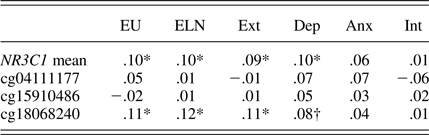
Partial correlations, controlling for child age, sex, race (African American vs. other), and GR genotype, were examined to determine the association between mean NR3C1 methylation and child outcomes (Table 4). Results indicated that NR3C1 mean hypermethylation was related to higher levels of ego undercontrol (r = .10, p = .04), higher levels of emotional lability–negativity (r = .10, p = .02), and greater externalizing behavior symptoms (r = .09, p = .04). NR3C1 hypermethylation was also associated with higher levels of child-reported depressive symptoms (r = .10, p = .03). NR3C1 methylation was not associated with child-reported anxiety symptoms (r = .06, ns) and overall counselor-reported internalizing behavior symptoms (r = –.01, ns).
Partial correlations between NR3C1 methylation and outcomes
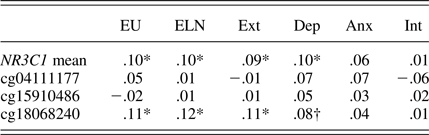
Note: Child age, sex, race, and glucocorticoid receptor genotype are controlled in correlations. EC, ego undercontrol; ELN, emotional lability–negativity; Ext, externalizing behavior; Dep, depressive symptoms; Anx, anxiety symptoms; Int, internalizing behavior.
†p < .10. *p < .05.
Partial correlations also were tested, controlling for child age, sex, race, and GR genotype, to determine associations between individual NR3C1 CpG sites and child outcomes. An examination of individual CpG sites within the 1F exon region indicated that hypermethylation at CpG site cg18068240 was associated with higher ego undercontrol (r = .11, p = .02), higher emotional lability–negativity (r = .12, p = .01), and higher externalizing symptoms (r = .11, p = .02). Hypermethylation at cg18068240 was also related to more depressive symptoms at a trend level (r = .08, p = .078). Methylation levels at CpG sites cg04111177 and cg15910486 were not associated with the outcomes.
NR3C1 exon 1F as a mediator
To examine the role of NR3C1 exon 1F methylation in the relation between child maltreatment and child outcomes, path analysis was conducted. Number of maltreatment subtypes, age, sex, race, and GR genotype were modeled as exogenous variables. Mean NR3C1 methylation was modeled as a mediator, and the following variables were included as endogenous variables: ego undercontrol, emotional lability–negativity, overall externalizing symptoms, depressive symptoms, anxiety symptoms, and overall internalizing symptoms. In a preliminary model, paths from child age, sex, and race to the mediator and all outcomes were specified. Those that were not statistically significant were trimmed from the final model. Paths from GR genotype to the mediator (NR3C1 methylation) and outcomes were estimated.
The final model fit the data well, χ2 (12) = 18.79, p = .09, CFI = 0.99, RMSEA = 0.03, SRMR = 0.03. The results indicated that more maltreatment subtypes were predictive of higher levels of ego undercontrol (b = 0.09, SE = 0.05, p = .04), higher levels of emotional lability–negativity (b = 0.19, SE = 0.04, p < .001), and higher levels of overall externalizing behavior symptoms (b = 0.19, SE = 0.05, p < .001). Greater numbers of maltreatment subtypes were also predictive of more depressive symptoms (b = 0.13, SE = 0.04, p = .002), and higher levels of overall internalizing behavior symptoms (b = 0.10, SE = 0.04, p = .03). More maltreatment subtypes was predictive of greater anxiety symptoms at a trend level (b = 0.08, SE = 0.04, p = .05).
Older children reported fewer depressive symptoms (b = –0.14, SE = 0.03, p < .001) and were rated by counselors as having fewer internalizing behavior problems (b = –0.14, SE = 0.04, p < .001) and less emotional negativity–lability (b = –0.08, SE = 0.02, p < .001). Boys had higher levels of ego undercontrol (b = 0.07, SE = 0.02, p = .002), emotional negativity–lability (b = 0.23, SE = 0.02, p < .001), more depressive symptoms (b = 0.10, SE = 0.04, p = .02), and more anxiety symptoms (b = 0.13, SE = 0.04, p = .004). GR genotype variation did not significantly uniquely predict NR3C1 methylation or any of the outcomes.
Consistent with the above analyses, children who experienced more maltreatment subtypes also evidenced mean NR3C1 hypermethlyation at exon 1F (b = 0.10, SE = 0.04, p = .02), over and above the effect of GR genotype. NR3C1 hypermethylation was associated with higher ego undercontrol (b = 0.09, SE = 0.04, p = .04), higher emotional lability–negativity (b = 0.09, SE = 0.04, p = .03), and higher overall externalizing symptoms (b = 0.09, SE = 0.04, p = .04). NR3C1 was not uniquely associated with depressive symptoms, anxiety symptoms, or overall internalizing symptoms.
To test whether NR3C1 represents a mechanism by which child maltreatment affects various child outcomes, RMediation was used (Tofighi & MacKinnon, Reference Tofighi and MacKinnon2011). Ninety-five percent asymmetric confidence limits that do not include the value zero indicate significant mediation. The results did not support significant mediation of NR3C1 methylation in the relation between child maltreatment and ego undercontrol, 95% CI [0.006, 0]; emotional lability–negativity, 95% CI [0.011, 0]; overall externalizing symptoms, 95% CI [0.204, –0.002]; depressive symptoms, 95% CI [0.125, –0.01]; anxiety symptoms, 95% CI [0.239, –0.027]; or overall internalizing symptoms, 95% CI [0.065, –0.076].
Discussion
Results indicated significant hypermethylation of the NR3C1 exon 1F mean among the maltreated children compared to the nonmaltreated children. These findings are congruent with the conclusions drawn in a number of prior reviews of animal and human studies that demonstrate a link between early adversity and hypermethylation of NR3C1 (Daskalaski & Yehuda, Reference Daskalaski and Yehuda2014; Palma-Gudiel et al., Reference Palma-Gudiel, Cordova-Palomera, Leza and Fananas2015; Turecki & Meanery, Reference Turecki and Meaney2016; Tyrka et al., Reference Tyrka, Ridout and Parade2016). We advance the literature by demonstrating the importance of investigating maltreatment parameters (developmental timing of maltreatment, the number of maltreatment subtypes, and the chronicity of maltreatment) in relation to NR3C1 methylation. To our knowledge, the only study conducted to date that has examined various dimensions of maltreatment was the study by Perroud et al., (Reference Perroud, Paoloni-Giacobino, Prada, Olie, Salzmann, Nicastro and Malafosse2011), which employed a sample of adults with borderline personality disorder. These investigators found that hypermethylation was associated with a greater number of maltreatment subtypes and greater severity of childhood abuse and neglect. The present investigation expands upon this work by employing a large representative sample of children with maltreatment experiences, documented prospectively from the coding of DHS record data and not retrospectively through adult self-report on the Child Trauma Questionnaire (Bernstein & Fink, Reference Bernstein and Fink1998) with a matched comparison group of children, and by controlling for genotype in all analyses.
Consistent with a growing literature on the negative consequences of child maltreatment experienced during the early years of life (Cicchetti, Handley, & Rogosch, Reference Cicchetti, Handley and Rogosch2015; Cicchetti, Rogosch, Gunner, & Toth, Reference Cicchetti, Rogosch, Gunnar and Toth2010; Curtis & Cicchetti, Reference Curtis and Cicchetti2013; Dunn, McLaughlin, Slopen, Rosand, & Smoller, Reference Dunn, McLaughlin, Slopen, Rosand and Smoller2013; Kaplow & Widom, Reference Kaplow and Widom2007; Manly, Kim, Rogosch, & Cicchetti, Reference Manly, Kim, Rogosch and Cicchetti2001), our results suggest that children who experience maltreatment during infancy and/or toddlerhood display significantly greater hypermethylation of the GR gene compared to nonmaltreated children. In addition, greater chronicity (the number of developmental periods in which maltreatment was experienced) was also related to higher methylation of NR3C1. Furthermore, the experience of more maltreatment subtypes also was related to higher hypermethylation. These findings are consistent with that of Parade et al. (Reference Parade, Ridout, Seifer, Armstrong, Marsit, McWilliams and Tyrka2016), who discovered that higher adversity composite scores were linked with higher hypermethylation among maltreated preschool-age children.
With regard to associations between NR3C1 methylation and various childhood psychological outcomes, the results of the present investigation of maltreated children indicated that higher mean NR3C1 was related to the following negative outcomes: higher levels of ego undercontrol, higher levels of emotional lability–negativity, greater externalizing behavior symptoms, and higher depressive symptoms. The outcomes were based on adult counselor ratings of the children after 35 hr of observation in a camp setting and child self-report (Child's Depression Inventory). These results highlight the role of methylation of NR3C1 in the effects of child maltreatment on the development of emotion dysregulation and psychopathology. We did not find higher mean NR3C1 to be related to overall anxiety symptoms, or counselor observational ratings of overall internalizing symptoms.
Our results are partially consistent with the prior literature on NR3C1 and internalizing symptoms. Specifically, the investigation of Parade et al. (Reference Parade, Ridout, Seifer, Armstrong, Marsit, McWilliams and Tyrka2016) found higher hypermethylation associated with higher internalizing scores among preschoolers, but not associated with higher externalizing scores. Developmental differences in samples may explain the disparate findings. Our sample had a mean age of 9.4 years, compared to the 4.2-year-old mean of the Parade et al. (Reference Parade, Ridout, Seifer, Armstrong, Marsit, McWilliams and Tyrka2016) sample.
Meaney and Szyf (Reference Meaney and Szyf2005) found that methylation leads to less GR transcription and functionality and increased risk for anxiety and depression. Likewise, in their study of 241 4- to 16-year-old clinic-referred children, Dadds et al. (Reference Dadds, Moul, Hawes, Mendoza Diaz and Brennan2015) also found some evidence for increased methylation associated with higher levels of externalizing symptoms; however, these results were only obtained in salivary DNA samples, but not in blood samples. Van der Knapp et al. (Reference van der Knaap, Riese, Hudziak, Verbiest, Verhulst, Oldenhinkel and van Oort2015) found NR3C1 methylation to be associated with risk for lifetime internalizing disorders. These results are consistent with animal models demonstrating that NR3C1 methylation is associated with anxiety-like behaviors (see Tyrka et al., Reference Tyrka, Ridout and Parade2016, for review).
The present investigation extends prior research by showing links with hypermethylation of NR3C1 and ego undercontrol and emotional lability/negativity, both of which are associated with underlying processes of psychopathology. We also extend the literature through demonstrating links with NR3C1 hypermethylation and externalizing symptoms. Contrary to our hypothesis, hypermethylation of NR3C1 did not mediate the effect of child maltreatment on these outcomes. Parade et al. (Reference Parade, Ridout, Seifer, Armstrong, Marsit, McWilliams and Tyrka2016) demonstrated that NR3C1 methylation mediated the association between child maltreatment and childhood behavioral problems. It is important to note a number of methodological differences between the Parade et al. (Reference Parade, Ridout, Seifer, Armstrong, Marsit, McWilliams and Tyrka2016) study and the present investigation. As described previously, the Parade et al. (Reference Parade, Ridout, Seifer, Armstrong, Marsit, McWilliams and Tyrka2016) study employed a sample of preschool children and the current study used a sample of school-aged children with a mean age of 9. In addition, Parade et al. (Reference Parade, Ridout, Seifer, Armstrong, Marsit, McWilliams and Tyrka2016) examined NR3C1 methylation at exons 1D and 1F; the present study examined methylation of exon 1F exclusively. Finally, the present study used both self-report and counselor-report measures of child internalizing and externalizing symptoms, as compared to the Parade et al. (Reference Parade, Ridout, Seifer, Armstrong, Marsit, McWilliams and Tyrka2016) study, which relied on a parent-report measure.
Implications and future directions
Epigenetic mechanisms may serve as a target for intervention because of their reversibility. Prevention scientists could include DNA methylation and gene expression in the design of their interventions (e.g., at baseline, at end of intervention, and at 1-year follow-up) in order to evaluate the efficacy of the interventions on epigenetic mechanisms. These methylation assays may be conducted genome-wide or at the level of specific regions of candidate genes with known functional properties, such as NR3C1 (Szyf & Bick, Reference Szyf and Bick2013). DNA is either methylated or demethylated in response to environmental experiences. Reversibility of DNA methylation is essential for multilevel interventions whose goal is to reset epigenetic programming (Cicchetti, Reference Cicchetti, Butcher, Hooley and Kendallin press; Klengel et al., Reference Klengel, Mehta, Anacker, Rex-Haffner, Pruessner, Pariante and Binder2013; Roberts et al., Reference Roberts, Keers, Lester, Coleman, Breen, Arendt and Wong2015). The changes that define the outcomes/phenotype are not caused solely by inherited genetic polymorphisms, but by genotypic variation and epigenetic modifications (Cicchetti et al., Reference Cicchetti, Hetzel, Rogosch, Handley and Toth2016a, Reference Cicchetti, Hetzel, Rogosch, Handley and Toth2016b; Mill, Reference Mill, Kendler, Jaffee and Romer2011, Szyf & Bick, Reference Szyf and Bick2013). Thus, it is conceivable that interventions may reverse DNA methylation and allay negative outcomes (Szyf & Bick, Reference Szyf and Bick2013; Toth, Gravener-Davis, Guild, & Cicchetti, Reference Toth, Gravener-Davis, Guild and Cicchetti2013). With increasing advances in molecular biology, neurobiology, and a multiple-levels of analysis approach (Cicchetti & Gunnar, Reference Cicchetti and Gunnar2008), prevention science will be in a better position to develop a fuller understanding of the mechanisms underlying efficacious intervention.
Given the central role of NR3C1 in the stress response system, future research investigating the associations among NR3C1 methylation and cortisol regulation and immune system functioning among maltreated children will be critical. Moreover, we focused on child maltreatment given its prevalence and negative developmental consequences; however, future research examining other forms of childhood adversity and effects on NR3C1 methylation will be important. Finally, we examined links between NR3C1 methylation and child outcomes during the school-aged years. It will be informative to determine whether early maltreatment experiences are associated with NR3C1 methylation throughout adolescence and emerging adulthood.
In summary, the present study examined NR3C1 methylation among a sample of maltreated and nonmaltreated children and investigated links with a number of negative psychological outcomes. Findings show that children with early onset maltreatment evidence significant NR3C1 hypermethylation compared to nonmaltreated children. More maltreatment subtypes experienced and more chronic maltreatment are both related to greater NR3C1 hypermethylation. Hypermethylation of NR3C1 is linked with a number of negative child outcomes, including greater emotional lability–negativity, higher levels of ego undercontrol, more externalizing behavior, and greater depressive symptoms. Together our results suggest that NR3C1 methylation is influenced by various child maltreatment experiences and that hypermethylation of NR3C1 may contribute to the development of psychopathology among children.