I. Introduction
Patients have been resorting to the courts in many jurisdictions to challenge administrative decisions which deny them the funding of health treatments by public health systems. This phenomenon is the topic of several case studies and comparative analyses aimed at understanding the actual and potential impact of adjudication on health systems and, in particular, how litigation affects fairness in the access to health care. It has also provoked a normative debate about whether, and if so to what extent, judges should get involved in decisions regarding the allocation of health care resources.Footnote 1
EnglishFootnote 2 courts are no exception as they have been judging claims against health care rationing decisions for over 30 years. Even so, the impact of this sort of litigation on the National Health Service (NHS) has not received much attention from the social rights literature compared to the copious scholarship on the same phenomenon in jurisdictions such as Canada, South Africa, Brazil and Colombia.Footnote 3 This lack of interest is most likely due to the absence of a justiciable right to health written in legislation and a general perception that English courts usually refrain from interfering with discretionary allocative decisions and issues of social policy.
However, this lack of attention to the case of England is a serious lapse in this literature. The English case law offers a wide spectrum of responses to the dilemma between holding decision-makers in the NHS accountable and recognising their expertise and constitutional role. England is also a jurisdiction in which adjudication has contributed to produce incremental, but significant and enduring, changes in the way the health system makes rationing decisions. This article aims at filling this gap and, by doing so, it will offer contributions not only to the literature on social rights but also to the public law, medical law and socio-legal studies scholarship.
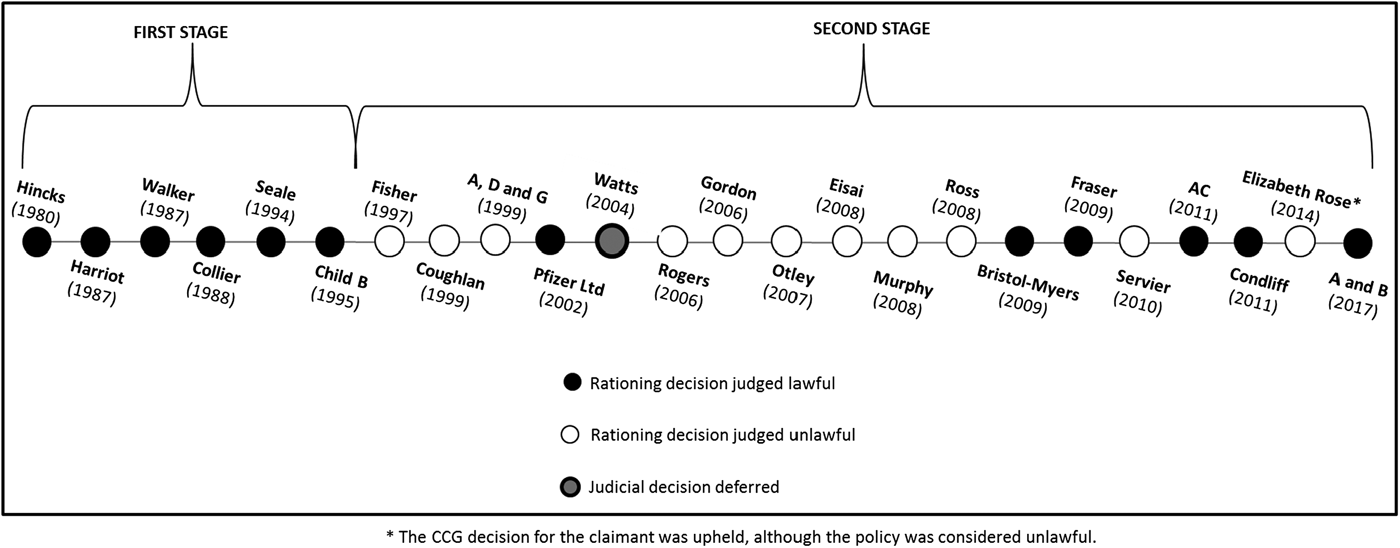
The English case law on health care rationing can be divided into two stages. This reflects the move from the courts’ very deferential “Wednesbury” approach in the first stage to the heightened scrutiny of rationing decisions in the second. The case law developed during the second stage offers a counter-example to a common perception among public law and human rights scholars that English courts are generally deferential to administrative decisions that involve discretionary allocative choice and are wary of interfering in issues of socio-economic policies.Footnote 4 This case law actually shows a judiciary that, although still sensitive to the financial and distributive issues facing policymakers, is not easily impressed by their constitutional authority and expertise, and that is willing to scrutinise procedural fairness, policy considerations and scientific evidence of rationing decisions.
It has been suggested in the medical law literature that this move from a very deferential approach to a heightened scrutiny of rationing decisions is the result of the increasing explicitness of rationing in the NHS. It is, according to this argument, the awareness of the existence, scope and processes of rationing that led to the heightened judicial control.Footnote 5 Indeed, the change in the courts’ approach to the judicial review of rationing decisions was concomitant to a move towards explicit rationing in the NHS. However, correlation is not causation and a more comprehensive analysis of the case law and of the process towards explicit rationing in the NHS, as proposed in this article, shows a more complex relationship between courts and rationing in England. It also shows that the more explicit rationing in the NHS cannot adequately explain the courts’ increasingly heightened scrutiny and that it is rather the latter that helps to explain the former.
Litigation and the rigorous judicial scrutiny of rationing decisions are certainly part of a context in which rationing has become more explicit, but courts have also contributed to creating this same context by making rationing more visible to the public (“explicit about what”) and by requiring primary decision-makers to provide clear and better reasons for denying the funding of a treatment and to decide through more transparent procedures (“explicit about why and how”). The mutually reflexive relation between how courts decide claims related to the public funding of health treatments and the way in which health care is rationed in the NHS makes the case of England relevant for the social rights literature trying to understand the roles courts can play in health policies. It is also important for socio-legal scholars interested in understanding the impact of adjudication on bureaucracies.Footnote 6
This article starts by examining English courts’ case law in cases that challenge the rationing of health care interventions by the NHS. It will then analyse the process towards explicit rationing in the NHS highlighting how courts have contributed to making health care rationing more explicit “about what” and “about why and how”. This paper will argue that courts’ departure from “Wednesbury unreasonableness” has led to the progressive incorporation of the conditions for “accountability for reasonableness”, as proposed by Norman Daniels.Footnote 7 The conclusion discusses the lesson that can be drawn from the analysis of the relation between courts and rationing in the NHS to understand the potentials, limitations and paradoxes of judicial accountability in health care policies.
II. Judicial Review of Health Care Rationing Decisions: From “Wednesbury” to a Heightened Scrutiny
This section will examine English court cases in which claimants challenged a rationing decision made within the NHS,Footnote 8 namely a discretionary decision to deny public funding for a health care intervention that results from the need to set priorities in the allocation of health care.Footnote 9 An analysis of these cases allows the division of the English case law into two distinct stages. In the first stage, from the 1980s until mid-1990s, the courts showed enormous deference to the decisions made by the NHS for epistemic and constitutional reasons. They considered medical/scientific assessments and allocative decisions to be beyond the reach of judicial scrutiny and thus that the courts should only intervene if the administrative decision was so unreasonable that no reasonable authority could ever have come to it.
In the second stage, from the mid-1990s onwards, the courts started judging in a way that, during the first stage, they had affirmed they should not. They have started scrutinising reasons and procedures to an extent that authorities were required to act “synoptically”, namely to demonstrate that they did the best possible job in gathering facts, evaluating alternatives and articulating the values that had led to their decisions.Footnote 10
It has been suggested that this change in approach is the result of a context in which health care rationing was becoming more explicit. However, this section argues that this change is better understood as the result of the incorporation of the language of rights with the related recognition of authorities’ duty to provide reasons in the English public law.
A. First Stage: Minimal Scrutiny and “Wednesbury Unreasonableness”
The first cases in which a decision not to fund treatment was challenged in courts were Hincks,Footnote 11 Harriott,Footnote 12 Walker,Footnote 13 Collier Footnote 14 and Seale. Footnote 15 In Hincks, Walker and Collier claimants sought a declaration that the delay in the performance of surgery they needed, due to insufficient funding and long waiting lists, was a breach of the respective health authorities’ duty to provide comprehensive health care. In Seale, the applicant claimed that the health authority's policy to fund in vitro fertilisation (IVF) exclusively to women between 25 and 35 years old was irrational because it was based on controversial scientific opinion and established a blanket cut-off point that took no account of individual circumstances. Harriot, which also involves funding for IVF, was a claim against an ethical committee recommendation to remove the applicant from the waiting list for assisted reproduction due to her past of criminal convictions.
In Hincks, Walker, Collier and Seale, the courts restrained themselves to a minimal level of scrutiny of the allocative choices and trusted primary decision-makers to make the best decisions. The court's reasoning was straightforward: resources are scarce, not all health needs can be met, and thus rationing is necessary; and health authorities are best able to do this. On this basis, the courts determined that they had no reason to review rationing decisions unless they were “Wednesbury unreasonable”, i.e. so absurd or outrageous in their defiance of logic or morality that no reasonable person addressing the question would have come to the same conclusion.
Under such a test a public body is placed under no obligation to explain the decision reached unless the applicant for judicial review can make a case for its irrationality. As the Court of Appeal affirmed in Collier, it would be desirable for health authorities to provide reasons and justification for the allocation of scarce resources, but courts were not the forum for calling into question the health authorities’ reasoning: “… this court and the High Court have no role of general investigators of social policy and of allocation of resources.”Footnote 16 Moreover, the courts refused to adjudicate between conflicting medical evidence and did not require authorities to consider exceptional individual circumstances to a general policy. Walker L.J., in Hincks stated:
This court can no more investigate on the facts of this case than it could do so in any other case where the balance of available money and its distribution and use are concerned. Those, of course, are questions which are of enormous public interest and concern – but they are questions to be raised, answered and dealt with outside the court … I am wholly convinced that this decision of the health authority is not justiciable … I deprecate any suggestion that patients should be encouraged to think that the court has a role in a case of this kind.Footnote 17
In Harriot, there was not a deep engagement with the reasons for refusing treatment either. Lack of resources was not an issue that emerged to the forefront of the recommendation to refuse the applicant funding for IVF, although it was mentioned that in a situation of scarcity “some individuals will have a more compelling case for treatment than others”.Footnote 18 Schiemann J. admitted the possibility of a policy being reviewed by courts, but mentioned the absurd and outrageous decision to refuse “treatment to anyone who was a Jew or coloured” as an example of an illegal policy.Footnote 19 The High Court also refused to find illegality in the facts that the applicant was refused the opportunity to establish that her case was exceptional and that the true reason for removing her from the waiting list had not been initially given to her.
Given the courts’ self-restraining understanding of their own role in reviewing rationing decisions and the difficulty of showing that a decision was absurd in its defiance of logic or morality, it is not surprising that in all the aforementioned cases the rationing decisions resisted judicial review.
A turning point in the courts’ approach was Child B. Footnote 20 A child suffering from cancer had received many courses of treatment all of which failed to produce enduring results. On this basis, the doctors concluded that no further treatment could be usefully applied. However, Child B's father found an expert in the US willing to try another course of chemotherapy. The child's doctors disagreed on the basis that the treatment would cause unnecessary suffering for the child and that the chances of success were very low given the experimental nature of the treatment. Based on the medical evidence and the cost of the treatment, the local health authority decided not to fund it.
The child's family sought judicial review and the decision not to fund another course of chemotherapy was quashed by the High Court for being “Wednesbury unreasonable”. The High Court judged that (1) the health authority failed to have regard for the wishes of the patient; (2) the treatment should not be considered experimental given the estimates of success presented by the American practitioners; (3) even though the prospects of success were small, the patient should enjoy a worthwhile chance of life; (4) the cost of the treatment was overestimated by the health authority; (5) the argument concerning the lack of resources consisted only of grave and well-rounded generalities; (6) when life is at risk, health authorities must do more than toll the bell of tight resources and must explain the priorities that have led them to decline to fund the treatment; and (7) in spite of the discretion given to a public authority, it should not be permitted to perpetrate an infringement of rights unless a substantial objective justification on public interest grounds could be demonstrated.
The innovations in this decision cannot be underestimated. Although still applying the language of “Wednesbury unreasonableness”, the case was analysed in a way that courts had explicitly affirmed in earlier decisions that they would not: questioning the health authority's medical/scientific appraisal of the treatment, transferring the burden of proof to health authorities who were expected to provide reasons for not providing the treatment, considering that the fact that resources are scarce does not justify the denying of treatment for costs reasons only, affirming that the patient's individual circumstances should be taken into consideration, and establishing that the health authorities’ level of discretion was narrower in such a case, given the important right that was being jeopardised.
The Court of Appeal, however, overturned this decision. It stated that the court was not the arbiter of the merits of cases and that no real evidence was needed to satisfy a court that no health authority was in a position to purchase everything it would wish in the interests of patients. Accordingly, courts could not shut their eyes to the real world in which health authorities were constantly pressed to make ends meet and were legally charged with making difficult and agonising decisions. Therefore, courts could not be expected to scrutinise or review the priority-setting decisions made by health authorities unless the authorities had acted in a way that exceeded their powers or unreasonably in the sense of being absurd: “Difficult and agonizing judgements have to be made as to how a limited budget is best allocated to the maximum advantage of the maximum number of patients. This is not a judgement which the court can make … it is not something that a health authority can be fairly criticized for not advancing before the court.”Footnote 21
Notwithstanding the decision of the Court of Appeal, which reaffirmed the self-restraint approach that had prevailed until then, the decision of the High Court in Child B is a landmark. Not only was it the first case in which a health care rationing decision was quashed, but it also inaugurated a legal reasoning and a heightened level of scrutiny that have become prevalent in the English case law ever since.
B. Second Stage: Heightened Scrutiny of Reasons and Procedures
After Child B, and in spite of the decision by the Court of Appeal, the principle that a rationing decision will withstand judicial review simply if it is not absurd was replaced by the requirement that authorities take all the relevant considerations into account when limiting access to a health treatment. In this second stage, the courts have started to require administrative decisions to be based on explicit and rational reasons, and made through transparent and fair processes. In addition, as will be shown in this section, the courts have become increasingly demanding and stringent when assessing these reasons and processes.
In Coughlan,Footnote 22 the decision to close a hospital where a disabled patient was living and move her to another location for financial and clinical reasons was quashed. The Court of Appeal considered, among other things, the assessment of the patient's individual circumstances, the legitimate expectation of the patient who had been promised she would be allowed to reside in that hospital “for life”, whether there was an overriding public interest that would justify frustrating this expectation, and if alternative placement that would meet her needs had been identified. As affirmed by Lord Woolf: “In drawing the balance of conflicting interests the court will not only accept the policy change without demur but will pay the closest attention to the assessment made by the public body itself.”Footnote 23
In Fisher,Footnote 24 a treatment for multiple sclerosis was denied by reasons of lack of funds and insufficient evidence of its efficacy and cost-effectiveness, in spite of an NHS circular asking health authorities to develop and implement arrangements to prescribe it. The High Court quashed the decision on the basis that the defendant authority had failed to give clear and rational reasons for not complying with the national policy and that it established a blanket ban that did not take into account the patient's individual circumstances.Footnote 25 A blanket ban on a treatment was also the reason for quashing a decision in A, D and G,Footnote 26 in which there was a challenge against a policy that gave gender reassignment surgery low priority for funding. Despite the local health authority policy mentioning that exceptional circumstances would be considered, the Court of Appeal found that the manner of considering these exceptional cases actually amounted to a blanket policy. The Court of Appeal also challenged the authorities’ scientific assessment by concluding that they had not engaged with the existing evidence that this treatment was effective.
The prohibition of a blanket ban and the duty of authorities to take into account the patients’ individual (and possibly exceptional) circumstances were reaffirmed in several subsequent cases in which decisions not to fund drugs for cancer for reasons of cost and lack of evidence were judged unlawful.Footnote 27 In these cases courts accepted that a drug may not be funded for priority-setting reasons, but such a policy would only be accepted as rational if grounded on clear and rational reasons and envisaged exceptional circumstances. Moreover, the concept of exceptionality cannot be too narrow to the extent that no case would be exceptional. In Rogers,Footnote 28 the Court of Appeal quashed a policy not to fund Herceptin but in exceptional clinical circumstances, which had been upheld by the High Court, on the grounds that the circumstances that would make a case exceptional were not clear. In Otley Footnote 29 and Ross,Footnote 30 based on divergent expert opinions, the courts also challenged the health authorities’ analysis of the scientific evidence and the conclusion that the claimant's case was not exceptional. In Murphy,Footnote 31 even though none of the factors brought by the patient could make her case exceptional, the court quashed the decision on the grounds that authorities had evaluated each of the factors separately rather than holistically (“in the round”).
Apart from cases against local health authorities, there have also been legal challenges to health technology appraisals made by the now called National Institute for Health and Care Excellence (NICE) that did not recommend the provision of treatments in the NHS. In these judgments the courts gave special attention to the fairness of the procedure through which a decision was made, which included discussions on whether NICE had the duty to release to interested parties a fully executable version of the economic model used to calculate cost-effectiveness,Footnote 32 and on the alleged bias or conflict of interest of the experts chosen by the institute to carry out the appraisals.Footnote 33
The issue of the appropriate intensity of judicial scrutiny of the decisions made by NICE and of the reasons given by the institute was raised in Servier. Footnote 34 The High Court judged that a NICE decision not to recommend a new treatment for osteoporosis had taken into consideration all the data, that the reasons were explained in a sufficient, reasonable and intelligible way, and that it was for NICE to decide on the weight to be attributed to the evidence brought.Footnote 35 The Court of Appeal disagreed with the High Court and decided that NICE should make a fresh decision. NICE had decided to reject part of the data presented by the product manufacturer due to its low scientific quality, but the Court of Appeal considered that the scientific reasons for this decision were “inadequately explained” by NICE.
There have been some exceptions to the heightened scrutiny approach of the second stage. In Pfizer,Footnote 36 the Court of Appeal overturned a High Court decision that had quashed the Department of Health policy restricting the funding of Viagra in the NHS. The High Court had concluded that the lack of sufficient and transparent reasons for this policy was a violation of domestic and EU law.Footnote 37 However, the Court of Appeal, echoing the judicial reasoning that had dominated the landscape in the first stage, judged that the allocation of resources was a political issue and that it would be inappropriate for each administrative decision to be subject to the detailed scrutiny and exposition of the merits and economics of particular medical products. The higher status of the defendant in this case – the Secretary of State for Health – may explain why it's decision was considered “political” by the court and thus attracting greater judicial deference if compared to decisions made by NICE or at local level. This could also explain why the majority of the Supreme Court in A and B Footnote 38 were not stringent in their assessment of the reasons given by the Secretary of State for Health for not making provisions to enable women resident in Northern Ireland to access abortion services in England free of charge under the NHS.
Another exception, however for a different reason, was the High Court decision in Watts. Footnote 39 This case concerned the right of a patient under European Union Law to claim reimbursement from the NHS of a treatment performed abroad. The High Court, departing from other judgments involving the denial of funding, conceptualised the case from the perspective of individual rights and needs rather than service provision.Footnote 40 It concluded that considerations of a purely economic nature could not itself restrict patients’ right to have medical services provided abroad and rejected as “speculation unnourished by common sense”Footnote 41 that this would put at risk the public system's capacity to work efficiently. The Court of Appeal deferred the judgment on this case until a decision of the European Court of Justice, but raised concerns about the High Court judgment and questioned whether a court was in the position to conclude that attributing to the NHS the duty to fund treatments abroad would not have an economic impact or undermine the waiting lists system.Footnote 42
In sum, an almost linear narrative can be told about how the case law has evolved from a very self-restrained review of health care rationing decisions towards one in which courts have constantly added new boxes that authorities had to tick for a rationing decision to withstand judicial review.Footnote 43 The assumption that primary decision-makers in the NHS are doing their work properly, and that the courts should not scrutinise their choices, has ceased to be prevalent among judges. Courts during the second stage have judged in a way that during the first stage they explicitly and unequivocally affirmed they should not: heightening the scrutiny of the reasons and procedures for policies, challenging scientific assessments based on competing expert opinions, requiring that exceptional individual circumstances be considered, and questioning the weighing up of the competing interests made by primary decision-makers. In some cases they have confronted budgetary issues and considered, in one case, that the provision of a drug would require the allocation of relatively small resources and would not put at risk the interest of other patientsFootnote 44 and, in another, that the respondent authority had funds available but decided not to use them.Footnote 45 This heightened judicial scrutiny led to several rulings against the NHS (see Timeline). In a few cases, a quashing order was followed by the requirement of the immediate provision of the treatment claimed by the patient.Footnote 46
C. Explaining the Departure from “Wednesbury Unreasonableness”
It has been argued in the medical law literature that the move from the very deferential classic “Wednesbury unreasonableness” to a heightened scrutiny of rationing decisions can be explained by the increasing explicitness in the way health care is rationed in the NHS.Footnote 47 According to this argument, the more people know that they are being denied potentially beneficial treatment, the more they will litigate; and the more transparent the reasons and processes for priority-setting are, the stricter the judicial scrutiny will be. The following excerpt by Syrett illustrates this position well: “Given that the environment in which rationing takes place is significantly altered from that which existed in the late 1980s – and, in particular, that awareness of the existence, scope and processes of rationing is much greater as a consequence of a general shift towards explicitness – such a transformation in judicial attitudes is perhaps unsurprising.”Footnote 48
If this argument is correct, then the case of England would have confirmed the hypothesis that explicit rationing “opens the door to attack” from dissatisfied patients and their lawyers and leads to more and more successful litigation.Footnote 49 However, by analysing the case law chronologically it is possible to observe that it is actually the rigorous judicial scrutiny of rationing decisions that has driven the NHS to be more explicit about the reasons and procedures leading to the denial of treatment, rather than the other way round.
Timeline – judicial review of health care rationing decisions

In most cases in which decisions not to fund treatments were judged unlawful, decision-makers were unable to meet the requirements of the courts: to give clear and rational reasons for a complete ban on a treatment; to take into account exceptional circumstances and analyse them as courts were expecting them to do; to thoroughly consider the relevant conflicting scientific evidence; and to disclose relevant information to interested parties. As the case law shows, courts were willing to add new requirements to the checklist which authorities had to follow in order to have their decisions upheld. These requirements, as will be discussed below, were subsequently incorporated into the decision-making process at the administrative level to avoid future litigation, to discharge the burden of proof expected by the courts, or simply to comply with a judicial decision.
Given that explicit rationing cannot adequately explain the transformation in the way courts review rationing decisions, this section develops an alternative hypothesis, namely that judges’ changing attitude towards health care rationing was part of a broader change in the English public law culture and practice that led to an increase in the courts' assertiveness with regard to their own role in judicial review in general.Footnote 50
Traditionally, the English courts have played a marginal political role and avoided interference in “policy questions”, probably due to the absence of a written Constitution and mechanisms for the control of constitutionality, and to a strong attachment to the principle of separation of powers. They had refused, on the whole, to substitute their own decisions on the merit of a policy for those of the primary decision-maker unless an administrative decision was “Wednesbury unreasonable”.Footnote 51 The courts’ very deferential approach when judging health care rationing cases before Child B should be understood within this broader context.
However, and particularly from the 1990s onwards, the growing use of the courts to challenge public authorities’ decisions was noted, and it was certainly not restricted to access to health care issues.Footnote 52 This is partly explained by the increasing pressure from the European Convention on Human Rights (ECHR) upon the British Constitution and legal culture in favour of greater participation by the courts in political and economic decision-making.Footnote 53 Rights were invoked as sources of normative principles or standards of public policy even before the ECHR was introduced into domestic legislation via the Human Rights Act (HRA).Footnote 54 The enactment of the HRA in 1998 brought to England the “politics of rights” and further increased the political power of the institutions responsible for enforcing these rights, namely the courts, vis-à-vis the political and administrative institutions responsible for making policies. The incorporation of the language of rights mitigated the barriers to judicial scrutiny, which were based on the authority of the formal source of power and on the respect for administrative discretion, and created the expectation that courts would do more than just testing whether an impugned decision was absurd.Footnote 55
In tandem with the affirmation of the language of rights, there has been an increasing tendency in English law to recognise the requirement for detailed scrutiny of public authorities’ reasons. Writing in 1986, Richardson found that the duty to give reasons was starting to be developed in the UK, although in a milder version than the “hard look” doctrine of US administrative law.Footnote 56 However, the principle that the administration has a duty to give reasons started to be articulated and applied in the early 1990s in a wide variety of cases and against a long established principle in English law that the authorities had no general duty to provide reasons.Footnote 57 This increasing judicial demand for public authorities to provide reasons was felt by the public administration. In the different editions of the document The Judge Over Your Shoulder, a guideline prepared by the Treasury Solicitor's Office to advise various authorities about how to make decisions less vulnerable to judicial review, it can be noted that the need to provide reasons was initially seen as exceptional and relevant only in certain circumstances, but later became the rule for the administration.Footnote 58
According to Hunt, English public law was already “feeling its way” towards a “culture of justification” and the HRA accelerated the pace of this transition.Footnote 59 The process of translating the language of rights into a demanding judicial control of administrative procedures and reasons transcended the traditional frontiers of the English courts’ deference and, at the same time, established new boundaries for the actions of the courts. The duty to provide reasons has become a device to allow courts to perform their enhanced supervisory function by retracing the authorities’ reasoning process to ensure that decisions were made in a thoughtful and non-arbitrary way.Footnote 60
The language of rights and the duty to provide reasons found an elective affinity in the English courts. This is perfectly translated in the words of Laws J. in a 1993 article, which affirmed that courts should accord “the first priority to the right in question unless the [decision-maker] can show a substantial, objective, public justification for overriding it”Footnote 61 and that “the greater the intrusion proposed by a body possessing public power over the citizen into an area where his fundamental rights are at stake, the greater must be the justification which the public authority must demonstrate”.Footnote 62
The same idea with very similar words appeared in in the High Court decision in Child B,Footnote 63 which was judged by Laws J. himself. The language of “Wednesbury” was not completely abandoned, although applied in a “heightened” form. For instance, the High Court in Otley Footnote 64 concluded that the health authority's policy was “Wednesbury unreasonable”, but only after carrying out a detailed scrutiny of the choices, scientific evidence and values underpinning the administrative decision.
The departure from an approach in which deference on the part of courts was not warranted by simply mentioning administrative discretion or constitutional authority, but had to be earned by authorities able to justify their decisions, was reiterated in a recent case on the funding of health treatment:
Irrationality simpliciter is a very high hurdle to surmount, and in its most straightforward sense entails the Court coming to the conclusion that the decision under scrutiny was so unreasonable as to be perverse. That assessment does not necessarily entail any evaluation of the reasons given by the decision-maker or the reasoning process displayed thereby. […] it is certainly possible to advance what may be seen as a somewhat narrower irrationality challenge which focuses on the quality and logicality of the reasons actually given by the decision maker in the particular case.Footnote 65
It is important to note that human rights were used by claimants in challenges to health care rationing decisions and rights have been discussed and mentioned in judgments to justify a heightened judicial scrutiny. However, human rights did not come to the forefront of judges’ legal analysis and have not been determinant for the outcome of the cases.Footnote 66 This finding is coherent with what Poole observed when analysing human rights cases decided by the English courts: even though in most cases there was some preliminary consideration of the importance of the rights affected by the administrative or political decision being challenged, these were not the primary centre of attention or discussion. Rather, according to Poole, cases were decided mainly on the basis of an analysis of the authorities’ expertise and the legitimacy of the judicial review in the constitutional balance.Footnote 67
Lastly, the findings of the case-law analysis in this section contradict the idea that English courts tend to be deferential to authorities when it comes to reviewing administrative decisions involving discretionary allocative decision-making in social policies.Footnote 68 The decision of the Court of Appeal in Child B, which is often cited as a leading authority of this deferential doctrine,Footnote 69 is actually one of the last examples of such a self-restrained approach by courts in the review of health care rationing decisions. What followed next was the vindication of what it had overturned.
In sum, the changes in the courts’ approach when judging health care rationing decisions are better understood when they are put in the broader context of the transformations in the English public law in recent decades. Therefore, to use explicit rationing as an explanatory variable offers a very limited account of the changes in the case law. It also prevents the understanding of the influence litigation had in shaping the way health care is rationed in the NHS. This sets the scene for what follows.
III. Priority-Setting in the NHS: From Implicit Rationing to Accountability for Reasonableness
Not only has the way the courts decide claims for the provision of health care changed significantly over the last 30 years, but health care rationing in the NHS has also evolved from implicit to being increasingly explicit “about what” and “about why and how” during the same period.
The distinction between the two aspects of explicit rationing – “about what” and “about why and how” – is important (although not always clearly made in the literature) because both aspects of explicitness do not necessarily come together. The public may be aware of which treatments are not being provided to patients (“explicit about what”), but without the reasons or the procedure through which these decisions are reached being disclosed (“explicit about why and how”).Footnote 70 As will be seen in this section, explicit rationing “about what” is not immediately or necessarily followed by explicitness “about why and how”. Being explicit “about why and how” is a policy choice. This distinction also allows a more precise account of the different stages in the process from implicit to explicit rationing in the NHS and of the role played by the heightened judicial scrutiny in making rationing more explicit – in both senses – in the NHS.
The impact of the courts on administration is not always easy to establish. Whilst it can be clear when certain bureaucratic changes are ordered by a court or when a policy is admittedly aimed at responding to a judicial decision or a group of decisions, there are other forms of impact that are more difficult to determine. Some changes are not provoked by the outcome of a judicial decision per se, but by what the courts say and the publicity brought by a particular case.Footnote 71 Moreover, the impact can also be diffuse and influence the less accessible aspects of an administration learning to live with the shadow of judicial review, such as the internal and informal working practices of departments and their decision-making culture.Footnote 72
Most of the impact courts have had on health care rationing is of the kind that is more difficult to determine. However, by focusing on two landmarks cases – Child B Footnote 73 and Pfizer Footnote 74 – it is possible to show that the impact exists and that it is relevant. Child B contributed to bringing the public's attention to the fact that rationing was occurring in the NHS and it also made health authorities aware that they now had to set priorities with the judges over their shoulders. Pfizer alerted the NHS that it needed a national system for making the assessment of health technologies more informed and consistent in order to avoid and respond to litigation. These two landmark cases, coupled with subsequent judicial decisions, created incentives for important institutional reforms and there is evidence that the courts’ rulings have been shaping the decision-making process in the NHS.
It is important to clarify that this article is not claiming any strong causal relation in the sense of arguing that litigation has been a sufficient or a necessary condition for the changes in health care rationing in England. As previous research on the impact of litigation on bureaucracies has indicated, it is very difficult to isolate the role of courts and estimate their independent impact because policymakers are continuously reacting to multiple pressures.Footnote 75 What is possible to show, however, is that courts interacted within a “soup of influences” that created a context that made rationing more explicit “about what” and that, through their rulings, they established a continuous policy dialogue with decision-makers in the NHS that contributed to make rationing explicit “about why and how”.
A. From Implicit to Explicit “About What”
The NHS, like any other health care system in the world, has always had to restrict access to health care for cost reasons. For many years, this restriction took the form of implicit rationing. Rationing decisions were mostly hidden in clinical appraisals made by practitioners who, aware of the budgetary constraints, have told patients that nothing more could be done to benefit their health, rather than by saying explicitly that a treatment could not be provided because resources were not available or were to be used for other priorities.Footnote 76 Thus, for many years, through a technocratic paternalism grounded in a “deep reservoir of deference to doctors”, the NHS managed to dampen down patients’ expectations and maintain implicit rationing.Footnote 77
This implicit rationing scheme started to become unsustainable in the 1990s. One of the reasons was the health reform that created a provider-purchaser split and introduced an internal market into the NHS. This led to an uneven provision of care as the access to some treatments depended on the patients’ catchment area rather than on their needs alone – the so-called “postcode lottery”. This made the public aware that the basket of treatments available to patients was not based solely on clinical reasons, but was also a matter of policy choice and priority-setting.Footnote 78
In addition, the menu of technological possibilities in health care began expanding exponentially in recent decades. Health conditions that were once considered untreatable are now finding suitable treatments as a result of the development of costly new medical technologies.Footnote 79 This scientific progress, coupled with its marketing and media coverage, has coincided with an ageing society of more educated and better-informed citizens (notably with the advent of the Internet) with higher expectations of being treated with the latest and best that the medical science can offer.Footnote 80 In England, the role of the media has also been particularly relevant with stories of health care rationing presented in a “melodramatic style”, which, whilst very rare in the 1980s, started to represent a constant source of public pressure on the NHS from the 1990s onwards.Footnote 81
In sum, patients have become more aware of what they could have and of what they were denied by the NHS. They have also become more assertive in demanding doctors and the health system to make use of these new technologies, including through litigation.Footnote 82
However, courts have not been merely reflecting the change in the way rationing has been carried out in the NHS. As already suggested by the socio-legal literature, judicial decisions are influenced by the very context that they help to createFootnote 83 and, if there is a court case to be singled out in this respect, it is Child B.Footnote 84
Child B was the first health care rationing case to receive the attention of the mass media and this gave explicit rationing “about what” an extraordinary visibility. Child B contributed to lifting the veil of implicit rationing for the public and started an unprecedented national debate about rationing, which greatly increased the pressure on authorities and politicians. Without the judicial dispute, the child's drama would arguably have passed unnoticed by the media and public opinion. Instead, the legal case was on the front pages of all the national newspapers, was the subject of many editorial comments, and also covered prominently on television.Footnote 85 The fact that the media coverage was often critical of the health authority also contributed to weaken the public's trust in the decisions made by the health system.Footnote 86 Commentators have also noticed that the repercussion of this court case made rationing more visible to the public and increased the interest of the media in broader discussions about priorities and the allocation of resources within the NHS.Footnote 87 Moreover, Child B sparked an academic debate on rationing and priority-setting in the NHS, as can be seen by the vast health policy literature cited in this article that focuses on understanding this case, its repercussions and trying to draw lessons from it. After the end of the legal dispute, and in contrast with the then usual reluctance to admit the existence of rationing, the defendant authority justified its decision stating that rationing is “necessary” and “legitimate”, and that it should be done explicitly rather than behind closed doors.Footnote 88
Child B not only made rationing “about what” more evident to the public, but it also made patients more aware that judicial review is possible. Qualitative research into cases of contested funding decisions soon after Child B showed that not only were decision-makers in the NHS concerned about the possibility of judicial review, but also patients had become more willing to go to court or at least to invoke the threat of legal action to put pressure on health authorities to reconsider their decisions not to fund a treatment.Footnote 89 One interesting example is a letter sent by a solicitor to a health authority informing that she/he had advised the patient to apply for judicial review against the decision not to fund a treatment, and mentioning that similar cases had already been granted leave.Footnote 90
Child B shows that the impact of a court case can go way beyond the judgment per se. The final decision by the Court of Appeal was overshadowed by the wide public, academic and political debate about rationing in the NHS that this case provoked. It has also made health authorities aware that their priority-setting decisions have become more visible and thus were more likely to be scrutinised both inside and outside the courtroom.
B. From Explicit “About What” to Explicit “About Why and How”
The visible mismatch between patients’ expectations and the level of care the NHS is capable of providing has undermined the equilibrium that had previously sustained an implicit rationing system. Authorities and politicians began to face the dilemma of choosing between the ever-heavier financial costs of providing new and expensive treatments or the ever-greater political costs of not providing them, or perhaps having to bear both costs at the same time.Footnote 91
The NHS response to the challenges brought about by explicit rationing “about what” was to make health care rationing “explicit about why and how”. Explicit rationing about “why and how” started with the efforts of health authorities to demonstrate that they had been rigorous and fair in arriving at their decisions. This led to greater involvement of external advisors, the establishment of scientific committees to provide better scientific evidence, and attempts to apply an explicit priority-setting framework with clear and standardised criteria against which services and treatments could be assessed.Footnote 92 The Department of Health also showed a growing enthusiasm for evidence-based medicine in order to identify and exclude procedures and treatments that were not cost-effective.Footnote 93 In 1994, the NHS Management Executive's Value for Money Unit urged health authorities to base their purchasing decisions on evidence of clinical effectiveness.Footnote 94
The case of Child B made it even clearer for health authorities that they were likely to be severely scrutinised by courts and the public and, hence, that they had to show that their decisions had been fair, transparent and based on rigorous assessment of the evidence. It also indicated that the NHS needed improvements in the existing procedures for priority-setting in order to deal with future cases. Ham and McIverFootnote 95 interviewed health authorities involved in rationing decisions after Child B to assess the changes in their decision-making process following this case. The conclusion was that Child B, the then recent judgment in Fisher,Footnote 96 and the constant threat of judicial review have contributed to make authorities aware that they were expected to provide better reasons to justify their decisions. In some of the cases discussed in this research, the more frequent involvement of lawyers in disputes about funding and the threat of judicial review resulted in authorities reconsidering its policy and occasionally revising its decision to avoid litigation.Footnote 97 Authorities have also realised that, to be able to provide better reasons, they needed an evidence-informed, transparent and consistent decision-making process. This, according to the interviewees, resulted in the establishment of committees for dealing with rationing decisions, the advice of independent external specialists, the search for more evidence and a more detailed look at it, a deeper understanding of the ethical issues involved, the adoption of appeal procedures, and more explicitness about the criteria against which the treatments demanded should be assessed. In sum, finding reasons that would be acceptable to both the courts and the public to safeguard their decisions from legal challenge had become a permanent concern among health authorities after Child B.
This case also prompted an academic debate about the role of the courts in assessing this kind of case. Many commentators criticised the Court of Appeal's decision for not demanding from the health authority better reasons for not funding a lifesaving treatment and for not engaging with the High Court's argument that a reported scarcity of resources was not enough to justify a rationing decision.Footnote 98
Child B, and the court cases that followed it, showed health authorities that rationing had to be more explicit “about why and how”, but also that they needed support from the central government to do so in the form of expertise and guidelines to make complex priority-setting decisions. At that time, health authorities at local level did not have much information available on the cost-effectiveness of treatments and they lacked expertise in producing evidence-based decisions. This resulted in inconsistent decisions, in the failure to provide sufficient evidence for restricting access to treatments, or in the unsatisfactory quality of the evidence provided.Footnote 99 For instance, the then Chief Executive of the Cambridge Health Authority (the defendant authority in Child B) complained about the “invidious position” of having to make difficult decisions without any guideline.Footnote 100
A sophisticated health technology assessment depends on high levels of scientific and economic expertise and is time and resource consuming. It would be too burdensome for each local health authority to provide a comprehensive and well-documented assessment of each new health technology. This would lead to unnecessary duplication of efforts and to an overall confusion and inefficiency in the system. The use of ambiguous, obscure or conflicting criteria by different health authorities when assessing competing claims on resources did not help to avoid financial, political or judicial pressure on the health system caused by explicitness “about what”. The fact that treatments were unevenly purchased by different but adjacent health authorities not only showed that health care was being rationed but also that health authorities lacked consistent criteria for priority-setting.Footnote 101 The NHS needed a stronger lead from the centre to make rationing decisions, coordinate technology information analysis and create nationally agreed standards.Footnote 102
The first case in which the Department of Health attempted to lead from the centre was the decision not to fund Viagra in the NHS other than in exceptional circumstances. The effectiveness of Viagra was not in doubt and the Department of Health justification for restricting the provision of this drug was the cost of the treatment and its affordability for the public health system. This was considered an important landmark in the history of the NHS because it showed for the first time that central government recognised the inevitability of rationing and that it was grappling publicly with the problem.Footnote 103
This policy, however, was criticised because there was no clear set of evidence-based reasons for rationing Viagra, and the pharmaceutical company Pfizer filed a lawsuit on this same ground.Footnote 104 The High Court required reasons in the form of objective and verifiable criteria for restricting the provision of a treatment, which the Government could not provide. The controversy around this case and the decision of the High Court in favour of the claimant showed that rationing decisions at the national level also had to be grounded on a fair procedure, solid evidence and consistent policy reasons.Footnote 105 In other words, the “lead from the centre” required not only central decisions being explicit “about what”, but also “about why and how”. Arguably, a “NICE-like” procedure was then necessary to justify the ban on Viagra, although at that time NICE was “still nothing more than a policy dream”.Footnote 106
At the end of the 1990s the Department of Health issued two consultation documents putting forward a strategy to deal with the need to improve the quality of care and the challenges raised by an increasingly explicit rationing: The New NHS: Modern and DependableFootnote 107 and A First Class Service: Quality in the New NHS.Footnote 108 These documents affirmed that the NHS was “facing more challenges than ever”, resulting from, amongst other things, greater and faster medical advances; a better-informed and more demanding public; an ageing population; low public confidence in the NHS prompted by the “postcode lottery”; a lack of any coherent assessment of which treatments worked best for patients; and the NHS having never been sufficiently open or accountable about the quality of its services. These documents proposed that decisions should be based on the best possible evidence and that the Government should provide new tools for tackling these challenges.
The proposal for the creation of the then called National Institute for Clinical Excellence (NICE) was set out in these documents based on the idea that high quality and cost-effectiveness are two sides of the same coin.Footnote 109 NICE was aimed at creating a coherent national system for the appraisal of new technologies in substitution for the plurality of bodies that had been carrying out this kind of analysis with different methods, variable quality, and sometimes duplicating each other's efforts and creating confusing evidence unlikely to be helpful to clinicians or authorities.
NICE was eventually established in 1999 in political recognition that a centralised, national, rational and transparent mechanism for setting priorities was necessary in face of the advance in new and expensive health technologies.Footnote 110 NICE is responsible for carrying out health technology appraisals – guidelines on the use of health technologies based on clinical and cost-effectiveness analysis – a task that, due to its complexity, frequently generates scientific and moral disagreement. The institute is also frequently under political pressure because a NICE decision appraisal not recommending a treatment will restrict patients’ access to it in the NHS.
It is thus necessary that NICE appraisals be legitimate. This was intended to be achieved by an emphasis on “procedural justice” in NICE, which means that “the processes by which health care decisions are reached are transparent, and that the reasons for the decisions are explicit”.Footnote 111 According to Michael RawlinsFootnote 112 (NICE's first chairman) and to NICE itself,Footnote 113 procedural justice in NICE follows Norman Daniels’ idea of “accountability for reasonableness”Footnote 114 and explicitly encompassed its four conditions:
-
(1) Publicity: decisions on the allocation of resources and the grounds for reaching them must be made public;
-
(2) Relevance: the grounds for the decisions must be relevant and acceptable by fair-minded people;
-
(3) Challenge and revision: the procedure should offer opportunities for challenging decisions and a transparent system should be available for revising decisions if new evidence becomes available;
-
(4) Regulation/Enforcement: NICE has to be accountable to the public for its reasonableness in order to guarantee that the first three conditions are met.
Procedural justice in NICE is reflected in the transparency of the decisions and of the reasons that back them up (publicity); the scientific rigour in the analysis of the evidence and consideration of social values and equity (relevance); and the right of stakeholders to be consulted and to challenge the decisions, which can then be revised to incorporate new evidence (challenge and revision). In addition, as shown in the previous section, courts have scrutinised the decision-making process in NICE to guarantee that the first three conditions are met (regulation/enforcement).
In a context in which fair-minded people may disagree about which principles of justice should guide the allocation of health care resources, “accountability for reasonableness” offers a solution of procedural justice to the problem of making rationing decisions fair and legitimate from the perspective of those whose health needs were not met, as well as the public and (at least in England) the courts.
The decision of the High Court in Pfizer was almost concurrent to the establishment of NICE and some commentators suggest a direct association between this case and the creation of the institute.Footnote 115 NICE itself has identified Pfizer as one the main drivers for its creation because the case showed that the Government was vulnerable to questions about the “ad hoc and opaque fashion in which decisions were made” while trying to centralise rationing decisions to attempt to avoid the problem of the “postcode lottery”.Footnote 116
NICE had come into existence by the time of the Court of Appeal decision in Pfizer but, interestingly, the Government did not refer Viagra for its assessment. Arguably, this was because the Government was afraid that a favourable appraisal by NICE would increase the pressure to supply Viagra.Footnote 117 Instead, the Government's litigation strategy was to insist that this case was a problem of affordability rather than of cost-effectiveness and, successfully, relied on a more deferential attitude from the Court of Appeal. The pharmaceutical company, on the other hand, argued that decisions about the funding of drugs should be based on “cost-utility analysis”, which the Government had not carried out. Whilst the Court of Appeal mentioned NICE in its decision as offering a comprehensive and empirically based framework for the adequate analysis of new technologies, it accepted the arguments of the Government without close scrutiny of this particular policy.
Like in Child B, even though the High Court's heightened scrutiny was eventually overturned by the Court of Appeal, the Pfizer case had an impact that went far beyond the final outcome of the litigation. In most of the subsequent judgments, courts were willing to scrutinise the process and the reasons for a rationing decision, including of those made by NICE.
In this section, the cases Pfizer and Child B were singled out for a deeper analysis, but this is far from meaning that these are the only relevant cases for understanding the impact of litigation on rationing. The continuous use of litigation to challenge rationing decisions and the increasingly heightened scrutiny by courts over the years have contributed to creating enduring changes in the way rationing decisions are made in the NHS. The courts’ requirements in judicial review are now integrated in the NHS decision-making processes for deciding on the provision of health care.Footnote 118
A survey of how health authorities make allocative decisions and set priorities identified the risk of judicial review as one of the reasons that justify the effort of making priority-setting decisions more explicit.Footnote 119 According to the preface to this research, “The exacting nature of the financial challenge facing the National Health Service (NHS), combined with increasing demand for NHS services, means that commissioners will have to make difficult decisions about how NHS resources are used. Processes for reaching and enacting these priorities will need to be robust and transparent, and capable of withstanding judicial review”.Footnote 120
It has also become common for lawyers and legal scholars to give presentations and write papers aimed at NHS staff explaining what judicial review is, helping to interpret judicial decisions, and providing guidance on how decisions should be made in order to prevent litigation or to avoid having decisions quashed by the courts. The advice includes recording and providing reasons in order to show that each case has been considered in a comprehensive and attentive way.Footnote 121
Following judgments quashing the blanket ban of treatments and requiring exceptional individual circumstances to be considered, health authorities have established Exceptional Case Panels to assess individual funding requests (IFRs) for treatments which are not routinely funded for all patients.Footnote 122 In the document that provides guidelines for health authorities to consider IFRs, it is stated that authorities “must be able to explain coherently their decisions to clinicians, patients, the public, and the courts”.Footnote 123 Additionally, throughout the document there are concerns about what the courts might think of decisions made by health authorities and how to proceed in such a way as to lessen the risk of having decisions reviewed by judges. It is even recommended that the health authorities act in a judicial-like way when analysing administrative appeals, using the same tests that courts apply to scrutinise their decisions.Footnote 124
The Department of Health has recommended that health authorities give written justification to patients who are denied a certain treatment, clarifying the reasons for the decisions; that these decisions be grounded on robust evidence and consistent criteria; and that the procedure and rationale for each decision be documented.Footnote 125 Moreover, the primary decision-makers’ duties of transparency, fairness and justification, which were imposed by the courts, have become rights to which the NHS itself states that patients are entitled.Footnote 126 The NHS Constitution, which Newdick considers the reflection of principles developed by a decade of judicial review,Footnote 127 declares that patients have the right to expect local decisions on funding be made rationally following a proper consideration of the evidence and that decisions not to fund a drug or treatment must be justified.
In conclusion, a heightened judicial scrutiny has pushed the NHS to ration health care in a way that is along the lines of “accountability for reasonableness” in order to avoid, respond to and comply with judicial review. These changes in the administrative decision-making reflect the fact that the denial of funding for a health intervention will hardly ever be upheld by courts if the decision and the grounds for it are not made public (“publicity”), based on sound evidence and reasonable policy considerations (“relevance”) and if the opportunity for adequately challenging the policy or presenting a case for an exception is not given (“challenge”). Accordingly, the courts are guaranteeing that health care rationing decisions in the NHS will comply with the first three conditions for “accountability for reasonableness” and are thus materialising the last condition (“regulation/enforceability”).Footnote 128
IV. Concluding Remarks
This article has argued that the heightened scrutiny applied by courts has made health care rationing more visible in England and has contributed to shaping the decision-making-process in the NHS. This relationship between litigation and explicit rationing “about what” and, in particular, “about why and how” has been surprisingly underemphasised in the literature. By bridging this gap, this article offers important contributions to the scholarship in public law, socio-legal studies, medical law and social rights.
First, a comprehensive account of the judicial decisions in cases related to health care rationing in this article challenges the idea that English courts tend to be deferential to authorities when it comes to administrative decisions involving discretionary allocative decisions in social policies. Whilst it is true that courts have very rarely interfered directly on the outcome of a policy by, for instance, ordering the provision of a treatment, they have definitely not shied away from holding authorities to account by continuously requiring better reasons and procedural fairness.
Second, this article provides evidence of the impact of the Judiciary on a social policy. This was done by showing that the standards and requirements established by courts have been incorporated in the decision-making process in the NHS, by investigating published documents by NHS bodies, and by reviewing the literature on the policy implications of specific court cases. The landmark decisions in Child B and in Pfizer also confirm that the policy impact of a decision is not necessarily linked to the legal success of the challenge.Footnote 129 Even though it is not possible to affirm that litigation was necessary or sufficient for making rationing explicit (in both senses) in the NHS, it is at least plausible to say that courts, by responding to a context of transformations in the legal culture and in the health system, have contributed to change the way in which the decisions about priority-setting in health care are made. In other words, an account of the changes in the way the NHS rations health care is incomplete without considering the role of litigation and judicial review.
Lastly, the analysis in this article vindicates the idea that authorities who are required by the courts to give reasons will make decisions more carefully and in a way that is publicly justifiable, grounded on evidence and taking into account different views.Footnote 130 However, one should be cautious not to jump too quickly to conclusions about whether this impact has been overall positive or to normative recommendations regarding how courts in England or elsewhere should judge cases related to the provision and funding of health care treatments. It is important to look at the findings of this paper in light of the paradox suggested by Mashaw, namely that “judicial review both supports political accountability and impairs it, demands administrative competence and undermines bureaucratic capacities”.Footnote 131
Policymakers who have the judges looking over their shoulders and are expected to act synoptically will spend a significant amount of time and resources that could have been used for other purposes to make sure that each aspect of their policy can resist judicial review. This is particularly true if, as it happens in the NHS, they feel compelled to carry out at administrative level the same tests that they expect to be applied in judicial review.Footnote 132 The opportunity costs of making decisions less vulnerable to judicial review are yet to be measured, but should not be ignored.
The increasingly heightened judicial scrutiny can also create uncertainty about what courts are expecting in terms of justification to uphold a decision. The consequence could be that decisions be based not on the best policy judgment but on the assessment of a policy's capacity to avoid or withstand judicial review. Those responsible for making allocative decisions in a health system may decide, for example, to avoid rationing care where it is most visible or which affects groups who are more disposed to litigate. They may also be likely to settle cases before they reach courts to avoid bad publicity, litigation costs and a possibly unfavourable precedent, even when the rationing decision would be reasonable and consistent from a policy perspective.Footnote 133 In other words, fear of litigation may lead to what decision-makers would see as second-best policies.
Furthermore, judicial oversight will not necessarily prevent inconsistent decisions from being made. For example, English courts require that a policy to not fund a treatment must consider exceptional circumstances. However, there are no clear directions about what would count as an exception. Apart from the costs for authorities to consider the evidence and cost-effectiveness of a treatment ad hoc for each individual requesting funding, this results in patients with similar clinical conditions receiving different levels of care depending on how “exceptionality” is being interpreted by decision-makers in their respective catchment areas.Footnote 134
Lastly, there is also no guarantee that policy decisions following judicial review will be better informed or reasoned. Courts, depending on how heightened their scrutiny is, may be putting themselves in a position to second-guess policy decisions and thus reduce administrators’ discretion to an extent that the outcome of a policy is practically pre-determined based on the courts’ assessment of the facts and of the policy considerations in a case.Footnote 135 This would result in the overriding of the administrative procedure by a judicial one that offers fewer of the virtues that courts require from primary decision-makers.
In sum, this article has argued that the heightened scrutiny applied by English courts has contributed to shaping the decision-making-process in the NHS by forcing decision-makers to take procedural justice seriously and to incorporate the conditions for “accountability for reasonableness”. However, what this means in terms of the efficiency and substantive justice in the provision of health care for the population is yet to be fully understood.Footnote 136