Although the number of studies on learning to read in Chinese has increased massively in the past two decades (e.g., Chik, Ho, Yeung, Chan, et al., Reference Chik, Ho, Yeung, Chan, Chung and Luan2012; Ho & Bryant, Reference Ho and Bryant1997; Leong, Tse, Loh, & Hau, Reference Leong, Tse, Loh and Hau2008; Shu, McBride-Chang, Wu, & Liu, Reference Shu, McBride-Chang, Wu and Liu2006; Tong, McBride-Chang, Shu, & Wong, Reference Tong, McBride-Chang, Shu and Wong2009; Yeung, Ho, Chan, Chung, & Wong, Reference Yeung, Ho, Chan, Chung and Wong2013; Yeung et al., Reference Yeung, Ho, Chik, Lo, Luan and Chan2011), research on learning to write in Chinese is still in the beginning phase.
Most studies on Chinese writing development have focused on spelling (e.g., Chan, Ho, Tsang, Lee, & Chung, Reference Chan, Ho, Tsang, Lee and Chung2006; Shu et al., Reference Shu, McBride-Chang, Wu and Liu2006; Tong et al., Reference Tong, McBride-Chang, Shu and Wong2009; Yeung et al., Reference Yeung, Ho, Chik, Lo, Luan and Chan2011). There is evidence that rapid naming, orthographic skills, and morphological awareness, which are important cognitive–linguistic skills in Chinese reading development, contribute to Chinese spelling development (Chan et al., Reference Chan, Ho, Tsang, Lee and Chung2006; Packard et al., Reference Packard, Chen, Li, Wu, Gaffney and Li2006; Shu et al., Reference Shu, McBride-Chang, Wu and Liu2006; Tong et al., Reference Tong, McBride-Chang, Shu and Wong2009; Yeung et al., Reference Yeung, Ho, Chik, Lo, Luan and Chan2011; Yeung, Ho, Wong, et al., Reference Yeung, Ho, Chan, Chung and Wong2013). However, there are relatively few studies on written composition (e.g., Yan et al., Reference Yan, McBride-Chang, Wagner, Zhang, Wong and Shu2011; Yeung, Ho, Chan, & Chung, Reference Yeung, Ho, Chan and Chung2013a, Reference Yeung, Ho, Chan and Chung2013b), and most of them focused on the development of written composition among children in early elementary grades. Furthermore, the findings about the cognitive–linguistic skills important to the development of Chinese written composition were inconclusive.
MODELS OF WRITING
Two major models of writing are the classic model by Hayes and Flowers (Reference Hayes, Flowers, Gregg and Steinberg1980), which theorizes about the cognitive processes involved in the writing processes among adults, and the knowledge-telling model by Bereiter and Scardamalia (Reference Bereiter and Scardamalia1987), which conceptualizes how beginning writers approach the written composition task. The former proposes that the act of writing consists of three major processes: planning, translating, and reviewing, while the latter suggests that little planning is involved in children's writing, and that oral language production and text writing share many similarities among elementary school children.
In the simple view of writing (Juel, Griffith, & Gough, Reference Juel, Griffith and Gough1986), two principal component skills of children's writing were hypothesized: spelling and ideation (i.e., the generation and organization of ideas). The empirical studies conducted by Abbott, Berninger, and Fayol (Reference Abbott, Berninger and Fayol2010), Berninger, Cartwright, Yates, Swanson, and Abbott (Reference Berninger, Cartwright, Yates, Swanson and Abbott1994), and Graham, Berninger, Abbott, Abbott, and Whitaker (Reference Graham, Berninger, Abbott, Abbott and Whitaker1997) in the last two decades have provided solid evidence for the significance of transcription skills (including spelling and handwriting) and oral language skills (including vocabulary, word fluency, and oral narrative skills; Berninger & Abbott, Reference Berninger and Abbott2010; Olinghouse & Leaird, Reference Olinghouse and Leaird2009; Roth, Reference Roth2000) in writing development.
The significance of transcription skills and oral language skills in writing is recognized in the not-so-simple view of writing by Berninger (Reference Berninger2000) and Berninger, Abbott, Abbott, Graham, and Richards (Reference Berninger, Abbott, Abbott, Graham and Richards2002) and the recent framework of cognitive processes in writing by Hayes (Reference Hayes2012) and Hayes and Berninger (Reference Hayes, Berninger, Arfé, Dockrell and Berninger2014). In the not-so-simple model, the writing process involves an interaction between transcription, text generation, and executive functions within the working memory environment. Oral language is a vital skill to the text generation component, which involves the transformation of ideas into language representation in working memory, and transcription helps translate these language representations into written symbols. This model highlights the importance of oral language skills and transcription skills in writing.
The framework of cognitive processes in writing (Hayes, Reference Hayes2012; Hayes & Berninger, Reference Hayes, Berninger, Arfé, Dockrell and Berninger2014) has three levels: a resource level, a process level, and a control level. The resource level includes general purpose processes and internal memories (i.e., working memory and long-term memory), which can be drawn on by other levels. In the process level, the proposer generates prelinguistic ideas, which are then converted into linguistic representation by the translator, and the transcriber is responsible for changing the linguistic representation into written language. Oral language skills and transcription skills are of great importance to the functioning of the components of the translator and the transcriber, respectively.
Although both transcription skills and oral language skills are significant component skills of writing, their developmental trajectories and longitudinal relationships with writing have been found to be different. The robust relationships between transcription skills (including handwriting and spelling) and writing have been found in cross-sectional studies among intermediate graders (Berninger et al., Reference Berninger, Cartwright, Yates, Swanson and Abbott1994, Graham et al., Reference Graham, Berninger, Abbott, Abbott and Whitaker1997). More recent longitudinal studies among primary grade children have shown that the longitudinal relationships between written composition and different types of transcription skills were different across elementary grades. Spelling was found to be a consistent longitudinal predictor of written composition from Grades 1 to 7, but handwriting was a longitudinal predictor of written composition only from Grades 3 to 4 (Abbott et al., Reference Abbott, Berninger and Fayol2010).
The longitudinal relationships between oral language skills and writing have been shown to be different across elementary grades. In the study by Juel et al. (Reference Juel, Griffith and Gough1986), the predictive power of oral language skills on written composition performance was stronger in Grade 2 than in Grade 1, but the opposite pattern was true for the predictive power of spelling on written composition performance. A more recent 5-year longitudinal study by Berninger and Abbott (Reference Berninger and Abbott2010) showed that oral language skills contributed uniquely to written composition in Grade 3 and Grade 7, but not in Grade 1. There are at least two possible explanations for the findings that oral language skills play a more important role in writing development in more advanced grades. First, attaining automaticity in transcription skills is the major developmental challenge that beginning writers have to overcome in the earliest stage of writing development (Berninger, Mizokawa, & Bragg, Reference Berninger, Mizokawa and Bragg1991). Oral language skills come into play only after children have become more proficient in transcription. Second, oral language skills are likely to continue to develop across elementary grades and thus remain significant predictors of individual differences in writing development even in more advanced elementary grades (Abbott et al., Reference Abbott, Berninger and Fayol2010).
In recent years, there have been attempts to examine the contribution of transcription and oral language skills in orthographies that are more transparent and less complex than English (Babayiğit & Stainthorp, Reference Babayiğit and Stainthorp2010, Reference Babayiğit and Stainthorp2011; Kim, Park, & Park, Reference Kim, Park and Park2013, Reference Kim, Park and Park2015; Mäki, Voeten, Vauras, & Poskiparta, Reference Mäki, Voeten, Vauras and Poskiparta2001). While transcription skills and oral language skills were significant predictors of writing performance among Korean children in Grade 1 (Kim et al., Reference Kim, Park and Park2013, Reference Kim, Park and Park2015), the relationship between transcription skills and writing has been found to be less strong in children learning to write in Finnish and Turkish. For example, in the 3-year longitudinal study by Mäki et al. (Reference Mäki, Voeten, Vauras and Poskiparta2001), among Finnish beginning writers, transcription skills (assessed by spelling tests) in Grade 1 predicted later writing quality in Grade 2 but not in Grade 3. The studies by Babayiğit and Stainthorp (Reference Babayiğit and Stainthorp2010, Reference Babayiğit and Stainthorp2011) among Turkish-speaking children in elementary grades also showed that transcription skills (i.e., spelling) only had effects on writing quality in the early phase of writing development. Oral language skills emerged as the most robust predictor of writing quality after Grade 2.
Although these results from these cross-orthography studies cannot be compared directly due to differences in design, they suggest that the component skills important to writing development in different orthographies might be different. Hangul, the writing system in the Korean language, is an alphabetic syllabary (Kim, Reference Kim2010). Similar to the English orthography, each letter in Hangul represents a phoneme. At the same time, the letters are packaged into square blocks, in which each corresponds to a syllable, like the Chinese orthography. Though Hangul is fairly transparent, it is comparatively less transparent than Finnish and Turkish. With reference to the differences in the patterns of results regarding the role of transcription and text generation in writing development among beginning writers learning these orthographies and English, it seems that the complexity of a writing system has an impact on the relative significance of the transcription and text generation in different phases of writing development. Data from studies on orthographies that are on the other end of the spectrum of orthographic depth are needed to verify this hypothesis.
Given the uniqueness of the Chinese writing system, the developmental pattern of cognitive–linguistic skills in Chinese writing development has important implications for the formulation of universal theories on writing development across different orthographies. Before reviewing the recent findings in the few studies examining the cognitive–linguistic skills important to writing development in Chinese, the characteristics of the Chinese writing system are discussed.
CHARACTERISTICS OF THE CHINESE WRITING SYSTEM
The Chinese writing system is often considered a deep orthography in terms of the consistency and transparency in which orthographic units map onto phonological units and semantic units (Hu & Catts, 1988). The basic unit of Chinese writing is a character. More than 80% of Chinese characters are phonetic compounds, characters that are made up of a semantic radical and a phonetic radical. The 200-odd semantic radicals and approximately 800 phonetic radicals (DeFrancis, Reference DeFrancis1989; Hoosain, Reference Hoosain1991) help in the learning of about 4,600–4,900 commonly used Chinese characters (Cheung & Bauer, Reference Cheung and Bauer2002; Lee, Reference Lee2000).
Still, the learning of these semantic and phonetic radicals takes a great deal of time and effort. At the same time, each Chinese character is made up of a configuration of strokes. There are 8 basic types of strokes and 22 to 41 stroke forms in Chinese (Law, Ki, Chung, Ko, & Lam, Reference Law, Ki, Chung, Ko and Lam1998). Hoosain (Reference Hoosain1991) found that the average number of strokes in 2,000 commonly used traditional Chinese characters is 11.2. Other than learning the strokes in each character, children learning to write in Chinese have to acquire the stroke sequences for writing Chinese characters. Given the complexity of the Chinese writing system, children need a considerable amount of time and effort to attain automaticity in Chinese transcription skills.
STUDIES ON LEARNING TO WRITE IN CHINESE
While transcription skills have been found to play an important role in writing in the English language among both children and adults (Hayes, Reference Hayes2012), they ceased to play a significant role in writing beyond Grade 2 among children learning to write in Finnish and Turkish (Babayiğit & Stainthorp, Reference Babayiğit and Stainthorp2010, Reference Babayiğit and Stainthorp2011; Mäki et al., Reference Mäki, Voeten, Vauras and Poskiparta2001). It is worthwhile to examine if transcription skills and oral language skills are significant component skills in Chinese writing across elementary grades.
One of the earliest studies to examine the cognitive–linguistic skills important in Chinese written composition was conducted by Yan et al. (Reference Yan, McBride-Chang, Wagner, Zhang, Wong and Shu2011). Results of their study showed that speeded naming, word spelling, and handwriting fluency measured at the ages of 6–9 were significant predictors of written composition quality at the age of 9 in the context of other variables, including age, vocabulary knowledge, and phonological awareness. These findings supported the importance of transcription skills (as reflected by word spelling and handwriting fluency) in writing development among Chinese children.
Two recent studies have also examined the cognitive–linguistic skills important in Chinese writing among primary school children in Hong Kong. The study by Yeung, Ho, Chan, and Chung (Reference Yeung, Ho, Chan and Chung2013b) tracked the writing development of 340 Chinese children from Grade 1 to Grade 4. Path analyses results showed that orthographic–motor integration skills, word spelling, and syntactic skills in Grade 1 were significant predictors of written composition across Grades 1 to 4, whereas oral narrative skills in Grade 1 only significantly predicted written composition in Grade 2. Because the Chinese writing system is less transparent than alphabetic languages and is very complex orthographically, children learning to write in Chinese are likely to be constrained by transcription skills for a longer period. These findings suggested the potential impact of orthographic depth and the complexity of the writing system on the development of writing skills in specific writing systems.
In another study, Yeung, Ho, Chan, and Chung (Reference Yeung, Ho, Chan and Chung2013a) examined the contribution of transcription skills (i.e., word spelling), syntactic skills, and discourse skills to Chinese written composition in the context of verbal working memory among students in Grade 4, when more advanced cognitive–linguistic and literacy skills are beginning to develop (Chik, Ho, Yeung, Wong, et al., Reference Chik, Ho, Yeung, Wong, Chan and Chung2012; Yeung, Ho, Chan, Chung, & Wong, Reference Yeung, Ho, Chan, Chung and Wong2013). The findings showed that word spelling and syntactic skills were significant concurrent predictors of written composition in Grade 4. Similar to the findings in the previous study, oral narrative skills did not significantly predict written composition in Grade 4 in this study.
One consistent finding in these studies was the predominant role of transcription skills in written composition development among students in Grades 1 to 4. However, there were inconsistent findings regarding the significance of other cognitive–linguistic skills (e.g., oral narrative skills), possibly due to differences in the grade levels of the participants and the measures used to assess the cognitive–linguistic skills. There is a paucity of development data on cognitive–linguistic skills important in writing development in upper elementary grades.
AIM OF THE PRESENT STUDY
The present study aimed to examine the contribution of oral language skills and transcription skills to Chinese written composition in the context of other cognitive–linguistic skills among children in upper elementary grades. To achieve this aim, Grade 4 and Grade 6 students were administered measures assessing the major types of cognitive–linguistic skills that have been found to be significant predictors of writing quality in previous studies, including spelling (e.g., Yan et al., Reference Yan, McBride-Chang, Wagner, Zhang, Wong and Shu2011; Yeung et al., Reference Yeung, Ho, Chan and Chung2013b), handwriting fluency (e.g., Yan et al., Reference Yan, McBride-Chang, Wagner, Zhang, Wong and Shu2011), working memory (e.g., Yeung et al., Reference Yeung, Ho, Chan and Chung2013a), oral language skills (e.g., Yan et al., Reference Yan, McBride-Chang, Wagner, Zhang, Wong and Shu2011; Yeung et al., Reference Yeung, Ho, Chan and Chung2013b), and syntactic skills (e.g., Yeung et al., Reference Yeung, Ho, Chan and Chung2013a, Reference Yeung, Ho, Chan and Chung2013b).
Given the complexity of the Chinese writing system, it was hypothesized that transcription skills would play a significant role in Chinese writing development in all elementary grades, including upper elementary grades. A comprehensive study by Graham et al. (Reference Graham, Berninger, Abbott, Abbott and Whitaker1997) found that spelling accuracy explained significant variance in writing performance only in early elementary grades, while handwriting fluency was a robust predictor of writing performance across elementary grades. It was expected that the higher the grade of students, the more advanced the levels of transcription skills involved in writing development. That is, the predictive power of word spelling (word-level accuracy) for written composition is expected to be surpassed by that of handwriting fluency (word-level automaticity) in upper elementary grades.
According to the developmental model for writing acquisition by Berninger et al. (Reference Berninger, Mizokawa and Bragg1991), linguistic skills (including vocabulary, syntactic skills, and discourse skills) become the key component skills to writing after automaticity in transcription skills is attained. Studies among children learning to write in Finnish and Turkish (Babayiğit & Stainthorp, Reference Babayiğit and Stainthorp2010, Reference Babayiğit and Stainthorp2011; Mäki et al., Reference Mäki, Voeten, Vauras and Poskiparta2001) have shown that oral language skills play a more important role in Grade 2 and beyond, when these children have developed automaticity in handwriting. With reference to these findings and the suggestions of Berninger et al.’s (Reference Berninger, Mizokawa and Bragg1991) model, it was hypothesized that oral narrative skills and syntactic skills would play a significant role in writing development in upper elementary grades, when children had achieved some proficiency in transcription skills. In order to measure oral language skills that are directly related to the written composition measure, we followed the design in the study by Juel et al. (Reference Juel, Griffith and Gough1986), where the tasks for oral language skills and written composition were basically identical except for the modality of responses.
METHOD
Participants
Ninety-seven Chinese children (40 boys and 57 girls) in Grade 4 (n = 47, 18 boys and 29 girls) and Grade 6 (n = 50, 22 boys and 28 girls) were recruited from two elementary schools located in Kowloon and the New Territories of Hong Kong. The mean ages of the participants were 10.06 years (Grade 4) and 12.23 years (Grade 6). The means of the parents’ educational level were 2.08 (mothers) and 2.13 (fathers) on a scale of 1 (primary school level) to 4 (postgraduate level). Formal instruction in character writing for most children in Hong Kong starts in Grade 1, and because of the complexity of the Chinese orthography, Chinese children need quite some time to learn the mechanics of character writing. The medium of instruction for Chinese language lessons in both schools was Putonghua, the official spoken language of China.
Measures
General reasoning ability
The children's nonverbal reasoning was measured by the Raven's Standard Progressive Matrices. This standardized test is made up of five sets of 12 items each. Each item consisted of a visual matrix with a missing piece. Children were required to select, from six to eight alternatives, the best part to complete the visual matrix. Calculation of the children's score of this task followed the norms established by the Education Department of the Hong Kong government in 1986.
Word spelling
A word spelling task was used to assess the participants’ word spelling. The stimuli consisted of 12 one-character Chinese words selected from popular Chinese textbooks for Grade 1 to Grade 6 in Hong Kong. For each trial, the participants were asked to write down the target word, which was read aloud by the experimenter. One point was given for each correctly written character, and the maximum possible score was 42. The internal consistency reliability of this task was 0.91.
Handwriting fluency
A text copying speed task adapted from the Chinese Handwriting Speed Test (Tseng & Hsueh, Reference Tseng and Hsueh1997) was used to assess the participants’ handwriting fluency. The test–retest reliability of the task reported in their study was 0.98. The stimulus in this task was a passage made up of high-frequency vocabulary in Grade 2 according to the Hong Kong Corpus of Primary School Chinese (Leung & Lee, Reference Leung and Lee2002). There were 314 characters in the passage. Participants were asked to copy the text onto an A4-sized paper with preprinted grids as fast and as legibly as possible for 3 min. In this task, performance was measured by the number of characters that the participants copied correctly from the texts.
Working memory
The sentence memory task used in the study by Yeung et al. (Reference Yeung, Ho, Chan and Chung2013a) was adapted to measure children's verbal working memory. There were five sets of stimulus sentences, each set comprising two to four unrelated declarative sentences. Each sentence was made up of five to eight Chinese syllables. The instructions with a demonstration, two practice trials, and the stimuli were presented to each participant individually through an MP3 player. After the presentation of each set of sentences, the participants were required to answer a comprehension question related to the stimulus sentences and recall the last word in each sentence of the set in any order. One point was given to each correctly answered comprehension question and to each correctly recalled response to each stimulus sentence. The maximum score for this task was 19. The internal consistency reliability of this task was 0.69.
Oral narrative skills
This task was the oral version of the written composition task and aimed to reveal participants’ text generation ability apart from the mechanics of writing. The order of this task and the written composition task was counterbalanced across subjects. The participants were given the topic, “One day at school a funny or surprising thing happened . . .” and were asked to choose a funny thing that happened or a surprising thing that happened and then add sentences to complete the story. The participants’ responses were digitally recorded and later transcribed. Following the design in the study by Juel et al. (Reference Juel, Griffith and Gough1986), this task was rated according to the same criteria as those of the written composition task. Twenty percent of the scripts transcribed were independently marked by two well-trained research assistants. The interrater reliability was 81%.
Syntactic skills
A word order knowledge task, which was adapted from the word order knowledge task in the study by Yeung et al. (Reference Yeung, Ho, Chan and Chung2013a, Reference Yeung, Ho, Chan and Chung2013b), was used to measure the children's awareness of acceptable word order in basic sentence structures in written Chinese. There were a total of 10 items: 1 four-segment item, 2 five-segment items, 2 six-segment items, 3 seven-segment items, and 2 eight-segment items. In each item, the participants were required to arrange the sentence fragments to form a syntactically correct sentence (see Example (1) below). Two practice trials were given. All the words appearing in this task were read aloud to the children to minimize the impact of word recognition ability on the performance. The maximum score for each item with four to six segments was 2. One point was given for a syntactically correct and meaningful sentence with one segment misplaced. The maximum score for each seven-segment or eight-segment item was 3. Two points were given for a syntactically correct and meaningful sentence with one segment misplaced. One point was given for a syntactically correct and meaningful sentence with two to three segments misplaced. The maximum score for this task was 25. The internal consistency reliability of this task was 0.81.
-
Example (1) (1) 妹妹Younger sister / (2) 看電視watching TV / (3) 喜歡likes
Answer: (1)(3)(2)
Written composition
A task modeled after the narrative writing task in the study by Berninger, Nagy, and Beers (Reference Berninger, Nagy and Beers2011) was used to assess the participant's written composition skills. The participants were given the topic, “One day at school a funny or surprising thing happened . . .” and were asked to choose a funny thing that happened or a surprising thing that happened and then add sentences to complete the story. There was no time limit in this task, but all students completed the task within 35 min. Responses of the children were scored according to four aspects: content, vocabulary, sentence structure, and organization. The marking criteria were developed by a team that included the researchers and experienced Chinese-language teachers.
The content aspect was scored on a scale of 0–5 ranging from very poor—mostly irrelevant information to very good—relevant, detailed and creative. Vocabulary was scored on a scale of 0–5 ranging from very poor—inappropriate choice of vocabulary to very good—rich and sophisticated choice of vocabulary. The sentence structure was scored on a scale of 0–5 ranging from very poor—incomplete/incorrect sentence structure to very good—a wide range of sentence structure and appropriate use of subordinate clauses and complex sentences. The organization aspect was scored on a scale of 0–5 ranging from very poor—discourse is disorganized to very good—discourse is well organized, coherent, and thoughtful with a logical and analytical progression of ideas. Twenty percent of the scripts transcribed were independently marked by two well-trained research assistants. The interrater reliability was 90%.
Procedures
All the tasks were conducted in activity rooms or classrooms in the primary schools. Tasks on general reasoning ability, word spelling, handwriting fluency skills, syntactic skills, and written composition were arranged as group tests. Working memory and oral narrative skills tasks were conducted individually. Short breaks were given in between the tasks to avoid overtaxing the children.
RESULTS
Descriptive analyses
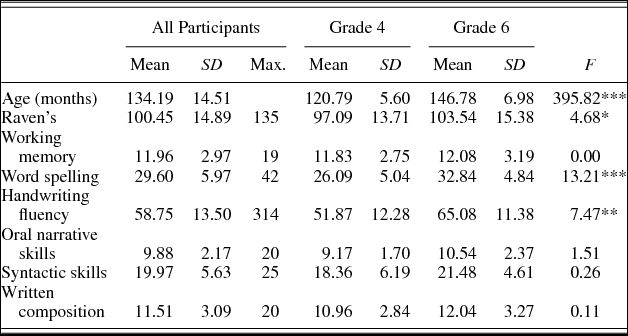
Table 1 shows the means and standard deviations of the measures in each grade, and the analysis of covariance (ANCOVA) test results. No floor or ceiling effect was evident. One-sample t tests conducted for each measure among participants in each grade showed that the performance of the participants on all measures was significantly different from the minimum scores (ts > 15.53, ps < .001) and the maximum scores (ts < –5.40, ps < .001).
Means, standard deviations, analysis of variance, and analysis of covariance results for measures in the present study

Note: Raven's, Raven's Standard Progressive Matrices. Analyses of covariance were conducted for working memory, word spelling, handwriting fluency, oral narrative skills, syntactic skills, and written composition; grade was entered as the independent variable, and age and Raven's scores were entered as covariates.
*p < .05. **p < .01. ***p < .001.
To examine the group differences between the participants in Grade 4 and Grade 6 in all measures, a multivariate analysis of covariance was conducted. In the multivariate analysis of covariance models, the measures were entered as the dependent variables, with grade (Grade 4 vs. Grade 6) as the independent variable, and age and Raven's scores as covariates. The results showed that the main effect of grade, Wilks λ = 0.78, F (6, 85) = 3.96, p < .01, was statistically significant.
Across-grade comparison on measures
A series of ANCOVAs was conducted to examine the differences in performance in the cognitive–linguistic measures between the participants in Grade 4 and Grade 6. In the ANCOVA, grade (Grade 4 vs. Grade 6) was entered as the independent variable, and age and Raven's scores were entered as covariates. Results showed that Grade 6 participants performed better than Grade 4 participants only in word spelling, and handwriting fluency measures (Fs > 7.46, ps < .01). No significant between-grade difference was found in measures of working memory, oral narrative skills, syntactic skills, and written composition.
Correlation
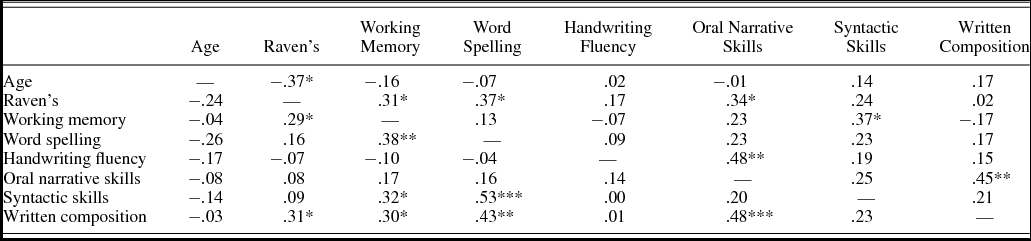
Table 2 presents the correlations between all the measures in the present study. Among Grade 4 participants, written composition was significantly correlated with oral narrative skills only (r = .45, p < .01). Among Grade 6 participants, written composition was significantly correlated with working memory, word spelling, and oral narrative skills (rs > .29, ps < .05).
Correlations among all variables in this study

Note: RA, Raven's Standard Progressive Matrices. The correlations among variables among Grade 4 participants are above the diagonal, and the correlations among variables among Grade 6 participants are below the diagonal.
*p < .05. **p < .01. ***p < .001.
Hierarchical multiple regression on written composition
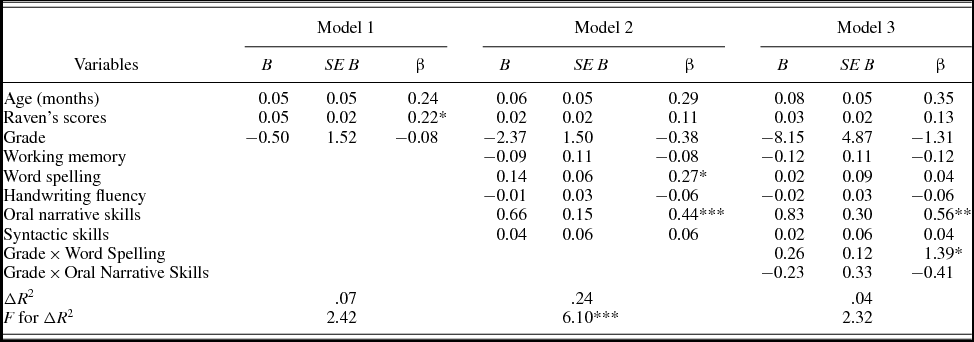
A hierarchical multiple regression analysis with written composition as the dependent variable was conducted to examine the unique contribution of working memory, word spelling, handwriting fluency, oral narrative skills, and syntactic skills to written composition. Age, Raven's scores, and grade were entered into the first step, and all cognitive–linguistic skills (working memory, word spelling, handwriting fluency, oral narrative skills, and syntactic skills) were entered into the second. The interaction effects of grade and word spelling, and of grade and oral narrative skills were entered into the third step.
Results of the hierarchical multiple regression analyses are shown in Table 3. All variables accounted for 35% of the variance in written composition. Age, Raven's scores, and grade accounted for 7% of the variance in written composition, △F (3, 90) = 2.42, p = .07. Working memory, word spelling, handwriting fluency, oral narrative skills, and syntactic skills together accounted for an additional 24% of the variance in written composition, △F (5, 85) = 6.10, p < .001. The interaction effects of grade and word spelling, and of grade and oral narrative skills accounted for an additional 4% of the variance in written composition, △F (2, 83) = 2.32, p = .10, which is not statistically significant. The interaction effect of grade and word spelling and that of grade and oral narrative skills did not contribute a significant amount of unique variance to writing after controlling for the contribution by working memory, word spelling, handwriting fluency, oral narrative skills, and syntactic skills. Based on the results, including final standardized βs, shown in Model 3, oral narrative skills and the interaction effect of grade and word spelling were unique predictors of written composition in the context of all variables.
Summary of hierarchical multiple regression analysis predicting written composition from cognitive–linguistic skills measures

Note: Raven's, Raven's Standard Progressive Matrices.
*p < .05. **p < .01. ***p < .001.
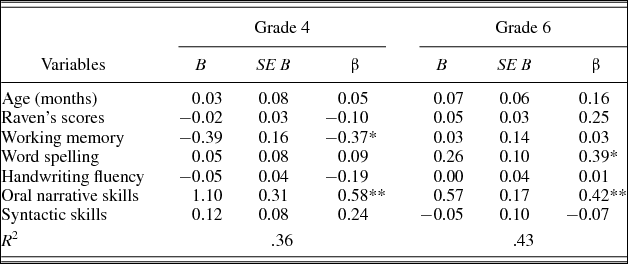
In view of the significant interaction effect of grade and word spelling, separate multiple regression analyses were conducted among participants in Grade 4 and Grade 6. Age and Raven's scores, were entered into the first step, and all cognitive–linguistic skills (working memory, word spelling, handwriting fluency, oral narrative skills, and syntactic skills) were entered into the second.
Results of the hierarchical multiple regression analyses are shown in Table 4. Age and Raven's scores accounted for 4% of the variance in written composition in Grade 4, △F (2, 42) = 0.77, p = .47, and 10% of the variance in written composition in Grade 6, △F (2, 46) = 2.43, p = .10. Working memory, word spelling, handwriting fluency, oral narrative skills, and syntactic skills together accounted for an additional 33% of the variance in written composition in Grade 4, △F (5, 37) = 3.83, p < .01, and 34% of the variance in written composition in Grade 6, △F (5, 41) = 4.88, p < .01. Based on the results of the final standardized βs, oral narrative skills and working memory were unique predictors of written composition in Grade 4, and word spelling and oral narrative skills were unique predictors of written composition in Grade 6.
Summary of hierarchical multiple regression analysis predicting written composition from cognitive–linguistic skills measures

Note: Raven's, Raven's Standard Progressive Matrices. When the measure of working memory was not included in the hierarchical multiple regression analyses, oral narrative skills were unique predictors of written composition in Grade 4, and word spelling and oral narrative skills were unique predictors of written composition in Grade 6.
*p < .05. **p < .01.
The fact that working memory was not significantly correlated with written composition, but was a significant predictor of written composition in the multiple regression equation in Grade 4 with a negative standardized β value, suggested the presence of suppression. A series of multiple regression analyses were conducted among Grade 4 participants. In each of the multiple regression equations, one of the predictors (i.e., word spelling, handwriting fluency, oral narrative skills, or syntactic skills) was dropped out to examine the potential source of the suppression. The results suggested that the suppressor effect was present when oral narrative skills were in the equations. Given the small sample size of participants in each grade, caution is needed in interpreting the results of the multiple regression analyses.
DISCUSSION
Cognitive–linguistic skills important to Chinese writing in upper elementary grades
In the present study, participants in Grade 4 and Grade 6 were administered tasks on word spelling, handwriting fluency, working memory, oral narrative skills, syntactic skills, and written composition. The ANCOVA results showed that sixth graders performed significantly better than fourth graders only in word spelling and handwriting fluency among all cognitive–linguistic skills assessed. This suggested that accuracy and automaticity in character production were still developing in upper elementary grades because participants in Grade 6 demonstrated significantly better spelling accuracy and faster handwriting fluency than participants in Grade 4.
The orthographic rules in Chinese are rather complicated due to the characteristics of Chinese orthography, such as different degrees of positional, semantic, and phonological regularities for radicals, and a large number of homophones and orthographic units (Ho, Reference Ho and Bond2010; Ho, Yau, & Au, Reference Ho, Yau, Au, McBride-Chang and Chen2003). It was thus expected that Chinese children may take a long period of time to attain automaticity in transcription skills. Previous studies examining transcription skills and written composition in Chinese (Yan et al., Reference Yan, McBride-Chang, Wagner, Zhang, Wong and Shu2011; Yeung et al., Reference Yeung, Ho, Chan and Chung2013a, Reference Yeung, Ho, Chan and Chung2013b) mainly focused on early elementary grades. Results from the present study help portray a more comprehensive picture of transcription skills development across elementary grades.
Transcription skills
Our findings were only partially consistent with our hypothesis that transcription skills played a significant role in Chinese writing development across elementary grades. Multiple regression analysis results showed that the interaction effect of grade and word spelling was a significant unique predictor of written composition performance in the context of other cognitive–linguistic skills. Separate multiple regression analyses among participants in Grade 4 and Grade 6 revealed that word spelling was a significant unique predictor of written composition in Grade 6, but not in Grade 4. In contrast to our hypothesis, the importance of spelling accuracy in writing development in upper elementary grades was not surpassed by handwriting fluency. Handwriting fluency was not a significant unique predictor of written composition in upper elementary grades in the present study.
The contribution of transcription skills to Chinese written composition among upper elementary graders was not as strong as expected. Studies on children learning to write in more transparent orthographies, such as Turkish (Babayiğit & Stainthorp, Reference Babayiğit and Stainthorp2010, Reference Babayiğit and Stainthorp2011) and Finnish (Mäki et al., Reference Mäki, Voeten, Vauras and Poskiparta2001), showed that spelling accuracy only had a time-limited impact on written composition performance in early elementary grades but not beyond. In contrast, spelling accuracy has been found to play a prominent role in English written composition development across elementary grades (Abbott et al., Reference Abbott, Berninger and Fayol2010; Graham et al., Reference Graham, Berninger, Abbott, Abbott and Whitaker1997).
The Chinese writing system is more opaque than the English orthography. It was thus speculated that transcription skills would have an important impact on Chinese writing development beyond early elementary grades. In past studies where spelling and handwriting were found to be significant longitudinal predictors of written composition across elementary grades (Abbott et al., Reference Abbott, Berninger and Fayol2010; Graham et al., Reference Graham, Berninger, Abbott, Abbott and Whitaker1997), measures of oral narrative skills, working memory, and syntactic skills were not included in the analyses. With the inclusion of other cognitive–linguistic skills that are potentially important to writing development, it was hoped that findings from the present study can help understand the relative importance of the different types of cognitive–linguistic skills in Chinese writing development.
Findings in the present study and previous studies on Chinese writing development (e.g., Yeung et al., Reference Yeung, Ho, Chan and Chung2013a, Reference Yeung, Ho, Chan and Chung2013b) have shown that the complexity of the Chinese writing system might lengthen the significance of spelling accuracy in the course of Chinese written composition development. However, neither word spelling nor handwriting fluency was a significant unique predictor of written composition among Chinese fourth graders in the present study. This pattern of results was different from that in the study by Yeung et al. (Reference Yeung, Ho, Chan and Chung2013a), which also examined the contribution of working memory, transcription skills, and oral language skills to written composition among fourth graders.
The methodology employed by the present study and the study by Yeung et al. (Reference Yeung, Ho, Chan and Chung2013a) was highly similar. One major difference that might have contributed to the different patterns of results in the two studies was the measures used to assess oral narrative skills. In the study by Yeung et al. (Reference Yeung, Ho, Chan and Chung2013a), oral narrative skills were assessed by a picture narration task on a topic that is different from the theme of the written composition task. In the present study, an oral version of the written composition task was used to assess oral narrative skills. Given the fact that the design of the oral narrative skills measure in the present study bears more resemblance to the written composition task than that in the study by Yeung et al. (Reference Yeung, Ho, Chan and Chung2013a), the contribution of oral narrative skills to written composition performance was likely to be stronger in the present study than in the study by Yeung et al. (Reference Yeung, Ho, Chan and Chung2013a). As a result, the contribution of other predictive variables, including transcription skills, was likely to be weaker.
Regarding handwriting fluency, we hypothesized that automaticity would occur after the development of accuracy in transcription skills. Because children in the present study were still struggling with accuracy in spelling, even in Grade 6, handwriting fluency was not a significant predictor of written composition. This contrasts with the finding in the study by Yan et al. (Reference Yan, McBride-Chang, Wagner, Zhang, Wong and Shu2011), in which handwriting fluency was a significant predictor of Chinese written composition. One possible reason for the discrepancy in the results was that a time limit of 10 min was imposed in the written composition task in Yan et al.’s (Reference Yan, McBride-Chang, Wagner, Zhang, Wong and Shu2011) study, but no time limit was set for the written composition task in the present study. Speed and fluency are likely to play a more important role for written composition within a limited time period.
Although some early studies on English writing (e.g., Graham et al., Reference Graham, Berninger, Abbott, Abbott and Whitaker1997) showed that the contribution of spelling to compositional quality was via the correlation with handwriting fluency and it was handwriting fluency that contributed directly to compositional quality across elementary grades, more recent findings from longitudinal studies among primary grade children have shown that only spelling, but not handwriting, is a significant longitudinal predictor of written composition (e.g., Abbott et al., Reference Abbott, Berninger and Fayol2010). Still, handwriting fluency, an indication of automaticity in transcription skills, is expected to play an increasingly important role in written composition development as students progress through the grades, when students have achieved a high level of accuracy in spelling. Future studies on writing development among Chinese students in middle and high schools are needed to test this hypothesis.
Oral language skills
As mentioned, research findings regarding the contribution of oral language skills to Chinese written composition were far from conclusive. Findings from the present study showed that oral narrative skills were a significant unique predictor of Chinese written composition among children in upper elementary grades in the context of other cognitive–linguistic skills. Oral narrative skills were the only significant predictor of Chinese writing performance in Grade 4 in the context of other variables. In contrast to our hypothesis, syntactic skills were not significant predictors of Chinese written composition in Grade 4 and Grade 6. These patterns of findings were different from those in previous studies among fourth graders (e.g., Yeung et al., Reference Yeung, Ho, Chan and Chung2013a, Reference Yeung, Ho, Chan and Chung2013b).
One possible explanation for the stronger relationship between oral narrative skills and written composition found in the present study compared to those in previous studies (e.g., Yeung et al., Reference Yeung, Ho, Chan and Chung2013a, Reference Yeung, Ho, Chan and Chung2013b) was because the measure of oral narrative skills in the present study bore more resemblance to the measure of written composition in the present study than those used in previous studies. Following the design in the classic study by Juel et al. (Reference Juel, Griffith and Gough1986) on literacy acquisition, oral narrative skills (i.e., ideas generation apart from the mechanics of writing) in the present study were basically identical to the measure of written composition except for the modality of responses. In previous studies, oral narrative skills were assessed by an oral sentence construction task (Yeung et al., Reference Yeung, Ho, Chan and Chung2013b) and a picture narration task (Yeung et al., Reference Yeung, Ho, Chan and Chung2013a), and the format and scoring methods were quite different from that of the measure of written composition in the respective studies.
Besides, the design and scoring method of oral narrative skills in the present study may have impacted the results regarding syntactic skills. One aspect of scoring for the oral narrative skills task was sentence structure, and thus children's syntactic skills were likely to be reflected in the oral narrative skills task performance. Because both the oral narrative skills and the syntactic skills tasks in the present study tapped children's syntactic skills, the unique contribution of the syntactic skills task to written composition was likely to be weaker in the context of the oral narrative skills task. Still, one should not overestimate the impact of the methodology used on the findings. In the study by Juel et al. (Reference Juel, Griffith and Gough1986), the path coefficient from oral narrative skills to written composition was only 0.22 in Grade 1 and it rose to 0.54 in Grade 2. In other words, similarities between oral narrative skills and written composition in terms of the format and scoring of measures alone cannot guarantee a significant relationship between the two.
In general, the present study contributes to the research efforts in mapping the developmental pattern of the two major components of writing in the model (transcription and text generation) in different phases of Chinese writing development among elementary grade students by providing additional data among children in upper elementary grades. Findings from past studies (e.g., Yeung et al., Reference Yeung, Ho, Chan and Chung2013a, Reference Yeung, Ho, Chan and Chung2013b) suggested that transcription skills emerged as an important skill in writing development at an early phase, and the present study showed that transcription skills was a unique predictor of writing performance in Grade 6, but not in Grade 4. Past studies have shown that oral expressive skills were only predictive of writing among children in Grade 2 (Yeung et al., Reference Yeung, Ho, Chan and Chung2013b), but not in Grade 4 (Yeung et al., Reference Yeung, Ho, Chan and Chung2013a, Reference Yeung, Ho, Chan and Chung2013b). However, findings in the present study showed that oral narrative skills were significant predictors of writing in Grade 4 and Grade 6.
This difference in findings may be attributable to the differences in the measures of oral language skills used in the different studies. While the measures of the construct of transcription were consistent across studies (Abbott et al., Reference Abbott, Berninger and Fayol2010; Berninger et al., Reference Berninger, Cartwright, Yates, Swanson and Abbott1994), the measures of oral language skills (including vocabulary, word fluency, oral retelling) were quite diverse in different studies (Berninger & Abbott, Reference Berninger and Abbott2010; Olinghouse & Leaird, Reference Olinghouse and Leaird2009; Roth, Reference Roth2000). To further discern the role of oral language skills in writing development, more research efforts are needed to explore the relationship between specific aspects of oral language skills and writing in future studies.
Conclusion
In this paper, we have examined the developmental pattern of cognitive–linguistic skills related to writing development in upper elementary grades. Our results supplement the findings from past studies in which either the predictors (e.g., Yeung et al., Reference Yeung, Ho, Chan and Chung2013a, Reference Yeung, Ho, Chan and Chung2013b) or the writing performance (e.g., Yan et al., Reference Yan, McBride-Chang, Wagner, Zhang, Wong and Shu2011) was measured in early elementary grades. Although spelling was still a significant predictor of Chinese writing in Grade 6, the significance of transcription skills in upper elementary grades was not as strong as expected. Similar to the findings in the longitudinal study by Abbott et al. (Reference Abbott, Berninger and Fayol2010) among English children, only spelling, but not handwriting, is a significant predictor of written composition among participants in the present study.
The types of cognitive–linguistic skills that were found to be important in Chinese writing among participants in upper elementary grades were in line with the simple view of writing. The findings suggest that the simple view of writing can be generalized to explaining writing development among beginning writers in Chinese, an orthography that is relatively difficult to master compared to other orthographies that have been examined in light of the simple view of writing (e.g., English: Berninger et al., Reference Berninger, Cartwright, Yates, Swanson and Abbott1994; Berninger, Whitaker, Feng, Swanson, & Abbott, Reference Berninger, Whitaker, Feng, Swanson and Abbott1996; Finnish: Mäki et al., Reference Mäki, Voeten, Vauras and Poskiparta2001; Turkish: Babayiğit & Stainthorp, Reference Babayiğit and Stainthorp2010, Reference Babayiğit and Stainthorp2011). This supports the universality of the simple view of writing across orthographies.
However, marked differences in terms of the developmental significance of transcription and text generation in different grades have been noted in studies on different orthographies. It has been observed that the simpler the orthography, the shorter the developmental period of writing that is affected by proficiency in transcription skills, and the earlier the emergence of the significance of oral narrative skills in writing development. This underscores the influence of the complexity of orthography on writing development. Universal models on reading development, such as orthographic depth hypothesis (Katz & Frost, Reference Katz and Frost1992), have paid special attention to the influence of the nature of orthographies on literacy development. It is highly plausible that the complexity of orthography has an important bearing on models of writing development.
Concerning educational implications, our findings suggest that any effective instruction on writing in Chinese should consider teaching both spelling and composing. Berninger et al., (Reference Berninger, Abbott, Abbott, Graham and Richards2002) compared four time-equated treatments: spelling, composing, combined spelling and composing, and untreated control, among third graders with low compositional fluency and found that the spelling and composing treatments were the most effective for persuasive essay writing, and improved performance in both spelling and composing.
The findings in the present study should be interpreted with some caution due to the following limitations. First, the present study was a cross-sectional study comparing different children at different phases of writing development. Second, each construct was only assessed by one measure, and these measures were not standardized tests. Third, the relatively small sample size limited the representativeness of the findings for school children of the same age range.
To address these limitations, future studies adopting a longitudinal design with a larger sample size are needed to validate the developmental patterns identified in the present study. In addition, previous studies on Chinese writing have mainly focused on narrative writing skills development, and future studies, especially those investigating writing development beyond the elementary grades, should examine different writing genres. Intervention studies examining the effectiveness of writing instruction that focuses on the training of specific cognitive–linguistic skills (e.g., spelling, oral narrative skills, and composing) and a combination of different skills are needed to establish the causal relationships between cognitive–linguistic skills and written composition development.