Introduction
Antipsychotic drugs are frequently used in nursing home patients for the treatment of behavioral problems in dementia. The prevalence of antipsychotic drug use in Dutch nursing homes has been estimated at approximately 35% (van Dijk et al., Reference van Dijk, de Vries, van den Berg, Brouwers and de Jong-van den Berg2000; Zuidema et al., Reference Zuidema, Derksen, Verhey and Koopmans2007) High levels of antipsychotic drug use have also been reported from other countries such as Canada (24%) (Bronskill et al., Reference Bronskill2004), Switzerland (36%) (Gobert and D'hoore, Reference Gobert and D'hoore2005) and Finland (39%) (Alanen et al., Reference Alanen, Finne-Soveri, Noro and Leinonen2006). In the U.S.A. antipsychotic use remains high (27%) (Briesacher et al., Reference Briesacher2005), despite the development of special legislation (OBRA) in 1987 in which specific indications for the use of antipsychotic medications were established to decrease their inappropriate use as chemical restraints (Shorr et al., Reference Shorr, Fought and Ray1994).This high prevalence has raised concerns given the high risk of antipsychotic drug related adverse events and the documented limited efficacy of these drugs in the treatment of behavioral problems in dementia (Schneider et al., Reference Schneider, Pollock and Lyness1990; Carson et al., Reference Carson, McDonagh and Peterson2006). More recently, new concerns have attracted attention. In 2005 the U.S. Food and Drug Administration (FDA) stated that the use of atypical antipsychotic drugs in elderly patients with dementia led to an approximately 1.6–1.7-fold increase in mortality (Kuehn, Reference Kuehn2005). In 2008, this warning was extended to all antipsychotic drugs (Kuehn, Reference Kuehn2008). Despite these concerns, there is no evidence of any substantial change in prescription behavior (Valiyeva et al., Reference Valiyeva, Herrmann, Rochon, Gill and Anderson2008). The lack of alternative care options, pressure from family and nursing staff “to do something”, and concerns regarding deterioration of behavior after stopping may explain why nursing home physicians continue to prescribe antipsychotic drugs. Marked clinical improvements in some patients may influence the physicians perceived success rate. Studies investigating the course of behavioral symptoms in nursing homes are scarce. To our knowledge, there are no large long-term longitudinal studies assessing the course of behavioral symptoms of nursing home patients before, during, and after treatment with antipsychotic drugs. Our primary objective was to describe the course of behavioral problems in a large sample of nursing home patients with dementia treated with antipsychotic drugs.
Methods
Setting
In this observational study, the effect of antipsychotic drug treatment on behavioral symptoms in nursing home patients with dementia was studied by comparing these symptoms before and after the first start of antipsychotic drug treatment using the Dutch Vrije Universiteit Resident Assessment Instrument Database (VURAIDB). The Resident Assessment Instrument (RAI) Database contains more than 400 Minimum Data Set (MDS) items covering 13 domains, including functional, cognitive and behavioral items. It includes a dichotomous registration of antipsychotic drug use in the last week before the assessment. Data are collected with the RAI version 2.0 (Hawes et al., Reference Hawes, Morris, Phillips, Fries, Murphy and Mor1997). The VURAIDB contains over 40,000 anonymous RAI assessments of more than 10,000 residents of 10 nursing homes in the Netherlands. Data were collected from 2002 to March 2008. Nursing home nurses are required to complete assessments for all residents. Residents were generally assessed upon admission and quarterly thereafter. Extra assessments were performed in case of a significant change in a resident's condition. The personnel performing the MDS assessments on each of the wards had received standardized training.
Study population
The source population comprised all nursing home patients aged 55 years and older who were admitted to a dementia ward or had a diagnosis of dementia. At least two MDS assessments had to be available.
Antipsychotic exposure
Nursing home staff recorded the frequency of use of antipsychotic drugs taken by the patient in the seven days before the assessment. New antipsychotic drug use was identified by the first MDS that reports any use of antipsychotic drugs in the last week. If multiple starts occurred, only the initial episode was used for analysis.
Outcome measures
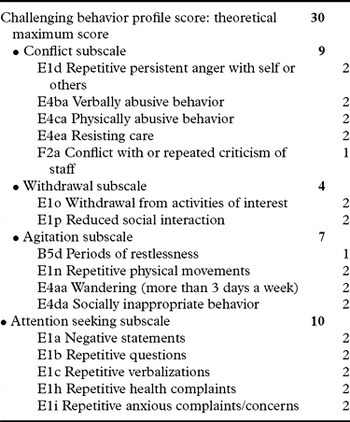
To assess behavior we used the Challenging Behavior Profile (CBP) (Gerritsen et al., Reference Gerritsen, Achterberg, Steverink, Pot, Frijters and Ribbe2008). The CBP includes nine items from the RAI 2.0 anxiety/mood section. A score of 0 on these items indicates no occurrence, a score of 1 indicates that the assessed problem was exhibited up to five days a week over the previous 30 days, and a score of 2 indicates that the problem was exhibited at least six days a week or daily over the previous 30 days. In addition, five items were included from the RAI 2.0 behavior section. For these items, a score of 1 indicates that the problem was exhibited up to three days over the previous week; a score of 2 indicates that the problem occurred almost daily (4–6 days) over the previous week; a score of 3 indicates that the problem occurred daily. For an optimally balanced contribution of each item to this scale score, categories 1 and 2 of the items with four response categories are taken together. The items are grouped in four subscales: conflict, agitation, withdrawal and attention seeking. The CBP score is the sum of the four subscales and ranges from 0 to 30. It is defined as being “extreme” if the total score is greater or equal than 15. A score of 10–15 was defined as “severe”, 5–10 as “moderate” and 1–5 as “mild”. A detailed description of the CBP items is given in Table 1.
Construction of the CBP score

Abbreviations: CBP = Challenging Behavior Profile; RAI = Resident Assessment Instrument.
The used MDS items have been validated in three studies comparing these items with (among others) the Psychogeriatric Dependency Rating Scale, the Brief Psychiatric Rating Scale and the Physician Behavior Checklist Score. These studies demonstrated good interrater reliability coefficients (0.63) and concurrent validity correlations of 0.51 to 0.58 (Hawes et al., Reference Hawes, Morris, Phillips, Mor, Fries and Nonemaker1995; Frederiksen et al., Reference Frederiksen, Tariot and De1996; Snowden et al., Reference Snowden1999; Reference Snowden, Sato and Roy-Byrne2003). For the CBP internal consistency, interrater reliability and validity against the Behavior Rating Scale for Psychogeriatric Inpatients (GIP) have been established (Gerritsen et al., Reference Gerritsen, Achterberg, Steverink, Pot, Frijters and Ribbe2008).
Since the CBP does not cover all individual items describing behavior or neuropsychiatric functioning, we also assessed outcomes on the following MDS items: unrealistic fear, unpleasant mood in the morning, attention deficit, incoherent speech, delusions and hallucinations.
Data analysis
We calculated the CBP scores for all assessments during the entire follow-up. For each patient the assessment closest before the first assessment mentioning antipsychotic drug use was used to calculate the CBP before the start. The first assessment mentioning antipsychotic drug use was used to estimate the scores during treatment. The first assessment without antipsychotic drug use was used to calculate the scores after withdrawal of therapy. Any increase in the CBP score is considered a deterioration, and any decrease an improvement of symptoms. A withdrawal was considered successful if the patient remained stable or improved at the first and next assessment after withdrawal.
Statistical analysis was performed with SPSS version 15.0. Wilcoxon matched pairs signed ranks test was used to evaluate the difference in symptom and overall scores before, during and after treatment for each individual. As we expect the number of missing values to be low and at random, we used pair-wise deletion of missing data resulting in variable numbers of patients for the assessed items.
Results
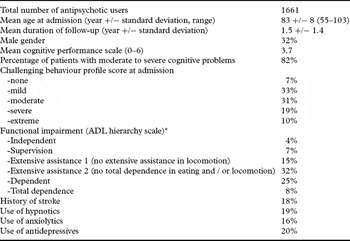
Of 10,318 nursing home residents included in the VURAI database, 9852 patients were aged 55 years or older. After excluding 5831 patients without diagnosis of dementia, our study population consisted of 4021 patients. From these, antipsychotic drug use was recorded for 1904 patients at any time during follow-up (47%). After excluding 243 patients for lack of follow-up, 1661 patients remained for analysis. The mean age was 83 years, 68% were women and 82% suffered from moderate to severe cognitive problems, defined as a score >2 on the Cognitive Performance Scale which ranges from 0 to 6 (Hartmaier et al., Reference Hartmaier, Sloane, Guess and Koch1994). The patients' characteristics are shown in Table 2. Almost half of these patients used an antipsychotic drug during the entire follow-up (820 patients) so effects of starting or stopping an antipsychotic drug could not be measured. We identified 319 patients with a first start of antipsychotic drug treatment during follow-up, 285 patients who stopped using antipsychotic drug during follow-up and 237 patients with both a start and stop of an antipsychotic drug. While most of the data were complete, missing information in 3% of patients resulted in variable numbers of patients eligible for analysis. Patients were followed until death (44%), discharge (7%) or the end of the study period (49%). The average time-interval between the assessments was 105 days (median 91 days).
Characteristics of the study population

Abbreviations: ADL = Activities of Daily Living.
*The hierarchical ADL scale ranges from minor oversight to highly dependent (Morris et al., Reference Morris, Fries and Morris1999).
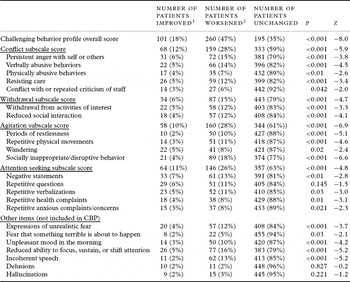
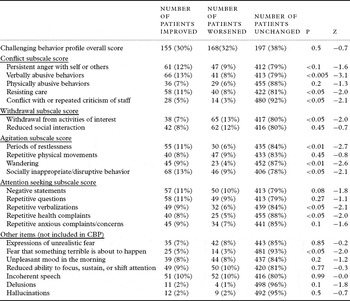
During treatment, mean scores for all evaluation points on the CBP and individual subscales were worse than the last recorded scores (Figure 1). Of the 556 patients starting on a antipsychotic drug, 101 (18%) improved and 260 (47%) deteriorated on the CBP score compared to their scores before therapy (Wilcoxon test, z = −7.955; p<0.001) – see Table 3. After at least three months of use, 134 (24%) improved and 296 (53%) deteriorated compared to baseline (Wilcoxon test, z = −7.531; p<0.001). The mean CBP increased from 6.1 at admittance to 7.6 before therapy. It increased to 8.9 directly after the start and was 9.4 after at least three months of use. Patients with severe behavioral problems prior to antipsychotic drug use showed improvement more often than patients with mild problems (Table 4).The course of challenging behavior after withdrawal of therapy was evaluated in 520 patients (data missing in three patients, 0.6%) (Table 5 and Figure 2). The challenging behavior profile improved in 155 patients (30%), worsened in 168 (32%), and remained stable in 197 patients (38%) (Wilcoxon test, z = −0.697; p = 0.486). At next assessment, these figures are 27% improvement, 42% worsening and 31% unchanged, (z = −2.77; p = 0.006).
Course of challenging behavior for starters

Wilcoxon matched signs paired ranks test for changes in challenging behavior profile before and at first assessment after start of antipsychotic drug use (n = 556)

Abbreviations: CBP = challenging behavior profile.
1The actual number of patients showing any improvement on these symptoms after start of antipsychotics.
2The actual number of patients showing any worsening on these symptoms after start of antipsychotics.
Linear-by-linear association of severity of behavior and response to therapy (p<0.001)

Abbreviations: CBP = challenging behavior profile.
Wilcoxon matched signs paired ranks test for changes in challenging behavior profile before and at first assessment after withdrawal of antipsychotic drug use (n = 520)

Abbreviations: CBP = challenging behavior profile.
Course of challenging behavior after withdrawal of antipsychotics

Discussion
We examined the course of behavioral symptoms in nursing home patients with dementia who started antipsychotic treatment during their stay. We found an estimated prevalence of antipsychotic drug use of 47% in our population during the study period from 2002 to 2008, which is comparable to the prevalence found by van Dijk (two-year prevalence 56%) in 1995 and by Zuidema (point prevalence 37%) in 2003 (van Dijk, Reference van Dijk, de Vries, van den Berg, Brouwers and de Jong-van den Berg2000; Zuidema, Reference Zuidema, Derksen, Verhey and Koopmans2007). Short-time antipsychotic use may have been missed in our study, resulting in an underestimation of the prevalence. At group level, we observed an improvement of behavioral symptoms in one-fifth to a quarter of the patients while half of the patients showed a worsening of behavioral symptoms. These results are in line with results from other studies: Schneider's meta-analyses on the effects of treatment with conventional antipsychotic drugs on agitation showed improvement in 18% of treated patients compared to controls (Schneider et al., Reference Schneider, Dagerman and Insel2006a). For the atypical antipsychotic drugs, Schneider reported benefit in 26–32% of patients randomly assigned to olanzapine, risperidone and quetiapine compared to 21% with placebo (Schneider et al., Reference Schneider2006b). After three months, no difference in functioning, care needs, or quality of life was found (Sultzer et al., Reference Sultzer2008). In a 12-week randomized controlled trial (RCT) among 345 patients with Alzheimer's disease, de Deyn et al. found no significant difference between the percentage of responders to risperidone, haloperidol and placebo on behavioral problems. In this study responders were defined as those patients who improved more than 30% on the BEHAVE-AD total score. An analysis of subscales, however, proved a significant effect on the aggression subscales, a finding that dominated the conclusions (de Deyn et al., Reference de Deyn1999). In another large RCT, Katz et al. defined responders as having a 50% reduction in BEHAVE-AD scores, and found only 12% more responders in the treatment group compared to placebo. He noted that only scores on the aggressiveness and paranoid delusion subscales were significantly reduced with antipsychotic drug use (Katz et al., Reference Katz, Jeste, Mintzer, Clyde, Napolitano and Brecher1999). A meta-analysis of all RCTs for atypical antipsychotic drugs showed overall limited effects on behavioral problems (Schneider et al., Reference Schneider, Dagerman and Insel2006a).
Differences in the assessment scales used, however, limit comparisons across trials. As most RCTs reported a mean change from baseline scores instead of a paired t-test for each individual, the number of patients that benefit from treatment is not reported in most studies. The results of three observational longitudinal studies on the prevalence of behavioral symptoms are also comparable with our study as they suggest that patients taking antipsychotic drugs are not more likely to improve than antipsychotic drug-free patients (Ballard et al., Reference Ballard2001; Aalten et al., Reference Aalten, de Vugt, Jaspers, Jolles and Verhey2005; Selbaek et al., Reference Selbaek, Kirkevold and Engedal2008). Our findings suggest that patients with severe behavioral symptoms benefit more from treatment, a finding consistent with Ballard et al. (Reference Ballard2008). This reduction in symptoms may, however, reflect the natural course of disease.
Discontinuation of antipsychotic drugs for behavioral symptoms has been reported to be successful in the majority of patients in all published studies (Thapa et al., Reference Thapa, Meador, Gideon, Fought and Ray1994; Bridges-Parlet et al., Reference Bridges-Parlet, Knopman and Steffes1997; Cohen-Mansfield et al., Reference Cohen-Mansfield, Lipson, Werner, Billig, Taylor and Woosley1999; van Reekum et al., Reference van Reekum2002; Ballard et al., Reference Ballard2004; Reference Ballard2008; Bergh and Engedal, Reference Bergh and Engedal2008; Ruths et al., Reference Ruths, Straand, Nygaard and Aarsland2008). Our findings suggest that behavioral problems worsen following the stopping of the antipsychotic drug in about one-third of the patients. This figure is comparable with the results of two studies of Ballard et al. (Reference Ballard2004; Reference Ballard2008) and one of Ruths et al. (Reference Ruths, Straand, Nygaard and Aarsland2008), who both found no deterioration after discontinuation in at least 67% of patients. Our study adds to the growing evidence that antipsychotic treatment of behavioral problems of dementia is often inefficient. Given the reported high rates of adverse events such as extrapyramidal symptoms (EPS) (Lee et al., Reference Lee2005), falls (Hien et al., Reference Hien2005), hip fractures (Liperoti et al., Reference Liperoti2007), venous thrombo-embolism (Zornberg and Jick, Reference Zornberg and Jick2000), cerebrovascular events (Gill et al., Reference Gill2005; Kleijer et al., Reference Kleijer, van Marum, Egberts, Jansen, Knol and Heerdink2008), pneumonia (Knol et al., Reference Knol, Marum, Jansen, Souverein, Schobben and Egberts2008), or death (Schneider et al., Reference Schneider, Dagerman and Insel2005; Wang et al., Reference Wang2005; Setoguchi et al., Reference Setoguchi, Wang, Alan, Canning, Kaci and Schneeweiss2008; Ballard et al., Reference Ballard2009), and the high prevalence of behavioral symptoms found in this study, this finding underlines the need for new effective and safe therapies.
The results of our study must be interpreted within the context of a number of limitations. As this is a descriptive study, it does not intend to prove that individual patients did worse or better because of the treatment in question. The association of antipsychotic treatment with an increase in behavioral symptoms does suggest that the influence of this therapy is limited, but we do not know how this increase in symptoms would have been without treatment. Perhaps antipsychotic drug use prevented behavioral problems rising to extreme levels, in which case this therapy would still be effective despite the higher CBP scores. Since it is common practice to prescribe antipsychotic drugs in case of behavioral problems, there is no way we can predict the level of problems in an antipsychotic drug free situation. The high number of patients not eligible for evaluation must be considered when interpreting the results. Given the vulnerability of the study population, the substantial number of deaths is not surprising and reflects real clinical practice. Antipsychotics have been shown to be more effective for true psychotic symptoms (hallucinations and delusions) and aggression. Using the CBP and its subscales may dilute a positive effect on these symptoms. We therefore included all results on symptom levels in Tables 3 and 5. We found no specific improvement of physical aggression, and a low prevalence of reported delusions and hallucinations.
Some limitations of this study relate to the inherent limitations of the RAI database. First, it relies on nursing staff for information in order to complete the assessment scales. To make sure that the patient's behavior is adequately recorded, the behavioral items of the MDS are always completed by nurses directly involved in the daily care of the patients. As in the MDS, no special emphasis is placed on the report of behavioral symptoms and these symptoms may be under-reported when compared to the use of specific research instruments such as the Cohen Mansfield Agitation Inventory (Bharucha et al., Reference Bharucha2008). Secondly; we used reported antipsychotic drug use instead of pharmacy records. As failure to report antipsychotic drug use is possible, the use of antipsychotic drugs may have been under-reported. We expect any resulting bias to be non-differential. Finally, antipsychotic drugs are often started when extremes of behavior occur, but this initial increase in behavioral symptoms will not always be captured in a quarterly assessment. This may lead to an underestimation of the initial effect of antipsychotic drugs. Nurses and staff were therefore encouraged to do an extra assessment if there was a significant change in the patient's status, which happened in 11% of cases. If, however, a MDS is recorded at a time of extreme behavioral problems, a regression to the mean phenomenon is likely to occur. In such a case, improvement is likely to occur spontaneously and is not necessarily related to the effect of antipsychotic drug treatment. This phenomenon may explain the better results of antipsychotic drug treatment in severe behavior (Table 4).
The course of symptoms after withdrawal of therapy must also be interpreted with caution, as improved behavior might be a reason to stop, which will cause selection bias. This does, however, reflect the situation in normal clinical practice. The strength of this study is that we have been able to follow a large sample of frail nursing home patients, and used a detailed assessment instrument to assess behavioral symptoms at regular intervals in a naturalistic setting.
In conclusion, these results indicate that the influence of antipsychotic therapy on the course of behavioral symptoms in nursing home with dementia is limited but not zero. Given these results and the current knowledge regarding major short- and long-term risks, doctors should be very reserved in prescribing antipsychotic drugs for problematic behavior. Since antipsychotic drugs may have an effect in a subgroup of patients and in specific types of problematic behavior (e.g. aggression, agitation) its use must not be prohibited. A detailed assessment of cardiovascular risk factors and goals of therapy must be made prior to starting antipsychotic drug therapy and effects on behavior should be closely monitored. Prescription figures of antipsychotic drugs in 30–40% of the nursing home patients with dementia, with a majority of these patients using antipsychotic drugs for months, can never be explained and defended based on current evidence.
Conflict of interest
None.
Description of authors' roles
D. Frijters and M. Ribbe provided the data; B. C. Kleijer, R. J. van Marum an A. C. Egberts designed the study, analyzed the data and wrote the paper, P. A. Jansen and E. R. Heerdink assisted in the interpretation of the data. All authors reviewed the manuscript and approved the final version.