1 Introduction
1.1 Coarticulation and contrast
Since a vast majority of documented languages contain a contrastive nasal stop (fewer than 2% of documented languages lack phonemic nasals, Maddieson Reference Maddieson, Dryer and Haspelmath2013), vowel nasalization resulting from coarticulation with an adjacent nasal phoneme is a pervasive cross-linguistic phenomenon. Early formal stances on coarticulation (e.g. Chomsky & Halle Reference Chomsky and Halle1968) presumed that coarticulation was a purely mechanistic consequence of physiological constraints on necessary transitions between adjacent articulations and was therefore universal, but relatively uninteresting from the point of view of linguistic competence. Soon after, however, work on coarticulation began to demonstrate that not all of these subphonemic coarticulatory patterns could be explained solely by the mechanics of articulation. A case in point is the observation that coarticulation is sometimes more extensive than physiologically necessary. For example, lip protrusion in French is observed up to six unrounded phonemes before pronunciation of the vowel /y/ (Benguerel & Cowan Reference Benguerel1974), and in English, nasal coarticulation occurs across multiple segments, as well as across word boundaries (Moll & Daniloff Reference Moll and Daniloff1971). Furthermore, overtly comparative work, beginning with Öhman (Reference Öhman1966) (see also e.g. Manuel & Krakow Reference Manuel and Krakow1984, Keating & Cohn Reference Keating and Cohn1988, Beddor & Krakow Reference Beddor and Krakow1999, Beddor, Harnsberger & Lindemann Reference Beddor, Harnsberger and Lindemann2002) has confirmed language-specific differences in the patterns of realization of coarticulation, suggesting that at least some aspects of coarticulation are part of the phonetic grammar.
If coarticulation is grammatically governed and manipulable, it would stand to reason that patterns of coarticulation might be shaped in some way by the contrastive structure of a given language. An explicit statement of such a position was made by Manuel (Reference Manuel1990), who argued that coarticulation should be constrained along phonetic dimensions that are relevant to phonological contrasts. Her guiding assumption was that coarticulation, which arguably by definition renders segments less distinct, is detrimental to segmental contrast, and this is especially the case when the surface-level phonetic patterns are potentially confusable with contrastive patterns in the language. Thus, the greater the pressure to maintain phonologically relevant perceptual distinctiveness, the more degree of coarticulation should be limited.
This prediction seems to be borne out in a number of cases. For example, Manuel & Krakow (Reference Manuel and Krakow1984) show that Shona and Swahili, both of which have five-vowel systems, exhibit greater vowel-to-vowel coarticulation than English, with its much larger vowel inventory. Due to its large inventory, distinctions among the vowels of English are already more tenuous than those of Shona or Swahili, so such a limit on vowel-to-vowel coarticulation in English would reduce the possibility of further threat to the contrast.
More relevantly to the current study, similar patterns have been observed for anticipatory nasal coarticulation as well. In French, which has a set of phonemically nasal vowels, the magnitude of nasal coarticulation has consistently been shown to be smaller than in English, where there is no such nasal contrast among vowels (Cohn Reference Cohn1990, Delvaux et al. Reference Delvaux, Demolin, Harmegnies and Soquet2008), potentially helping to avoid perceptual confusion between nasalized oral vowels (in nasal consonant contexts) and phonemically nasal vowels (Manuel Reference Manuel, Hardcastle and Hewlett1999). Hereafter, we use the term nasal to refer to vowels with phonemically contrastive nasality and nasalized to refer to vowels with contextual or coarticulatory nasalization. Such constraints in French appear to be temporal as well. For example, an oral vowel adjacent to a nasal consonant in a word like bonne /bɔn/ ‘good-fem’ remains oral for most of its duration, showing contextual vowel nasality only at the edge closest to the nasal consonant, maintaining its perceptual distance from a word like bon /b
 / ‘good-masc’, which is nasal throughout (Cohn Reference Cohn1990). Note, however, that there is no within-word minimal pair contrast between oral and nasal vowels in pre-nasal contexts in French, as phonemically nasal vowels do not appear in this position.
On the other hand, carryover nasality is not particularly constrained in French: for example, the pattern and degree of vowel nasality is similar between nez /nɛ/ ‘nose’ and lin /l
 / ‘linen’. In carryover contexts, then, the distinction between contextual nasalization and contrastive nasalization is reduced – despite the fact that it is in this context (as opposed to pre-nasal context) that French actually maintains an oral–nasal vowel contrast. The contrast between vowels in this context is carried somewhat, however, by slight differences in vowel quality between the oral and nasal members of a pair. /
/, for instance, is lower and backer (with higher F1 and lower F2) than /ɛ/. Other vowel pairs in French show similar distinctions (see e.g. Delvaux, Metens & Soquet Reference Delvaux, Metens and Soquet2002, Carignan Reference Carignan2014).
Other cross-linguistic comparisons also call into question the thesis that patterns of coarticulation are determined (at least in part) by a language's contrastive structure. Farnetani (Reference Farnetani, Hardcastle and Marchal1990), for instance, finds that the relatively minimal degree of contextual nasal coarticulation in Italian is comparable to that in French, despite the fact that Italian lacks an oral–nasal phonemic vowel contrast. Similarly, Solé (Reference Solé1995) reports a minimal (and temporally-constant) degree of nasal coarticulation in Spanish, again, despite the lack of an oral–nasal vowel contrast. And van Reenan (Reference van Reenen1982) observes that phonemically nasal vowels in European (Parisian) French are more nasalized than nasal vowels in Canadian (Quebecois) French, despite the fact that this difference clearly cannot be accounted for by differences in the phonological system, as the feature-structural value of nasal vowels in both dialects is ostensibly the same. Furthermore, an aerodynamic comparison of Agwagwune, which has phonemic vowel nasality, and Akan, which does not, found that the attendant difference in coarticulation was not one of degree but rather of timing and location of peak nasalization (Huffman Reference Huffman1988). And the phonologically-conditioned limits on vowel-to-vowel coarticulation have not always been replicated either. (See, for instance the comparison of Mandarin and Cantonese in Mok Reference Mok2013.)
The mixed findings leave open the questions of what the relation is between coarticulation and contrast and what types of influences shape language-internal phonetic and phonological patterning of a single feature. This paper seeks to contribute to the clarification of these issues by describing the coarticulatory and contrastive patterns of vowel nasality in Lakota.
1.2 Nasality in Lakota
Lakota, also called Teton, is a Siouan language spoken in the northern plains of North America. Rood & Taylor (Reference Rood and Taylor1996) estimated that Lakota is the first or second language of approximately 10,000–12,000 people in the United States and Canada. More recent surveys, along with anecdotal evidence, indicate that on and around the reservations in South Dakota and North Dakota, the number of Lakota speakers is approximately 6000, and most of the fluent speakers are over the age of 40 years (Lewis, Simmons & Fennig Reference Lewis, Simons and Fennig2014).
Lakota is of particular interest with respect to nasality because it has both coarticulatory and contrastive vowel nasality. Lakota has five oral vowels, /i e a o u/, and three nasal vowels, /ĩ ã ũ/ (written orthographically as iŋ, aŋ, uŋ). All of these vowels can occur preceding or following a nasal consonant (/n m/), with the caveat that VN sequences are frequently, but not always, heterosyllabic. Within a Lakota morpheme, most syllables have the structure CV or CCV. Vowel deletion and fast speech processes may also create CVC syllables, as in núŋpa ‘two’ [ˈnũpa] > núŋm [ˈnũm]. Within polymorphemic words, however, syllabification of VCCV sequences depends upon the morphological structure of the word. For example, the word šičámna [ʃiˈtʃamna] ‘bad smelling’, in which the /mn/ sequence belongs to a single morpheme, syllabifies as ši.čá.mna [ʃi.ˈtʃa.mna], following the more frequent pattern in the language in which VN sequences are heterosyllabic (V.N). By contrast, čhaŋmháŋska [tʃʰãmˈhãska] ‘chocolate’, which is morphologically čhaŋháŋpi + háŋskA (with final vowel deletion and nasal assimilation in the first word) syllabifies as čhaŋm.háŋ.ska [tʃʰãm.ˈhã.ska], with a tautosyllabic VN sequence. Tautosyllabic VN sequences may also surface in reduplicated forms such as núŋmnuŋpa (núŋm.nuŋ.pa) [ˈnũm.nũ.pa] ‘two at a time’.
The current study examines the acoustic patterns of vowel nasality in Lakota across contrastive and coarticulatory contexts. Previous studies have provided some insights into the language-specific patterns of nasality in Lakota. Rood & Taylor (Reference Rood and Taylor1996: 444) claim, based on auditory observation, that the oral vowels /i/, /u/, and /a/ are generally pronounced with some degree of nasalization when they follow a nasal consonant (i.e. in carryover contexts). This basic observation was made earlier in Lakota studies by Boas & Deloria (Reference Boas and Deloria1941: 4) and was re-confirmed by White Hat (Reference White Hat1999: 31). Rood & Taylor (Reference Rood and Taylor1996: 444–445) add that, impressionistically, for some speakers, contrast in vowel nasality is neutralized in these carryover contexts. Furthermore, based on their impressions, it appears that those speakers who maintain a phonemic contrast in these contexts produce ‘strong’ nasalization for phonemically nasal vowels and ‘weak’ nasalization for phonemically oral vowels that are nasalized due to the carryover coarticulation. Based on historical and cross-dialectal evidence, Rood & Taylor (Reference Rood and Taylor1996: 445) also suggest that the speakers who maintain a contrast after nasal consonants are most likely continuing an earlier pattern in the language where full contrast existed in these contexts. Michaud, Jacques & Rankin (Reference Michaud, Jacques and Rankin2012: 222) make a broader, less qualified claim about post-nasal neutralization, saying simply that the opposition between nasal and oral vowels is neutralized after nasal consonants in Lakota.
The aims of this paper are two-fold: first, to document and systematically describe the acoustic nasality patterns in Lakota, a language that is understudied, especially with respect to its phonetics; and second, to contribute meaningfully to the discussion of the relationship between phonological and structural factors on the one hand and the phonetic and articulatory patterns within a language on the other, all within a historically-informed context.
2 Method
2.1 Participants
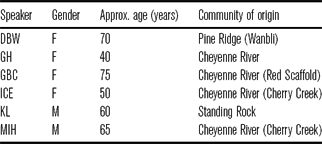
Data were elicited from six speakers of Lakota (four women, two men). The age range of the speakers was about 40–75 years. Four of the speakers were near the top of the age range (over 60 years old), one of the speakers was a generation younger (about 40 years old), and one was in between (in her 50s). The speakers were all from various communities in South Dakota: four from Cheyenne River, one from Standing Rock, and one from Pine Ridge. These speaker demographics are summarized in Table 1. Five of the six speakers are lifelong speakers of Lakota; the sixth (KL) is a speaker since childhood, having learned the language in school. All still speak Lakota regularly with certain friends and community members. Four of the speakers also teach Lakota language in the schools (GH, ICE, MIH) or in cultural seminars (KL).
Participant demographics.

2.2 Materials
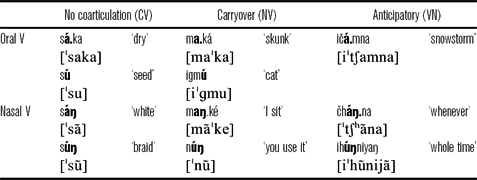
The current study examines phonemically oral and nasal vowels in three contexts: without nasal coarticulation (CV), carryover nasal coarticulation (NV), and anticipatory nasal coarticulation (VN). Note that the nasal segment in the anticipatory coarticulation context was often, but not always, across a syllable boundary. In total, there were 27 words with target low vowels, /a/ or /ã/, and 20 words with target high back vowels, /u/ or /ũ/, distributed across crossed contrastive and coarticulatory categories (except high back vowels in pre-nasal contexts, where there is just one nasal /ũ/, and oral /u/s, which are relatively uncommon, were inadvertently excluded). Oral–nasal vowel pairs were matched as closely as possible for stress and phonetic context. Additional (non-target) /a ãu ũ/ vowels in these words were analyzed as well. Examples of these word types are shown in Table 2; the full word list is given in the appendix.
Example of Lakota words in the six conditions elicited for this study, crossing coarticulatory and contrastive contexts. Target vowels are shown in bold.

2.3 Elicitation
Three of the speakers (DBW, GH, GBC) were recorded in a sound-attenuated booth at the University of Colorado Phonetics Lab in Boulder, CO. Two speakers (ICE, KL) were recorded in a sound-attenuated booth at the Makhoche Recording Studios in Bismark, ND. And the final speaker (MIH) was recorded near Ft. Yates, ND, in a quiet meeting room at a local hotel. Different microphones were used in the different recording settings, but all were studio quality microphones with flat low-frequency response. In each case, the microphone was positioned 4–6 inches directly in front of the speaker's mouth and nose.
The written word list was given to the speakers to look over before recording, and the speakers were given the opportunity to ask questions both before and during the recording session. All of the speakers except GBC had formally studied or taught Lakota and were knowledgeable of the orthography and conventions for writing Lakota. Even so, the speakers displayed different levels of comfort with reading Lakota, so oral prompting with English equivalents was used in some cases (especially for speakers MIH and GBC). During the recording, the word list was presented in several sub-sections, and each sub-section was read three times consecutively by each speaker.
2.4 Nasality (A1-P0 and A1-P1)
The lowering of the velum during vowel nasalization couples the nasal passage with the oral cavity and introduces the resonances of the nasal passage to those already present from the oral cavity. Consequently, nasalized vowels have more ‘formants’, or relative spectral peaks, than non-nasalized vowels. These additional nasal formants have fairly stable and predictable frequencies, with one (called P0) found usually between 250–450 Hz and realized on the first or second harmonic, and a second (called P1) usually around 950–1000 Hz (House & Stevens Reference House and Stevens1956, Hattori, Yamamoto & Fujimura Reference Hattori, Yamamoto and Fujimura1958, Marilyn Chen Reference Chen1997).
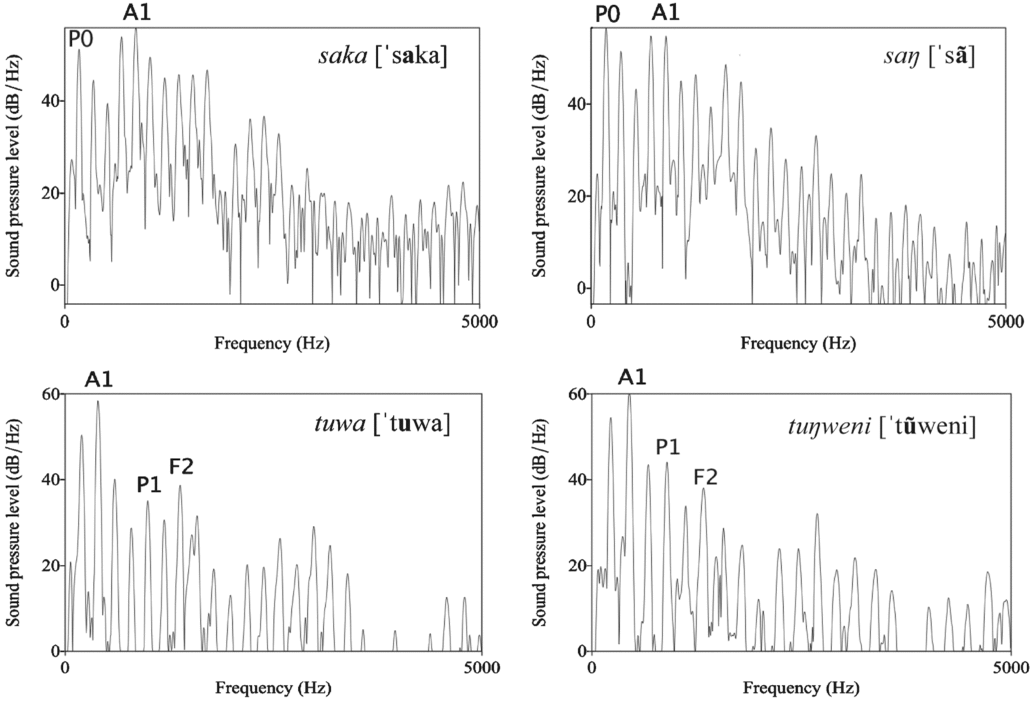
As nasal airflow increases, in other words, as nasalization increases, the amplitude of these nasal formant peaks tends to increase. This increase in nasal peak amplitude is accompanied by a damping of the oral formant peaks, especially F1 (whose amplitude is called A1). Therefore, degree of nasalization can be quantified on the basis of the difference in amplitude between the oral formants and the nasal formants (e.g. A1-P0 or A1-P1), which is smaller the more nasal the vowel (Marilyn Chen Reference Chen1997). Figure 1 illustrates A1 and P0 in spectra from oral and contrastively nasal vowels of Lakota.
Spectra of oral and nasal vowels. Top panels: A1 and P0 in spectra of the oral low vowel in saka [ˈsaka] the nasal low vowel in saŋ [ˈsã]; bottom panels: A1 and P1 in spectra of the oral high vowel in tuwa [tuwa] and the nasal high vowel in tuŋweni [tũweni]. Spectrum pairs are from the same native Lakota speaker in the current study.

In the current study, nasality is measured as A1-P0 for non-high vowels and as A1-P1 for high vowels. Because P0 is often obscured by the first formant in high vowels, where F1 is low and in the region of P0, A1-P1 is a more reliable measure in these cases. Measurements were generated automatically by script in Praat at three timepoints across the vowel, including the start and midpoint, and a point half-way between the midpoint and the end of the word. Endpoints were avoided because endpoint measurements proved to be unreliable, due both to the effects of word-final creak and to the difficulty of VC segmentation. At each point, spectra were generated for a single pulse (iterated to fill the analysis window), and A1, P0, and P1 were automatically identified on the basis of pitch and LPC analyses. P0 was selected as the higher of H1 or H2; A1 was selected as the highest harmonic peak within a window of one f0 on either side of the LPC-calculated F1 frequency; P1 was selected as the highest harmonic peak between 850 and 1050 Hz. Tokens with identified f0 or F1 outside of reasonable frequency ranges, as well as high back vowel tokens where identified F2 was non-distinct from identified P1 (since many /u/ and /ũ/ vowels had especially low F2) were flagged and excluded from further analysis. This culling eliminated fewer than 10% of low vowel measurements and nearly a third of high vowel measurements.
Following the measurement of raw acoustic nasality, the data set for non-high vowels (A1-P0) and the data set for high vowels (A1-P1) were separately z-score transformed by speaker for analysis.
The duration of each vowel was also measured.
2.5 Statistical analyses
The z-transformed A1-P0 data for the low vowels (n = 2038) and A1-P1 data for the high back vowels (n = 537) were fit to separate linear mixed models. Each model was fit using the lme4 package (Bates et al. Reference Bates, Maechle, Bolker and Walker2013) in R, and the languageR package (Baayen Reference Baayen2011) was used to produce associated probabilities of t-values based on Markov Chain Monte Carlo sampling. The fixed and random effects structure of the low vowels model contained the main predictors of phonemic vowel nasality (oral, nasal), coarticulatory context (none, anticipatory, carryover), and vowel timepoint (continuous: 1–3), along with interaction terms for these three main predictors. Random intercepts of speaker and item were included to factor out these idiosyncratic effects. The high vowel model was fitted with a similar fixed effects structure; the one difference was that since there were no items with oral vowel /u/ in an anticipatory nasalization context, the coarticulatory context predictor consisted of only two levels (none, carryover).
3 Results
3.1 Contrastive nasality
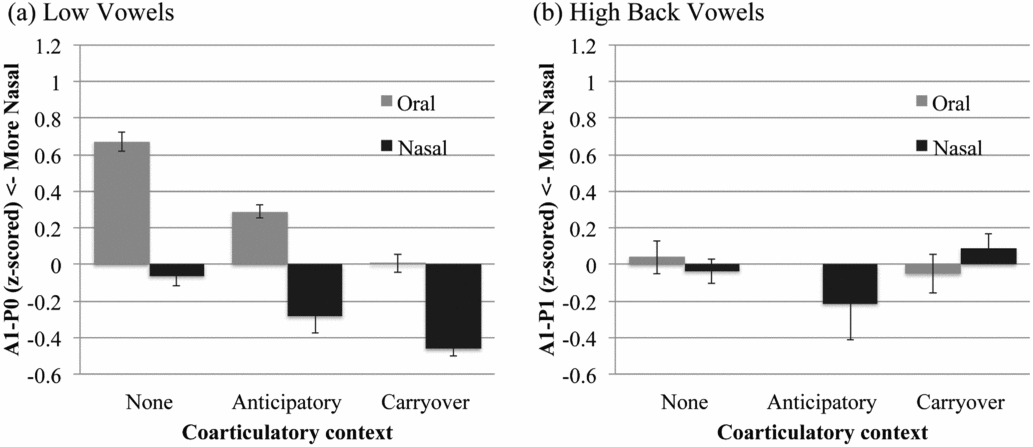
As expected, contrastively nasal vowels were more nasal than oral vowels, at least among low vowels, as shown in Figure 2. (Recall that a lower (z-transformed) A1-P0 or A1-P1 value indicates greater nasalization.) This is most straightforwardly illustrated in CVC-type words, where the vowels can be seen independent of potential coarticulatory influences, but it is also apparent in the VN and NV contexts for the low vowels, where both oral and nasal vowels are also subject to contextual nasalization. Among the high back vowels, there is no apparent oral–nasal contrast. However, looking at these patterns in more detail, across the time course of the vowel (as in Figure 4 below), it can be seen that for the high back vowels in non-coarticulatory contexts (CVC), there is the expected distinction at least at the midpoint and late point. This pattern by timepoint is discussed and analyzed in Sections 3.2.2 and 3.3.2 below.
Mean and standard error values of acoustic vowel nasality, averaged across timepoints, for oral and nasal vowels in anticipatory, carryover, and no nasal coarticulatory contexts. (a) Low vowels (/a/ and /ã/); (b) high back vowels (/u/ and /ũ/).

3.2 Contextual nasality
3.2.1 Low vowels
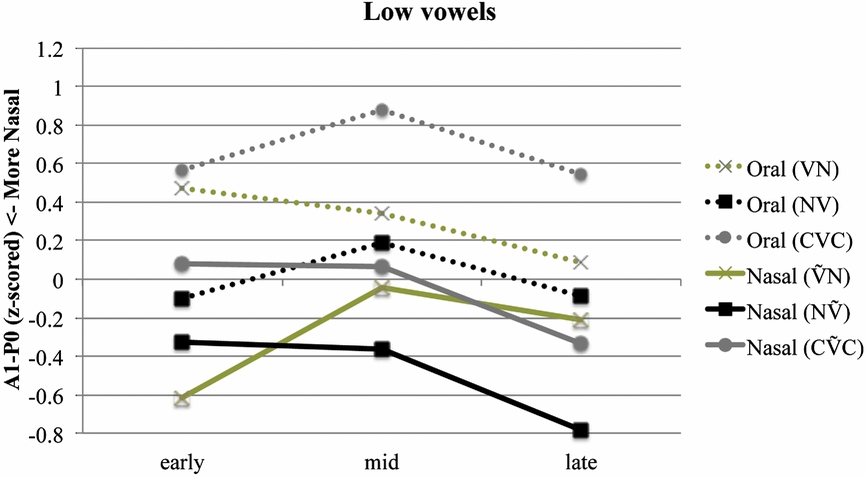
Among low vowels, it is also the case, as expected, that vowels adjacent to nasal consonants generally show greater nasality than vowels not in the context of nasal consonants, as can be seen in Figure 2, as well as in Figure 3 by timepoint. In other words, as seen in the low vowels, there is contextual, or coarticulatory, nasality in Lakota, both anticipatory and carryover.
Mean z-scored A1-P0 for oral (dotted lines) and nasal (solid lines) low vowels (/a/ and /ã/) in anticipatory (VN, indicated by ‘x’), carryover (NV, indicated by squares), and no nasal coarticulation (CVC, indicated by circles) contexts, plotted by timepoint.
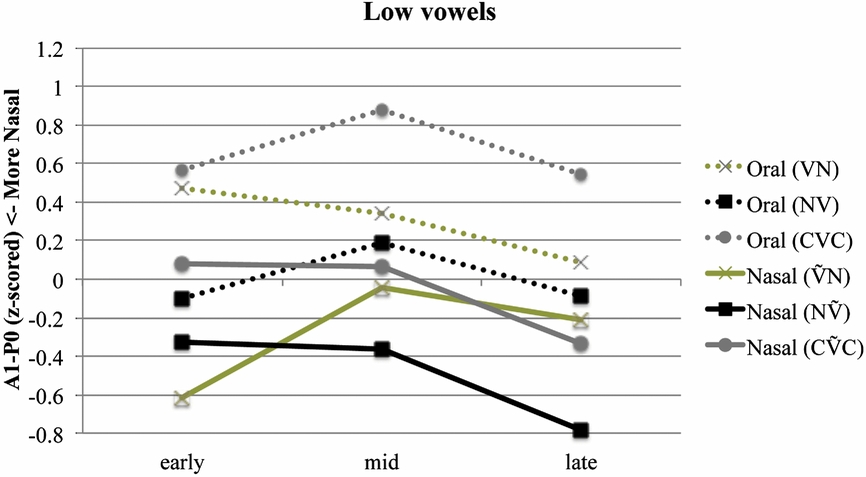
Looking at these vowels, we can see that nasality averaged across the vowel is least in vowels in oral contexts, greatest in vowels in NV (carryover) contexts, and intermediate in VN (anticipatory) contexts. This difference is true of both phonemically oral and phonemically nasal vowels and is consistent with previous characterizations of Lakota that describe strong carryover nasalization (Rood & Taylor Reference Rood and Taylor1996). This pattern is also reasonable given that the anticipatory nasal consonant contexts are overwhelmingly heterosyllabic, while the carryover contexts are tautosyllabic. The syllable boundary (which is also a morpheme boundary, since syllabification in Lakota reflects the morphology) creates a prosodic break between the vowel and consonant in the VN cases that could lead to coarticulatory resistance (Krakow Reference Krakow1999).
In phonemically oral vowels, the pattern of nasality across the three timepoints (early, mid, and late), as shown in Figure 3, is phonetically and phonologically straightforward. The vowel in the oral context, with least nasality (presumably no nasality other than that due to speaker-inherent velum position), has a fairly flat nasality profile, with just a slight peak in A1-P0 at the midpoint. The vowel in pre-nasal context starts oral and becomes increasingly nasal across the course of the vowel, approaching the influencing nasal consonant. The nasality profile for vowels in NV contexts is almost perfectly parallel to that of the vowels in oral contexts, just substantially more nasal. Although nasality in NVs is not greatest at the beginning of the vowel, adjacent to the influencing nasal consonant, this relatively flat pattern for carryover nasality has been reported for other languages as well, e.g. English and French (Cohn Reference Cohn1990).
Among phonemically nasal vowels, the vowel in the oral context, which is least nasal of the nasal vowels overall, shows greatest nasality (lowest A1-P0) at the last measurement point, suggesting that nasal vowels increase in nasality over their course. As with the oral vowels, the nasal vowels in NV contexts show a nasality profile parallel to the no coarticulation context, also with greatest nasality at the last measurement point. The fact that nasality is not greatest adjacent to the nasal (at the beginning of the vowel) is slightly surprising, but no more so than for the oral vowel, and in fact unifies the carryover pattern across oral and nasal vowels. The nasal vowel in pre-nasal (anticipatory) context shows what might seem to be the least predictable profile, with greatest nasality at the start of the vowel, furthest from the conditioning nasal context. We note that there is a small number of words (three) in which the /a/ vowel occurs between two nasal consonants. The vowels in these NVN contexts are similar in degree and pattern of coarticulation to NVs at the early point in the vowel but similar in degree and pattern to VNs at the late point of the vowel. In other words, vowels with two flanking nasals do not appear to be more nasalized by virtue of their bilateral nasal context, but the pattern of their nasalization is reflective of both contexts.
Overall, the nasality profiles of the low nasal vowels (as seen in Figure 3) are more similar to one another than the profiles of the low oral vowels, suggesting that the differences in nasality due to coarticulation are smaller for nasal vowels than for oral ones. These descriptive observations will be statistically confirmed and further analyzed in Section 3.3.1 below.
3.2.2 High back vowels
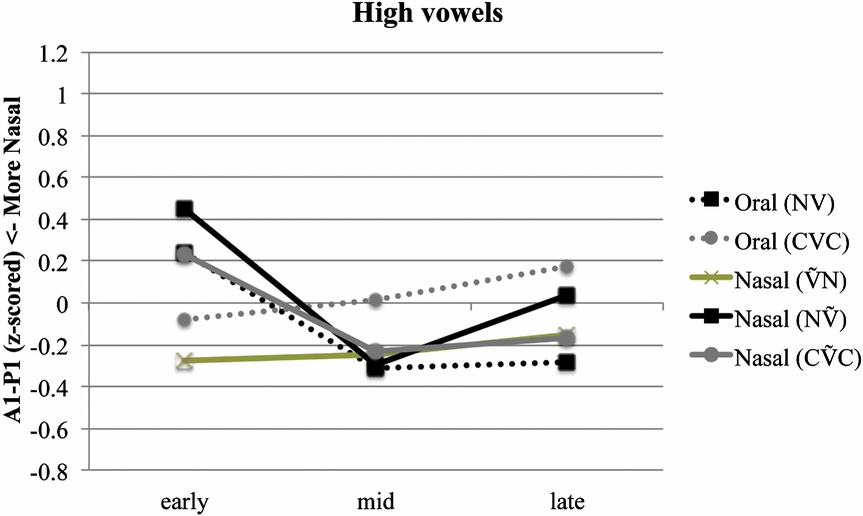
The nasality patterns in the high back vowels are slightly harder to discern, as the conditions are generally less distinct from one another, both on average, as shown in Figure 2 above, and across timepoints, as shown in Figure 4. While the nasal /ũ/ in a VN context does appear to be more nasal than the same vowel in a non-coarticulatory context, suggesting anticipatory coarticulation, there are no comparable differences for either oral or nasal vowels in the NV context.
Mean z-scored A1-P1 for oral (dotted lines) and nasal (solid lines) high back vowels (/u/ and /ũ/) in anticipatory (VN, indicated by ‘x’), carryover (NV, indicated by squares), and no nasal coarticulation (CVC, indicated by circles) contexts, plotted by timepoint. (There were no oral /u/s in anticipatory contexts.)
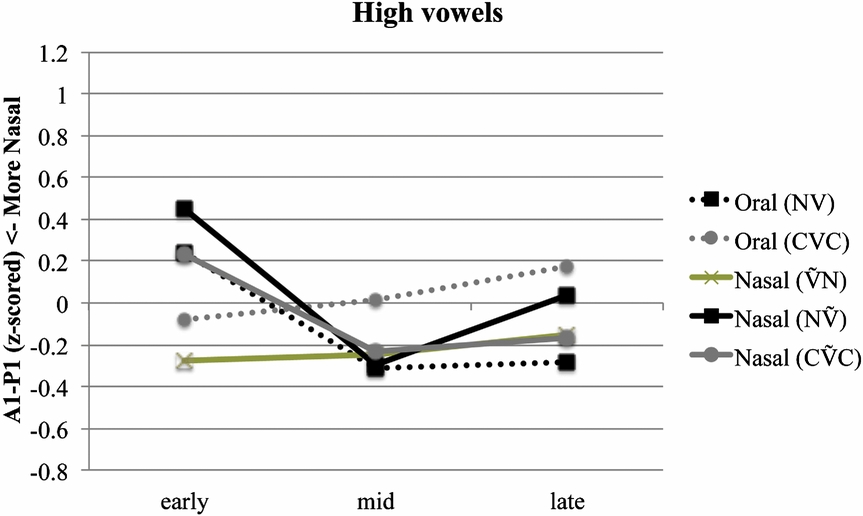
As with the low vowels, the oral vowel in the oral context, with least nasality overall, has a relatively flat nasality profile (in this case, with a slight increase in A1-P0 across the vowel). The oral vowel in post-nasal (NV) context is most oral at the beginning and is more nasal by the end of the vowel. Although this pattern is perhaps unexpected, given the position of the influencing nasal consonant, it matches the pattern in the post-nasal nasal vowel, as well as the nasal vowel in the non-coarticulatory context. Again, as with the low vowels, the phonemically nasal vowels in the oral context and in the NV context show greatest nasality (lowest A1-P0) at the last measurement point, suggesting that high back nasal vowels increase in nasality over their course as well. The nasal vowel in pre-nasal (anticipatory) context shows a fairly flat profile. This profile cannot be compared to the oral vowel's profile since no /u/ vowels were collected in this context.
As noted above, then, overall, the nasality profiles for the high back vowels are more similar to one another than the profiles of the low vowels, indicating fewer distinctions with respect to nasality (either contrastive or coarticulatory) for these vowels than for the low vowels. In particular, there is little evidence for contrastive nasalization in carryover contexts, as well as little evidence for much (carryover) coarticulation in phonemically nasal vowels. These descriptive observations will be statistically confirmed and further analyzed in Section 3.3.2 below.
3.3 Analyzing nasality
3.3.1 Low vowels
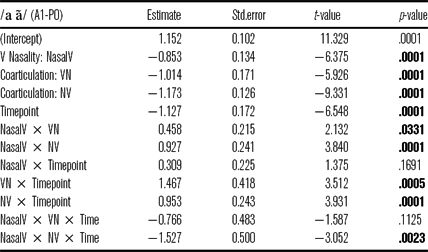
A linear mixed effects model of normalized A1-P0 for the low vowels, reported in Table 3, confirms the observations above. The model revealed a significant main effect for Phonemic Nasality, indicating that nasal vowels have greater acoustic nasality (lower A1-P0) than oral vowels, which were the model default (t = –6.38, p < .0001). There was also a significant main effect of Coarticulatory Context, as both vowels preceding nasals (t = –5.93, p < .0001) and vowels following nasals (t = –9.33, p < .0001) were more nasalized than vowels in non-nasal contexts (the model default). Significant interactions between Phonemic Nasality and Coarticulatory Context were the result of smaller oral–nasal differences in pre-nasal (t = 2.13, p = .03) and especially post-nasal (t = 3.84, p < .0001) contexts than in (default) oral contexts.
Linear mixed effects model for low vowels. Bold indicates significance at the p < .05 level.

The model of low vowels also yielded a significant main effect for Timepoint (t = –6.55, p < .0001), along with significant interactions for Timepoint with Coarticulatory Context (t = 3.51, p = .0005 for anticipatory and t = 3.93, p < .0001 for carryover), indicating generally that the shapes of the nasality contours over time differed across conditions (as described in Section 3.2.1 above) and are relevant patterns in this acoustic data set. In particular, as confirmed in post-hoc regressions by condition, oral vowels before nasal consonants increase in nasality across the vowel (estimate = –.12, t = –3.2, p = .001), as do nasal vowels in non-coarticulatory contexts (est. = –.11, t = –3.7, p < .001) and nasal vowels following nasal consonants (est. = –.14, t = –1.96, p < .05), while nasal vowels before nasal consonants decrease in nasality (est. = .16, t = 3.9, p < .001). In terms of the effects these patterns have on contrast between oral and nasal vowels, we can see via post-hoc t-tests that these vowels differ in post-nasal contexts at the late timepoint (t(36) = 3.29, p < .001) but not early (t(36) = 1.3, p = .19), while the vowels in pre-nasal contexts differ early (t(80) = 6.7, p < .001) but only marginally later (t(80) = 1.8, p = .06).
3.3.2 High back vowels
A linear mixed effects model of normalized A1-P1 for high vowels, reported in Table 4, is somewhat less clear. We attribute the diminished differences, relative to those found among low vowels, to a combination of noisier measurements (since P1 picking is more difficult than P0 picking) and reduced statistical power (due to the smaller number of high vowel stimuli and the fact that nearly a third of possible measurement points had to be omitted because P1 was indistinguishable from the F2 peak), in addition to truly less distinct patterns. The anticipatory (VN) condition was also omitted, since there were only phonemically nasal, and not oral, vowels in this context.
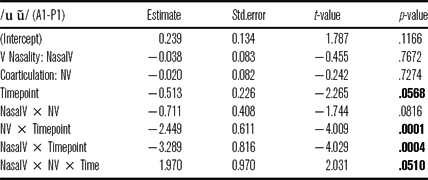
Linear mixed effects model for high back vowels. Bold indicates significance at the p < .05 level or near significance.

The model revealed no main effects of Phonemic Nasality (t = 0.46, p = .77) or Coarticulatory Context (t = 0.24, p = .73). There was, however, a near-significant main effect of Timepoint (t = 2.27, p = .057), as well as significant two- and (near-significant) three-way interactions with Timepoint. In particular, post-hoc regressions by condition confirm that the oral /u/ vowels before nasal consonants (like the /a/ vowels) increase in nasality across the vowel (est. = –.21, t = –3.1, p = .005), as do nasal vowels in non-coarticulatory contexts (est. = –.15, t = –2.9, p = .003) and nasal vowels following nasal consonants (est. = –.17, t = –3, p =.003). The three-way interaction of Phonemic Nasality and Coarticulatory Context by Time was interpreted through observation of the patterns illustrated in Figure 4, along with post-hoc pairwise comparisons. Phonemically nasal vowels in non-coarticulatory contexts were more nasalized than their oral counterparts at the midpoint and endpoint of the nasality contours (t(144) = 2.4, p = .01), while the nasal-oral pattern is seemingly reversed (though non-significantly) at the early point (t(47) = 1.4, p = .17). Phonemically nasal vowels in carryover contexts (following a nasal consonant), though, appear to be most different from oral vowels in the same contexts late in the vowel, though in fact, statistically, they are no more nasal than oral vowels at any position: early (t(76) = 1, p = .3), mid (t(47) = .08, p = .9, or late (t(29) = 1.1, p = .2).
One unexpected aspect of the complex nasality interaction for high vowels is the observation that the oral vowel in oral context is more nasal on average than the nasal vowel in oral contexts or either the oral or the nasal vowel in NV context at the early timepoint. As noted above, the difference between CVC and CṼC turns out to be non-significant (t(47) = 1.4, p = .17), as does the difference between CVC and NV (t(58) = 1.3, p = .21). However, the difference between CVC and NṼ does appear to be statistically reliable (t(50) = 2.3, p = .02). We cannot account for this pattern, except to say that A1-P1 measurements used for the high back vowel are overall more variable than the A1-P0 measurements used for the low vowels (due both to the measure itself and to the noise involved in the calculation of the measure), and at the early point in particular, the number of tokens left after culling is particularly small.
3.4 Speaker differences
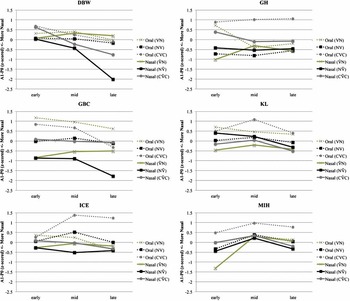
Plots of /a ã/ by speaker (in Figure 5) show a fair bit of variability across speakers with respect to the details of the nasal patterns. Only low vowels were plotted by speaker since the number of data points was greater and the measurements were less variable overall. However, there are a number of properties we can identify across all speakers as well as other sub-regularities that we can identify across groups of speakers.
Mean z-scored A1-P0 for oral (dotted lines) and nasal (solid lines) low vowels (/a/ and /ã/) in anticipatory (VN, indicated by ‘x’), carryover (NV, indicated by squares), and no nasal coarticulation (CVC, indicated by circles) contexts, plotted by speaker.

It is generally the case that nasal vowels were more nasal than oral vowels, for a given timepoint in a given context. Only in GH's NVs does the pattern appear to be reversed. It is also generally consistent that within nasal vowels, at least those in non-coarticulation contexts, measured nasality is greatest at the ends. And it is nearly consistent that vowels in coarticulatory contexts are more nasal than those in fully oral contexts (with the exceptions of VNs for GBC and NṼs for KL). These observations are corroborated by the main effects of Phonemic Nasality, Timepoint, and Coarticulatory Context in the low vowel model reported above.
The cross-speaker patterns are more complicated, however, with respect to post-nasal context in particular, and the relation between nasal and oral vowels in NV contexts. For three of the speakers (DBW, GBC, and ICE, shown in the left panels of Figure 5), these vowels are quite distinct, and as expected, the nasal vowel is more nasal than the oral vowel. For the other three speakers, however, there is little or no difference between the oral and nasal vowels in this context. For KL, the vowels are not identical with respect to pattern, but don't differ overall with respect to degree. Post-hoc pairwise t-tests comparing nasality in oral and nasal post-nasal vowels showed a significant difference for just the speakers in the left panel (ostensible non-neutralizers) (t(89) = 4.89, p < .001), but no difference for just the speakers in the right panel (ostensible neutralizers), (t(78) = 1.4, p = .15). Although these post-hoc analyses must be interpreted with caution, given that there is no independent basis for separating speakers into these groups, the comparisons suggest that some speakers maintain an oral–nasal contrast in post-nasal context while others do not.
3.5 Other factors
It is worth considering briefly features other than nasality, like duration or vowel quality, which might also play a role in the oral–nasal vowel contrast in Lakota. Rood & Taylor (Reference Rood and Taylor1996) characterized nasal vowels in Lakota as lax, as well as nasal, relative to their oral counterparts. Such a distinction does not seem to be present in the current data. Although phonemically oral high back vowels appear to be slightly higher, and also fronter, at least in the acoustic vowel space (F1 = 303 Hz, F2 = 1345 Hz for /u/ vs. F1 = 324 Hz, F2 = 1318 Hz for /ũ/), neither difference is significant in post-hoc pairwise comparisons (F1: (t(314) = 1.7, p = .08), F2: (t(314) = .9, p = .3)), though the F1 difference is marginally suggestive of laxing. Among low vowels, it is the nasal vowels that show these properties (F1 = 660 Hz, F2 = 1445 Hz for /ã/ vs. F1 = 710 Hz, F2 = 1357 Hz for /a/); however, only the F1 difference is significant (F1: (t(3745) = 2.65, p < .001), F2: (t(3745) = 1.42, p = .15)), suggesting slight centralization of the low vowel. With respect to duration, overall, nasal vowels are slightly longer than oral vowels (nasal duration mean = 176 ms vs. oral duration mean = 172 ms; t(3745) = 2.3, p < .05), but though this difference is statistically reliable, it is very small. Based on these comparisons, then, it seems that relatively little of the perceptual burden of the oral–nasal contrast could be carried by either vowel quality or duration.
4 Discussion
4.1 Summary
This study has highlighted several consistent and reliable findings with respect to the patterning of vowel nasality in Lakota. First, the contrast between phonemic oral and nasal vowels is realized acoustically in non-coarticulated contexts for all vowel types and in contexts preceding a nasal stop (anticipatory coarticulation contexts) in low vowels, where it could be investigated. In post-nasal contexts, the oral–nasal contrast is more limited, realized for three of the six speakers in low vowels, but not in high back vowels. Contrastive nasalization is generally greater in degree late in the vowel than at its start, though in anticipatory coarticulation contexts (for low vowels), nasality is greatest at the start of vowel. This unexpected point will be discussed further below. Finally, the data show clear evidence of both anticipatory and carryover coarticulation across vowels and across speakers (with the main exception being high vowels in carryover contexts, which are not more nasal than non-nasal–adjacent vowels). Generally, nasalization in carryover contexts is greater than that in anticipatory contexts.
4.2 Contextual neutralization
Recall that Rood & Taylor (Reference Rood and Taylor1996) reported that there was no nasal vowel contrast for some speakers following a nasal consonant, i.e. in carryover coarticulation contexts. In other words, NṼ and NV are reportedly neutralized. This situation diverges from the situation in Assiniboine, a nearly mutually intelligible Siouan language spoken slightly to the north, where they report that a contrast in this position is consistently maintained. The data in the current study reflect the variable situation for Lakota that Rood & Taylor described. In the low vowel data overall (Figure 4 above), oral and nasal vowels following nasal consonants are clearly different, indicating that the contrast has not been completely lost in Lakota. However, looking at individual speakers (Figure 5 above), we saw two separate groups: those who maintained a NV~NṼ distinction and those who did not.
It is not clear what might define the two groups of speakers, other than the maintenance (or not) of this contrast. Demographics do not seem to be explanatory: it is not the case that age, gender, or community of origin is distinct across groups. It is also not the case that speakers differed with respect to the patterning of oral and nasal vowels in any other context (non-nasal or anticipatory). No such neutralization has been reported elsewhere either; however, given the grouping of speakers with respect to carryover contexts, it seemed relevant to explicitly acknowledge the phonological extent of the special patterning of these groups of speakers. With respect to the details of their production of nasality more generally, it was not found that the groups differed systematically with respect to raw degree of nasality or raw difference between oral and nasal vowel nasality either.
We might assume that the neutralization of contrast, as observed by Rood & Taylor (Reference Rood and Taylor1996) as well as in the current study, could be attributed to the potential perceptual confusion between (strong) carryover coarticulation and contrastive nasality. The fact that some speakers show distinctly different patterns – and that Assiniboine maintains the NṼ~NV contrast – suggests, though, that at least some speakers can perceive this difference. Further, it demonstrates that these speakers can produce and perceive the difference not only between oral and nasal but also between nasal and more nasal, since for these speakers, there is systematically additive nasality for nasal vowels in the context of a preceding nasal consonant.
Synchronic impressionistic observations from Lakota speakers, as well as from language learners, confirm these predictions, at least in part. Some speakers and learners report perceiving the ostensibly oral low vowels in post-nasal contexts (e.g. the first vowel in maká [maˈka] ‘skunk’) as more ‘weakly nasalized’ compared to the stronger nasalization they hear in underlying nasal low vowels (e.g. in maŋké [mãˈke] ‘I sat’) (personal communication to the author AM). These reported impressions would appear to be consistent with the additive nasality found for nasal vowels in NṼ contexts for some speakers in the current study (DBW, GBC, and ICE; Figure 5). However, despite the reported impressions of a three-way perceptual distinction between non-nasal, weakly nasal, and strongly nasal, many modern Lakota speakers also find that the strong and weak nasalizations are freely interchangeable (Jan Ullrich, personal communication, 2013). Thus, speaker perceptions provide somewhat non-conclusive information overall regarding degrees of nasalization and neutralization of oral–nasal vowel contrast in carryover nasal contexts.
With respect to the neutralization found in the high back vowels, however, the confusion hypothesis seems quite plausible. The three-way perceptual distinction, where it is noted, is said to be more perceptually salient for the low vowels, /a/ and /ã/, than for the high vowels, /i/ and /ĩ/ and /u/ and /ũ/. And anecdotally, Lakota language learners also report that the high nasal vowels are especially hard to hear (personal communication to the author AM).
It has sometimes been proposed that the development of distinctive nasalization shows a cross-linguistic low vowel preference, or a high vowel dispreference (e.g. Matthew Chen Reference Chen1972, Matthew Chen & Wang Reference Chen and Wang1975). Philological evidence suggests that the development of nasal vowels in Old French, for instance, began with low vowels in the 10th and 11th centuries and did not reach the high vowels until the 14th century (Pope Reference Pope1952, Straka Reference Straka1955, cited in Hajek & Maeda Reference Hajek, Maeda, Broe and Pierrehumbert2000: 53). Ultimately, Hajek & Maeda discount some of the relevant textual evidence, as well as present language case studies (e.g. Panamanian Spanish and a small handful of Chinese dialects) that counter the nasal high vowel dispreference seen in Old French. However, it is indisputable that contrastive nasality on high vowels in French was eventually subsequently lost, as there are no phonemically nasal high vowels in contemporary French (despite the fact that there are three or four non-high nasal vowels and three oral high vowels).
The relationship between vowel height and nasality seems to rest, at least in part, on perceptual effects. High vowels are particularly spectrally sensitive to velic opening (e.g. Ohala Reference Ohala, Ferguson, Hyman and Ohala1975, Maeda Reference Maeda1993). In other words, a smaller velic opening can lead to a percept of nasality for a high vowel than for a low one. Thus, it is not that nasality cannot be heard on high vowels; rather, it's that there is less acoustic/articulatory space for distinctly oral vowels. This would render an oral–nasal contrast harder to maintain among high vowels – especially in a nasal consonant context where all vowels would be produced with some velic opening. Indeed, overall, there seems to be a smaller range of nasality in the high vowels than in the low vowels in the current study.
4.3 Historical nasality patterns
The patterns of nasality in Lakota, and the speaker differences, deserve a brief discussion from the perspective of the diachronic evolution of nasality. Nasal vowels most commonly derive from tautosyllabic anticipatory coarticulation patterns, along with subsequent nasal coda loss, e.g. French: VN# > Ṽ#. Carryover nasal consonant coarticulation evolving to contrastive vowel nasality is also attested, e.g. Tai-Kadai (Austroasiatic), Celtic, Indo-European: CNV > CLṼ or CṼ (Hajek Reference Hajek1997).
However, cross-linguistic comparison of nasality patterns across the Siouan family shows that in these languages nasality appears to have spread from nasal vowels to preceding sonorants: CLṼ > CNV (or CNṼ) (Michaud et al. Reference Michaud, Jacques and Rankin2012: Section 2). There is clear evidence for this leftward vowel-to-consonant spread of nasality in all the documented Siouan languages, including Lakota, Dakota, Chiwere, Hochunk, Kansa, Osage, Quapaw, and Omaha-Ponca. Some Siouan languages, such as Mandan and, to a lesser extent, Lakota and Dakota, show further productive rules of iterative leftward spread of nasality over consonant clusters and across syllable boundaries in words (Michaud et al. Reference Michaud, Jacques and Rankin2012). These observations constitute clear evidence of a historical connection between vowel nasality and preceding consonant nasality in Siouan, suggesting a possible mode of explanation for the strength and (counter-intuitive) pattern of carryover nasal coarticulation observed in the current study.
More specifically, historical reconstruction indicates that at some point in the evolution of Lakota, what are now onset nasal consonants received anticipatory nasalization from an upcoming phonemically nasal vowel, Ṽ. Since the nasal vowels were the original nasal elements in the language family, we expect that the vowel nasality in these contexts should have been quite robust, suggesting explanation for the high degree of vowel nasality in what are now post-nasal (carryover coarticulation) contexts. This historical connection could also explain why the pattern of nasality that we observe for Lakota in vowels following a nasal consonant looks like the pattern of nasality one would expect for underlying nasal vowels. Namely, in both NV and NṼ contexts, nasality increases over the course of the vowel (just as it does in CṼ and Ṽ) despite the fact that in the carryover coarticulation contexts, the influencing nasal consonant is at the start of the vowel rather than at the end. The results from this study suggest that at least some Lakota speakers may have retained a historical phonetic pattern in their production of vowels in post-nasal contexts, most clearly in the case of the low nasal vowel /ã/.
If the historical picture were as simple as the explanation given above, however, we would expect only nasal vowels in post-nasal consonant environments. Given that modern Lakota has oral vowels in post-nasal contexts, other processes must also be at work. Michaud et al. (Reference Michaud, Jacques and Rankin2012: 213) point to cases of apparent synchronic exceptions to the leftward spreading of nasality in Dakotan (Lakota and its closest relatives Dakota and Assiniboine), e.g. in words such as wáŋ [ˈwã] ‘arrow’ and wíŋ [ˈwĩ] ‘female’. They also suggest that the complex synchronic state of nasalization in the Dakotan languages is attributable to dialect mixing, along with a certain degree of relatively recent denasalization of historically nasal vowels following nasal consonants. Examples of words showing such post-nasal denasalization include maká [maˈka] ‘skunk’, matȟó [maˈtˣo] ‘bear’, mní [ˈmni] ‘water’, and napé [naˈpe] ‘hand’, among others. That the vowels in the initial syllables of these words were originally nasal vowels is attested by the fact that many of the related languages still show this nasality. For instance, for the Lakota word maká ‘skunk’, we find the following cognates: Omaha-Ponca, mąga [mãga]; Osage, mąka [mãka]; Kansa, mąga [mãga] ~ [mõga]; Quapaw, mąka [mãka] ~ [mõka]; Chiwere, mųkha [mũkʰa].
If the originally nasal vowels following /m/ and /n/ in the above words have indeed denasalized in Dakotan, then at least in these specific instances, the recent nasality shifts in Lakota bear a resemblance to the evolution of nasality in French, though in the reverse direction. In French, where vowel nasality derived from anticipatory coarticulation in tautosyllabic pre-nasal contexts, the conditioning nasal was lost, yielding VN > Ṽ, not ṼN. Lakota, at least in some instances and in some words, shows evidence of a three-stage process leading to a similar loss or reduction of conditioning nasality: LṼ > NṼ > NV. Determination of exactly which words and which contexts may have participated in this denasalization process is beyond the scope of the current study, as it will require extensive and detailed dialectological-phonetic documentation. It is perhaps revealing, as noted above, that recent Lakota dictionaries, including Ullrich (Reference Ullrich2011), have chosen to omit marking the nasality on vowels in words with etymologically nasal vowels following a nasal consonant, under the assumption that nasality of the vowel in these words is predictable. Note also that these post-nasal contexts are precisely those for which Rood & Taylor (Reference Rood and Taylor1996: 445) reported speaker-dependent neutralization of contrast between nasal and oral vowels.
Another factor relevant to a discussion of the historical evolution of nasality in Lakota concerns the morphological system of person-number marking in the language. In Lakota, there is a small class of active verbs called ‘nasal stem verbs’, which contain an underlying nasal vowel at the point of inflection in the root word. Typically, they follow a paradigm in which the person-number marking involves changing an underlying /j/ in the stem into a /m/ for 1st person singular and a /n/ for 2nd person singular. This change takes place before the underlying nasal vowel of the stem, yielding nasal vowels in carryover coarticulation contexts. (Some verbs in this class are slightly irregular in that there is no /j/ in the stem, but the inflection still immediately precedes the underlying nasal vowel.) Two discourse-frequent verbs from this subclass include yaŋká [jãˈka] ‘sit’, maŋké (1sg) [mãˈke], naŋké (2sg) [nãˈke], and ečhúŋ [eˈtʃʰũ] ‘do something’, ečhámuŋ (1sg) [eˈtʃʰamũ] and ečhánuŋ (2sg) [eˈtʃʰanũ]. Based on the morphological transparency of these nasal-stem forms, Ullrich (Reference Ullrich2011) keeps a nasalized vowel in the orthographic representation, even in post-nasal position. Note also that these inflectional contexts allow for minimal or near-minimal pairs with the etymological nasal vowels cited earlier; compare maká [maˈka] ‘skunk’ with maŋké [mãˈke] ‘I sat’.
4.4 Nasal coarticulation in Lakota: The role of phonetic implementation
There are aspects of nasal coarticulation in Lakota that might be directly phonetically explainable. For example, among low vowels, oral vowels in VN contexts are nasalized, and nasality increases across the vowel toward the nasal consonant. This would seem to follow the expected pattern of velum lowering in anticipation of the nasal consonant. The evidence for coarticulatory nasality in NV contexts is also phonetically expected, and the coarticulatory nasality in oral vowels is in a phonetically predictable direction. The details of these patterns of realization, however, are more difficult to explain exclusively in terms of articulatorily determined overlap, or even articulatorily patterned overlap.
Most basically, for example, given velum lowering in nasal vowels, additional coarticulatory lowering in the context of a nasal consonant is physiologically and articulatorily unnecessary. Yet, speakers in the current study showed systematically greater nasality in nasal vowels in at least some nasal consonant contexts. The presence of coarticulatory nasality in contrastively nasal vowels suggests that the coarticulation is by design – either phonologically specified or perhaps specifically maintained to signal information to a listener.
Furthermore, the pattern of carryover nasal coarticulation among the speakers who maintain a nasal–oral contrast cannot be explained by a velum raising gesture following the preceding consonant, as might be expected. Among both oral and nasal low vowels in NV contexts, the pattern of nasality parallels the pattern in non-coarticulatory contexts. In other words, the nasalization does not decrease across the vowel (further from the influencing nasal consonant). In fact, in the case of nasal vowels, nasality actually increases across the course of the vowel in carryover contexts (just as in non-coarticulatory contexts). Carryover coarticulation, then, seems to be categorical rather than phonetic: it involves an overall consistent increase in degree of nasality in vowels following nasal consonants.
The pattern of anticipatory coarticulation in nasal vowels is similarly confusing from a phonetic standpoint. While low oral vowels in VN contexts increase in nasality toward the nasal consonant, and while nasal vowels in non-coarticulatory contexts tend to increase in nasality across their duration as well, nasal vowels in VN contexts are most nasal at their early timepoints – opposite the expectation from either an articulatory or a categorical view. In fact, at the late point, closest to the nasal consonant, nasal vowels in VN contexts are no more nasal than nasal vowels in CVC contexts – i.e. there is no evidence of anticipatory coarticulation at the late point in nasal vowels. It is as though the additional nasality at the beginning of the coarticulated vowel is there just to mark that there is nasal context somewhere, rather than to prepare the articulators for an upcoming nasal.
Both carryover coarticulation (where it occurs) and anticipatory coarticulation on nasal vowels would appear, then, to be grammatically specified. Carryover coarticulation, where it occurs, is realized as categorical nasality, and anticipatory coarticulation on nasal vowels is marked systematically but seemingly not in a phonetically-determined way (at least in nasal vowels). As suggested above, the common shape of the nasal contour in NVs and nasal vowels may arise, then, due to the historical connection between the two (with NVs evolving from nasal vowel contexts). And the anticipatory pattern may arise to keep anticipatory coarticulation phonetically and perceptually distinct from carryover nasality and contrastive nasality.
4.5 Nasal contrast in Lakota: The role of phonetic implementation
Refocusing on oral–nasal comparisons rather than on coarticulatory vs. non-coarticulatory contexts suggests an alternative explanation to the seemingly reversed patterns of nasality in nasal vowels in nasal consonant contexts – one in which the ‘mis-placed’ nasality is attributable to contrast rather than to coarticulation.Footnote 1 Since the velum will almost certainly be somewhat lowered in contexts adjacent to a nasal consonant, a certain amount of nasality at vowel onset in NV contexts and at vowel offset in VN contexts is predicted, regardless of whether the vowel is phonemically nasal or oral. Thus, it is the other edge of the vowel (offset for NV contexts and onset for VN contexts) that would have the potential to be articulatorily and perceptually most distinct and to provide systematic cues to the phonemic status – oral or nasal – of the vowel.
Such an account nicely explains the different nasality patterns in oral and nasal vowels – in particular, in coarticulatory contexts. However, if the early nasality in VNs and the late nasality in NVs is attributed to contrast rather than coarticulation, there is in fact little evidence for anticipatory coarticulation in nasal vowels, since the only evidence for increased coarticulation in ṼN, relative to CṼC, is early in the vowel. In other words, what we interpreted above as evidence of anticipatory coarticulation in nasal vowels (i.e. the difference in nasality between ṼN and CṼC) would really be contrastive nasality. Further, this account leaves the striking parallel over time between the CVC and NV patterns found for both oral and nasal vowels coincidental.
4.6 Relating coarticulatory and contrastive nasality patterns
It is not clear that the two accounts presented above for the nasality patterns in nasal vowels in nasal contexts are distinguishable on the basis of the production patterns alone. However, the two accounts, attributing the ‘mis-placed’ nasality in the one case to coarticulation, influenced by contrast, and in the other case, attributing it to contrast, affected by coarticulation, make different predictions about how that nasality will be perceived by listeners. If the nasality is coarticulatory, and it is moved (when nasal vowels occur in pre-nasal contexts) to maintain a clear realization of coarticulation, as suggested by the first account, then a certain usefulness for coarticulatory cues in Lakota is implied. Cues from nasal coarticulation are indeed known to play a predictive role in the perception of words with nasal contexts in English (e.g. Ali et al. Reference Ali, Gallagher, Goldstein and Daniloff1971, Lahiri & Marslen-Wilson Reference Lahiri and Marslen-Wilson1991), as well as to facilitate lexical perception of words with nasal contexts when enhanced (Scarborough & Zellou Reference Scarborough and Zellou2013). On the other hand, if the nasality is contrastive, and its location of realization varies in order to help maintain a clear contrast between oral and nasal vowels, a different usefulness for the nasality cues is suggested. In both cases, the nasality patterns are hypothesized to cue differences that enhance lexical perception, and we predict that such perceptual enhancement could be found in Lakota. In principle, the interpretation by listeners of the early nasality in ṼNs and of late nasality in NṼs could resolve the ambiguity between accounts – in particular, whether its presence enhanced lexical distinctions based on oral–nasal vowel differences or lexical distinctions based on oral–nasal consonant context differences.
Both cases also lead us to nuance our view of the relation between coarticulation and contrast. The idea that coarticulatory or contextual nasality might be perceptually informative, as entailed in the first position, would seem, at least in a case like Lakota's, at odds with the assumptions underlying Manuel's (Reference Manuel1990) prediction, laid out at the beginning of this paper, that coarticulation should be constrained where there is contrastive use in a language of perceptually similar features. Insofar as nasal coarticulation would render nasal and oral vowel contrasts less distinct, it should be constrained. Such a pattern was not at all borne out in the current study of Lakota, however, where coarticulation was seen pervasively in both oral and nasal vowels and in both pre- and post-nasal contexts, and where phonemic oral–nasal contrasts are presumably nonetheless perceptible by Lakota speakers. And the idea that it is contrast that might be differently realized in coarticulatory contexts suggests another completely different means to the same end that Manuel (Reference Manuel1990) proposes. Ultimately, the goal, of course, is to ensure that phonemic contrasts are well-expressed in coarticulatory contexts, as elsewhere. In the current study, though, we find potential evidence that, rather than coarticulation being constrained to maintain this contrast, contrast is enhanced to overcome, or to co-exist with, coarticulation.
In any case, the analysis carried out here suggests that there are simultaneous phonological (categorical) and phonetic (continuous) aspects to Lakota nasalization, and that the phonological patterns (whether about grammatical coarticulation or about contrast) may have perceptual, as well as historical, underpinnings. The findings of this study reiterate support of previous claims that coarticulatory patterns are grammatical (Keating Reference Keating and Fromkin1985, Flemming Reference Flemming, Embarki and Dodane2011) or under speaker control (Whalen Reference Whalen1990). And, as discussed for Lakota, we can relate the synchronic patterns of coarticulation to diachronic processes and patterns of nasality evolution in the history of a language. Indeed, then, the language-specific patterns of coarticulation need to be discussed and investigated not only with reference to articulatory constraint and to the system of contrast in a language, but also, potentially, with consideration of the history of that language as well.
Acknowledgements
We are grateful to Will Styler for his technical assistance with data and measurement scripts. Thanks as well to Adrian Simpson and to our anonymous reviewers for their thoughtful comments on our paper. And special thanks to our Lakota speakers for their willingness to help us learn about their language.
Appendix. Word list
Note that in orthography, nasal vowels are written as Vŋ. Low vowel words are at the top of each list; high back vowel words are at the bottom. Target vowels are shown in bold.