INTRODUCTION
Care for a person with a chronic and progressive illness usually depends on the presence of a carer and his or her willingness to take on this role. Informal carers are defined as those unpaid and untrained people who provide care to an ill person because of their relationship with them (Smith, Reference Smith, Payne and Ellis-Hill2001). Informal care is mainly provided by family members or others who are close to the sick person, such as neighbors and friends (Clark & Seymour, Reference Clark and Seymour1999). Current changes in policy aim to base care for people with long-term conditions increasingly in community settings, including the home, and to avoid unnecessary admissions to the hospital (Department of Health, 1990). Against this background, informal carers are coming to the attention of policy, and their value has been recognized in several documents (Department of Health, 1999, 2005; Department for Work and Pensions, 2005). These recommend support in their caring role but have not as yet formulated guidance on what needs to be provided (Arksey & Glendinning, Reference Arksey and Glendinning2007).
What services need to offer carers is still unclear. A systematic review concluded that better quality evidence is needed to decide on the effectiveness of interventions for carers (Harding et al., Reference Harding, Higginson and Donaldson2003). Research underpinning these interventions is based on the concept of caregiving burden, investigating associations between different factors of patient status and carer burden (McCorkle et al., Reference McCorkle, Yost and Jepson1993; Anderson et al., Reference Anderson, Linto and Stewartwinne1995; Goldstein et al., Reference Goldstein, Concato and Fried2004). From these studies, we know that carers are vulnerable to negative physical, psychological, and social consequences. Many studies have found that their needs go largely unmet and that they receive insufficient help from services with daily physical caring and emotional issues and that there is a lack of information about health and social services (Jones et al., Reference Jones, Hansford and Fiske1993; Twigg & Atkin, Reference Twigg and Atkin1994; Nolan et al., Reference Nolan, Grant and Keady1996; Rhodes & Shaw, Reference Rhodes and Shaw1999).
An important influence to carers' functioning is the way in which carers experience the illness's effects on the patient. One of the major stresses constituting a carer's burden is the experience of physical symptoms. In this study, we focused on a group of carers of patients with different conditions who suffer from breathlessness. This is one of the core symptoms that becomes particularly persistent and frequent toward the end of life (Solano et al., Reference Solano, Gomes and Higginson2006) and it causes considerable stress to carers as the disease progresses (Booth et al., Reference Booth, Silvester and Todd2003). Patients' partners and direct carers suffer significantly as they witness their loved ones gasping for breath and feel unable to help (Booth et al., Reference Booth, Silvester and Todd2003). Little is known about carers of breathless patients and how this symptom affects their experience of caregiving and coping.
The strategies that carers use to cope can affect their experiences in different ways (Nolan et al., Reference Nolan, Grant and Keady1996). Studies have shown that problem-focused styles tend to be more successful than emotion-focused styles (Zarit & Edwards, Reference Zarit, Edwards and Woods1996). In the context of the daily care for advanced illness and the complex ways in which breathlessness can manifest itself, carers may not only feel helpless and burdened by their caregiving tasks, but they have varying experiences that range from complete hopelessness to dissatisfaction to satisfaction with their role or achievements (Hudson, Reference Hudson2004; Salmon et al., Reference Salmon, Kwak and Acquaviva2005). Little is known about the factors that mediate the caregiving experience from which carers draw their reserves and that give meaning to caring. Even less is known about how carers cope in the face of a difficult symptom such as breathlessness. This could inform health practitioners about how to support carers in their caregiving role. Services could build on those aspects that carers see as essential and meaningful and help them to continue providing informal care. Interventions could target those elements that carers find particularly stressful and assist them in managing these situations.
Therefore, we aimed to investigate the caring experience of carers for patients with an advanced progressive illness (chronic obstructive pulmonary disease [COPD], heart failure, cancer, or motor neuron diseases [MND]), who suffer from breathlessness. The questions we addressed were:
• What do carers use as resources to make caring possible or to improve their experience of caring?
• What are the factors they see as threats to what they aim to achieve or to their ability to carry on caring?
• What are the resources that carers for breathless patients draw on?
METHODS
Data were collected in the context of a qualitative study exploring the experiences of breathlessness among patients with advanced lung cancer, COPD, cardiac failure, and MND at different stages of their illness and in different care settings. The study took place in a large teaching hospital and in the community in London between July 2005 and March 2006.
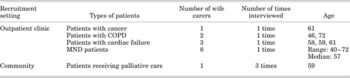
This article is based on a purposive sample of 15 informal carers who were approached via the patients they cared for during their visits to respiratory clinics at the hospital, at specialist respiratory nurses' ward rounds and consultations, “Breathe Easy” service users meetings, and from the disease registers of the primary care team in a Family Doctor's surgery. Demographic data and other information were obtained directly from carers during the interviews (see Table 1). Patients' information was retrieved from patients' records or specialist databases. Patients' letters were also used for this purpose.
Carers details

Consenting carers were interviewed at home, except for two carers who preferred to be interviewed in the researcher's office. Interviews lasted between 40 and 150 minutes. They were in-depth and semistructured; a topic guide was used following a number of broad themes on the experience of caring, coping with symptoms, and help seeking. All were tape-recorded and transcribed verbatim. Field notes were kept of nonverbal aspects (e.g., body language) and in situations in which it was inappropriate to tape-record. Data were collected until a point of saturation was reached, when no more new information emerged from the data and no new insights were generated.
Interpretation of the results was from a Grounded Theory perspective (Strauss & Corbin, Reference Strauss and Corbin1990), which aims to discover hypotheses about a phenomenon by grounding them in data, especially in practical interactions and social process. This was facilitated by the use of the NVivo software program. The texts of transcribed interviews and discussions were read and coded in several stages. Sections of texts relating to particular topics or themes were labeled and related to each other and to the observational data, giving rise to more abstract generalizations. Texts were scrutinized for implicit meanings expressed in subtle turns of phrase or choice of words.
The data were collected in the context of a broader program on breathlessness, in which a team of researchers worked on related issues of the symptom. This included opportunities for exchanging experiences and data for comparison and further discussion and this functioned as a way to verify the accuracy of data interpretations. We present direct illustrative quotations from the data.
Ethics approval was granted by the King's College Hospital Local Research Ethics Committee and by representative bodies (the hospital and community research and development committees) in the boroughs in which the study was carried out. The data were anonymized.
RESULTS
We found issues that affected caring in a positive or a negative way. The threats to caring were uncertainty, carers' own health problems, an inverted world, negative reactions from outside, person loss, and acute exacerbations. The resources that carers drew on to make caring possible or to improve their satisfaction were acceptance of the situation, self-care, availability of support, feeling that caring is a shared responsibility with the patient, and getting on with caring in the case of acute exacerbations.
Threats to Caring
Uncertainty
One of the main threats to caring was uncertainty about the future. Carers found it very difficult not knowing what was going to happen. A previous experience of an acute situation caused by a symptom like breathlessness made this even worse. Carers wanted to be prepared for these situations and to know what was the best they could do for the patient and for themselves.
I'd like somebody to tell me when it's gonna happen. It's like living with a pressure cooker or a time bomb… . I know what his problems are. … Although Mr. Johns told us it wouldn't improve his breathing and everything like that, the build up towards the operation was horrendous. (carer of a patient with heart failure)
Carers' Own Health Problems
Carers having health problems themselves feared that there would come a time when they could no longer do certain things for the patient or that it would be at the expense of their own health. In some cases, there was no way around, and technology or outside help were the only solutions.
I had a bladder operation 11 months ago [at] Northwick Park hospital in London. I'm back where I was, I'm lifting Eric, helping get the wheelchair, fold it in and out the car boot; he holds on to me when he's walking and he presses down so hard he pulls me. I have to stop him because I can't be doing it and I've always relied on him to do the lifting and carrying. I don't know what I'm going to do. (carer of an MND patient)
I had to go down to [the chemist] today on account of this problem with this oxygen. I don't know where I am with it; well, the only one helping me out was the chemist… . “You can't keep prodding about,” he said. “Your doctor'll have to sort this problem out,” he said. “Can't be running around,” he said, “because you're not a young women yourself,” which I'm not. (carer of a patient with COPD)
An Imploded World
Carers spoke about changes to both patients' and carer's lives that had happened because of illness. They described that much energy goes into adapting to new restrictions caused by an illness, which sometimes even requires complete reversals of roles. Restricted mobility and new dependencies and responsibilities require time and effort, especially where the primary carer is the sole carer.
Because we're quite private because of what's happened, his world is imploded and in some respects so has mine, erm, and I really don't think that perhaps other people outside really truly appreciate what goes on and what the stresses and strains are, because we hide them. (carer of a patient with heart failure)
Oh, yeah, can't go out like I could, you know. I was never one for going anywhere unless I go shopping or going to see a friend, … people I used to work with, you know. For years and years and, er, that I can't do now. If I go out now I have to rush back … because I'm worried about him. (carer of a patient with heart failure)
Perceived Judgments from Outside
Carers told about patients being worried about how they are judged by people when they go out. Patients feel uneasy when the signs of bad health become visible in public, especially when their disability is not obvious at first sight. Several carers told about the barrier that patients have to go through when a wheelchair is discussed. Patients need time to accept this, as they feel it labels them as disabled and they do not want to present themselves as such. Carers spoke about the problems they face when they take the patient out and how this led them to avoid these in the future. They described situations where a wheelchair would make it possible for the patient to go out, but they often opted to stay indoors and miss out on spending cherished time with their family.
He wouldn't let us get a wheelchair for him, so he stayed here and I went and I'm glad I went. But all the time I was there I felt guilty coz he was here on his own and he was missing his grandson's birthday. So it's trying to find, I try not to let him … stop me doing things, but it does; at the end of the day it does. (carer of a patient with heart failure)
For people like Chris that you can't actually see any physically wrong with them. I don't know, it makes life that little bit more difficult when you go out coz people look at you, like if I'm carrying the shopping bags and he's walking, doesn't bother me in the least, but people look and then it makes him feel awkward. (carer of a patient with heart failure)
Person Loss
Carers spoke about the grief it caused them when they realized that the illness had affected the patient in such a way that they showed traits they had never known the person had before the illness. They found it even more difficult when the person had changed to such an extent that they saw him as different from how they had known him before. This had an effect on their relationship.
And we've never, we've, we've never had an argumentative sort of relationship, so it's quite, it's quite new in some ways, erm, so it's upsetting. (carer of a COPD patient)
Occasionally there are still flashes of the old Richard who's always had a great sense of humor… . but a lot of the time it's a different person, a different person; it is very hard. Well, I just think it must be so difficult for those people who have Alzheimers, well, for the carers, who have to look after them. That must be sooo difficult, I mean this is nothing like that, but there is definitely a change in character. (carer of a COPD patient)
Acute Exacerbations (AEs)
AEs were perceived as a threat to caring. As much as carers tried to rely on themselves and did everything they could not to have to ask help from others, in these situations they had to be realistic and balance their hope that exacerbations would pass, their wish to take account of what the patient wanted, and their judgment of the right moment to call for emergency care. When carers reflected on AEs, they saw these episodes as detrimental to all their previous attempts to achieve improvements in the patient's condition.
It seems like we take one step forward and three steps back. (carer of a patient with heart failure)
Resources for Care
Acceptance
In response to the ever present uncertainty of the patients' condition, carers resorted finally to accepting life as lived within the limits that symptoms posed for them. This was not something they mentioned when carers were explicitly asked about their coping mechanisms. Rather, it came up as a strategy they did not deliberately apply to solve immediate problems but as something they were only partly aware of and that they had developed over time. It appeared after a period of intense searching for help, when their problem-solving strategies showed their limits, and when their caring did not show direct rewards.
I mean, a person does dwell on their illness all the time. They've thought about nothing else, for the past year, and it's very difficult to kind of get away from that conversation, I mean, I try and I make sure I get papers, … things like that, so that there's something … to focus, yeah, to talk about something else. Because you're going to spend the whole day talking about the problem, and the thing is I haven't got the answer for it. (carer of a COPD patient)
Previously, carers still had the hope that they or others could undo the damage caused by illness and bring them back to their healthy old selves. Slowly, carers realized that their present condition could not be changed again.
My sister lives in Wiltshire… . We'd like to go there, that would be a good option airwise, because the pollution is not helping at all, so that's something that we're sort of in the process of, but it's not a quick fix. (carer of a COPD patient)
But that's normally what I do, I'll either get angry and I'll go and bash something or I'll shed a few tears and I think: “Well, it's not gonna change anything; get on with it; so there's no magic answer.” (carer of patient with heart failure)
Carers adjust their sense of reality gradually, and the strategy of acceptance is part of tackling uncertainty that is unsettling and whereby they can create some kind of normality for themselves. What helps in this process is the idea that there are others with similar problems.
It's beneficial to see that you're not the only one and that there are some people worse than you and some people dealing with the same situation you've got. So you don't feel so isolated. But also, … having focus and having things to do and getting out to keep the confidence. (carer of patient with heart failure)
Self-care
Carers often forgot their own needs when looking after their husbands, who were perceived as having more acute or worse symptoms. Sometimes they recognized the importance of staying healthy themselves, that they were the pillars on whom the patient relied. Some carers spoke about keeping fit in a purely instrumental way, in order to be able to continue caring. Others told about how therapeutic it was to break away from caring, even if this was only for the daily walk with the dogs. One carer only had reserved particular times for herself, and this was what kept her going.
So you're talking to other people, you know, that whole … social thing as well. I'll go along with him and … I can go for a swim or something coz it's actually the leisure center. So that's quite a positive thing for me because … you very quickly fall into yourself not bothering because you don't look after yourself too much. So that's quite a good thing; it means that I get out and do something for me as well. (carer of a COPD patient)
But occasionally I might want a day when I can go for a long walk, in which case, you know, he might have to be there (in the care home) until I've done my walk and then I will go and pick him up. (carer of a COPD patient)
Support
Carers expressed their appreciation for whatever support they received from people who had given them a helping hand when they needed it or who had made the time to show concern about them. Carers felt that a wider social network was something that helped them cope with the threat of isolation that many couples face. This, however, was easier for the more extroverted people, and it was based on reciprocity. Linking with others was sometimes a conscious strategy when family connections were not stable or permanent.
The Jamaican lady upstairs, she's very good. If I was in trouble or anything she'll be down, you know; she just said to me: “You alright Nora?” you know, and I do the same for her. She was sick and I picked up her little girl from the school so, er, that's how you have to keep in, be friends with people you know. Then when you're in trouble they'll help you. (carer of COPD patient)
It would be very easy for me not to have any social life at the moment with working full time, and it sometime feels wrong to be depriving Richard of my time when I'm not at work, but I feel, and this is what I talk about with my therapist quite a bit, it is very important because I will have to carry on afterwards when David is no longer here.” (Carer of COPD patient)
Communication with others than those closely related or emotionally involved to share experiences or feelings was seen as essential. This was a resource that would lead to information about other resources and that would legitimize their actions and feelings.
From just talking to you, it's really quite therapeutic because you understand exactly, and you've heard so many others, what the situation is. So having that facility is quite, you know, and if that was there, it's almost like carers anonymous… . Even if there was like a web site with an e-mail that you could just sort of say, 10 o'clock on a Saturday night, and you think, oh my God, you can just type in and somebody comes and types back: “That's OK, things are fine.” (carer of patient with heart failure)
But she [the psychotherapist] is someone that I can talk to about anything and don't feel that I am being disloyal to Richard if I want to have a moan. (carer of a patient with COPD)
Shared Responsibility
Caring was only seen as possible when the patient showed he valued what the carer did for him. Carers expected a degree of cooperation from patients, which varied according to their relationship.
He's probably gone ‘round to our neighbor and said: “Oh, give me a cigarette, for goodness sake.” I'm sure he's had a couple but I don't think he's had any more because he knows that, I have threatened that, … if he smokes, that I'll give up… . I've said, there's no point in me being at home and giving up work. And, if you're just gonna continue, it's a waste both of our time. So you have to be a bit nasty. And you get angry and frustrated about that as well. But, because there's nothing you can do to help a person, … if they're undoing anything that is being done. (carer of a COPD patient)
If the relationship between patient and carer was affected in such a way that the carer started to doubt about the purpose of caring, the only option was to resort to outside help and negotiate the caring conditions within the limits of the changed relationship.
Well, this is what we're trying to work out with the counsellor, what we can do with the positive that we can have a relationship that we both are happy with. (carer of a COPD patient)
“Get On with It”
Carers’ responded to crisis situations, difficult moments that threatened to make them lose control, or irreversible realities with the strategy of “getting on with things/” This was a mechanism that blocked out all threats to concentration and focused on achieving regaining the balance by dealing with the here and now.
And dealing with the situation, both at home and getting the ambulance and everything else, then when I was in hospital, I'd got my file. I was all very, very efficient and you just block out [everything else], that bit goes. (carer of MND patient)
When he couldn't breathe, the infections coming on, … and couldn't eat and everything else and then many trips to A&E over the Christmas period and then finally being admitted. So that was quite frightening but I went into, they call it “flight, flight or fight” don't they, or whatever. I went into complete automation, I got rid of all emotion. I just went into shear sort of practicalities. (carer of a MND patient)
Care to Breathe
Daily Breathlessness
The symptom of breathlessness was experienced as a very real threat to caring. Among the range of resources that carers developed and refined over time and which they could rely on to pull them through difficult times, carers hardly had anything for coping with breathlessness. Carers generally felt helpless, having absolutely nothing to offer the patient who was struggling with breathlessness except watching him and taking part in his suffering.
But it is frightening and you feel helpless because there's nothing you can do, apart from giving advice, erm, but there's nothing else you can do. (carer of a COPD patient)
And, erm, I, I just sort of try but it does make you feel very inadequate because there is not a lot you can do. (carer of a heart failure patient)
Carers sometimes suggested strategies to deal with breathlessness. They realized that the advice offered was not always what the patient found most helpful when breathless. They described how it could lead to irritation for the patient who was trying to keep his breathlessness under control. It could even lead to anger, which made things worse and caused misunderstanding between patients and carers. One carer told about how she had learned breathing techniques in her yoga lessons and what happened when she tried to explain to her partner who was breathless:
So I've tried to talk to David and say, you know: “When you get breathless you should just concentrate on breathing out and then you will breathe in naturally and you don't have to think about it.” But of course, the first thought when you get breathless is the (imitates fast, shallow inward breaths) and that doesn't help at all… . So I think he finds it very hard to cope with because he just tenses up and starts stamping his feet and, you know, all those things make it worse and I've tried hard, but, obviously, there is nothing more irritating when you're fighting for breath and someone's saying to you: “Be calm, breathe out.” But … that must make it a lot worse for him. (carer of a COPD patient)
The bad-tempered reactions could be described as almost chronic, and carers told about how difficult this was for them.
But it was it all rather difficult and he became quite difficult and I gather that is one of the symptoms of, erm … lack of oxygen. (carer of a COPD patient)
Carers described breathlessness as bringing on other symptoms such as anxiety, fear, and depression. It made patients lose confidence and it took away all motivation to undertake any activity. Breathlessness was seen as the underlying causal factor of all the other problems they had to deal with.
It creates an environment whereby if you think about you'd like to do something, it creates an automatic block: “Will I be able to?” (carer of a heart failure patient)
I don't think people realize what an inhibitor it actually is… . It's very much hidden, but people just live with it day to day without thinking about it until it becomes rather than chronic, critical. (carer of a heart failure patient)
Breathlessness was perceived as the worst symptom to handle, not allowing assistance of any kind. One carer told about the trip she accompanied her husband on, with a group of people who were terminally ill. Full hospice care was included, but even then, the care for her breathless husband was the most challenging, compared to the care for people with other severe physical disabilities.
He didn't do as much as was laid on and that I thought he would be doing. Partly, I think, because it is actually physically very hard for him to get around. I mean, he had a wheelchair and he had his oxygen but … he wasn't able to do a lot of the things. And there were some people who were very disabled, but none of them had the breathing problems. So, even though they were very badly handicapped in lots of ways and, you know, had to be lifted in and out of things, they were able to do much more than he was. (carer of a COPD patient)
Acute Exacerbations
When breathlessness became acute, carers told about the difficulty of deciding when the right moment was to call on emergency care. Eventually, when breathing difficulties became critical or when panic started to take over, they called for an ambulance. Carers said that panic was the most difficult to cope with. Carers described care in cases of acute exacerbations as a learning process. After the first incidents, they knew better what to expect and what was appropriate from the advice they had received from professionals.
But I couldn't, the hardest thing was coping with Roland about two or three times when he got into a panic situation and I didn't really know what to do and I hadn't got a Lorazepam which will calm him down initially. [It] gives you time to then deal with the situation and gives him time. So I think dealing with him in a panic was [the worst], because that's totally out of character. The third time it happened earlier on this year, we did not waste time, we go straight, everybody says, go straight to A&E. So don't use up your own emotional energy and get into such a situation where things are seriously bad. (carer of a MND patient)
Carers had different experiences when calling on emergency care in case of AEs. Carers for COPD patients sometimes had difficulties accessing emergency care. In two cases they said that, upon arrival at the hospital, nurses strapped the patient into a Nippy (an instrument that ventilates patients noninvasively through a nasal mask). This was experienced as very traumatic when the machine did not follow the breathing rhythm the patient was trying to get control over, as well as the claustrophobic effect it has on the patient, and this led to a fight between the patient and the nurses.
DISCUSSION
In this article we explored the factors that mediate the caregiving experience of carers for patients in advanced progressive illness and suffering from breathlessness. Through a qualitative study design, we examined what carers experienced as most threatening to their caring role and which resources they drew their reserves from that enabled them to continue caring or to improve this experience. These coping responses inform us about how the threats were transformed into resources that give meaning to caring and what the limits of caring are.
Previous research had a greater focus on the negative consequences of caring (Liston et al., Reference Liston, Mann and Banerjee1995; Nolan et al., Reference Nolan, Grant and Keady1996; Schneider et al., Reference Schneider, Murray and Banerjee1999), motivated by the intention to find adequate solutions to the problems encountered in caring for someone with long-term illness and experiencing debilitating symptoms. In this context, the concept of carer burden was further developed and served as the basis for a variety of assessment tools where carer circumstances added to the understanding of the care needs of a person with chronic, advanced, or terminal illness (Zarit et al., Reference Zarit, Reever and Bach-Peterson1980). Recently, this focus shifted toward greater attention to the positive experiences of caring (Nolan et al., Reference Nolan, Grant and Keady1996), which then give insight into the caring conditions for both carer and patient, the risks they are exposed to, and the opportunities to intervene with services that are acceptable to patients and carers.
The interviews with carers gave evidence of a diversity of stresses that could impact negatively on caring or lead to breakdown of the caring arrangement at home. We were able to reduce these accounts into more encompassing categories that integrated the stresses typically experienced by wife spouses in this sample, who were the main and sole carers for their husbands at home who had an advanced and progressive illness and suffered from breathlessness. In this light we need to consider the categories that emerged from our interview data. The theme of uncertainty emerged as one of the hardest elements of an unpredictable disease trajectory that characterizes the conditions included into this study. Carers adapted more or less successfully with different degrees of acceptance to this uncertainty, which eventually included also the acceptance of their declining health and the revision of goals within realistic boundaries. An imploded world and perceived negative reactions from outside were counteracted by support from others, which allowed carers to offload or legitimize negative feelings and come to terms with them. Support was recognized as a way to fight off isolation and its negative consequences. As the conditions studied here involved generally older carers living alone, they identified their own actual or potential health problems as a threat to caring and they consciously and proactively took care of their own health, which enabled them to continue to care for their spouses at home. Person loss was experienced as the ultimate threat to caring, jeopardizing the relationship between patient and carer and, finally, the motivation for caring. Carers identified shared responsibility for one's well-being and cooperation as necessary conditions for caring. Finally, AEs of the symptoms that appeared as part of the conditions studied were found to pose an important threat to caring. This was due to a lack of preparation or knowledge of what to do or expect in case of emergencies. Carers reported responding with an attitude of “get on with it,” where they disconnected from any emotional involvement that could distract them from saving their husband's life.
We found that caring for patients suffering from breathlessness was particularly challenging (Booth et al., Reference Booth, Silvester and Todd2003). Daily breathlessness was experienced as impairing the patient further and further as well as affecting the relationship between carer and patient (Bergs, Reference Bergs2002). Carers said that they did not know of any helpful strategies to relieve breathlessness for the patient or of ways to reduce the carer's anxiety when witnessing the patient struggling for breath (Booth et al., Reference Booth, Silvester and Todd2003). Breathlessness was experienced as a constant threat and, in comparison to other symptoms, the most difficult to cope with. Carers identified it as the underlying causal factor of all the other problems they had to deal with and as a symptom excluding any assistance. Except for the carers with MND, those caring for patients with other conditions were ill prepared for coping with AEs (Elkington et al., Reference Elkington, White and Addington-Hall2004). They told about the learning process they went through to distinguish daily breathlessness from acute episodes and the right moment to call on emergency care. In the hospital, carers had sometimes witnessed traumatic events in the application of noninvasive ventilation to COPD patients. We found that patients with MND benefited from a more comprehensive palliative care approach, and they were better prepared with proactive advice, emergency contacts, and medication to tackle panic attacks.
Practice Recommendations
Carers resorted to both problem-focused and emotion-focused strategies according to the specific threats they faced. The data showed that interactional strategies also fulfilled an important role in managing stressful situations. Support from others was sought to counteract isolation and to come to terms with negative reactions from the outside world. The very purpose of caring appeared to be based on reciprocity between the patient and carer, who expected a certain degree of shared responsibility for the patient's care. To help carers to cope better with their caring role at home, all three elements of coping need attention. Opening this caring dyad by the active participation or availability of health care professionals when needed can help careres strengthen the coping strategies they are already using and suggest approaches to the threats they need to deal with. Involvement of health professionals could lead to information and advice, and this enhances competence, especially in managing difficult symptoms such as breathlessness. Professional support can reduce isolation for carers, which is a major complaint for people disabled by breathlessness. Care can be negotiated in interaction between the carer, the patient, and a professional carer, which will alleviate stresses through sharing responsibility. Current policy that relies on informal home care cannot assume that the informal carer takes the sole responsibility for his or her ill relatives. Recurring threats such as isolation and uncertainty can no longer be ignored and need to be recognized and addressed for these policies to become operational.
Limitations of the Study
What the carers in this study identified as threats to their caring capacities and the resources they used to cope with these were inevitably specific to the conditions their husbands suffered from. However, further studies could determine to what extent these threats and resources feature in other conditions and are part of the caring experience in general.
CONCLUSION
This study examined the factors that mediate the caregiving experience for informal carers providing care for patients with advanced illness and suffering from the symptom of breathlessness. Through a qualitative design we were able to identify what carers in this sample experienced as most threatening to their caring role and what they used as coping strategies to eliminate or moderate the effect of the threats. We found that carers resorted to problem-focused, emotion-focused, and interactional strategies, which were consistent with their understanding of illness and the values they attached to caring for their spouses.
Evidence of recurring problems related to caring for a person with advanced illness at home can no longer be ignored in the context of current policies relying on informal care. Carers need to be included in opportunities for support provision for advanced illness. Negotiated involvement of a care professional could buffer the heavy responsibilities related to home care. They could provide problem-solving skills and build on the resources that carers draw on in response to what they experience as most threatening to their caring role.
ACKNOWLEDGMENTS
We thank Cicely Saunders International (CSI), whose funding made this research possible.