Introduction
The oil-crisis induced recessions of the early 1970s brought the Golden Age of welfare state development to a close and signalled a new age of welfare politics, emphasising economic constraints and fiscal austerity. Economic globalisation, population ageing and the appearance of chronic unemployment put increasing economic and political pressure on the welfare state for reform. The end of the long boom clearly brought welfare state retrenchment on to the political agenda in the advanced capitalist democracies of the West; however, comparative welfare state scholars disagree over the meaning of this new stage of welfare politics. From one perspective, new economic constraints changed the policy agenda in many states, but did not alter the underlying conflicts between labour and capital at the heart of welfare politics (Korpi and Palme, Reference Korpi and Palme2003). An alternative perspective proposed by Pierson (Reference Pierson1994, Reference Pierson1996) sees the retrenchment period as a fundamental shift in the nature of welfare politics. In this new era, the welfare state has evolved into a policy institution that fundamentally alters the political and economic landscape, reshaping the interests and actors involved in social policy debates. This new period is characterised by the emergence of broad agreement across party lines on the general parameters of the welfare state, reducing the intense partisan conflicts of the past to debates over reforming the margins of the welfare system.
Despite the widespread interest in the politics of welfare state retrenchment, comparatively little has been said of the specific impact of these new trends on national health care systems (Hacker, Reference Hacker2004; Moran, Reference Moran2000). This article examines the era of retrenchment politics in the welfare state through an examination of health care policy reform. In particular, it seeks to determine whether the new politics of the welfare state implies a reshaping of the political landscape, characterised by a growing convergence, between major parties from across the political spectrum, on the basic goals of the health care system. In other words, have partisan differences over health care diminished over time, replaced by a general consensus on the continuation of national health care as a shared policy goal? Or, do deep partisan differences remain over the nature of the health care system, resulting in significant efforts by parties of the right to roll back earlier state commitments to national health care?
The paper proceeds with an examination of the competing claims made concerning the meaning of the shift into the age of retrenchment on the politics of the welfare state. The next section explains why and how health care represents a valuable policy arena for exploring the politics of retrenchment in the broader welfare state. The following section offers an analysis of 18 OECD countries from 1960 to 2000 to test competing hypotheses concerning the relationship between partisanship and health care retrenchment. The final section explores the implications of this research for both health care politics and the broader discussion of welfare state retrenchment.
Partisanship and the welfare state
The oil-shock induced recessions of the early 1970s ended the post-War economic boom that had financed the great expansion of the welfare state across the West. Even as countries recovered from the initial recessions, they appeared to face a new economic reality of rising structural unemployment, greater capital mobility, increased global economic competition and population ageing. These changes placed pressure on the welfare state both by increasing demand for existing programmes and undermining the tax base needed to support them. These new economic and demographic pressures brought welfare state reform and retrenchment squarely on to the political agenda in countries across the West in the 1980s. Yet, the welfare state has proven surprisingly resilient. Rather than substantial retrenchment and rollbacks, welfare states have remained remarkably stable and expenditure rates in most countries have continued to rise (Castles, Reference Castles2004; Swank, Reference Swank2002).
Welfare state scholars are divided over the meaning of this new era of retrenchment on both the politics and structure of welfare states. To explain the resiliency of the welfare state in the face of political, economic and demographic challenges, Pierson (Reference Pierson1994, Reference Pierson1996) introduced what has become known as the ‘new politics’ perspective. Pierson suggests that this new stage of welfare state politics is not simply a shift in the political agenda. Instead, the shift from debates over welfare expansion to welfare reform represents a fundamental shift in the nature of welfare state politics that may significantly diminish the impact of partisan conflicts on future welfare state development. Pierson suggests that the very existence of the welfare state fundamentally alters the interests of political parties by reshaping the political and economic foundations of the social policy debate. As welfare programmes emerged, they created new political constituencies of welfare state beneficiaries who resist efforts at scaling back benefit levels. Because retrenchment involves imposing direct costs on benefit recipients in exchange for diffuse and uncertain future gains to society at large (that is, lower taxes or higher GDP growth), reformers face potentially high political costs for relatively minor political gains.
The political costs of reform depend heavily on the capacity of the reformers to avoid blame for their actions (Weaver, Reference Weaver1986) and the structure of the programme itself (Pierson, Reference Pierson1994). For broadly based programmes like pensions or national health care, these new constituencies of supporters can pose a significant political obstacle to retrenchment. For example, in the original conflict over pensions, conservative parties fought to defend the status quo and prevent the development of public pension systems. In the current era, pensions have become imbedded in a larger political economy that assumes their continued existence. Economically, businesses have adapted to the existence of public pension systems and adjusted their own benefits packages accordingly; while workers have altered their own savings and consumption patterns in response to guaranteed retirement income. Moreover, pensions have a large built in constituency of both current and future recipients. The emergence of this new constituency of pension beneficiaries (present and future) represents an effective shift in the preferences of the electorate as a whole toward support for public pensions. In this way, the major reform proposals of the past have become an accepted part of the status quo that may be subject to reform, but not to fundamental overhaul. As political parties adapt to the changes in the interests of their own constituencies, this should result in a convergence between parties of the left and right on the continuation of existing welfare state institutions.
Researchers working within the power resources tradition challenge the claims of the new politics perspective that retrenchment represents a growing consensus of political parties from across the political spectrum on the welfare state (Korpi and Palme, Reference Korpi and Palme2003). The power resources approach draws on a Neo-Marxist vision of the welfare state as a product of the democratic class-struggle between workers and capital (Esping-Andersen, Reference Esping-Andersen1990; Huber and Stephens, Reference Huber and Stephens2001). From this perspective, the welfare state represents the efforts of workers to protect themselves from exploitation by employers through state programmes that reduce the dependence of workers on the market. Power resource scholars suggest that the new period of globalisation did not fundamentally alter the political dynamics that drive welfare state development (Korpi and Palme, Reference Korpi and Palme2003). Rather than the erosion of partisan differences over welfare policy and outcomes, the power resources approach sees the current age of retrenchment as part of the ongoing class struggle. In this new era, parties of the left continue to use the state to protect the working classes from the insecurities of globalised capitalism, while parties of the right manoeuvre to undo the reforms of the past and to promote the interests of employers in maintaining a flexible, politically weak and low-cost workforce.
The power resources and new politics approaches therefore suggest two competing hypotheses. Pierson's new politics perspective suggests that the relationship between partisan control over government and the welfare state should not remain constant. Instead, the impact of the political ideology of governing parties on welfare state policy should diminish over time as parties of the right adapt to the political reality of the welfare state and parties of the left recognise the limits to the welfare state implied by greater economic and demographic pressures. Alternatively, the power-resources perspective suggests that in the current era significant partisan differences should remain between parties of the right and left in how they deal with the challenges of government austerity.
Empirical research examining the relationship between partisan control over government and welfare state development during the age of retrenchment has found mixed results. Pierson's (Reference Pierson1994) examination of the retrenchment efforts of the Reagan and Thatcher governments uncovered the severe limitations reformers faced in seeking to roll back welfare programmes. Similarly, quantitative research examining the impact of partisanship on social expenditures has shown both limited instances of retrenchment and limited partisan effects in the new era of retrenchment politics (Kittel and Obinger, Reference Kittel and Obinger2003; Huber and Stephens, Reference Huber and Stephens2001). At the same time, Korpi and Palme (Reference Korpi and Palme2003) find a connection between the power of political parties and the ‘social rights’ imbedded in the welfare state. Studies looking at replacement rates and benefit levels for core social programmes like unemployment and social security find that party strength still plays an important role in how states have reacted to pressures for austerity (Allan and Scruggs, Reference Allan and Scruggs2004; Amable et al., Reference Amable, Gatti and Schumacher2006).
This paper attempts to contribute to the research on partisan politics and welfare reform through an analysis of health care politics in the current age of retrenchment. Though generally ignored in the broader debates over welfare state development and retrenchment, national health care may provide a unique opportunity for testing the competing claims of the new politics and power resources schools. The next section examines the health care sector and how it serves as an important policy arena for understanding the period of welfare state retrenchment.
The new politics of health care
Health care has long been an understudied aspect of the welfare state. Largely focused on major cash benefits programmes like pensions and unemployment, welfare state researchers and the typologies they create generally ignore the health care system (Bambra, Reference Bambra2005; Moran, Reference Moran2000). Though welfare scholars have examined the initial development and evolution of national health care systems (Blake and Adolino, Reference Blake and Adolino2001; Hacker, Reference Hacker1998; Immergut, Reference Immergut, Steinmo, Thelen and Longstreth1992, Reference Immergut, Powell and Wessen1999; Navarro, Reference Navarro1989; Steinmo and Watts, Reference Steinmo and Watts1995), comparatively little attention has been paid to how health care systems have been implicated by the larger shift of the welfare state into the era of retrenchment politics (Hacker, Reference Hacker2004; Moran, Reference Moran2000). The absence of health care from debates over welfare state retrenchment is particularly problematic given the absolute size of the health care system as a proportion of the welfare state and the centrality of growing health care expenditures growth to social policy debates in many countries.
National health care systems pose a number of significant advantages to the study of retrenchment. First, cost pressures have forced health care reform on to the agenda of all states. The twentieth century witnessed an amazing transformation in the science and technology of medicine. Advances in surgical, diagnostic and pharmaceutical technologies greatly expanded the benefits of medicine. These same advances created the conditions for spiralling health care costs by dramatically increasing patient demand and utilisation of medicine. The expansion in medical technology and sophistication combined with the ageing of populations to produce seemingly unrelenting growth in health care expenditures across the West (Huber and Orosz, Reference Huber and Orosz2003).
For countries committed to national health care, the increasing real costs of medicine poses a significant challenge. In 1960, the average health care expenditure in the 18 countries studied here was 4.1 per cent of GDP. At this time, it was common to believe that national health care would reduce health expenditures by improving overall population health. By the year 2000, health care expenditures had grown to an average of 8.6 per cent of GDP. The early optimism of health care policy makers has been replaced with real concerns over the capacity of the state to meet its health care obligations. The spiralling costs of health care have placed health care reform at the centre of debates concerning the continued viability of the welfare state in the new age of globalised capitalism.
Along with its importance as a policy area in the welfare state, the structure of health care systems presents an opportunity for examining many of the retrenchment dynamics discussed above. By definition, national health care systems have a broad constituency who will immediately recognise the consequences of lost benefits or rising costs. Even when satisfaction with a particular system is low, national health care as an overarching policy goal remains broadly popular. In fact, cross-national surveys suggest strong support for more public spending on health care, rather than less (Donelan et al., Reference Donelan, Blendon, Schoen, Davis and Binns1999; King and Maynard, Reference King and Maynard1999). Moreover, the health care system engages a broad range of powerful interest groups, including doctors, hospitals, local officials and private and non-profit insurance companies. These interest groups have strong political connections and, in the case of doctors and hospitals, broad public legitimacy. As a result, they pose an obstacle to reform both directly in the political sphere and indirectly through their capacity to alert the public to reforms and shape public attitudes in the ensuing political debate (Giaimo, Reference Giaimo2002). Given the universality of the programme and the non-class-based actors involved, the health care sector provides a clear test of Pierson's claim that welfare programmes create new constituencies that alter earlier dynamics of welfare state politics.
How have the politics of national health care systems been affected by the shift into the age of retrenchment? Anecdotal evidence does not provide a clear indication of the impact of partisanship on health care over time. Despite the potentially high political costs involved, countries across the OECD engaged in a seemingly constant string of marginal adjustments along with occasional efforts at broader reform (Docteur and Oxley, Reference Docteur and Oxley2004). In the early 1990s, conservative governments across the West, following the lead of Thatcher's Conservatives in Britain, introduced a series of ostensibly market-based reforms under the banner of ‘managed competition’ (Jacobs, Reference Jacobs1998; Giaimo, Reference Giaimo2002; Ham and Brommels, Reference Ham and Brommels1994). The privatisation rhetoric surrounding these reforms suggested dramatic and sweeping reforms of the health care system that would fundamentally alter the states’ role in health care. In the end, the Thatcher government faced incredible political pressures from both the public and health care providers to expand the public health care system, which highly constrained her ability to dramatically reform the health care system (Appleby, Reference Appleby, Powell and Wessen1999; Klein, Reference Klein1985). In practice, what is most remarkable about the managed competition reforms is their incredibly limited nature. The end product of managed competition in Britain and other states was to reinforce state control over the health care system, rather than to shift toward market provision of health care (Saltman, Reference Saltman2002; Maarse and Paulus, Reference Maarse and Paulus2003; Brown and Amelung, Reference Brown and Amelung1999). In other words, despite the political rhetoric, conservative reforms appeared to maintain and even strengthen the commitment of the state to national health care.
Along with the failure of conservative reforms to alter substantially the basic commitments of the state to the health care system, there have been notable instances of parties of the left making significant cutbacks in the health care sector. For example, in Canada the Liberal party, the very architects of the national health insurance system, introduced a significant reduction of the state's commitment to the health care system with the Established Programs Financing Act of 1977 that established a long-run project of reducing the total burden of the health care system on the national government. Though eventually reversed by the Liberals at the beginning of the new century, this period of severe budget constraint suggests that parties on both sides of the political spectrum are capable of reform.
An impressionistic account of this period of health care reform suggests that parties from both sides of the political spectrum have largely converged on a generalised agreement on the maintenance of universal health coverage and the need to control the rate of expenditure growth, but the evidence remains unclear and open to interpretation. The next section tests the predictions of the new politics and power resources literature on the role of partisanship in the current age of welfare retrenchment against the health care reform experiences of 18 high-income OECD countries. This statistical analysis should help to determine whether the current era of health care (and broader welfare) politics represents a fundamentally new stage of politics characterised by widespread agreement over the basic aims of policy, or whether significant partisan differences remain over the state's role in the health care sector.
Data and methods
The dataset used to examine the relationship between partisanship and health care expenditure contains information on 18 high-income OECD countries from 1960 to 2000. The countries were chosen for broad comparability and data availability and include Australia, Austria, Belgium, Canada, Denmark, Finland, France, Germany, Ireland, Italy, Japan, Netherlands, Norway, New Zealand, Sweden, Switzerland, the United Kingdom and the United States. The dataset is based upon the Comparative Welfare States Data Set (Huber et al., Reference Huber, Ragin, Stephens, Brady and Beckfield2004) and other sources where indicated.
Measuring health care retrenchment
A core question of the retrenchment literature involves how best to measure the retrenchment process. The most simple and obvious measure is the annual rate of spending growth of the public health care system. This is measured as the first-order difference of public health care expenditures as a percentage of GDP for each year.Footnote 1 By focusing directly on expenditure patterns, this measure captures the difference in growth trajectories of the public health care system under different governing coalitions. If parties of the right are more likely to pursue austerity measures than parties on the left, this should be reflected in more negative growth years and slower average annual growth when right-wing parties control the government.
The emphasis on spending as a measure of retrenchment can be challenged on a number of fronts. Allan and Scruggs (Reference Allan and Scruggs2004) argue that the use of aggregate spending measures may be inadequate to capture the complexity of retrenchment processes (see also Esping-Andersen, Reference Esping-Andersen1990; Korpi and Palme, Reference Korpi and Palme2003). First, expenditures are determined not simply by a programme's benefit levels, but also by the underlying demand for benefits. This means that cuts in benefits may be masked by growing numbers of recipients or, as in the case of health care, by a rising demand for the benefit per recipient. Second, many efforts at retrenchment attempt to reduce political costs by cutting growth rates of programmes, rather than their current spending level (Pierson, Reference Pierson1994). These critiques suggest that the effects of retrenchment can only be seen through a comparison of the trajectory of spending after reforms with the counterfactual level of spending without those reforms. Because we cannot know these counterfactuals with any certainty, spending growth rates become a highly inaccurate measure of real retrenchment.
In response to the weakness of spending measures, researchers have shifted their attention to replacement rates and benefit levels that directly measure changes in social rights (Allan and Scruggs, Reference Allan and Scruggs2004; Korpi and Palme, Reference Korpi and Palme2003; Amable et al., Reference Amable, Gatti and Schumacher2006). Replacement rates and benefit levels may be a preferred measure of welfare retrenchment in other areas of the welfare state, but a direct analogue to these measures does not exist for health care. Though health care reform occasionally takes the form of reducing coverage or increasing the out-of-pocket costs of patients, more often health care reforms involve efforts to constrain health care budgets by placing limits on health care providers that work to reduce ‘excess’ patient utilisation of medicine (Docteur and Oxley, Reference Docteur and Oxley2004). In other words, many health care reform efforts involve not direct cuts, but efforts to induce providers of health care to ration the supply of health care to patients. These reform efforts are not reflected in any easily quantifiable measure or index, making it difficult to use more direct measures of retrenchment in the quantitative analysis of health care retrenchment.
Though health care retrenchment cannot be directly measured through replacement rates, the unique nature of health care service provision allows for an estimation of the growth of the health care programmes relative to the underlying demand for these services in a way that is not possible with other sectors of the welfare state. Rather than relying purely on the level of public expenditures, an alternative approach uses public expenditures as a percentage of all health care expenditures (public and private). In a given year, this public share measure provides an indication of how much of health care demand in the society is met by the state. The year-to-year change in the public share of health care spending measures the extent to which public responsibility for health care changes by capturing the relative growth of public and private health care expenditures. Growth in the public share of health care expenditures would occur anytime public health care spending grew faster than private health care spending in a given year. During these periods of positive growth, the public system is providing for a greater proportion of the overall health care demand. Inversely, years in which the public share of health care expenditures declines occur when public health expenditures grow more slowly than private expenditures. These periods of negative growth may be caused by one of two phenomena. First, public health expenditures might grow more slowly as the result of constrained public spending that is not keeping pace with increasing demand for health care. In this instance, the excess demand for health care not met by the public system is being shifted into the private sector. This would capture, for example, the Thatcher government's efforts to contain the health expenditures of the British National Health Service to a level below that of the real growth in health care demand (Appleby, Reference Appleby, Powell and Wessen1999). Second, negative values may reflect policy changes that transfer the burden of public health care spending on to the private sphere, such as the introduction of cost-sharing techniques (that is, co-pays). In this case, private sector expenditures should grow more quickly in response to higher out-of-pocket payments and an increased utilisation of private insurance to pay for new patient costs, reducing the overall public share of health care expenditures.
The emphasis on the relative growth of public health care expenditure partially alleviates the problems associated with traditional expenditure measures by capturing the trade-off between public and private health care spending. Because public health care spending to some degree ‘trades off’ with private health care expenditures, private expenditures represent a rough measure of the amount of demand for health care unmet by the state. In other words, by providing an indicator of the relationship between the current government spending growth path and the overall growth of demand for health care, the relative growth of the private sphere serves as a proxy measure of the counterfactual expected growth path of the public health care system without reform. Clearly, this measure is far from perfect as the spending trade-off between the public and private sector is never dollar for dollar. At least some portion of a decline in the public sector will simply result in unmet demand that is not transferred into the private sector. Despite this limitation, the public share measure serves as at least a rough proxy of the government's response to growing health care demands. Moreover, changes in the public share should be highly responsive to policy change. Any effort to reduce the public sector growth path below society's demands should result in an immediate downward shift in the public share of total health care expenditures as patients shift toward greater private provision.
Systemic drivers
Advances in medicine and the ageing of the population are at the heart of the expansion of medical expenditures across countries; however, there remains substantial variation between countries in both their levels of total health care spending and their average rate of growth. This variation suggests that health care cost growth is not a mere reflection of improvements in medicine, but is also affected by unique features of health care systems in each country. The classification of health care systems is a notoriously difficult task given the incredible complexity of the health care economy. Despite the large degrees of internal variation, we can generally distinguish between two broad families of health care systems (Blank and Burau, Reference Blank and Burau2004). With national health service or single payer systems, the state adopts the role as the sole purchaser of publicly provided health care. Alternatively, health care systems may be organised around a social insurance or corporatist framework that depends on semi-private health insurance funds to provide coverage. Social insurance systems rely on the negotiations between nominally independent insurance funds and health care suppliers to maintain cost control and provide complete universal health care coverage. In these systems, the state does not play a major role as a purchaser of health care, but rather attempts to regulate the market for health care to produce broad-based coverage.
These large-scale structural differences have two important consequences for this study. First, the number of payers in the health care system affects the market power of purchasers (insurance companies, the state and so on) relative to that of health care suppliers (doctors, hospitals and so on). National health services provide the state with enormous economic power in the health care market. The effective monopsony power generated by single payer systems gives states the capacity to constrain the forces of health care cost growth by suppressing physician fees and so on. Alternatively, social insurance arrangements rely on a large number of potential purchasers of health care. This weakens the market power of purchasers, allowing health care suppliers to bid-up prices and weaken efforts at overall cost control. As a result, we should expect social insurance systems to exhibit higher rates of annual expenditure growth than national health services.
Second, national health services systems concentrate budgetary authority for the public system in the hands of the state. Health care is effectively a line-item in the budget that can be altered through direct state action. Within social insurance systems, the overall public health care budget is determined by summing up the budgets of the individual insurance funds. The decentralisation of budgetary authority may limit the capacity of the state to govern the annual health care budget, requiring the adoption of more indirect measures of health care spending control. This decentralisation of budgetary authority suggests once again that social insurance systems may be highly constrained in their efforts at health care expenditure control. As a result, we should expect to see a positive relationship between decentralised health care systems and health care cost growth.
In this analysis, the decentralisation of budgetary authority and the weakened market power of purchasers under social insurance systems are controlled for with a simple dummy variable coded 1 for those countries with social insurance models of national health care. In addition, the United States is coded as a decentralised health care system to reflect the fact that the heavy dependence on private provision restricts the capacity of the government to constrain total health care expenditures.
Along with these broad structural characteristics of health care systems, health care policy experts isolate a number of structural determinants of health care spending growth. Health policy experts emphasise the importance of doctor payment schemes, the extent of administrative control over doctor decision-making, differences in pharmaceutical coverage, the existence and structure of fee-schedules, the presence of cost-sharing mechanisms and hospital organisation as all important to determining the relative costs of health care. Though these policy variations are of critical importance for understanding differences between states, they are problematic for this study for two reasons. First, each of these policy variations is incredibly complex and its impact on spending is influenced by the broader context in which it operates. The effects of any particular policy variable on overall health care spending depend on how it functions to influence actors’ incentives amidst the broader policy environment. The high level of complexity and the absence of readily available data on these policy variables largely restricts their use in a study of this type. More importantly, on a theoretical level, the purpose of this study is to isolate partisan effects on public health care spending growth. From this perspective, these policy mechanisms are causal pathways that connect partisanship to health care cost growth. Controlling for these policy dynamics is inappropriate in this context as they are not disturbance terms, but rather a part of the overall causal mechanism. The theoretical tenuousness and technical complexity of controlling for these lower-level policy variations, legislate against their direct analysis within this project.
Partisan power and control variables
The central concern of this project is whether the partisan character of government affects the probability of health care retrenchment in the current era. The indicator of the ideological position of the government is derived from Cusack and Engelhardt's (Reference Cusack and Engelhardt2003) cabinet centre of political gravity index. The centre of political gravity is an additive measure of the ideological position of each party in government on a single left–right scale weighted by their size in the coalition. Cusack and Engelhardt measure the ideological position of parties by creating a composite index of expert surveys and their own indicator based on the Comparative Manifesto Project. To simplify presentation of results, the measure was rescaled to vary from 0 to 100, with higher values representing parties that are more conservative. As with other measures of cabinet ideology, the centre of gravity index significantly misrepresents partisan control in the United States due to its reliance on cabinet control as a measure of the governing majority in the legislature. The traditional method of measuring cabinet ideology is problematic for the United States as the President has direct control over the cabinet, but not the legislative agenda. To correct for this problem, the cabinet centre of gravity for the United States was measured as the ideological position of the party that controls the houses of Congress. If control over the Senate and House of Representatives was split, then the centre of gravity score was the average of the ideology scores of the Democratic and Republican parties.Footnote 2
In addition to cabinet ideology, the analysis also includes a number of control variables. A measure of institutional fragmentation is included, utilising Huber and Stephens’ (2001) ‘veto points’ index. The veto points measure is an additive index that accounts for institutional features that fragment decision-making authority. These factors include the presence of federalism, bicameralism, presidentialism, judicial review and referenda. During the process of welfare expansion, constitutional veto points are associated with slower rates of expenditure growth and programme development (Heclo, Reference Heclo, Danziger and Weinberg1986; Stephens, Reference Stephens1980; Huber et al., Reference Huber, Ragin and Stephens1993; Swank, Reference Swank2002; Immergut, Reference Immergut, Steinmo, Thelen and Longstreth1992). The proliferation of decision-making actors generates opportunities for opponents of the welfare state to block the development and growth of welfare programmes. The expected impact of veto points during the process of retrenchment is less clear (Pierson, Reference Pierson1994). Veto points may offer advocates of the welfare state greater opportunities to block retrenchment efforts, reversing previous efforts at reform. Alternatively, veto points may render the decision-making process more complex allowing political leaders to reduce their own accountability in unpopular cost-cutting measures. Given the potential for cross-cutting and the complex effects, this study offers no expectations concerning the impact of veto points on health care retrenchment.
The effects of demographic change on health care demand are modelled in two ways. First, the rate of annual population growth is included to capture the growth of potential benefit recipients. Second, the growth of the population over the age of 65 is included as the first order difference of the percent of the population over 65. This measure controls for the effects of population ageing on demand for expensive long-term care and pharmaceutical treatments of chronic conditions. Both of these variables should be associated with higher rates of expenditure growth.
The health of the economy may also impact the rate of health care spending and the public share of health care expenditures by altering the revenue streams available to government. GDP growth is measured as the annual percentage change in per capita GDP in constant dollars. High GDP growth should be correlated with faster growth rates of public health care spending because it improves state revenues and reduces demands for fiscal austerity. In addition, the analysis includes the unemployment rate as a measure of the economic pressures faced by the state in a given year. High unemployment creates fiscal pressures on governments and the welfare state in particular that may make retrenchment more likely. As a result, the unemployment rate should be negatively associated with growth in the public health care sector.
Finally, the analysis includes the current public share of health care spending. The current level of the public share variable is included under the assumption that programmes are likely to grow more slowly as they become larger. In addition, larger health care programmes may face greater political and economic pressure for reform as they place a larger fiscal burden upon the state. As a result, the current public share of health care expenditures should be negatively associated with changes in the public share of health care spending.
The analysis
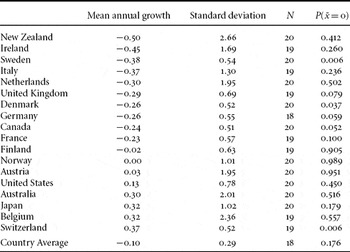
A central claim of the new politics perspective is that the welfare state is highly resistant to efforts at retrenchment. An initial test of this proposition would involve an analysis of the public share of health care spending at the beginning of the 1980s to levels in 2000, the last year in the sample. Unfortunately, statistical breaks in the data prevent a comparison of the public share of health care spending across long periods of time for many countries. As an alternative approach, Table 1 presents the average annual growth rate in the public share of health care from 1980 to 2000, excluding years in which there was a statistical break in the data. The data reveal a wide variation across countries. A number of countries witnessed a decline in the public share over the period. The greatest reduction occurred in New Zealand where health care reforms reduced the average public share in the country by an average of 0.5 percentage points per year, implying a total reduction in the public share of health care spending of 10 percentage points across the period. However, as the result of a wide standard deviation and small sample, these results are not statistically significant. Statistically significant reductions in the public share of health care spending were seen in two countries at the 0.05 level, Denmark and Sweden, and an additional four at the 0.10 level, Canada, France, Germany and the United Kingdom.
Average annual change in the public share of health care spending from 1980 to 1999

Note: Mean annual change across countries excluding years with statistical breaks.
The decline in the public responsibility for health care during the 1980s and 1990s suggests that a number of governments shifted an increasing burden of health expenditures on to the private sector, either by constraining budgets below the level of growing demand or through direct cuts in the public health care system. This evidence of retrenchment in national health care systems poses a challenge to the new politics perspective. The new politics perspective predicts that retrenchment should be highly constrained by entrenched interest groups and popular support for national health care. Yet, the evidence suggests that a number of states have seen cutbacks in the role of the state in health care. This is consistent with the predictions of the power research approach that the welfare state remains vulnerable to significant cutbacks. At the same time, whether this reduction in public responsibility for the health care system represents substantial retrenchment or only marginal reform is open to interpretation. Neither the new politics nor the power resources school provide a clear or definitive standard for when a reduction in the welfare state represents significant retrenchment or only marginal reform. Yet, it is important to recognise that these cutbacks are occurring in a sector of the welfare state thought to be highly resistant to efforts at reform.
The central concern of this project is whether partisan control over government remains an important predictor of health care policy change during the current age of retrenchment. To examine the impact of partisanship on the public health care system, I modelled the data using OLS regression with panel corrected standard errors and fixed-effects for countries (Beck and Katz, Reference Beck and Katz1995). The use of growth rates as a dependent variable significantly reduces the risks of autocorrelation in panel data (Kittel and Winner, Reference Kittel and Winner2005); however, the models also include the lag of the dependent variable to further control for autocorrelation.
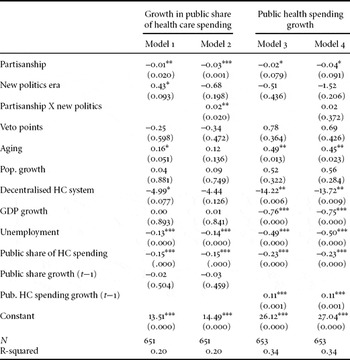
Table 2 presents the results of the regressions on the growth of the public share of health care spending and overall public health care expenditures. Model 1 represents the baseline model for examining the impact of partisanship on the growth in the public share of health care expenditures. The coefficient for the partisanship variable is negative and statistically significant, signalling that right party control over government is associated with slower growth in the public share of health care expenditures. Unexpectedly, a dummy variable for the new politics era, here defined as the years after the 1972 oil crises, is associated with faster growth in the public share of health care expenditures, suggesting that, all else held equal, states took on a greater role in the health care system after 1972; however, this relationship is not statistically significant. Model 3 provides the baseline model for public spending growth. The results are generally consistent with Model 1; however, the partisanship variable misses traditional standards of statistical significance with a p-value of 0.079. These models provide evidence of a link between partisan control over government and the expansion of the public role in the health care system, but only more limited evidence for a direct effect of partisanship on public expenditures.
Partisanship and changing government responsibility for health care

Notes: *p < .1 **p < .05 ***p < .001.
OLS regressions using panel corrected standard errors and fixed effects. P-values in parenthesis.
The baseline models examine the link between partisanship and the development of the public role in the health care system, but they do not directly test the claim of the new politics perspective that the impact of partisan differences on the health care system should decline over time. Model 2 offers a more direct test of the new politics hypothesis by introducing an interaction term between the new politics dummy variable and the partisanship variable. The inclusion of an interaction term makes it possible to examine the statistical relationship between partisanship and the growth in the public share of health care expenditures contingent upon whether it is the era of the new or old welfare politics.
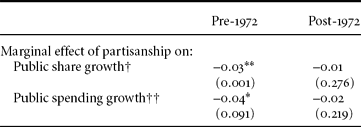
The inclusion of interaction terms makes it difficult to interpret the coefficients and standard errors of the constituent terms in isolation (Brambor et al., Reference Brambor, Clark and Golder2006). In order to capture the conditional nature of the coefficients and standard errors, Table 3 presents the predicted marginal effects of partisanship on both dependent variables prior to and during the new politics period. The results of both interactive models generally conform to the predictions of the new politics perspective. In the early period from 1961 to 1972, the partisanship variable is negatively associated with growth in the public share of health care expenditures. In the post-1972 period, the coefficient for partisanship approaches zero and becomes statistically insignificant. This suggests that, as predicted by the new politics approach, the relationship between partisanship and the growth of the public share of health care expenditures declines over time. Prior to 1972, more conservative governments were associated with slower growth in public health care systems; however, following 1972 there was no statistically discernible difference between the spending patterns of governments of the right and left.
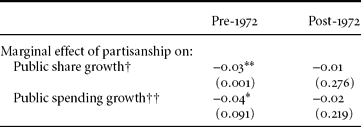
When looking at the effect of partisanship on public spending growth the results are generally consistent with that for the growth of the public share, but provide less clear evidence for the new politics perspective. Model 4 suggests that right parties are generally associated with slower overall public spending growth prior to 1972 and this effect declines in the new politics period; however, as suggested by the results from the baseline model for public spending growth (Model 3), the association between partisanship and public health care expenditure growth is not statistically significant in either period.
The evidence presented on the changes in the public share of health care expenditures provide support for the new politics perspective; however, this approach is based on the assumption that the new politics period began as a clear break with the earlier period immediately following the oil-crisis recessions of the early 1970s. The assumption of an instantaneous transition from the old to the new politics of the welfare state may be unrealistic. It may be more appropriate to assume that the new politics period emerged more gradually as parties adapted their platforms and policy preferences to the new economic and demographic challenges faced by the welfare state. If the retrenchment era politics emerged more gradually over time, then it may be more appropriate to model the relationship between partisanship and growth in the public health care sector under the assumption that the effects of partisanship on welfare state politics declined over time, rather than collapsing to zero after a single point in time.
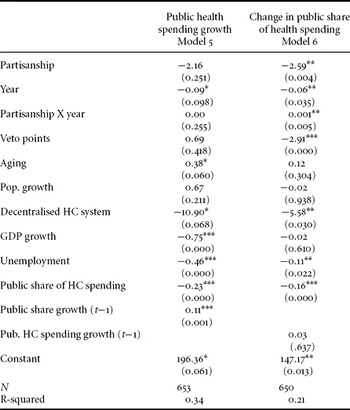
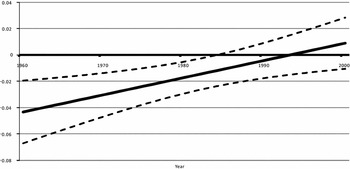
Models 5 and 6 presented in Table 4 provide a final test of the new politics hypothesis under the assumption that the effects of partisanship on the health care system declined more gradually over time. The introduction of an interaction term between the year and the cabinet ideology measure tests for the possibility of a generalised (and uniform) decline in the relationship between partisanship and health care expenditures over time. Again, it is difficult to interpret the coefficients and standard errors of interaction terms, particularly for continuous variables. To ease interpretation, Figure 1 presents a graphical representation of the changing effect of partisanship on the growth in the public share of health care expenditures over time (Model 5). The straight line represents the predicted coefficient for the partisanship variable at different periods of time; while the dashed lines reflect the 95 per cent confidence interval for each period (Brambor et al., Reference Brambor, Clark and Golder2006). The results provide clear evidence for a declining effect of partisanship on changes in the public share of health care expenditures. For the year 1960, the predicted marginal effect of a change in partisanship is a statistically significant –0.043. For the year 2000, the coefficient for the partisanship variable becomes positive (0.009) and is statistically insignificant. The upper boundary of the 95 per cent confidence interval crosses zero beginning in 1984, meaning that partisanship is no longer statistically significant after this time. Analysis of the results (not shown) from the analysis of public health care spending growth (Model 6) reveals a similar relationship with the effects of partisanship declining over time to statistical insignificance.
The changing impact of partisanship on healthcare spending over time

Notes: *p < 0.1 **p < 0.05 ***p < 0.001.
OLS regressions using panel corrected standard errors and fixed effects. P-values in parenthesis.
Marginal effect of partisanship on the growth of the public share of health care spending across time.

Taken together, the evidence presented here suggests that, as predicted by the new politics approach, partisan control of government has had a declining effect on the growth of national health care systems. Regression analysis demonstrated that the impact of partisanship on the government's share of health care expenditures declined significantly over time. By the mid-1980s, partisanship was no longer a statistically significant predictor of changes in the government's share of health care expenditures. This is consistent with the contention of the new politics approach that, as the result of shifts in the underlying politics of health care, the spending patterns of parties began to converge over time.
Conclusions
In the current era of fiscal discipline and austerity, political leaders across the West have been forced to assess the viability of earlier commitments to the welfare state. Welfare state scholars have long disagreed over the meaning of this current era of retrenchment for the politics. Do the current conflicts over welfare retrenchment mirror the struggles of labour and capital that seemed to define earlier welfare politics? Or, does the current era represent a fundamentally new political environment in which new actors and interest groups have emerged, transforming and significantly reducing the ideological conflicts of the past?
This study contributed to this debate by examining the often-ignored impact of the retrenchment era on the politics of health care. By examining the relative growth of the public and private health care sectors in 18 advanced industrial countries, this paper sheds light on the effect of the transition to retrenchment era politics on the role of partisanship in determining spending patterns. Analysis of the changing responsibility of government for health care spending challenged the new politics perspective by revealing significant cutbacks in the health care system in a number of countries. Though this evidence does not provide definitive proof of substantial retrenchment due to an absence of clear standards for what constitutes significant retrenchment, the evidence suggests that retrenchment of even the most popular and visible of welfare state programmes is possible. The analysis of health care reform therefore suggests that though retrenchment may be politically difficult, it is far from impossible.
The central concern of this analysis involved whether the politics of retrenchment had reduced the impact of partisanship on health care policy. The results suggest that partisanship played a significant role in determining the growth in the public share of health care expenditures early on, but the effects of party control of government diminished over time. The interaction models suggest that the partisan character of governing parties no longer played a significant role in shaping the growth of the public sector by the mid-1980s when the measured effects became negligible and statistically indistinguishable from zero. These results are consistent with the new politics perspective's prediction of a declining impact of partisanship on the welfare state over time.
Taken together these results provide mixed evidence for both the new politics and power resources approaches to retrenchment politics. Although the data reveal significant retrenchment in a number of health care systems, they also suggest that the importance of partisan politics for health care policy has declined in the retrenchment era. These results call for further investigation into other factors that may play a role in shaping retrenchment outcomes, including the structure of health care and political institutions.
Finally, this study offers a strong argument for the incorporation of the study of health care reform into the analysis of welfare state retrenchment. Health care systems are large and highly visible welfare state programmes that engage a large number of powerful interest groups. At the same time, the continued rise of health care expenditures has placed health care at the centre of debates over welfare reform. For these reasons, health care poses a unique and significant challenge to potential reformers that may shed light on the conflicts between fiscal pressures for reform and political resistance to significant change. Further research into the politics of health care may uncover new insights into the broader politics of welfare state reform, by highlighting the ways in which political and economic cross-pressures shape the preferences and political strategies of parties across the ideological spectrum.