The British general election of May 2010 failed to deliver any party a parliamentary majority. Consequently, no single party could form a government without a degree of support from one or more other parties.Footnote 2 Two options were potentially possible: either one of the two largest parties – the Conservatives or, less plausibly, Labour – could form a minority government with sufficient passive support from other parties to get their budget approved, or one or other of them could enter into a coalition with one or more other parties. The former option, of a ‘confidence and supply agreement’, suggests minimal concessions. Such deals imply that the other parties need only support those policies they agree with or have no reason to disagree with. However, that condition may constrain the government so much as to force it into inaction and so has generally proved unstable and short lived. By contrast, the latter option of a coalition promises greater stability because those involved become partners in government and must settle on a joint programme.Footnote 3 However, it thereby requires all sides to compromise and concede something to the others. Not only must favoured policies that are unacceptable to the coalition partners be jettisoned, moved down the list of priorities or watered down, but also it is likely that all partners will have to accept and actively promote some measures they believe misguided or even wrong. Potentially, this circumstance puts in question the political integrity of the politicians involved. The suggestion arises that to attain office they have betrayed themselves and their parties by abandoning both their own principles and their undertakings to their voters. Indeed, the Conservative–Liberal Democrat Coalition that emerged after the election has attracted precisely this criticism, with supporters of both parties alleging that in compromising with each other the politicians have compromised themselves and their electors. Both parties stand accused of abandoning specific pledges, on immigration and inheritance tax (in the case of the Conservatives) and on student fees (in the case of the Liberal Democrats) and of diluting their distinctive ideologies in the process.
My aim is not to explore the rights and wrongs of this episode per se, but rather to use it to illustrate the nature of political compromise. Though not unknown,Footnote 4 minority governments and coalitions are less common in Britain – at least in national elections – than in most other democratic systems, where they are the norm rather than the exception. However, in the spirit of Charles Dickens's Mr Podsnap, coalitions have generally been regarded by British political commentators as a feature of ‘other countries’ sadly obliged by their more proportional electoral systems to ‘do…as they do’.Footnote 5 This conventional Podsnappery holds coalition government to be defective precisely because it entails compromises that are thought to be inherently unprincipled and undemocratic, for it is assumed that they necessarily involve breaking electoral commitments.Footnote 6 The possibility for ‘uncompromising’ politics provided by the British plurality voting system is deemed an advantage rather than a defect, therefore: one of the ways ‘this Island was Blest…to the Direct Exclusion of such Other Countries…as there may happen to be’.Footnote 7 In what follows, I shall challenge that view by defending the sorts of compromise that coalition government entails as both principled and democratic.
Compromise is an ambiguous term, and evokes positive as well as negative connotations. Deployed negatively, as in the standard criticism of coalitions, it conjures a picture of democratic politics and politicians more generally as unprincipled and untrustworthy. From this perspective, to compromise is to compromise oneself by falling short of one's professed standards.Footnote 8 Politicians compromise because they are prepared to do anything to enjoy the perquisites of office. Deployed positively, however, it describes an admirable willingness to include and respect the concerns of others. From this perspective, to compromise is to hear (and hearken to) the other side.Footnote 9 Compromise may even render a policy both better and more democratic by benefiting from, and appealing to, a broader range of perspectives from within the political community.Footnote 10
On the negative account, any post-electoral compromise entails going back on the pledges politicians made to the voters, in order to do a deal with those whom they had hitherto opposed. As a result, its democratic credentials seem poor. Compromise appears most coherent and acceptable the more minimal and instrumental it is. To retain their political integrity, therefore, politicians should only make pragmatic concessions to achieve as much of their programme as possible.Footnote 11 In particular, the ends and principles that motivate a given political vision – such as their view of the rights and obligations of individuals towards society at large – should be kept out of politics so far as they can. They provide side constraints on any compromise, for a compromise is morally acceptable to the extent these ends are not themselves compromised. By contrast, on the positive account, compromise cannot be entirely pragmatic. There must be some appreciation of the moral vision of those with whom one compromises for any agreement to be possible. As a result, compromise has to be moral in both substantive and procedural terms. Certain complementarities between core moral commitments must be found as a basis for the compromise, and the means of doing so must be motivated by an acceptance of the legitimacy of disagreement.
The positive as well as the negative view has been evident in assessments of the Coalition.Footnote 12 Although the two Coalition party leaders tend to employ the negative view when talking to their own supporters, they resort to the positive view when appealing to each other. In the first case, they suggest that compromise is a regrettable necessity but has been kept to a minimum.Footnote 13 In the second case, they argue that compromise has offered an opportunity to combine the best of both parties' visions.Footnote 14 Amy Gutmann and Dennis Thompson have related the negative and positive views of compromise to the campaigning and governing mindsets, and there is a degree of truth in that observation.Footnote 15 However, I wish to argue that even in a campaign the positive view is the more coherent and democratic of the two. The negative view only proves tenable in a limited, and increasingly unusual, set of circumstances.
In terms of my somewhat stylized depiction of the options following the 2010 UK election, it might appear that the negative view of compromise coincides more with ‘the confidence and supply agreement’ and the positive account more with the eventual Coalition. To some extent, that impression proves well founded. As I shall attempt to show below, the Coalition Agreement probably would not have been possible without at least some elements of the positive view being adopted by the actors involved. However, it is not my intention to defend Coalition government as morally superior to majority or minority government, let alone to suggest that this Coalition provided the best possible outcome for the 2010 election. I simply wish to defend the positive view as the most normatively appealing way to tackle the compromises that most people accept form an inevitable part of political life. After all, even a party enjoying a parliamentary majority may need to compromise with certain factions on its own side to get particularly contentious measures through. Yet the negative view will always regard such compromises as regrettable and slightly dirty. By contrast, the positive view will treat them as part and parcel of a pluralist and democratic society, in which disagreement and diversity are facts of life. I do not deny that parties can be divided in ways that make the positive approach impossible and that there are dirty and even rotten compromises.Footnote 16 Nevertheless, pace the negative view, I shall argue that compromises are more likely to prove unsatisfactory and unsavoury the more they are tackled from the negative as opposed to the positive perspective.
The central claim is that the negative view of compromise rests on a misconception of the democratic process. It latches on to certain apparent paradoxes in the notion of compromising that reflect those posed by democratic theory more generally, and within representative democracy in particular. However, the negative view's favoured approach – of minimal compromise – actually compounds rather than resolves these dilemmas. At the heart of the problem lies what I shall call the ‘representation paradox’, which parallels the paradox in the theory of democracy noted many years ago by Richard Wollheim.Footnote 17 Wollheim's paradox consisted of the dilemma of a committed democrat who believes A ought to be done when the democratic majority holds that B ought to be done, and thereby finds him or herself believing that both A and B ought to be done, even if A and B are incompatible with each other.Footnote 18 The representation paradox develops this point further and has two aspects: the first on the side of the represented, the second on that of the representative.Footnote 19 With regard to the represented, compromise suggests that voters are potentially not simply caught between being committed to the view they may have voted for, on the one hand, and the process of democratic voting, on the other, as Wollheim observed. They are also caught between the views that the representative they voted for pledged to uphold on their behalf and the views he or she actually puts into practice. As a result, the represented may feel that their vote truly counts for nothing. Meanwhile, representatives can find themselves having been elected to do one thing – and presumably believing that policy to be the right one – yet having to do something else. In each case, the fact of compromise arguably compromises the integrity of both the agents involved – the citizen in the first case and the politician in the second.
I shall set about dissolving this paradox as follows. In the first section I criticize the paradoxical position implied by the negative view whereby compromises are more likely to be principled if they are pragmatically motivated and moral principles and ends are excluded as far as possible from the compromise. According to this line of thinking, to compromise on moral grounds risks being incoherent, suggesting one should think it right to do what one believes to be wrong, while a compromise of moral ends and principles risks being either unprincipled or implies moral correction – that both sides have modified their views because they have come closer to a consensus on what is morally fairer or more just for them to do, in which case neither is compromising at all.Footnote 20 Against this position, I distinguish a ‘shallow’ compromise based on trading and bartering from a ‘deep’ compromise that has the mutual modification of ends and principles at its core. The first type of compromise can be purely pragmatic and instrumental, but it proves difficult for the second type to be so without involving some moral acceptance of the legitimacy of the different views involved in the disagreement. However, such acceptance need not signal incoherence, a lack of principle or moral correction, merely that both parties find reasons within their own moral views for conceding something to each other. While certain avoidance strategies of what I call ‘trimming’ and ‘segregation’ may be needed to protect those areas where no compromise is available, most political compromise cannot but involve the ends and principles of those involved and have them at its core. For they define the contours of the policies we favour and the ways they might be traded or bartered. As a result, compromise will often need to be moral rather than purely pragmatic in both substance and process, since it will rest on a degree of reciprocity and mutual recognition between the parties concerned.
The second section then turns to the way in which accepting the authority of democratic decision-making itself implies such a moral acceptance of the need for compromise. Indeed, that very moral acceptance lies behind the standard solution to the Wollheim paradox. Democracy involves accepting disagreement and distinguishing one's own view as a contribution to that disagreement from the democratic outcome as a resolution of that disagreement. One way of characterizing this acceptance is to see democracy as a means for promoting a fair compromise which accords equal respect and concern to different views without assuming any consensus between them. The democratic process arranges compromises between people who all believe that they are entitled to live by their own conception of the good but need to reach some collective agreements to do so. The aggregative aspect of democracy suggests that it does this in a purely mechanical way, but democracy also has its deliberative phase. As such, it builds on deep as well as shallow compromises in order to forge the coalitions needed to win elections, even in a plurality system.
The third section then argues that compromise between representatives becomes more rather than less legitimate the deeper it goes. The representation paradox derives from a delegatory model of representation, which gets caught on the horns of Wollheim's dilemma and allows at best for the shallowest of compromises. On this account, representatives are tied to specific policy commitments to which they should stick as far as possible. The assumption is that deep compromise only proves possible on the trustee model that divorces the compromises of representatives from those of the voters, and enjoys the most indirect democratic legitimacy. However, if elections are viewed as being about principles and not just policies, then representatives may legitimately engage in a deep compromise on the electorate's behalf, to the extent that their political reasoning reflects the principled arguments of the voters. This argument rests on a quasi-pictorial view of representation in which the representative body roughly mirrors the reasoning on political issues found within the electorate. Given, as I argue in the first section, that keeping faith with principles allows for more flexibility in compromising than a commitment to policies does, while – as I show in the second section – an adherence to democracy itself mandates a willingness to compromise, then representatives can legitimately enter deep compromises for their supporters so long as they reason as them. The result is that coalitions and compromise can be regarded not simply (and negatively) as normal for democratic politics; they constitute a (positive) democratic norm.
THE NATURE OF COMPROMISE: SHALLOW AND DEEP
According to the standard definition, compromise involves disagreement between two or more people who need to make a collective decision, in which all parties settle for less than they believe they are entitled to.Footnote 21 So conceived, compromise differs from both a coerced agreement and a consensus. It differs from a coerced agreement in being voluntary. It may be occasioned by the force of circumstances making it impossible for politicians to act without cooperating with others holding different and conflicting views to theirs, but it is assumed that they always have alternatives or could choose not to act at all. As we saw in the case of the 2010 UK election, a Conservative-led Coalition was not the only option, and fresh elections might have been called. Yet, though consented to, the result does not reflect a consensus because it involves all sides accepting a settlement that falls short of what they regard as right or good in ways they may feel misguided and even wrong. Consequently, any compromise involves all concerned choosing to some degree to hold their noses and to do certain things they would rather not have done in order to get a collective agreement. Compromises are interpersonal but also intrapersonal; to compromise with others one must also compromise with oneself.Footnote 22
Though all compromises share these features, they can take different forms that reflect different motivations. Here too at least one common feature appears necessary. As Van Parijs notes,Footnote 23 the condition for any compromise is Pareto optimality – each party must feel the compromise is an improvement on the status quo. It would be hard to imagine them compromising otherwise. Yet, that may suggest that compromise consists solely of pragmatic, minimal concessions. For example, a compromise on a coalition is acceptable to the extent that the parties regard implementing some of their programme as better than implementing none of it and letting another group implement theirs. I shall characterize political compromises of this type as ‘shallow’ and contrast them with ‘deep’ compromises of a more principled kind.Footnote 24 In the first type, compromise is instrumental and restricted as far as possible to policy issues, in the second type compromise is moral and involves a degree of mutual respect for, and accommodation of, the different principles and ends of the parties involved.
‘Shallow’ compromises involve a trade-off. The simplest trade-off is to ‘split the difference’. If a buyer is bargaining with a trader in the market over the price of a hat, he may prefer paying £10 to £20, and the trader may prefer that he pay £20 rather than £10. However, so long as the buyer feels paying £15 is better than having no hat, and the trader sees £15 as better than making no sale, they can compromise simply by splitting the difference.Footnote 25 Such compromises are instrumental. The preferences of buyer and trader are largely fixed and unaffected by the bargaining. The aim is simply to coordinate the buyer's desire for a good hat at a low price, with the trader's desire to sell his hats at the highest price possible. Such deals reflect the relative bargaining power of the parties concerned and allow for the rich tourist buyer to exploit the poor local trader. If the trader's need to sell is greater than the buyer's need for a hat, that may mean that the concession is not equitable – they might settle at £13, all but wiping out the trader's profit. Such trading need not be substantively moral, therefore. It also need not involve the discussion of moral notions in the process. Trading assumes a common currency that allows these compromises to be resolved along one dimension. The various parties may hold conflicting positions about, say, the exploitation of developing countries by the developed world. But they need not discuss them openly, or if they do so need not accommodate the views of the other to compromise. The trader may say (or think), ‘What about my starving wife and kids?’, and the buyer say (or think), ‘You should try selling hats at £13 rather than at £20 – you would do more business.’ Within the transaction, though, their different positions are commensurable – each simply has his price.
However, political compromises are invariably multi-dimensional and involve different and possibly incommensurable currencies. After all, the idea of politicians being bought practically defines an ‘unprincipled’ compromise. It might, though, still be possible to barter. In a barter the parties share no common currency, monetary or otherwise. Suppose Jane barters three apples for John's two pears. They may value them for quite different reasons – Jane does not eat fruit but appreciates their decorative qualities and prefers the shape of John's pears to that of her apples, John likes eating fruit and fancies a change from pears. Yet, even if Jane regards one of her apples as equivalent to one of John's pears whereas John thinks his pears are worth two of her apples, the compromise is possible because each wants what the other has enough to make concessions. Likewise, a political compromise may be possible if certain of each group's most favoured policies are ones that the other groups feel less strongly about. In such cases, they too may be able to barter, including in their common programme, say, the housing policy favoured by one group and the school policy favoured by another. Log-rolling classically takes this form. Note, though, that, like trading, bartering is instrumental and can be both immoral and amoral. The parties need not attempt to understand each other, nor need the deal be particularly fair – one party may be at a considerable advantage to the other and use that advantage to get more than the other does, whether they deserve to do so or not. All the parties need do is to discover a point that will satisfy their exogenously defined preferences sufficiently for each to feel a deal is better than no deal.
However, people tend to support given policies not simply as matters of ‘pure’ preference – be it mere taste or self-interest – but also for normative reasons. If the reasons one group have for prioritizing housing over schools are different and in conflict with the reasons the other group have for prioritizing schools over housing, then even a barter will not be available. For the reason for a group supporting housing may equally be a reason for their not supporting schools and vice versa. In these cases, moral principles and ends may block both trading and barter. Edmund Burke may have believed that ‘all government…is founded on compromise and barter,’ yet remarked ‘none will barter away the immediate jewel of his soul.’Footnote 26 In this case, a shallow instrumental compromise will be impossible without it turning into a morally reprehensible compromise of the kind only the most unprincipled would enter into – those who, in Oscar Wilde's definition of a cynic, ‘know the price of everything and the value of nothing’.Footnote 27
A ‘deep’ compromise may be possible, though. Deep compromises involve reasoning about principles as well as policies. Individual preferences are not taken as fixed and exogenous, with the aim being to maximize their satisfaction. Rather, our preferences reflect reasons that can be modified to accommodate the reasons of others through the process of debating and negotiating with them. Indeed, it is only through mutual modifications at the level of principle that a joint policy position can be built. Say the reasons that Party A has for prioritizing a certain policy towards schools is a theory about equality of opportunity that leads its proponents to be opposed to most forms of welfare redistribution, while Party B sees housing as a priority precisely because it holds that more welfare-friendly view of equality. In this situation, any attempt to combine their policies will require that they also to some degree combine their respective reasoning about them too. Such a combination can be some way short of a consensus. Each, though, may be moved to find ways to accommodate some of the reasons of the other side that are congruent with their own reasoning. For example, Party B may not have seen scholarships to private schools as the best way of improving the educational prospects for poorer sections of society, but nonetheless acknowledge that there is a meritocratic strand to their own line of reasoning that can accommodate such a policy. Likewise, Party A may regard certain forms of social housing as akin to a ‘scholarship’– a step on the housing ladder for deserving, hard-working families – and approve increased spending in this area on that basis. In these cases, compromise becomes possible because neither side is simply adopting an instrumental and pragmatic approach. Each is attempting to appreciate to some degree the moral reasoning of the other side by relating it to similar reasoning of their own. There is a core of substantive mutual moral appreciation at the heart of the compromise that nonetheless falls short of mutual moral correction or consensus.
‘Shallow’ compromises have elements in common with what Rawls calls a ‘modus vivendi’, while a ‘deep’ compromise has affinities with his idea of an ‘overlapping consensus’.Footnote 28 As with a ‘modus vivendi’ a shallow compromise depends on a contingent balance of forces between the parties involved, leading them to rub along together. But each looks to break the agreement as soon as it is advantageous to do so. Thus, such arrangements need not be either particularly equitable or stable. By contrast, a deep compromise involves the parties showing a degree of equal concern and respect for each other. They seek to acknowledge and accommodate the views of the others. Yet, unlike Rawls's ‘overlapping consensus’, such agreements remain within, and are sustained by, politics. Rawls believed that political interaction depended on removing certain basic principles from the sphere of political debate as common ground rules.Footnote 29 By contrast, these rules can be seen as the continuing focus of ongoing political compromise. For example, Liberal Democrats and Conservatives disagree about constitutional rights and the electoral system and, as we shall see, had to reach a compromise on both in the Coalition Agreement.
The option of a minority government, as described at the start of this article, can be built round a shallow compromise. Each party to it can adopt purely instrumental reasoning. However, it would be a classic ‘modus vivendi’ and prone to unravel fairly quickly as soon as one of the parties believed it electorally advantageous to opt out. To avoid this possibility, the Coalition Agreement had as a central plank a commitment by both parties to govern together for a full parliamentary term. However, to make that credible, they had to forge a common programme of government, for which a deep compromise became necessary. Thus, the Coalition Agreement begins by enunciating three shared principles – freedom, fairness and responsibility – that provided the common ground for their programme. Yet, as has become clear in debates over reform of the National Health Service (NHS), the parties diverge considerably in their interpretation of them. However, because each accepted that reference to these principles creates valid reasons for a given policy proposal, it became possible for each side to make mutual concessions at the level of policy.Footnote 30 For instance, there is a common language of dispersing power away from the centre and upholding the rights of individuals against the state. This allowed the parties to adopt the Conservative's policies of planned cuts in public sector spending, welfare to work programmes and other measures that sought to reduce state interference and promote market initiatives. However, it also supported the Liberal Democrat policies that emphasized local democracy and control, such as improving the voice of patients in NHS decisions, and even the pupil premium for disadvantaged children, which goes directly to schools rather than via local education authorities and could be seen in a similar meritocratic light to Conservative policies for fostering entrepreneurship. Analogous overlapping reasoning allowed Conservatives to postpone their preferred tax cut of raising the threshold for inheritance tax to prioritize the Liberal Democrats' favoured policy of raising the threshold for income tax.
Of course, there may be areas that prove not to be amenable to either a shallow or a deep compromise. In these cases, the parties will seek to find ways of agreeing to disagree by adopting strategies of ‘trimming’ or ‘segregation’. Trimming involves reducing the expression of dissent to a level that allows for coexistence. In the Coalition Agreement between the Liberal Democrats and Conservatives, for example, the strategy of ‘trimming’ was adopted for marriage/civil partnership tax breaks, the commissioning of nuclear power stations and higher education funding. In these areas, Liberal Democrat MPs can abstain in parliamentary votes and speak but not vote against government policy, thereby making it possible that these measures will pass while allowing the MPs to voice and maintain their opposition to them. The Liberal Democrats also dropped their opposition to replacing the Trident missile-based nuclear weapons programme but were allowed to propose alternatives. Likewise, segregation seeks to isolate the issue from the rest of the programme, either by handing it over to a third party or postponing it altogether. The Coalition government set up some 11 ‘independent’ commissions to review various policies, from the possible drafting of a British Bill of Rights to the review of public sector pensions, with the aim of providing a non-partisan (as opposed to a bi-partisan) view of a potentially contentious policy. The Liberal Democrats' proposal of the alternative vote system was initially a trimming of their preference for proportional representation. They had hoped that this move might enable a barter or trade-off with the Conservatives in exchange for their proposal to redraw constituency boundaries, since both could be justified (albeit on different grounds) as making votes fairer.Footnote 31 However, the decision to put it to a referendum operated as a segregating device in handing that decision to the electorate rather than Parliament and allowing MPs of each party to campaign on either side. The debt crisis also allowed certain costly and potentially divisive policies to be trimmed from the agenda, notably the Liberal Democrat pledge to abolish student fees, or segregated and parked until the distant future, such as the Conservatives' promise on stamp duty. These concessions were presented as compromises dictated by the economic climate rather than collaboration with another party. and so were not really compromises but a matter of facing facts.
In describing somewhat summarily the character of the compromise that lies behind the Coalition Agreement, I do not wish either to criticize or to endorse it, but merely to illustrate what political compromise involves. The key feature is that compromise only works to the extent that participants feel that the compromise policy relates to principled and other moral reasons they hold. Shallow compromises can be non-principled, but for that very reason prove elusive. Similarly, trimming and segregation allow participants to avoid changing their reasons, but they have to be used sparingly or there would be no common programme at all. At some stage, therefore, compromise must go deeper and involve mutual changes in the different parties' reasoning too, so that they can agree on an overlapping substantive moral core – albeit one that is itself built around a deep compromise. What I now wish to suggest is that such changes require a democratic ethos which can be related in its turn to resolving both Wollheim's paradox in the theory of democracy and the related representation paradox.
DEMOCRACY AS COMPROMISE
The defining circumstances for compromise are the existence of disagreement in conditions where a collective agreement is desirable and none of the parties is able to coerce the others into accepting their own favoured view. These are also the circumstances of democratic politics. Much as any theory of justice must assume conditions of relative scarcity, rough equality between the parties involved and conflicting plans of life, without which a theory of justice would neither be necessary nor possible,Footnote 32 so a theory of democracy assumes disagreement and the need to resolve it in an equitable, uncoerced manner so as to reach a collective decision.Footnote 33 We look to a theory of justice to take moderate scarcity as the normal human condition and offer an account of how we might divide a pot that will always be insufficient to meet all the conflicting demands that are made on it. Wishing that condition away removes the need for a theory of justice in the first place. Likewise, we need a theory of democratic politics that takes disagreement about justice as a fact of life and offers an account of how collective decisions might be legitimately made despite that situation. Moreover, much as justice also requires certain conditions that not only make a just decision necessary but possible, so democracy also assumes a certain rough equality between citizens so that none can simply impose their view on others, or at least an acceptance that such an imposition would be illegitimate. These circumstances not only create the space for democracy, however, but also render both compromise and the Wollheim paradox inevitable.Footnote 34
Democracy offers a way of taking collective decisions despite our disagreements. It does so by recognizing our equal entitlement to hold different views. As Wollheim observed, the paradox is only apparent because the view I hold, that A is just, and the view that results from the democratic machine, that B is just, respond to two different if complementary questions. The second is the answer to ‘what should we do, given that we disagree on whether policy A or B is just?’ The first is a response to ‘what do I think is just?’, and is my contribution to the disagreement.Footnote 35 Peter Singer has remarked that accepting a democratic process to resolve this disagreement is ‘a paradigm of a fair compromise’.Footnote 36 That view needs some qualification. If democracy involves a shared conception of fairness, then acceptance of democracy is not itself a matter of compromise. Instead, there is a consensus that democracy is a fair way of settling disagreements. At best, it provides a moral side constraint on compromise – that when we vote on whether to accept a compromise, say, we will adopt a democratic procedure.Footnote 37 However, a more plausible version of Singer's formulation arises if democracy is seen as a mechanism that allows for compromise through being a process characterized by mutual respect whereby each seeks to respond to the views of others without giving up their own. In submitting to the process, no voter need change their views or concede to others. There is an acceptance that all are entitled to disagree and that we must reach collective agreements in ways that respect our disagreements. We can term this the underlying ethos of democracy.
Joseph Carens argues that ‘in a democracy people should make concessions to their opponents even when the concessions are not needed to create a majority.’Footnote 38 That goes too far. As Simon May has pointed out, the mere fact of moral disagreement need not of itself give a moral reason to compromise.Footnote 39 I can hold a reasonable view with which I acknowledge others can reasonably disagree, but unless they can offer clear reasons for me altering my view – which would not be compromise but moral correction – I have no moral reason to seek a mutually satisfactory compromise. For, there can be no reason to regard the compromise view as more reasonable than the one I hold – it will be no less subject to reasonable disagreement. Nor should I feel morally obliged to compromise for reasons of mutual respect. So long as my view respects democratic norms and the right of others to hold different reasonable views to mine, then if a majority favours my position I am entitled to make it policy without conceding anything to the minority.Footnote 40 However, that does not mean compromise is purely pragmatic, as May contends. First, as we saw in the last section, when circumstances make compromise pragmatically necessary, we have reason to compromise in a way that is principled. It is not just that principles provide side-constraints on compromise, they must form part of the compromise. In such cases, the democratic ethos of respecting disagreement involves more than an acceptance of fair and neutral procedures and requires reciprocal concessions. Second, there may be no reasonable resolution of conflicting values other than one achieved by a process of mutual accommodation. This situation can arise in cases of what Nagel calls the ‘fragmentation of value’ in which there are decisive and sufficient normative reasons for two or more courses of action between values that are incomparable because they stem from irreducibly different bases.Footnote 41 The likelihood of this circumstance occurring increases in complex and pluralist societies, where social differentiation and ethnic diversity means that citizens bring very different perspectives and life experiences to bear on a problem and are apt to weigh it in different ways. Finding room for all these values may not be possible, and the only reasonable moral response to this practical dilemma may be to appeal to the democratic ethos and seek a compromise under fair conditions. This response cannot be regarded as seeking the ‘best’ balance of views through mutual moral correction, because no such ‘optimal’ position exists – or at least is accessible to us given the limits of practical reason. Instead, citizens and politicians morally respond to the fact of pluralism through a politics that accords with the democratic ethos. So-called non-majoritarian electoral systems, that is those systems that use some form of PR rather than plurality voting and even institutionalize proportionality in the administrative structures, as consociational systems do, effectively institutionalize compromise in this way as a means of accommodating pluralism.Footnote 42 In such systems compromise helps construct a collective good by bringing all sections of society together.
Within those pluralist societies that endorse the democratic ethos, therefore, reaching collective decisions will almost always involve compromise so as to mitigate disagreement sufficiently in order to produce workable, mutually respectful, collective decisions. At the very least, a majority will need to be constructed from various coalitions of minorities.Footnote 43
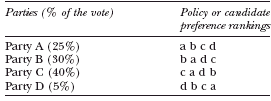
In a mass democracy this occurs to a large degree through party leaders devising programmes with broad electoral appeal. In favourable circumstances, that can be achieved by a relatively shallow compromise. Under conditions where voters' preferences can be aligned along a single dimension – standardly left–right – party competition should lead to convergence on the median voter, which has been shown to be the Condorcet winner.Footnote 44 In other words, the most electorally appealing policy package would be the one containing those policies that a majority of people would rank most highly had they been able to do so. Nevertheless, it is unlikely that many if any will get their most favoured policies. Instead, they will need to compromise and settle for their second or third best. Take the example in Table 1. In this example, the plurality winner would be ‘c’, since it is the first preference of the most people. However, the Condorcet-winner is ‘a’, since it emerges as the majority preference when its ranking is compared against each of the alternatives. As Albert Weale has observed, the Condorcet-winner ‘captures the idea of a majority converging around a compromise solution where there are divergent ideal preferences’.Footnote 45
Condorcet Voting as Compromise

Increasingly, though, the political divisions of contemporary democracies cannot be modelled in this way. As I noted, people's preferences and hence their principles are multi-dimensional. New cultural, ethnic, gender and other cleavages have overlaid the old left–right divide, while new issues, from global warming to stem-cell research, arise that unsettle hitherto dominant dividing lines.Footnote 46 In this situation deeper compromise becomes necessary. Politicians cannot treat voters' preferences as fixed and merely seek to maximize the satisfaction of as many as possible. Too many of them prove conflicting and incompatible for that to be a plausible strategy for winning a majority. As a result, politicians must attempt to appeal to the reasons that lie behind voter preferences and to persuade them in part to modify those reasons in the manner explored in the previous section. In the UK, the Conservatives have had to struggle to bring together Europhiles and Europhobes, traditionalists and libertarians, climate change deniers and rural ecologists, and generally appeal to the middle of the electoral spectrum without losing too many from their more radical wings. A similarly eclectic mix can be found in all the main parties. As I noted, such pluralism has often motivated moves to PR and a more ‘consensual’ style of democratic politics, in which compromise is institutionalized.Footnote 47 In these more proportional electoral systems the multi-dimensional character of politics is reflected in a multiplicity of parties. Yet, if these parties aspire to be partners in a governing coalition, the reasoning behind their policies must be roughly congruent with the reasoning of a number of other parties. A workable coalition will only arise to the extent deep compromise proves possible.
In both the shallow and the deep version of a democratic compromise, therefore, voters are not just accepting to settle their differences by submitting them to the arbitration of a procedure that treats all of them fairly. Unless voters are content to accept permanent opposition, they also must be open to a more substantive compromise. Such compromises follow from a democratic commitment to each person's views counting for something. And, being views, these imply principles as well as policies. However, such compromises do not just occur within the election but also, and most crucially, post-election, among representatives. It is to the relationship of these legislative compromises to the preceding electoral compromises that I finally turn.
THE REPRESENTATION PARADOX
Much of the ire that compromise arouses gets turned against politicians. In compromising among themselves they are accused of betraying their electoral mandate. In this section, therefore, I shall explore the form of representation needed if the ‘deep’ compromises necessary for coalition-building are to keep faith with the commitments politicians make to their voters. Three types of representation are routinely distinguished in the literature: representation as delegates, where the representatives are instructed what to do; representation as trustees, where representatives decide what to do; and representation as copies, where representatives replicate what to do.Footnote 48 In practice, representatives no doubt find themselves adopting elements of all three. However, I want to suggest that deep compromise among representatives operates most democratically to the extent that it corresponds to a variant of the third type of representation.
Delegatory forms of representation seem to have the most straightforwardly democratic credentials. On this view, politicians get elected to pursue a certain programme and then are honour bound to act under the instructions of the electorate and stick to their campaign pledges. However, this position appears to brook almost no compromise. Arguably, though, it allows for shallow compromises. True, specific policy pledges, such as George Bush's ‘read my lips, no new taxes’ or the Liberal Democrats' promise not to raise student fees, can only be modified or abandoned at the cost of appearing to betray the electorate. Yet, for that very reason, they tend to be rare – politicians know that unforeseen events make such promises rash. Instead, election campaigns tend to involve politicians putting forward rather vaguer policies linked to a certain ideological perspective. For example, both Liberal Democrats and Conservatives committed themselves to rolling back the alleged erosion of civil liberties under Labour in ways that they linked to their distinctive views of freedom, but without going into too many specifics. If we see legislators as delegates with regard to these general ends, then compromise might be possible with regard to means and to achieve the maximal satisfaction of these ends. This proposal has been made by Thomas Christiano. He argues that full-time professional politicians may reasonably claim greater expertise than ordinary citizens with regard to means, but should act under their instructions as to ends. As a result, they should be ‘limited to deliberating about means and bargaining with other legislators…to achieve the best possible compromise among citizen's announced schedules of trade-offs’.Footnote 49 However, this solution rules out deep compromises. Therefore, to the extent we have seen these to be necessary; a different form of representation seems called for.
A standard assumption has been that, for representatives to be able to negotiate compromises about ‘ends’, they must act as ‘trustees’. This is the position commonly ascribed to Edmund Burke. In his famous ‘Speech to the Electors of Bristol’, Burke explicitly disavowed the view that the electorate issued ‘authoritative instructions’ to their representatives.Footnote 50 For the representatives to be bound to represent the partial interests of their constituents, he argued, would be inconsistent with their role within Parliament as deliberators on the national interest. To do that, representatives had to be free to exercise their own judgement as to what was the best way both to pursue the interests of the Bristol voters, and to relate them to the interests of the country as a whole. That view clearly goes beyond deliberation about means to encompass the discussion of ends. Yet, it comes at a price. To be consistent with democracy, Burke's position must assume that politicians are selected for their good judgement rather than to represent the judgement of their constituents – a judgement that extends not just to the means whereby their interests might be best realized but also to whether those interests serve the best ends. If so, it then becomes mysterious how electors could be competent to choose their representatives and hold them to account. It also overlooks the degree to which campaigns do rest on reasoning among the electorate and with politicians. Indeed, it is precisely the claim to be a trustee in this Burkean sense that leads voters to distrust politicians and reject their compromises as illegitimate. They regard these compromises as attempts by politicians to substitute their reasoning for the reason of those who they ought to serve. Though politicians may claim to act for the public interest, if the public's express views on their interests are being disregarded in the process, the suspicion always will be that they are simply serving their own.
Representation as replication is usually associated with forms of ‘mirror’ representation, often linked to a politics of presence that will allow the representative body to be ‘an exact portrait, in miniature, of the people at large’, able to ‘think, feel, reason, and act like them’.Footnote 51 This aspiration has generally been thought impossible to fulfil in all respects. The archetypal ‘gay’, ‘lesbian’, ‘black’, ‘white’, ‘male’ and so on proves a chimera. Yet, this aim also lies at the heart of the paradox raised by the very concept of representation, which seeks to make present what is not present.Footnote 52 Certain theorists have recently adapted this argument and given it a more limited and plausible application as the representation of citizen's political views as these emerge through the electoral process.Footnote 53 As with Christiano's account of delegation cited above, it is accepted that, as professionals, representatives have the advantage over most voters in having the time to become better informed about the issues than most of them can be. The election is rather an attempt by politicians to show how their various policy proposals relate to the views of citizens. For, pace Burke, voters participate in elections not to push their interests per se, but to express their views.Footnote 54 After all, as a different voter paradox has it, to vote simply to achieve a given policy would be irrational; the likelihood of your vote counting sufficiently to be worth going to the polls is too remote.Footnote 55 So the appeal of representatives lies in their thinking like their voters – in their being like-minded in their reasoning.Footnote 56
Representation conceived in this way does not require that one represents how everyone in a polity thinks about every single issue. Nor does it involve duplicating how they reason in all spheres of life. Rather, it involves seeking to represent the main modes of thinking about political issues – those with significant support – in ways that are roughly proportionate to their distribution among the populace. As far as that is the case, it will be legitimate for representatives to legislate in ways that continue the process of deep compromise that forms a necessary part of any successful election campaign. That is, they can reason on politics ‘as’ their voters, not just about means but also about the ends that they share with them, applying this reasoning in collaboration with other representatives so as to reach collective agreements on how to tackle the policy issues of the day. Indeed, the diversity of views found in most pluralist societies is likely to make such compromise necessary.
Which electoral system might best achieve this result lies outside the scope of this article. However, as the Conservative–Liberal Democrat Coalition testifies, even a plurality system can produce sufficient diversity to make compromise necessary. The argument here is that, in evaluating the democratic credentials of such compromises, it is not the policies per se that ought properly to be our focus – or that of the parties concerned when making compromises – but rather their reasoning on these policies. To the extent that this is plausibly representative of the reasoning of their supporters, that in the case of the Coalition Agreement the Conservatives and Liberal Democrats reasoned as one would expect of such parties – themselves a broad church – then their joint decisions can be said to support rather than undermine democracy. Such compromises can be regarded as democratically authorized and accountable as well as consistent with the democratic ethos, for they offer a realistic way in which citizens can be taken seriously as reasoning agents about public policy, and their views be accorded equal concern and respect in the on-going policy-making process.
CONCLUSION
This article has addressed the question of whether democratic politicians can compromise with each other without compromising themselves, democracy or their supporters. In the first section I suggested that cannot be by making shallow compromises that avoid issues of principle. Such compromises would indeed prove unprincipled in every sense. Political compromises cannot avoid reasoning on ends as well as means. Yet, such deep compromises need not just to involve principles but also to be principled, showing mutual respect for the views of others. The second section then argued that such deep compromises reflect the ethos of democracy. Acceptance of a democratic process will appear paradoxical to those unprepared to countenance any compromise. However, the paradox can be resolved for democrats prepared to see both the procedures and outcomes of democracy as involving a fair compromise, in which we take seriously the entitlement of all citizens to a say in matters of collective concern. Finally, I explored how far politicians can avoid the representation paradox and enter into compromises with each other without betraying their electoral commitments. The answer lies in grasping the paradoxical character of representation itself and conceiving representatives as making present the reasoning of those who are not present, whose views to some extent they must share. This need not involve a politics of presence or mirror representation, for it involves the representation of political ideas not of persons, as these are forged and expressed within the electoral process.
None of the above is to deny that there may be matters that cannot be compromised. The more the cleavages within a political community are segmental and vertical, rather than cross-cutting and horizontal, the shallower compromise tends to become, and the greater the resort to trimming and segregation. Communities that are deeply divided on ethnic, cultural or religious lines tend to end up adopting ever more ‘special rights’ to trim issues off the agenda, and to demand the segregation of ever more decisions into autonomous decision-making bodies, such as regional assemblies or regulative authorities.Footnote 57 However, the more such devices are employed, the less the citizens involved can be said to form a democratic community – and in extreme cases may even split up, as indeed Scottish and Welsh nationalists, for example, desire. That possibility merely reinforces my central point – to accept democracy is to accept compromise. When the divisions with a political community are such that various groups can no longer compromise with each other then it is likely that they must either separate into distinct demoi or give up on democracy altogether.