Introduction
Whenever there have been wars and armed conflicts with lengthy periods of foreign soldiers in close proximity to local civilian populations, there have been encounters between troops and civilians, from superficial to intimate. In the post-war period in Germany, allied soldiers and German women maintained sexual contacts for manifold reasons, e.g. these (illegal) relationships ensured the survival of women and their families in times of shortages and insecurity (e.g. supply of food, accommodation, and safety). At the end of World War II, sexual violence dominated (Mochmann et al., Reference Mochmann, Lee and Stelzl-Marx2009). According to estimations, approximately 1.9 million German women and girls were raped at the end of the war (Sander and Johr, Reference Sander and Johr1992). As a result of these sexual contacts, children were born, fathered by occupation soldiers with local women. Among these children were those conceived in conflict-related sexual violence and also in intimate relations of more or less consensual nature ranging from the so-called “business arrangements” to love relationships. Due to the nature of the circumstances into which Children born of war were born, no exact data exists about their numbers. Many grew up unaware of their biological origins, because knowledge was often kept hidden. Recent estimations assume that there are up to 400,000 German occupation children (GOC) (Stelzl-Marx and Satjukow, Reference Stelzl-Marx and Satjukow2015).
Childhood maltreatment is defined as “any act of commission or omission by a parent or other caregiver that results in harm, potential harm, or threat of harm to a child, harm does not need to be intended” (Gilbert et al., 2009). Childhood maltreatment includes physical, sexual, and emotional abuse as well as physical and emotional neglect. The long-lasting effects on mental and physical health persist into adulthood (Kessler et al., Reference Kessler, Davis and Kendler1997; Gilbert et al., 2009). Due to its prevalence as well as its complex and cumulative effects on the developing brain, mind, and body, childhood maltreatment is perhaps one of the most important developmental risk factors in childhood and adolescence (Shonkoff et al., Reference Shonkoff, Boyce and McEwen2009).
The childhood living conditions of GOC were characterized by familial and societal areas of conflicts between integration and rejection. Concealment, financial problems, public, and familial repulsion often played a role. When investigating the psychosocial consequences of these conditions, three core aspects were of salient importance: identity development, stigmatization/discrimination and childhood maltreatment. The societal attitude toward GOC and their mothers at the end of WWII and during following years was predominantly hostile (Stelzl-Marx, Reference Stelzl-Marx2009a; Glaesmer et al., Reference Glaesmer, Kaiser, Freyberger, Braehler and Kuwert2012). Today, it is beyond question that more or less overt discrimination and/or stigmatization was a formative experience of GOC. In fact, most carried a double burden, being the offspring of the “enemy” and being born out of wedlock. Moreover, some of the GOC were conceived as a result of conflict-related sexual violence and intimate relations of more or less consensual nature resulting in an increased risk of mental disorders in the mothers and of disturbances in mother–child attachment (van Ee, Reference van Ee2011; Kaiser et al., Reference Kaiser, Kuwert, Braehler and Glaesmer2016).
In 2013, the first quantitative study on psychosocial aspects of growing up as GOC was conducted in Germany (Kaiser et al., Reference Kaiser, Kuwert and Glaesmer2015a) to deliver empirical evidence about the experiences of GOC and the long-term outcomes of these experiences. One hundred forty six GOC were assessed with a comprehensive questionnaire, including childhood experiences, stigmatization/discrimination, identity issues, childhood abuse and neglect, and current mental disorders (depression, somatization, Posttraumatic Stress Disorder (PTSD)) (Kaiser et al., Reference Kaiser, Kuwert, Brähler and Glaesmer2015b). Nearly half of the sample (48.6%, n = 71) stated their biological father was an American soldier, 22.6% (n = 33) were offspring of a former French soldier, 2.7% (n = 4) of former British soldier, and 21.9% (n = 32) of members of the Red Army (Kaiser et al., Reference Kaiser, Kuwert and Glaesmer2015a). In 2.7% (n = 4), the origin of the father is unknown. Around three-quarter (75.3%) stated their mother was in a voluntary and positively connoted relationship with their biological father. Of these, 19.1% (n = 21) were with a soldier of the Red Army, 51.8% (n = 57) with a member of the American army, and 23.6% (N = 26) with a French soldier. Ten GOC (6.8%) reported to have been fathered as a result of rape, in seven cases by a Red Army soldier. Twenty six (17.8%) did not know their background of procreation. GOC resemble a group with specific experiences in childhood. Out of the 146 GOC, only 1.4% (n = 2) grew up with their biological father. More than half of the participants (55.7%, n = 79) had moved at least once when they reached school age; of these relocation cases, 46.8% (n = 36) experienced a change of the primary attachment figure in the context of relocation (e.g. from their mother to grandparents). Between the age of 7 and 14, 59.7% (n = 86) had moved at least once, with the consequence of a change in the primary attachment figure in 34.6% (n = 28) of these cases (Kaiser et al., Reference Kaiser, Kuwert and Glaesmer2015a). One-fifth (20%, n = 29) of the sample reported that aspects of their physical appearance suggest an “occupation background” (e.g. color of hair and/or skin; shape of eyes) (Kaiser et al., Reference Kaiser, Kuwert, Brähler and Glaesmer2015b). One-half (54.6%, n = 77) of the participants reported stigma experiences in childhood and adolescence, because they were fathered by a soldier of the occupation forces (Aßmann et al., Reference Aßmann, Kaiser, Schomerus, Kuwert and Glaesmer2015). Stigmatization and discrimination were experienced in different settings, such as social environment (e.g. peers and neighborhood), public institutions (e.g. school and parish), or within the family they grew up in (e.g. “When I was three years old and my mother needed help from her mother, she was not admitted to her apartment because a friend of her sister was visiting at the moment.”; “That my stepfather kept calling me Frenchman and constantly accused my mother, that really hurt.”) (Aßmann et al., Reference Aßmann, Kaiser, Schomerus, Kuwert and Glaesmer2015). Compared with the general population in Germany, GOC show higher prevalence rates of traumatic experiences (48.6% vs. 18.0% with at least one traumatic event), a higher point prevalence of PTSD (11.6% vs. 1.4%), major depression (10.0% vs. 1.7%), and Somatization (15.8% vs. 4.0%) (Kaiser et al., Reference Kaiser, Kuwert, Brähler and Glaesmer2015b). These findings lead to the complex and long-term impact of the burdened social, financial, and familial conditions of GOC in childhood and adolescence.
Considering the previous statements, GOC seem to be at an increased risk of childhood maltreatment compared to the general population. Glaesmer et al. (Reference Glaesmer, Kaiser, Freyberger, Braehler and Kuwert2012) assume that the three core aspects (identity development, stigmatization/discrimination, and childhood maltreatment) are specific experiences capable of formative and profound impact that are expected to be related to the long-term psychological well-being of GOC. Since empirical evidence in this group was missing so far, the analyses presented here aim to investigate frequency of childhood maltreatment in GOC and to compare findings to a birth-cohort-matched sample (BCMS) from the general population of Germany. Moreover, the association of childhood maltreatment and current mental disorders (depression, somatization, PTSD) will be investigated to shed light on the long-term outcomes of the experiences and living conditions of GOC.
Methods
Participants and study protocol
Sample of German occupation children of WW II (N = 146)
A sample of GOC was collected in the project “Occupation children: Identity development, stigma experience, and psychosocial consequences growing up as a German occupation child.” The call for participants was distributed via press release, different national and international networks (e.g. www.childrenbornofwar.org; www.bowin.eu), and online-platforms for GOC as well as other “children born of war” (e.g. www.gitrace.org; www.coeurssansfrontiers.com). Potential participants were invited to contact the first author to learn more about the project and leave their addresses. Inclusion criteria were being born after 1940, mother of German nationality, biological father being a foreign occupation soldier, and being able to read and understand the German language. Study material was distributed by postal mail, containing a questionnaire, study information as well as consent forms for participation and contact for interviews planned in the future. Data were collected between March and December 2013. Of 184 questionnaires sent, 164 were returned; nine were excluded since they did not fit the definition of “occupation children” (participation rate: 88.6% corrected for neutral drop-outs). Another nine were excluded to correct for outliers in age, leaving 146 cases born between 1945 and 1966 to be included for analysis. The study was reviewed and approved by the ethics committee of the Medical Faculty of the University of Leipzig. Methodological approach, sample specifics, and background are described in detail in Kaiser et al. (Reference Kaiser, Kuwert and Glaesmer2015a).
Birth-cohort-matched sample from the general population (N = 920)
A representative sample of the German general population was selected with the assistance of a demographic consulting company (USUMA, Berlin, Germany) in 2010. The area of Germany was separated into 258 sample areas representing the different regions of the country. Households of the respective area and members of these households fulfilling the inclusion criteria (age at or above 14 years, able to read, and understand the German language) were selected randomly. The sample is representative in terms of age, gender, and education. A first attempt was made for 4,445 addresses, of which 4,055 were valid. If not at home, a maximum of three attempts was made to contact the selected person. All participants were visited by a study assistant, informed about the investigation, and handed self-rating questionnaires. The assistant waited until participants answered all questions and offered help if persons did not understand items. A total of 2,504 people between the ages of 14 and 90 years agreed to participate and completed the self-rating questionnaires (participation rate: 56% of valid addresses). For more information about the entire sample, see Iffland et al. (Reference Iffland, Brähler, Neuner, Haeuser and Glaesmer2013). A total of 920 participants (36.7%) were born between 1945 and 1966. This subgroup is used as a general population comparison group for the GOC birth cohorts. The study complies with ICC/ESOMAR (www.esomar.org) International Code on Market and Social Research regarding ethics in social sciences and was reviewed and approved by an institutional ethics review board.
Instruments
Childhood trauma questionnaire
Childhood maltreatment was assessed with the German version of the Childhood Trauma Questionnaire (CTQ) (Bernstein et al., 2003; Klinitzke et al., Reference Klinitzke, Romppel, Häuser, Brähler and Glaesmer2012), a 28-item self-rating scale consisting of five subscales. Each item is rated from 1 (never true) to 5 (very often true) with a possible range of subscale scores from 5 to 25. The German version of the CTQ has been shown to be a reliable and valid screening tool for childhood maltreatment in clinical samples. The internal consistency of the subscales lies between 0.62 and 0.96 (Bernstein et al., Reference Bernstein2003). As a measure of test–retest reliability at a median interval of 6 weeks, the intra-class coefficient was 0.77 for the CTQ as a whole and 0.58–0.81 for the subscales. However, in a German validation study of the general population (Klinitzke et al., Reference Klinitzke, Romppel, Häuser, Brähler and Glaesmer2012), the five factor structure of the original version showed only a moderate fit. The subscale “physical neglect” was highly correlated with the other subscales and presented weak internal consistency in comparison to the other subscales. In the present study, threshold scores suggested by Walker et al. (Reference Walker1999) were applied to determine the presence/absence of the different types of childhood maltreatment.
Traumatic events and PTSD
Corresponding to the trauma list of the PTSD module (Perkonigg et al., Reference Perkonigg, Kessler, Storz and Wittchen2000) of the Munich Composite International Diagnostic Interview (Wittchen and Pfister, Reference Wittchen and Pfister1997), eight potential traumatizing events were given (e.g. “You were the victim of a rape”; “. . . of a natural disaster”; “You received strong bodily threats (as with a weapon), were attacked, injured, or tortured.”) and an open question about “another terrible event or a catastrophe.” Additionally, an inquiry was made concerning one war-related event (You were driven out of your homeland).
The Posttraumatic Diagnostic Scale (PDS) was originally introduced by Foa et al. (Reference Foa, Cashman, Jaycox and Perry1997) for further details on the original version. It consists of four parts, with the first and second exploring the traumatic event. Part 3 contains 17 questions on PTSD symptoms according to DSM-IV. The perceived degree of personal impairment caused by the symptoms is measured with part 4. For this survey, diagnostic criteria for 1-month Posttraumatic Stress Disorder according to DSM-IV were assessed with part 3 of the PDS. Griesel et al. (Reference Griesel, Wessa and Flor2006) report a sensitivity of 1.00 and a specificity of 0.64, indicating good suitability as a screening instrument. Internal consistency with Cronbach's α = 0.94 is also good. PTSD is diagnosed on the basis of DSM-IV criteria, except for the E- and F-Criterion. Participants were diagnosed with PTSD when they met criteria A, B, C, and D according to DSM-IV (American Psychiatric Association, 2000). Symptom items must have been marked at least “1” on a four point Likert Scale ranging from 0 to 3 to be counted as positive. Participants must meet DSM A1 and A2-criterion and fulfill at least one of the five intrusion-items, three of the seven avoidance-items and two of the five hyperarousal-items. Partial PTSD was diagnosed according to Hauffa et al. (Reference Hauffa, Rief, Brähler, Martin, Mewes and Glaesmer2011) when A1 criterion was met and they fulfilled at least one symptom of at least two clusters (B, C, or D). The sum score of all 17 items assessing symptoms of PTSD represents severity of post-traumatic symptomatology.
Depressive symptoms
To assess depressive symptoms, the Depression module of the Patient Health Questionnaire (PHQ-9) (Kroenke et al., Reference Kroenke, Spitzer and Williams2001) was applied. The PHQ-9 contains nine items assessing depressive symptoms. It shows high sensitivity and specificity levels (Wittkampf et al., Reference Wittkampf, Naeije, Schene, Huyser and van Weert2007). Response categories for these items range from 0 (not at all) to 3 (nearly every day). A “Major depressive syndrome” (MDS) was diagnosed if five or more items were answered with at least “more than half of the day.” Diagnosis of “other depressive syndrome” (ODS) was assigned if two, three, or four depressive symptom criteria were present at least “more than half of the day” including items 1 and 2. MDS and ODS were combined to depressive syndromes (DS).
Somatic symptoms
Somatic symptoms were assessed with the respective module of the Patient Health Questionnaire (PHQ-15) (Kroenke et al., Reference Kroenke, Spitzer and Williams2002). The PHQ-15 contains 13 somatic symptoms typical for primary care patients and two items from the depression module. For this study, the item on “menstrual pain” was excluded, since the expected age of the sample is above menopausal onset. A diagnosis of a “somatoform syndrome” was assigned if at least three questions were answered with “strongly affected.”
Statistical analyses
Statistical analyses were conducted with SPSS for Windows, version 20.0. Besides descriptive methods, χ 2-square tests were applied to test for differences between both groups (BCMS vs. GOC) in sociodemographic characteristics. Logistic regression analyses were applied to compare the prevalence of different types of abuse and neglect in GOC and BCMS and to test the association of the different types of abuse and neglect with depressive and somatoform syndromes as well as PTSD. All logistic regression analyses are controlled for age and gender.
Results
Samples
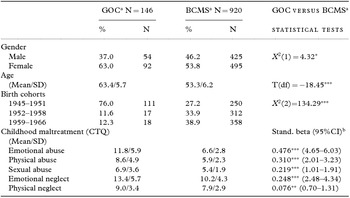
One hundred forty six GOC were included in the analysis and compared with a BCMS (N = 920). Sociodemographic characteristics and mean CTQ-subscale scores of both samples are presented in Table 1.
Characteristics of the both samples

***p < 0.001; **p < 0.01; *p < 0.05.
a GOC= German occupation children; BCMS=birth-cohort matched sample from the German general population.
b Five linear regression analyses each including age, gender, and sample as independent variables multivariate standardized beta for “sample” is reported; subscale total scores of the CTQ are the dependent variables of the five separate linear regressions.
Although the participants of both samples were born between 1945 and 1966, there are significant differences in the distribution of the years of birth. While a large proportion of GOC were born during the first years after WWII, the BCMS is distributed equally over the reference period. Thus, both samples significantly differ with respect to distribution across the birth cohorts (Χ 2 = 134.29; p < 0.001) and with respect to mean age (T = −18.45, p < 0.001). The proportion of women is significantly higher in the GOC sample than in the BCMS (63.0% vs. 53.8%; Χ 2 = 4.32; p < 0.05). GOC have significantly higher mean scores than BCMS in the five subscales of the CTQ (Table 1).
Experiences of childhood abuse and neglect in German occupation children and the general population (BCMS)
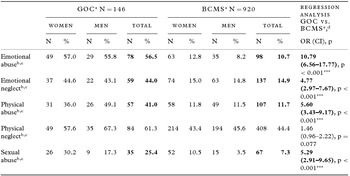
Table 2 gives an overview of the frequency of experiences of childhood abuse and neglect in GOC compared with BCMS stratified by gender. GOC are more likely to report emotional abuse (56.6% vs. 10.7%), emotional neglect (44.0% vs. 14.9%), physical abuse (41.0% vs. 11.7%), and sexual abuse (25.4% vs. 7.3%). The differences were tested with logistic regression analyses controlled for age and gender, revealing significant differences between GOC and BCMS with odds ratios (OR) between 4.7 and 10.8. In contrast, there are no significant differences in frequencies of physical neglect in both samples in a logistic regression analysis (Table 2).
Prevalence of childhood abuse and neglect in German occupation children (GOC) and the German general population (BCMS)

***p < 0.001; **p < 0.01; *p < 0.05.
a GOC= German occupation children; BCMS=birth-cohort matched sample from the German general population.
b According Childhood Trauma Questionnaire (CTQ).
c According to Walker et al. (Reference Walker1999).
d Logistic regression controlled for age and gender, OR for sample is reported.
Association of childhood abuse and neglect with depressive and somatoform syndromes and PTSD in GOC
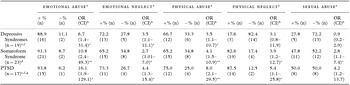
Table 3 gives an overview of the association of the different types of childhood abuse and neglect and mental distress. According to PHQ-9, 10.0% (n = 14) meet the criteria of MDS and another 3.6% (n = 5) are classified as having ODS. Summarized, 13.6% of the sample thus comply with a depressive syndrome. Participants reporting emotional abuse, emotional neglect, or physical abuse in childhood are significantly more likely to have depressive syndromes with ORs ranging from 3.5 to 6.7 in the regression analyses controlled for age and gender. There is no significant association between physical neglect and sexual abuse in childhood and current depressive syndromes (Table 3, upper part). 15.8% (n = 23) of the sample are classified as participants with SS according to PHQ-14. All five subtypes of experiences of abuse and neglect are significantly associated with current SS, with ORs ranging from 2.7 to 10.8 in the logistic regression analyses controlled for age and gender (Table 3, middle part). A total of 17 (11.6%) are classified as having PTSD. All five subtypes of experiences of abuse and neglect in childhood are significantly associated with current PTSD, with ORs ranging from 4.2 to 16.1 in the logistic regression analyses controlled for age and gender (Table 3, lower part). Emotional abuse shows the strongest associations with the different mental disorders under study compared to the other types of abuse and neglect (Table 3).
Association of experiences of childhood abuse and neglect with depressive syndromes, somatoform syndrome and posttraumatic stress disorder in German occupation children (GOC) (N = 146)

a Assessed with CTQ, classification (+/−) according to Walker et al. (Reference Walker1999).
b Logistic regression analyses with depressive syndromes/somatoform syndrome/PTSD as dependent variable and emotional abuse/emotional neglect/physical abuse/physical neglect/sexual abuse as predictors, controlled for age and gender, Odds ratios (OR) and confidence intervals (CI) for e.g. emotional abuse +/– are reported.
c Major and minor depressive syndrome assessed with PHQ-9.
d Somatoform syndrome according to PHQ-14 (menstruation item excluded).
e Full PTSD assessed with the PDS.
f N's slightly differ due to missing CTQ data.
g GOC with partial PTSD (n = 26) (see Kaiser et al., Reference Kaiser, Kuwert, Brähler and Glaesmer2015b) were excluded from the logistic regression analyses.
***p < 0.001; **p < 0.01; *p < 0.05.
Discussion
The present study is the first to report quantitative data on the childhood maltreatment of children born of war using the example of GOC. We included 146 GOC in a questionnaire-based study investigating childhood maltreatment. The findings are compared to a BCMS of the German general population. Moreover, associations of childhood maltreatment with current mental disorders in GOC were investigated.
A large proportion of GOC in our study was exposed to different kinds of maltreatment during childhood and adolescence. More than half of the sample (56.6%) reports emotional abuse, and a large part reports emotional neglect (44.0%) and physical abuse (41.0%). Around one-quarter of the sample reports sexual abuse. Compared to the German general population of the same age, GOC are more likely to experience emotional abuse and neglect and to physical and sexual abuse. The probability of exposure to these different kinds of childhood maltreatment in GOC is five to ten times higher than in the general population of the same birth cohort. Emotional abuse is a very common experience, especially in comparison to the general population (OR = 10.79). Moreover, physical neglect is very often reported by GOC (61.3%), but there is no significant difference compared with the general population. As we know from psychometric analyses of the CTQ, the subscale physical neglect shows unsatisfactory psychometric properties (Bernstein et al., Reference Bernstein2003; Villano et al., Reference Villano2004; Klinitzke et al., Reference Klinitzke, Romppel, Häuser, Brähler and Glaesmer2012; Grassi-Oliveira et al., Reference Grassi-Oliveira2014). Moreover, physical neglect as assessed with the CTQ is a common finding in the German generation growing up in the period after WWII (Häuser et al., Reference Häuser, Schmutzer, Brähler and Glaesmer2011), as the CTQ assesses physical neglect with items inquiring about the lack of food or appropriate clothing. Both are common experiences in the first years after WWII in Germany. The everyday occurrence of such experiences might lead to a slight overestimation of physical neglect, and the respective CTQ-items might not properly assess physical neglect in this cohort.
It is a well-established finding that childhood maltreatment is one of the major risk-factors for childhood and adolescent mental health problems. In our study, emotional abuse and neglect as well as physical abuse are associated with depressive syndromes, somatoform syndromes, and PTSD. Moreover, physical neglect is associated with somatoform syndrome and PTSD, and sexual abuse is associated with somatoform syndromes. These findings are in line with the available evidence and particularly emphasize the long-term outcomes of childhood maltreatment, since there are decades between the actual exposure to childhood maltreatment and the current mental health problems assessed in the study. Unfortunately, we do not know much about the trajectories of mental health problems in GOC across the lifespan, since this is the first quantitative study in this target group assessing point prevalence of mental disorders in this group (Kaiser et al., Reference Kaiser, Kuwert, Brähler and Glaesmer2015b).
Although our study has major strengths (e.g. first study in the field, addressing a hidden population and a hidden topic, participatory approach, comparison with a BCMS), some factors limit the interpretation and generalizability of our findings. First, childhood maltreatment and mental health problems were assessed using self-rating instruments and not a clinical interview, but the respective modules of the PHQ as well as the PDS show very good psychometric properties and are well-established instruments. Despite limited diagnostic accuracy, especially in individual diagnostics, self-report measures were used for reasons of comparability with the general population sample and for economic reasons. Moreover, since GOC resemble a group whose size can only be vaguely estimated and which is difficult to access, collecting a representative sample was not a seizable option; instead, press articles and networks were used to reach potential participants. Inevitably, the sample is selective and possibly biased. Most likely individuals will participate in a study like this who are interested in coming to terms with their past and for whom this topic is of current and high relevance. Furthermore, a certain ability to reflect upon their past and themselves is a requirement. There were some participants who wanted to complete the questionnaire at first, but were not able to, since working on it increased their mental distress beyond tolerable levels. On the contrary, those who feel free of burden and for whom being a GOC is of low relevance, will also be unlikely to participate. Hence, selectiveness is expected in both directions. Furthermore, we assessed experiences of childhood maltreatment decades ago. Due to this fact, we are facing recall bias as a relevant source of error. Thus, a critical reflection about recall bias is an important issue. From a psychometric or methodological perspective, dimensional measures like the CTQ with several items assessing every subdomain of childhood maltreatment including a rating of the frequency of the experiences seem to be a more reliable measure than a dichotomous item on a trauma list. There are at least two recommended cut-off scores for the CTQ subscales, e.g. the original cut-offs recommended by Bernstein et al. (Reference Bernstein2003) and the cutoff scores published by Walker et al. (Reference Walker1999). We decided to apply the latter one with a dichotomous format, but one has to consider that prevalence of childhood maltreatment is usually higher using these cut-off scores (Glaesmer, Reference Glaesmer2016).
Conclusions
These findings underline that GOC were at high risk for childhood maltreatment, which might be attributable to the burdened social, financial, and familial conditions of GOC and their mothers. Moreover, these results emphasize the complex and long-term impact of these burdened conditions and the important role of childhood maltreatment for mental disorders even decades later. Unfortunately, we do not know much about trajectories of mental disorders across the lifespan of GOC, but the results highlight the importance of conceptualizing Children Born of War as a highly vulnerable group in past and recent conflict and post-conflict settings, which should be targeted by preventive interventions reducing burdening conditions and long-term mental health disadvantages on the individual and community level.
Conflicts of interest
None.
Description of authors’ roles
H. Glaesmer designed the GOC study, supervised data collection, was responsible for the statistical design of the study, she carried out the statistical analyses for this paper and wrote this paper, P. Kuwert designed the GOC study and proof read the paper, E. Braehler designed the representative population-based study, M. Kaiser designed the GOC study, collected the data, was responsible for the statistical design of the study, and proof read this paper.
Acknowledgments
The authors thank all participants of this study for dedicating their time and for their readiness to go back into memories that were not at all times happy places to return to. Furthermore, the authors express their gratitude to the researchers (Sabine Lee, Ingvill Mochmann, Silke Satjukow, and Barbara Stelzl-Marx) and all representatives of platforms for children born of war who answered questions and helped in recruiting participants and establishing communication networks.
The study was partially funded by a doctoral scholarship granted to Marie Kaiser by the state of Saxony as well as a start-up grant provided by the German ministry of Science (BMBF) to Philipp Kuwert at the University of Greifswald. This study has been approved by the ethics committee of the Medical Faculty of the University of Leipzig.
Abbreviations
-
GOC = German Occupation Children
-
WWII = World War II
-
BCMS = Birth-cohort-matched sample
-
CTQ = Childhood Trauma Questionnaire
-
PTSD = Posttraumatic Stress Disorder
-
PHQ-9 = Patient Health Questionnaire-9
-
PHQ-15 = Patient Health Questionnaire-15