



Reply
We welcome the Commentary on our article Reference Moncrieff, Pillai, Marston, Johnson, Barnes and Priebe1 about the consequences of relapse in people with schizophrenia and recurrent psychoses, by Drs De Peri and Benedetto Mellacqua. Reference De Peri and Mellacqua2
To test their hypothesis that it is the duration of relapse, rather than relapse per se, that influences prognosis we explored the effect of duration of admission to hospital for a severe relapse on the outcomes of participants in the Research into Antipsychotic Discontinuation And Reduction (RADAR) trial at 24 months.
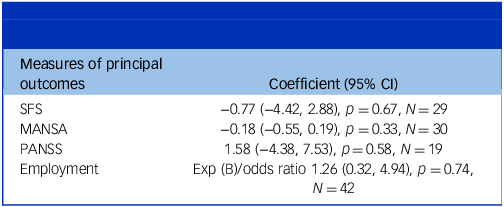
We transformed the duration of admission (in days) using the natural logarithm because it was highly skewed, even after excluding people who were not admitted to hospital; this resulted in a normally distributed variable. Using this (which excludes people who were not admitted), and adjusting for baseline values of the relevant outcome, we did not find a significant effect of duration of admission on any of the principal outcomes we examined at 24 months, including social functioning, quality of life, symptom scores and employment rates (Table 1). Adjusting for age, gender and randomised group made no substantial difference to the results, nor did using the non-transformed data on duration of admission.
Effect of duration of admission on principal outcomes at 24 months

SFS, Social Functioning Scale; MANSA, Manchester Short Assessment of Quality of Life; PANSS, Positive and Negative Syndrome Scale; Exp (B), exponentiated regression coefficient.
The numbers of people admitted to hospital with outcome data were small, so our analysis may lack power, but it does not suggest that the duration of relapse affects outcomes. Moreover, we had data only for the duration of an admission and not for the duration of relapses that were not sufficiently severe to require admission. Therefore we could not explore the relationship between outcome and the duration of relapses for the main definition of relapse that we had used in the original analysis, which was a relapse of any severity.
However, even if there was a relationship between duration of admission and outcome, this does not necessarily demonstrate that a longer relapse causes poor outcomes. Plausibly protracted relapse and poor outcome may both be reflections of a more severe underlying condition with a worse prognosis. Longer relapse may also be associated with worse social functioning and quality of life by causing more disruption to people’s lives, rather than through a biological mechanism as implied in the Commentary.
In response to the authors’ point about the age and chronicity of our sample, we agree that our results may not apply to people earlier in the course of their condition. Arguably, an early relapse might be more socially disruptive than one that occurs later, but the idea that a relapse might be neurotoxic at one point in time but not at another needs justification.
Acknowledgements
The views expressed are those of the authors and not necessarily those of the National Institute for Health and Care Research (NIHR) or the UK Department of Health and Social Care.
Author contributions
J.M. was the chief investigator for the RADAR trial and S.P. was co-chief investigator. S.P. and J.M. conceived the analysis to which the current Commentary refers. J.M. drafted the current paper and S.P. reviewed it. Both authors approved the final draft and had responsibility for the decision to submit for publication.
Funding
The original trial was funded by the National Institute for Health Research (NIHR; no. RP-PG-0514-20004). The funder had no role in the study design, data collection, data analysis, data interpretation and writing of the analysis referred to in, or undertaken for, this Commentary.
Declaration of interest
J.M. has grants from National Institute for Health and Care Research (NIHR) and is a co-applicant on grants from the Medical Research Future Fund in Australia. She receives royalties from books about psychiatric drugs. She is co-chairperson of the Critical Psychiatry Network. S.P. has grants from NIHR.



eLetters
No eLetters have been published for this article.