

Archaeological data labor in the United States is increasingly unsustainable across the discipline, given current technological and ethical modes of practice. Sustainability will require systemic reforms that focus on equitable labor practices and robust governance models. By redefining data labor through co-stewardship, archaeologists can begin to generate collective and specific benefits for communities. This requires integrating the valuation of heritage information as a public good to be supported through publicly funded efforts, with the recognition that it is also a contested domain involving power and the ongoing impacts of colonization. These efforts will necessitate judicious and ethical navigation of both intersecting and conflicting interests in open data as defined by models such as the FAIR Principles for Scientific Data Management and Stewardship (Findable, Accessible, Interoperable, Reusable; Wilkinson et al. Reference Wilkinson, Dumontier, Aalbersberg, Appleton, Axton, Baak and Blomberg2016), the CARE Principles for Indigenous Data Governance (Collective benefit, Authority to control, Responsibility, Ethics; Carroll et al. Reference Carroll, Garba, Figueroa-Rodríguez, Holbrook, Lovett, Materechera and Parsons2020), and the United States OPEN Government Data Act (OPEN; Stuessy Reference Stuessy2022).
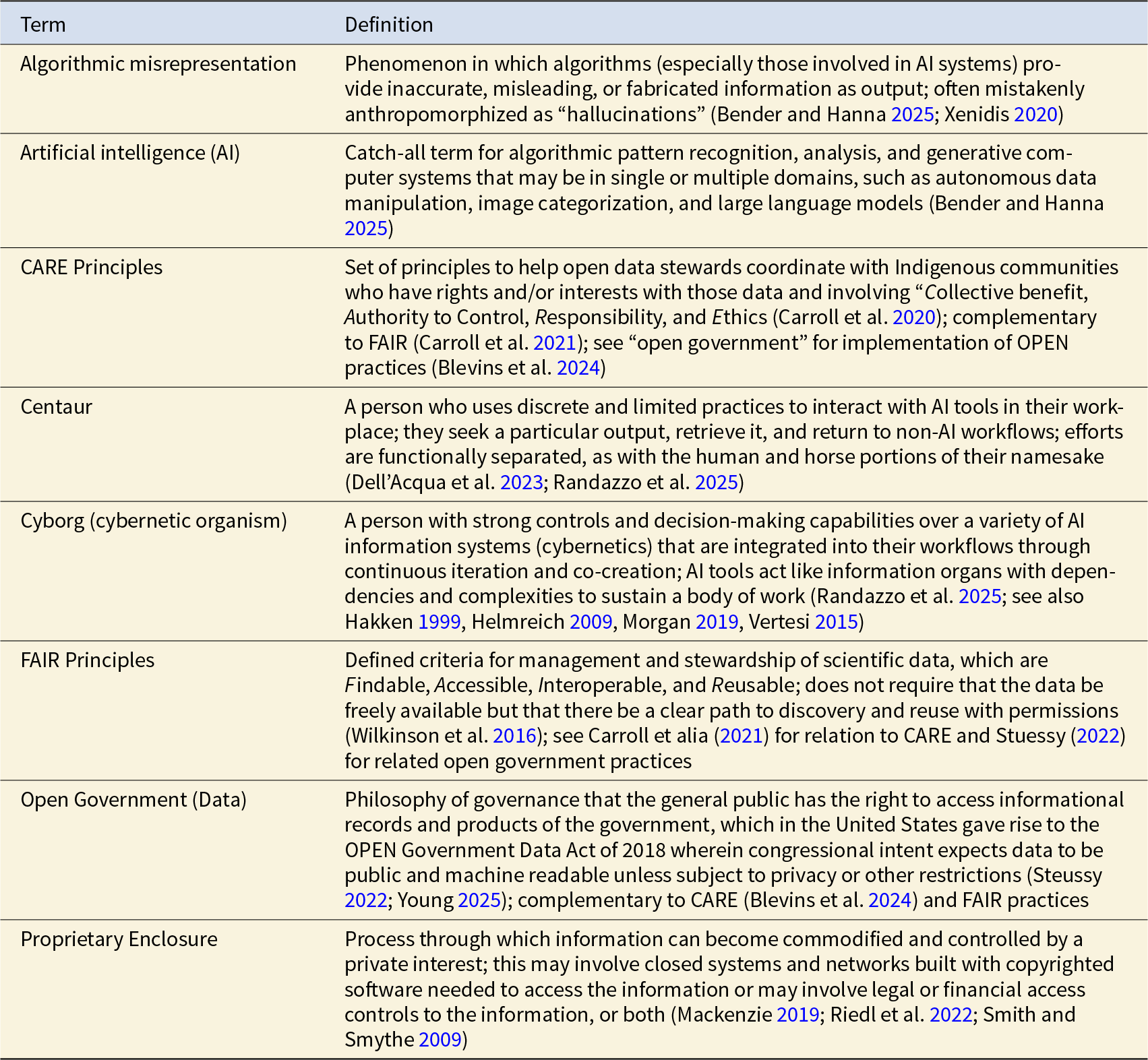
Such navigation will be assisted by a variety of trends in current ethical and practical considerations in archaeology and anthropology regarding how data reflect cultural rights, codes of ethics, professional practices of reflexivity, constructs of labor, relations of science and the humanities to the nation-state, pedagogy and training in higher education, and the encroachment of oligarchic “big tech” into these domains through its dominance of monetized infrastructure and AI. Successful navigation of these issues can result in a more sustainable set of relations in which archaeologists, Indigenous communities, and the public transform data ecosystems from extractive infrastructures into collaborative commons. In these practices, Indigenous Peoples are decision-makers and innovators as data stewards today and in the future. Because this article introduces what may be new concepts for the reader, we provide a list of terms with their definitions and salient references in Table 1.
Important Concepts Discussed and References for Further Information.

Table 1 Long description
A two-column glossary lists key terms and definitions related to artificial intelligence, data governance, and information control. It defines algorithmic misrepresentation as inaccurate or fabricated AI outputs often mislabeled as hallucinations, and describes artificial intelligence as a broad set of pattern-recognition, analytic, and generative systems. Three governance entries compare frameworks: CARE focuses on Indigenous data rights and ethics, FAIR outlines findable, accessible, interoperable, and reusable data stewardship without requiring free access, and Open Government emphasizes public access to government records and machine-readable data with privacy limits. Two workplace roles contrast how people integrate AI: a centaur uses AI for discrete tasks and then returns to non-AI workflows, while a cyborg continuously integrates multiple AI systems into iterative co-creation. Proprietary enclosure is defined as the commodification and restriction of information through closed systems or legal and financial controls. Definitions include citations for further reading, and the table provides concepts rather than quantitative measurements.
Contemporary archaeology in the American context operates within a complex data ecosystem in which Indigenous Peoples are sovereign within the United States, and their communities, governments, and organizations engage in archaeological research and activities with and without American archaeologists (Gonzalez Reference Gonzalez2016; Laluk et al. Reference Laluk, Montgomery, Tsosie, McCleave, Miron, Carroll and Aguilar2022). Recognition of this reality has led to an expanded scope of professional responsibilities for archaeologists in academic, cultural resource management (CRM), government, and public sectors. There is considerable overlap between these sectors in the management and reuse of archaeological data, which creates tensions regarding policies and best practices for curation and access and determining who is responsible for such stewardship and caretaking. These responsibilities are often made more complex by the legal obligations of archaeologists to properly collect, preserve, and share archaeological information in the United States, as mandated by Tribal Laws, the Antiquities Act, National Historic Preservation Act, Archaeological Resources Protection Act, Native American Graves Protection and Repatriation Act, and the Title 36 Code of Federal Regulations (CFR) Part 79 requirements for curation of federally owned or administered archaeological collections, as well as a myriad of state and local statutes. These varied statutes mandate that archaeological collections and records, now modally digital, be curated and made accessible for future use but not in ways that could endanger the integrity of the archaeology or violate the rights and interests of Indigenous communities.
Furthermore, the Society for American Archaeology (SAA) and the Register of Professional Archaeologists (RPA), two of the largest professional societies for American archaeologists, have established digital data stewardship as a core principle. SAA Principles of Archaeological Ethics (Society for American Archaeology 2024) #5 (Preservation of the Archaeological Record) and #6 (Reporting) specifically describe this, as does RPA Code and Standards (2025) Principle 3 (Adhere to Standards of Archaeological Research). Because of these mandates, the need to digitize legacy datasets, create born-digital new datasets, and coordinate institutionally held datasets with internal and external metadata coherence—all in keeping with technical and regulatory standards while meeting ethical expectations—entail substantial and complex labor. This labor and those who do it, however, are not necessarily supported by higher education preparedness, technical infrastructure of the archaeological workplace, and available finances to support and sustain—let alone, incentivize—positive developments, an issue we discuss later.
Digital technologies used in archaeology, especially over the past 25 years, have transformed the discipline’s operational, ethical, and intersectional landscape in some ways that are unique but in many other cases are similar to changes arising in other sciences, humanities, and governmental structures. Information and communication technology (ICT) infrastructures have become integral to archaeological practice, including “research, data collection, analysis, teaching, public and community engagement, publication, [and] scholarly communication” (Watrall and Goldstein Reference Watrall, Goldstein, Watrall and Goldstein2022:3). ICTs have enabled unprecedented capacities for data acquisition, management, preservation, and dissemination in all sectors. Highly precise locational databases, high-resolution imaging and 3D documentation of excavated materials and landscapes, aggregation of complex quantitative and qualitative big datasets, proliferation of digital literature, and successful but often conceptually and professionally isolated strategies for training in higher education and professional development now define the landscape of archaeology’s relationships to ICT. These issues raise urgent questions about ethics, sustainability, equity, and justice in the modally digital stewardship of cultural heritage.
Archaeology’s data labor is interwoven with the complex ethics of data stewardship, which in turn has been treated too often as peripheral rather than central to archaeological inquiry (Laluk et al. Reference Laluk, Montgomery, Tsosie, McCleave, Miron, Carroll and Aguilar2022). The practical aspects of archaeology’s ICT relationships relate to the wide variety of expectations and outcomes in data collection and labor management seen across the discipline (Batist Reference Batist2025; Heitman Reference Heitman2026; Huvila Reference Huvila2008; Mickel Reference Mickel2021). The result is a labor regime marked by hidden work and systemic inequalities that reinforce power differentials, silences, and exclusion, rather than destabilizing power imbalances in knowledge production and societies. This situation undermines the sustainability of archaeological practice and compromises the discipline’s capacity to fulfill its ethical, legal, public, and scholarly mandates.
At the heart of this crisis are extractive socioeconomic forces surrounding capital acquisition and consolidation that have shaped and continue to shape concepts of governance and the management of archaeological data and labor. Western paradigms of legal order and intellectual property—grounded in high modernist ideals of private property, contractually defined transfers or negations of rights, and unrestricted resource extraction in a worldview of unlimited growth and expansion—continue to structure the environments in which archaeological data governance develops.
Yet as Mickel (Reference Mickel2021:10) demonstrates in the case of decades-long, labor-intensive excavations in Petra and Çatalhöyük, this situation is more complex. She describes that when workers hired from descendant or local resident communities expressed their knowledge and expertise in archaeological methods and cultural practices, Western archaeologists typically silenced them by firing or suspending them without pay. As Mickel explains, this situation led to workers denying “having any such expertise,” which she conceptualizes as “lucrative non-knowledge” (Reference Mickel2021:12). Conceptualizing archaeological labor as both “body and economy,” Mickel (Reference Mickel2021:14) collapses the colonial distinction of sweaty work from the work that takes place in libraries and laboratories, signaling that the governance and management of archaeology’s data are fundamentally tied to workers and labor relations. Crucially, she highlights the deep interests and abilities of local communities to maintain control and decision-making over archaeology (Mickel Reference Mickel2021:25).
In this context, the financial and political dominance of proprietary ICT software, services, and infrastructure—most recently exemplified in the rise of the so-called AI bubble— introduces new vectors of exploitation as archaeological labor becomes one more extractive resource to be algorithmically managed as raw material for systems of profit (Bender and Hanna Reference Bender and Hanna2025; Kansa Reference Kansa, Averett, Gordon and Counts2016; Monteiro Reference Monteiro2022). Past, present, and future modes of extraction are intertwined in a continuing process that erodes cultural sovereignty and ethical accountability. The technologies change, but many abuses remain startlingly coherent.
To begin to examine these concerns, we conceptualize data labor in archaeology from the lens of digital and AI systems and discuss how Indigenous Data Sovereignty and data governance principles such as CARE, FAIR, and OPEN can facilitate policy reforms and support ethical data practice in all sectors of American archaeology. We draw on a systems view to highlight the importance of training the next generation of archaeologists in critical lenses that include decolonial and Indigenous perspectives in digital methods and AI, so they can see the whole process of archaeology, destabilizing power, and cultivating accountability in the data ecosystem.
Data Labor in Archaeology
Growing numbers of archaeologists are interested in the state of labor in their craft and the influence of identity, power, and labor conditions on archaeological practice, ethicsm, and knowledge production (Arthur et al. Reference Arthur, Mohapi and Mitchell2011; Irving Reference Irving2024; Mickel Reference Mickel2021; Mickel and Byrd Reference Mickel and Byrd2022; Quirke Reference Quirke2010; Shepherd Reference Shepherd2003; Yellowhorn Reference Yellowhorn, Gnecco and Lippert2015). Specifically, archaeologists focus on precarity in the commercial sector (Ulm et al. Reference Ulm, Mate, Dalley and Nichols2013; Van Oeveren Reference Van Oeveren2025; Zorzin Reference Zorzin, Gnecco and Lippert2015), the economic value of archaeology (Sanchez Reference Sánchez, Gnecco and Lippert2015), and the marketability of archaeological training and skills (Aitchison Reference Aitchison2004; Aitchison and Edwards Reference Aitchison and Edwards2008; Everill Reference Everill, Hamilakis and Duke2007). More recently, scholars are increasingly conceptualizing labor in archaeology in terms of computer-mediated data work alongside conventional field and laboratory data (Batist Reference Batist2025; Gupta et al. Reference Gupta, Nicholas, Blair, Watrall and Goldstein2022; Heitman Reference Heitman2026). These views recognize that the practice of archaeology is hierarchically structured and socially and culturally mediated: thus, they make visible who is doing what in archaeology, where, how, with what purpose, and to whose benefit.
In the context of digital and AI systems, Lina Dencik (Reference Dencik and Verdegem2021:267), digital media specialist and director of the Data Justice Lab, positions labor within ongoing debates on capitalism “that significantly shape the circumstances of working people whilst limiting their ability to influence decisions that govern their lives.” Noting the pervasiveness of data infrastructures and AI systems in workplaces, she remarks on the absence of “worker voices, unions and labor perspectives” and a focus on “individual rights, data protection, ethics and fairness, privileging citizen and consumer rights over workers’ rights” (Dencik Reference Dencik and Verdegem2021:268). These frameworks then diminish, if not obscure, both the ongoing “conditions of injustice in which technology is situated” (Dencik Reference Dencik and Verdegem2021:268) and power dynamics, of which AI systems are an outcome. Crucially, Dencik highlights that working conditions and employment relations are negatively affected by algorithmic management, in which phones, laptops, and emails are used to monitor workers’ professional activities. In addition, workers’ data are extracted from social networks, shared calendars, and collaborative working tools, generating (behavioral) data on workers well beyond the workplace. Dencik thus positions technology as infrastructures designed to maintain and enhance processes of surveillance and violence in society.
Archaeological data labor is frequently invisible. It is not photographed by newspapers, but the understandings engendered by aggregate archaeological data make news. Crowds of visitors do not flock to a computer pod to see archaeology at work, but visualizations from well-maintained data promote better public understanding. Clients, regulatory agents, and stakeholders do not take time to monitor an archaeologist at a keyboard, but the resulting data products often have impacts on finances, properties, and human rights. This datafication work—turning excavation into data (e.g., Poehler Reference Poehler2023)—is arguably as laborious as fieldwork and potentially much longer lasting for most projects, because the data developed themselves can become digital artifacts and take on a new use life for decades or longer, even if the physical site from which they are derived is never revisited. Data labor in archaeology then encompasses the full life cycle of data—whether derived from workers in the field, those using specialized analytical tools in a laboratory, or those working in cultural repositories (museums, libraries, archives, etc.) and universities, in communities, in government offices, and at policy tables.
These issues were recognized near the beginning of this century (e.g., Snow et al. Reference Snow, Mark Gahegan, Hirth, Milner, Mitra and Wang2006), but whether they are framed as challenges (Kintigh et al. Reference Kintigh, Altschul, Beaudry, Drennan, Kinzig, Kohler and Limp2014), new paradigms (Huggett Reference Huggett2015, Reference Huggett2020), or existential conundrums (Domeischel and Childs Reference Domeischel and Childs2024; Nicholson et al. Reference Nicholson, Fernandez and Irwin2021; Ortman and Altschul Reference Ortman and Altschul2023), a common demand is to make archaeological data labor more visible, to support it professionally, and to finance it sustainably. In the year 2026, when scientific funding and regulatory support for archaeology in the United States are so uncertain, we need renewed and sustainable paths for archaeological data labor.
Digital and AI Systems
Archaeologists are long-standing members of labor communities. Whether involved with academic research or CRM, practitioners have been early adopters of databases, geographic information systems, myriad specialized software packages, novel uses of instruments such as radar and drones, programming languages, and internet technologies to such an extent that data labor for several generations now has fundamentally reconfigured definitions of craft and practice (Caraher Reference Caraher2019; Morgan Reference Morgan2022). Nevertheless, we can still clearly see the practically and theoretically humane reasons for archaeological work to be accomplished as a vital mode of cultural production and understanding (Shanks and McGuire Reference Shanks and McGuire1996). Thus, the use of AI systems in archaeology can represent a potentially logical continuance of the symbioses archaeologists as scientists and workers have developed with their technological professional environments similar to NASA Mars explorers (Vertesi Reference Vertesi2012, Reference Vertesi2015), deep-sea marine biologists (Helmreich Reference Helmreich2009), geologists exploring petroleum sources (Solberg Reference Solberg2025), epidemiologists and public health practitioners (Biruk Reference Biruk2018), government workers (Hakken Reference Hakken1999), and higher education faculty (Wells and VanderVeen Reference Wells and Vanderveen2026).
Brief History of AI
As described by linguist Emily Bender and AI researcher Alex Hanna (Reference Bender and Hanna2025:5), “AI is a marketing term. It doesn’t refer to a coherent set of technologies. [The phrase] is deployed when the people building or selling a particular set of technologies will profit from getting others to believe that their technology is similar to humans.” Like those authors, we use the term when it is presented by others but recognize (for instance, in archaeology) that there are vitally important algorithmic differences between analytical systems based on function, such as parsing natural-language scientific texts, recognizing shapes of structures in aerial imagery, or classifying artifacts with measurements and qualities. Nevertheless, analytical systems discussed expressly as AI and AI-adjacent algorithmic systems have for decades held a promise to amplify all digital archaeological research (e.g., Richards and Ryan Reference Richards and Ryan1985; Van den Dries Reference Van den Dries1998) and heritage management (e.g., Kohler and Parker Reference Kohler and Parker1986; Migliori et a. Reference Migliori, Abate, Alderuccio, Bordoni, Calosso, Di Lorenzo, Mencuccini, Pierattini and Ponti2015; Myers Reference Myers1999; Richards et al. Reference Richards, Tudhope, Vlachidis, Barcelo and Bogdanovic2015), with rapid analyses of qualitative, quantitative, textual, and image datasets intertwined with them (and future) existing digital archaeological data systems.
We must also recognize that, in the continuing present, archaeological information systems already have issues with professional management capacities (Wilshusen et al. Reference Wilshusen, Heilen, Catts, de Dufour and Jones2016) and potentials for unequal access (Gupta et al. Reference Gupta, Blair and Nicholas2020). Currently, the capital-intensive character of much AI systems development encourages the concentration of technical expertise and training data in corporate hands. Established research institutions, governmental agencies, and archaeological practitioners at all levels are increasingly encountering a proprietary AI landscape that seemingly threatens the sustainability of archaeological efforts to document, protect, and safely and respectfully communicate about the archaeological record. Irresponsible AI development in the archaeological workplace carries the potential to divorce datasets from their use contexts and undermine the standing of scientific experts, rightsholders, and stakeholders to protect public goods and community rights from processes of proprietary enclosure, algorithmic misrepresentation, and technocratic governance.
Proprietary Enclosure
Proprietary enclosure describes a process through which public information can become commodified and controlled by a private interest: it may involve closed systems, data, and networks built with copyrighted software that must be purchased to access the information (Smith and Smythe Reference Smith and Smythe2009) or legal or financial access controls on the information itself (Mackenzie Reference Mackenzie2019; Reidl et al. Reference Riedl, Whipple and Wallace2022), or both. Proprietary enclosure can pose threats when archaeological data are surrounded by proprietary AI systems for analysis, query, and basic access. As highlighted by Zuboff (Reference Zuboff2019), the “rogue mutation” of capital forces surrounding software-as-a-service to government and private-sector clients—which defines much of the current professional-as-consumer AI bubble—creates a profit motive whereby human experience (the lived data trails of archaeological users and the AI-connected data of the archaeological past) becomes potential raw material for commercial practices of AI development; for instance, any reader who has scored federal grant proposals or reviewed manuscripts in recent years has certainly been instructed by program officers and editors to “please not use AI tools to review the proposals and drafts” for fear that those documents will be stored as more training data.
The massive collection of data for proprietary modeling and reuse in closed systems for financial gain is an imperative for the continued technological and financial growth of proprietary AI systems that is hard to resist. Their business model feeds on data created by anyone, but public scientific data are considered especially foundational, which unfortunately increases the potential to misuse such data and violate ethical and statutory protections at an industrial scale. Proprietary AI tools have been demonstrated to memorize or retain the corpus of training data and user data to such an extent that large portions of copyrighted texts such as the Harry Potter series, A Game of Thrones, The Hunger Games, and numerous others are reproducible with proper prompts (Ahmed et al. Reference Ahmed, Cooper, Koyejo and Liang2026). Imagine the potential legal entanglements and threats to the archaeological record if the databases of a state or federal agency or a CRM company were to undergo AI memorization, threatening the overall sustainability of available archaeological data, responsive stewardship, and decision-making as currently practiced.
Algorithmic Misrepresentation
Algorithmic misrepresentation also threatens archaeological data by its misuse and subsequent unsustainability. Algorithms do not emerge from nature; they are human constructs and reflect the historical moments in which they are developed just as much as the data they analyze reflect the times in which they were collected and codified. Examples of AI tools engaging in algorithmically driven misrepresentation are rampant and pressing problems in many domains as AI tools regularly generate dangerous responses (Center for Countering Digital Hate 2025), perpetuate discriminatory outcomes (Xenidis Reference Xenidis2020), and harbor a growing trend for corporate algorithmic manipulation of users for profit (Microsoft Defender Security Research Team 2026). AI tools are, of course, known for offering just plain wrong information for users with frequent effect: this incorrect information is often characterized as algorithmic “hallucinations” by AI apologists. AI tools are complex pattern recognition and replication statistical software systems; when they cannot reach statistically significant determinations for answers based on their training, parameters, and available data, they will often inject random sampling or equivocal choices into their outputs, which (especially in large language models) mimic a hallucinating writer but are just insignificant mathematical output transformed into chunks of language (Bender et al. Reference Bender, Bergstrom and West2025; Binz et al. Reference Binz, Alaniz, Roskies, Aczel, Bergstrom, Allen and Schad2025). Evolutionary biologist Carl Bergstrom, a coauthor of Bender and colleagues (Reference Bender, Bergstrom and West2025), has written an article to promote generalist understanding of this issue (Bergstrom and Ogbunu Reference Bergstrom and Ogbunu2023) and created a free and open online course on large language models (Bergstrom and West Reference Bergstrom and West2025). When systems are programmed to provide an answer, they will provide an answer even if it is wrong.
Efforts are underway in disciplines such as medicine (Aljamaan et al. Reference Aljamaan, Temsah, Altamimi, Al-Eyadhy, Jamal, Alhasan, Mesallam, Farahat and Malki2024), law (Magesh et al. Reference Magesh, Surani, Dahl, Suzgun, Manning and Ho2025), and finance (Erdem et al. Reference Erdem, Hassett and Egriboyun2025) to assess and counter algorithmic misrepresentation. Archaeology will need to do much more labor across the discipline in the vein of Magnani and Clindaniel (Reference Magnani and Clindaniel2025) regarding algorithmic misrepresentation, because as noted by Cook and Compton (Reference Cook and Compton2018:38), “Digital technologies are indeed tools, but they are not neutral or passive and therefore the technological ecosystem within which archaeology functions must be connected to broader paradigmatic shifts.”
Counteracting algorithmic misrepresentation to protect sustainability requires deliberate co-creative partnership with Indigenous communities about how data are gathered, annotated, and shared. In practice, this means engaging with Indigenous and descendant communities represented in the archaeology about how data held in cultural institutions and repositories could be misused or bring harm to individuals and collectives. Transparency here is equally critical for sustainable practice and data provenance, and metadata construction should be well documented to demonstrate to scholars, policymakers, and publics how conclusions about archaeological information are drawn. The antidote to AI misrepresentation is a transparent and well-regulated data management strategy.
In practice this may result in different levels of openness and availability as the process of data development progresses. Some projects such as the United Kingdom’s Archaeology Data Service, the Digital Index of North American Archaeology, Open Context, the Paleoindian Database of the Americas, and many public-facing governmental database instantiations engage in regular vetting of new materials and reconsideration of legacy materials in their public systems. Other projects may maintain limited availability and security protections such as password log-ins as the potential harms from misuse of data are recognized; these projects include the Digital Archaeological Record, GeoPacha, and many governmental database instantiations for public-sector and contracted archaeological practitioners. Tribal Nations’ data management strategies can be further strengthened by supporting Tribal-led repositories such as those being developed for Indigenous health and sovereignty (Anderson et al. Reference Anderson, Tsosie, Peters, Trinidad, McCartney, Fernandez and Dale2025) and by developing data-sharing agreements that bring clarity to Tribal expectations and institutional responsibilities when Indigenous data are shared and circulated.
Technocratic Governance
Technocratic governance characterizes a third threat vector from AI to archaeological data sustainability. Technocratic visions depict AI tools as offering frictionless, data-driven governance, which as we have seen is certainly not the case. Nevertheless, pressures on politicians, policymakers, and institutions from the sales and advertising forces of especially proprietary AI tool developers will continue to result in “disconnected discourses” (Kling Reference Kling, Rosenbaum and Sawyer2005) where the realities of AI systems as another kind of ICT tool will not prevent emergent complications and dangers in workplaces. This creates the potential for continued harms as the perception of automation is used as a cost-saving cudgel, leaving archaeologists as data laborers—humans-in-the-loop—to clean up AI messes, rather than dealing with the necessary functions of their actual jobs (Bender and Hanna Reference Bender and Hanna2025). This recognizable danger, especially in public and private bureaucracies such as governmental archaeological resource managers and archaeological consultants within CRM businesses, will cause significant damage as their professional labor in ethically and time-sensitive domains is compromised and reassigned (Graeber Reference Graeber2015, Reference Graeber2018)—thereby resulting in poor mitigation practices, damage to the archaeological record, and harms to Indigenous communities and other publics. To prevent drifts toward technocratic governance, heritage ethics, reflected in policies and practice, should demand that AI tools (especially in policy and compliance domains) remain subordinate to deliberative human processes where, again, open platforms, transparent algorithms, and participatory governance will be critical elements.
Understanding AI–Human Labor Relations
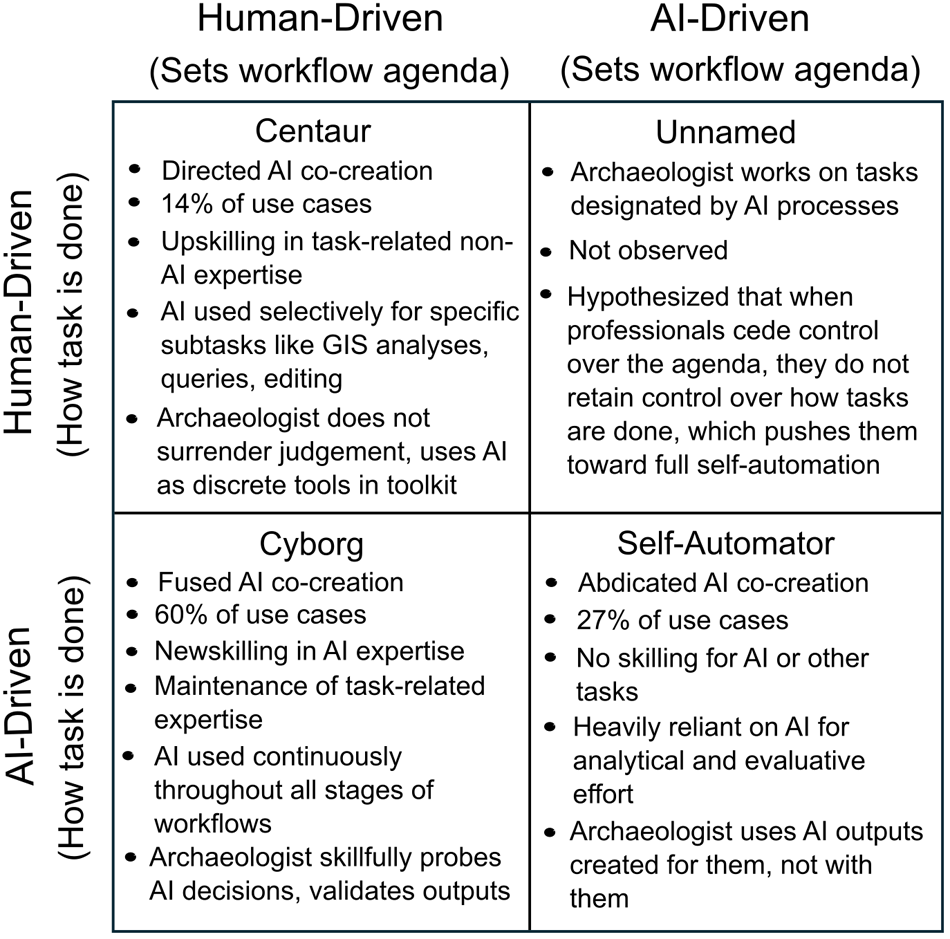
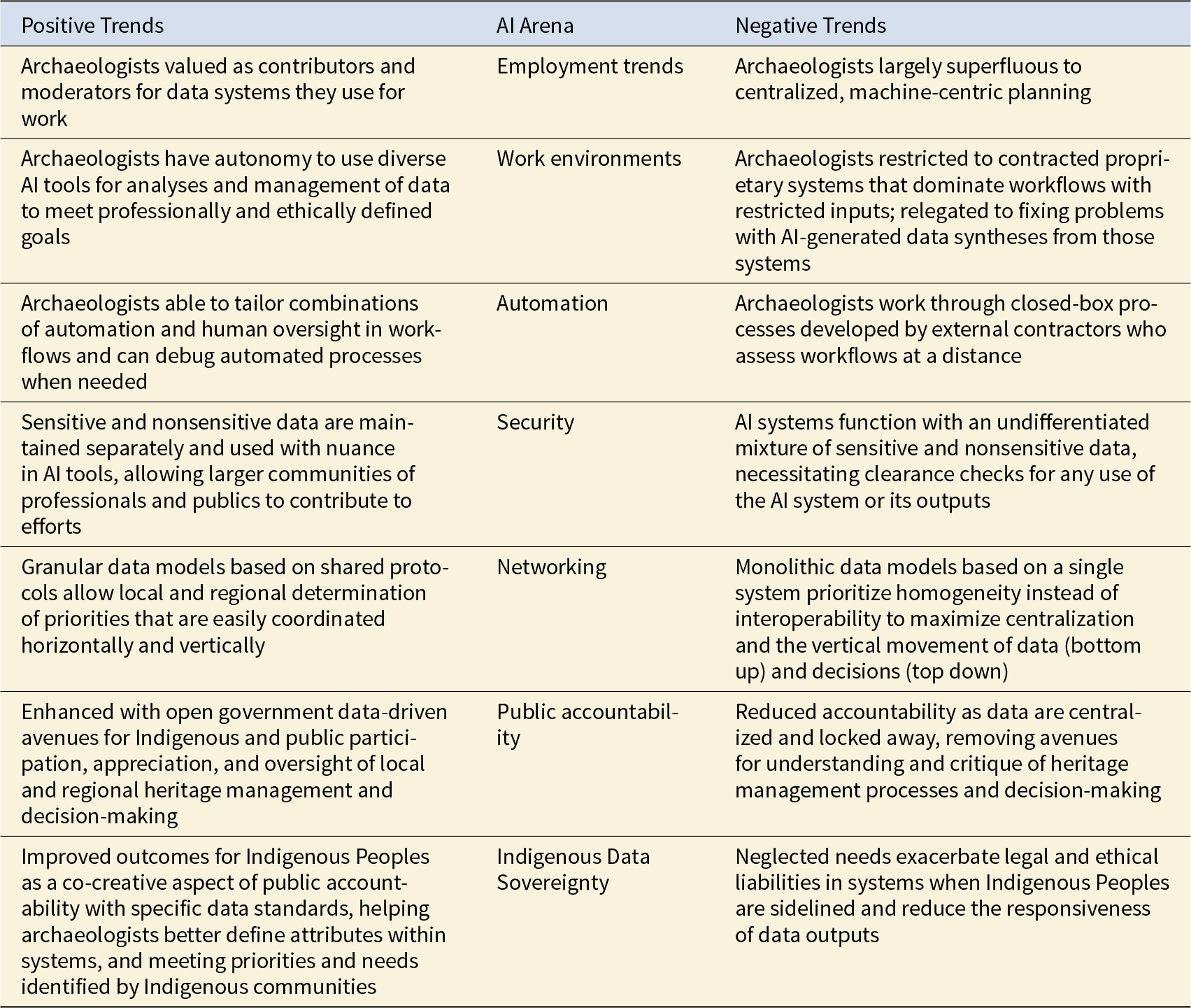
Recent efforts at the Harvard Business School by Dell’Acqua et alia (Reference Dell’Acqua, McFowland, Mollick, Lifshitz-Assaf, Kellogg, Rajendran, Krayer, Candelon and Lakhani2023) and Randazzo et alia (Reference Randazzo, Lifshitz-Assaf, Kellogg, Dell’Acqua, Mollick, Candelon and Lakhani2025) have sought to categorize how AI systems use in professional environments can be understood in relation to preexisting technological symbioses. Because AI systems implementation is currently a fast-moving topic, Randazzo and coauthors (Reference Randazzo, Lifshitz-Assaf, Kellogg, Dell’Acqua, Mollick, Candelon and Lakhani2025) provide the most current and complete assessment: they studied the use of AI systems within the workflows of 244 global management consultants as information professionals and conducted follow-up interviews to illuminate the thought processes and values of those participants. Investigators sought to determine how participants understood their own skill sets, the capabilities of AI systems regarding other algorithmic software processes in their tool kits, and the tasks to be performed. Investigators categorized their findings into four sets of human–AI system relationships based on how agendas are set (by humans or AI) and how tasks are accomplished in a range from humans making discrete choices for AI systems to AI systems running frequently in the background with or without human intervention. Their findings are detailed next, applied to archaeological labor settings and visualized in Figure 1; we also organize likely AI labor trends for archaeological settings in Table 2.
Archaeological interpretations of AI–human labor relationships in workplaces as observed and described by Dell’Acqua elia (Reference Dell’Acqua, McFowland, Mollick, Lifshitz-Assaf, Kellogg, Rajendran, Krayer, Candelon and Lakhani2023) and Randazzo et alia (Reference Randazzo, Lifshitz-Assaf, Kellogg, Dell’Acqua, Mollick, Candelon and Lakhani2025:Figure 1, Table 2).

How AI can Affect Archaeological Labor Sustainability.

Table 2 Long description
A quadripartite figure which shows combinations of human and AI action in a workplace. The x-axis indicates the entity who sets the workflow agenda, with human to left and AI to right. The y-axis indicates the entity who accomplishes a task, with AI below and human above. The upper left quadrant is labeled “Centaur,” it indicates human agenda and human task completion, and describes a scenario where a human uses AI for discrete tasks. The upper right quadrant is labeled “Unnamed,” because the sources referenced did not observe this in practice, it indicates an AI agenda and human task completion. The lower right quadrant is labeled “Self-Automator,” it indicates an AI agenda and AI task completion, and describes a scenario where the human has abdicated responsibility. The lower left quadrant is labeled “Cyborg,” it indicates a human agenda and AI task completion, and describes a scenario where human and AI work are frequently mixed.
Note: Adapted from the Canadian Union of Public Employees (2024).
Randazzo and coauthors (Reference Randazzo, Lifshitz-Assaf, Kellogg, Dell’Acqua, Mollick, Candelon and Lakhani2025) defined the smallest group as “centaurs” (14%) with high human involvement in setting agendas and implementing tasks, reliance on human judgment to control AI system workflows at all times, and visioning human–AI relationships with a strong division of labor based on capacities in the same way the human and horse halves of a centaur have very different capacities. To make an example in an archaeological workplace, let us imagine a scenario of predictive archaeological site modeling, for which practitioners in 2026 already have this relationship with their available technologies. They will discretely use data directly or in summary from site location files, diagnostic artifact and component databases, a wide range of digital and hardcopy literature, environmental geospatial repositories, and other sources as necessary in a GIS or other digital modeling framework. Implementation of AI systems in any or all aspects of this process, in such a way, could be understood as the inclusion of a new technological system to be scoped and tested for specific purposes.
Randazzo and colleagues (Reference Randazzo, Lifshitz-Assaf, Kellogg, Dell’Acqua, Mollick, Candelon and Lakhani2025) defined a second group called “cyborgs” (60%) with high human involvement in setting agendas and who used AI systems fluidly across all possible tasks as they understood the capacities of AI systems for specific purposes. A cyborg allowed AI-processes to run in multiple tasks toward completion of a goal in ways defined by a human, because they had achieved newly skilled understandings of how AI systems could accomplish information tasks in their areas of expertise in the same way that a person understands the capacities of their own limbs to accomplish physical tasks. In that sense, these users functioned as cybernetic (information) organisms in the workplace. Some readers may only be familiar with the cybernetic organism or cyborg concept through Donna Haraway’s “Cyborg Manifesto” (Reference Haraway1991); however, it has long held substantial currency in studies of human–technology interaction to help understand the affordances, constraints, and social lives of technologies (e.g., Graf Reference Graf2023; Hakken Reference Hakken1999; Helmreich Reference Helmreich2009; Moloney Reference Moloney2025; Morgan Reference Morgan2019; Solberg Reference Solberg2025; Vertesi Reference Vertesi2012, Reference Vertesi2015; Wells and VanderVeen Reference Wells and Vanderveen2026; Williams and Park Reference Williams and Park2023). Using the same scenario as before, predictive archaeological site modeling in a workplace, cyborgs could be envisioned as super-users who have the capacity to automate many of the modeling workflows and data streams based on need; cyborgs have a fluent understanding of the source data, the AI systems manipulations involved, and who has the disciplinary expertise to critique AI systems outputs as they would the outputs of a colleague. Importantly in this scenario, the infrastructure available to a cyborg archaeologist will have more affordances than constraints. Available archaeological data will be readily interoperable in an AI environment, and the cyborg archaeologist and their AI “limbs” will be able to get into the places data are held (access controls) and manipulate those data (AI functions could run all the GIS functions) successfully.
Randazzo and coauthors (Reference Randazzo, Lifshitz-Assaf, Kellogg, Dell’Acqua, Mollick, Candelon and Lakhani2025) have defined a third group called “self-automators” (27%) with high AI systems involvement in setting agendas and implementing tasks. Self-automators yielded important aspects of their workflows to systems that they would occasionally monitor. They had lower levels of interactions and problem solving with the AI system and used AI-generated outputs with little to no modification. Importantly, the work products in this category were seen as lacking depth, and the self-automators themselves were not seen to increase their expertise in AI systems or their own professional knowledge domains. In an archaeological workplace, self-automators could be envisioned as functionaries who occasionally check the progress of automated analytical decisions. Again, using the same predictive archaeological site modeling example in a workplace, a self-automator may develop a set of automated predictive modeling tasks that will run with little to no human intervention on a series of data with homogenized interoperability parameters; such data may be indicated in templates or forms (perhaps created under instructions from management) that guide the AI system to data (likely standardized with reduced nuance) from repositories; the expertise of the self-automator archaeologist may only be called into use if the AI system flags error that it cannot handle but may use those experiences to further tailor the AI system.
Notably, Randazzo and colleagues (Reference Randazzo, Lifshitz-Assaf, Kellogg, Dell’Acqua, Mollick, Candelon and Lakhani2025) did not observe any instances of the potential fourth group, with both high AI systems agenda setting and high human task involvement (i.e., AI defining the work for humans). They hypothesized that self-automation, with all its limitations, may often be a response to perceived threats of AI processes being placed in an organizational management role. For the sake of completeness, however, let us imagine one more instance of the predictive archaeological site modeling scenario. In this case, a “fourth group” archaeologist sits at the end of an AI system that their employer has obtained from a vendor already designed for another workplace to use as is, the data and networks at this archaeologist’s job have been reconfigured to meet the needs of this externally developed AI system, and this archaeologist is tasked with dealing with errors flagged by the system similar to their self-automator counterpart but may lack the agency to funnel those experiences into systemic improvements. In a worst-case scenario this “fourth group” archaeologist might engage in professional counter-skilling to more efficiently handle repetitive endemic errors thrown by the system that are beyond their control.
Categorization of human–AI relationships helps us consider the emerging data labor environments in which archaeologists increasingly find themselves. For instance, Randozzo and coauthors (Reference Randazzo, Lifshitz-Assaf, Kellogg, Dell’Acqua, Mollick, Candelon and Lakhani2025) found that some users migrated between centaur and cyborg practices, but efforts that underwent self-automation did not revert, and a similar understanding of archaeological workplaces could be illuminating. This is especially important for archaeologists working in the heritage management public sector (especially state and federal agencies) in which large, cross-cutting purchases for AI services and subsequent AI policies may shape or even dictate available AI systems and strategies, necessarily restructuring work for their private-sector colleagues.
The Advisory Council for Historic Preservation (ACHP 2024) is continuing to investigate “innovative information technology,” including development “of a plan for a centralized geolocation database of US historic properties to allow federal agencies and project sponsors to accurately and efficiently identify and avoid impacts on historic properties.” This plan has evolved to an approach that “leverages the latest advancements in AI to create a system linked initially to available GIS cultural resources databases at the state and federal level, and eventually to other sources beyond that” (ACHP 2026). This planned “AI-driven data collection and planning tool” would “retrieve relevant data remotely from disparate systems . . . on whether areas have been subject to past study or not . . . ; “generate a project research report to inform early project planning and research needs . . . ; offer visual simulation tools to help predict areas of potential resource impacts . . . ; and “facilitate assessment of project adjustments to optimize location or route planning. . . . The ACHP is working to integrate the latest Google AI solutions, including agentic deep research, geographic reasoning, and generative AI models, to yield information,” and this platform “aims to significantly expedite and improve Section 106 reviews within federal permitting processes while ensuring robust protection of historic properties” (ACHP 2026). As these plans come to fruition, they will certainly affect the private- and public-sector CRM archaeologists who supply regulatory data on behalf of their clients to those agencies. Academic research archaeologists may have a bit more latitude, but tensions between higher education and research and AI contracts and policies are also developing (Binz et al. Reference Binz, Alaniz, Roskies, Aczel, Bergstrom, Allen and Schad2025; Bender et al. Reference Bender, Bergstrom and West2025; Wells and VanderVeen Reference Wells and Vanderveen2026), and academics remain beholden to federal and state statutes, policies, and technical systems for their work. Time will tell which combinations of AI potentials will be achieved versus the dangers mitigated and which forms of AI workplaces will be created to enable diligent and expert public servants to manage archaeological heritage for the benefit (or detriment) of Indigenous peoples, the American public at large, and the broader scientific and cultural understanding of humanity.
Sustainability through Indigenous Data Sovereignty and Data Governance Principles
The ethical landscapes of archaeological data become even more complex when viewed through the well-meaning but occasionally ahistorically optimistic lenses of open data initiatives. Models such as FAIR emphasize technical optimization, for instance, ensuring that data is findable, accessible, interoperable, and reusable in ways that promote improved engagement of ICT tools with FAIR data in comparison with non-FAIR data but in which the humans using the tools, their human purposes, and their human rights are very much an afterthought. Principles such as FAIR and open government data (the primary goal of OPEN) advance expectations of transparency and reproducibility, but they carry potentials to collide with frameworks that promote relational accountability and cultural rights such as the CARE Principles, in which the constituent concepts of “collective benefit,” “authority to control,” “responsibility,” and “ethics,” in combination help articulate a vision of data stewardship rooted in living, community-defined priorities and human rights.
Understanding the tensions between the FAIR (Wilkinson et al. Reference Wilkinson, Dumontier, Aalbersberg, Appleton, Axton, Baak and Blomberg2016), CARE (Carroll et al. Reference Carroll, Garba, Figueroa-Rodríguez, Holbrook, Lovett, Materechera and Parsons2020, Reference Carroll, Herczog, Hudson, Russell and Stall2021), and open government data models (Blevins et al. Reference Blevins, Murray and Ortiz2024; Steussy Reference Stuessy2022; Young Reference Young2025) requires archaeologists to engage in judicious and reflexive decision-making in concert with their ethical principles, as defined by various professional organizations (see RPA and Chartered Institute for Archaeologists 2018). Such negotiations and decisions are rarely straightforward, especially when archaeologists are often interested in solutions with much longer time horizons than are most of the ICT development community. Nevertheless, it is well worth the effort to weigh the potential positive intersections and conflicts of interests between ethics and practices of openness, privacy, cultural rights, and scholarly integrity.
The stakes of these negotiations and decisions extend like an iceberg deep beyond the visible surface of technical compliance. They introduce to the archaeological workplace fundamental questions about the values that animate archaeological practice. Is heritage information primarily a public good, freely accessible to all? Or is it a contested domain enmeshed in colonization and ongoing harms of extraction and accumulation? How can data labor seek to frame these facets to reveal important contexts and relationships for the same datasets? A data labor model of archaeology allows us to trace the ways archaeologists must consistently reconcile the practices and expectations of scientific inquiry with the rights and affordances of communities whose histories and identities are embedded within the data they analyze, as defined not only by statements like the United Nations Declaration on the Rights of Indigenous Peoples but also aspects of the US National Historic Preservation Act if one expects that legislation to fairly represent all within its jurisdiction. As such, this situation demands a reconfiguration of archaeological data labor not just as actions in the realm of technical function but also as ethical and political practices within broader relations of power, knowledge, and responsibility.
Sustainability Lessons from Open Government Data
Sustainability in archaeological data labor will be considerably enhanced by viewing archaeological practice at large, and especially cultural resource management archaeology, as scientific practices that produce structured information qualifying as open government data pursuant to federal law, especially the Foundations for Evidence-Based Policymaking Act of 2018 and its OPEN Government Data Act provisions (US Government Accountability Office 2022; Young Reference Young2025): they, as law, were largely inspired by earlier Obama-era executive orders (Obama Reference Obama2013) about making public information machine readable and more readily reusable so as to accomplish responsibilities defined under the Freedom of Information Act (FOIA) and similar legislation. When principles of open government data, which all make provisions for sensitive information, are adapted to archaeological contexts, they can enhance scientific integrity, public accountability, and expand participation in archaeological processes while simultaneously addressing ethical imperatives for Indigenous Data Sovereignty.
Archaeological outcomes viewed as open government data in practice will help practitioners thread the needle of responsibilities for digital data interoperability and ethics. Archaeology as a scientific discipline uses systematic methods to collect, analyze, and interpret material evidence of the human past. Academic or research archaeology is frequently subject to regulatory scrutiny through government permitting processes designed to verify the capacity of research teams and institutions to properly record and preserve the informational contexts and aspects of archaeological sites as protected heritage resources; in the rare instances where such permitting is not required, professional ethical standards (e.g., RPA, SAA) define expectations for research that are generally in line with applicable statutes for recording, preservation, and reporting of information to government regulatory agencies. CRM as an aspect of archaeological practice constitutes the majority of archaeological work in the United States and is driven by compliance with various federal, state, and local preservation laws governing ground-disturbing economic activities, such as construction, utility and infrastructure maintenance, and extractive industry. All these projects, regardless of archaeological sector, generate vast quantities of structured data in the forms of (especially) site records, artifact inventories, and geospatial models, but eventually CRM and academic research archaeology share similar ICT capacities, affordances, and dependencies, both practically and ethically. Failures to operationalize data for long-term access and reuse across archaeology thus undermines both scientific understanding and public accountability and inflates industry and governmental costs. Treating archaeological data labor as a scientific endeavor resulting in open government data can address these shortcomings by embedding transparency and interoperability in the data life cycle.
The original definitions of open government data in the United States mandated that federal agencies make their data open by default in machine-readable formats, with caveats for privacy and security safeguards (Young Reference Young2025; see Obama Reference Obama2013). As codified in law in 2018, the principles of open government data should resonate strongly with archaeological ethics practice: CRM projects funded through public resources and regulated by statutes produce data that are classified as government assets, whereas academic research in archaeology generally results in the same. Treating these outputs as open government data could facilitate evidence-based policymaking for heritage management and planning. This is especially important when legislation protecting heritage resources is itself under political scrutiny and when even supporters of such preservation activities often find it difficult to develop a complete picture of preservation successes that demonstrate transparency in the allocation of funds and regulatory scrutiny for cultural preservation (ACHP 2026). Archaeological data as open government data could also facilitate a data ecosystem where syntheses and contrasts of archaeological data across political jurisdictions are more feasible, which is especially important because current regulatory boundaries rarely correspond well to one area of interest, whether defined by archaeological research or by Tribal needs.
The turn to open government data is, however, not without difficulties. Despite the recognized benefits of open government data, congressional (US Government Accountability Office 2022) and executive reports (Young Reference Young2025) repeatedly describe how US federal agencies have struggled to implement comprehensive data inventories and public engagement strategies, especially regarding esoteric datasets that were formerly housed in file cabinets for references in decision-making. However, the difficulties of federal bureaucracies working to retrofit existing modes of information practice into new legislative and technical categories are often distinctly different from those of archaeological science. Archaeology, as a shovel-ready exercise in open data, offers a use case for advancing open government data objectives with disciplinarily established data structures and recognized societal benefits of its outputs. In fact, influential models of responsive open government data can supply archaeologists not only with insights toward framing their outcomes in terms of technical compliance for interoperability and reuse but also and, even more importantly, can promote a disciplinary workplace cultural shift toward participatory governance with respect for Indigenous rights.
Civic technologist Cyd Harrell (Reference Harrell2020) emphasizes the importance of user-centered design, an ICT philosophy that involves feedback from end users and puts their needs at the center of development, balancing privacy and transparency and supporting iterative development in public-sector technology projects: each of these concepts brought to archaeological work can help practitioners create digital datasets that invite meaningful collaboration, give voice to communities seeking to promote benefits and mitigate harms, and relieve archaeologists from seeing archaeological data products as one-stop-and-done items that must be perfected in isolation for all time. Legal and technological scholar Beth Noveck (Reference Noveck2009), who also serves as the first Chief AI Strategist for the State of New Jersey, developed the concept of “Wiki-Government” (which for archaeologists extends this vision of public supports for the benefit of archaeological practice) with models of co-creation and critique around intellectual property issues and patents. This model involves publics, professionals, and government institutions working together to improve decision-making and outcomes with structured participation. For archaeology this model could help demonstrably organize representatively crowdsourced interpretation projects, community-driven heritage planning and assessment, and provide feedback mechanisms that allow rightsholders and stakeholders to shape governance policies.
For instance, the US Geological Survey runs an open cartography project called the National Map (ESRI 2002), which enlists the informed public to help maintain geospatial data as a public good through a crowdsourced effort, the National Map Corps. What public benefits could we imagine for archaeology with a similar, appropriately secure, informationally robust system built with respect for Indigenous rights? Open government data are not merely a technical standard but also an inclusive practice that fosters trust and accountability. One example is the success of the DINAA project (Wells et al. Reference Wells, Kansa, Kansa, Yerka, Anderson, Bissett, Myers and DeMuth2014), which largely indexes nonsensitive attributes of government and scientific archaeological data to foster public and research outcomes; for instance, DINAA allows archaeologists to model and communicate continental-scale threats of climate change to archaeological sites at replicable and granular scales (Anderson et al. Reference Anderson, Bissett, Yerka, Wells, Kansa, Kansa, Myers, DeMuth and White2017), train CRM and general archaeology students on vital nuances of regional heritage management (Cook et al. Reference Cook, Çakirlar, Goddard, DeMuth and Wells2018), and open the publicly funded record of archaeological heritage for research and understanding (Kansa et al. Reference Kansa, Kansa, Wells, Yerka, Myers, DeMuth, Bissett and Anderson2018; Wells et al. Reference Wells, Kansa, Kansa, Yerka, Anderson, Bissett, Myers and DeMuth2014), all while actively respecting Indigenous sovereignty (Kansa et al. Reference Kansa, Kansa, Anderson, Wells, Myers, Yerka and Hess2021).
If openness is a cornerstone of archaeological ideals for scientific and ethical practice, it must be reconciled with the ethical and legal obligations to protect sensitive cultural information, and here too open government data concepts can be of use. Indigenous communities have been marginalized in heritage decision-making processes and the handling and mishandling of archaeological data have perpetuated ongoing harms (Johnson Reference Johnson2023; McLellan and Woolsey Reference McLellan and Woolsey2024). Too often, the creation of archaeological data has resulted in a false sense of ownership by the individuals or institutions that recorded it; they feel like they can control the data and do what they deem appropriate with that information. Not only does this lead to the erosion of Indigenous sovereignty by divorcing descendant communities from observational and locational data that documents their heritage but also the release of sensitive cultural information may violate Section 304 of the National Historic Preservation Act (NHPA).
Section 304 protects sensitive information (such as character, ownership, or specific location) about National Register–eligible historic properties by allowing federal agencies to withhold this information from the public when such disclosure could result in a significant invasion of privacy, harm or theft of the historic property, or impede the use of a traditional religious site by cultural practitioners. It ensures that historic preservation goals are met while controlling access to specific data, thereby balancing public access with resource protection (ACHP 2016). However, reviews of information to be released in compliance with Section 304 are extremely nuanced and require lengthy consultation between CRM professionals, federal agencies, and descendant communities. Each document or dataset must be interrogated individually, with close attention to all its metadata and the overall digital environment into which the data may eventually be released. Because of the advances in many technologies, unsuspecting crumbs of information that are not redacted or withheld from public release could potentially be used to inform language models or search engine queries to unite disparate data via keyword or location, resulting in a data breach compromising a significant cultural resource. Navigation of an open government path for archaeological data is not trivial, neither for archaeologists nor for Indigenous communities; however, recent US federal considerations help us imagine the ways in which the concepts of open government data and Indigenous data governance can intersect to reinforce positive elements, as described in a 2024 Congressional Research Service report:
Some have asserted that tensions between Indigenous data sovereignty and some federal laws and policies can be addressed through the application of the CARE principles. A global effort involving international and U.S.-based entities has produced principles for promoting Indigenous data governance. Known as the CARE Principles for Indigenous Data Governance, these principles are intended to guide how Indigenous people are included in processes that concern Indigenous data discovery, data access, data use, reuse, and attribution in a way that strengthens Indigenous peoples’ control over their data. . . . Congress may choose to address these issues in different ways. It could maintain the status quo and allow federal agencies to consider IK [Indigenous Knowledge] on an ad hoc basis. As part of its oversight role, it could require the disclosure of all IK, TEK [Tribal Environmental Knowledge], and Indigenous data used by a federal agency in any action, or it could qualify this requirement by allowing agencies to redact potentially confidential or sensitive information. Alternatively, Congress could address some Indigenous concerns about Indigenous data sovereignty. For instance, Congress could direct federal agencies to adopt the CARE principles. It could also direct a federal agency, or agencies, to establish a repository for Indigenous data and IK to facilitate collaboration between Indigenous peoples and researchers. Alternatively, Congress could direct agencies to use, or otherwise support, existing nonfederal scientific repositories that already, or could, include Indigenous data. Congress may choose to exempt IK from FOIA requests or otherwise enable federal agencies to maintain the confidentiality of IK. For example, Congress provided a FOIA exemption that allows the government to withhold “trade secrets and commercial or financial information obtained from a person [that are] privileged or confidential,” and might consider a similar exemption for IK. Congress might also direct a federal study on, or establish a legal mechanism for, IK protection in federally funded research [Blevins et al. Reference Blevins, Murray and Ortiz2024:26–27].
In the United States, the Environmental Justice Subcommittee of the National Science and Technology Council released an “Environmental Justice, Data, and Research Plan” in 2024, which explains at length the responsibilities of federal agencies to the CARE Principles and Indigenous Knowledge in their domains. We can recognize that environmental compliance is often tied closely to archaeological compliance and reporting practices in the public, private, and research sectors, and take inspiration from this report. Salient passages from that report state:
Consistent with the Framework for Federal Scientific Integrity and Practice, agencies should ensure that different modes of science, such as community science, community-engaged research, participatory science, and crowdsourcing, have the recognition, support, and resources to meet the same standards of scientific integrity that traditional modes are expected to uphold. This may require expanded scientific integrity practices and expectations, such as granting communities more autonomy over research questions and research design, recognition of data and knowledge sovereignty, and inclusion of multiple forms of evidence, such as Indigenous Knowledge. For example, agencies could develop guidance and training on data collection, data quality, and data management strategies. A cross-agency group should also identify best practices, opportunities, and limitations for doing community-engaged research in the context of the Paperwork Reduction Act and other relevant laws . . .
To capture the full experience of humans in their environments—especially the experiences of communities with EJ concerns—agencies should employ methodologically diverse toolsets in their evidence-building science, data, and research activities. . . . Evidence can be quantitative or qualitative and can be viewed broadly as the available body of information indicating whether a belief or proposition is valid or true. Evidence includes Indigenous Knowledge as a form of knowledge that can and should inform federal government decision-making where appropriate . . .
Federal access to Indigenous Knowledge and data from Tribal Nations is a privilege. Federal employees engaging in science, data, and research-related activities should recognize that members of Tribal Nations may possess knowledge that is sensitive, sacred, or belongs to certain families or clans. Members of Tribal Nations may have concerns about privacy, confidentiality, or potential threats to natural or cultural resources, or they may fear loss of access to or desecration of lands and waters if certain information is shared with others.
As an extension of their legal sovereignty, Tribal Nations control the knowledge and data they hold. When working with Tribal Nations on science, data, and research activities relevant to EJ [environmental justice], agencies should have extensive consultation about the needs and desires of Tribes about how data they share with federal agencies is handled. The collection of new data and the use of existing data on or about their Nations should also follow established principles and standards of consultation. When desired by representatives of Tribal Nations, agencies should follow principles of FAIR (Findable, Accessible, Interoperable, and Reusable) and CARE (Collective benefit, Authority, Responsibility, and Ethics) [Environmental Justice Subcommittee 2024].
In Canada, the First Nations principles of ownership, control, access, and possession (OCAP), established in 1988 and trademarked by the nonprofit First Nations Information Governance Centre (FNIGC), provide guidance for the broad spectrum of data types and issues, including cultural heritage, related to the well-being of First Nations peoples (First Nations Information Governance Centre [FNIGC] 2019a, 2022). The FNIGC describes how the Canadian federal Access to Information Act of 1985 can create problematic issues with public disclosure of sensitive information related to First Nations communities; for instance, the legal relationship of First Nations to the Canadian federal government in the 1985 legislation was problematically contextualized in terms of only those groups recognized as governments, leaving the majority of First Nations unrecognized (FNIGC 2019b). In what may be a more engaged development, recent Canadian federal guidance on open government data states,
Data on Indigenous Peoples and communities have historically been collected in a colonial context, and unilateral efforts by the federal government to publish those data can be viewed as a continuation of that colonial legacy. The Government of Canada recognizes this reality and will continue to work with Indigenous Peoples to support their self-determination in the data sphere [Treasury Board of Canada Secretariat 2023:23].
Kisha Supernant, archaeologist and expert on Indigenous heritage rights and geospatial data, recently published a statement on archaeological practice and governance in Canada regarding the emergent place of the United Nations Declaration on the Rights of Indigenous Peoples (UNDRIP) in Canadian heritage law:
Over the past several decades, archaeology in Canada has been transforming. There is growing recognition that Indigenous peoples hold inherent rights to their cultural heritage, including archaeological sites, ancestral remains, cultural materials, knowledge, and data. Indigenous-engaged archaeology has emerged as one way of shifting practice to better recognize and respect those rights. This shift is not simply ethical or methodological. It is fundamentally about governance, authority, and accountability . . .
Canada’s commitment to implementing UNDRIP through federal legislation marks a significant shift in how laws and policies should be interpreted. Although implementation remains uneven, the implications for archaeology are immediate. If Indigenous peoples have the right to control their cultural heritage, archaeological research cannot proceed solely on the basis of regulatory compliance or academic interest. Authority must be understood as a matter of Indigenous governance.
From a policy perspective, this reframes archaeology from a technical or compliance-driven activity into a governance issue. Heritage management systems that do not recognize Indigenous jurisdiction are increasingly misaligned with Canada’s legal commitments . . .
In archaeology, tensions remain between Indigenous data sovereignty and legislative frameworks that deny Indigenous ownership and control over archaeological materials and data. Where heritage legislation defines archaeological materials as state property, Indigenous peoples are prevented from fully exercising their cultural rights. Policymakers must therefore consider how open data mandates and digital infrastructure investments can be aligned with Indigenous governance rather than undermine it [Supernant Reference Supernant2026].
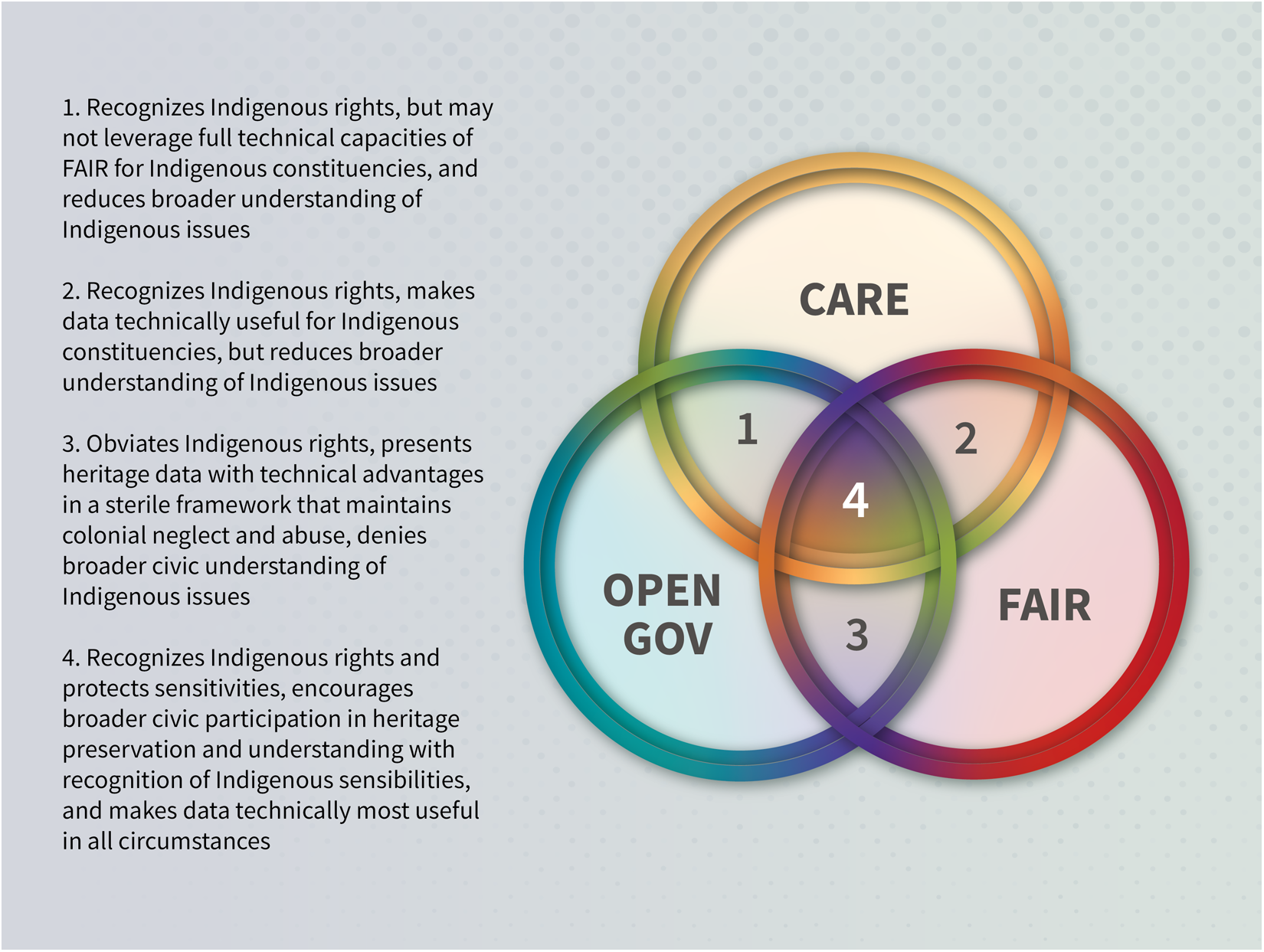
Simply put, open government data practices provide an avenue for generally ethical publication and sharing of data produced for the public good, with important caveats for privacy, respect, and intellectual property regarding those individuals and groups of people who are governed. The CARE Principles provide a mechanism for articulating the rights of Indigenous communities to minimize harms and determine future uses of Indigenous data, especially in the realm of government data. This is not a naive claim to authority: the records of government abuses and failures to recognize the rights of Indigenous Peoples are manifest (Deloria Reference Deloria1992; Dunbar-Ortiz Reference Dunbar-Ortiz2014; Wilkins and Stark Reference Wilkins and Stark2018). However, if archaeologists are willing to recognize their place as scientists largely working under the auspices of statutory principles, then our responsibilities to engage ethically and openly with the public extends to Indigenous Peoples as partners with sovereign rights in the public sphere. We illustrate how the intersections of FAIR, CARE, and open government practices can be conceptualized in Figure 2 and explain this in detail next.
Ethical and practical strengths and limitations of different intersections of FAIR, CARE, and open government practices in archaeology.

Figure 2 Long description
A Venn diagram of three interlocking circles, representing the CARE Principles, the FAIR Principles, and OPEN Government principles. Each circle intersects with the other two, creating four potential overlaps. The intersection of OPEN Government and CARE is labeled “1” and indicates that the lack of FAIR technical capacities reduces efficacy. The intersection of CARE and FAIR is labeled “2” and indicates that this recognizes Indigenous rights but reduces broader understanding of Indigenous issues. The intersection of FAIR and OPEN Government is labeled “3” and indicates that this situation obviates Indigenous rights and maintains colonial neglect and abuse. The intersection of all three circles is labeled “4” and indicates that this situation recognizes Indigenous rights and encourages broader civic understanding of Indigenous sensibilities, while also making data technically useful.
As the documentation from Blevins and coauthors (Reference Blevins, Murray and Ortiz2024), the Environmental Justice Subcommittee (2024), the Treasury Board of Canada Secretariat (2023), and Supernant (Reference Supernant2026) describes, there are avenues in open government law to respectfully and fruitfully work with Indigenous Peoples as co-creative partners in both Canada and the United States. Such action will make data more useful to Indigenous communities, will recognize their rights to protect Indigenous Knowledge as appropriate (CARE), and ensure that data that can be more public facing will be robust for public appreciation and research (FAIR) as a living part of twenty-first-century community life in a sustainable way that can be maintained and enriched for future generations.
It is a strength that our actions as archaeologists can be seen as governed by statutes and guidelines that extend far beyond archaeology; this provides for the beneficence of our efforts and minimizes the harms of our actions in ways that are not dissimilar to the concepts of human subjects rights that govern the actions of our sociocultural anthropological colleagues. We do not have to invent new systems of practice to connect our codes of ethics to the rights of Indigenous Peoples; we just need to treat all peoples who are subjects of archaeological data with the rights and respect to which they are entitled. Archaeological efforts to collaborate with Tribal Institutional Review Boards on the development of inclusive CRM practices (Kimmel et al. Reference Kimmel, Katz, Lewis and Wilk2023) and efforts to create publicly open archaeological data with continuing input from Tribal Historic Preservation Officers and umbrella organizations like the National Association of Tribal Historic Preservation Officers (Kansa et al. Reference Kansa, Kansa, Wells, Yerka, Myers, DeMuth, Bissett and Anderson2018, Reference Kansa, Kansa, Anderson, Wells, Myers, Yerka and Hess2021; Wells et al. Reference Wells, Kansa, Kansa, Yerka, Anderson, Bissett, Myers and DeMuth2014) are illustrative of the ways these processes can proceed. Such models illustrate that ethical stewardship, inclusivity, and open science are mutually reinforcing and, importantly, diversify the labor, use, and reuse of archaeological data to develop broader networks of support with deeper foundations for sustainability.
Conclusion
The sustainability of archaeological data labor will require a reconsideration of its ethical, legal, and practical orientations toward one that supports archaeological workers, as well as the communities with whom and for whom they work, as embedded in information flows that persist through society delivering benefits of knowledge, inspiration, and meaning. As demonstrated here, the proliferation of ICTs has situated archaeology within a data ecosystem wherein digital infrastructures mediate almost every aspect of the discipline—from project design to project enactment and fulfillment—through analyses, curation, communication, reanalyses, and recommunication. This digital turn, however, has often rendered archaeological labor invisible and poorly supported in the long run. The neglect of data labor creates the risk of rendering the discipline more frequently ineffective in meeting ethical and practical goals. Such neglect also potentially endangers the entire knowledge enterprise of archaeology as extractive logics and proprietary risks entailed with infrastructure development and the recent deployment of AI systems threaten to alienate archaeologists, Indigenous communities, and publics from sources of scientific information about the human past.
To counter these trends, archaeologists must embrace disciplinary reforms that center co-stewardship and participatory governance at all levels. Although we recognize that data are relational constructs created by knowledge workers and communities, we can also recognize not only their entanglement with colonization and contemporary struggles for justice but also their importance as public goods for understanding the human condition. Frameworks such as CARE and FAIR, when thoughtfully combined under an umbrella of open government data, can complement technical interoperability (FAIR) and relational accountability and Indigenous rights (CARE) in ways that enhance transparency and public trust. Embedding these principles at all stages of workflows in the data life cycle ensures that openness promotes collective benefit rather than exploitation, treats data as living and continuing constructs (Biruk Reference Biruk2018; Boelstorff and Maurer et al. Reference Boellstorff, Maurer, Gregg and Seaver2015), and allows us to rethink our professional relationships to data (Huggett Reference Huggett2022). Data, like software, when shared in positive social structures, carry the potential to build crosscutting solidarities and values (Zeitlyn Reference Zeitlyn2003). Subsequently, our data labor becomes more ethically determined and simultaneously more sustainable, facilitating expanded research reuse, promoting greater understanding, and creating stronger public goods.
To complement the ethical and practical join of FAIR, CARE, and open government principles, we will need continued and expanded efforts in digital archaeological pedagogy (e.g., Cook et al. Reference Cook, Çakirlar, Goddard, DeMuth and Wells2018; De la Cova et al. Reference De la Cova, Hofman, Marklein, Sholts, Watkins, Magrogan and Zuckerman2024; Graham Reference Graham2020, Reference Graham2025; Kansa and Kansa Reference Kansa and Kansa2021; Marwick Reference Marwick, Jade d’Alpoim Guedes, Bates, Bollwerk, Bocinsky and Carter2017) that explicitly stress the importance of making tools and data available for others to reuse to counter extractive logics; there is also the need for disciplinary-specific AI training in the vein of Bergstrom and West (Reference Bergstrom and West2025) but for a variety of archaeological algorithmic purposes beyond large language models. As a supplement to this article, we provide an example set of teaching activities around legacy data, FAIR, CARE, and open government, with some options for low-stakes guided AI training (for more detailed AI implementations we recommend Graham Reference Graham2025; see Supplemenary Material 1).
Sustainability in archaeological data labor is not just a technical problem: it is a social, cultural, and economic issue. Defining data labor as a collaborative practice, focused on beneficial outcomes, human rights, and common knowledge among informationally intertwined people, will help archaeologists turn siloed and obtuse data infrastructures into equitable commons built for human outcomes that are augmented by technological developments, rather than enclosed by them. As is characteristic of positive feedback loops in information processes, such practices ultimately should engender public awareness and appreciation of archaeological resources in the world, leading to greater demands for the protection of archaeological resources and their continued investigation by people with technology for people with technology.
Acknowledgments
No permits were required for this research. Figure 2 credit goes to Dr. Sepideh Saffari. In the first round of documentary organization, the primary author used a Microsoft Copilot Notebook to organize some of the references used and to search for information within them but did not use AI text in the document. They also used GPTZero to check the work as human and verify that AI did not influence the writing. In the revision process, no AI tools were used.
Funding Statement
A Social Sciences and Humanities Research Council of Canada (SSHRC) Insight Development Grant was awarded to Gupta (no. 430-2021-00948).
Data Availability Statement
No original data were used in the article.
Competing Interests
The second author is a member of the editorial board of Advances in Archaeological Practice. The other authors report none.
Supplementary Material
The supplementary material for this article can be found at https://doi.org/10.1017/aap.2026.10164.
Supplemenary Material 1. Teaching Module: “Examining the Ethical and Practical Possibilities of Open Data in Archaeology.”


 Open access

