


Introduction
Experiences of psychosis, such as hearing voices or having unusual beliefs, are relatively common experiences, affecting approximately 1% of the UK population (NICE, 2014). Extensive research has been conducted in order to understand the psychological mechanisms that underlie experiences of psychosis from a cognitive behavioural therapy (CBT) perspective (Morrison, Reference Morrison2001). Given the continued debate about the efficacy of psychological therapies for the treatment of psychosis (e.g. CBT) (Jauhar et al., Reference Jauhar, McKenna, Radua, Fung, Salvador and Laws2014) interest continues to grow in developing approaches for the treatment of psychosis and, more broadly, the psychological mechanisms underpinning the experience of it.
Social rank theory is an evolutionary approach and offers potential in understanding the cause and development of psychosis (Gilbert, Reference Gilbert2000; Price, Sloman, Gardner Jr, Gilbert and Rohde, Reference Price, Sloman, Gardner, Gilbert and Rohde1994). Social rank theory suggests that, like other animals, humans are motivated to compete and gain important resources for survival. However, whilst in other animals and non-human primates this competition most commonly involves physical competition, humans place importance on being evaluated as attractive, liked and valued by others (Gilbert, Reference Gilbert2000). Feeling liked, wanted and valued by others helps humans to feel safe, and are highly physiologically regulating experiences in which we can form positive images of self, but also can feel comfortable to develop cooperative, supportive and mutually beneficial relationships with others. Our motives, emotions, thoughts and behaviours are influenced by perceptions and evaluations of our own, and other peoples’, social rank, status and power (Gilbert, Reference Gilbert2000). Low social rank can develop from life experiences that make us feel threatened and unsafe, such as trauma, sexual abuse, and bullying, but more broadly, societal factors such as poverty and living in areas of high violence (Gilbert and Miles, Reference Gilbert and Miles2000).
There is growing evidence that unfavourable or low social rank, which is commonly associated with shame, submissive behaviour and negative (inferior) social comparison, is associated with a variety of psychopathologies, including depression and anxiety (Birchwood, Meaden, Trower, Gilbert and Plaistow, Reference Birchwood, Meaden, Trower, Gilbert and Plaistow2000; Gilbert, Reference Gilbert2000). Shame is linked with high self-blame and self-criticism, and involves strong intense distressing feelings (Gilbert and Allan, Reference Gilbert and Allan1998). Shame can either be internally focused (focused on the self) or externally focused (thinking that others are shaming of us). Shame is usually unwanted and very difficult to control, and can develop into feelings of anxiety and depression (Gilbert and Allan, Reference Gilbert and Allan1998).
A number of studies have highlighted the relevance of social rank and shame to positive symptoms of psychosis. People who experience psychosis have been found to have low social rank and view themselves as more inferior than non-clinical controls (Allison, Harrop and Ellett, Reference Allison, Harrop and Ellett2013). Low social rank has been shown to be associated with auditory hallucinations (Gilbert et al., Reference Gilbert, Birchwood, Gilbert, Trower, Hay and Murphy2001). For example, Birchwood et al. (Reference Birchwood, Meaden, Trower, Gilbert and Plaistow2000) found a relationship between level of subordination service users felt in their social relationships and the level of subordination felt from their voices. This relationship has been supported in another similar study (Fox, Gray and Lewis, Reference Fox, Gray and Lewis2004). Low social rank has also been shown to be associated with experiences of paranoia. Studies have found that paranoid thinking was significantly associated with unfavourable social rank, submissive behaviour and lower social power in a non-clinical sample (Freeman et al., Reference Freeman, Garety, Bebbington, Smith, Rollinson and Fowler2005; Gilbert, Boxall, Cheung and Irons, Reference Gilbert, Boxall, Cheung and Irons2005). The role of shame has also recently been explored in relation to paranoid ideation. In a non-clinical sample, internal shame (negative thoughts and feelings about the self) was associated with social anxiety, whilst external shame (perceptions that others view you negatively) was associated with paranoia (Matos, Pinto-Gouveia and Gilbert, Reference Matos, Pinto-Gouveia and Gilbert2012; Pinto-Gouveia, Matos, Castilho and Xavier, Reference Pinto-Gouveia, Matos, Castilho and Xavier2012).
Although limited, the current literature highlights a relationship between social rank, shame and experiences of psychosis. Perceptions of social rank and shame have been shown to be associated with positive symptoms (Fox et al., Reference Fox, Gray and Lewis2004), social anxiety, inferiority in relationships (Birchwood et al., Reference Birchwood, Meaden, Trower, Gilbert and Plaistow2000), and depression in those who experience psychosis. However, there has been no attempt at understanding how social rank and shame may link to experiences of psychosis. The Compassion Focused Therapy (CFT) model (Gilbert, Reference Gilbert2010), as well as cognitive models (Garety, Reference Garety2001; Morrison, Reference Morrison2001), highlight the role of affect as a causal and maintenance factor in psychosis. Depression in particular is a pervasive difficulty for those with psychosis regardless of their diagnostic subtype (Buckley, Miller, Lehrer and Castle, Reference Buckley, Miller, Lehrer and Castle2009). When depression is present, the risk of long-term psychosis, relapse and hospitalization is increased (Drayton, Birchwood and Trower, Reference Drayton, Birchwood and Trower1998; Krabbendam, Janssen, Bijl, Vollerburgh and Van Os, Reference Krabbendam, Janssen, Bijl, Vollerburgh and Van Os2002). A number of studies illustrated a clear association between social rank, shame and depression (Cheung, Gilbert and Irons, Reference Cheung, Gilbert and Irons2004; Gilbert and Miles, Reference Gilbert and Miles2000). Therefore, negative emotional affect, such as depression, has the potential to play a role in the relationship between social rank, shame and experiences of psychosis. This is yet to be explored.
Recent literature and service developments – spurred on by user led movements – have highlighted the importance of also understanding the role of psychological mechanisms in relation to personal recovery in psychosis (Wood, Price, Morrison and Haddock, Reference Wood, Price, Morrison and Haddock2010). Personal recovery in psychosis is increasingly acknowledged as a process that incorporates an array of psychosocial factors and can occur without the alleviation of positive symptoms (Chadwick, Reference Chadwick1997; Pitt, Kilbride, Nothard, Welford and Morrison, Reference Pitt, Kilbride, Nothard, Welford and Morrison2007). It includes aspects such as rebuilding self, rebuilding life and hope for a better future, which arguably would occur alongside increased social rank and reduced shame. Social rank and shame have not been explored in relation to recovery in psychosis. Therefore, it is important to examine whether psychological mechanisms, such as social rank and shame, are relevant to personal recovery in psychosis.
This study aims to build on the current evidence by examining the relevance of social rank and shame to experiences of psychosis, namely positive symptoms and personal recovery in psychosis. Moreover, this study will explore the role of depression in relation to social rank and external shame, and consider depression as a mediator between the threat mechanisms (social rank and external shame) with psychosis (positive symptoms and personal recovery). It is hypothesized that low social rank and external shame will have a significant relationship with positive symptoms, depression and personal recovery in psychosis. It is also hypothesized that depression will act as a mediator or moderator for social rank and shame and their respective relationships with psychosis (positive symptoms and personal recovery).
Method
Participants
Participants met the following criteria: (a) they were either diagnosed with a schizophrenia-spectrum disorder (schizophrenia, schizophreniform disorder, schizoaffective disorder, delusional disorder or psychotic disorder not otherwise specified; ICD-10) or were under an early intervention service (to allow for diagnostic uncertainty); (b) were aged between 18 and 65 years; (c) had capacity to provide informed consent to the study; and (d) spoke fluent English. Participants were excluded if they were unable to give informed consent and not able to communicate in English. Participants were recruited from mental health teams in East London, UK.
Measures
Social Comparison Scale (Allan and Gilbert, Reference Allan and Gilbert1995)
A measure of social rank was obtained using the Social Comparison Scale (SCS). Allan and Gilbert (Reference Allan and Gilbert1995) found the SCS to have high internal consistency in clinical populations (Cronbach's α = 0.88). Respondents are asked to make global ratings of themselves in relation to others, with a series of bipolar constructs, rated on a 1–10 Likert scale. The scale has 11 items, measuring a series of bipolar constructs of inferior–superior, attractiveness–unattractiveness and insider–outsider. Low scores on this scale reflect lower levels (less favourable comparisons) of social rank.
Other as Shamer Scale (Goss, Gilbert and Allan, Reference Goss, Gilbert and Allan1994)
The Other as Shamer (OAS) scale was used to measure experiences of external shame. The OAS is an 18-item scale measuring external shame, reflecting global judgements of how people think others view them. It has been found to have good internal consistency, with Cronbach's alpha of 0.92 (Goss et al., Reference Goss, Gilbert and Allan1994). Participants rate item agreement on a 4-point Likert scale. Example items include “I feel other people see me as not good enough” and “other people put me down a lot”. Higher scores illustrate higher levels of external shame.
Process of Recovery Questionnaire (Neil et al., Reference Neil, Kilbride, Pitt, Welford, Nothard and Sellwood2009)
Personal recovery was measured using the Process of Recovery Questionnaire (QPR). It has two subscales measuring intrapersonal and interpersonal recovery respectively. Questions are rated on a 5-point Likert scale ranging from “strongly agree” to “strongly disagree”. Examples of items include “I feel able to take chances in life; I am able to assert myself; I can weigh up the pros and cons of psychiatric treatment”. Higher scores on this measure illustrate higher levels of personal recovery. Studies suggest that the QPR has good reliability and internal consistency for both subscales, with Cronbach's α = 0.94 (intrapersonal) and α = 0.77 (interpersonal) respectively. The total scale score will be used for analysis as in previous research (Morrison et al., Reference Morrison, Hutton, Wardle, Spencer, Barratt and Brabban2012).
Positive and Negative Syndrome Scale (Kay, Fiszbein, and Opler, Reference Kay, Fiszbein and Opler1987)
Experience of psychosis was measured using the Positive and Negative Syndrome Scale (PANSS). The PANSS has been used widely in psychosis studies and considered a reliable and valid tool (Mortimer, Reference Mortimer2007). The PANSS is a clinician administered semi-structured interview to measure the positive, negative and general symptoms associated with psychosis. The first author LW, who conducted all the PANSS assessments, had been fully PANSS trained and assessed for inter-rater reliability at the Psychosis Research Unit, Greater Manchester West NHS Foundation Trust. The PANSS consists of three subscales: positive, negative, and general symptoms. As this study was interested in the experience of positive symptoms, only this subscale of the PANSS was used. Example items on the positive subscale include delusions, hallucinations, and suspiciousness. Higher scores illustrate increased positive symptoms.
Calgary Depression Scale (Addington, Addington and Maticka-Tyndale, Reference Addington, Addington and Maticka-Tyndale1994)
Depression was measured using the Calgary Depression Scale (CDS) which is a nine item measure that examines subjective experiences of depression in psychosis. It has been found to be a reliable measure, with Cronbach's alpha of 0.89 (Addington et al., Reference Addington, Addington and Maticka-Tyndale1994). Participants are rated on a 4-point rating scale from 0–3 (0 = absent, 1 = mild, 2 = moderate, 3 = severe). Items examine areas such as current mood, hopelessness, self-depreciation and guilt ideas of reference. Higher scores illustrate increased levels of depression.
Statistical analysis
All statistical analysis was conducted on SPSS version 20 (IBM Corporation, 2011). As there was less than 20% of missing data, any missing data were replaced with the mean. Data were screened for normality and most variables were found to be normally distributed (except the Calgary and PANSS-P scales). Therefore, Spearman's correlation coefficients were used to examine the relationships between all variables.
Data met all assumptions necessary for the completion of a regression analysis. No outliers were identified, the Leverage and Cook's Distance values did not illustrate any influential cases and residuals were normally distributed. Multiple linear regression was used to examine the associations of social rank and external shame with depression, personal recovery and positive symptoms. Mediation and moderation analysis was conducted to examine whether depression acted as a mediator or moderator between the independent variables and dependent variables. The methodology outlined by Baron and Kenny (Reference Baron and Kenny1986) for mediation and moderation was utilized in order to test the predefined hypotheses. For mediation to be present, four stages have to be met: (1) the independent variable (IV) has to significantly predict the dependent variable (DV); (2) the mediator (M) has to significantly predict the DV; (3) the IV has to significantly predict the M; and (4) finally the IV and M are entered into a regression model and if mediation is present, the M will be significant and the significance level of the IV will be significantly reduced (partial mediation) or made non-significant (full mediation). Moderation was identified by conducting a regression analysis with the IV, moderator and interaction term (IV x moderator) entered as predictor variables. If the interaction term was found to be a significant predictor it was assumed that moderation was present.
Results
Participant demographics
Fifty-two participants took part in the study, 31 males and 21 females. The average age of the sample was 36.96 years (range 19 – 62; SD: 13.02). Thirty-one participants were recruited from a Community Mental Health Team (CMHT), 19 from Early Intervention Services (EIS) and 2 from a Psychiatric Intensive Care Unit (PICU). Twenty-five were diagnosed with Schizophrenia, 14 with non-organic psychosis, 7 with Bipolar Affective Disorder and 6 with Schizoaffective Disorder. Twenty-four were White British, 13 Black, 11 Asian and 4 from other ethnic backgrounds.
Exploratory data analysis
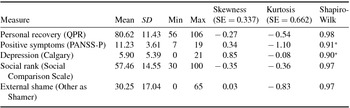
Descriptive statistics are displayed in Table 1. The Shapiro-Wilk statistic suggests that PANSS-P and Calgary scales distributions are significantly different from normal, and this appears to be linked with the sample reporting relatively low levels of positive symptoms (7 equates to an absence of symptoms on the PANSS) and depression symptomology (falling in the mild range). Moreover, in comparison to Neil et al. (Reference Neil, Kilbride, Pitt, Welford, Nothard and Sellwood2009), personal recovery scores were relatively high. Participants’ mean social rank and external shame were lower than in a depressed sample (Gilbert, Reference Gilbert2000).
Descriptive statistics of measures and distribution parameters

Relationships between variables
To explore the relationship between all variables, a Spearman's correlation analysis was undertaken. Results are presented in Table 2. Social rank and external shame were both found to be significantly related to levels of depression, positive symptoms of psychosis (PANSS-P total), and personal recovery. Low social rank was significantly correlated with increased experiences of positive symptoms of psychosis and, in particular, to higher levels of depression symptomology and lower perceived personal recovery. External shame was significantly associated with higher levels of positive symptoms and a lower personal recovery. Moreover, external shame was significantly associated with higher levels of depression.
Spearman's correlation coefficient and significance values of all variables

** Correlation is significant at the .01 level; *correlation is significant at the .05 level
Exploratory regression analysis
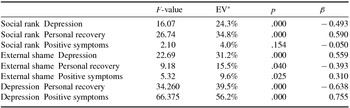
Initially, social rank and external shame were entered together as independent variables into three regression models to examine their associations with the depression, personal recovery and positive symptoms respectively. Regression model data can be found in Table 3. The depression model was found to be significant with both social rank (β = 0.340, t = −2.908, p < 0.005) and external shame (β = 0.440, t = 3.770, p <.001) acting as significant independent variables. A significant model was also found with the dependent variable personal recovery; social rank was identified as a significant predictor (β = 0.516, t = 4.327, p < .001) but external shame was not (β = −0.213, t = −1.778, p = .080). A significant model was not identified with positive symptoms although it was nearing significance.
Multiple regression models of depression, personal recovery and positive symptoms

*Explained variance
Exploring the role of social rank in psychosis
Regression coefficients and p values can be found in Table 4. Regression analysis found that social rank was significantly independently associated with depression and personal recovery. Social rank was not significantly associated with positive symptoms. Depression could not be examined as a mediator between social rank and positive symptoms as they were not significantly associated (did not meet stage 1). Depression was not found to be a moderator of social rank and depression as the interaction term was not significant. Depression did not mediate the relationship between social rank and personal recovery as the significance of social rank did not reduce when personal recovery was added as a predictor variable in the regression model (did not meet stage 4).
Exploratory regression analysis examining associations between variables

*Explained variance
Exploring the role of external shame in psychosis
Regression analysis found that external shame was significantly associated with positive symptoms, personal recovery, and depression (Table 4). Depression was also found to be associated with both dependent variables; positive symptoms and personal recovery.
In order to explore for mediation and moderation, external shame and depression were entered together into a regression model with positive symptoms and personal recovery as dependent variables respectively. Depression was found to be the only significant variable in both regression models, indicating that depression is a full mediator for external shame for both relationships with positive symptoms (F(2, 49) = 35.04, p < .001; EV 58.9%) and personal recovery (F(2, 49) = 16.39, p < .001; EV 40.9%).
Discussion
This study aimed to explore the relationship of external shame and social rank with experiences of psychosis and personal recovery from psychosis. It also aimed to explore whether depression mediated these relationships. Results suggested that high levels of external shame and low social rank were significantly correlated with increased depression and positive symptoms, and reduced ratings of personal recovery in psychosis. Moreover, symptoms of depression were found to play an important role in the relationship between external shame and experiences of psychosis.
Low social rank had a significant independent relationship with personal recovery and depression symptoms, but not positive symptoms. Although not directly assessed here, the relationship with depression may indicate that low social rank plays an underlying role in emotional distress associated with psychosis, which has been found in previous literature (Allison et al., Reference Allison, Harrop and Ellett2013). Low social rank was also associated with lower perceived personal recovery, and again highlights how social rank could have a potentially useful role in understanding the recovery process. Personal recovery factors, measured by the QPR, broadly examine factors such as improving self-esteem, connectedness to social networks and overcoming stigma (Neil et al., Reference Neil, Kilbride, Pitt, Welford, Nothard and Sellwood2009). It may be that perceived social rank – of self as inferior, unattractive and unable – inhibits one's ability to engage with the recovery process.
This study also supports the important role of depression symptoms in the relationship between shame and symptoms of psychosis and personal recovery (Gumley, Braehler, Laithwaite, MacBeth and Gilbert, Reference Gumley, Braehler, Laithwaite, MacBeth and Gilbert2010). Higher levels of external shame were found to be significantly associated with increased positive symptoms and lower reported personal recovery through a mediatory relationship with depression (i.e. higher levels of depression symptoms). Moreover, low social rank was associated with experiences of depression in psychosis. These findings illustrate that depression has an important role in understanding the link between social rank, external shame and experiences of psychosis. Previous research has shown that emotional difficulty, such as depression, and heightened emotional awareness play a significant role within the development and maintenance of psychotic symptoms (Garety, Reference Garety2001; Morrison, Reference Morrison2001), and are central to the threat system outlined in the CFT model (Gilbert, Reference Gilbert2010).
Experiences of positive symptoms of psychosis were shown to be explained by a relationship with external shame that was mediated by depression. This supports previous literature that suggests that experiences of psychosis are associated with external attributions, i.e. where people are more likely to attribute internal triggers/feelings to external sources (Janssen et al., Reference Janssen, Versmissen, Campo, Myin-Germeys, Os and Krabbendam2006). Moreover, findings illustrate the intrinsic role of depression in this process. Another explanation may be that high external shame is a reflection of threatening interpersonal experiences with others, in which the other(s) has been experienced as shaming, hostile or rejecting in some way. It may be that a sense that others may look down on the self, and hold the self in negative regard, may be an important component in understanding the broader experience in psychosis. Although not assessed in this study, it may be that depression has an important contributory and/or maintenance role in psychosis, and that this may in itself be influenced by an individual's underlying or pre-existing low social rank and sense of shame. Future longitudinal studies would need to examine these relationships over an extended period of time.
The significant relationships between low social rank and external shame and personal recovery suggest that it may be important for clinicians to consider social rank and shame based experiences in the assessment and treatment of recovery from psychosis. Psychotherapeutically, it may be important for clinicians to directly formulate and provide interventions for social rank and shame based difficulties as a way of facilitating recovery. The evidence base for psychosis recommends CBT as the first-line intervention for psychosis (NICE, 2014), and this may be a helpful approach to work with such presentations high in shame and low in social rank. However, other approaches such as Compassion Focused Therapy (CFT) may be able to alleviate shame more effectively (Gilbert, Reference Gilbert2010), given that social rank theory is embedded within its theoretical framework, and that the approach was developed to work with complex presentations in which shame and self-criticism were common. Recent studies looking at the effectiveness of CFT for people with psychosis suggest that this may be a helpful and efficacious therapeutic approach (Braehler et al., Reference Braehler, Gumley, Harper, Wallace, Norrie and Gilbert2013; Laithwaite et al., Reference Laithwaite, O’Hanlon, Collins, Doyle, Abraham and Porter2009; Mayhew and Gilbert, Reference Mayhew and Gilbert2008). Further studies will help to delineate therapeutic interventions for working with shame and low social rank in people struggling with psychotic difficulties.
These findings may also have important implications for the therapeutic relationship between service users and mental health services (e.g. teams). Here, it may be helpful to consider the relationship between service users and mental health services as a form of “social relationship”, in which the same negative relational patterns experienced by service users in their interpersonal relationships (i.e. detachment, criticism, shame, lack of care/nurturance/respect) can get played out on a larger scale with contact with mental health teams (Priebe, Richardson, Cooney, Adedeji and McCabe, Reference Priebe, Richardson, Cooney, Adedeji and McCabe2011). Mental health services may need to consider ways in which they can become more aware of how low social rank and shame may commonly influence service users accessing and engagement with services. Moreover, an understanding of these may help services to facilitate change and help service users to manage the nature of their shame, partly through warm, empathic and compassionate interactions that may ultimately facilitate the recovery process.
Limitations
There are a number of methodological limitations to this study. One main limitation was the small sample size and that some data were not normally distributed. The sample was relatively “recovered” and did not have current experiences of psychosis, which may impact upon the generalizability of findings. Although this study followed the recommendations outlined by Tabachnick and Fidell (Reference Tabachnick and Fidell1996) having 10 participants per variable, this rule is quite modest compared to other recommendations (Cohen and Cohen, Reference Cohen and Cohen1975; Green, Reference Green1991). Therefore, a larger sample size would have provided larger statistical power and reduced the likelihood of type II errors, which is common in small sample sizes. In addition, the cross-sectional nature of the study means that causality cannot be determined. Further, longitudinally based studies may help to elucidate whether low social rank and external shame are predictive of experiences of psychosis, maintain experiences of psychosis, or are the result of someone experiencing psychosis.
A further limitation to the study was the measure of recovery itself. There is ongoing debate about what constitutes recovery, especially in psychosis (Silverstein and Bellack, Reference Silverstein and Bellack2008), and trying to measure this quantitatively may lack validity. The recovery movement was initially developed by service users and it has been argued that professionals have adopted the term and misunderstood its original meaning. Recovery was initially about power and optimism for service users in the mental health system, whereas professionals considered it to be symptom alleviation (Wood et al., Reference Wood, Price, Morrison and Haddock2010). Although there has been a shift in professionals’ understanding of recovery, there is still disparity between service user and professional understanding of the construct.
This study has highlighted that unfavourable social rank and external shame are significantly related to positive symptoms in psychosis, depression symptoms, and personal recovery. It may be that social rank and external shame are associated with symptoms and recovery in psychosis both directly, but also via their relationship with higher levels of depression symptomology. This poses interesting questions about the psychological processes associated with psychotic symptoms and recovery, and may provide important avenues for future treatment. Further research is required to examine these relationships.
Acknowledgements
Conflict of interest: The authors have no conflicts of interest with respect to this publication.





Comments
No Comments have been published for this article.