Introduction
Not only is major depressive disorder (MDD) the most prevalent psychiatric disorder (De Graaf et al. Reference De Graaf, ten Have, van Gool and van Dorsselaer2012; Volkert et al. Reference Volkert, Schulz, Härter, Wlodarczyk and Andreas2013), it is also the number one cause of disease burden in high-income countries (WHO, 2008). With increasing age, MDD is more likely to be underdiagnosed and undertreated (Small, Reference Small2009; Barry et al. Reference Barry, Abou, Simen and Gill2012). Possibly, this is due to shifts in the presentation of specific depressive symptoms across the lifespan. MDD symptoms might resemble characteristics inherent to the ageing process, making MDD increasingly hard to recognize for patients as well as clinicians (Wetherell et al. Reference Wetherell, Petkus, McChesney, Stein, Judd, Rockwell, Sewell and Patterson2009). Therefore, gaining insight into age-related variability of symptom profiles of MDD might help improve diagnosis and treatment.
One of the most important reasons for a shift in the presentation of MDD across the lifespan may be the different underlying biological and psychosocial mechanisms causing the depression. Early depression onset has often been shown to be associated with personality (especially neuroticism) (Van den Berg et al. Reference Van den Berg, Oldehinkel, Bouhuys, Brilman, Beekman and Ormel2001; Grace & O'Brien, Reference Grace and O'Brien2003; Sneed et al. Reference Sneed, Kasen and Cohen2007; Korten et al. Reference Korten, Comijs, Lamers and Penninx2012), and adverse life events (Grace & O'Brien, Reference Grace and O'Brien2003; Korten et al. Reference Korten, Comijs, Lamers and Penninx2012). In older age, the likelihood for a somatic pathway to depression might increase. Neurobiological factors, such as cerebrovascular disease, neurodegeneration, and inflammation, may impact the response of the brain towards stress, and therefore might increase the susceptibility to depression (Weisenbach & Kumar, Reference Weisenbach and Kumar2014). Late depression onset has indeed been associated with poor health (Sneed et al. Reference Sneed, Kasen and Cohen2007) and vascular risk factors (Van den Berg et al. Reference Van den Berg, Oldehinkel, Bouhuys, Brilman, Beekman and Ormel2001). Even though personality and life events are not exclusively associated with an early depression onset (Van den Berg et al. Reference Van den Berg, Oldehinkel, Bouhuys, Brilman, Beekman and Ormel2001; Grace & O'Brien, Reference Grace and O'Brien2003) and despite the fact that MDD in older ages does not rule out an early depression onset, somatic depressive symptoms might become relatively more prominent across the lifespan.
A recent meta-analysis on differences in depressive symptoms between younger and older persons supports the notion that somatic symptoms might become increasingly apparent over the lifespan (Hegeman et al. Reference Hegeman, Kok, van der Mast and Giltay2012a ). In this meta-analysis, depressive symptoms of the Hamilton Rating Scale for Depression (HAMD; Hamilton, Reference Hamilton1960) were compared between younger and older persons with a DSM-IV diagnosis of MDD. Psychomotor agitation, hypochondriasis, and general and gastrointestinal somatic symptoms were indeed found to be more prevalent in older persons. The only somatic symptom not associated with older age was reduced interest in sex, this was found to be more common in younger persons. Feelings of guilt, which could be seen as a cognitive symptom, were found to be more prevalent in younger persons as well.
Even though this meta-analysis already pointed out several differences in the presentation of depression between younger and older persons, age was dichotomized, and the cut-off ages used to distinguish younger and older persons in the included studies ranged from 50 to 70 years. Hence, middle-aged persons have been assigned to age groups inconsistently, even though changes in depressive symptoms may also take place during middle-aged years. Moreover, the HAMD does not cover all DSM depressive symptoms in detail (Bagby et al. Reference Bagby, Ryder, Schuller and Marshall2004). For example, whereas weight loss is included, other somatic symptoms such as weight gain and appetite disturbance are left out.
The aim of the current study is to examine age-related variability of depressive symptoms in a large sample of currently depressed outpatients, using a wide age range (18–88 years). We will examine mood symptoms, cognitive symptoms, and somatic/vegetative symptoms. Taking into account general ageing theories and previous empirical findings, we expect the prevalence of somatic/vegetative symptoms to increase with age. There is some evidence to expect age-variability in mood and cognitive symptoms as well. Older age has been associated with depression without sadness (Gallo et al. Reference Gallo, Rabins and Anthony1999), and, as mentioned before, younger age has been associated with feelings of guilt (Hegeman et al. Reference Hegeman, Kok, van der Mast and Giltay2012a ).
Method
Study sample
Data used in this study were from the Netherlands Study of Depression and Anxiety (NESDA; participants aged 18–65 years) and the Netherlands Study of Depression in Older Persons (NESDO; participants aged 60–93 years), two ongoing, multi-centre cohort studies with similar methods and infrastructures, in which the natural course, determinants, and consequences of depression are examined (Penninx et al. Reference Penninx, Beekman, Smit, Zitman, Nolen, Spinhoven, Cuijpers, de Jong, van Marwijk, Assendelft, van der Meer, Verhaak, Wensing, de Graaf, Hoogendijk, Ormel and van Dyck2008; Comijs et al. Reference Comijs, van Marwijk, van der Mast, Naarding, Oude Voshaar, Beekman, Boshuisen, Dekker, Kok, de Waal, Penninx, Stek and Smit2011).
The initial NESDA sample consisted of 2981 persons with a current depressive and/or anxiety disorder (n = 1701), a remitted depressive and/or anxiety disorder (n = 628), or no lifetime depressive and anxiety disorder (n = 652). Participants were recruited from the general population, primary healthcare, and outpatient mental health care facilities. The initial NESDO sample consisted of 510 older adults with either a current depressive disorder (n = 378) or no lifetime depressive and anxiety disorder (n = 132), recruited through primary healthcare and out- and inpatient mental healthcare facilities. In both studies, a current psychiatric diagnosis was defined by a recency of 6 months. Exclusion criteria for both cohorts were as follows: (1) insufficient command of the Dutch language or insufficient capability to participate; (2) a primary clinical diagnosis of a psychiatric disorder other than depressive and anxiety disorders (e.g. obsessive compulsive disorder); and for NESDO additionally (3) (clinician-suspected) dementia, or having a Mini-Mental State Examination (MMSE; Folstein et al. Reference Folstein, Folstein and McHugh1975) score <18 (out of 30).
For the current study, baseline data were used and participants were included when the following criteria were met: having a current MDD diagnosis at baseline; being an outpatient; and having a valid scale score for the self-report Inventory of Depressive Symptomatology (IDS-SR; Rush et al. Reference Rush, Gullion, Basco, Jarrett and Trivedi1996). This selection resulted in 1404 participants (1093 from NESDA, 311 from NESDO) being included in this study.
MDD diagnoses were based on DSM-IV criteria, derived using the Composite International Diagnostic Interview (CIDI, WHO version 2.1, lifetime, Wittchen, Reference Wittchen1994). Baseline face-to-face assessments were completed at participating centres between 2004 and 2007 for NESDA, and between 2007 and 2010 for NESDO. Ethical approval was obtained by both NESDA and NESDO from all Ethical Review Boards of the participating centres, and all participants provided informed consent.
Measures
Age
Participants’ age was obtained during the baseline interviews, and ranged from 18 to 88 years. Age was used as a continuous variable per 10 years (age/10), but was also recoded into a categorical variable with six age groups: 18–29, 30–39, 40–49, 50–59, 60–69, and ⩾70 years.
Depression characteristics and depressive symptoms
Age at onset of the first MDD episode, recurrence of episodes, and presence of co-morbid dysthymia and/or anxiety in the past 6 months (yes/no) were obtained using the CIDI (Wittchen, Reference Wittchen1994). Anxiety severity in the past week was measured using the Beck Anxiety Inventory (BAI; Beck et al. Reference Beck, Epstein, Brown and Steer1988), a 21-item self-report questionnaire rated from 0 (‘not at all’) to 3 (‘severely’), with total scores ranging from 0 to 63. Presence of chronic diseases was established by asking participants whether they suffered from lung disease, heart disease, diabetes mellitus, stroke, osteoarthritis, cancer, ulcers, intestinal disease, liver disease, epilepsy, and thyroid disease and whether they were under treatment for these diseases. A count variable was created for the number of chronic diseases under treatment.
The 30-item IDS-SR (Rush et al. Reference Rush, Gullion, Basco, Jarrett and Trivedi1996) was used to establish depression severity in the past week, using the total IDS-SR score (range 0–84), with a higher score indicating higher depression severity. It was also used to establish the presence of 30 individual depressive symptoms in the past week. Items were scored from 0 (‘no problems’) to 3 (‘severe problems’). In line with previous studies, symptoms were recoded into dichotomous variables, with a score of 0 or 1 indicating the symptom was not present, and a score of 2 or 3 indicating presence of the symptom (Khan et al. Reference Khan, Carrithers, Preskorn, Lear, Wisniewski, John Rush, Stegman, Kelley, Kreiner, Nierenberg and Fava2006). The separate items weight loss and weight gain were recoded into a single three-category variable: no change (score of 0 or 1 on both variables), decreased weight (score of 2 or 3 on weight loss), or increased weight (score of 2 or 3 on weight gain). Increased appetite and decreased appetite were recoded similarly. Finally, the item asking about diurnal variation was recoded to distinguish those with worse mood in the morning from those with no diurnal variation or no worse mood in the morning. Although studies on the validity of the 30-item IDS-SR in older populations are still on-going, the shorter version of the IDS, the QIDS-16, has been shown to be a valid diagnostic tool for detecting MDD in older persons (Doraiswamy et al. Reference Doraiswamy, Bernstein, Rush, Kyutoku, Carmody, Macleod, Venkatraman, Burks, Stegman, Witte and Trivedi2010).
In order to improve clinical interpretability, individual dichotomized symptoms were categorized into symptom clusters as well. Based on clusters of depressive symptoms used previously across varying populations (Wardenaar et al. Reference Wardenaar, van Veen, Giltay, den Hollander-Gijsman, Penninx and Zitman2010; Roest et al. Reference Roest, Thombs, Grace, Stewart, Abbey and de Jonge2011; Hegeman et al. Reference Hegeman, Wardenaar, Comijs, de Waal, Kok and van der Mast2012 Reference Hegeman, Wardenaar, Comijs, de Waal, Kok and van der Mast b ; Wiltink et al. Reference Wiltink, Michal, Wild, Zwiener, Blettner, Münzel, Schulz, Kirschner and Beutel2013; De Miranda Azevedo et al. Reference De Miranda Azevedo, Roest, Hoen and de Jonge2014), we distinguished three symptom clusters: mood symptoms, cognitive symptoms, and somatic/vegetative symptoms. The mood symptoms cluster consisted of: diminished capacity for pleasure or enjoyment, diminished interest in people/activities, diminished quality of mood, diminished reactivity of mood, feeling anxious or tense, feeling irritable, feeling sad, interpersonal sensitivity, leaden paralysis, and panic/phobic symptoms. Cognitive symptoms included: concentration/decision-making problems, future pessimism, self-criticism and blame, and suicidal thoughts. Finally, the somatic/vegetative cluster included: aches and pains, appetite disturbance, constipation/diarrhoea, diurnal variation with a worse mood in the morning, early morning awakening, low energy level/fatigability, other bodily symptoms, problems falling asleep, problems sleeping during the night, psychomotor agitation, psychomotor retardation, reduced interest in sex, sleeping too much, and weight disturbance. For each cluster, a sum score was created. In the somatic/vegetative cluster, the items weight loss, weight gain, decrease in appetite and increase in appetite were added separately. As a result, the mood sum score potentially ranged from 0 to 10, the cognitive sum score ranged from 0 to 4, and the somatic/vegetative sum score ranged from 0 to 16.
Statistical analysis
Baseline depression characteristics across the six age groups were evaluated and described using one-way analyses of variance (ANOVAs) for continuous variables, and χ2 analyses for categorical variables. Additionally, we used simple linear regression analyses to evaluate associations between depression characteristics and age as a continuous variable.
χ2 analyses were performed to examine whether the prevalence of the individual depressive symptoms was similar across the six age groups. In addition, ANOVAs were conducted to test whether the sum scores of the three symptom clusters (mood symptoms, cognitive symptoms, and somatic/vegetative symptoms) differed between age groups. To see whether age as a continuous variable was associated with the presence of depressive symptoms, multivariate logistic regression analyses were performed for all depressive symptoms separately, in which the presence (yes or no) of each symptom was the dependent variable. Two different logistic regression models were assessed: model 1 only included continuous age as a predictor; in model 2 sex, depression severity and anxiety diagnosis were added as covariates. Because ‘weight disturbance’ and ‘appetite disturbance’ had three-answer categories (no change, decrease, or increase), for these two symptoms multinomial logistic regression analyses were performed, using the same two models. Finally, three multiple linear regression analyses, using the same covariates, were conducted in order to test the linear associations between age and the sum scores of the three symptom clusters.
Missing data ranged from 0.0007% (falling asleep) to 4.1% (diurnal variation) and were not imputed. Statistical significance was set at an alpha of 5%. All analyses were performed using SPSS v. 20 for Windows (IBM Corporation, USA).
Results
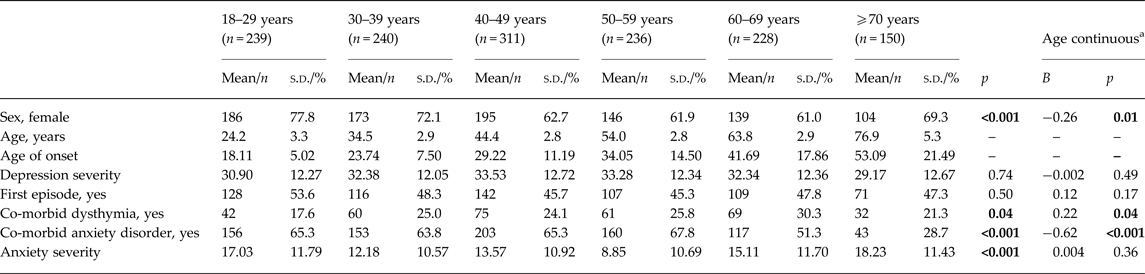
Participants’ mean age was 47.5 [standard deviation (s.d.) = 16.6] years, and over two-thirds of the sample was female (Table 1). The youngest and oldest age groups, compared to the middle-aged groups, included relatively more females (69.3–77.8%), less often had co-morbid dysthymia, and had slightly higher levels of anxiety severity. The prevalence of a co-morbid anxiety disorder decreased with age. Levels of depression severity were found to be similar across the lifespan.
Socio-demographic and clinical characteristics per age group

a Age per 10 years.
Individual symptoms
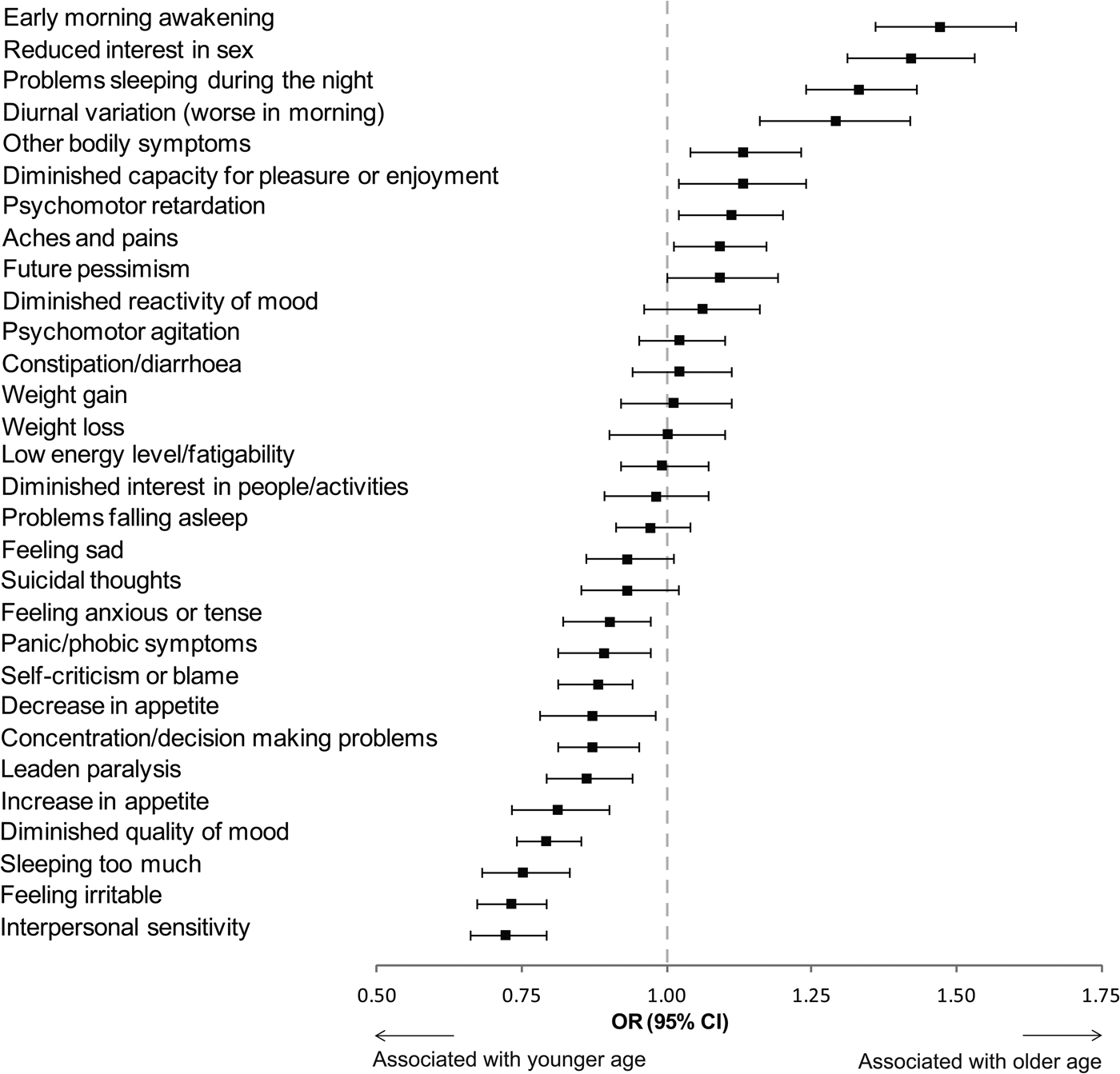
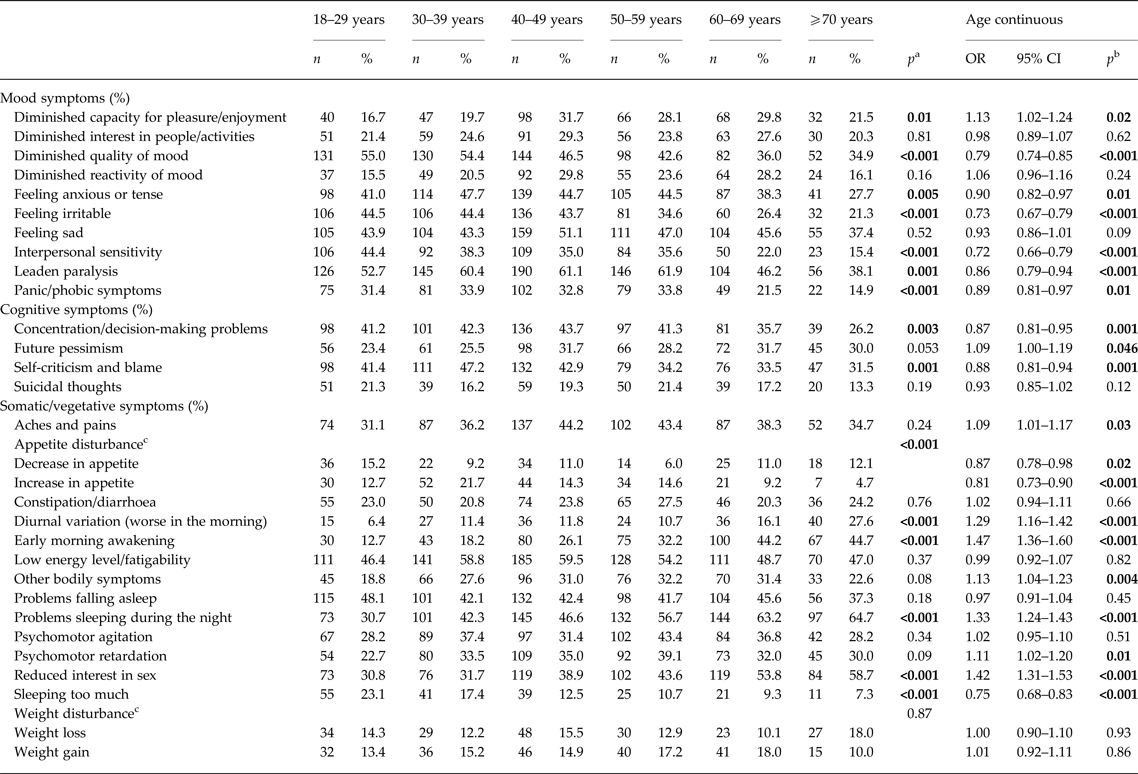
Twenty (67%) out of 30 symptoms were found to be associated with age, of which 11 were associated with younger age, and nine were associated with older age (Fig. 1 and Table 2, adjusted models). The symptom most likely to increase over the lifespan was found to be early morning awakening [odds ratio (OR) 1.47, 95% confidence interval (CI) 1.36–1.60]. Other symptoms associated with increasing age were reduced interest in sex (OR 1.42, 95% CI 1.31–1.53), problems sleeping during the night (OR 1.33, 95% CI 1.24–1.43), diurnal variation with a worse mood in the morning (OR 1.29, 95% CI 1.16–1.42), other bodily symptoms (OR 1.13, 95% CI 1.04–1.23), diminished capacity for pleasure and enjoyment (OR 1.13, 95% CI 1.02–1.24), psychomotor retardation (OR 1.11, 95% CI 1.02–1.20), aches and pains (OR 1.09, 95% CI 1.01–1.17) and future pessimism (OR 1.09, 95% CI 1.00–1.19). In order to examine whether the association between age and interest in sex was driven by the loss of sexual partners at old age, we performed a sensitivity analysis among those who were married or had a partner (n = 927). The association not only lasted, but became even stronger towards old age (OR 1.47, 95% CI 1.33–1.64, originally: OR 1.42, 95% CI 1.31–1.53).
Odds ratios (OR) and 95% confidence intervals (CI) for the association between age (per 10 years) and the presence of depressive symptoms. OR < 1 indicates symptom is associated with younger ages, OR > 1 indicates symptom is associated with older ages. Adjusted for sex, depression severity and anxiety diagnosis.

Frequencies, χ2 statistics, and p-trend for linearity of individual depressive symptoms per age group; linear associations for age (per 10 years) as a continuous variable

OR, odds ratio; CI, confidence interval.
a Unadjusted p trend for linearity.
b Adjusted for sex, depression severity and anxiety diagnosis.
c Multinomial logistic regression; reference = no change.
The symptoms that were found to decrease over the lifespan, were interpersonal sensitivity (OR 0.72, 95% CI 0.66–0.79), feeling irritable (OR 0.73, 95% CI 0.67–0.79), sleeping too much (OR 0.75, 95% CI 0.68–0.83), diminished quality of mood (OR 0.79, 95% CI 0.74–0.85), increase in appetite (OR 0.81, 95% CI 0.73–0.90), leaden paralysis (OR 0.86, 95% CI 0.79–0.94), concentration/decision-making problems (OR 0.87, 95% CI 0.81–0.95), decrease in appetite (OR 0.87, 95% CI 0.78–0.98), self-criticism and blame (OR 0.88, 95% CI 0.81–0.94), panic/phobic symptoms (OR 0.89, 95% CI 0.81–0.97), and feeling anxious or tense (OR 0.90, 95% CI 0.82–0.97). The remaining symptoms were not associated with age. Additional adjustment for the number of chronic diseases only yielded marginal differences in findings. As associations between depressive symptoms and age may be nonlinear, we examined the presence of quadratic associations post-hoc. For six out of 30 symptoms (i.e. aches and pains, psychomotor retardation, leaden paralysis, other bodily symptoms, problems falling asleep, sleeping too much) we found significant quadratic associations. However, linear associations remained significant as well and quadratic associations reduced the model fit for each symptom. Therefore, linear associations were presented.
Symptom clusters
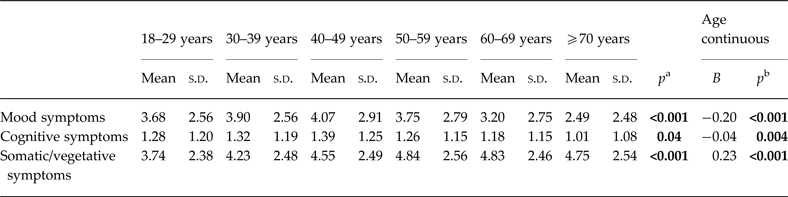
Although individual mood symptoms were not exclusively associated with either an increase or decrease over the lifespan, six out of 11 symptoms associated with younger age were mood symptoms (i.e. leaden paralysis, feeling anxious or tense, panic/phobic symptoms, diminished quality of mood, feeling irritable and interpersonal sensitivity). The sum score of mood symptoms was negatively associated with age as well (B = −0.20, p < 0.001, Table 3), indicating that the number of mood symptoms one experiences might indeed decrease over the lifespan. The core symptoms of depression, represented by four items of the IDS-SR, were part of the mood symptoms cluster but were inconsistently associated with age. Feeling sad and diminished interest in people/activities were unrelated to age. Diminished capacity for pleasure and enjoyment was associated with older age, and diminished quality of mood was associated with younger age.
Means and standard deviations of symptom cluster sum scores per age group; linear associations for age (per 10 years) as a continuous variable

a Unadjusted.
b Adjusted for sex, depression severity and anxiety diagnosis.
Out of the four cognitive symptoms, two were associated with younger age (concentration/decision-making problems and self-criticism and blame), one was associated with older age (future pessimism), and one was unrelated to age (suicidal thoughts). The sum score of cognitive symptoms was weakly but significantly negatively associated with age (B = −0.04, p = 0.004, Table 3). Taken together, cognitive symptoms seemed to be inconsistently associated with either a decrease or increase over the lifespan.
Somatic/vegetative symptoms, although again not exclusively, were often found to be associated with older age. Out of the nine symptoms significantly associated with older age, seven were somatic/vegetative symptoms (i.e. early morning awakening, reduced interest in sex, problems sleeping during the night, diurnal variation with a worse mood in the morning, psychomotor retardation, other bodily symptoms and aches and pains). In line with this, the sum score of somatic/vegetative symptoms was significantly positively associated with age (B = 0.23, p < 0.001, Table 3), supporting the notion that somatic/vegetative symptoms are more likely to occur at older age. Associations between age and sum scores of symptom clusters were unchanged when we additionally adjusted for the number of chronic diseases. Moreover, no significant quadratic associations were found for any of the sum scores of symptom clusters.
Discussion
Using a large sample of currently depressed persons (N = 1404), this study assessed whether 30 depressive symptoms were associated with age, as this may have consequences for diagnosis and treatment of MDD. Even though depression severity was found to be stable across the lifespan, 20 (67%) out of 30 symptoms were significantly associated with age. Eleven symptoms were found to be more common in younger ages, whereas nine were found to be more likely in older ages. Our results are in line with previous findings by demonstrating the stability of depression severity over time, and by showing a shift towards somatic symptoms over the lifespan (Hegeman et al. Reference Hegeman, Wardenaar, Comijs, de Waal, Kok and van der Mast2012a ). However, the number of symptoms that seems to shift across the lifespan exceeds previous findings, as the meta-analysis by Hegeman et al. (Reference Hegeman, Wardenaar, Comijs, de Waal, Kok and van der Mast2012a ) only found six (35%) out of 17 symptoms to differ between younger and older persons.
In line with previous findings (Hegeman et al. Reference Hegeman, Wardenaar, Comijs, de Waal, Kok and van der Mast2012a ), the number of somatic/vegetative symptoms reported increased with age. However, in our study, reduced interest in sex was associated with older age, whereas this was previously found to be more common in younger ages. It has been suggested that reduced interest in sex might be a problem specifically in younger ages, because older persons are more likely not to have a partner (Hegeman et al. Reference Hegeman, Wardenaar, Comijs, de Waal, Kok and van der Mast2012a ). However, our finding fits the view that older persons may be more apathetic (Brodaty et al. Reference Brodaty, Altendorf, Withall and Sachdev2010), showing diminished interest in various aspects of life, including sex. This notion is also supported by our finding that having diminished capacity for pleasure or enjoyment was found to be associated with older age. Showing diminished interest for people/activities, which might also resemble apathy, was not related to age in our study. We found younger persons to demonstrate slightly more cognitive symptoms (i.e. self-criticism and blame and concentration/decision-making problems) but the direction was less clear compared to somatic/vegetative symptoms and the association with younger age seems to be rather weak. This seems consistent with previous findings, as Hegeman et al. (Reference Hegeman, Wardenaar, Comijs, de Waal, Kok and van der Mast2012a ), with regard to cognitive symptoms, only found guilt to be associated with age. Mood symptoms were found to become less common over the lifespan, although findings were inconsistent for the core symptoms of depression. Interestingly, feeling sad was unrelated to age, even though previous research demonstrated sadness to be less common in older ages (Gallo et al. Reference Gallo, Rabins and Anthony1999). The shifts in depressive symptoms over the lifespan found in our study might be the consequence of differential aetiologies of depression across the lifespan, since depression at early age might be more closely associated with personality and early life events, whereas in older age a more somatic pathway to depression could be prominent. Another explanation for this shift in symptoms could be an increase in physical illnesses in older persons, depressed as well as non-depressed (Hegeman et al. Reference Hegeman, de Waal, Comijs, Kok and van der Mast2015).
Several somatic symptoms found to be more common in older ages, such as early morning awakening or aches and pains, may be seen as problems inherent to ageing or the presence of chronic somatic diseases. Nevertheless, additional adjustment for the number of chronic diseases under treatment did not reduce our association between somatic/vegetative symptoms and older age. The occurrence of somatic/vegetative symptoms at older age might explain why late-life depression has been found to be relatively more often underdiagnosed, as older persons experiencing these symptoms may show attribution bias thinking their problems are simply consequences of growing older, and they may not feel the need to seek help (Fiske et al. Reference Fiske, Wetherell and Gatz2009; Wetherell et al. Reference Wetherell, Petkus, McChesney, Stein, Judd, Rockwell, Sewell and Patterson2009). General practitioners may not always be able to recognize these problems as being part of a depressive episode either (Wetherell et al. Reference Wetherell, Petkus, McChesney, Stein, Judd, Rockwell, Sewell and Patterson2009). However, including somatic symptoms in geriatric screening instruments for depression might in turn lead to overestimation of late-life depression (Fiske et al. Reference Fiske, Wetherell and Gatz2009). Somatic complaints following physical diseases may then be misinterpreted and might wrongly be seen as somatic symptoms of depression, even though DSM-V criteria for MDD emphasize that somatic symptoms should not be the consequence of physical diseases. Rather, it might be worthwhile to ask persons who report physical complaints about their mood, as older persons might not have the habit of expressing mood problems and might focus on physical health (Wetherell et al. Reference Wetherell, Petkus, McChesney, Stein, Judd, Rockwell, Sewell and Patterson2009). Further, Hegeman et al. (Reference Hegeman, de Waal, Comijs, Kok and van der Mast2015) found older depressed persons with a high physical disease burden to not only show somatic depressive symptoms, but also to demonstrate elevated levels of mood and motivational symptoms. Thus, not only should one be aware that late-life depression might present in a more somatic way compared to depression earlier in life, but it might also be useful to raise awareness of co-morbid depressive symptoms in those suffering from physical diseases, especially since MDD intensifies the disability of somatic conditions (Lyness et al. Reference Lyness, Niculescu, Tu, Reynolds and Caine2006) and may adversely affect treatment adherence in these conditions (Ciechanowski et al. Reference Ciechanowski, Katon and Russo2000). When treating MDD in older persons, it may be recommended to treat somatic/vegetative depressive symptoms alongside mood symptoms. For instance, insomnia has been found to predict worse depression treatment outcome (Troxel et al. Reference Troxel, Kupfer, Reynolds, Frank, Thase, Miewald and Buysse2012), and another study showed that behavioural treatment for sleep disturbance not only improved sleep quality, but also significantly reduced depressive symptoms (Buysse et al. Reference Buysse, Germain, Moul, Franzen, Brar, Fletcher, Begley, Houck, Mazumdar, Reynolds and Monk2011).
This study shows several strengths. We were able to depict the likelihood of depressive symptoms over a wide age range by combining two large cohort studies, which used identical measuring instruments. Another strength is the use of DSM-IV based clinical diagnoses of MDD. Finally, we included age as a continuous variable in our analyses, contrary to the majority of previous studies in which arbitrary cut-off ages were used to distinguish younger persons from older persons. The cross-sectional nature of this study is a limitation, as we did not assess the development of depressive symptoms within individuals over time. Moreover, we did not include extensive data on neurocognitive assessment. Although our older sample seemed relatively healthy with only a minority (n = 10) scoring in the range of mild cognitive impairment on the MMSE (Folstein et al. Reference Folstein, Folstein and McHugh1975), and since (suspected) dementia was an exclusion criterion, it may be possible that even milder cognitive dysfunctions may have gone undetected. In addition, our findings are mainly generalizable to those with normal cognition.
In conclusion, this study showed that even though overall depression severity is stable across the life course, MDD presents itself rather differently across the lifespan. Depressive symptoms shift from being more mood-related in younger ages to being more somatic in older ages. Possibly, this is due to the heterogeneous aetiology of MDD. This shift should be taken into account in order to prevent under-diagnosis of depression, especially in late-life, and to tailor MDD treatment by targeting age-appropriate symptoms.
Acknowledgements
The infrastructure for the NESDA study (www.nesda.nl) was funded through the Geestkracht program of the Netherlands Organisation for Health Research and Development (Zon-Mw, grant no. 10-000-1002); and participating universities (VU University Medical Centre, Leiden University Medical Centre, University Medical Centre Groningen).
The infrastructure for the NESDO study (http://nesdo.amstad.nl) is funded through the Fonds NutsOhra (project 0701-065); Stichting tot Steun VCVGZ, NARSAD The Brain and Behaviour Research Fund (grant ID 41080); and the participating universities and mental healthcare organizations (VU University Medical Centre, Leiden University Medical Centre, University Medical Centre Groningen, UMC St Radboud, and GGZ inGeest, GG Net, GGZ Nijmegen, GGZ Rivierduinen, Lentis, and Parnassia).
Declaration of Interest
Dr Penninx has received an unrestricted research grant from Jansen Research. R. Schaakxs, Dr Comijs, Dr Lamers, and Dr Beekman report no competing interests.