Introduction
In 2010, traumatic brain injury (TBI) was associated with 2.5 million emergency department visits, hospitalizations, and deaths in the United States alone (Faul, Xu, Wald, & Coronado, Reference Faul, Xu, Wald and Coronado2010). Disability due to TBI is estimated to affect approximately 2% of the United States population and a significant number of survivors are left with long-term cognitive impairment in domains including executive function, memory, and information processing speed (Levin, Benton, & Grossman, Reference Levin, Benton and Grossman1982; Thurman, Alverson, Dunn, Guerrero, & Sniezek, Reference Thurman, Alverson, Dunn, Guerrero and Sniezek1999). These cognitive deficits, in combination with emotional and behavioral difficulties, contribute to significant disability and limitations in societal participation. Widespread damage in white matter, frequently called diffuse axonal injury (DAI), is one of the most significant post-injury neuropathologies that may explain and predict cognitive and real-world outcome in TBI (Povlishock & Katz, Reference Povlishock and Katz2005).
Due to its sensitivity to white matter integrity, diffusion tensor imaging (DTI) has increasingly been used to assess TBI. Typically, white matter damage is quantified by diffusional metrics such as fractional anisotropy (FA) and/or mean diffusivity. As summarized in a recent review by Hulkower and colleagues (Hulkower, Poliak, Rosenbaum, Zimmerman, & Lipton, Reference Hulkower, Poliak, Rosenbaum, Zimmerman and Lipton2013), white matter damage measured by FA, the most frequently used DTI metric, is reported in areas including but not limited to the corpus callosum, internal capsule, corona radiata, and cingulum bundle. Lower FA values in TBI in these regions are the most frequent findings across the spectrum of TBI severity (Hulkower et al., Reference Hulkower, Poliak, Rosenbaum, Zimmerman and Lipton2013). However, in the acute phase of injury, both increased and decreased FA values have been reported (Bazarian et al., Reference Bazarian, Zhong, Blyth, Zhu, Kavcic and Peterson2007; Huisman et al., Reference Huisman, Schwamm, Schaefer, Koroshetz, Shetty-Alva, Ozsunar and Sorensen2004; Wang et al., Reference Wang, Bakhadirov, Devous, Abdi, McColl, Moore and Diaz-Arrastia2008; Wilde et al., Reference Wilde, McCauley, Hunter, Bigler, Chu, Wang and Levin2008). It is speculated that elevated FA reflects more water molecules trapped in the intracellular compartment due to cytotoxic edema (Edlow & Wu, Reference Edlow and Wu2012). Healthy aging is also found to be associated with FA decrease and MD increase (Bennett, Madden, Vaidya, Howard, & Howard, Reference Bennett, Madden, Vaidya, Howard and Howard2010; Burzynska et al., Reference Burzynska, Preuschhof, Backman, Nyberg, Li, Lindenberger and Heekeren2010).
Although DTI research in TBI is rapidly growing, the precise relationship between white matter deficits and cognitive impairment remains unclear (Hulkower et al., Reference Hulkower, Poliak, Rosenbaum, Zimmerman and Lipton2013; Levine et al., Reference Levine, Kovacevic, Nica, Schwartz, Gao and Black2013). While noting a consensus that DTI measures such as FA are associated with scores on measures of cognitive function, Hulkower et al. (Reference Hulkower, Poliak, Rosenbaum, Zimmerman and Lipton2013) reported studies with positive, negative, and no significant correlations between FA and many cognitive domains included in the review. Some of this heterogeneity may be due to variation in cognitive measures and acuity/severity of TBI in the sample populations, but some may be attributed to shortcomings in the use of regional DTI parameters as a metric for estimating white matter integrity.
An alternative method of characterizing white matter injury and subsequent connectivity disruption may contribute to establishing the brain-behavior relationship between DAI and cognitive deficits in TBI. A method that quantifies the whole-brain networks instead of focusing on regional fiber paths may show promise for the following reasons. First, the higher-level cognitive processes known to be affected by TBI such as executive function are known to be dependent on widely distributed neural networks (Collette, Hogge, Salmon, & Van der Linden, Reference Collette, Hogge, Salmon and Van der Linden2006; Kim et al., Reference Kim, Whyte, Patel, Europa, Slattery, Coslett and Detre2012). For this reason, one might predict that disruption of white matter at different loci might affect the same cognitive process, and that the relationship between white matter disruption in a specific location and cognitive functioning might be highly variable as a result. Second, the neuropathology of TBI is also known to involve multiple neural circuits that display large heterogeneity among individuals.
It has long been recognized that the human brain consists of structural networks with numerous interacting neuronal elements. However, it is only recently that neuroimaging researchers have started to use graph theory to model them. In graph theory, each brain region is typically represented by a node, and then graph topology among nodes are quantified by various network metrics. Currently, it is not firmly established which set of metrics should be used to describe brain networks (Bullmore & Sporns, Reference Bullmore and Sporns2009). However, researchers have made significant progress during the past decade in applying graph theory to brain imaging data including DTI. DTI data can provide structural connectivity between two regions via tractography, making it amenable to graph theory analysis. It has been established that network properties of the human brain possess small-worldness, that is, densely connected local areas with sparse long-range connections connecting them, to meet a balance between local specialization and global communication in the network (Rubinov & Sporns, Reference Rubinov and Sporns2010; Stam & Reijneveld, Reference Stam and Reijneveld2007). There is now considerable evidence that these quantifiable network properties can provide novel insights into the neuropathology of various neuropsychiatric conditions including Alzheimer’s disease, schizophrenia, and multiple sclerosis (Bullmore & Sporns, Reference Bullmore and Sporns2009; He & Evans, Reference He and Evans2010; Li et al., Reference Li, Jewells, Kim, Chen, Moon, Armao and Shen2013; Lo et al., Reference Lo, Wang, Chou, Wang, He and Lin2010). Alterations in brain connectivity in these conditions, including reduction of local and/or long-range connections measured by network metrics, have increasingly been related to behavioral impairment.
If DAI disrupts network connections following TBI, graph theoretical analysis is likely to reveal altered network metrics at the structural level. These alterations may lead to important insights into the mechanisms of adaptation or recovery from TBI. Several studies have investigated TBI of varied acuity and severity using graph theoretical analysis. However, the majority of studies used ‘functional’ signals such as BOLD fMRI (Nakamura, Hillary, & Biswal, Reference Nakamura, Hillary and Biswal2009; Pandit et al., Reference Pandit, Expert, Lambiotte, Bonnelle, Leech, Turkheimer and Sharp2013), electroencephalogram (Cao & Slobounov, Reference Cao and Slobounov2010), or magnetoencephalogram (Castellanos et al., Reference Castellanos, Paul, Ordonez, Demuynck, Bajo, Campo and Maestu2010) and produced inconsistent findings (i.e., increased vs. reduced network efficiency in TBI). In a recent study of DTI based structural connectome in TBI, it was found that people with TBI displayed network inefficiency at the structural level and that this altered topology was associated with impaired executive function (Caeyenberghs et al., Reference Caeyenberghs, Leemans, Leunissen, Gooijers, Michiels, Sunaert and Swinnen2014).
The present study aimed to add to the growing literature on this topic in several ways. First, we assessed real-world behavioral deficits in individuals with TBI by using self- and family-rated questionnaires to determine whether network topology metrics are associated with the level of frontal/executive dysfunction observed in everyday life. Second, we used a strict exclusion criterion for focal lesions, limiting our analysis primarily to the diffuse form of TBI neuropathology. The co-presence of diffuse and focal lesions in moderate to severe TBI has been a major confounding factor that hinders isolating the effect of DAI. With the restriction on focal lesions used here, cognitive and behavioral impairment and alterations in network topology observed in our sample can be more confidently attributed to disconnectivity due to DAI. Third, while Caeyenberghs and colleagues (Caeyenberghs et al., Reference Caeyenberghs, Leemans, Leunissen, Gooijers, Michiels, Sunaert and Swinnen2014) related network metrics to only executive function, we used a battery of psychometric tests tapping into executive function, verbal learning, and processing speed to explore the relationship between multiple cognitive domains and structural network properties.
Methods
Participants and Procedure
Twenty-five people with TBI and 18 uninjured control participants were enrolled in this study. Participants with TBI were recruited from the outpatient clinical programs at the Drucker Brain Injury Center at MossRehab Hospital and the research registry maintained at MossRehab (Schwartz, Brecher, Whyte, & Klein, Reference Schwartz, Brecher, Whyte and Klein2005). Control participants were recruited from public advertising in local newspapers, and from social contacts of hospital staff and TBI participants. Individuals with TBI must have had at least a moderately TBI with confirmed or probable DAI at least 2 months previously. The severity criteria were defined by one or more of the following, documented in the medical record: lowest Glasgow Coma Scale score ≤12; post-traumatic amnesia >1 hour; abnormality consistent with TBI in acute neuroimaging study. Additional inclusion/exclusion criteria included: ages 16–60, no current substance abuse, no history of other major neurologic or psychiatric illness, no medications that are likely to substantially affect cognitive performance, no ferrometalic implants.
On-line Supplementary Table 1 summarizes the demographic and clinical characteristics of participants with TBI. Although severity and other characteristics of TBI were confirmed for all participants at the time of enrollment through review of primary medical records, those records were not kept due to an administrative error and attempts to reconstruct severity data from medical records at the time of manuscript writing were unsuccessful for six participants. Although we lacked the traditional TBI severity indices for these six participants, all had abnormalities in chronic neuroimaging that were consistent with a TBI resulting in DAI: T1 imaging abnormalities consistent with DAI, micro-hemorrhages, or very small (smaller than 1.0 cm3) “focal lesions” (i.e., encephalomalacia). A board-certified neurologist with extensive experience in lesion assessment (H.B.C.) reviewed the T1-weighted images to locate and describe the lesions and the first author quantified the size using ITK-SNAP 3D segmentation software (www.itksnap.org). We used the images at the time of testing because focal lesions at the time of testing are more relevant to imaging data analysis steps such as spatial registration, and also because we believe focal lesions detected at chronic imaging reflect more permanent damage caused by TBI. To focus on the diffuse mechanism of TBI, we excluded individuals who had large focal brain lesions (operationally defined as greater than 1 cm3). Two participants with TBI were excluded after being scanned due to sizable encephalomalacia found after scanning and one was excluded due to dental braces artifacts. Inclusion/excusion criteria for control participants were similar with the exception of having no history of TBI with loss of consciousness. Control participants were matched with participants with TBI at the group level for age, gender, ethnicity, handedness, and years of education.
Each TBI and control subject underwent a single 1-hr MRI scan, conducted at the Center for Functional Neuroimaging at the University of Pennsylvania. They also had a behavioral testing session lasting approximately an hour. In this session, they performed a set of brief psychometric measures intended to assess areas of common impairment after TBI including executive function, speed of processing, and memory. In addition, they completed a questionnaire designed to assess their executive functioning in real-world context. The present study complies with institutional research standards for human research and was completed in accordance with the Helsinki Declaration.
Neuropsychological Battery
Demographically adjusted test scores were used whenever available. To assess speed of mental processing, we used the Processing Speed Index from the Wechsler Adult Intelligence Scale III (WAIS-III; D Wechsler, Reference Wechsler1997a). The index was constructed from age-corrected scores of Digit Symbol and Symbol Search sub-tests. The California Verbal Learning Test II: Adult – Short Form (Delis, Kramer, Kaplan, & Ober, Reference Delis, Kramer, Kaplan and Ober2000) was administered to evaluate verbal learning and episodic memory. The age- and gender-corrected t scores of the sum of recall scores over all four trials were used. Four psychometric tests were included in the battery to assess different aspects of executive function. As a measure of working memory with manipulation component, the Digits Backward section of the Digit Span subtest of the Wechsler Memory Scale III (D. Wechsler, Reference Wechsler1997b) was included. Raw scores were used because no standardized scores were available. The Controlled Oral Word Association (Benton & Hamsher, Reference Benton and Hamsher1983) test for verbal fluency was administered to measure cognitive flexibility and initiation. The total number of correct responses was adjusted for age and education. Trail Making Test-Parts A and B (Reitan & Wolfson, Reference Reitan and Wolfson1985) were administered, with Part B included as a measure of mental flexibility and divided attention. We used age-, gender-, education-, and race-adjusted t scores. The color-word task score of the Stroop Test (Trenerry, Crosson, DeBoe, & Leber, Reference Trenerry, Crosson, DeBoe and Leber1989) provided a measure of selective attention and inhibition of habitual responding. Age-corrected percentile scores were used for this test.
After demographic adjustment, we constructed a composite score for executive function to reduce type I error and increase signal to noise ratio (Kim et al., Reference Kim, Whyte, Hart, Vaccaro, Polansky and Coslett2005). Use of a composite score reduces the number of separate analyses conducted and, therefore, the need for correction for multiple testing. Moreover, since the score on each measure presumably has some error, combining multiple measures into a single composite tends to augment the signal while averaging out the noise due to error. This composite score was developed by ranking the individual scores and dividing by the maximal possible rank for each test. As a result, the adjusted ranks ranged from 0 to 1.0 for all tests. The final executive composite score was then computed by averaging rank scores of all available tests for a participant.
Real-World Behavioral Questionnaire
The Frontal Systems Behavior Scale (FrSBe; Grace, Stout, & Malloy, Reference Grace, Stout and Malloy1999) was used to assess the multifaceted frontal behavioral impairment following TBI. The three components evaluated by the 46-item scale are executive dysfunction, disinhibition, and apathy. We used the age- and gender-adjusted total t scores for current behavior. The participant and a designated family member completed different versions of the scale: self-reported and family-reported FrSBe, respectively.
MRI Acquisition
Imaging was conducted on a Siemens 3.0 Tesla Trio whole-body scanner (Siemens AG, Erlangen, Germany), using a standard Transmit/Receive head coil. DTI images were collected with a single-shot, spin-echo, diffusion-weighted echo-planar imaging sequence and a generalized auto-calibrating partially parallel acquisition (GRAPPA) imaging acquisition. The diffusion sampling scheme consisted of one image without diffusion gradients (b=0 s/mm2), followed by 30 non-collinear and non-coplanar diffusion encoding directions isotropically distributed in space (b=1000 s/mm2). Additional imaging parameters were: TR=7300 ms, TE=91 ms, number of averages 2, and 1.875 mm2 in-plane and 2-mm out-of-plane resolution. High-resolution T1-weighted anatomic images were also obtained using a 3D MPRAGE imaging sequence with the following acquisition parameters: TR 1620 ms, TI 950 ms, TE 3 ms, flip angle 15°, 160 contiguous slices of 1.0 mm thickness, field of view 192×256 mm2, matrix=192×256, and 1NEX with a scan time of 6 min. The resulting voxel size was 1 mm2.
Creating Structural Connectome
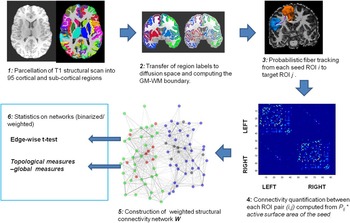
Cortical parcellation and sub-cortical segmentation of each subject was obtained by applying Freesurfer’s spherical registration to the T1 structural volume (Fischl, Sereno, & Dale, Reference Fischl, Sereno and Dale1999). A total of 95 ROIs were extracted to represent the nodes of the structural network, comprising 68 cortical regions and 27 sub-cortical structures from the Desikan atlas (Desikan et al., Reference Desikan, Segonne, Fischl, Quinn, Dickerson, Blacker and Killiany2006) supplied via Freesurfer. The seed regions were limited to the grey matter–white matter boundary of each ROI for reliable tracking. These regions were then transferred to the diffusion space via an intra-subject affine co-registration between T1 and fractional anisotropy (FA) volumes.
Whole brain probabilistic tractography was performed on the diffusion weighted images (DWI) using the FSL’s Diffusion Toolbox (Behrens et al., Reference Behrens, Woolrich, Jenkinson, Johansen-Berg, Nunes, Clare and Smith2003). For this, in the first stage a Markov Chain Monte Carlo sampling was used to construct voxel-wise distributions on principal diffusion directions. Probabilistic fiber tracking was then run from each seed region to every other ROI, by repeatedly sampling from the diffusion distributions at each seed voxel, calculating the streamline each sample follows and then using the results to create a distribution of possible tracks weighted by their probability (Behrens et al., Reference Behrens, Woolrich, Jenkinson, Johansen-Berg, Nunes, Clare and Smith2003). We used the default parameters of 5000 sample streamlines per voxel. Subsequently, we compute a 95×95 matrix p of probability values, where P
ij
represents a scaled conditional probability of a pathway between regions i and j. While several connectivity measures have been used in previous studies (Bassett et al., Reference Bassett, Bullmore, Verchinski, Mattay, Weinberger and Meyer-Lindenberg2008; Gong, He, et al., Reference Gong, He, Concha, Lebel, Gross, Evans and Beaulieu2009; Hagmann et al., Reference Hagmann, Sporns, Madan, Cammoun, Pienaar, Wedeen and Grant2010), we used a scaled conditional probability P
ij
between the seed ROI, i, and the target ROI, j, given by
 $$P_{{ij}} ={{S_{{i\to j}} } \over {S_{i} }} R_{i} $$
, where S
i→j
denotes the number of fibers reaching the target region j from the seed region i while S
i
is the number of streamlines seeded in i. We scale this ratio by the surface area R
i
of the ROI i that accounts for different sizes of the seed region. This measure quantifies connectivity such that P
ij
≈ P
ji
, which on averaging gives an undirected weighted connectivity measure. The resulting P
ij
measures are contained in a 95×95 undirected symmetric weighted connectivity network, W called the Structural Connectome. Figure 1 gives a schematic for the pipeline.
Overview of data pre-processing and structural connectome construction.

Connectivity (Edge-wise) Analysis
In comparing general connectivity between groups—here, controls, and TBI—we look for significant differences in W. Each connection weight P ij was linearly regressed on group, age and gender, considering recent evidence on age- and gender-related differences in network topology (Gong, Rosa-Neto, et al., Reference Gong, Rosa-Neto, Carbonell, Chen, He and Evans2009). The resulting group T-statistic was used to construct the output T matrix (95×95). This T was then thresholded at positive and negative values (t=±3.5) to define connections that are significantly stronger in either group (corresponding to p<.001, uncorrected for multiple comparisons). A positive T ij indicates higher connectivity in the controls while negative indicates higher in TBI subjects.
Calculating Network Properties
The structural network is analyzed at several levels of granularity. Earlier studies have associated structural networks with brain function at the whole-brain level. Therefore, examining macroscopic network attributes is an important first step in analysis. Here we focus on shortest path length, modularity, and transitivity at a global level (Rubinov & Sporns, Reference Rubinov and Sporns2010).
Shortest path length
Quantifies the number of edges that are required for a node to reach another node. This measure indicates how well the regions communicate with each other, with shorter paths indicating a higher efficiency.
Modularity
Modularity reflects how well the network can be delineated into groups (or communities), as defined via spectral clustering. This approach divides the network so as to maximize the number of intra-group edges and minimize inter-group edges. A modularity measure is then calculated from the community structure, based on the proportion of links connecting nodes in different groups. The weighted modularity of a network is defined as follows:
 $$M={1 \over l}\mathop \sum\limits_{i,j\in N} \left[ {w_{{ij}} {\minus}{{k_{i} k_{j} } \over z}} \right]$$
where w ij is the weight of the edge connecting nodes i and j, k i is the sum of i’s edge weights, and z is the sum of all edge weights in the network.
Transitivity
The transitivity of a network quantifies the proportion of fully connected triangles, that is, nodes whose neighbors are also immediate neighbors of each other. It is defined as:
 $$T={{\sum_{i\in N} 2t_{i} } \over {\sum_{i\in N} k_{i} (k_{i} {\minus}1)}}$$
where t i is the weighted geometric mean of the triangles around node i. A high t i means that a node’s neighbors are also likely to be neighbors of each other, and a high network transitivity value may indicate increased local connectivity.
Density
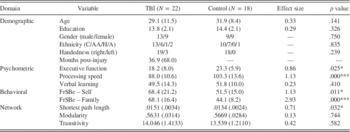
It is defined as the percentage of connections present related to a fully connected connectome. Density was not different between groups (effect size 0.43; p-value .14).
Statistics
The group differences between healthy controls and participants with TBI in age, years of education, and scores from cognitive and behavioral measures were tested with Mann-Whitney U tests. The group differences in gender, ethnicity, and handedness were tested with Fisher’s exact tests. Considering recent evidence that age and gender affect network topology (Gong, Rosa-Neto, et al., Reference Gong, Rosa-Neto, Carbonell, Chen, He and Evans2009), the differences between the two groups in terms of network metrics were tested using a rank analysis of covariance (Quade, Reference Quade1967) with age and gender as covariates. Correlations of network parameters with behavioral measures were conducted using Spearman’s rho within each group. The main reason for not combining the two groups was to avoid spurious correlations that may appear in aggregate data (e.g., Simpson’s paradox; Simpson, Reference Simpson1951). Given that there were group differences in many neuropsychological and imaging measures, this precaution was warranted. Another reason is that the mechanisms underlying those correlations may be different between the two groups. For example, in theory, correlations in the control group can be driven only by the mechanisms present in the general population while correlations found in patient group might also be driven by injury-specific mechanisms. Small sample size prevented us from conducting a direct statistical comparison of the correlations in the two groups. Considering the small sample size, the exploratory nature of this study, and the risk of Type II error, an alpha level of .05 was applied to these analyses without multiple comparison correction.
Results
Participant Characteristics
Twenty-two participants with TBI and 18 uninjured control participants were included in the final analysis (see Methods). Table 1 summarizes selected demographic, clinical, cognitive, and behavioral variables with group difference test results. The two groups did not differ in terms of age, gender, years of education, handedness, or ethnicity.
Demographic, psychometric, behavioral, and network characteristics of study participants

Note. Mean and standard deviation, in parenthesis, are reported with corresponding p values from tests of group difference. See the Methods section for detailed explanation about tests used for each domain. Effect sizes are defined by Morris and DeShon (Morris & DeShon, Reference Morris and DeShon2002).
*p<.05.
***p<.005.
C=Caucasian; AA=African American; H=Hispanic; A=Asian; FrSBe=Frontal Systems Behavior Scale.
Group Differences in Cognitive and Behavioral Measures
As shown in Table 1, there were differences between the two groups in executive function and processing speed. The participants with TBI performed significantly worse in both domains, with large effect size of TBI. Between-group differences in verbal learning did not reach significance. Table 1 also shows that there were significant group differences in both self- and family-reported FrSBe total scores, indicating more frequent symptoms in persons with TBI, with large effect sizes.
Group Differences in Local and Global Connectivity Measures
Table 2 reports the connections where connection-wise analysis revealed reduced connectivity in TBI compared to controls. Most connections found to be impaired in TBI originated from subcortical nodes. No connections were found where controls have reduced connectivity compared to TBI. In terms of global network metrics, those with TBI displayed significantly increased shortest path length measure (effect size=.71; p=.032), indicating reduced network efficiency (see Table 1). The two groups did not differ in modularity and transitivity.
Connections where people with TBI showed reduced connectivity compared to uninjured controls

Relationship between Global Network Metrics and Cognitive Performance
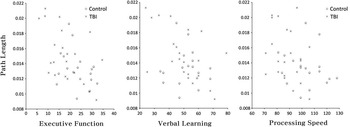
To determine whether altered network topology is associated with cognitive impairment, nonparametric correlations between network metrics and cognitive measures in participants with TBI were calculated and reported in Table 3. The same relationship was examined in the uninjured controls and reported in the same table. In people with TBI, shortest path length was negatively correlated with executive function (rho=−.502; p=.017) and verbal learning (rho=−.573; p=.005), indicating that increased path length (i.e., reduced efficiency) is associated with poorer performance.
Correlation between cognitive performance and network parameters

Note. Nonparametric correlation coefficients (Spearman’s rho) and corresponding p values, in parenthesis, are reported.
*p<.05.
**p<.01.
Relationship between Global Network Metrics and Behavioral Measures
Table 4 reports nonparametric correlations between network metrics and behavioral scores in participants with TBI and controls. In people with TBI, shortest path length was correlated with FrSBe – Family total scores (rho=.512; p=.025), indicating that reduced network efficiency in TBI is associated with impaired ‘frontal’ behavior observed by a family member.
Correlation between real-world behavioral measures and network parameters

Note. Nonparametric correlation coefficients (Spearman’s rho) and corresponding p values, in parenthesis, are reported.
*p<.05.
Discussion
The purpose of the present study was to conduct graph theoretical analysis of DTI based structural connectome and relate network parameters to cognitive dysfunction as well as real-world behavioral impairment in people with chronic diffuse TBI. The main findings and their implications are discussed in the following.
Our first major finding is that reduced network efficiency, measured by the shortest path length metric, was correlated with performance in both executive function and verbal learning. Our results corroborated recent findings by Caeyenberghs and colleagues (Reference Caeyenberghs, Leemans, Leunissen, Gooijers, Michiels, Sunaert and Swinnen2014) (i.e., correlation between network efficiency and executive function) using a different set of executive function tests. However, our finding of a robust association between verbal learning and shortest path length (the correlation remained significant even in a subgroup analysis with smaller N; see On-line Supplementary Table 2) expands their results and suggests that altered structural connectivity may underlie deficits in multiple cognitive domains. It is interesting that processing speed, for which participants with TBI showed the most impaired performance, was not correlated with shortest path length. Considering a decent spread of processing speed scores (shown in Figure 2), it is unlikely that the lack of correlation is due to a limited range of scores. Instead, this result suggests that the global network inefficiency metric might be most relevant to higher-level cognition such as executive function and memory retrieval, rather than processing speed. It is also worth mentioning that we could not find significant relationships between network metrics and cognitive measures in uninjured controls. This may indicate that the significant relationship observed in people with TBI is not common in the general population, but reflect injury-specific mechanisms. However, given the small sample size of controls and lack of direct statistical testing between the two correlations, a larger study is warranted to further explore this issue.
Scatter plots showing the relationship between cognitive measures and the shortest path length metric.

Another important contribution of the current study is the finding that DTI based structural connectome is related to real-world behavioral impairment observed in TBI, as measured by the FrSBe. Our findings provide the first piece of evidence on the notion that altered structural connectivity measured by complex network topology metrics may be the neural correlate of real-life frontal dysexecutive behavior observed in people with TBI. Given the dearth of research on ecological validity of neuroimaging indices including network metrics, we hope the current study will inspire future efforts in this topic. Although it was not an aim of this study to compare self- with proxy ratings, inspection of Table 1 suggests that our participants with TBI were, on average, in close agreement with family members on the magnitude of their frontal/ executive impairment in daily life (rho=.608; p<.001). It would also be of interest to study the metrics used in this investigation in a sample of persons with TBI who were less aware of these deficits.
The fact that shortest path length was significantly longer in people with TBI as compared to controls means brains affected with TBI take increased number of edges (or steps/jumps in layman’s terms) to connect one node to another, causing inefficient global network integration. Participants with TBI as a group did not show alterations in transitivity, which suggests that diffuse TBI might not seriously affect local clustering. Increased path length on DTI based structural connectome in individuals with TBI was recently reported by Caeyenberghs and colleagues (Reference Caeyenberghs, Leemans, Leunissen, Gooijers, Michiels, Sunaert and Swinnen2014). Studies by Cao and Slobounov (Reference Cao and Slobounov2010) and Pandit and colleagues (Reference Pandit, Expert, Lambiotte, Bonnelle, Leech, Turkheimer and Sharp2013) reported similar results using electroencephalogram and resting state fMRI, respectively. However, there are other network analysis studies that found increased functional connectivity in TBI as shown by increased connection strength and decreased shortest path length (Castellanos et al., Reference Castellanos, Leyva, Buldu, Bajo, Paul, Cuesta and del-Pozo2011; Nakamura et al., Reference Nakamura, Hillary and Biswal2009). Because these functional connectivity studies differ in many dimensions including imaging modality (e.g., fMRI, magnetoencephalography, etc.) and patient characteristics (e.g., chronicity, severity, presence of sizable focal lesions, etc.), it is difficult to explain the discrepancies. Furthermore, a recent study did not find a significant relationship between structural and functional dysconnectivity in TBI (Caeyenberghs, Leemans, Leunissen, Michiels, & Swinnen, Reference Caeyenberghs, Leemans, Leunissen, Michiels and Swinnen2013). More studies examining both structural and functional network connectivity in this population may shed light on a better understanding of the nature of altered connectivity caused by diffuse TBI. In addition, more research is needed to properly interpret the relationship between altered network metrics and cognition/behavior. Currently there is little empirical evidence to support plausible mechanistic (or neuroanatomic) hypotheses linking network metrics to behavior (e.g., long-distance fiber tracts are disproportionately damaged in TBI) and such linkages should be the focus of future investigations (cf. Bullmore & Sporns, Reference Bullmore and Sporns2009; Sharp, Scott, & Leech, Reference Sharp, Scott and Leech2014).
Our last finding is that the strength of connections between many brain regions, measured by edge-wise connectivity analysis, was reduced in people with chronic TBI. In particular, connections arising from subcortical areas were most affected. This finding is nicely in line with previous neuropathologic, morphometric, and simulation studies that reported vulnerability of deep gray matter structures such as thalamus in TBI (Graham, Maxwell, Adams, & Jennett, Reference Graham, Maxwell, Adams and Jennett2005; Kim et al., Reference Kim, Avants, Patel, Whyte, Coslett, Pluta and Gee2008; Mendez, Hurley, Lassonde, Zhang, & Taber, Reference Mendez, Hurley, Lassonde, Zhang and Taber2005). The two cortical areas reported in Table 2—that is, posterior cingulate and superior temporal cortices—are also among the significantly affected areas by TBI in terms of atrophy and functional dysconnectivity (Kim et al., Reference Kim, Avants, Patel, Whyte, Coslett, Pluta and Gee2008; Pandit et al., Reference Pandit, Expert, Lambiotte, Bonnelle, Leech, Turkheimer and Sharp2013).
Because our sample was tested at variable intervals after TBI, it is worth considering time post-injury as a potential confounding factor. Although our sample is in the chronic phase where imaging indices are likely to change more slowly than during the acute phase (cf. Blatter et al., Reference Blatter, Bigler, Gale, Johnson, Anderson, Burnett and Bailey1997), there is emerging evidence that the process of white matter integrity loss can extend well into the chronic phase (e.g., Adnan et al., Reference Adnan, Crawley, Mikulis, Moscovitch, Colella and Green2013). To examine whether time post-injury could confound our main results regarding the relationship between network metrics and neuropsychological function, we conducted post hoc correlations between time post-injury and the four main dependent variables that produced significant results (i.e., executive function, verbal learning, shortest path length, and family-reported FrSBe). None of these variables showed significant correlations with time post-injury (Spearman’s rho ranged from .02 to .30 and associated p-values from .93 to .17). Another potential confounding factor is participants’ involvement in rehabilitation treatment. At present, however, there is no agreed-upon method for quantifying or defining rehabilitation treatment, which makes use of treatment data as a covariate infeasible. Moreover, if variations in treatment moderated the relationship between neuroimaging metrics and behavior, we would expect this to erode the strength of the reported relationships, not to inflate them.
A chief limitation of the present study is the use of a relatively small convenience sample, whose representativeness of the TBI population as a whole is unknown. Another limitation is the previously noted loss of acute TBI severity information for six participants. We repeated our main analyses after excluding these six subjects. As Supplementary Tables 2 and 3 demonstrate, the pattern of results remained similar.
Other limitations relate to the methodology used and the interpretation of structural connectivity based on DTI tractography. We defined connection strength between two areas using the number of reconstructed streamlines from probabilistic fiber tractography. However, one should keep in mind that these are not actual physiological measures, but abstract models of white matter tracts, the validity of which is dependent on the imaging sequence and analysis algorithm. In addition, signal inhomogeneity effects caused by micro-vascular shear or bleeds can affect diffusion signals. Although we excluded patients with macroscopic focal signal abnormalities for this reason, future research should address how to deal with smaller hemorrhages when calculating DTI metrics.
In conclusion, the current study demonstrated that reduced network efficiency measured by graph theoretical analysis of DTI based structural connectome is associated with high-level cognitive dysfunction such as executive function and verbal learning, as well as real-world behavioral impairment in chronic survivors of diffuse TBI.
Acknowledgments
The authors declare no competing financial interests. This work was funded by a grant with the Pennsylvania Department of Health (PI: J.W.). The department specifically disclaims responsibility for any analyses, interpretations, or conclusions. Part of the funding also came from grant 5R01NS065980-02 (PI: J.K.) from the NINDS, NIH and 1R01MH092862 (PI: R.V.) from the NIMH, NIH. The authors thank John Slattery, Grayce Selig, and Tincy Philip for their assistance in data collection and analysis.
Supplementary material
To view supplementary material for this article, please visit http://dx.doi.org/10.1017/S1355617714000812