Introduction
Rice is an important staple food crop for more than half of the world's population. Rice productivity has to be improved enormously to meet the demands of growing population. Rice farmers in flood-prone ecosystem are more vulnerable to changing climatic conditions and constitute about 7% of global rice area (Yang et al., Reference Yang, Wu, Chen, Lai, Yen and Yang2017). Enhancing rice productivity in marginal environments is essential to improve the livelihood of the farming community (Panda and Barik, Reference Panda and Barik2021). Rice crop suffers four major types of floods from seed germination to harvesting stage: (a) anaerobic germination, where submergence happens during germination, (b) flash floods where plants are completely submerged for 2 weeks, (c) stagnant flooding (SF) with up to 30–50 cm deep water due to prolonged floods and (d) deep water ecology with water depth more than 50 cm for most of time (Mackill et al., Reference Mackill, Ismail, Pamplona, Sanchez, Carandang and Septiningsih2010). Submergence up to 50% plant height at any growth stage leads to reduction of rice yield by at least 25% (Swain et al., Reference Swain, Herath, Pathirana and Mittra2005) and yield loss up to 47% under SF (Kato et al., Reference Kato, Collard, Septiningsih and Ismail2014). Two major adaptive mechanisms for flood tolerance are quiescence and escape.
Anaerobic germination is prerequisite not only for rice cultivation under direct seeded condition but also required for survival of crop at nursery stage in flood-prone lowland areas during monsoon. Multiple QTLs for anaerobic germination qAG-1, qAG-2, qAG-7, qAG-5a and qAG-5b (Ling et al., Reference Ling, Ming-yu, Ming and Jian-min2004), qAG-1, qAG-2-1, qAG-11 and qAG-12 from KHAIYAN (Angaji, Reference Angaji2008), qAG-1-2, qAG-3-1, qAG-7-2, qAG-9-1, qAG-9-2 using Khao Hlan (Angaji et al., Reference Angaji, Septiningsih, Mackill and Ismail2010), a large QTL on chromosome 7 from Mazhan Red (Septiningsih et al., Reference Septiningsih, Ignacio, Sendon, Sanchez, Ismail and Mackill2013) and qAG7 from Nanhi (Baltazar et al., Reference Baltazar, Ignacio, Thomson, Ismail and Septiningsih2014) were identified. One major QTL on AG1 was incorporated in Chierangsub1 (Toledo et al., Reference Toledo, Ignacio, Casal, Gonzaga, Mendioro and Septiningsih2015).
Flash flood tolerance conferring Sub1A, an ethylene-responsive factor gene, was identified from FR 13 A (Xu et al., Reference Xu, Xia, Fukao, Canlas, Maghirang-Rodriguez, Heuer, Ismail, Bailey-Serres, Ronald and Mackill2006). This Sub1A gene was widely exploited by incorporating it into popular rice varieties globally (Neeraja et al., Reference Neeraja, Maghirang Rodriguez, Pamplona, Heuer, Collard, Septiningsih, Vergara, Sanchez, Xu, Ismail and Mackill2007; Septiningsih et al., Reference Septiningsih, Pamplona, Sanchez, Neeraja, Vergara, Heuer, Ismail and Mackill2009, Reference Septiningsih, Hidayatun, Sanchez, Nugraha, Carandang, Pamplona, Collard, Ismail and Mackill2014; Khanh et al., Reference Khanh, Linh, Linh, Ham and Xuan2013; Nawarathna et al., Reference Nawarathna, Perera and Samarasinghe2014; Ara et al., Reference Ara, Uddin, Iftekharuddaula, Saikat and Khan2015; Girijarani et al., Reference Girijarani, Satyanarayana, Suryanarayana, Ramanarao, Neerajakshi, Chamundeswari, Ravikumar, Pavani, Kondayya, Ratnasree, Vishnuvardhan, Sivaramprasad and Reddy2015; Iftekharuddaula et al., Reference Iftekharuddaula, Ahmed, Ghosal, Moni, Amin and Ali2015, Reference Iftekharuddaula, Ahmed, Ghosal, Amin, Moni, Bisnu, Hirendra, Siddiquea, Collard and Septiningsih2016; Singh et al., Reference Singh, Singh, Xalaxo, Verulkar, Yadav, Singh, Singh, Prasad, Kondayya, Ramana Rao, Girija Rani, Anuradha, Suraynarayana, Sharma, Krishnamurthy, Sharma, Dwivedi, Singh, Singh, Nilanjay, Singh, Kumar, Chetiah, Ahmad, Rai, Perraju, Anita, Singh, Mandal, Reddy, Singh, Katara, Marandi, Swain, Sarkar, Singh, Mohapatra, Padmawathi, Ram, Kathiresan, Paramsivam, Nadarajan, Thirumeni, Nagarajan, Singh, Vikram, Kumar, Septiningshih, Singh, Ismail, Mackill and Singh2016; Ahmed et al., Reference Ahmed, Rafii, Ismail, Abdul, Rahim, Tanweer and Latif2016; Korinsak et al., Reference Korinsak, Siangliw, Kotcharerk, Jirapong, Jonaliza, Boonrat, Grienggrai, Nitat and Theerayut2016; Aditi et al., Reference Aditi, Pawan, Neera, Renu, Yashi, Balwant, Nisha, Sangeeta, Amitha, Vandna, Satish, Ramana Rao, Girija Rani, Anuradha, Satyanarayana, Krishnamurthy, Prabodh, Deepika Singh, Nilanjay, Kumar, Sanjay, Ahmad, Mayank, Jawahar, Marandi, Padmini, Sarkar, Singh, Reddy, Nimai, Paramsivam, Nadarajan, Thirumeni, Jyothi, Padmavathi, Ram and Singh2019). Three non-Sub1 QTLs were identified from IR 72 (Septiningsih et al., Reference Septiningsih, Sanchez, Singh, Sendon, Pamplona, Heuer and Mackill2012), three from FR 13A on chromosomes 1, 8 and 10 (Gonzaga et al., Reference Gonzaga, Carandang, Sanchez, Mackill and Septiningsih2016) and a major QTL for submergence qSUB8.1 from Ciherang Sub1 (Gonzaga et al., Reference Gonzaga, Carandang, Anshuman, Collard, Thomson and Septiningsih2017).
Most of the Sub1 incorporated lines are vulnerable to survive under SF (Sarkar and Bhattacharjee, Reference Sarkar and Bhattacharjee2011; Sandhya Rani et al., Reference Sandhya Rani, Kutubuddin, Chattopadhyay, Sarkar and Pravat Kumar2019). Survival per cent and yield under SF are dependent on moderate elongation, high tillering, lesser carbohydrate depletion and higher fertility (Vergara et al., Reference Vergara, Nugraha, Esguerra, Mackill and Ismail2014). QTLs for grain yield under SF, along with days to flowering, flag leaf length and leaf sheath length, were detected by Singh et al. (Reference Singh, Carandang, Gonzaga, Collard, Ismail and Septiningsih2017a, Reference Singh, Septiningsih, Balyan, Singh and Rai2017b). Existence of compensatory mechanisms between tiller growth and shoot elongation under SF results in poor yields in addition to lodging risk (Zhu et al., Reference Zhu, Chen, Ella and Ismail2018). Land races tolerating flash floods and SF were assessed for genetic diversity (Barik et al., Reference Barik, Kumar, Lenka and Panda2020). Genetic resources like AC37887 and AC39416A that can tolerate anaerobic germination and SF were identified by Sandhya et al. (Reference Sandhya, Kuanar, Ray, Sethi, Chattopadhyay and Sarkar2017).
Submergence-tolerant varieties with the Sub1 gene do not usually possess traits for anaerobic germination and SF indicating that the genes governing these traits are independent to Sub1. QTL mapping and candidate gene discovery from new genetic resources that have excellent adaptation to different kinds of flooding is very important for breeding climate-resilient flood-tolerant rice varieties (Singh et al., Reference Singh, Carandang, Gonzaga, Collard, Ismail and Septiningsih2017a, Reference Singh, Septiningsih, Balyan, Singh and Rai2017b).
The present study is designed to identify QTLs for flood tolerance using 184 recombinant inbred lines (RILs) developed using Indra (MTU 1061) as female parent and new genetic resource AC 39416A for anaerobic germination and SF.
Materials and methods
Development of RILs
Indra (MTU 1061), a high yielding popular rice variety, was developed by crossing PLA 1100 and MTU 1010 and was released in 2006 by Regional Agricultural Research Station (RARS), Maruteru of Acharya NG Ranga Agricultural University (ANGRAU). Indra variety that is tolerant to flash floods for 1 week and susceptible to anaerobic germination and SF (Girijarani et al., Reference Girijarani, Suryanarayana, Satyanarayana, Ramana Rao, Prasad, Neerajakshi, Chamundeswari and Ravikumar2013; Reddy et al., Reference Reddy, Girija Rani, Satyanarayana, Suryanarayana, Chamundeswari, Ravi Kumar, Ramana Rao and Vishnuvardhan2015) was used as female parent. New genetic resource AC39416A collected from National Rice Research Institute (NRRI), Cuttack was used as donor. AC39416A can tolerate 3 weeks of anaerobic germination and SF (Sandhya et al., Reference Sandhya, Kuanar, Ray, Sethi, Chattopadhyay and Sarkar2017). Cross was initiated during wet season of 2013 and 4000 plants were obtained in F2 generation. One hundred eighty-four single plants from F2 population were randomly selected and advanced up to F6 generation by single seed descent method at RARS, Maruteru during 2014–2016.
Genotyping of RILs
Genomic DNA was isolated using the method of Zheng et al. (Reference Zheng, Subudhi, Domingo, Magantay and Huang1995). Quality and quantity were estimated using eight channel vis spectrophotometer (Thermo scientific, USA). Polymerase chain reaction mixture of 10 μl comprising of 10 × Taq buffer A 1 μl, forward and reverse primer each 1 μl (Sigma aldirch), 2.5 mm dntp 0.5 μl (Genei), one unit of Taq DNA polymerase 1 μl (Genei), 25 ng of genomic DNA 3 μl and sterile distilled water 2.5 μl was used for amplification. Thermo profile of initial denaturation at 94°C for 5 min followed by 35 cycles of denaturing at 94°C for 30 s, annealing at 55°C for 0.5 min, extension at 72°C for 1.0 min and ending up with 7 min at 72°C for the final extension was adopted using Pro S master cycler (Eppendorf). Electrophoresis was carried out on 3% agarose gels and images were visualized using Syngene gel documentation system.
Out of 624 markers screened for parental polymorphism between Indra and AC 39416 A at RARS, Maruteru, 104 polymorphic simple sequence repeats markers were used to genotype 184 RILs. Saturated fine mapping was performed using more markers within the identified QTL regions. Five polymorphic markers were identified between RM15848 and RM15561 for qAG3.1 and six for qSF10.1 between RM 304 and RM 6100 for fine mapping. Gel images were scored as A for Indra allele, B for AC 39416A allele and H for heterozygote. QTL mapping was performed using QCIM software with 1000 permutations as per Wang et al. (Reference Wang, Li, Zhang and Meng2016).
Phenotyping of RILs
Anaerobic germination (AG)
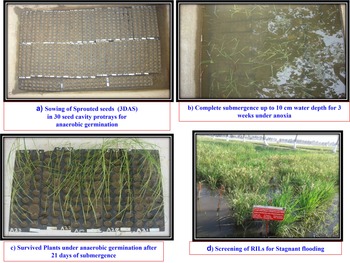
For each RIL, 30 pre germinated seeds were sowed on third day in pro trays. These trays were submerged in a concrete tank by maintaining 10 cm deep for 3 weeks during 2016 and 2017 (Fig. 1(a)–(c)). Survived plants after 21 days were counted for anaerobic germination.
Phenotypic screening of RILs for anaerobic germination and SF.

Stagnant flooding (SF)
Thirty-day-old seedlings of RILs were transplanted in submergence pond with a spacing of 20 cm between rows and 15 cm between plants with 25 hills per row. Water depth of 30–50 cm was maintained from 1 week after transplanting to reproductive phase during 2017 and 2018 (Fig. 1(d)). Survived plants were counted at 30 days after transplanting. Plant survival % was calculated as number of (plants survived/total number of plants) × 100.
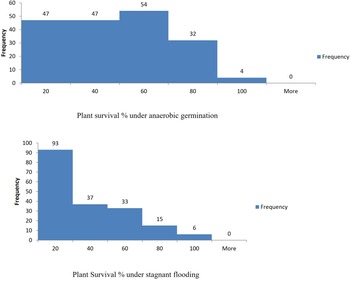
Frequency distribution of 184 RILs for plant survival % under anaerobic germination and SF.

Results
Plant survival % for anaerobic germination shows a wide variation (0–90%) even under SF (0–100%) (Table 1). Majority of RILs have an anaerobic germination per cent ranging between 40 and 60% with a mean of 43.32. Similarly, plant survival under SF is on the lower end of distribution with a mean of 26.93% (Fig. 2). Only four RILs for anaerobic germination and six RILs under SF show maximum plant survival %, with a range between 81 and 100%. Only one RIL has a maximum performance with about 70% plant survival rate under AG and 100% under SF. Parent AC 39416 A has a higher plant survival rate of 88.80% under anaerobic condition and 78.69% under SF than the check Swarnasub1 (34.30% AG, 20.20% SF) and female parent Indra (10% AG, 16.67% SF).
QTL for Anaerobic germination qAG 3.1on Chromosome 3.

Summary of anaerobic germination and plant survival % under stagnant flooding among RILs

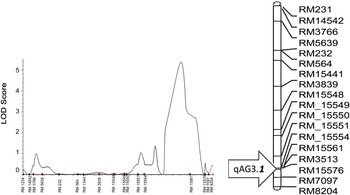
Results of QTL mapping revealed that QTLs for anaerobic germination qAG3.1 were found on chromosome 3 between RM 15848 (24.68 Mbp) and RM 15561 (24.82 Mbp) with a LOD score of 2.89. The phenotypic variation explained is about 7.16% with an additive effect of 4.48 (Table 2). Fine mapping of qAG 3.1 resulted in identification of a major QTL with LOD score of 5.36 that explains a phenotypic variance of 59.08%. This QTL is between RM 15554 (24.72 Mbp) and RM 15561 (24.82 Mbp) (Fig. 3). The identified QTL qAG3.1 was also validated in another population consisting of BC1F1 lines of Swarnasub1 and AC 39416 A that was developed under NICRA project during 2018.
Identified QTLs for flood tolerance using RILs of AC39416A

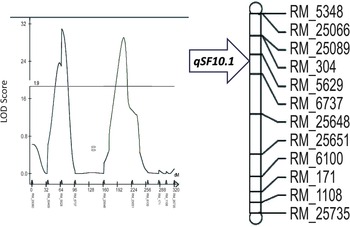
QTL for plant survival % under SF qSF10.1 was detected on chromosome 10 with a LOD score of 5.66, a phenotypic variance of 13.21% and an additive effect of 10.79. The identified QTL for SF qSF10.1 was validated in the year 2018 by screening RILs under SF with a LOD score of 3.10, phenotypic variance of 7.56 and an additive effect of 7.71 between RM 304 (18.65 Mbp) and RM 6737 (18.71 Mbp) represented in Fig. 4 and Table 2.
QTL qSF10.1 for plant survival % under stagnant flooding.

Rice gene annotation (http://rice.plantbiology.msu.edu/) revealed LOC_Os03g42130 gibberellin 20 oxidase2 and LOC_Os03g44170 glutathione S-transferase as putative candidate gene loci that might be responsible for anaerobic germination in our identified QTL qAG 3.1 genomic region on chromosome 3. The genomic region of QTL for plant survival %, qSF10.1 revealed LOC_Os10g35020 glycosyltransferase and LOC_Os10g35050 aquaporin proteins as putative candidate genes that play a role for plant survival % under SF.
Discussion
Variation in RILs for anaerobic germination and plant survival % under SF indicated that expression of alleles for different types of floods is different and it depends on plant adaptive mechanism in response to stress signalling. Rice plant coleoptile has to grow faster under anoxia for germination and show moderate elongation under SF. In the present study too, only one RIL was detected as tolerant for both situations and AC39416A has significantly higher plant survival % than Swarnasub1 and Indra. Rumanti et al. (Reference Rumanti, Sitaresmi and Nugraha2022) and Agbeleye et al. (Reference Agbeleye, Olubiyi, Ehirim, Shittu, Jolayemi, Adetimirin, Ariyo, Sanni and Venuprasad2019) also found significant variation in plant survival % for both AG and SF and identified different tolerant accessions for each.
QTLs for anaerobic germination qAG 3.1 on chromosome 3 and qSF10.1 for plant survival % under SF on chromosome 10 were detected using RILs of Indra and AC 39416A. This indicated that alleles contributing to different types of floods are present in AC39416A.
Angaji et al. (Reference Angaji, Septiningsih, Mackill and Ismail2010) also reported QTL for anaerobic germination qAG 3 between RM 7094 (26.87 Mbp) and RM 520 (30.91 Mbp) on chromosome 3 using Khao Hlan On as donor, RILs of Nampyeong/PBR cross (Jeong et al., Reference Jeong, Cho and Jeong2020), F2:3 population of Nanhi/IR64 (Baltazar et al., Reference Baltazar, Ignacio, Thomson, Ismail and Septiningsih2014) and IR64/Kharsu 80A (Baltazar et al., Reference Baltazar, Ignacio, Thomson, Ismail, Mendioro and Septiningsih2019). The above results support the idea that QTL qAG3.1 possesses genes that trigger signals for anaerobic germination from AC39416A.
Identified QTL for plant survival % under SF is in the vicinity of a reported QTL for plant survival on chromosome 10 between RM 222 (20.70 Mbp) and qSUB10.1 at RM25835 (21.31 Mb; Gonzaga et al., Reference Gonzaga, Carandang, Sanchez, Mackill and Septiningsih2016). QTLs for plant survial % (Toojinda et al., Reference Toojinda, Siangliw, Tragoonrung and Vanavichit2003) in F2 derived population of Jao Him Nin/KDML 105, grain weight and days to 50% flowering under SF were also identified on chromosome 10 in RILs of Ciherang-Sub1/IR10F365 (Singh et al., Reference Singh, Carandang, Gonzaga, Collard, Ismail and Septiningsih2017a, Reference Singh, Septiningsih, Balyan, Singh and Rai2017b) and Swarna/Rashpanjor (Chattopadhyay et al., Reference Chattopadhyay, Chakraborty, Samal and Sarkar2021).
LOC_Os03g42130 gibberellin 20 oxidase2, a putative gene locus, inhibits gibberellic acid biosynthesis under anoxia conditions. Production of α-amylase does not require gibberellic acid for germination under anaerobic conditions (Loreti et al., Reference Loreti, Yamaguchi, Alpi and Perata2003) and the amylase activity remained unchanged under anaerobic germination in AC39416A and FR 13A (Sweetaleena et al., Reference Sweetaleena, Sandhay Rani and Sarkar2019). LOC_Os03g44170 glutathione S-transferase, a putative candidate gene locus, might also play a role in crosstalk between submergence tolerance during germination (Thapa et al., Reference Thapa, Tabien, Thomson and Septiningsih2022) and hormone response pathways (Jain et al., Reference Jain, Ghanashyam and Annapurna2010), and also protects the plants from oxidative stress under anoxia conditions (Kumar and Trivedi, Reference Kumar and Trivedi2018).
Results of gene prediction between RM 304 (18.650 Mbp) and RM 6737 (18.71 Mbp) revealed putative candidate gene LOC_Os10g35020 glycosyltransferase and LOC_Os10g35050 aquaporin protein that might be responsible for plant survival % under SF. Glycosyltransferase plays a role in antioxidant defence mechanism under flooding (Sanhezz-Bermudez et al., Reference Sanhez-Bermudez, del Pozo and Pernas2022) and submergence tolerance on chromosome 10 (Qi et al., Reference Qi, Kawano, Yamauchi, Ling, Li and Tanaka2005) by expression of genes with response to ethylene and gibberellin. LOC_Os10g35050 aquaporin protein putative candidate genes also play a role in adaptive mechanism for plant survival % under SF. Partial to prolonged SF might have triggered protein accumulation of aquaporins (Tyerman et al., Reference Tyerman, Niemietz and Bramley2002). Plant aquaporin not only play a role to facilitate osmotic water transport across membranes but also transports nutrients like urea (Gaspar et al., Reference Gaspar, Bousser, Sissoëff, Roche, Hoarau and Mahé2003), ammonia (Loque et al., Reference Loque, Ludewig, Yuan and Von Wirén2005) and CO2 (Hanba et al., Reference Hanba, Shibasaka, Hayashi, Hayakawa, Kasamo, Terashima and Katsuhara2004). The presence of glycosyltransferase loci might trigger hormone response pathways for plant survival % and aquaporin proteins loci might manifest the plant for nutrient uptake and gas diffusion for adaptation under SF.
Conclusion
In this study, identified QTLs qAG 3.1 for anaerobic germination for 21 days and qSF10.1 for plant survival % under SF from RILs generated by Indra/AC39416A can be further exploited for marker-assisted gene pyramiding using AC 39416A as donor for both anaerobic germination and SF. Studies on gene prediction revealed that AC39416 A adapts to anaerobic germination and SF by constitutive protein production in response to particular environmental signalling which has to be further traced out by advanced physiological and molecular studies.
Acknowledgements
We acknowledge the National Initiative for climatic resilience in Agriculture (NICRA) for providing funds under sponsored grant to carryout above research work at the Regional Agricultural Research Station, Maruteru of Acharya NG Ranga Agricultural University, Andhra Pradesh, India. We acknowledge Dr Sujan Mamidi for editing the manuscript.
Conflict of interest
None.