Introduction
Pain is a common symptom among community-dwelling persons with Alzheimer's disease (AD); previous studies report prevalences of 32–64% (Shega et al., Reference Shega, Hougham, Stocking, Cox-Hayley and Sachs2004; Hunt et al., Reference Hunt2015). The ability to understand and communicate pain may be diminished among these people; thus, pain may be presented in uncommon ways. Pain may aggravate behavioral and psychological symptoms of dementia (BPSD), such as anxiety, depression, and aggression (Corbett et al., Reference Corbett2012). Diminished ability to communicate pain and its uncommon symptoms is suspected to lead to improper diagnosis or inadequate treatment (Scherder et al., Reference Scherder, Herr, Pickering, Gibson, Benedetti and Lautenbacher2009; Corbett et al., Reference Corbett2012).
The first line of treatments for BPSD is non-pharmacological care interventions, followed by anti-dementia medication (Azermai et al., Reference Azermai2012). Frequently, however, BPSD are treated with antipsychotics and benzodiazepines and related drugs (BZDRs) (Taipale et al., Reference Taipale, Koponen, Tanskanen, Tolppanen, Tiihonen and Hartikainen2014; Saarelainen et al., Reference Saarelainen2015). Antipsychotic use has been associated with an increased risk of cerebrovascular events (Mittal et al., Reference Mittal, Kurup, Williamson, Muralee and Tampi2011), pneumonia (Tolppanen et al., Reference Tolppanen2016a), and mortality (Schneider et al., Reference Schneider, Dagerman and Insel2005). Similarly, BZDRs use is associated with a higher risk of hip fractures (Bakken et al., Reference Bakken, Engeland, Engesæter, Ranhoff, Hunskaar and Ruths2014) and pneumonia (Taipale et al., Reference Taipale2017) among older people. Clinical care guidelines recommend avoiding BZDR use among the cognitively impaired and emphasize careful monitoring and low initial doses when treating BPSD with antipsychotics (Azermai et al., Reference Azermai2012; American geriatrics society, 2015). However, pain among persons with dementia appears to correlate with increased use of antipsychotics, at least in nursing home patients (Rajkumar et al., Reference Rajkumar2017).
Some evidence exists that BPSD could be alleviated with analgesic use; intervention studies have reported mixed, yet overall positive results (Manfredi et al., Reference Manfredi, Breuer, Wallenstein, Stegmann, Bottomley and Libow2003; Chibnall et al., Reference Chibnall, Tait, Harman and Luebbert2005; Husebo et al., Reference Husebo, Ballard, Sandvik, Nilsen and Aarsland2011, Reference Husebo, Ballard, Cohen-Mansfield, Seifert and Aarsland2014a, Reference Husebo, Ballard, Fritze, Sandvik and Aarsland2014b). Theoretically, proper analgesia should also decrease the use of symptomatic pharmacotherapy. Only one previous study has investigated the impact of analgesics (acetaminophen) on the use of psychotropic drugs, finding no difference compared to placebo (Chibnall et al., Reference Chibnall, Tait, Harman and Luebbert2005). However, the study sample was small and done as a cross-over trial on nursing home patients with moderate-to-severe dementia. Population-based studies on this subject are lacking.
The aim of this study was to analyze the effect of opioid initiation on the prevalence of antipsychotic and BZDR use in non-experimental settings.
Methods
We conducted this research as a part of the Medication use and Alzheimer's disease (MEDALZ) study, which has been described previously (Tolppanen et al., Reference Tolppanen2016b). The cohort consists of all persons diagnosed with AD in Finland during 2005–2011 (n = 70,718), however, in this study we restricted the analyses to those diagnosed with AD in 2010 or 2011 (n = 24,747) due to inconsistent reimbursement of codeine combination products in the years before 2010. The MEDALZ cohort comprises data from nationwide registers, such as Prescription Register, Special Reimbursement Register, Hospital Discharge Register, and socioeconomic data from Statistics Finland. Persons with AD were identified from the Special Reimbursement Register, which comprises data on entitlement to special reimbursement of drugs for chronic illnesses and is maintained by the Social Insurance Institution (SII). Special reimbursement for AD requires diagnosis based on the NINCDS–ADRDA (McKhann et al., Reference McKhann, Drachman, Folstein, Katzman, Price and Stadlan1984) and DSM-IV (American Psychiatric Association, 1994) criteria. The criteria require a computed tomography or magnetic resonance imaging scan, and confirmation of the diagnosis by a neurologist or geriatrician. A certificate of the fulfillment is sent for evaluation to the SII, which then grants special reimbursement. People with AD keep receiving this reimbursement even with disease progression.
The Prescription Register includes information on all purchases of prescribed and reimbursed drugs from Finnish pharmacies. Over-the-counter (OTC) drugs or drugs used during stays in hospitals or public nursing homes are not recorded. However, opioids are only available with prescriptions and are reimbursed in Finland. The Hospital Discharge Register consists of data on all inpatient hospital days, including dates and discharge diagnoses utilizing International Classification of Diseases version 10 (ICD-10) codes. Data from the registers were de-identified before being submitted to the research team; thus, according to Finnish law, ethics committee approval is not a requirement.
Drugs in the Prescription Register were classified according to the WHO Anatomical Therapeutic Chemical (ATC) classification system (WHO Collaborating Center for Drug Statistics Methodology). Opioids were defined as N02A and antipsychotics as N05A, excluding lithium. Benzodiazepines and related drugs were defined as N05BA, N05CD, and N05CF. Drug use periods were modeled using a mathematical modeling method PRE2DUP, as described previously (Tanskanen et al., Reference Tanskanen2015; Taipale et al., Reference Taipale, Tanskanen, Koponen, Tolppanen, Tiihonen and Hartikainen2016). The method was utilized for constructing drug use periods, i.e. when continuous drug use started and ended, for each person and ATC code. The method is based on calculation of sliding averages of daily dose, according to individual purchasing behavior taking into account regularity of purchases, hospitalizations, and stockpiling. Date of the first drug purchase was considered to be the start of the drug use. The method has been validated previously for register-based drug use studies (Taipale et al., Reference Taipale, Tanskanen, Koponen, Tolppanen, Tiihonen and Hartikainen2016); it estimates actual drug use more precisely compared to previous methods.
The prevalence of antipsychotic and BZDR use in 30-day time periods before opioid initiation was compared with time periods after the initiation with interrupted time series analyses (Wagner et al., Reference Wagner, Soumerai, Zhang and Ross-Degnan2002; Vidal et al., Reference Vidal2008). Interrupted time series analysis is a powerful quasi-experimental design, which allows estimation of pre- and post-intervention trends and change in the level of outcome measure (i.e. antipsychotic or BZDR use) after the intervention (i.e. opioid initiation). It strengthens the before–after design by measuring the outcome repeatedly over the follow-up period both before and after the intervention. The method takes into account on existing changes in levels of the outcome measure, i.e. rising trend of antipsychotic use prevalence due to AD progression. Thus, the results show only the impact of the intervention and possibly other, yet simultaneous changes. Previously, the method has been most frequently utilized in health care research for the evaluation of policy changes (Wagner et al., Reference Wagner, Soumerai, Zhang and Ross-Degnan2002); however, it can and has been utilized in clinical and in medication use studies (Wagner et al., Reference Wagner, Soumerai, Zhang and Ross-Degnan2002; Matowe et al., Reference Matowe, Leister, Crivera and Korth-Bradley2003; Vidal et al., Reference Vidal2008; Hawley et al., Reference Hawley2016).
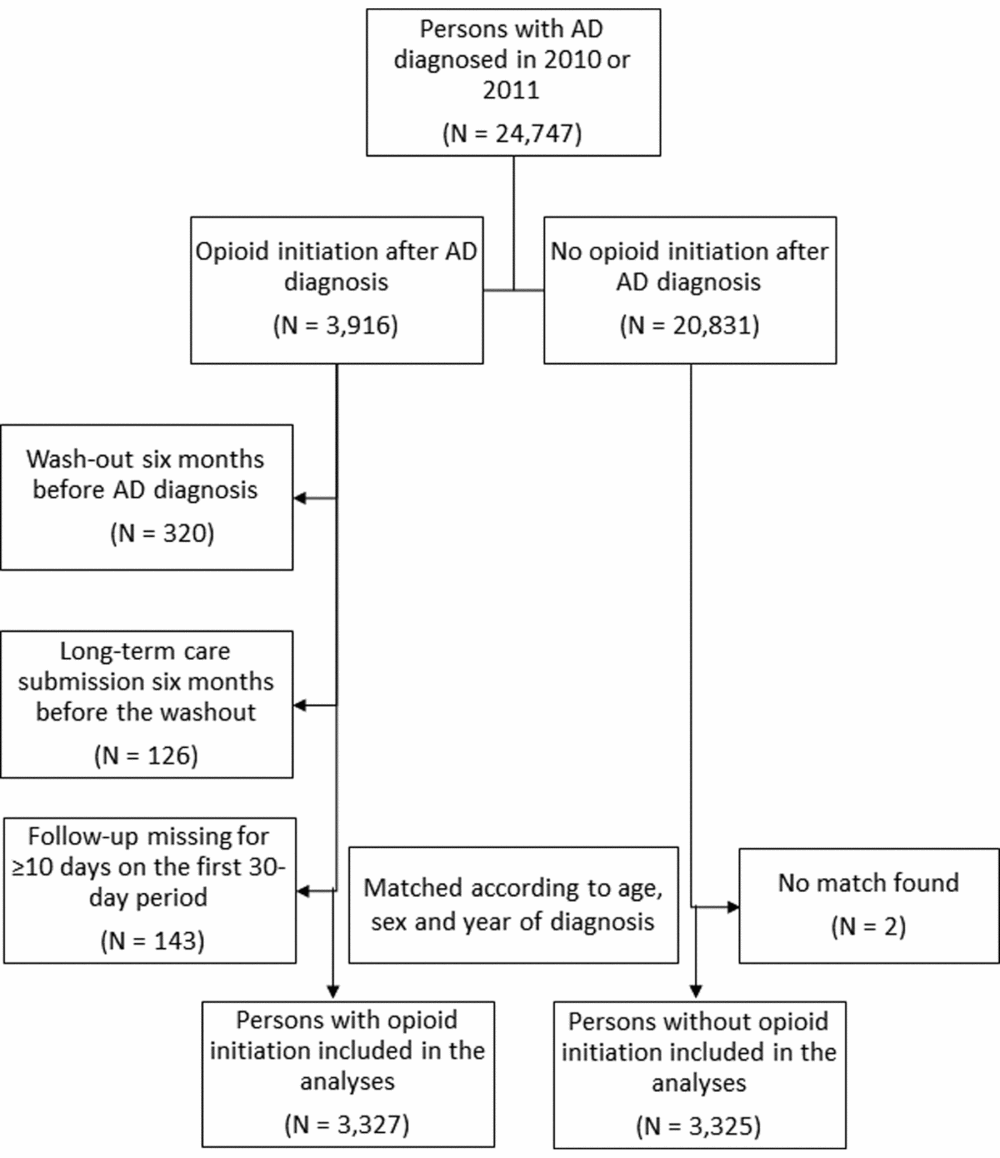
We studied the prevalence of antipsychotic and BZDR use six months before and six months after opioid initiation. We restricted the analyses to those diagnosed with AD in 2010 or 2011 due to inconsistent reimbursement of codeine combination products in the years before 2010. We identified opioid initiators with a six-month wash-out period to exclude prevalent users. Furthermore, as drug use in hospitals is not included in the registers, we excluded persons with long-term hospitalizations of over six months prior to the opioid initiation (see Figure 1 for details). Follow-up after opioid initiation continued until death, less than ten days of follow-up per month due to hospitalization or the end of the study period (December 31, 2012), whichever came first.
Formation of the study sample. AD = Alzheimer's disease.

To further analyze the impact of opioid initiation on antipsychotic and BZDR use, we created a matched cohort of persons who did not initiate or use opioids. Each opioid initiator was matched with one non-initiating person with AD according to age, gender, and time since AD diagnosis (≤90 days) at the date of opioid initiation. Follow-up of the non-initiators was censored according to the same criteria as for the opioid initiators. We then measured the prevalence of antipsychotic and BZDR use at the same time points as the individually matched opioid initiators, i.e. before and after opioid initiation of the matched person.
Covariates were measured at opioid initiation or at the corresponding date for the non-initiators. Data for diabetes (type 1 and 2), rheumatoid arthritis, and schizophrenia were collected from the Special Reimbursement Register. Data on history of hip fracture (ICD-10 codes S72.0, S72.1, S72.2, and corresponding ICD-8 and ICD-9 codes) were collected from the Hospital Discharge Register. Covariates on prescription drug uses were collected based on PRE2DUP-modeled drug use from Prescription Register data and assessed in the 14 days preceding opioid initiation. We collected data for non-steroidal anti-inflammatory drugs (NSAIDs, ATC code M01A, excluding glucosamine), acetaminophen (N02BE01), and bisphosphonates (M05BA, M05BB). Active cancer treatment was defined as any cancer as a main or side diagnosis in the Hospital Discharge Register or anticancer drug purchases within 12 months. Anticancer drugs were defined according to drugs on market in Finland in 2015: L01 (antineoplastic agents), L02 (endocrine therapy), L03AA (colony stimulating factors), L03AB01 (interferon alfa natural), L03AB04 (interferon alfa-2a), L03AB05 (interferon alfa-2b), L03AC (interleukins), L03AX (other immunostimulants, excluding L03AX13, glatiramer acetate), L04AA10 (sirolimus), L04AA18 (everolimus), L04AA34 (alemtuzumab), L04AX02 (thalidomide), and L04AX03 or L01BA01 (methotrexate, excluding persons with a Special Reimbursement for rheumatoid arthritis).
Statistical analyses
Opioid initiation effects on the level and trend of antipsychotic and BZDR use in time series were estimated with segmented linear regression models. Time periods of 30 days six months before, at the month of opioid initiation and five months after the initiation were utilized to define a pre-opioid segment, an opioid initiation and a post-opioid segment. We calculated regression coefficients for each segment to express the change in antipsychotic and BZDR use prevalence among both opioid initiators and non-initiators. Both cohorts were first analyzed separately and then by examining the difference in rates, i.e. by subtracting the prevalence of antipsychotic or BZDR use of opioid initiators from the prevalence of the non-initiators for every time period (Penfold and Zhang, Reference Penfold and Zhang2013). All analyses for opioids were carried out according to the intention-to-treat principle.
Autocorrelation of the time points was estimated utilizing a Durbin–Watson test (Penfold and Zhang, Reference Penfold and Zhang2013). Autocorrelation refers to the dependency of regression residuals over the measured time points. For the results of the Durbin–Watson test, p < 0.05 was considered to indicate statistically significant serial autocorrelation. We further analyzed autocorrelation in sensitivity analyses where time periods were analyzed in 15-day intervals creating a total of 24 time periods. All time series analyses were performed in autoregressive forms. The test expressed some positive autocorrelation for some of the analyses. However, it was weak and models did not adjust for it.
Descriptive analyses were completed using percentages with p-values or 95% confidence intervals (CIs) and means with standard deviations (SDs). Statistical analyses were performed using the SAS statistical software (version 9.4; SAS Institute Inc., Cary, North Carolina, USA).
Results
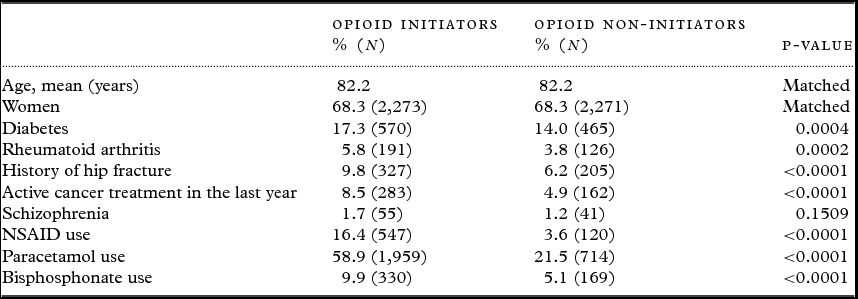
After exclusions, 3,327 opioid initiators and 3,325 non-initiators were included in the analyses. Mean age at opioid initiation was 82.2 years (SD 6.9 years) and 68% were women (Table 1). Opioid use was initiated on average 333 days after AD diagnosis, with a median of 291 days. However, 60.1% of those initiating opioid use begun within the first year from the diagnosis. In the year preceding opioid initiation, 8.5% of the opioid initiating persons received cancer treatment or had a diagnosis for cancer, compared with 4.9% among the non-initiators. NSAIDs and paracetamol on prescription were used by 16.4% and 58.9% of opioid initiators, respectively, compared with 3.6% and 21.5% by the non-initiators. All comorbidities were more common among opioid initiators than among the non-initiators. Moreover, exclusion after opioid initiation due to long-term hospitalization, death, and end of the follow-up period were more common among opioid initiators than among non-initiators (878 vs. 556 persons excluded in total).
Description of the study population

NSAID = non-steroidal anti-inflammatory drugs.
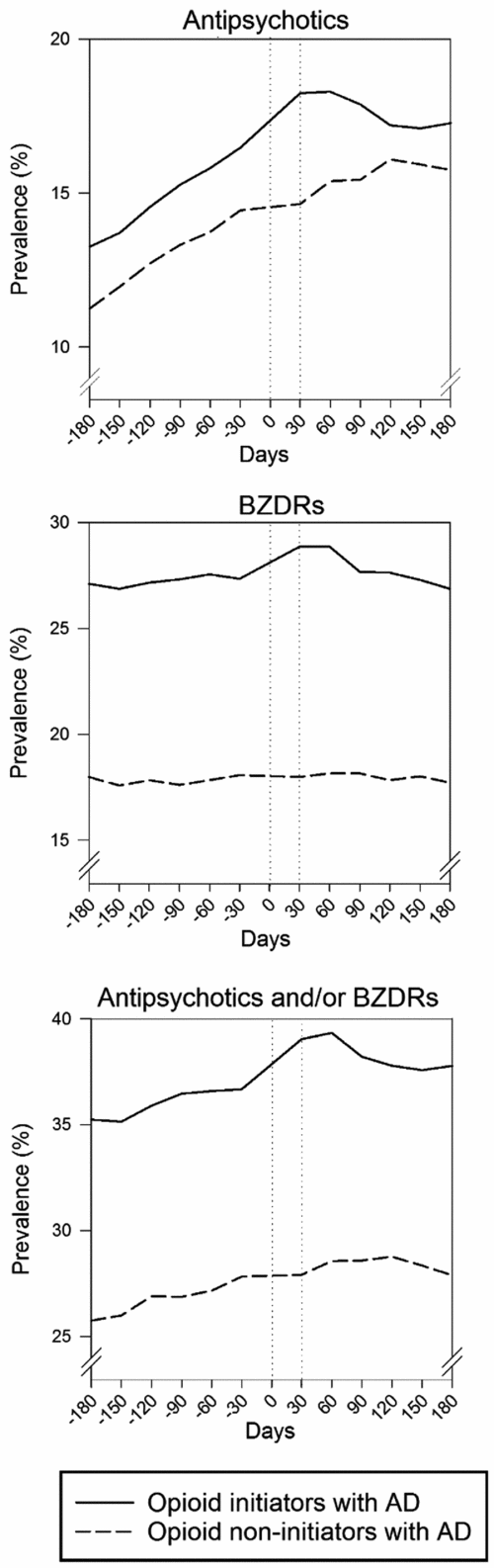
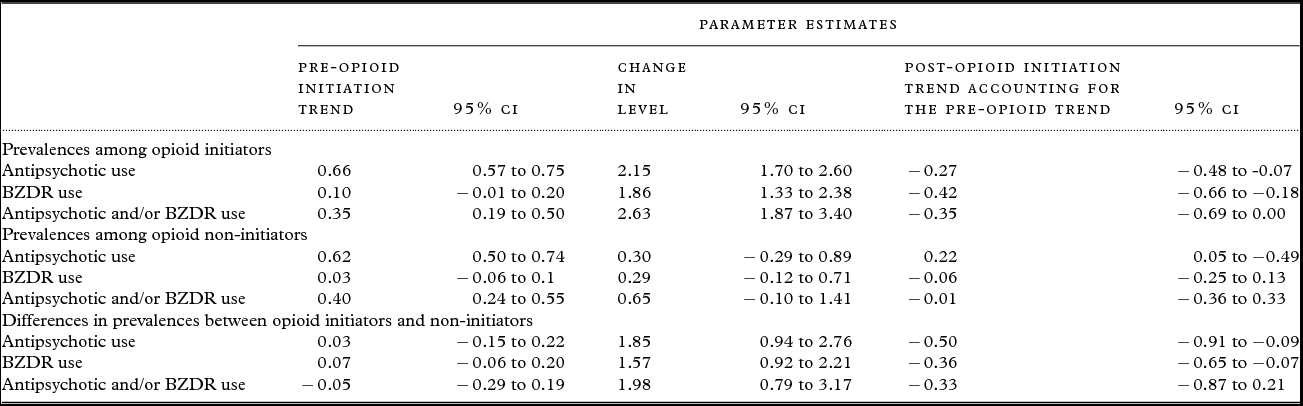
Prevalence of antipsychotic use was 13.3% six months pre-opioid initiation, 18.3% at opioid initiation, and 17.3% six months post-initiation (Figure 2). Antipsychotic use increased by 0.7 percentage points (pps, 95% CI 0.6–0.8 pps) per month after the start of the pre-opioid segment until opioid initiation (Table 2). There was an additional increase of 2.1 pps (1.7–2.6 pps) immediately after opioid initiation. In the post-opioid segment, there was a decrease in slope of 0.9 pps (0.8–1.1 pps) per month. Accounting for the pre-opioid rate, the prevalence of antipsychotic use decreased by 0.3 pps per month after opioid initiation (0.1–0.5 pps).
Prevalences of antipsychotic, benzodiazepine, and related drug use and the use of both or either in relation to opioid initiation or corresponding date (Days = 0). BZDR = benzodiazepines and related drugs; AD = Alzheimer's disease.

Parameter estimates for antipsychotic and benzodiazepine and related drug use prevalence trends among persons with Alzheimer's disease initiating and not initiating opioid use

BZDR = benzodiazepines and related drugs; CI = confidence interval.
Prevalence of BZDR use was 27.1% six months before opioid initiation, 27.3% at opioid initiation, and 26.9% six months after the initiation (Figure 2). BZDR use did not increase statistically significantly in the pre-opioid segment (0.1 pps, 95% CI −0.0–0.2 pps). In the month of opioid initiation, BZDR use increased by 1.9 pps (1.3–2.4 pps). One month after opioid initiation, slope of BZDR use decreased by 0.5 pps (0.4–0.7 pps) until the end of follow-up. Taking the pre-opioid rate into account, the prevalence of BZDR use decreased by 0.4 pps per month after opioid initiation (0.2–0.7 pps).
At the start of the pre-opioid segment, 35.2% of the opioid initiators used an antipsychotic or BZDR or both (Figure 2). At the month of opioid initiation, the same figure was 39.0% and 37.8% at six months after the initiation. Antipsychotic and/or BZDR use increased by 0.4 pps (95% CI 0.2–0.5) per month after the start of follow-up until opioid initiation (Table 2). There was an additional increase of 2.6 pps (1.9–3.4 pps) immediately after opioid initiation. In the post-opioid segment, there was a decrease in slope of 0.7 pps (0.5–0.9 pps) per month until the end of follow-up. The prevalence of antipsychotic and/or BZDR use after the opioid initiation decreased by 0.4 pps per month (0.0–0.7 pps), when the pre-opioid rate was taken into account; however, this change was not statistically significant.
Among the matched cohort of opioid non-initiators, prevalence of antipsychotic use at the beginning of the pre-opioid segment was 11.2% (Figure 2). At the month in which the matched persons initiated opioid use, the prevalence was 14.6%, increasing to 15.7% at six months after opioid initiation. In a segmented regression analysis comparing the prevalence of antipsychotic use between opioid initiators and non-initiators, there was no statistically significant difference in the regression coefficients from the beginning of the pre-opioid segment until opioid initiation (Table 2). Opioid initiation immediately resulted in an increase in difference of 1.9 pps per month (0.9–2.7 pps) and a small decrease in the post-opioid segment (0.5 pps per month, 0.3–0.8). Similar results can be seen for BZDR use. However, the use of antipsychotic and/or BZDR did not decrease statistically significantly during the post-opioid segment.
Discussion
In this register-based study among community-dwelling persons with AD, we found that initiation of prescription opioid use slightly decreased antipsychotic and BZDR use compared to a period before opioid initiation and to a cohort of non-initiators. Opioid initiation was immediately associated with an increase in antipsychotic and BZDR uses, followed by a decrease a month after and until the end of the follow-up six months after the initiation. To our knowledge, this is the first study among persons with dementia to investigate the impact of analgesic initiation to psychotropic drug use in population-based settings.
Previous studies among persons with cognitive impairment have found that treatment with analgesics has resulted in positive changes in neuropsychiatric symptoms (Manfredi et al., Reference Manfredi, Breuer, Wallenstein, Stegmann, Bottomley and Libow2003; Chibnall et al., Reference Chibnall, Tait, Harman and Luebbert2005; Husebo et al., Reference Husebo, Ballard, Sandvik, Nilsen and Aarsland2011, Reference Husebo, Ballard, Cohen-Mansfield, Seifert and Aarsland2014a, Reference Husebo, Ballard, Fritze, Sandvik and Aarsland2014b). These findings are in accordance with our main results of decreasing antipsychotic and BZDR use in association with opioid initiation. Interestingly, in their placebo-controlled crossover trial, Chibnall et al. found no reduction in as-needed psychotropic drug use during a four-week period of receiving 3g of acetaminophen per day. The discrepancy between the results of Chibnall et al. and ours may be explained by different study populations and very dissimilar methods. Moreover, as our study was register-based, we could not control for any possible BPSDs. As such, it may be possible that the reduction in antipsychotic and BZDR use, at least partly, reflects clinical concern on sedative load of patients on opioid therapy. This seems unlikely, however, as the use of both antipsychotic and BZDR greatly increased in the month of opioid initiation. Interestingly, we did not find a statistically significant decrease in the post-opioid initiation trend when we combined the prevalences of antipsychotic and/or BZDR uses. This may be due to the fact that this cohort includes more people using both drug classes concomitantly and so discontinuation of both is more unlikely. However, this issue requires more investigation. Finally, all our analyses regarding opioid initiation were done on intention-to-treat basis. Continued opioid treatment may have had resulted in greater decrease in antipsychotic or BZDR use.
There were striking differences in antipsychotic and especially BZDR use prevalences between those who initiated opioid and those who did not. These differences can be somewhat explained by more prevalent comorbidity, for example the almost two-fold prevalence of cancer. We have previously reported more prevalent use of psychotropics in association with analgesic use and long-term opioid use among persons with AD (Hamina et al., Reference Hamina, Taipale, Tanskanen, Tolppanen, Tiihonen and Hartikainen2017a, Reference Hamina2017b). Nevertheless, risks of co-prescribing opioids and other psychotropic drugs should be kept in mind (Abdulla et al., Reference Abdulla2013; American geriatrics society, 2015).
The role of treating underlying causes such as pain is frequently emphasized in clinical guidelines of treating BPSDs (Doody et al., Reference Doody2001; NICE, 2006; Rabins et al., Reference Rabins2007). However, the research on the subject is less clear. A meta-analysis of studies investigating the association of pain and neuropsychiatric symptoms found only weak evidence between these symptoms (van Dalen-Kok et al., Reference van Dalen-Kok, Pieper, de Waal, Lukas, Husebo and Achterberg2015). The authors of the meta-analysis suggest this may be due to problems in assessment of both pain and neuropsychiatric symptoms and due to a lack of longitudinal studies on the issue. Our results, along with others (Manfredi et al., Reference Manfredi, Breuer, Wallenstein, Stegmann, Bottomley and Libow2003; Chibnall et al., Reference Chibnall, Tait, Harman and Luebbert2005; Husebo et al., Reference Husebo, Ballard, Sandvik, Nilsen and Aarsland2011; Husebo et al., Reference Husebo, Ballard, Fritze, Sandvik and Aarsland2014b), indicate positive results for analgesic treatment; in our case that opioid initiation reduces symptomatic drug use in non-experimental settings in a six-month period, however slightly. Nonetheless, on a population level even small changes in particular antipsychotic use may result into health benefits for persons with AD. The possibility of these health benefits warrants further research. Importantly, a slow decline in use of both antipsychotics and BZDRs can be expected, as gradual discontinuation of both drug groups is often required after long-term use. In addition, register-based drug use models cannot estimate the date of discontinuation definitely and thus, may contribute to a seemingly slower decline in drug use.
Similarly, the reasons behind the initial surge in antipsychotic and BZDR use after opioid initiation require more investigation. It is possible that in some cases the same reasons apply for both opioid and antipsychotic/BZDR initiation, e.g. exacerbation of BPSDs after a pain inducing trauma. Due to our 30-day window, a progressive increase in drug prescriptions after difficult BPSD occur is also possible. On the other hand, opioid treatment may result into adverse effects, which in theory could be then treated with antipsychotics and/or BZDRs. Third explaining factor for the increase may possibly be an artificial peak due to more frequent visits to the physician's office and the pharmacy in the month of opioid initiation. However, this is unlikely to be the sole cause of initial increase, as antipsychotic and BZDR use continued to be more prevalent in the next 30 days, as well.
A major strength of our study is the nationwide coverage of the utilized registers. Our study includes all opioid initiating persons with a clinically verified diagnosed AD from the years 2011 and 2012 from Finland. Due to the strict criteria of the SII, which are based on international standards (McKhann et al., Reference McKhann, Drachman, Folstein, Katzman, Price and Stadlan1984), the diagnosis can be considered reliable. However, mixed cases of AD and features of vascular or Lewy body dementias are included in our study. Our method of utilizing data on dispensed drugs as opposed to prescription data is a more accurate estimation of actually used drugs (Beardon et al., Reference Beardon, McGilchrist, McKendrick, McDevitt and MacDonald1993). Further, the utilized drug use model, PRE2DUP, is previously validated (Taipale et al., Reference Taipale, Tanskanen, Koponen, Tolppanen, Tiihonen and Hartikainen2016) and takes into account individual variations in drug use patterns instead of fixed-dose assumptions (Tanskanen et al., Reference Tanskanen2015). Interrupted time series analysis is a strong quasi-experimental design on investigating change over time (Wagner et al., Reference Wagner, Soumerai, Zhang and Ross-Degnan2002) as it takes into account previous rates of drug use from multiple time points. This design can be considered an important strength of our study.
Limitations of our study are related to the utilized registers, including the previously discussed lack of data on BPSDs. Similarly, we have no data on pain, its severity, or detailed indications of opioid therapy. Unsurprisingly, pain related morbidities were significantly more prevalent among those initiating opioid use compared to those who did not. However, these illnesses may or may not be the indications for the opioid use period under investigation. In addition, the Special Reimbursement Register does not include data on AD severity, and therefore sub-analyses on different stages of the disease were not possible to carry out. This study is also restricted to community-dwelling persons, as drugs used in hospitals or nursing homes are not included in the Prescription Register. Based on previous research from Nordic countries, opioid and psychotropic drug use patterns of persons with dementia differ greatly between those living in the community and those in institutions (Wills et al., Reference Wills, Claesson, Fratiglioni, Fastbom, Thorslund and Winblad1997; Lövheim et al., Reference Lövheim, Karlsson and Gustafson2008; Haasum et al., Reference Haasum, Fastbom, Fratiglioni, Kåreholt and Johnell2011; Jensen-Dahm et al., Reference Jensen-Dahm, Gasse, Astrup, Mortensen and Waldemar2015), and thus it is important to note that our results cannot be generalized outside community-dwelling persons.
Conclusion
In this nationwide register-based study on community-dwelling persons with AD, antipsychotic and BZDR use was very frequent. Initiation of prescription opioid use slightly decreased the use of both antipsychotics and BZDRs. Future research should determine whether symptom-based pharmacotherapy of BPSDs can be reduced with adequate pain treatment of persons with AD.
Conflict of interest
HT and AT have participated in research projects funded by Janssen with grants paid to the institution where they were employed. JT has served as a consultant to Lundbeck, Organon, Janssen-Cilag, Eli Lilly, AstraZeneca, F. Hoffman-La Roche, and Bristol-Myers Squibb. He has received fees for giving expert opinions to Bristol-Myers Squibb and GlaxoSmithKline; lecture fees from Janssen-Cilag, Bristol-Myers Squibb, Eli Lilly, Pfizer, Lundbeck, GlaxoSmithKline, AstraZeneca, and Novartis; and grant from Stanley Foundation. JT is a member of advisory board in AstraZeneca, Janssen-Cilag, and Otsuka. SH has received lecture fees from Professio and MSD.
The work of AH was partly funded by a grant from Tor, Joe and Pentti Borg foundation. Other authors declare no conflicts of interest.
Description of authors’ roles
AH, PL, and HT designed the study, carried out the analysis and interpretation of the data, and prepared the manuscript. AT, AMT, JT, and SH designed the study and carried out the interpretation of the data.