INTRODUCTION
Gelatinous zooplankton including salps (order Salpida) are an important but often overlooked component of marine ecosystems (Andersen, Reference Andersen and Bone1998; Mills, Reference Mills2001). Salps have a complex life history with alternation of generations between aggregated sexual blastozooids (aggregate form) and solitary asexual oozooids (solitary form). The sexual and asexual forms are so different that early taxonomists categorized them as different species until their life cycles became known (Fraser, Reference Fraser, Kermack and Barnes1981).
Salps can form extremely dense populations in the form of blooms or ‘swarms’ several kilometres in diameter (Raymont, Reference Raymont1983; Bathmann, Reference Bathmann1988). Under favourable conditions, blooms can form rapidly, aided by their ability to reproduce both sexually and asexually and their high feeding capacities, amongst the highest in the metazoans (Madin & Purcell, Reference Madin and Purcell1992; Bone, Reference Bone1998). In high concentrations they can effectively graze phytoplankton stocks within a few days (Deibel, Reference Deibel1982). They are able to feed on particles of a wide size range, from bacteria to microzooplankton (Silver & Bruland, Reference Silver and Bruland1981; Caron et al., Reference Caron, Madin and Cole1989; Kremer & Madin, Reference Kremer and Madin1992), and by removing all available food they can exclude other zooplankton groups (Alldredge & Madin, Reference Alldredge and Madin1982). This can influence the seasonal development of copepod populations through both direct grazing pressure and competition for prey species (Makarov & Solyankin, Reference Makarov, Solyankin and Solyakin1990; Paffenhofer et al., Reference Paffenhofer, Atkinson, Less, Verity and Bulluck1995; Dubischar & Bathmann, Reference Dubischar and Bathmann1997), influencing the structure of the whole pelagic community (Bathmann, Reference Bathmann1988).
Salps are widely distributed in oceanic waters, including those of the western Atlantic. They are not considered to be indigenous to British waters as it is thought that they cannot survive the winter (Fraser, Reference Fraser, Kermack and Barnes1981); however, they can form ephemeral populations carried with influxes of oceanic waters to the British coast and as such are considered to be good indicators of oceanic water movements (Russell, Reference Russell1935; Fraser Reference Fraser1949, Reference Fraser1969; Reid et al., Reference Reid, Edwards, Beaugrand, Skogen and Stevens2003).
There are 11 species of salp recorded in or adjacent to UK and Irish waters, all of which are in the family Salpidae (Fraser, Reference Fraser, Kermack and Barnes1981). The family Salpidae is made up of two sub-families – Salpinae and Cyclosalpinae. The most commonly observed salp in British and Irish waters is Salpa fusiformis (Cuvier, Reference Cuvier1804), which is a member of the sub-family Salpinae. Mass occurrences have been observed in the North Sea (Reid et al., Reference Reid, Edwards, Beaugrand, Skogen and Stevens2003), Ireland (Bathmann, Reference Bathmann1988), Scotland and Norway (Murray & Hjort, Reference Murray and Hjort1912; Hardy, Reference Hardy1923; Fraser, Reference Fraser1949, Reference Fraser1969; Brattstrom, Reference Brattstrom1972). Mass occurrences of S. fusiformis in the North Sea have been linked to variations in the North Atlantic Oscillation (Reid et al., Reference Reid, Edwards, Beaugrand, Skogen and Stevens2003).
The largest species of the salpidae is Thetys vagina (Tilesius, Reference Tilesius1802), also a member of the sub-family Salpinae, which reaches >230 mm in total length (TL) in the solitary asexual form and 250 mm TL in the aggregate sexual form (Metcalf, Reference Metcalf1918; Fraser, Reference Fraser, Kermack and Barnes1981), although individuals up to 300 mm have been found in Hawaii (Nakamura & Yount, Reference Nakamura and Yount1958). Records of T. vagina are sparse and it is typically observed at low densities in all oceans (Hubbard & Pearcy, Reference Hubbard and Pearcy1971; Ensal & Daponte, Reference Ensal, Daponte and Boltovskoy1999). Whilst this species is most commonly observed in warm oceanic waters, there are a small number of records from colder zones (McAlice, Reference McAlice1986; Sims, Reference Sims1996; Van Soest, Reference Van Soest and Bone1998; Iguchi & Kidokora, Reference Iguchi and Kidokora2004). There are two known records from UK waters; from St Kilda, Scotland in 1996 (Sims, Reference Sims1996) and from Wick, Scotland in 1929 (Thompson, Reference Thompson1948). There is also one record from the western Irish Sea (Fraser, Reference Fraser1961). Given the paucity of records, this species is considered to be extremely rare in British waters.
Within the sub-family Cyclosalpinae there are five species found adjacent to UK waters; however, only Cyclosalpa bakeri (Ritter, Reference Ritter1905) and Helicosalpa virgula (Vogt, Reference Vogt1954) have been observed within the UK (Fraser, Reference Fraser1961), with the only record of C. bakeri from Scotland.
In this study a mass occurrence of salps from north Scotland is documented and records provided of the diversity of gelatinous zooplankton at some of most remote islands in Scotland.
MATERIALS AND METHODS
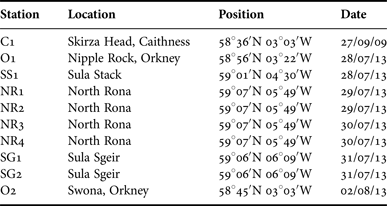
Sampling was undertaken during two surveys, a one-day survey of the north coast of Caithness and a six-day survey across the islands of the north coast of Scotland, Figure 1. The Caithness survey was undertaken from the ridged inflatable boat ‘North Coast Explorer’ on 27 September 2009 as part of the Seasearch dive programme. The survey of the islands of the north coast of Scotland, incorporating the Orkney Islands, Sula Stack, North Rona and Sula Sgeir, was undertaken from the MV Halton from 28 July 2013 to 2 August 2013. Sampling schedule and locations are shown in Table 1 and Figure 1.
Sampling locations, Scotland: C1, Caithness; O1, O2, Orkney Islands, SS1, Sula Stack; NR1–4, North Rona; and SG1–2, Sula Sgeir.

Sample station locations from Caithness, Orkney, Sula Stack, Sula Sgeir, North Rona, Scotland.
Surveys were undertaken using SCUBA from a maximum depth of 30 m to the surface, with the diversity and abundances of benthic and pelagic organisms recorded. Each survey lasted a maximum of 60 min. Species and abundance estimates were recorded in situ, with photographic records made of all specimens using a Nikon D300 and D600, Nikkor 105 mm macro and Tokina 10–17 mm lenses with Ikelite housings and Inon Z240 flash units. Pelagic observations were made throughout the full water column; however, abundance estimates were made in three replicate counts of 30 cm3 at 6 m depth. Photographic records of abundance were made at each location. Temperature at 6 m depth was also recorded using an Apeks Quantum dive computer. Reference specimens were collected for microscopic examination. For gelatinous zooplankton, identification keys by Russell (Reference Russell1953, Reference Russell1970), Fraser (Reference Fraser, Kermack and Barnes1981) and Kirkpatrick & Pugh (Reference Kirkpatrick, Pugh, Brill and Backhuys1984) were utilized.
RESULTS
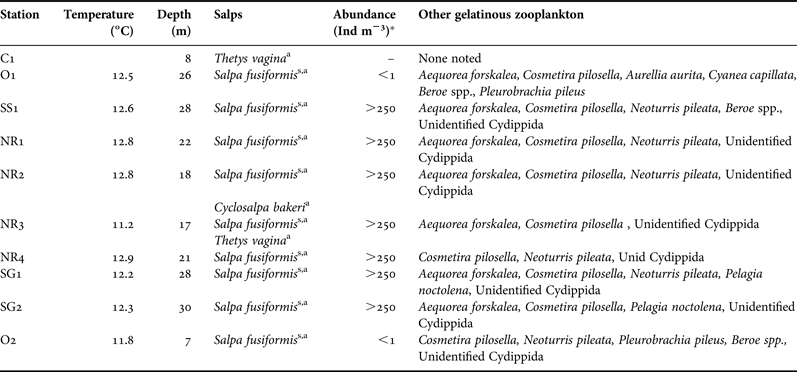
During the 2013 survey, large numbers of Salpa fusiformis were observed at all sampling stations (Sula Skerry, Sula Sgeir, North Rona and west coast of Orkney) (Table 2). In situ observation noted that the highest abundances were in the top 10 m but abundances were highly spatially variable, with salps aggregating in gullies and reef areas. Both aggregate chains of sexual individuals (Figure 2) and solitary asexual individuals were observed (Figure 3). Aggregate chains of up to 35 individuals were observed, many of which had young embryos growing within the cloacal chamber. Highest abundances estimates at 6 m were observed at stations SS1, NR1-4 and SG1-2 with abundances estimated to be exceeding 250 indm−3 (Figure 4). Abundances at stations O1 and O2 were estimated to be less than 1 indm−3.
Gelatnous zooplankton species observed at sample station locations in Caithness, Orkney, Sula Stack, Sula Sgeir, North Rona – Scotland.
s = solitary asexual form.
a = aggregate sexual form.
* Estimated abundance of Salpa fusiformis recorded at 6 m depth.
Example of Salpa fusiformis chain (blastozooids or aggregate form), North Rona, 29 July 2013.
Example of Salpa fusiformis (oozooids or solitary form), Sula Sgeir, 31 July 2013.
Example of photographic record of gelatinous zooplankton abundance (species Salpa fusiformis), North Rona, 29 July 2013.
The aggregate chains were observed to be easily broken up, and some aggregate forms of Salpa fusiformis were observed to be separated from their chain. Benthic anthozoa, including Sagartia elegans (Dalyell, Reference Dalyell1848) and Actinia equina (Linnaeus, Reference Linnaeus1758), were observed to be actively feeding on Salpa fusiformis (Figure 5).
Example of Sagartia elegans consuming Salpa fusiformis, Sula Sgeir, 31 July 2013.
The salp Thetys vagina was observed at station NR3, North Rona on 30 July 2013. The species was the aggregate form with four individuals observed in the chain. The aggregate form of T. vagina was also observed on 21 September 2009 at station C1, Skirza Head, with two individuals in the chain (Figure 6). Thetys vagina was observed to be actively swimming on both occasions.
Cyclosalpa bakeri chain (blastozooids or aggregate form), North Rona, 29 July 2013. Image courtesy of Matthew Doggett.
The salp aggregate form of Cyclosalpa bakeri was observed at North Rona on 30 July 2013 (Figure 7). Fifteen individuals were observed in a circular chain.
Thetys vagina (blastozooids or aggregate form), Skirza Head, Scotland, 27 September 2009.
Other gelatinous zooplankton observed during the survey period included the scyphomedusae Pelagia noctiluca (Forsskål, Reference Forsskål1775), Aurelia aurita (Linnaeus, Reference Linnaeus1758) and Cyanea capillata (Linnaeus, Reference Linnaeus1758), and the hydromedusae Neoturris pileata (Forsskål, Reference Forsskål1775), Cosmetira pilosella (Forbes, Reference Forbes1848) and Aequorea forskalea (Péron & Lesueur, Reference Péron and Lesueur1810). The Ctenophore Pleurobrachia pileus (Müller, Reference Müller1776) and Beroe spp. were also observed.
An unidentified Cydippida ctenophore was observed with the salp bloom at all survey stations in 2013. The ctenophores were 50–70 mm in length had equal length comb rows, which extended from the aboral end to approximately half way along the body to the openings of the sheaths where two tentacles exit (Figure 8). Parasitic copepods were observed on the ctenophore but these were not identified.
Unidentified Cydippida ctenophore, Scotland, July 2013.
DISCUSSION
In this study, a bloom of the salp Salpa fusiformis is documented in the north of Scotland. High density salp blooms have the potential to deplete the phytoplankton stock (Bathmann, Reference Bathmann1988), converting small particles into rapidly sinking faecal pellets (Madin, Reference Madin1982), outcompeting other zooplankton and larval fish (Fraser, Reference Fraser1961; Alldredge & Madin, Reference Alldredge and Madin1982; Bathmann, Reference Bathmann1988). In the areas where the bloom forms, salps can influence the seasonal development of copepod populations (Makarov & Solyankin, Reference Makarov, Solyankin and Solyakin1990; Paffenhofer et al., Reference Paffenhofer, Atkinson, Less, Verity and Bulluck1995; Dubischar & Bathmann, Reference Dubischar and Bathmann1997) and the structure of the whole pelagic community (Bathmann, Reference Bathmann1988). However, the advection of salps to coastal waters, away from areas where the bloom was initially formed, can stimulate primary production due to nitrogen excretion by salps through metabolic processes (Alcaraz et al., Reference Alcaraz, Saiz, Fernandez, Trepat, Figueiras, Calbet and Bautista1998) and through their disintegration (Fraser, Reference Fraser1963). The resulting release of nutrients can stimulate the production of phytoplankton and, therefore, increase zooplankton abundance. This process has been linked to increased productivity in the herring fishery in Shetland (Fraser, Reference Fraser1963).
The observations of two rare species of salp in this study, Thetys vagina and Cyclosalpa bakeri, extend the known range of these species. Including the two observations of T. vagina presented in this study, all four records of T. vagina in UK waters come from the north of Scotland (Thompson, Reference Thompson1948; Sims, Reference Sims1996), a comparatively remote area which is subject to limited survey efforts. Whilst the records in this study could indicate an increase in the number of T. vagina being transported into UK waters, possibly as a result of climate change, it is perhaps more likely that the low level of survey effort means that this species is under recorded.
There is only one previously known record of Cyclosalpa bakeri in UK waters (Fraser, Reference Fraser1961), however, this single record of Cyclosalpa bakeri has been questioned by Van Soest (Reference Van Soest1974), suggesting it could be Cyclosalpa foxtoni which was not described until 1974. The observation of the chain in this study, therefore, represents either the first or second record from the UK.
The unidentified Cydippida ctenophore is a species that is not identified by Greve (Reference Greve1975) as present in British waters. The observation of this unknown Cydippida and the two rare salps illustrates the paucity of knowledge of the oceanic gelatinous zooplankton around the British coast, particularly offshore. Despite the high density of salps observed in this study, their presence would have gone undocumented had it not been observed on this expedition. There has been increasing effort to develop models to understand the variations in economically important fish species, however, these models often exclude the effects of plankton fluctuations which have the potential to significantly impact recruitment, particularly in the North Sea (Reid et al., Reference Reid, Edwards, Beaugrand, Skogen and Stevens2003). Without more detailed study of the natural variability in zooplankton abundance and their drivers, our understanding of the systems that influence higher taxa is likely to remain incomplete.
ACKNOWLEDGEMENTS
I would like to thank the skipper of the MV Halton, Bob Anderson, and crew members Liam Thornes and Kenny Budge. I would also like to thank Matthew Doggett for providing the image of Cyclosalpa bakeri. I would like to acknowledge the SCUBA survey members who participated in the recording of the benthic and pelagic species on this expedition – Dr Richard Shucksmith, Dr Joanne Porter, Dr Matthew Doggett and Polly White, as well as the other trip participants Sarah Smith, Fiona Graham and Kirsty McWilliam. The survey in 2009 was organized by Christopher Rickard and Fiona Watson as part of the Seasearch diver survey scheme and was part-funded by Scottish Natural Heritage via Seasearch Scotland. I would like to acknowledge the other divers on this survey, Linda Davies, Fiona Watson and Christopher Rickard.