In May 1906, a formerly enslaved girl named Noumbé Daffa fled the Saint-Louis home of her guardian, Suzanne Audibert, in response to a scolding. Noumbé was known to French authorities, having obtained official recognition of her emancipation before entering the colony's system of guardianship (tutelle) in 1901, and, like many other so-called ‘liberated minors’, she had experienced increased government oversight during the last few years. Indeed, only months before, a previous guardian, Rokaya Jupiter, had tired of Noumbé’s disobedience and returned her to the administration, which had in turn entrusted her to Audibert. When Audibert could not produce her for evaluation by the guardianship commission in October 1906, a police investigation found Noumbé living in another Saint-Louis neighborhood and revealed that she had a young child. Given her status as a mother, the secretary general formally released her from guardianship.Footnote 1
Noumbé Daffa was among over 1,600 liberated minors who lived and worked in private homes in Saint-Louis and other towns in Senegal at the turn of the twentieth century, a period in which the colonial state often intervened in their lives. Responding to rising concern among officials in Paris and West Africa about slavery and analogous conditions, and contributing to broader efforts to extend French authority and bureaucracy in French West Africa, Governor General Ernest Roume attempted to reduce the exploitation of children that guardianship had facilitated since its creation in 1849 by issuing two reforms.Footnote 2 Reflecting the ethos of child protection and attention to ‘humanity’ that characterized several policies of this era, Roume's reforms of 1903 and 1904 proposed frequent surveillance and better record keeping as tools to protect formerly enslaved children from abuse by their guardians and to ensure that they became economically productive and moral town residents.Footnote 3 The reforms also positioned the state as the protector of marginalized children, privileging its priorities and undercutting the Catholic missions that had previously worked with this population. Indeed, as liberated minors and their guardians more frequently encountered the state in the wake of Roume's reforms, guardianship structured discourses about the labor and behavior appropriate to formerly enslaved children in Senegal's towns and about the terms under which they could participate in secular urban life.
A focus on childhood and children — perceived as dependent on parents, caregivers, or masters, whether enslaved or free — brings into relief the slippage between ‘slave’ and ‘child’ status in post-emancipation Senegal and highlights town residents’ continued reliance on dependent domestic labor, though mediated and moderated by guardianship, well into the twentieth century.Footnote 4 Indeed, as Martin Klein, Bernard Moitt, and others have shown, guardianship exposed French ambivalence about domestic slavery in Africa in the late nineteenth and early twentieth centuries, and, as Ousseynou Faye argues, it was part of a much longer history of domestic service in Senegal. Given that officials relied on guardianship to control unaccompanied and thus potentially disorderly children, scholars like Ibrahima Thioub see it as part of the state's effort to address juvenile delinquency.Footnote 5 Yet at the same time, a focus on liberated minors also allows us to better understand children's experiences of domestic service and other types of labor, the stigmas of slavery even after its abolition, and the interventions of the colonial state. Indeed, I argue that children's cooperation with or rebellion against guardianship not only shaped the circumstances in which they lived and worked, but also influenced discourses about childhood, labor, and stigma in post-emancipation Senegal. Even as some officials expressed increasing opposition to slavery and a 1905 law banned enslavement and transactions in persons across French West Africa, liberated minors’ actions underscored limits to the state's humanity and shaped the contours of the childhoods available to the formerly enslaved.
Children and childhood remain under-explored themes in African history, despite the fact that scholars have paid considerable attention to the history of youth.Footnote 6 Indeed, a substantial literature explores how young people challenged generational hierarchies; responded to colonialism by converting to Christianity, attending school, participating in labor migration, or engaging in criminal activity; and began to mobilize against colonial rule. Scholars have also discussed some of the problems with ‘youth’ as an analytic category, most particularly, its imprecise definition and its often-assumed male gender.Footnote 7 Yet, though Africanists have produced numerous studies of slavery, pawnship, labor, colonial education, and other institutions or practices that involved children, children most often appear in our scholarship as subjects who were acted upon rather than as historical actors.Footnote 8
More recently, however, scholars have shifted the focus, turning to innovative sources and methods to privilege children's experiences and perspectives. Perhaps most notable — and most relevant here — is Abosede George's Making Modern Girls, which, moving between social welfare workers, elite African ‘girl-savers’, and working-class Lagosians, contends that colonial-era efforts to protect and discipline problematic girls in Lagos rendered the child as the ‘first category of native to emerge as a universal subject in Africa’.Footnote 9 My study, like George's, takes seriously the significance of labor in shaping ideas about and experiences of childhood. I depart from her approach, however, in making direct connections between the market for slave labor in Senegal and the post-emancipation demand for liberated minors to perform domestic service and other labor in colonial towns. I consider both boys and girls, paying attention to the significance of gender in shaping children's experiences and strategies. Relying on records maintained for over 1,600 children from 1904 to 1911 and on a rich collection of letters, police reports, and other documents written over a slightly longer period, I argue that while officials positioned post-reform guardianship as a means of reducing child exploitation, actions taken by some liberated minors to highlight and challenge legacies of slavery had a greater impact on the type of childhood available to formerly enslaved people in Senegal's towns.Footnote 10
GUARDIANSHIP, THE STATE, AND CATHOLIC MISSION, 1848–1904
Senegal's system of guardianship emerged in 1849 in response to concern that the French emancipation decree of 1848 had encouraged formerly enslaved children in Saint-Louis and Gorée to withdraw their labor and turn to vagrancy after leaving their masters. The system involved assigning emancipated children to guardians (often former masters), restoring order and providing guardians with labor, glossed as vocational training.Footnote 11 As Moitt and others have stressed, not only did guardianship enable residents to keep exploiting the formerly enslaved children already present in their towns, but it also provided a cover for continued trade in child slaves from the hinterland, where, for decades, political expediency prevented the French from seriously challenging slavery.Footnote 12 In addition, guardianship incorporated children who arrived in Saint-Louis unaccompanied after fleeing slavery in the surrounding areas, and the number of such children increased significantly from the 1880s as officials ceased routinely returning runaway slaves to their allies in the interior.Footnote 13
By the early twentieth century, public opinion in France and in other imperialist countries had become increasingly concerned with slavery and its vestiges around the world. Prodded by the colonial ministry in Paris, Governor General Roume twice reformed guardianship, reflecting the changing sensibilities that produced a ban on enslavement and slave trading across French West Africa in 1905. To address concerns about guardians inappropriately benefitting from liberated minors’ labor, Roume's 24 November 1903 decree indicated that, going forward, liberated minors should ordinarily be placed in institutional settings rather than with individuals. The hundreds of liberated minors already under guardianship would remain in private homes — the colony's vocational schools had limited capacity and the public orphanage for boys had not yet opened — but they were not untouched by the reform. Indeed, in response to Roume's instructions, the lieutenant governor of Senegal, Camille Guy, quickly created ‘commissions charged with the surveillance and the protection of liberated minors’ to attend to these children. Consisting of one or two colonial officials, the presiding judge of the local court, a ‘European or assimilated merchant or colonist’, and two notables, the commissions were to proceed immediately with a ‘census’ of all liberated minors in the registers to determine whether or not they remained with their guardians.Footnote 14
Given the new focus on record keeping, Guy and Roume were alarmed when the Saint-Louis commission confirmed that the head of the judicial service had not adequately supervised or documented guardianship for decades. This realization prompted Roume's second reform, which, in October 1904, put the secretary general in charge of the system, making him responsible for entrusting liberated minors to institutions or individuals, addressing discipline problems that guardians could not handle, coordinating with police to conduct investigations related to guardianship, and — assisted by the new surveillance commissions — maintaining up-to-date records.Footnote 15 These commissions, with a mandate to regularly ‘inspect’ liberated minors after completing their initial census, played a critical role in the record-keeping functions of the reformed system, first in Saint-Louis, and a few years later in Dakar and other towns. Enlisting the police to deliver summonses to guardians’ homes, commissioners assessed the health, ‘moral and material situation’, and approximate age of the liberated minors who appeared before them. Over the years, commissioners saw many of these children multiple times, and eventually, some guardians and a few wards began to complain about the frequency of the intrusion.Footnote 16 Through the involvement of the secretary general, the police, and the commissions, the reformed guardianship system multiplied points of contact between liberated minors and representatives of the colonial state and created spaces in which to work out appropriate roles for formerly enslaved children in Senegal's towns.
Notably, Catholic congregations, which had worked with Senegal's children for decades in schools, orphanages, workshops, and other institutions, were essentially sidelined from this debate. This absence is significant, since missionaries had often targeted (formerly) enslaved children as potential converts and had even provided for liberated minors.Footnote 17 It suggests that the reform of guardianship stemmed not only from a decreasing tolerance for slavery, but also from the state's effort to outmaneuver missions for influence over marginalized children in the context of secularization in France and its impact on the colonies. In December 1904, the administration finally managed to open the fully secular boys’ orphanage in Sor, outside Saint-Louis, that officials and general councilors had discussed for years. Though it functioned for less than three years, this institution received the ‘insubordinate’ liberated minors who had previously been sent to the penitentiary-school in Thiès, operated by the Congregation of the Holy Spirit (Spiritans) on behalf of the administration from 1888 to 1902. It also housed orphans and ‘morally abandoned’ children, directly competing with the orphanage at the Spiritan mission in Ngazobil and Thiès. Though high costs doomed the penitentiary-school and the General Council had authorized funds for the Sor orphanage years before, the campaign to secularize surely played a role in the timing of these changes.Footnote 18
Pressure to cease public support for Catholic institutions in Senegal became more apparent shortly after Roume's 1903 guardianship reform, when a metropolitan newspaper editorial lashed out against Lieutenant Governor Guy's suggestion that the administration send newly liberated minors to the Spiritan orphanage at Ngazobil and lambasted his perceived ambivalence about secularization. Roume did not see Ngazobil as a viable option and the administration generally continued entrusting both boys and girls to individual guardians through 1904 in Saint-Louis, and later in other towns and outposts. Some reliance on the Sisters of Saint-Joseph de Cluny continued, however, with the government sending undisciplined liberated minor girls to the Sisters’ workhouse in N'Dar Toute.Footnote 19 Nevertheless, through the reforms of guardianship in 1903 and 1904 and the creation of a secular orphanage, the state privileged its vision of the childhood available to formerly enslaved children and attempted, with only partial success, to push aside the religious congregations. After these reforms, in spaces and records controlled by the state, multiple — and sometimes competing — voices came together to produce knowledge and expectations about childhood, or to push back against them.
FROM SLAVERY TO GUARDIANSHIP
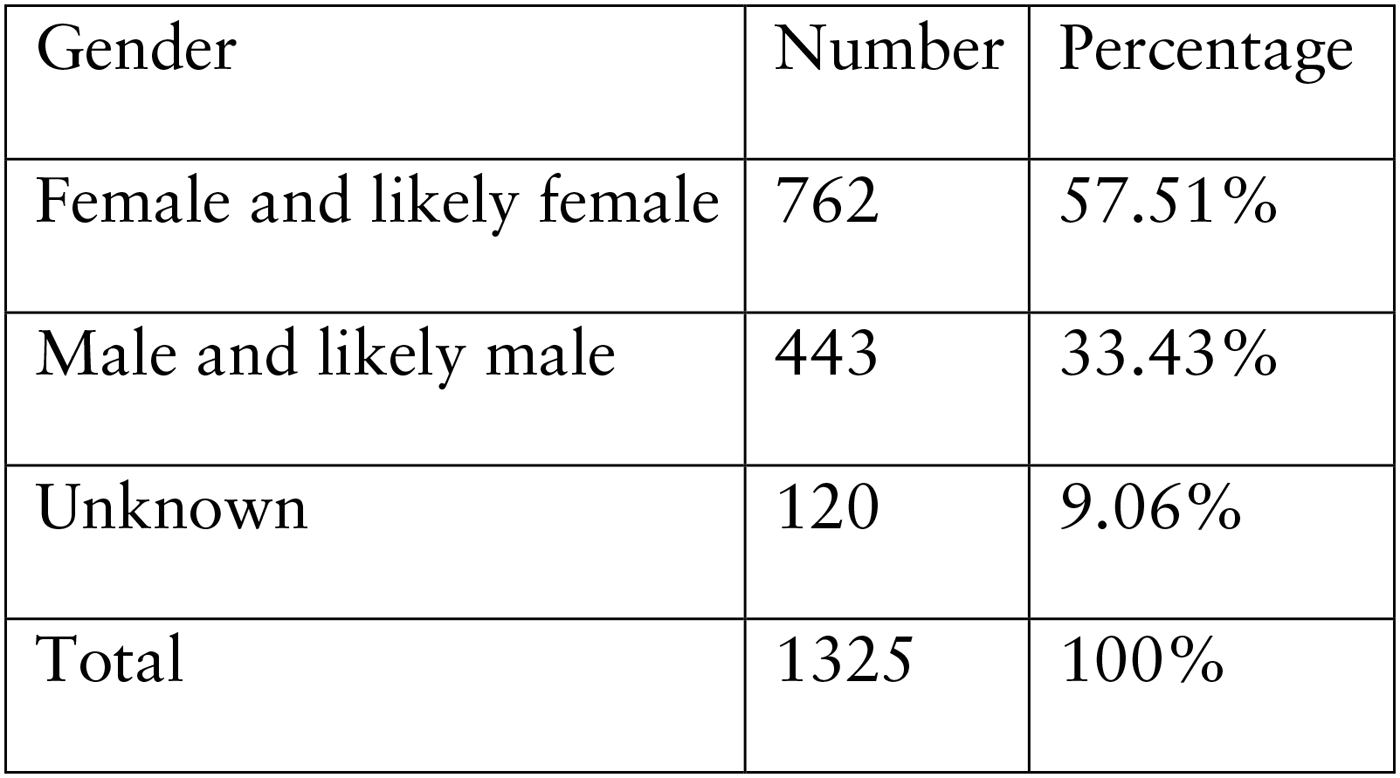
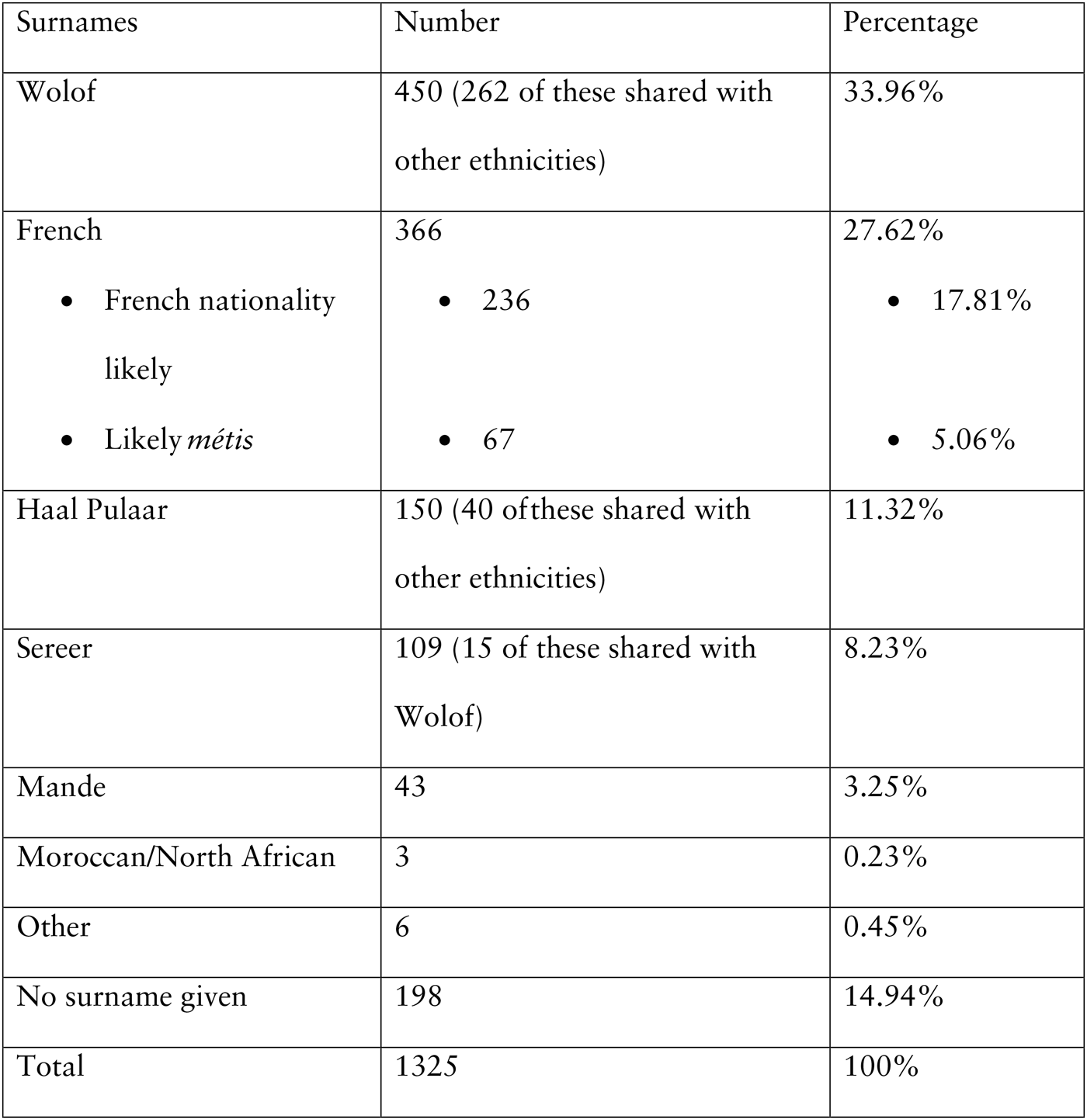
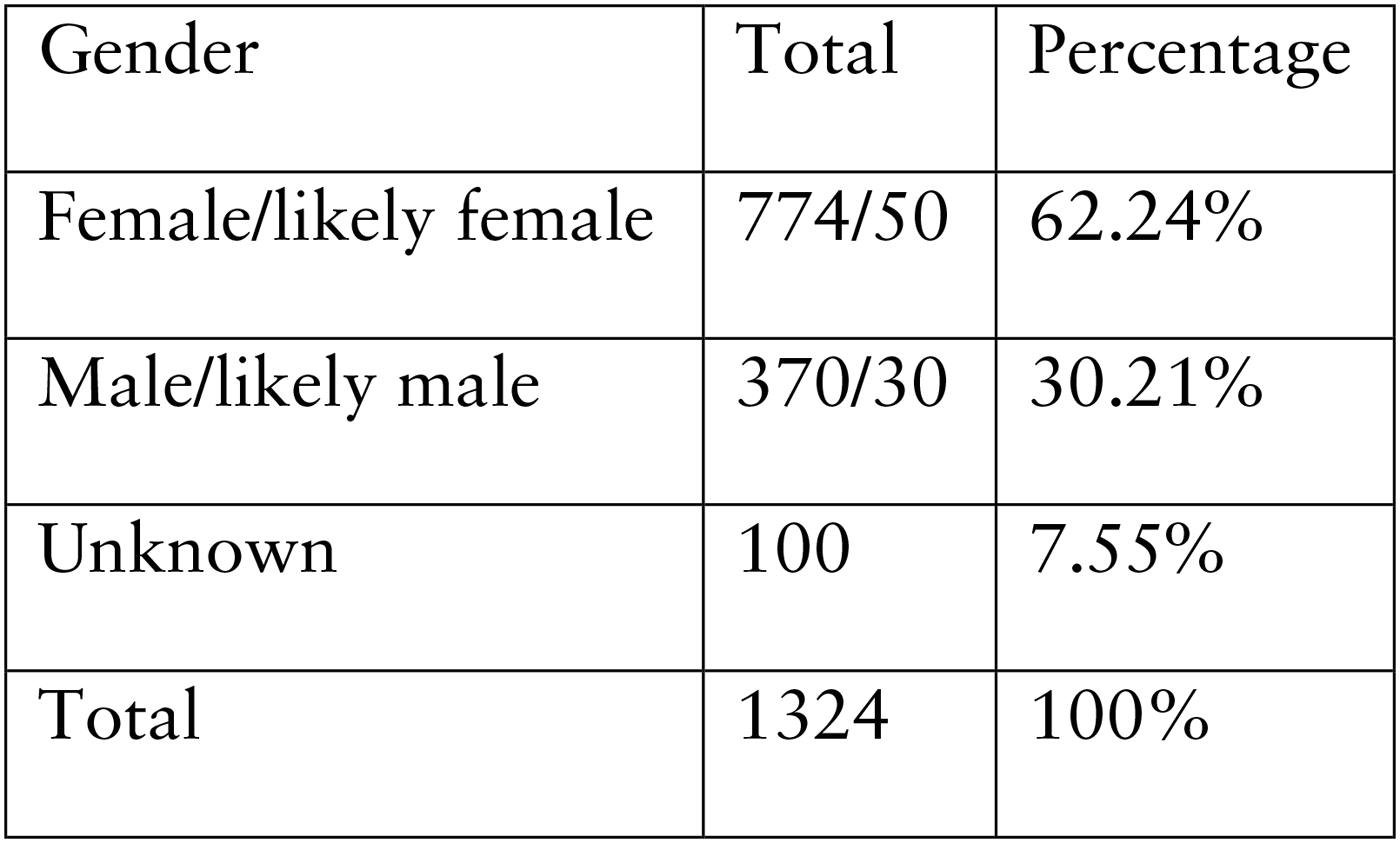
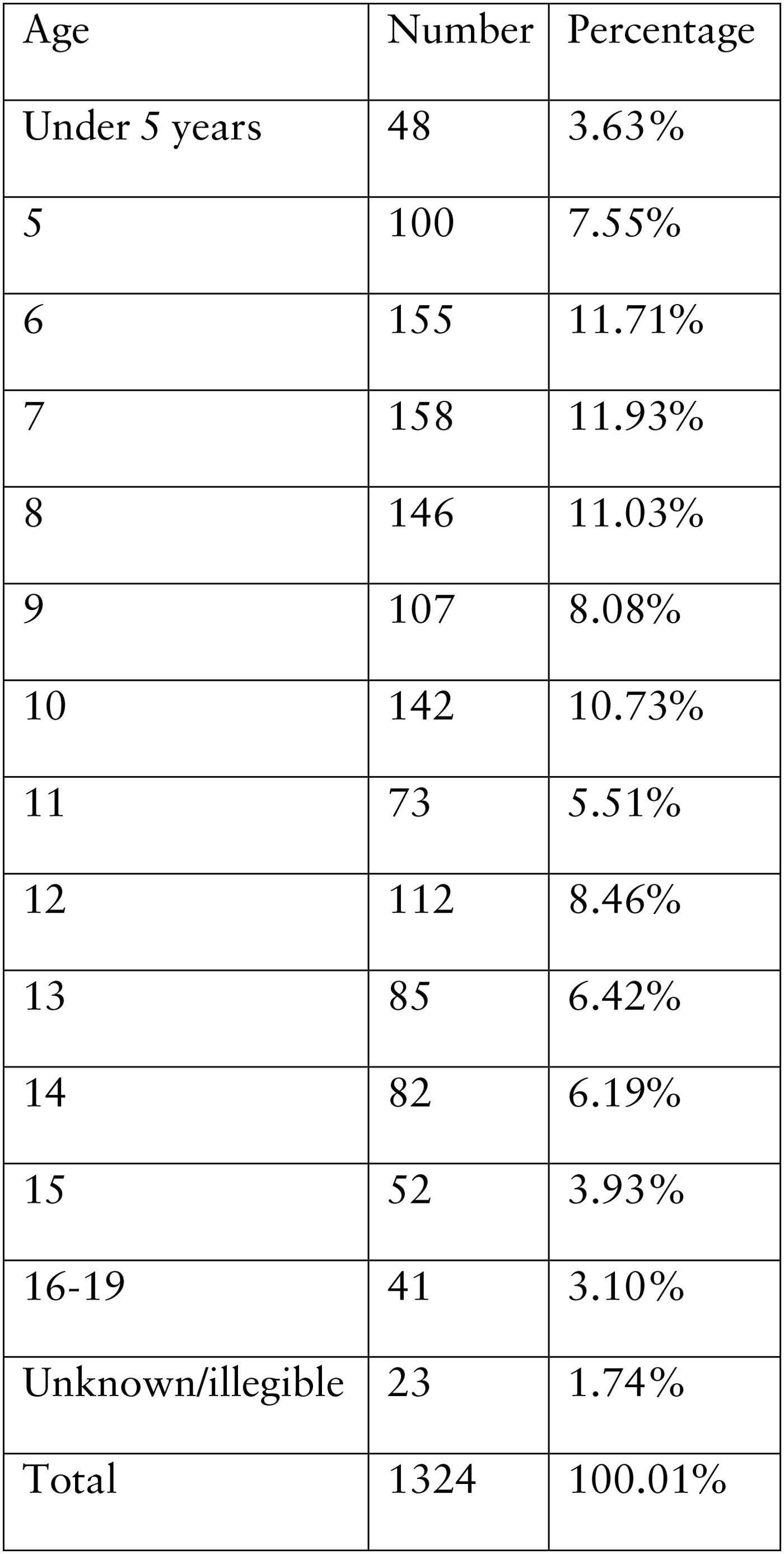
Senegal's turn-of-the-century guardianship system had much in common with the urban domestic slavery it had replaced. Prior to emancipation in 1848, enslaved girls and women, for example, had worked primarily as pileuses (millet pounders), laundresses, and in other aspects of domestic service, precisely the occupations that predominated among female liberated minors, as I discuss in more detail below. In this period, guardians in Saint-Louis, as shown in Fig. 1 below, tended to be female, echoing earlier slave ownership practices of signares, and, as shown in Fig. 2, their surnames suggest that they were mostly Wolof, French, or of mixed French and African (métis) ancestry. For their part, liberated minors tended to be female and young, but old enough to perform many household tasks and other labor, with 53.4 per cent of them falling between the ages of six and ten, as shown in Figs 3 and 4. Despite the likelihood of some error in these ascribed ages — the records contain multiple examples of new estimated ages made in subsequent encounters with the children — they suggest that families intended to benefit from children's labor for years, since they would remain under guardianship until found to have reached majority at 18. They are also consistent with the increasing importance of slave children across the region in the mid- to late-nineteenth century. Although minors came from as far away as the Congo Free State and from as nearby as the French protectorate in Senegal, officials most frequently recorded as their ‘place of birth’ various sites within the Soudan (24.1 per cent of the 806 entries that include birthplace information), ‘among the Moors’ or other references to Mauritania (14.8 per cent), and ‘among the Bambaras’ (28.0 per cent). The areas and peoples referenced in these records suffered instability and warfare in the late nineteenth century, conditions that, as in earlier decades, led to the enslavement of tens of thousands, including those who went on to become liberated minors. Thus, despite real differences in scale — there were 6,008 enslaved people among Saint-Louis's 12,138 residents in 1845, but perhaps only 800 liberated minors in a population of 28,469 in 1904 — there was considerable continuity in their experiences of enslavement or ‘liberation’.Footnote 24
Guardians in Saint-Louis, Senegal, 1895–1911, Gender.Footnote 20
Notes: The table does not include information on the subsequent guardians to whom some liberated minors were assigned. One of the liberated minors was entrusted to a couple, rather than a single individual as was the norm. The total number of guardians reflects this.

Guardians in Saint-Louis, Senegal, 1895–1911, surnames and ethnicities.Footnote 21

Liberated Minors in Saint-Louis, Senegal, 1895–1911, Gender.Footnote 22

Liberated Minors in Saint-Louis, Senegal, 1895–1911, ascribed age when entering guardianship.Footnote 23

The costs and benefits to guardians also had much in common with slavery, despite some important divergences. Officially, guardians had to provide liberated minors with shelter, food, and clothing; tend to them when ill; and ensure that they acquired skills or a trade that would prepare them to make a living after they reached majority. Guardians were strictly prohibited from selling liberated minors and they had to notify the administration of plans to relocate. With official permission, they could arrange marriages on behalf of liberated minors, and although they could receive bridewealth, they were not supposed to retain it for their own benefit. In return, they could benefit from any labor performed in the context of professional training or apprenticeship. In practice, most guardians requested liberated minors to perform work that might once have been assigned to slaves, and at least a few childless women made the case that their wards took the place of the children they lacked. Guardians frequently retained liberated minors well past their majority, spent bridewealth, and even claimed rights to children born to their wards. They tended not to notify the administration when they moved or traveled. Before Roume's reforms took effect, the state seems to have intervened only in cases involving the worst physical abuse, by temporarily or permanently removing the child.Footnote 25 For decades, town residents had incorporated formerly enslaved children by treating them essentially as slaves. As oversight of guardianship increased after 1903 and as the French began to challenge slavery in the region, however, negotiations about the labor, behavior, and indeed the childhoods of liberated minors took on new importance.
LABOR
Not surprisingly, given the connections between guardianship and slavery, reports of the guardianship commissions after 1904 and other correspondence point to the labor of liberated minors as a central concern. Indeed, officials in Senegal, as in other post-emancipation societies, had long worried about the work ethic of former slaves, and this concern had led to the creation of guardianship in 1849. Yet preparing children to become productive workers took on new importance in the early twentieth century, as officials touted economic development and social progress.Footnote 26 In this context, officials and guardians continued to develop specific, and often gendered, expectations for the work performed by liberated minors in colonial towns, that at least appeared distinct from slavery. At the same time, some liberated minors envisioned childhood differently, rejecting overly taxing workloads and communicating their own ideas about how guardians should treat them.
With the creation of guardianship, official rhetoric emphasized training for liberated boys, deeming their labor essential to the economy, and this preoccupation continued into the twentieth century. Indeed, Roume's 1903 reform called on the administration to send newly liberated minors to public ‘institutions for aid or apprenticeship’ or, under certain circumstances, to ‘private workshops’.Footnote 27 Yet in practice, very few held formal apprenticeships or attended colonial vocational schools, as indicated by a 1904 study that found only 17 boys learning trades like woodworking, carpentry, bread baking, and bookbinding from master artisans in Saint-Louis. The colony's trade schools incorporated even fewer of these children, at least in the years before and immediately after Roume's reforms. Asked in 1904 to submit a list of liberated minor boys equipped to attend the Pinet-Laprade vocational school in Dakar, the guardianship commissions in Saint-Louis and Dakar came up with only a handful of names. Their counterparts elsewhere proposed none at all.Footnote 28
In contrast, it seems likely that many liberated minors learned a trade by assisting their guardians with their work. Of 1,324 children who entered guardianship in Saint-Louis after 1895, for example, at least 299 of them were placed with Africans who worked as pileuses (millet-pounders), laundresses, fishermen, traders, sellers, and cloth-dyers. Significantly, pileuses, laundresses, and cloth-dyers, all of them women, almost always took in female wards, while men who fished or engaged in trade predominantly served as guardians for boys.Footnote 29 These trends likely resulted from the gender preferences of guardians, who could make specific requests, and they might also suggest that the liberated minors learned these gendered professions from their guardians.
While some liberated minors specialized in specific skilled trades, many — girls and boys — performed domestic service in private homes or in commercial settings. This was likely the experience of most of the over 175 liberated minors entrusted to colonial officials, interpreters, railway workers, soldiers, representatives of commercial firms, lawyers, and others in professions directly tied to the colonial administration or economy. And many of the 27 liberated minors entrusted to ‘property-owners’ and the 232 placed with women listed as ‘housewives’ or ‘wives’, or as having no profession, probably worked in domestic service as well.Footnote 30 Indeed, European and métis guardians almost uniformly used their wards in this capacity, and the association between liberated minors and domestic service became so commonplace that some used the terms interchangeably.Footnote 31
Yet although both girls and boys provided domestic service, gender shaped the nature of work performed. White or métis guardians who ran French-oriented households expected girls to do laundry, iron, clean, care for children, cook, and run errands. Hence, in a 1906 letter complaining about the attitude of his ward of ten years, M. Alexis Béziat referred to her as his ‘maid [ma bonne]’. The following year, Dakar entrepreneur M. V. Peignet asked the government to make him the guardian of ‘2 young girls of 12 to 15 years for the service of my house’. They would run errands in town, ‘wash dishes and help cook for me’, he wrote, adding that he would treat them like they were his own children.Footnote 32 And in 1909, the administrator of Tivaouane, P. Godel, noted that Aïssatou had settled in to her relatively new role providing childcare in his own home.Footnote 33 These examples make clear that guardians in such households viewed liberated minor girls primarily as maids and child-minders. The nature of the work performed by liberated minor girls in homes following African customs is harder to discern from the archival record, but information compiled by the Rufisque guardianship commission in March 1906 provides some insight. The commission indicated that all seven female wards in African households did ‘housekeeping [ménage]’ or worked in the ‘interior’ of the house, in most cases living with the family or with other domestics.Footnote 34
Liberated minor boys filled a wider variety of roles as domestics, serving as valets, butlers, and livestock attendants in addition to cooking, cleaning, and running errands. They performed these tasks almost exclusively for French officials and for those directly associated with the colonial administration or French economy.Footnote 35 J.-J. Crespin, an official in the Secretary General's office, for example, had Balla Fall run errands and perform other household tasks. Mme H. Bancal envisioned even more distinctly gendered roles for her wards when in 1908 she asked the secretary general to send her ‘two orphaned minors’. Specifically, she requested a ‘young man, age 12 to 14, who will serve me by tending the small herd of animals that I keep in Guéoul’, and a ‘little girl between 8 and 12 years, who I will teach to serve me and to work’.Footnote 36 Other boys served as domestics in commercial enterprises or offices, jobs that girls do not seem to have performed.Footnote 37
Regardless of their social position, race, or cultural background, guardians agreed to take in wards because they valued their labor, and officials continued to try to accommodate residents’ appeals for children to perform specific, often gendered, tasks. Tellingly, the lieutenant governor responded to M. Peignet's request for two girls by explaining that all minors were currently ‘employed’. Likewise, he told Mme Bancal that he would try to honor her request as soon as possible, though marginalia added to her letter suggest that someone in the administration questioned her intention to teach a girl to serve and work.Footnote 38 As they attempted to distance guardianship from exploitation, officials discussed the benefits of paying the oldest liberated minors, yet they do not appear to have questioned the assumption that formerly enslaved children should spend their childhood as laborers. This position certainly stemmed from concern about the viability of African economies as slavery declined, but it also reflected assumptions about class and social status originating in both France and West Africa. Indeed, metropolitan stereotypes linked idleness to vice in the working class, and in the region, (former) slave status remained stigmatized and associated with particular types of labor.Footnote 39 Thus, although a 1911 manual for administrators indicated that liberated minors should attend the French school ‘whenever possible’ and although officials generally worried about African enrollment at colonial schools, guardianship emphasized work as the defining feature of childhood for formerly enslaved children in post-emancipation Senegal.Footnote 40
Although guardianship often successfully managed children's labor, unreasonable labor demands, criticism of work performance, and punishment sometimes prompted challenges to or ruptures in the system. By complaining to the authorities or running away, some liberated minors expressed dissatisfaction with their working conditions. These behaviors triggered inquiries and — at least occasionally — material change in minors’ circumstances. Although such challenges to guardianship were recorded relatively infrequently, the colonial archive contains enough of them to suggest that not only did liberated minors have their own sense of what constituted acceptable treatment, but also that when their own experiences fell short, they employed a variety of strategies to rectify the situation. In a few other cases, by contrast, liberated minors spoke or acted in ways that signaled acceptance of their circumstances. In these varied responses, and likely in others not captured by the colonial archive, liberated minors weighed in on what childhood might mean for former slaves in post-emancipation Senegal.
Liberated minors sometimes complained to authorities about their guardians’ impossibly high standards or disparaging remarks, a step that must have required considerable courage given their marginalized status. In December 1905, for example, Awa Siga told a police interpreter that she no longer wanted to stay with Mme Lefranc because the woman frequently beat her. When a police officer inquired, Mme Lefranc admitted to striking Awa with a shirt in a spat over laundry, but maintained that she had not hurt the girl, a contention with which the officer agreed. Awa had done a poor job, she said, and had been ‘insolent’ in response to criticism. Mme Lefranc conjectured that Awa, who had recently accompanied her on a seven-month stay in France, begrudged having to return to a more constrained and difficult environment in Saint-Louis.Footnote 41 Whether or not this was true, it is certainly possible that Awa's experiences in France empowered her to pursue her own interests in Senegal. Bigué N'Diaye also expressed frustration with her guardian's criticism of her work, though she went about it in a different way. Appearing before the October 1906 meeting of the Saint-Louis guardianship commission, Bigué told commissioners that she wanted a new guardian, since Mme A. Patterson was ‘never satisfied with her services’ and was ‘continually reproaching her’. Although guardians normally accompanied their wards to these meetings, Mme Patterson had left the task to someone else on that date, and it is likely that her absence allowed Bigué to air her grievances more freely.Footnote 42 In turning authorities’ attention to their complaints, these girls not only contested the stigma that allowed guardians to mistreat them, but also attempted to use colonial structures to their advantage.
Liberated minors also sometimes ran away in order to escape harsh treatment or work demands that they found overly burdensome. And though liberated minors pursued such extreme actions relatively rarely — I have found only 41 cases for Saint-Louis between 1895 and 1911 — they tended to attract significant attention from the administration.Footnote 43 In March 1905, for example, Balla Fall ran away from J.-J. Crespin, an action that resulted in a three-day prison sentence. Not yet fully recovered from an injury that had given him a reprieve from domestic service, Balla had packed his clothes and fled when asked to run an errand. Ultimately, fed up with this and other incidents of ‘misconduct’, Crespin relinquished guardianship over the 19-year-old, and Balla was sent to the orphanage in Sor.Footnote 44 Similarly, in October 1906, Nielé Diara ran away from Mme Vigier, who had been her guardian since 1898, the year of her emancipation at the age of seven. When the police found her, Nielé told them she had fled because Mme Vigier had asked her to continue performing housework despite the fact that she had a sore finger. Though the police commissioner doubted this explanation, noting that Nielé’s finger wound appeared small, it is certainly possible that Mme Vigier's demands seemed unreasonable to the girl.Footnote 45 Balla and Nielé thus seem to have rejected the expectation that they work while injured.
Other liberated minors fled guardians who beat them or failed to adequately provide for them. In 1906, for example, Sokhna Trawalé began repeatedly running away from her guardians. When the police asked why, she told them that Mme Gaillard frequently beat her without warning or reason. In February 1911, the police learned that Bayérika had run away from Abou Diop because ‘she was not well cared for’. Similarly, when the police located him in Goundou village in April 1906, 15 days after he fled the Saint-Louis home of his guardian, Baka Sar N'Diaye, young Abdoulaye explained that he was frequently beaten. He also complained about missing out on schooling, noting that N'Diaye did not send him to any school, French or Qur'anic. N'Diaye vehemently denied these accusations, mustered witnesses to attest that Abdoulaye's misbehavior sometimes required physical ‘correction’ and expressed sadness at the prospect of losing the boy he had raised for seven years, since around the age of four. In the end, Abdoulaye returned to his guardian, only to flee again a little over a year later, after which he disappeared from the archive.Footnote 46 These episodes of flight show how some contested an exploitative system. In running away, these liberated minors pushed back against stigmas of slavery, challenged the terms under which they could partake in urban life, and underscored the limited humanity of the colonial state.
The liberated minors who ran away from their guardians tended to be older, as in the example of Noumbé Daffa, with whom this essay began, and several of the cases discussed above. At least 27 of 41 Saint-Louis runaways were 13 or older, and perhaps 9 of these had reached the age of majority but remained in guardianship. The decision to run away thus may have reflected a desire for greater autonomy as they neared an age at which many married or struck out on their own. This seems to have been the case for Balla Fall, who ran away a second time shortly after the secretary general removed him from the orphanage and returned him to J.-J. Crespin. This time, Balla went to a town along the railroad where he found a job as a cook for a M. Morilhon. Similarly, in a 1908 investigation of a runaway, the Dagana administrator found that Boubakar Gueye was in fact 24 years old. He had left his guardian, a carpenter in Saint-Louis, and had begun to work with a fisherman in Dagana. ‘Given his age’, the official wrote, Boubakar had said he ‘wanted to be emancipated [affranchi], being capable of being self-sufficient’.Footnote 47 As these examples suggest, running away could force the state to recognize independence from guardianship.
Although disagreement regarding labor expectations and treatment was one of the most common sources of conflict between guardians and liberated minors, most liberated minors did not openly criticize their guardians or complain to the guardianship commissions. This lack of evidence almost certainly stems in part from colonial hierarchies that silenced many marginalized people, from gaps in the records maintained by commissions inclined to indicate that all liberated minors appeared ‘well’, and from the fact that hundreds of liberated minors escaped commission surveillance entirely.Footnote 48 Yet it may also be the case that at least some did not wish to complain. Perhaps, for some, guardianship offered stability or seemed less exploitative than slavery. Abibou M'Baye raised this possibility when he apparently told the commission in 1905 that he was ‘well cared for’ and ‘content’.Footnote 49 Furthermore, some chose to remain with their guardians as paid workers after they reached majority. In 1906, for example, Yacine Diouf, age 22, continued to perform domestic service for her guardian, Mr Deproge of Thiès, after being removed from guardianship, though she now received a wage. These examples suggest that even as some liberated minors challenged stigma and mistreatment, labor, sometimes performed for guardians under altered conditions, remained an important economic strategy and childhood experience.Footnote 50
By mediating guardians’ access to labor and children's work experiences in colonial towns, guardianship provided an opportunity for those involved with it to shape trajectories of childhood for the formerly enslaved in post-emancipation Senegal. Neither officials, committed to economic growth and vocational training, nor town notables, guided by longstanding prejudices, questioned the assumption that work should define childhood for liberated minors, Roume's reforms notwithstanding. For their part, liberated minors generally accepted the idea that they should work — indeed, adults also demanded labor from children of free status — but some of them challenged guardianship when the workload was too heavy or treatment too harsh. Through such actions, these liberated minors made clear that, in an era of reform and antislavery rhetoric, post-emancipation childhood would need to be negotiated and not simply imposed.
(MIS)BEHAVIOR
Guardianship also structured debates about the behaviors deemed acceptable for formerly enslaved children, and served, in a way, as an institution of moral reform. Indeed, liberated minors’ behavior and morality worried officials, commissioners, and guardians alike. Guardians complained when wards acted out, asked the secretary general to help with discipline, and even sent unruly wards away. At the same time, guardianship commissions collected information about minors’ ‘material and moral’ status, asking questions of young people and their guardians to elicit this information.Footnote 51 By probing, evaluating, documenting, complaining about, and disciplining the conduct of liberated minors, officials and guardians sent a message to these children about the kinds of behaviors that they considered unacceptable. Yet conversely, liberated minors may have deployed so-called misbehavior strategically, to register discontent with their circumstances or claim greater autonomy. The behavior of liberated minors became a significant point of contention, and the discourses surrounding it raised questions about how formerly enslaved children might contribute to and belong in Senegal's towns.
Guardians frequently complained that liberated minors refused to obey, failed to respond with appropriate respect, or habitually misbehaved. Indeed, guardians often cited ‘insolence’, ‘disobedience’, or ‘misconduct’ as grounds for terminating guardianship, and in a few cases, they accused liberated minors of theft. In November 1904, for example, sales representative Edouard Duprat sent minor Tiephi Samba away, explaining to the secretary general he could not ‘make use of [him] at all, due to the disobedience and ill will of this child’. In late 1907, Edouard d'Erneville returned Alcagny to the administration, citing his ‘deplorable conduct’. And in September 1909 Widow Paul Deproge notified the official that she had recently turned her ward, Gaston Fall, over to the police, since he had stolen from her over a long period. Unable to ‘correct’ his errant behavior, she wanted to give up guardianship.Footnote 52 The secretary general typically accepted these sorts of complaints and worked to find new placements for the liberated minors in question, turning to the hospital, the prison, or the orphanage to take them in when private individuals did not come forward. Thus, through guardianship, guardians and officials worked together to enforce standards for liberated minors’ behavior. They envisioned a childhood for these low status minors that consisted of service, respect, and quiet obedience, in essence deploying state resources to impose behavioral norms that varied little from slavery.
Liberated minors, of course, did not uniformly accept these expectations. While some apparently complied, a small number acted out in ways that had disproportionate impact, since they captured the time and attention of guardians, officials, and sometimes police. Their disobedience, disrespect, theft, and other undesirable actions can be read as what James C. Scott described as ‘everyday forms of resistance’.Footnote 53 And, since complaints of misconduct sometimes resulted in a change in guardianship, such actions could have material impact on liberated minors’ circumstances. In August 1906, for example, liberated minor Cecilé began refusing to complete her household work and started responding to her guardian with what Mme Le Franc called ‘extreme insolence’. Furthermore, on two occasions, she fled to M. and Mme Roumégaux, who lived in the city of Saint-Louis, some distance away from the Le Franc home. Unable to tolerate this misbehavior, Mme Le Franc sent the girl back to the administration, and the secretary general promptly made Mme Roumégaux her guardian. Yet she remained uncooperative, and within days, Henri Roumégaux notified the secretary general that they would not keep her since she was ‘lazy’, ‘licentious’, and always seeking to ‘escape’. After a third woman agreed to take Cecilé, but abruptly changed her mind when she learned about the girl's reputation, the secretary general decided to send Cecilé, who was about 12, to the Catholic girls’ workhouse. Though we cannot discern Cecilé’s intent, it is notable that her disagreeable behavior ended her relationship with a series of guardians, ultimately bringing her to the Sisters of Saint-Joseph of Cluny.Footnote 54
The outcome of habitual misbehavior was perhaps happier for Saïdane, a liberated minor who lived in Tivaouane and who found himself emancipated from guardianship at around age 15. Because he had run away several times from both local chief Maissa M'Baye and trader Amadou M'Boup, and because he had earned a reputation for a difficult and ‘demanding’ temperament, no one wanted to take him in. In November 1909, the secretary general decided that Saïdane did not need yet another guardian but was old enough to support and take care of himself.Footnote 55 As in Cecilé’s case, Saïdane's misconduct prompted discussion and then intervention from the colonial state, though with a different end. In refusing to obey and otherwise misbehaving, these liberated minors upset lingering social norms associated with slavery and made clear that they wanted to belong in the community on their own terms.
Even as guardians and officials attempted to enforce specific expectations for the comportment of all liberated minors, they paid additional attention to girls, policing their mobility and their sexuality.Footnote 56 Guardianship commissions and police officers sent to investigate guardianship-related matters may have asked questions about sexual liaisons, and they took note of female minors’ pregnancies, children, and marriages. More significantly, numerous guardians complained that older female wards committed sexual improprieties or went out at night without permission, and when they asked to terminate guardianship, the secretary general obliged.
Hence, in September 1906, M. Fréau sent back a 14-year-old liberated minor after only 10 days, describing her as ‘licentious (vicieuse) and lying’. The girl, Sokhna Trawaré, did ‘not want to stay in my home unless I give her the freedom to run around where she wants at night’, Fréau claimed, and would ‘not stay anywhere’ unless permitted these liberties. Similarly, in January 1907, Charles Pellegrin planned to end his guardianship over Niellé, a girl of about 15 who had come to his home a few months before. This liberated minor had ‘intolerable conduct’, he claimed, continuing to ‘spend her nights outside’ despite his efforts to correct her behavior.Footnote 57 In attempting to constrain the mobility and presumed sexual activity of their female wards, these guardians, one French, the other métis, positioned chastity as central to the girlhood available to liberated minors, yet they also reinforced slave-era norms giving masters control over the sexuality of their slaves.Footnote 58
Fears that officials would judge them harshly for failing to instill bourgeois French morality in their wards, that liberated minors would turn to prostitution, or that they could be accused of prostituting their charges likely played a role in leading these French and métis guardians to send problematic girls away.Footnote 59 Yet even as some guardians viewed the street as a space of sexual immorality, others created sexual danger inside their own homes, exploiting the vulnerability of their young wards. Indeed, liberated minors in Senegal were sometimes targets of sexual advances, including rape, from their guardians and employers, a problem exacerbated by the widespread stigma linking slave status or descent to sexual licentiousness.Footnote 60 In August 1906, for example, a liberated minor named Awa fled the sexual abuse she suffered in the home of her guardian, Mme Marième Sow of Saint-Louis. When the police tracked her down to nearby N'Dar Toute, where she was staying with M. Bara N'Dao, they found the 20 year old in an advanced stage of pregnancy. She had run away, she explained, because her guardian's husband had fathered the child, and the family had started treating her poorly after they learned of her pregnancy. Given this, the police commissioner called on the secretary general to house Awa in the civil hospital instead of returning her to her guardian. The police commissioner's willingness to put aside his usual skepticism at liberated minors’ complaints suggests that this sort of exploitation may have been common.Footnote 61
Sexual relationships, whether consensual or forced, could directly impact girls’ status as wards, especially if they produced children. Officials, commissioners, and some guardians promoted sexual restraint among liberated minor girls; yet the state also recognized childbearing and marriage as indicators of majority that could emancipate girls from guardianship. This was the experience of some, though certainly not all, of the 83 young women who had one or more children and the 132 young women who married between 1895 and 1911 while still under guardianship in Saint-Louis.Footnote 62 Although these numbers surely include some exploitative sexual encounters, it is also possible that some liberated minor girls pursued sexual relationships strategically. Indeed, not only could marriage or childbirth lead the state to remove a young woman from guardianship, but to the extent that liberated minors decided about sex for themselves, they made a powerful statement about personhood, pushing back against the idea that guardians, like slave masters of the past, should control dependents’ sexuality. In disobeying, disrespecting, running away, and having sex, liberated minors challenged assumptions about how dependent and formerly enslaved children should behave. Tracked and monitored more regularly after Roume's reforms, their rebellious behavior highlighted ways in which the state fell short of its aims of child protection and made the case that, while their childhoods might be defined by work and dependence on non-kin guardians, they should not be treated like slaves.
CONCLUSION
In reforming guardianship in Senegal, Roume, Guy, and others moved to situate this state institution at the center of debates about how post-emancipation society would function and how childhood might be defined for the formerly enslaved. With increased emphasis on monitoring and record-keeping after 1903, guardianship took on new importance as the colonial state began to more aggressively undermine slavery in the region, develop new bureaucratic structures, pursue secularization, and promote economic development. Yet despite the rhetoric of child protection that characterized much official correspondence, records show that the state largely accepted local assumptions about the type and amount of labor appropriate for formerly enslaved children and the deferential behaviors they should display.
Liberated minors, on the other hand, sometimes challenged dominant expectations, linked to slavery, about their work lives, interactions with guardians, and sexuality. Focusing, insofar as records allow, on their actions and perspectives, not only allows us to better understand the experiences of formerly enslaved children and young people, but also reveals that they had a significant impact on post-emancipation Senegal as they used the state's new commitment to child protection to challenge extreme mistreatment and combat certain kinds of stigma. Guardianship, then, shaped post-emancipation society, but largely because some children used it as a vehicle to make their own change.