When Bartolomé Colon encountered a trading canoe off the coast of the Yucatan Peninsula in 1502 containing “copper axes and bells which were used as currency” (Columbus Reference Columbus1959; Piña Chan Reference Piña Chan, Lee and Navarette1978:39), he was unaware that the artifacts were valuable commodities with complex and intersecting economic, social, and ritual meanings. Mayapan was an urbanized core zone in the Postclassic Mesoamerican world system that exchanged raw materials, prestige goods, and subsistence goods used in everyday life. Because the Yucatan Peninsula contains no native sources of metal (Bray Reference Bray and Hammond1977:397), the inhabitants of Mayapan took advantage of long-distance trade connections to obtain finished metal objects, the materials to make them, and the specialized knowledge to produce them. Local metalworkers at Mayapan imported luxury goods from distant areas of Mesoamerica and literally reshaped them to suit their own tastes, needs, and demands or those of their patrons. These patterns of production and consumption reflect both local and interregional influences and vary according to the socioeconomic status of the consumers. While metal objects were luxury items available to those who could afford them, wealthy inhabitants could afford them in greater quantity and variety.
The concept of the Postclassic Mesoamerican world system is useful for understanding the interaction of Mayapan with other metalworking sites in non-Maya cultures. The original world-systems model developed by Immanuel Wallerstein (Reference Wallerstein1974) was a Marxist critique of structural-functionalist and modernist theories in sociology and sought to explain the rise of a European world economy based on the capitalist mode of production (Shannon Reference Shannon1989; Wallerstein Reference Wallerstein1974:67). World systems incorporate smaller units such as cultures, tribes, nations, states, classes, or ethnic groups (Schortman and Urban Reference Schortman and Urban1992:17) into an economic system that constitutes a single economy based on global economic exchange and division of labor (Shannon Reference Shannon1989). Rather than assuming that economic, political and cultural boundaries overlap, Wallerstein's (Reference Wallerstein1974:347–348) model differentiates among three types of systems: (1) world empires, which are economically and politically unified; (2) world economies, which involve economic exchange across cultural and political boundaries; and (3) mini-systems, which are territorially small with overlapping political, cultural and economic boundaries.
A fundamental characteristic of world systems is that the division of labor is unevenly distributed geographically between core zones, semi-peripheries, and peripheries (Chase-Dunn and Hall Reference Chase-Dunn and Hall1997:35–36). This uneven economic development often results in the articulation of an interregional division of labor with the processes of state formation (Hopkins Reference Hopkins and Goldfrank1979). According to the theory, political networks and economic networks can mutually reinforce each othersuch that strong states develop in core economic areas and weak states develop in peripheral areas. In addition, different zones within the world system shift in their role over time (Chase-Dunn and Hall Reference Chase-Dunn and Hall1997:35–36). Wallerstein's ideas have been applied to a number of academic disciplines, including sociology, history, economics, and anthropology and anthropological archaeology (Chase-Dunn and Hall Reference Chase-Dunn and Hall1997; Kepecs and Kohl Reference Kepecs, Kohl, Smith and Berdan2003:14). However, I will limit the discussion to those Mesoamerican archaeological examples that are the most relevant to my study.
While scholars disagree on whether the adoption of a world-systems approach is an appropriate lens for examining Postclassic Mesoamerica (Kepecs and Kohl Reference Kepecs, Kohl, Smith and Berdan2003:19), previous research suggests that there are numerous benefits to this concept as long as definitions are modified to reflect the organizational differences of New World states (Chase-Dunn and Hall Reference Chase-Dunn and Hall1997; Schortman and Urban Reference Schortman and Urban1992; Smith and Berdan Reference Smith and Berdan2000, Reference Berdan, Masson, Gasco, Smith, Smith and Berdan2003). Postclassic Mesoamerica was a multicentric and commercialized world economy but never became a world empire (Kepecs and Kohl Reference Kepecs, Kohl, Smith and Berdan2003:18). The Aztec empire of central Mexico was perhaps the most powerful empire in Mesoamerica, although it existed within a world context that included other, smaller, autonomous political cores (Blanton and Feinman Reference Blanton and Feinman1984). Mesoamerica never had a core–periphery hierarchy at the world-system scale or a single, all-encompassing world system (Kepecs and Kohl Reference Kepecs, Kohl, Smith and Berdan2003:18). Instead, Postclassic Mesoamerica had both regional and interregional exchange circuits that formed subsystems for the exchange of goods and information and that changed over time with the waxing and waning of political centers (Smith and Berdan Reference Smith, Smith and Berdan2003:30).
Scholars studying Mesoamerica and other non-European regions often refine Wallerstein's original definitions and models while continuing under the label of world-systems theory (Chase-Dunn and Hall Reference Chase-Dunn and Hall1997), and others frame the patterns in terms of cross-cultural trade (Curtin Reference Curtin1984) or interregional interaction (Schortman and Urban Reference Schortman and Urban1992). More emphasis has been placed on broad economic concepts such as the long-distance exchange of commodities and division of labor across political boundaries than on his specific case study and definitions. Mesoamerican archaeologists have applied world-systems models to societies with commercialized but non-capitalist economies (Blanton and Feinman Reference Blanton and Feinman1984; Kepecs et al. Reference Kepecs, Feinman and Boucher1994; Smith and Berdan Reference Smith, Smith and Berdan2003). Many adaptations of world-systems models challenge Wallerstein's contention that the exchange of luxury goods among elites does not produce important systematic effects or contribute to economic complexity (Chase-Dunn and Hall Reference Chase-Dunn and Hall1997:28, Schneider Reference Schneider1977:27). Jane Schneider (Reference Schneider1977:27) argues that to ignore luxuries as nonessential items is to ignore their role in the creation and reinforcement of status and wealth, the mobilization of labor, and the political ends that wealth could serve. World-systems models are ideally suited to examining the systemic properties behind elite exchanges of symbols and luxury goods and how long-distance exchange created, maintained, or changed local social structures (Blanton and Feinman Reference Blanton and Feinman1984:674; Feinman and Nicholas Reference Feinman and Nicholas1991:13–18; Kepecs et al. Reference Kepecs, Feinman and Boucher1994:142).
Luxury goods formed a significant part of Mesoamerican long-distance exchange (Kepecs et al. Reference Kepecs, Feinman and Boucher1994). Unfortunately, approaches that focus on elite exchange often assume that luxury items were also sumptuary items and do not take into account different levels of commercialization in Postclassic Mesoamerican economies. Luxury goods and sumptuary goods are both consumed by high-status individuals; luxury goods are restricted to the economically wealthy due to high cost, and sumptuary goods are restricted to certain groups within society through laws or social rules (Levy Reference Levy1979:50). In a society with a commercialized economy, luxury goods would be archaeologically associated primarily, but not exclusively, with high-status individuals.
While the concept of interregional interaction is inherent in the concept of “Mesoamerica” as a cultural region, interregional economic exchange was generally associated with diffusionism before the concept of the world system gained popularity. For example, trade models of the 1960s and 1970s focused on diffusion (Piña Chan Reference Piña Chan, Lee and Navarette1978; Rathje Reference Rathje, Sabloff and Lamberg-Karlovsky1975; Sanders Reference Sanders1960). William Rathje (Reference Rathje and Leone1972, Reference Rathje, Sabloff and Lamberg-Karlovsky1975) anticipated Wallerstein's work and used a “core–buffer” model to examine exchange in the Yucatan Peninsula (Masson 2002). He suggested that demands for non-local utilitarian items such as salt, basaltic or groundstone metates, and obsidian in the Peten, where these items were unavailable, led to the development of hierarchical social organization as core centers gained control over long-distance exchange networks (Rathje Reference Rathje and Leone1972). Jeremy Sabloff and Rathje (Reference Sabloff and Rathje1975) suggested that, by the Late Postclassic, bulk trade in utilitarian items was facilitated by maritime exchange networks, which resulted in a more even distribution of resources across sectors of the population.
World-systems perspectives have been usefully employed in Oaxaca to explain patterns of exchange (Blanton and Feinman Reference Blanton and Feinman1984; Feinman and Nicholas Reference Feinman, Nicholas, Schortman and Urban1992; Joyce Reference Joyce1993; Peregrine Reference Peregrine, Peregrine and Feinman1996; Peregrine and Feinman Reference Peregrine and Feinman1996; Whitecotton Reference Whitecotton, Schortman and Urban1992; Workinger Reference Workinger2002). Joseph Whitecotton (Reference Whitecotton, Schortman and Urban1992) identifies the interacting polities of the Mixteca, parts of the Valley of Oaxaca, and Tehuantepec as a world economy. Concurrently with political decentralization, commercial growth fostered the expansion of trade networks from the Mixtec and Zapotec polities to the Tarascan empire, the Tututepec and Tehuantepec polities on the Oaxaca coast, and Chiapanec groups in highland Chiapas that had important trade relations with the Soconusco. Hugh Ball and Donald Brockington (Reference Feinman, Nicholas, Schortman and Urban1978:112) have called this economic network the West Mexican–South Coast Combine. Gary Feinman and Linda Nicholas (Reference Feinman, Nicholas, Schortman and Urban1992:113) also note that, within the Valley of Oaxaca, the Ejutla Valley provided raw materials and utilitarian craft items to other parts of the valley and served as an economic gateway for long-distance exchange.
At Chichen Itza, Susan Kepecs and colleagues (Reference Kepecs, Feinman and Boucher1994:144) use a model of state-based world systems that focuses exclusively on long-distance interactions among high-ranking elites who inhabited urbanized regional cores. A powerful regional core with a multilevel settlement hierarchy, Chichen Itza was supported by a periphery that stretched all the way to the northern coast of the Yucatan Peninsula and beyond. Chichen Itza exported resources to central Mexico and the Guatemala highlands, including high-quality salt and cotton and imported prestige items such as Fine Orange pottery and ornaments made of jade, turquoise, gold, and green obsidian.
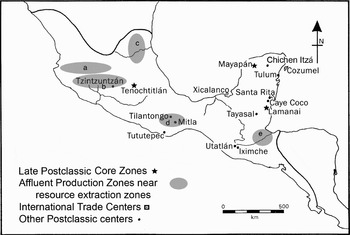
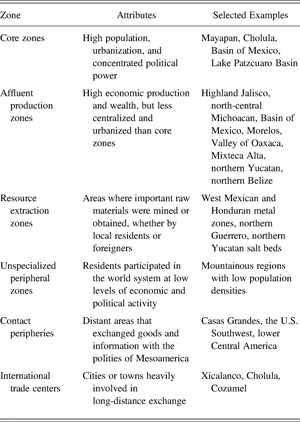
Michael Smith and Frances Berdan (Reference Smith, Smith and Berdan2003:24) advocate a holistic approach to the Postclassic Mesoamerican world system. They address space, time, exchange, and style zones and the nature and movement of key commodities. Spatially, their model of the Mesoamerican world system includes central and western Mexico, the Yucatan Peninsula, El Salvador, western Honduras, and the Pacific Coast of Nicaragua and Costa Rica. While they acknowledge the interaction between the American Southwest and lower Central America, they consider these links as examples of extra-systemic exchange. They expand the traditional zones of world-system theory—cores, peripheries, and semi-peripheries—to core zones, affluent production zones, international trade centers, resource-extraction zones, unspecialized peripheral zones, and contact peripheries (Smith and Berdan Reference Smith, Smith and Berdan2003:24; Table 1). Core zones correspond to some prior definitions of world-system cores but without the connotation that cores must dominate peripheries (Smith and Berdan Reference Smith, Smith and Berdan2003:24). Core zones in their scheme have high populations, concentrated political power, and urbanization and include major centers such as Chichen Itza, Mayapan, Tula, Tajin, Cholula, and Tenochtitlan. Affluent production zones are areas of high economic production and accumulated wealth but do not have the same level of urbanization and political centralization as core zones. Resource extraction zones are areas where important raw materials were mined or obtained. International trade centers were cities or towns heavily involved in long-distance exchanges (Smith and Berdan Reference Smith, Smith and Berdan2003:31). These four zones are important in analyzing the different economic zones in the Postclassic Mesoamerican world system that were involved in the production and exchange of metal artifacts as related to Mayapan (Figure 1). Affluent production zones were particularly important in the development of metallurgy, and when located near sources of natural metal deposits, they produced some of the most technologically complex and widely distributed metal artifacts in Mesoamerica. This occurred in two affluent production zones of West Mexico: highland Jalisco and north-central Michoacan, in the Valley of Oaxaca, and in the Naco Valley of Honduras.
Map of Mesoamerica, showing core zones, affluent production zones, and international trade centers involved in the production, consumption, and exchange of metal artifacts. Affluent production zones include: (a) highland Jalisco; (b) north-central Michoacan; (c) Huastec region; (d) central Oaxaca; and (e) northwestern Honduras (adapted and redrawn from Smith and Berdan Reference Smith, Smith and Berdan2003:26).

Spatial components of the Postclassic world system

Source: Smith and Berdan Reference Smith, Smith and Berdan2003:24.
The study of metallurgy in the Postclassic period can benefit from a world-systems perspective. At least two house lots occupied by metalworkers at Mayapan took advantage of and relied on economic and social opportunities provided by long-distance trade networks. In this case, the production of metal artifacts could not have existed without both materials and specialized knowledge obtained from distant cultures. Through the data, it is possible to see how these local producers took imported luxury goods from distant cultures and literally reshaped them to suit their own tastes, needs, and demands or those of their patrons. I also examine specific local and interregional influences that helped to shape the unique patterns of production and consumption at Mayapan. Many of these influences were derived from Mayapan's role within that world system as an urban core center in international exchange networks.
MAYAPAN, AN URBANIZED CORE CENTER
Mayapan, as a core zone and the most powerful regional center in the Maya area in approximately a.d. 1000–1450, imported and exported commodities to outside regions. Its residents produced, consumed, and distributed metal objects. While most studies of Postclassic trade at these sites have argued that most trade with Mayapan began after a.d. 1250, chronologies for Mayapan and Chichen Itza have since been refined (Andrews et al. Reference Andrews, Andrews and Castellanos2003; Peraza Lope and Masson Reference Peraza Lope and Masson2006). New radiocarbon dates indicate the establishment of Mayapan's early center by the twelfth century or perhaps as early as the eleventh century, although most major construction occurred during the thirteenth and fourteenth centuries a.d. (Peraza Lope and Masson Reference Peraza Lope and Masson2006).
As the most powerful core center in the Maya Lowlands during the Late Postclassic period, Mayapan was a major producer and consumer of certain luxury and utilitarian commodities. Mayapan's economy possessed a low level of commercialization (Smith Reference Smith2004b), with various aspects of commercialized economies such as transport, trade, markets, money, traders, and merchants (Berdan et al. Reference Berdan, Masson, Gasco, Smith, Smith and Berdan2003:100; Smith Reference Smith2004a). The site likely exported the high-quality salt resources that it obtained from the northwestern Yucatan Peninsula and may have succeeded Chichen Itza as an exporter of cotton to other parts of Mesoamerica (Piña Chan Reference Piña Chan, Lee and Navarette1978:42). Mayapan's international trade networks included routes to central Mexico and Oaxaca and to the Mexican Gulf Coast for salt, slaves, cacao, dyes, Fine Orange pottery, and obsidian, including a small amount of Pachuca obsidian (Piña Chan Reference Piña Chan, Lee and Navarette1978:42); to the sites on eastern coast of the Yucatan Peninsula such as El Meco, Cozumel, Tulum, Ichpaatun, and Santa Rita (Milbrath and Peraza Lope Reference Milbrath and Lope2003:25); to the Ixtepeque source in Guatemala for obsidian (Escamilla Reference Escamilla1999; Milbrath and Peraza Lope Reference Milbrath and Lope2003:25); and to the south as far as the Ulua Valley in Honduras. The famous story of the fall of Mayapan told in the Chilam Balam of Chumayel claims that, during the massacre of the Cocom lineage by the rival Xiu lineage, the only survivor was a son who was away on a trading mission to the Ulua Valley for cacao (Tozzer Reference Tozzer1941:36).
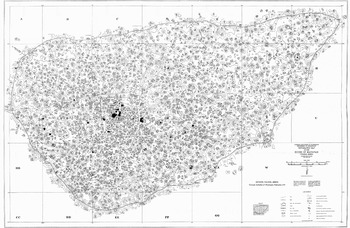
Mayapan was both an economic core zone and a seat of political power, with a highly urbanized center and a large population (Figure 2). The Carnegie Project, which performed the first major excavations at Mayapan during the 1950's, estimated the population at between 10,000 and 11,000, but Bradley Russell's 2003–2005 survey suggests a population of 12,000–13,000, which includes the settlement outside the city wall (Masson et al. Reference Peraza Lope and Masson2006). The city was intentionally designed defensively: its exterior wall does not bisect preexisting buildings, and there are gates on all sides of the city. Settlement density drops outside of the city wall. Inside the wall, space is also delineated by house-lot walls, locally known as albarradas (Brown Reference Brown1999; Bullard Reference Bullard1952, Reference Bullard1954). The remains of a wall surround the civic-ceremonial center, although it may have been constructed after contact with the Spanish. The civic-ceremonial center had both administrative and religious functions. Structures in the ceremonial center are close together, without the large, open plazas and causeways that characterize Chichen Itza. Mayapan supported numerous craft specialists who created a variety of artifacts such as ceramic effigy censers, lithic tools, and metal objects.
Map of Mayapan. Structures associated with metal artifacts are highlighted in black (adapted from Jones Reference Jones, Pollock, Roys, Proskouriakoff and Smith1962).

Mayapan is one of the few core zones from any time period with evidence of metal production. While production likely occurred at Tenochtitlan in the Late Postclassic, according to ethnohistorical evidence from Fray Bernadino de Sahagún (Reference Sahagún1950–1975), no archaeological evidence for metalworking has been found. Most metal-producing sites, with the exceptions of Lamanai and Mayapan, are located in affluent production zones with their own sources of metal—specifically, the West Mexico Metallurgy Zone and northwestern Honduras, where the Quemistlan Bell Cave is located (Blackiston Reference Blackiston1910). However, due to the lack of raw materials and the low scale of production documented at Mayapan, the metal objects produced at this city were most likely for local or regional consumption rather than for interregional exchange.
METAL IN MESOAMERICAN ETHNOHISTORY
Mesoamerican ethnohistory describes metal objects in association with several significant activities: warfare, dancing, and exchange. The Chilam Balam of Maní, a town located to the south of Mayapan, emphasizes the use of bells as items of dress, specifically associated with the war costume of Kukulkan: “[i]n the Katun 5 Ahau, Kukulkan beckoned with his hands, his bells tinkled, and he gathered his tribute of honey and quail. In the nineteenth year Kukulkan beckoned a second time, and again his war bells were heard, and he took his donation of the miserably poor ones” (Craine and Reindorp Reference Craine and Reindorp1979:114). The footnote by Eugene Craine and Reginald Reindorp adds that this passage means that Kukulkan was dressed for war with bells on his wrists in this mythological narrative, and that the sound of the bells signaled the advent of war and suffering. The Chilam Balam of Chumayel also mentions bells attached to clothing: “[t]his is the bead collar: it is its little bells” (Roys Reference Roys, Eric and Thompson1967:98). Fray Diego de Landa (Reference Landa1978) emphasizes the role of imported metal objects from Mayan long-distance trade routes in dance and exchange. He describes bells, which are common in the Mayapan assemblage, and the use of metal axes and chisels, which are not. Landa (Reference Landa1978:94) claims:
In this country there has so far been found no kind of local metal. … They had a certain soft brass which, when founded with a light mixture of gold yielded them hatchets and the little rattles they used in their dances, as well as a certain sort of chisels which they used in making the idols and boring out the blowpipes … this brass and other plaques or sheets, of greater hardness, is part of their traffic in Tabasco for their idols. They had among them no other kind of metal.
Finally, bells may have functioned as a form of currency. Fray Diego Lopéz de Cogolludo (Reference Cogolludo, Diego and Rubio Mañé1957) writes, “The money that they used was small bells and jingle bells of copper that had a value according to their size” (see also Piña Chan Reference Piña Chan, Lee and Navarette1978:43). Other types of money included shells, red spools, rings, and cacao (Landa Reference Landa1978:9; Piña Chan Reference Piña Chan, Lee and Navarette1978:43). In 1502, Columbus encountered a trading canoe with cargo that included cotton clothing, cacao beans, wooden sword clubs edged with flint, copper axes for cutting wood, bells, and certain discs and crucibles for melting the copper (Columbus Reference Columbus1959). This account has led some archaeologists to suggest that metallurgy in the Maya region may have been practiced by itinerant metalsmiths (Berdan et al. Reference Berdan, Masson, Gasco, Smith, Smith and Berdan2003:98; Bray Reference Bray and Hammond1977:397; Hosler Reference Hosler2003:169; Proskouriakoff Reference Proskouriakoff, Pollock, Roys, Proskouriakoff and Smith1962a:424). The Spanish accounts tend to emphasize the function of metal as currency more than the native accounts, and the social and ritual functions of metal objects could have been of equal or greater importance to the Maya.
The Florentine Codex provides a detailed description of both the technical and ritualized aspects of metalworking in the Aztec empire (Sahagún Reference Sahagún1950–1975:14:73). Metalworking was a highly specialized activity, and specialists were divided into two groups: the smiths, who beat and polished gold into thin sheets; and the finishers, who were high-ranking master craftsmen dedicated to lost-wax casting. The lost-wax casting process is described as a highly standardized series of steps that included the creation and sculpting of a charcoal and clay core, which was then covered with three layers: rolled beeswax, pulverized charcoal, and coarse clay, with a channel for the gold to enter. After drying for two days, the mold was put into a charcoal brazier to melt the wax. Then the gold was melted in a ladle censer and was poured into the mold through the channel to create the metal object. Once cooled, the object was burnished with a pebble, rubbed with alum, reheated over a fire, and rubbed with “gold medicine”, which was “just like yellow earth mixed with a little salt” (Sahagún Reference Sahagún1950–1975:14:75). The casting process also involved creating gold-copper and silver-copper alloys for more durable objects and making repairs to cracked or split objects (Sahagún Reference Sahagún1950–1975:14:78).
Western Mexican and Aztec ethnohistorical sources also emphasize the symbolic aspects of metal, particularly its association with fertility and creation. Dorothy Hosler (Reference Hosler1994:233) defines three ritual uses of bells in Aztec society: in celebrations of human and agricultural fertility and regeneration; in warfare, where the sounds of bells could protect those who wore them; and in symbolizing paradise through sound. She argues that the sounds and colors of metal objects were associated with the sounds of thunder and lightning and were linked to fertility and the creation of humans. Gold and silver were considered divine excrement of the sun and the moon, respectively (Hosler Reference Hosler1994). Xipe Totec was the Aztec god of goldsmiths and represented fertility and renewal. According to Sahagún (Reference Sahagún1950–1975:3:3), some of the most important gods in the Aztec pantheon wore ankle bells—for example, Quetzalcoatl, associated with fertility, and Huitzilopochli, the god of war. The Relación de Michoacán depicts the chief Tarascan warrior wearing ankle bells as he and his men attack a village (Tudela Reference Tudela1977:190). Bells and other types of rattles were used in a variety of fertility rites, particularly those associated with Tlaloc (Sahagún Reference Sahagún1950–1975:2:151).
Metal objects had important social functions in both the Tarascan and the Aztec empires. For example, tweezers became a symbol of priestly office in the Tarascan empire. Bells served as a social symbol of the Aztec elite and were often worn on clothing. Hosler (Reference Hosler1994:236) notes that bells were often worn around the ankles, attached to clothing, or attached to rattle boards in the Aztec empire. The Tarascan elite were interred with gold shields on their backs and gold bells at their ankles, and in battle they were protected by a shield of silver (Tudela Reference Tudela1977:251). Huastec warriors also wore bells when going to war (Durán Reference Durán1967:167). Finally, bells and rattles were associated with dance in several cultures, including the Tarascan empire, the Huichol of Nayarit, and other native groups (Hosler Reference Hosler1994:245). Spanish and indigenous authors indicate that metal was meant to be worn and displayed. These similar social and ritual uses of metal artifacts between West Mexico and the Aztec empire, and the Yucatec Maya, suggests that concepts of social and ritual uses of metal objects accompanied their physical exchange.
SOURCES OF METAL AND EXTERNAL TRADITIONS OF METALLURGY
As there are no significant deposits of copper anywhere in the Maya Lowland area (Bray Reference Bray and Hammond1977:397), Mayapan relied on distant sources of metal and traditions of metallurgy for both raw materials and production technology. Metallurgy at Mayapan may have emulated four important external traditions in Mesoamerica: West Mexico, Honduras, the Huastec region, and Oaxaca. All were affluent production zones located near sources of native metal, and one or more of these zones could have provided raw material, production technology, and/or finished objects to production sites such as Mayapan and Lamanai either directly or through central intermediaries. Hosler's work provides evidence that West Mexican metallurgy was inspired by traditions in lower Central America, Colombia, and the southern part of the modern nation of Ecuador. Metal objects such as nose rings and sheet metal were produced at sites such as Salango, La Florida, and Pirincay during the Formative Period (1500–500 b.c.). Metal objects and the technology to produce them reached Mesoamerica via Pacific coastal traders from these areas between a.d. 600 and 800 (Hosler Reference Hosler and Maddin1988b, Reference Hosler1994; Hosler and Macfarlane Reference Hosler and Macfarlane1996). West Mexican metalsmiths in this region refined and adapted this technology to fit the needs of their culture, emphasizing objects such as bells and tweezers that were less emphasized in South American traditions. Technological refinement and experimentation by West Mexican metalsmiths beginning around a.d. 1200–1300 involved alloying copper with arsenic, silver, tin, and gold. These artisans emphasized gold and silvery colors that had ritual significance (Hosler Reference Hosler1994:229). Western Mexican metal objects were traded over long distances, as far north as Hohokam sites in the U.S. Southwest and as far south as Lamanai, Belize. Previous studies of metal objects in the Maya area have documented a strong resemblance to West Mexican artifacts (Bray Reference Bray and Hammond1977; Pendergast Reference Pendergast1962; Root Reference Root, Pollock, Roys, Proskouriakoff and Smith1962).
Another major Mesoamerican tradition of metallurgy comes from Honduras, which had its own sources of native copper. More than 800 bells were found in the Quemistlan Bell Cave located near the site of Naco, with a wide range of types that included anthropomorphic and zoomorphic effigy bells (Blackiston Reference Blackiston1910). In addition, explorers found strips of sheet copper that were 3–7 inches long. Stylistically, some of the anthropomorphic and zoomorphic bells from the Cenote of Sacrifice at Chichen Itza are very similar to the Quemistlan bells, indicating a strong connection between Honduran metal producers and consumers in the northern Yucatan Peninsula. Honduran producers, like their counterparts in lower Central America and Colombia, often crafted artifacts out of tumbaga, an alloy of gold and copper (Hosler and Stresser-Pean Reference Hosler and Stresser-Pean1992). Sheet metal fragments of tumbaga, copper, and gold at Mayapan suggest trade connections between Mayapan and Honduras. William Root (Reference Root, Pollock, Roys, Proskouriakoff and Smith1962:398) also noted that many of the Mayapan bells had similar trace element ratios to the Quemistlan bells.
Two other traditions of metallurgy were present during the Postclassic: one in the Huastec region of Veracruz, and one in Oaxaca. In the Huastec region, evidence comes from two sources, Plantanito and Vista Hermosa, which were both under the control of the Aztec empire (Hosler and Macfarlane Reference Hosler and Macfarlane1996:1822). The area has local sources of native metal, including Las Minas in Veracruz. At Vista Hermosa, one ingot and two small semi-metallic masses indicate the use of semi-processed production material. Finished artifacts were recovered from both sites, including bells, bell clappers, sheet metal, needles, axes, and metal fragments. The chemical compositions of some artifacts from Villa Hermosa match the ingot and the intermediate material and indicate that they were made from similar alloys and were likely manufactured locally, while most of the small globular bells were made from unalloyed copper. Some of the Plantanito bells were made from a similar alloy, while others were made from copper and alloys of copper-tin and copper-arsenic. Other bells were miscast or retained the casting sprues, which may indicate local production. The variation of lead isotope ratios within bell subtypes suggest multiple manufacturing locales that produced similar designs but used different materials (Hosler and Macfarlane Reference Hosler and Macfarlane1996; Hosler and Stresser-Pean Reference Hosler and Stresser-Pean1992:1822). Hosler suggests that the technology could have been introduced from West Mexico to the Huastec region via merchants responsible for distributing Aztec trade goods throughout regional markets.
Oaxaca had its own tradition of metallurgy during the Postclassic period. Two known mines, El Taviche and Los Ocoltes, provided the region with native metal (Hosler and Macfarlane Reference Hosler and Macfarlane1996:1821). Metalworkers in Oaxaca developed a unique copper-gold alloy after a.d. 1200; its relation to West Mexico's earlier copper-based metallurgy is unclear. Oaxaca is well known for producing axe-monies: stylized axes that were far too thin to be mistaken for functional tools and, instead, served as a form of wealth (Hosler et al. Reference Hosler, Lechtman and Holm1990). Several have been found at Chichen Itza, suggesting trade connections between the two regions (Coggins and Shane Reference Coggins and Shane1984). No axe-monies have been found at Mayapan, but an anthropomorphic effigy ring is probably a trade piece from Oaxaca and appears to be of a copper-gold alloy (Root Reference Root, Pollock, Roys, Proskouriakoff and Smith1962:398). All four regional traditions were important in the production of metal artifacts in Postclassic Mesoamerica. Metalworkers at Mayapan emulated these distant traditions with some distinct local variations, as the following analysis will demonstrate.
METHODS OF ANALYSIS FOR MAYAPAN'S METAL ARTIFACTS
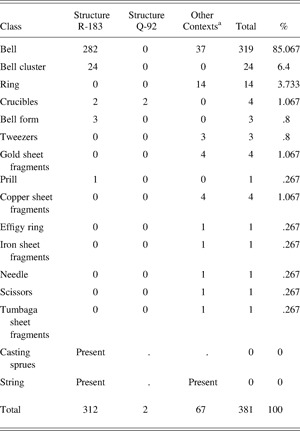
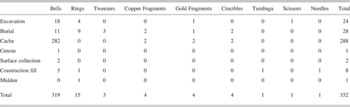
This study analyzes a total of 381 metal artifacts from Mayapan from four major archaeological projects. Thirty-nine are from the Carnegie Project of the 1950–1960s (Pollock et al. Reference Pollock, Roys, Proskouriakoff and Smith1962); 13 are from the Economic Foundations of Mayapan Project, directed by Dr. Marilyn Masson (Masson et al. Reference Peraza Lope and Masson2006); 312 are from salvage excavations carried out in 1997–1998 in conjunction with the expansion of the Merida–Oxkutzcab highway (Peraza Lope Reference Peraza Lope1998); and 17 are from the ongoing excavations of the Proyecto Mayapan (Peraza Lope et al. Reference Peraza Lope, Kú, Ojeda and Euán1999; Peraza Lope et al. Reference Peraza Lope, Kú, Ojeda and Kú2003; Peraza Lope et al. Reference Peraza Lope, Euán, Kú, Ojeda, Chim and Ayala1997). Table 2 shows the forms recovered from Mayapan and the contexts in which they were recovered. Bells make up the overwhelming majority (85.067%) of the assemblage, which also includes tweezers, needles, rings, and fragments of sheet metal. Production tools and debris have also been found and include crucibles, casting sprues, prills, bell clusters, and failed bells.
Metal artifacts at Mayapan

aSee Table 7 for other contexts.
All artifacts were analyzed by the author according to metric attributes, including dimensions and weights, along with a typological classification of forms and raw materials. This study does not include trace-element analysis, which is currently being undertaken by Carlos Peraza Lope and Elizabeth Baquedano (Peraza Lope, personal communication 2005). The results of trace-element analysis will help identify the location(s) of origin of metals used in production activities. However, Root (Reference Root, Pollock, Roys, Proskouriakoff and Smith1962) analyzed the metal artifacts excavated by the Carnegie Project, which provides a baseline of information on the sources of metals used in the production of copper objects recovered archaeologically at Mayapan during the course of that project. His analysis revealed that most of the metal artifacts at Mayapan are composed of various copper alloys rather than of pure copper. According to Hosler (Reference Hosler1994), this use of alloys rather than pure copper is found throughout western Mexico, as well, with few exceptions.
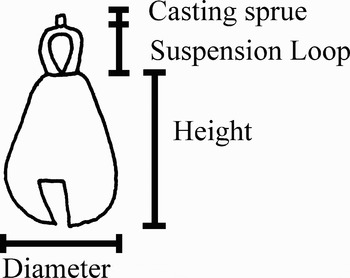
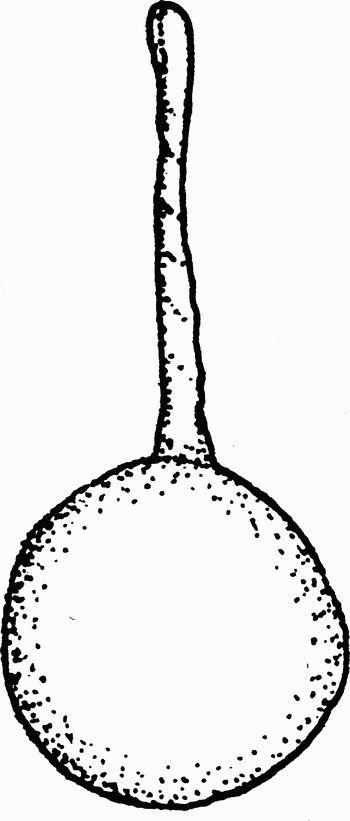
The classification of metal artifacts in this study draws on Mayapan types established by Root and was compared with other established typologies (Bray Reference Bray and Hammond1977; Hosler Reference Hosler and Maddin1988b; Pendergast Reference Pendergast1962). Bells are classified here according to the following terminology. The bell consists of three main elements (Figure 3): the suspension loop, the resonator (the round, hollow chamber of the bell), and the clapper (the pellet inside that produces sound). Suspension loops, as the name implies, were used to attach the bells to other objects, such as clothing (Hosler Reference Hosler1994:236). The posterior surface of the bell is the one to which the suspension loop is attached. The anterior surface is the opposite end and contains the slit, which allows the bell to produce sound. Bells were produced through the lost-wax casting process, which has been described in detail by Hosler (Reference Hosler1994), F.G. Hawley (Reference Hawley1953), and Stanley Long (Reference Long1964). This process often leaves behind manufacturing debris. Casting sprues form as metal fills the mold and may either be trimmed off after the bell has cooled or remain attached to the suspension loop. Prills are small drops of metal spilled during the casting process and are often found at manufacturing sites.
A diagram showing the analytical components of bells: casting sprues, the suspension loop, and the resonator. The resonator was measured in two dimensions: height and diameter.

Quantitative variables were measured to permit comparisons of size. Bell diameters were measured across the widest part of the resonator; height was taken perpendicular to the diameter and did not include the suspension loop. Since suspension loops often varied in height irrespective of the height of the resonator, the resonator height is more representative of the actual size of the bell. For the crucibles, the diameter of the body of the vessel and rim were recorded, and height was measured from base to rim. Since a scale was unavailable for part of the study, weight was taken only of metal fragments and discarded casting sprues.
An examination of the contexts in which metal artifacts were found permits comparisons of socioeconomic status with the quantity, size, and type of metal artifacts. The contexts of the artifacts were analyzed based on maps, available excavation records, and personal communication with the excavators, when possible. Using the Carnegie map (Jones Reference Jones, Pollock, Roys, Proskouriakoff and Smith1962), I calculated the distance from the center of the Castillo to each structure from which metal artifacts had been recovered and the two-dimensional area of each structure. This information was used to consider the geographical distribution of metal artifacts across Mayapan's urban environment. I determined the function and socioeconomic status of each structure through consultation with the excavators or descriptions in publications. I also examined the provenience of the artifacts within the structure, with special consideration of burial contexts. Unfortunately, due to the variation in excavation practices over time, excavation volumes are available for only a small number of the structures under consideration, limiting contextual comparisons to two-dimensional space.
Variability in artifact form and style was analyzed in terms of artifact class, material, and form for all artifacts; for bells, it was also analyzed in terms of the type of slit form, suspension loop type, presence or absence of a clapper, and decorative elements such as incised rings or wirework. While style alone is not an indicator of the origin of an artifact (Hosler Reference Hosler and Maddin1988b), the presence of rare or anomalous styles can identify potential foreign imports or copies.
TYPES OF METAL ARTIFACTS AT MAYAPAN
The artifacts in the Mayapan assemblage shows that residents were selectively producing and consuming artifacts that were items of personal adornment that could be worn and displayed as portable wealth. Bells were by far the most numerous artifact in the study, representing 85.067% (N = 319) of the assemblage (N = 381), and were both imported and manufactured at Mayapan itself (Table 2). Evidence that they were worn as clothing adornments comes from the notable discovery of small strings attached to some of the bells. It is still uncertain whether the strings were made of cotton, henequen, or some other fiber. They were stained blue-green from contact with the bells, and it is possible that contact with the copper alloy contributed to their preservation. The strings were less than 1 mm in diameter and likely attached the bells to clothing.
Production Tools
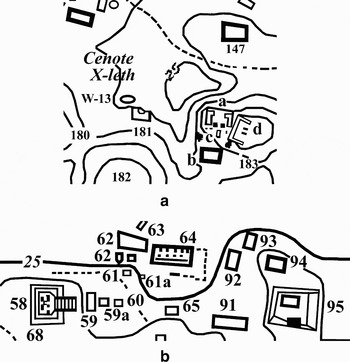
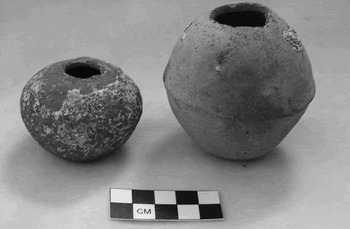
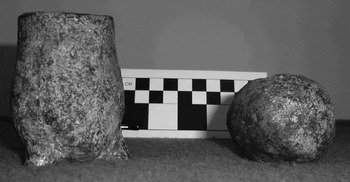
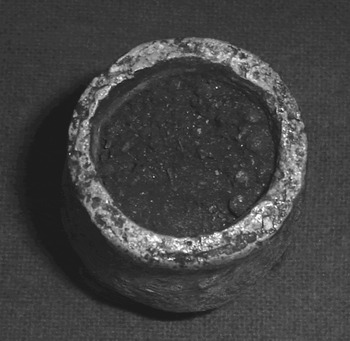
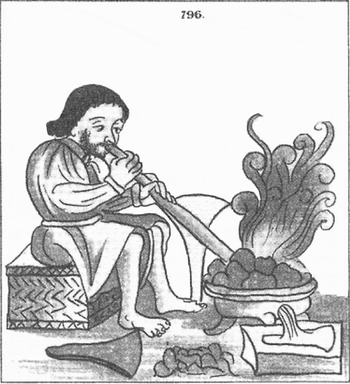
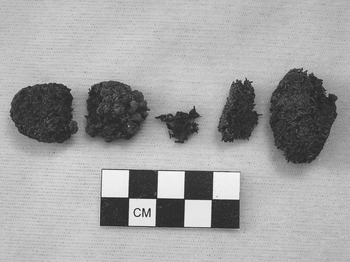
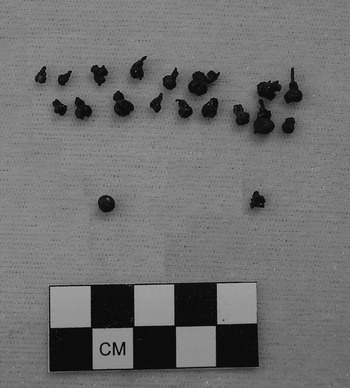
Recent finds of crucibles at two different locations at Mayapan strongly suggest the presence of specialized metalworkers. A cache in Structure R-183b (Figure 4a), an elite house to the east of the ceremonial center, consisted of a small olla containing 282 bells, two crucibles, 24 bell clusters, and three failed bells, all buried together at the base of the exterior of the western wall and surrounded by production debris such as casting sprues and a prill (Peraza Lope Reference Peraza Lope1998). Excavations in 2001 by Peraza Lope at Structure Q-92 (Figure 4b), a small house at the northern end of the central plaza of the ceremonial center, uncovered another two crucibles containing copper or copper ore (Figure 5; see also Peraza Lope et al. Reference Peraza Lope, Kú, Ojeda and Kú2003). The crucibles were offerings in a multiple burial containing five individuals located under the floor along the interior back wall of the house. The crucibles from Q-92 were tecomates of established ceramic types: Navula Unslipped and Mama Red (Smith Reference Smith1971). The vessels had diameters of 5.9 cm and 7.2 cm, respectively, and measured 4.7 cm and 7.5 cm in height. The crucibles from the R-183b cache were a small tecomate and a small tripod vase (Figure 6), both classified as Navula Unslipped. Solidified metal drippings filled all three tecomates to just over half their capacity, with some metal fragments adhering to the interior walls, and with some loose fragments, including casting sprues and failed bells, filling the vessels just below capacity. This combination of production debris suggests that the tecomates held remnant waste metal from previous casting events. The tripod vase was filled to capacity with solidified metal, with small failed bells visible on the surface (Figure 7). The bottom of the Navula tecomate from Q-92 was tapered almost to a point and had a raised appliqué in a ring around it, perhaps to facilitate the melting of the metal inside the crucibles or to enable it to fit inside a suspension ring over a fire. These are in sharp contrast to Sahagún's depiction of an adult Aztec male blowing into a tube as molten metal poured out of a brazier into an axe mold (Figure 8; Sahagún Reference Sahagún1950–1975:11:Plate 796). The brazier is filled with small lumps that may represent ore in the process of being smelted but could also be charcoal to heat the metal until it liquefied. The crucibles at Mayapan are small and lack spouts or any openings in their sides, suggesting that they were designed to be portable or easily exchanged. Their small size could also indicate that production was on a smaller scale than in central Mexico, which is closer to sources of raw material. The R-183b cache may have held a third tecomate due to the presence of ten lumps of metal that appear at one time to have been inside a crucible (Figure 9). As noted in the four intact crucibles, the lumps of metal were composed of casting sprues and failed bells. The failed bells were smaller than the complete bells found in the cache and were generally 2–3 mm in height and had a globular shape. The failed bells may be a result of producers' experimenting with smaller sizes of bells, often with unsuccessful results. The failed bells and casting sprues were then put into the crucibles to recycle them into new objects.
Locations of structures where crucibles were recovered: (a) Structure Q-92, a small house in the ceremonial center; (b) Structure R-183b, an elite house to the east of the ceremonial center (redrawn from Jones Reference Jones, Pollock, Roys, Proskouriakoff and Smith1962).

Crucibles from an elite burial, Structure Q-92.

Crucibles from a cache, Structure R-183b.

Solidified metal inside of the small tripod vase from R-183b, with failed bells visible on the surface.

An Aztec metalworker casting axes using a crucible with a spout and a clay mold (redrawn from Sahagún Reference Sahagún1950–1975:11:Plate 796).

Lumps of metal composed of casting sprues and failed bells. They appear to have been from inside a third crucible (not found) from the R-183b cache.

Production Debris
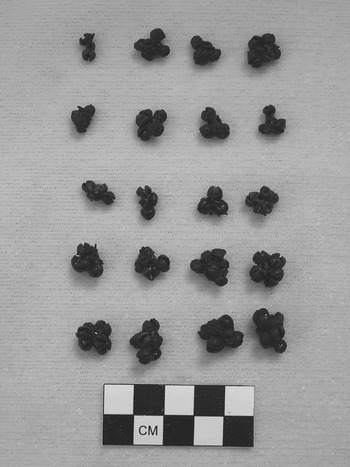
Production debris found in association with crucibles in the cache at Structure R-183b suggests that lost-wax casting was performed by specialists associated with the elite house lot. As mentioned, bell clusters, failed bells, casting sprues, and a prill surrounded the crucibles and bells at the base of the exterior of the western wall (Peraza Lope Reference Peraza Lope1998). The 24 bell clusters are the result of casting errors in the local production of bells at or near Structure R-183b (Figure 10). They consisted of four to eighteen small globular bells fused together. While some of the smaller bells from R-183b were occasionally stuck together, as well, they possessed functional, intact suspension loops, whereas the bell clusters did not. Clearly, the metal would have had to be partially melted for them to be stuck together, which suggests that this happened as the bells were being cast during the final stages of the lost-wax casting process, possibly due to errors in the construction of the mold. This hypothesis is supported by the presence of casting sprues on the majority of the suspension loops and by one case in which extra casting sprues remained attached to the dorsal and ventral surfaces of the exterior walls of the bell resonator. It is also possible that the bells became melted together during recycling. Many of the bells contained clappers, suggesting that they were being made as functional bells, not simply tinklers.
Bell clusters from the R-183b cache, consisting of four to 18 small bells fused together.

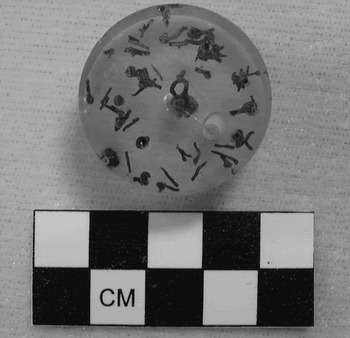
Other types of manufacturing debris found in the R-183b cache included failed bells. Failed bells (Figure 11) were often so small that the resonator filled with metal during the lost-wax casting process and, in some cases, the gaps in the suspension loops filled in with metal, as well. Detached casting sprues were found, which could have been trimmed off suspension loops or other cast artifacts. The excavators removed a small bell surrounded by casting sprues and preserved their respective locations inside a clear plastic cylinder (Figure 12). Another item found among the manufacturing debris was a small round copper ball 0.4 cm in diameter. It most likely represents a large prill, which is a drop of metal spilled during the casting process, although it could also be the clapper to a large bell. Overall, 79.4 g of metal production debris were associated with the cache, not including the metal inside the crucibles or the plastic cylinder. While it is possible that these artifacts were imported as raw materials for producers, the variety of types of manufacturing debris and their association with the crucibles and bells suggest that they are byproducts of lost-wax casting of bells that took place at the R-183b house lot. No evidence of stages of production other than lost-wax casting, such as furnaces or slag heaps, has yet been found at Mayapan.
Failed bells found in the R-183 cache. Most retain casting sprues, and the suspension loops and resonators filled with metal during the casting process.

A small copper bell, casting sprues, and manufacturing debris recovered during the excavation of the R-183b cache and put inside a clear plastic cylinder to preserve their relative locations.

Miscellaneous Metal Objects
Rings and tweezers were other forms of portable wealth popular at Mayapan. Rings could be worn in a variety of ways. In West Mexico, small, open rings were worn as earrings, hair ornaments, and hair-braid holders (Hosler Reference Hosler1994). However, the rings found at Mayapan are closed, and their size suggests that they could have been worn on fingers (Root Reference Root, Pollock, Roys, Proskouriakoff and Smith1962:Figure 48). They include plain and decorated rings and an anthropomorphic effigy ring that is likely an imported piece from Oaxaca (Root Reference Root, Pollock, Roys, Proskouriakoff and Smith1962). The Carnegie Project also found four pairs of tweezers of the variety known as shell tweezers, which were used in West Mexico and are also present at Lamanai (Hosler Reference Hosler1994; Root Reference Root, Pollock, Roys, Proskouriakoff and Smith1962; Simmons Reference Simmons2005a; Figure 13). There is no evidence for or against local production of tweezers at Mayapan, but the technical expertise needed to produce them and stylistic similarities to West Mexican tweezers suggests that they may have been imported.
Shell tweezers from Mayapan, possibly imported from West Mexico (drawn from a photograph; Proskouriakoff Reference Proskouriakoff, Pollock, Roys, Proskouriakoff and Smith1962a:Figure 48r).

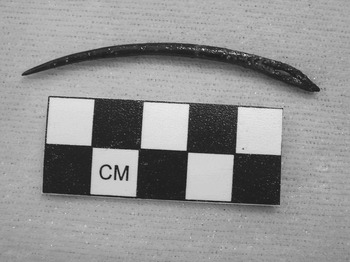
The only needle in the collection was probably produced in West Mexico (Figure 14). The needle is a perforated-eye sewing needle, which corresponds to Hosler's type 1. This needle is not nearly as common as the loop-eye type. Perforated-eye needles were made by cold-working the shaft, then punching the eye with a tool like an awl. The Mayapan needle is sharp on both ends, and the shaft is slightly bent, which often occurs due to the elasticity of the copper. The needle in this collection dates to Period 1 in the West Mexican chronology (a.d. 600–1200/1300; Hosler Reference Hosler1988a, Reference Hosler1994). These needles first appeared in Ecuador between a.d. 100 and 500 and are also found in Peru; in West Mexico, the first examples appeared around a.d. 800. This style is earlier than the loop-eye type and was probably imported into the Maya area through trade with West Mexico or through intermediaries between the two areas.
A perforated eye needle from Mayapan, possibly imported from West Mexico.

Other artifacts in this study include fragments of tumbaga and gold, which are likely pre-Contact, and fragments of iron, which are likely post-Contact. A pair of miniature scissors was also found; they may be colonial or from the early explorers who visited the site.
Bells
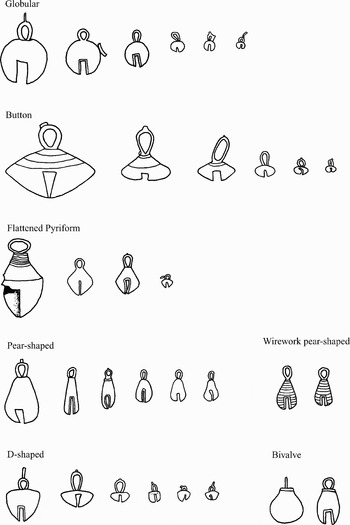
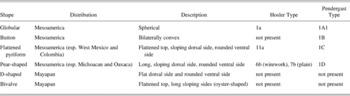
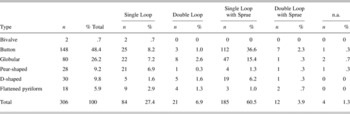
Although there are numerous published typologies for Mesoamerican bells (Bray Reference Bray and Hammond1977; Hosler Reference Hosler and Maddin1988b; Pendergast Reference Pendergast1962), I decided to use and expand the Carnegie Project typology developed by Root for Mayapan for several reasons. First, it is important to have a basis for comparing the artifacts within the site. Second, the Pendergast and Hosler typologies did not encompass the full range of types present at the site and would have required the addition of several new types. Third, while Hosler's critiques of purely stylistic criteria are justified (Hosler Reference Hosler and Maddin1988b), and her use of volume and pitch to classify bells are important additions to metallurgical studies, this type of data collection could not be performed with the resources available in the field laboratory when this study was conducted. In addition, many of the bells in this study were crushed, deformed, or stuck together in clusters, which would make pitch and volume difficult to calculate. The Mayapan types include globular, button, flattened pyriform, pear-shaped, D-shaped, and bivalve, and are described in Table 3 and illustrated in Figure 15. The bell types are correlated in Table 3 with those established by Hosler and Pendergast to allow for regional comparisons of Mayapan with other areas of Mesoamerica.
Bell types identified in the Mayapan assemblage, recovered from recent excavations.

Mayapan bell forms

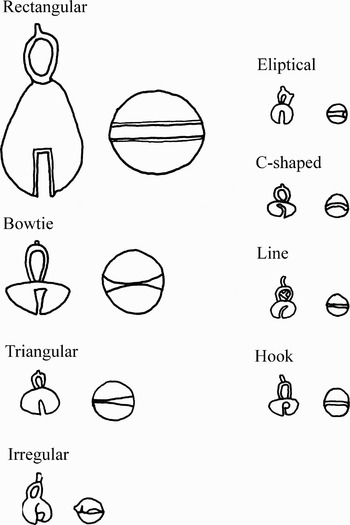
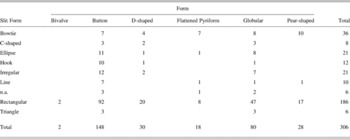
In addition to the overall form of the bell, the collection also showed an equivalent amount of variation in slit form (Table 4). The various slit forms included the following: bowtie, C-shaped, irregular, elliptical, hook-shaped, line (so narrow that there is no true mechanism for sound to escape from the resonator), rectangular, and triangular (Figure 16). Of these, it is likely that the most numerous slit forms—the bowtie, the elliptical, and the rectangular—represent production norms. The others may be casting errors or may have been a consequence of the metalworker's prying the resonator slit open after the bell was cast, inserting the clapper, and clamping the edges shut. In particular, the bowtie slit form could have resulted from this process. The irregular slit forms are usually found on the smallest bells, where either errors in the casting process or the insertion of a clapper may have accidentally created irregular slit forms. Since imported bells would be less likely to have production errors or irregularities, bells with irregular slit forms were most likely locally produced.
Slit-form types identified in the resonators of bells in the Mayapan assemblage recovered from recent excavations.

Bell forms versus slit forms, Mayapan, 1996–2004

Notes: n.a.= not applicable.
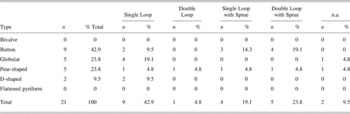
The suspension loop category actually encompasses two variables: the thickness of the loop and the presence or absence of a casting sprue (Table 5). The loop could be either single or double width. Doubled loops were often wider, but single loops could be equally wide if flattened. Casting sprues are remnants from the lost-wax casting process and the means by which the metal entered the mold to form the bell. At Mayapan, the majority of the suspension loops retain the sprue, and some bells have a second sprue on the loop. The bells not found in the R-183b cache tend to have a single loop without casting sprues or to show evidence of the sprue's having been clipped or filed off (Table 6). While the practice of leaving casting sprues on suspension loops is common in Mesoamerican metallurgy (Hosler, personal communication 2005), it is possible that this practice differed between production areas and were more frequently trimmed off exported bells (Hosler and Macfarlane Reference Hosler and Macfarlane1996).
Bell types found at Mayapan, 1996–2004

Note: n = number, n.a. = not applicable.
Bell types found at Mayapan, 1996–2004, excluding the R-183b cache

Notes: n = number, n.a. = not applicable. The table does not include artifacts from the Carnegie excavations.
Bell clappers were analyzed by presence or absence. Hosler (Reference Hosler1988a) has argued that some bells were not originally manufactured with clappers and were, instead, “tinklers,” which made noise by hitting against other tinklers. In the Mayapan assemblage, 193 bells had a clapper, and 110 bells had no clapper. It is possible that at least some of the clappers may have fallen out post-depositionally; therefore, the absence of a clapper cannot indicate that the artifact is a tinkler.
LOCAL ARTIFACT PRODUCTION
The data from Mayapan, and from Lamanai, suggest that some Maya metal producers were more than itinerant smiths who wandered from site to site producing artifacts for a handful of elites. At Mayapan, producers were specialized metalworkers who were either permanent or semi-permanent residents of the city and resided in elite households (see Inomata Reference Inomata2001). Producers could have been elites participating in craft production, or they could have been attached specialists producing for elite patrons. To produce metal objects successfully, metalworkers needed to be involved in the international exchange of raw materials, needed to know specialized production techniques, and needed access to finished products to emulate. In characterizing the organization of metal production, I refer to four parameters outlined by Cathy Costin (Reference Costin1991:9): context, concentration, scale, and intensity. In the following discussion, I use these parameters classify production at Mayapan and examine the implications for economic structure and social organization.
Metal production at Mayapan was highly concentrated, and current evidence is limited to the R-183b cache (Peraza Lope Reference Peraza Lope1998), where manufacturing debris such as a possible prill and loose casting sprues were found in situ. The crucibles in the Q-92 burial may indicate that the interred individuals were associated with metal production in some way, but the burial itself is not in a production context. While four crucibles were made from local pottery types, their variation in both size and form suggests that they were not produced in a standardized manner. There is no evidence that Mayapan was importing ore, slag, or other forms of unprocessed metal. Based on trace element data from Root (Reference Root, Pollock, Roys, Proskouriakoff and Smith1962), it is likely that Mayapan's metalsmiths were melting down finished artifacts imported from other areas. The producers were thus only participating in the final production phase of lost-wax casting of artifacts and were not involved in the mining or smelting of raw material, the melting of ore into ingots, the separation of copper from slag, or the combination of metals into specific alloys. Since the crucibles were made from local pottery types, it is likely that the producers were not directly involved in the transportation of the metal from affluent production zones to Mayapan itself. Instead, local producers were limited to the amount of material they could import from affluent production zones, either directly or through intermediate centers.
The contexts in which the crucibles and masses of partially melted bells and sprues were recovered suggest that metal production was associated with elite members of Mayapan society. Costin (Reference Costin1991:11) defines context as the degree of attachment between elites and producers. Structure R-183b is an elite house situated within a residential compound located approximately 250 m southeast of the ceremonial center. Peraza Lope (Reference Peraza Lope1998) suggests that this residential compound may have been home to merchants or secondary elites. Structure Q-92 is a small house next to a burial-shaft temple in the northern part of the ceremonial center; its proximity to some of the most important temples in the city also implies elite status or, perhaps, that the occupants were servants in the service of the city's elites. Furthermore, within both elite contexts, production tools and debris were placed in ritual contexts. The two crucibles in Q-92 were interred with one of six individuals under the floor of the house, while the bells in R-183b were part of a cache, placed inside a small olla and buried with two crucibles at the base of the exterior of the western wall of the structure. This suggests that production material was associated with two different types of elite ritual. However, consumption of metal was associated with a broader range of social contexts, as discussed in the following section.
The scale of production was relatively small, in keeping with the highly specialized nature of metallurgy. While the assemblage includes 381 artifacts, these artifacts could have been produced and consumed over several generations, and several of the artifacts were imported from other sites, as suggested by stylistic information and Root's trace element analysis. Only two production contexts are currently documented (representing less than 1% of all excavated contexts) and are associated exclusively with elite households. Mayapan metal producers were likely few in number, and had limited access to imported metal resources; thus, it is likely that they were producing metal artifacts for local consumption rather than interregional exchange.
Intensity in Costin's (Reference Costin1991) scheme refers to the amount of time producers spend producing a certain craft and the amount of specialization necessary. The lost-wax casting process is difficult and would have required specialized knowledge (Long Reference Long1964). Since techniques had to be imported from affluent production zones, producers would have had to be either immigrants or locals instructed in the process by an expert from another metalworking region. As a result of either lack of skill or consumer demand, a simplification of the process is reflected in bell forms at Mayapan, which are less intricate than West Mexican and Central American designs, or even than the offerings of the Cenote of Sacrifice at Chichen Itza. It does not seem likely that Mayapan producers were experimenting with specific alloys. Such experimentation would have been difficult due to the long distance between Mayapan and natural metal resources. Furthermore, if Mayapan metalworkers were unsure of the physical properties of recycled metal, casting intricate designs could have been difficult.
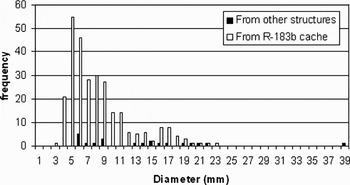
In terms of the skill of the producers, the assemblage simultaneously reveals a familiarity with the technology and experimentation that resulted in production failures. The average diameter of bells in the R-183b cache was 0.83 cm, with a standard deviation of .4 cm, a range of 0.3 to to 2.3 cm, and a median of 0.7 cm (Figure 17). This is smaller than bells from other structures, which had an average diameter of 1.35 cm, with a standard deviation of 0.8 cm, a range of 0.6 to 3.9 cm, and a median of 1.3 cm. (This does not include bells from the Carnegie excavations.) It is important to note the difference between sample sizes and that the full range of artifacts from other contexts may not be represented. Despite this, the distribution of bell size in the R-183b cache was skewed toward small-size bells, which are more difficult to cast than large bells. However, manufacturing debris such as the bell clusters and failed bells suggests that experimentation with size was accompanied by several errors in the casting of the smallest bells. These bells were invariably the small bells, between 0.3 cm and 0.7 cm in diameter. The use of recycled metal could also have contributed to high failure rates during the casting process.
Distribution of bell diameter for bells in the Mayapan assemblage. The distribution of bell diameter is skewed toward smaller sizes in the R-183b cache relative to those found in other contexts.

Bells from the R-183b cache reflect a greater concern with size than appearance or functionality. Casting sprues were not trimmed from the suspension loops of 60.46% of bells at the site, and several bells had extra casting sprues adhering to the exterior surface. Clappers or pellets were not present in 36.3% of the bells; this could be from post-depositional processes but could also have been done intentionally if the smaller bells were not meant to produce sound. The variety in bell slit forms indicates that producers were frequently engaging in experimentation with the casting process and that several types of highly irregular slit forms resulted.
Metalworkers at Mayapan specifically tailored their products to the tastes of the elite, which may have included recasting some imported artifacts into bells. When Root analyzed 19 of the copper artifacts from Mayapan, he claimed that the composition of the copper was such that the objects could have originated in the Valley of Mexico, Oaxaca, or the Quemistlan Bell Cave, but not in West Mexico or Guatemala. He reached this conclusion because the eight Michoacan artifacts he had lacked lead and all but two lacked arsenic, antimony, and bismuth. The three Guerrero artifacts lacked arsenic, antimony, and tin. In more recent years, Hosler has found arsenic in artifacts from Michoacan and Guerrero, and wirework bells were included in the R-183b cache, making trade between the two regions more plausible. In addition, Root could not link 20 of the 38 objects he examined stylistically or chemically with any specific location. It is quite possible that these 20 artifacts were produced at Mayapan, perhaps by mixing metal from different regions. Failed bells in the production debris and inside the crucibles suggests that metalworkers also recycled their own production errors. As discussed later, recasting was practiced at Lamanai, suggesting that a similar practice may have been in place at Mayapan.
LOCAL CONSUMPTION PATTERNS
Consumers at Mayapan primarily used wearable metal artifacts that reflected their wealth, especially bells. Without chemically testing all of the bells, it would be impossible to determine which bells were locally produced. However, the bells in the R-183b cache have a higher probability of being locally made than others due to their association with production debris. The wirework bells in the cache were most likely imported, but the possibility remains that they were a local imitation of West Mexican wirework bells. When the Mayapan bell assemblage is compared with that of Chichen Itza, it is apparent that different stylistic demands existed. The Mayapan assemblage lacks the highly elaborate effigy bells, anthropomorphic and zoomorphic bells, bells with detailed wirework, and bells made of highly distinctive alloys of copper and arsenic, gold, or silver. The presence of tumbaga from Honduras/Central America and tweezers, a needle and wirework bells from western Mexico suggests that trade connections to these areas were still possible, either directly or through intermediate centers. The presence of elaborate bells at Chichen Itza (Coggins and Shane Reference Coggins and Shane1984), the Soconusco (Voorhies and Gasco Reference Voorhies and Gasco2004), and Santa Rita (Chase and Chase Reference Chase and Chase1988) suggests that, while elaborate bells were available through trade routes, the residents of Mayapan preferredred plainer styles, whether imported or made locally.
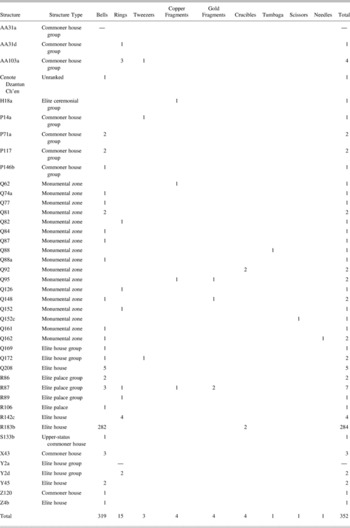
The use of metal artifacts varied significantly between the monumental zone and household contexts. Metal artifacts were found in 17 structures within the monumental zone and 25 structures outside of it, mostly located to the southeast and southwest of the ceremonial center (Table 7). Metal artifacts were found in structures ranging in size from approximately 40.7 m2 to 1223.633 m2, and the size of the structure was not significantly correlated with the number of metal artifacts recovered from it. Nine structures were commoner houses; one structure was an upper-status commoner house; nine structures were elite houses; one structure was a shrine in an outlying elite administrative center, Itzmal Ch'en; four structures were within two different elite palace groups; 15 structures were in the monumental zone; and one context was the Cenote Dzantun Ch'en, located to the south of the city wall (following structure classifications made by the excavators). The commoner houses were located outside the monumental center and were most often within solares (house lots) of two to four structures, with the exception of X-43, a small, solitary building located close to wall on the southeastern edge of the city. Elite houses were located either inside or outside of the monumental center, occasionally also within solares, and most often in groups of four buildings around a patio. An outlying elite administrative center, Itzmal Ch'en, is a complex of structures located close to the eastern gate of the city and contains a shrine, oratory, temple, colonnaded halls, and nearby commoner residences. The elite palace, excavated by the Carnegie Project, consists of four large dwellings, a kitchen, a storage area, and three shrines and contained rich burials and caches that suggest elite residence (Proskouriakoff and Temple Reference Proskouriakoff and Temple1955). The structures in the monumental zone form the elite ritual and administrative center and include temples, colonnaded halls, and small, unadorned houses with benches that may have belonged to priests or administrative officials of some sort.
Structures at Mayapan with metal

Notes: The table includes artifacts from the excavations by the Carnegie Institution of Washington, DC. A fourth pair of tweezers was reported by the Carnegie Institution, but the structure number was not listed.
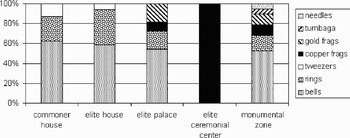
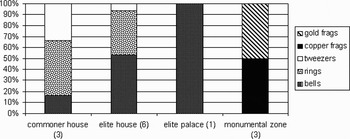
While the number of metal artifacts found in a particular structure did not correlate with status, a greater variety of artifacts was found within the monumental zone than outside of it (Figure 18). Elite and commoner houses had the same types of artifacts: bells, rings, and tweezers. Elite palaces had gold foil in addition to bells and rings, but no tweezers. The only metal from Itzmal Ch'en to date is a fragment of copper located under the shrine in the center of the plaza. The monumental zone contained all of these artifact types, with the addition of sheet copper, tumbaga, and a needle. Apart from the R-183b cache, burials were the most common depositional context for metal artifacts, followed by excavation contexts in structure interiors, and in lesser frequencies, by contexts such as construction fill, midden deposits, and surface collections (Table 8). Bells, rings, and tweezers were all found in elite and commoner household burials, as well as in other excavation contexts. Proportions of artifacts varied in both elite and commoner burials relative to other excavated contexts; elites had a greater proportion of bells in burials, while commoners had a greater proportion of rings in burials (Figure 19). Fragments of copper and gold were associated primarily with buildings in the monumental zone, although some were also found in the elite palace and the Itzmal Ch'en administrative group. Rather than reflecting the diverse types of metal artifacts found in excavation contexts, monumental zone burials contained only fragments of copper and gold, while burials in the elite palace contained only bells. However, these burials often contained large quantities of other objects signifying elite status, such as ceramics and lithic tools, effigy and non-effigy censers, stingray spines, worked bone and shell, and jade beads.
Relative frequencies of artifacts from all contexts recovered in both recent excavations and excavations by the Carnegie Institution of Washington, DC.

Relative frequencies of artifacts recovered in burial contexts from both recent excavations and excavations by the Carnegie Institution of Washington, DC.

Depositional contexts of metal artifacts at Mayapan

Note: The table includes artifacts from excavations by the Carnegie Institution of Washington, DC.
Residents of Mayapan used metal artifacts to reproduce and emphasize social divisions between the inhabitants of the monumental zone and the domestic structures beyond it, through differences in the range of artifacts used and the contexts in which they were placed. In the domestic realm outside the monumental zone, metal artifacts played important roles in funerary ritual, conferring status on the deceased; in the monumental zone, they were more important in conferring status on the living. In this way, the artifacts in the monumental zone assemblage suggest that most elite uses of metal objects were in performance, clothing, and as a form of wealth, as described in several of the books of the Chilam Balam (Craine and Reindorp Reference Craine and Reindorp1979:114; Roys Reference Roys, Eric and Thompson1967:98). Even the metal needle, which had a functional use in sewing and/or weaving, could have conferred additional prestige on these important craft activities, which were symbolically associated with elite Mesoamerican women (Brumfiel Reference Brumfiel, Gero and Conkey1991; Hendon Reference Hendon, Claasen and Joyce1997; Joyce Reference Joyce1993; McCafferty and McCafferty Reference McCafferty and McCafferty1994). Few items at Mayapan match the utilitarian uses noted by Landa (Reference Landa1978:94), although it remains possible that such items will be found through further excavation. However, compared with the assemblage of metal artifacts at Lamanai (Simmons Reference Simmons2005a), which contains fishhooks and axes, the difference is striking.
At present, it appears that metal artifacts at Mayapan had a dual role: one in ritual, performance and display; and one as a part of household wealth. More than that of other sites, Mayapan's assemblage emphasizes artifacts used in display, and bells in particular. The emphasis on bells is even reflected in iconography in the monumental center: garters with bells appear around the ankles of one of the skeletal molded stucco figures on the southeastern corner of the Castillo, Structure Q-162a (Milbrath and Peraza Lope Reference Milbrath and Lope2003:18). Bells are particularly important in display because they have both a visual and an auditory component (Hosler Reference Hosler and Maddin1988b, Reference Hosler1994). Hosler's (Reference Hosler1994: 232) work shows that tweezers were used in the display of elite status in two ways: worn at the neck as a visual symbol, and used to maintain a clean-shaven appearance associated with high status. The tweezers may have served a similar purpose for the residents of Mayapan, although they were found in commoner houses and burials, as well as those of the elite.
Metal artifacts were important in domestic structures, both as portable wealth and grave offerings. Bells, rings, and tweezers were found in a greater number of domestic structures than ritual structures, and 23.8% of all structures with metal objects were commoner houses. Although mostly absent from monumental zone burials, bells, rings, and tweezers were particularly important in household burial contexts (Figure 19). Both elite and commoner household burials outside the monumental zone contained these artifacts, although on average elites had more artifacts per burial (2 ± 3.61) than commoners (2 ± 1). Five bells were found as an anklet in an elite child burial in Structure Q-208 (Pollock et al. Reference Pollock, Roys, Proskouriakoff and Smith1962:77), and bells, rings, and tweezers were the most common items found in both elite and commoner burial contexts. This supports the interpretation of metal artifacts as commodities that were broadly available and worn by both elites and commoners as indicators of wealth and status within and beyond the household.
The distribution of bells across socioeconomic-status levels is consistent with the commercialized, urbanized economy of Mayapan. Kenneth Hirth (Reference Hirth1998) predicts that in a market system, high-value imported goods are positively, but not exclusively, associated with household wealth levels. Data from Cuexcomate and Capilco (Smith Reference Smith1987, Reference Smith1999) support this model for Morelos from a.d. 1350–1440, immediately before Aztec conquest of the area. Bronze objects were recovered at both elite and commoner houses, suggesting that they were obtained through the market (Smith Reference Smith1999:529). At Mayapan, while metal production is associated with elite households, the artifacts themselves were available to individuals on all levels of society, from the elite palace R-86 to the small commoner household X-43. Rather than being sumptuary items associated exclusively with the elite, metal artifacts were available to those who could afford them. However, because metal was a rare commodity, imported over long distances and created by specialists, it was likely very expensive. Elite households had more metal artifacts than commoner households, even when the R-183b cache is not considered, and elites in the monumental zone had access to a greater variety of metal artifacts than both elites and commoners living outside the monumental zone.
Metal artifacts were part of a complex, commercialized economy at Mayapan. Producers depended on technology, training, and resources acquired through connections in the world system, but they also had to respond to the needs of the local economy. Production was associated with elite households, and the producers could have been elites themselves or attached specialists. Due to limited metal resources, they were probably producing for Mayapan and its immediate periphery. Producing smaller, plainer bells in large quantities would have been technologically challenging and resulted in many production failures, but it would also have created the potential for a broader distribution of artifacts. Data from both the assemblage composition and the contexts in which copper objects were found strongly suggest that some residents of Mayapan placed an emphasis on displaying their wealth in the form of copper items that helped reinforce their socioeconomic status in the community.
Patterns noted thus far in copper production and use at Mayapan do not, however, seem to typify those seen throughout the entire Postclassic Mesoamerican world system. Other sites played different economic roles in the world system, and these roles, as well as the demands of their particular regions and sites, had significantly different effects on the composition of their metal-artifact assemblages. To better understand Mayapan in the context of the world system, I now turn to a selection of these other sites.
MAYAPAN IN CONTEXT: REGIONAL PATTERNS OF POSTCLASSIC METALLURGY
Lamanai
The Maya site of Lamanai, on the New River of Belize, was the most similar to Mayapan in both the local production of metal artifacts and their consumption through long-distance exchange. The Maya Archaeometallurgy Project, directed by Scott Simmons, has recovered evidence for the local production of copper artifacts (Simmons Reference Simmons2005a, Reference Simmonsb). Like Mayapan, Lamanai had no local sources of metal and had to import production material in the form of ingots and finished artifacts. Evidence of this pattern of production includes four copper ingots, as well as two casting reservoirs found in direct association with copper axe fragments. According to Hosler's analysis (in Simmons Reference Simmons2005a), the casting reservoirs were made of stock metal derived from melting down copper artifacts. Other byproducts of casting activities, including pieces of scrap sheet metal, miscast copper bells, and prills, were also recovered. Hosler (Reference Hosler1994:210–213) conducted chemical composition analyses of 45 of the 187 total copper artifacts recovered to date (24%) and found that objects dating to the Early Postclassic period were produced from West Mexican metal sources. In addition, some of those recovered from Early Postclassic-period deposits are representative of a “local southeastern copper-based casting tradition (Hosler Reference Hosler1994:215). Probably in Terminal Postclassic times and certainly by the beginning of the Spanish Colonial period, the Maya at Lamanai were producing their own copper objects, many from recycled metal (Hosler Reference Hosler1994; Simmons Reference Simmons2005a, Reference Simmonsb; Simmons et al. Reference Simmons, Pendergast and Graham2008).
There is a striking similarity in production practices between Mayapan and Lamanai. Like Mayapan, the main production technique at Lamanai was lost-wax casting. Production debris in the form of prills, small scraps of sheet metal, and miscast bells were recovered in both architectural and midden contexts at Structure N11-18, a substantial residential structure that David Pendergast (Reference Pendergast1993:128) interprets as a possible cacique's house. In addition, these materials were recovered in the same kinds of contexts at nearby Structure N11-27, a smaller residential structure that is coeval with occupation at Structure N11-18 (Simmons Reference Simmons2005b).
Consumption patterns at Lamanai resemble the overall pattern of the Mayapan assemblage, but with the additional emphasis on functional items. To date, 187 copper and alloyed copper artifacts have been recovered at Lamanai (Simmons et al. Reference Simmons, Pendergast and Graham2008). Whole bells make up 11.2% of the copper assemblage, while miscast bells represent 14.4% of the assemblage at that site. Bells that were intentionally flattened and otherwise distorted make up 16.5% of the Lamanai copper assemblage; they are believed to have been crushed in preparation for recasting (Simmons, personal communication 2007). While bells make up 42.1% of the copper assemblage at Lamanai, at Mayapan they represent approximately 85.1% of all of the artifacts found to date (see Table 2). Both assemblages contain other elite-status items, such as rings, ornaments, needles, and tweezers, although in all cases Lamanai possessed these items in equal numbers to, or greater numbers than, Mayapan. These similarities could be explained through common international exchange routes, which were avenues for metal artifacts, the specialists who made them, and the transfer of cultural meanings that emphasized sound, ritual, status display, and performance. As at Mayapan, Lamanai's elites were interred with various status display objects. These artifacts began to appear at the site in the twelfth and thirteenth centuries, primarily from West Mexican sources, and included elaborate bells, filigree finger rings, buttons, and other clothing ornaments. Nearly all of those found were at Structures N10-2 and N10-4, which formed the locus of elite administrative life at the site during Early Postclassic times (Simmons et al. Reference Simmons, Pendergast and Graham2008). Many of the artifacts were found in burials at these two structures, which also date to the Early Postclassic period (Pendergast Reference Pendergast1981). The stylistic features of some of these metal objects suggest that they could represent a local southeastern Mesoamerican tradition, potentially from the Honduran or Guatemalan highlands (Hosler Reference Hosler1994:208). The majority of artifacts dating to the Colonial period appear to have been made at Lamanai from recycled metal; it is likely that copper production at the site predates Spanish contact in Belize (Simmons et al. Reference Simmons, Pendergast and Graham2008).
While the entire Mayapan assemblage emphasizes ritual and status items, consumption at Lamanai also focused on functional items, such as chisels, celts, axes, fishhooks, and pins. These utilitarian items were not represented in the Mayapan assemblage, which could be explained by several factors. Mayapan is not located near any oceans or rivers, while Lamanai is on the New River, so fishhooks are likely to have been more important to the residents of Lamanai. The absence of utilitarian forms such as axes, celts, and chisels at Mayapan is somewhat surprising but may be due to Mayapan's more highly urbanized population and spatial removal from its supporting agricultural zone. However, if axes were ceremonial rather than functional, this would not account for their absence. The difference could also be the result of changes in consumption over time. Mayapan dates to the Early Postclassic, while the axes and other woodworking tools recovered at Lamanai date to Late Postclassic and Spanish Colonial times. Finally, the absence of utilitarian tools may simply be due to sampling, and they may be recovered in future excavations.
Honduras
As previously mentioned, Honduran sites such as El Coyote and the Quemistlan Bell Cave near the Naco Valley are located in an affluent production zone near sources of native copper. The Quemistlan Bell Cave assemblage represents one of the most extensive caching locales of bells in Mesoamerica and is more than twice as large as the Mayapan collection. The precise location of the Quemistlan Bell Cave is unknown, but it likely lies somewhere in the general vicinity of El Coyote. Since Mayapan is a far larger site in physical dimensions, this suggests that the scale of production was significantly larger in the area of the Quemistlan Bell Cave. Stylistic diversity is greater in the Quemistlan assemblage, since effigy bells have not been found in excavations at Mayapan. Also, the Quemistlan assemblage appears to have greater diversity in size: some of the bells were almost 7.5 cm in diameter (Blackiston Reference Blackiston1910). Stylistically, the anthropomorphic and zoomorphic bells from the Cenote of Sacrifice at Chichen Itza are very similar to some of the Quemistlan bells. This could be interpreted in several ways. Merchants in Honduras may have had stronger trade connections with Chichen Itza than with Mayapan, or Mayapan consumers may have had a preference for plainer, smaller bells. However, the presence of pieces of tumbaga sheet metal and sheet copper suggest that Mayapan also had trade connections with Honduras.
The site of El Coyote provides evidence of copper processing. The monumental center of the site is approximately 5 to 6 km away from the Quemistlan Bell Cave, and was in an area of limited natural resources that must have required extensive trade with surrounding areas (Richardson Reference Richardson2005). However, the presence of imported green Pachuca obsidian blades indicates that El Coyote had important interregional connections, as well. The site is situated in an area that has native copper-ore deposits that are found on both the east and west sides of the Capaulapa Valley (Richardson Reference Richardson2005). While the periods of occupation and use of the site are not well known at present, occupation and processing of copper took place during the Postclassic and Colonial periods. Four steps in copper processing were found at the site: the separation of copper-rich nodules from the surrounding rock, possibly through grinding; smelting using adobe blocks as furnaces; separating copper from the slag using a water table and crushing; and discarding slag and used furnaces in waste heaps. While the site does not contain evidence of the final stage of casting copper into finished artifacts, its proximity to the Quemistlan Bell Cave suggests that this process took place locally, if not at the site itself. Metal also could have been provided to sites such as Mayapan and Lamanai in the form of sheet metal or ingots. The potential for wealth provided by this raw material may have been one of the reasons the Cocom lineage of Mayapan developed such extensive trade networks with Honduras (Piña Chan Reference Piña Chan, Lee and Navarette1978; Roys Reference Roys, Eric and Thompson1967).
West Mexico
As previously noted, West Mexico was an affluent production zone (Smith and Berdan Reference Smith, Smith and Berdan2003:27) that created and exported metal artifacts all over Mesoamerica from about a.d. 600 to the Contact period (Hosler Reference Hosler1994). The metalworking zone contains deposits of silver, copper, and other ores in the modern states of Sinaloa, Nayarit, Jalisco, Colima, Michoacan, Mexico, and Guerrero, and sources of tin are mainly found in Zacatecas. Hosler divides western Mexican metallurgy into Period 1 (a.d. 600–1200) and Period 2 (a.d. 1200/1300 to the Spanish invasion). The artifacts made and produced in both periods likely affected Mayapan, which received needles, tweezers, and wirework bells through long-distance exchange and may also have received production materials such as metal ingots, or even instruction in metallurgical techniques.
Period 1 objects from the sites of Tomatlan and Cerro de Huistle suggest that the emphasis on artifacts for status display and personal adornment was not limited to the Maya region, but was inherent in Mesoamerican metallurgical traditions from its inception. Direct evidence for production is present at sites such as Tomatlan (possible metalworking tools), Amapa (bits of slag and “slugs” or possible cast blanks), Peñitas (ceramic sherds with metal residues), and La Villita (possible crucibles; Hosler Reference Hosler1994:50). Production techniques included lost-wax casting of bells and cold-hammering of needles, tweezers, rings, awls, and axes.
While pure copper was used to craft most artifacts during Period 1, Period 2 was characterized by an expansion of production techniques to experiment with alloys and manipulate the color, sound, and form of artifacts. Tin, arsenic, and silver were used to create artifacts that were gold and silver in appearance—colors linked to supernatural deities, the sun and the moon. Direct evidence of production during this period occurs at Bernard and La Villita (slag), Apatzingan (pieces of copper ore), Lago Chapala (possible partially processed ingots; (Hosler Reference Hosler1994:127), and El Manchon (a furnace, two varieties of copper ore, slag, and possible small furnaces or crucibles). As at El Coyote, there is currently no evidence for casting or commodity production at primary production sites (Hosler Reference Hosler2003). During this period, both production techniques and finished artifacts became more widely distributed. Bronze alloys and objects, particularly bells, were crafted in the Huastec region, while bells and other objects that resemble West Mexican styles and chemical composition are found in both Aztec and Maya sites, such as Cuexcomate in the Valley of Mexico and San Gervasio and Lamanai in the Maya region. Changes also occurred in the assemblage, as smiths were able to craft harder and more durable awls and needles from the new alloys. Ritual and status items such as wirework bells and tweezers were among the most commonly exported items and dominated production (Hosler Reference Hosler1994:197).
Whether West Mexico provided the techniques and skill that inspired local production of metal artifacts at Mayapan is unknown, but finished artifacts from western Mexico were incorporated into the households and burials of Mayapan consumers. The forms of the needle, the pairs of tweezers, and the wirework bells suggest West Mexican origins, and Root's trace element analysis suggests that some of the pieces he analyzed had a similar composition to West Mexican metals. Because Mayapan contains significantly fewer ornate artifacts that are stylistically specific to West Mexico than does Chichen Itza, Tatiana Proskouriakoff (Reference Proskouriakoff, Pollock, Roys, Proskouriakoff and Smith1962b) hypothesized that western Mexican trade patterns shifted so as not to include Mayapan. However, enough West Mexican-style artifacts are present at Mayapan to suggest that trade between the two regions continued, either directly or through intermediate centers in Oaxaca or Tabasco.
Chichen Itza
Chichen Itza was Mayapan's antecedent as the most powerful regional center in the northern Yucatan Peninsula but differed from it significantly in terms of metal-artifact production and consumption. It was in power during the Epiclassic and Early Postclassic periods and, as many researchers have noted, had significant external trade connections (Milbrath and Peraza Lope Reference Milbrath and Lope2003). Although Chichen Itza lacks evidence of local production, the Sacred Cenote of Chichen Itza has one of the most diverse assemblages of metal-artifact consumption in the Maya region (Coggins and Shane Reference Coggins and Shane1984). The artifacts found in the Cenote of Sacrifice indicate that Chichen Itza had extensive external trade connections with Oaxaca, West Mexico, and Central America, including Panama. The assemblage is far more diverse than the Mayapan assemblage in terms of artifacts, materials, and production techniques, and it generally represents a higher level of skill in production. The assemblage includes numerous items made of hammered and engraved sheet gold, including disks, ornaments, masks, miniature masks, and effigy spear points. There are two bowls made from sheet copper covered with gold foil. There are even two examples of metal sandals, although it is not certain that they were ever worn. Other artifacts include intricately cast humanoid, animal, heteromorphic, and bell-shaped figurine pendants made out of tumbaga and gold. The assemblage contains a wide variety of plain, wirework, decorated, and effigy bells representing animals, humanoids, and deities (Figure 20). All of the Mayapan bell types are represented in the cenote assemblage, including D-shaped, pear-shaped, wirework, globular, and button. The decorated and effigy bells at Chichen Itza are far more intricate than the Mayapan bells and require a far more sophisticated knowledge of alloys and casting techniques to produce. Effigy, openwork, and plain rings are all represented in the cenote assemblage, as well. Artifacts were made of a wide variety of metals and alloys, including tumbaga, gold, copper, silver, tin, and copper alloys. Their composition suggests that they were imported from West Mexico, Oaxaca, and lower Central America (Lothrop Reference Lothrop1952).
A bell in the shape of a monkey found in the Cenote of Sacrifice, Chichen Itza (drawn from a photograph; Coggins and Shane Reference Coggins and Shane1984:87).

The metal artifacts that have been recovered from Chichen Itza thus far are primarily found in ritual contexts such as the Cenote of Sacrifice. The High Priest's Grave, which is contemporaneous with Mayapan, also features bells in a burial ritual context and, particularly, as jewelry (Thompson Reference Thompson1968). However, there is no evidence that the residents of Chichen Itza were producing their own metal artifacts. Instead, there seems to have been a strong emphasis on metal as offerings, as portable art, and as exotic luxury items. The intricate designs of the bells indicate that their appearance, perhaps even more than their sound, was their most important aspect. As at Mayapan, there is a distinct lack of utilitarian items such as axes, fishhooks, and awls. However, there is also a lack of other status items that appear at Mayapan, such as tweezers and metal needles. Metal artifacts are rare outside the Cenote of Sacrifice, suggesting that there was an emphasis on their role in religious ritual. Further excavations can refine interpretations of the role of metal outside the cenote.
Cozumel
The site of San Gervasio on Cozumel Island provides an example of a site contemporaneous with Mayapan that shows similar consumption patterns but has no evidence of local production. San Gervasio was an international trade center linked to Mayapan through maritime trade routes from the Ulua Valley of Honduras to Acalan, Tabasco, and thus could have obtained metal artifacts from many of the same sources (Piña Chan Reference Piña Chan, Lee and Navarette1978; Sanders Reference Sanders1960; Scholes and Roys Reference Scholes and Roys1957:3). How far circum-Yucatan trade routes extended east beyond the Ulua Valley is not ethnohistorically documented.
Metal-consumption patterns at San Gervasio strongly resemble those at Mayapan. Two important patterns are the association of metal artifacts with burials and the caching of bells in ceramic vessels. Burial 1 at San Gervasio contained 91 copper bells in a small out-flaring olla incensario (Robles Castellanos Reference Robles Castellanos1980). The bell forms represented in this cache include globular and pear-shaped, two common forms represented at Mayapan (Pinto Bojorquéz Reference Bojorquéz and Patricia1997:204). There are 12 wirework bells in the collection, eight of which also have a zigzag pattern, which suggests trade connections to western Mexico, but these do not dominate the assemblage. Two bells have zoomorphic designs and are connected with cotton threads. This style of bell is securely identified with the northern area of modern Honduras (Robles Castellanos Reference Robles Castellanos1980:51). The individual was an infant of very high status, as the offerings also included 44 beads of jade, shell, and coral. As at Mayapan, bells were used in a burial context as an indicator of wealth for a juvenile individual. The form of the offering in Burial 1 was similar to the R-183b cache at Mayapan; a large number of bells were placed in a small vessel. However, the function of the two offerings differed. The R-183b cache was not in a burial context and represents a production area.
Tabasco
While most exchange has been documented to the east, it is likely that trade routes to the west also existed. Laguna Tupilco, Tabasco, was on the western end of the same maritime trade networks that circumnavigated the Yucatan Peninsula and ended in the Ulua Valley of Honduras and was connected to trade routes from the Valley of Mexico (Scholes and Roys Reference Scholes and Roys1957:3). Many towns in Tabasco spoke primarily Nahuatl due to immigration; immigrants included not only merchants but entire families (Scholes and Roys Reference Scholes and Roys1957:23). Through Tabasco, Mayapan could have exchanged artifacts and ideas indirectly with central Mexico, as demonstrated by the numerous central Mexican gods and goddesses depicted on effigy censers. Román Piña Chan (Reference Piña Chan, Lee and Navarette1978:42) describes metal objects being used and worn in many areas of Tabasco, such as gold mixed with copper among the people of Acalan, rings worn at Tixchel, and “medallions thin as gold paper, ornaments in the form of butterflies, masks, earplugs or earrings and necklaces with beads in the form of turtles, all in gold” among the people of Tabasco. According to Piña Chan, gold and copper were imported to the international trade center of Xicalango by Mexica merchants. Metal was then traded north along the coast to ports such as Campeche, where residents had “snails set in silver and gold” (Piña Chan Reference Piña Chan, Lee and Navarette1978:42). Thus, international trade centers in Tabasco allowed gold and copper artifacts to travel from central Mexico to Mayapan and other areas in the Yucatan Peninsula. Trade routes from Tabasco via Chiapas may also have been a source of metal artifacts to Pacific coastal sites on the Isthmus of Tehuantepec and the Soconusco, including bells, tweezers, and axe-monies (Hosler and Macfarlane Reference Hosler and Macfarlane1996:1822).
SUMMARY
Copper bells and other metal artifacts at Mayapan, on one hand, reflect the influences of a world system that supplied producers with essential technological and material resources; on the other, they reflect the demands of local residents in an urban setting with a commercialized economy. As a core zone in a Postclassic Mesoamerican world system (Smith and Berdan Reference Smith, Smith and Berdan2003), Mayapan was able to support household production of copper bells, even though it lacked its own sources of native metal and a longstanding tradition of metalworking such as those at sites in West Mexico and Honduras. Mayapan would not have been able to establish and maintain local production without the economic power and influence it wielded within the world system. The association of metal production with two elite residences suggests that the producers were permanent or semi-permanent residents of Mayapan. The bells in the cache indicate that the producers were casting mainly small, plain bells in large quantities, which evidently were made from melting down other artifacts. The high demand created by its consumers resulted in a unique assemblage that emphasized plain bells in unusually small sizes and artifacts such as rings and tweezers that displayed the wealth and status of the wearer. These artifacts were visual symbols of socioeconomic status in the public contexts of the monumental zone, the private contexts of elite and commoner households, and ritual contexts such as burials and caches. Elites controlled metal production, but finished metal objects were available to those at all levels of society. The high value of metal meant that elites could afford more objects, and the elites in the monumental zone could afford the greatest variety of them.
This study puts the metallurgical tradition at Mayapan in a local context and in an interregional context in the highly complex Postclassic world economy. It cannot be fully understood without the perspectives that both of these contexts provide. Contrasting Mayapan's metalworking tradition with those at affluent production zones in West Mexico, the Huasteca, northern Belize, and Honduras highlights Mayapan's distinctive use of metalworking technology. When comparing these traditions with those seen at consumer sites such as Chichen Itza and Cozumel Island, it becomes clear that metalworking sites are highly diverse and that the particular form their traditions took were shaped by both the world system and local economic and social demands. At Mayapan, the result was an assemblage that gave residents of the city the opportunity to display their wealth, status, and connections to distant regions.
RESUMEN
Los residentes de Mayapan produjieron y adquirieron artefactos metálicos mediante redes de intercambio comercial a larga distancia en el sistema mundo mesoamericano del periodo posclásico. En este artículo, realizo un análisis estilístico y tipológico de artefactos metálicos y desechos de moldeo por cera perdida hallados en excavaciones recientes en Mayapan y con referencia a colecciones previamente excavadas por el Instituto Carnegie de Washington, DC. Como un nucleo en el sistema mundo posclásico de Mesoamérica (Smith and Berdan Reference Smith, Smith and Berdan2003), Mayapan fue capaz de sustentar la producción local de cascabeles de cobre aunque careciera de fuentes propias de metales nativos y una tradición metalúrgica de larga data como la existente en sitios del occidente de México y Honduras. Mayapan habría sido capaz de establecer y matener la producción local aun en ausencia del poder económico e influencia que ejerció en su sistema mundo. La asociación de crisoles, grupos de cascabeles, cascabeles fallidos y restos del moldeo con residencias de la elite sugiere que los productores fueron ya sea miembros de la elite o especialistas adjuntos, y que fueron residentes permanentes o semipermanentes de Mayapan. Según indica alijos de cascabeles, los artesanos moldearon mayormente grandes cantidades de cascabeles simples, los cuales evidentemente fueron hechos a partir de la fundición de otros artefactos.
Sin embargo, la distribución de artefactos metálicos dentro de Mayapan sugiere que estos no fueron bienes suntuarios restringidos sólo a la elite, sino bienes de lujo al alncace de aquelllos que pudieron costearlos. Los artefactos metálicos han sido hallados tanto en residencias de la elite como del vulgo, así como en edificaciones administrativas y ceremoniales del centro monumental, además del complejo administrativo de la elite en el distante sitio de Itzmal Ch'en. La alta demanda resultó en una producción que le dio énfasis a los cascabeles simples de tamaños inusualmete pequeños, y artefactos como anillos y pinzas que realzaron la afluencia y el estatus de sus poseedores. Estos artefacto fueron símbolos ostensibles del estatus socioeconómico en los contextos públicos de la zona monumental, los espacios privados de la elite, los domicilios de la gente común, y los contextos rituales como enterramientos y alijos. Las elites controlaron la producción pero los objetos terminados estuvieron a disposición de todos los niveles de la sociedad. El alto valor del metal provocó que las elites pudieran costear más objetos y las elites de la zona monumental pudieran adquirir la gran mayoría de ellos.
La tradición de las tierras altas de Mayapan contrasta con la tradición de las afluentes zonas productoras del occidente de México, la Huasteca, Lamanai, y Honduras en cuanto al uso de la tecnología metalúrgica. Esas tradiciones son discernibles en sitios de consumo como Chichén Itza y la Isla de Cozumel. Queda claro que son muy diversos los sitios productores y que las tradiciones fueron modeladas tanto por el sistema mundo, como por las economías locales y las demandas sociales. En Mayapan, el resultado fue un ensamblaje de artefactos metálicos que le permitió a los residentes de la ciudad ostentar su afluencia y estatus, además del establecimiento de conexiones entre Mayapan y regiones distantes.
ACKNOWLEDGMENTS
I thank my adviser, Marilyn Masson, and Carlos Peraza Lope for all of their help and support and use of their data. I thank the Museo de Antropología in Merida, Yucatan, Mexico, for its support in gaining access to the collection, especially Blanca Gonzalez and Landy Pinto. I thank Dorothy Hosler, Laura Richardson, Edward Schortman, and Scott Simmons for comparative information on metallurgy in general and from specific sites, and Sean Rafferty at the University at Albany, State University of New York, for his insight and helpful comments. Additional thanks to the reviewers whose helpful comments enabled me to improve the manuscript; the faults and errors remain entirely my own. This research was made possible by a First Encounter Scholarship from the Institute of Mesoamerican Studies at the University at Albany, State Universitiy of New York, and by support from the Foundation for the Advancement of Mesoamerican Studies, Inc., and the National Science Foundation (SBR #1018919) provided to the Economic Foundations of Mayapan Project.