Introduction
Within the family Aphididae, aphids are known as economically important insect pests of global importance. Some aphids cause severe direct damage to crops and may also transmit plant viruses. Both problems result in significant yield losses (Kieckhefer and Kantack, Reference Kieckhefer and Kantack1988; Hughes and Maywald, Reference Hughes and Maywald1990; Fabre et al., Reference Fabre, Dedryver, Leterrier and Plantegenest2003). Sæthre et al. (Reference Sæthre, Godonou, Hofsvang, Tepa-Yotto and James2011) recently conducted extensive diagnostic surveys in Benin and identified aphids as one of the main biotic constraints to urban and peri-urban (UPU) vegetable production. The major aphid pest species listed by Sæthre et al. (Reference Sæthre, Godonou, Hofsvang, Tepa-Yotto and James2011) were Aphis craccivora Koch, Aphis gossypii Glover and Lipaphis erysimi (Kaltenbach).
In contrast to earlier investigations that did not reveal any hymenopterous parasitoids of A. craccivora in southern and central Benin (Tamò et al., Reference Tamò, Ekesi, Maniania, Cherry, Neuenschwander, Borgemeister and Langewald2003), Sæthre et al. (Reference Sæthre, Godonou, Hofsvang, Tepa-Yotto and James2011) showed that aphid parasitoids are common in vegetable agroecosystems across the country and may play an important role in controlling aphids. The polyphagous solitary alien species Lysiphlebus testaceipes (Cresson) (Hymenoptera: Braconidae, Aphidiinae) was identified as a countrywide aphid endoparasitoid on vegetables in Benin (Sæthre et al., Reference Sæthre, Godonou, Hofsvang, Tepa-Yotto and James2011).
The origin of L. testaceipes is North America (Smith, Reference Smith1944); however, to date, no information exists on how and when L. testaceipes spread or was introduced to Benin (Sæthre et al., Reference Sæthre, Godonou, Hofsvang, Tepa-Yotto and James2011). In addition, few studies exist on the oviposition behaviour of this polyphagous, much-used species in biocontrol (Tepa-Yotto et al., unpublished data). The present work was therefore carried out not only to increase the knowledge on the oviposition behaviour of L. testaceipes but also to examine the host preference and adaptation of this potential biological control agent in its new environment (West Africa). In addition, the aim of this study was to investigate whether there is any shift in the host preference of this aphidiine species new to West Africa compared with the native range. This study is the first step towards including L. testaceipes in an integrated pest management (IPM) strategy against aphids in vegetable systems in the country.
Materials and methods
Collection and rearing of aphids
The three aphid species (A. craccivora, A. gossypii and L. erysimi) were sampled from vegetable production sites in Southern Benin on common beans (Phaseolus vulgaris L.), sweet pepper (Capsicum annuum L.) and cabbage (Brassica oleracea L.), respectively. Separate cultures of the collected aphid species were established in insect-rearing cages in a screenhouse. The rearing procedure of the aphids was as follows. Adults of the collected aphid species were placed individually on fresh leaves for 24 h in Petri dishes at 26 ± 1 °C in the laboratory to generate new nymphs. Newly produced nymphs were fed for 2 days on fresh leaves in Petri dishes. Using a tiny brush, these nymphs were then transferred to healthy potted plants grown to the eight true-leaf stage. The different aphid species were maintained on their respective original host plant species, i.e. sweet pepper (Hybrid Yolo-wonder; Technisem, Savigny Sur Orge Cedex, France), common beans (Haricot Phenomene; Technisem) and cabbage (F1K-K Cross; Takii & Co., Ltd, Kyoto, Japan). The same varieties of plants were used throughout the experiments.
Collection and rearing of parasitoids
Aphis gossypii mummies were collected from sweet pepper plants in the field in Southern Benin and carried to the laboratory. Samples of emerging adults of L. testaceipes were identified and a culture of the aphid endoparasitoid was then established using A. gossypii on sweet pepper. Four potted aphid-infested plants were arranged per insect-rearing cage. Mated females were selected with an aspirator and released into cages for 6 h. Ten females were released per cage. Parasitized aphids were mummified within 5 days and the mummies were carefully isolated in plastic boxes (diameter 9.5 cm; height 4.5 cm). The majority of males emerged on the 8th day, followed by the females one day later. Serial cohorts of L. testaceipes were produced in a screenhouse at 9-day intervals.
Fertilized female parasitoids for the experiments
Leaves with the attached aphid mummies were cautiously sampled from the rearing cages. These leaves were cleaned of living aphids and kept in plastic boxes (diameter 9.5 cm; height 4.5 cm). The mummies were then observed until L. testaceipes female adults emerged. A drop of 2 ml nutritive solution of honey (70%) was applied to the net on the top of the box to feed parasitoids. Mated females were picked out for the experiments after they had been observed copulating. The wasps used in all the experiments were reared on A. gossypii and had no oviposition experience.
Parasitoid oviposition behaviour
A no-choice oviposition behaviour study of L. testaceipes on A. craccivora, A. gossypii and L. erysimi was performed in a Petri dish (diameter 8.5 cm). The aphids used were collected from laboratory cultures. All instar nymphs and newly moulted apterous adults of each aphid species were randomly selected for the experiments. Ten aphids were exposed to a parasitoid female less than 24 h old, previously mated and without oviposition experience. The number of aphids was minimized to 10 in each trial to avoid the wasp having several encounters with the same aphid(s). Each wasp was tested three times for each aphid species at 26 ± 1 °C. By the time the experiment was concluded, 15 wasps (replicates) had been used per aphid species, making a total of 45 parasitoids and 1350 aphids. Direct observations were carried out in a Petri dish under a stereomicroscope at 40 × magnification. During the oviposition act, the number of stings given to a single aphid by the parasitoid was recorded. Any ovipositor bending that did not touch the prey was excluded. After the 10 nymphs/adults had been probed and/or stung by the female wasp, they were one by one removed with a tiny brush, and 10 new nymphs/adults were added in the Petri dish according to Sampaio et al. (Reference Sampaio, Bueno, Soglia, De Conti and Rodrigues2006). It was concluded that L. testaceipes definitely rejected the host-patch when the wasp had left or was unresponsive for more than 300 s. The aphids that were probed and/or stung were transferred one by one and kept individually on a leaf of plant placed on a moistened paper tissue in Petri dishes. Some of the aphids were still alive after 2 days. These aphids were dissected under a stereomicroscope to check for the first-instar larvae of L. testaceipes according to Persad and Hoy (Reference Persad and Hoy2003).
Study of parasitoid preference for the three aphid species in Petri dishes
The preference of L. testaceipes for A. craccivora, A. gossypii and L. erysimi was studied under choice and no-choice conditions at 26 ± 1 °C in the laboratory. In the choice experiments, four different combinations of the three aphid species were offered to the wasps. Fifty aphids per species, comprising all instar nymphs and newly emerged apterous adults with different morphs, were placed on separate same-sized plant leaves in a Petri dish (diameter 8.5 cm). The total number of aphids offered to each wasp varied with the number of aphid species (either three or two species) included in the different choice experiments. In these trials, a total of 150 aphids were exposed to each wasp when the three aphid species were present and a total of 100 aphids with two aphid species. Each aphid species comprising 50 individuals was also tested in the no-choice experiments. In all cases, one mated female parasitoid less than 24 h old (without oviposition experience) was used. The aphids were exposed to the parasitoid for 8 h of contact under daylight conditions. Each experiment was replicated with 15 females of L. testaceipes. The number of larvae of the parasitoid in the hosts was determined by dissecting living aphids 2 days after the wasp was removed from the Petri dish. Dissecting was time-consuming and some of the aphids were kept frozen at − 16 ± 0.5 °C for subsequent dissection.
Study of parasitoid preference for the three aphid species in cages
The choice and no-choice experiments were also performed in insect-rearing cages (46 × 45 × 43 cm) to study the preference of L. testaceipes on A. craccivora, A. gossypii and L. erysimi in the laboratory. Six-week-old potted plants of sweet pepper, common beans and cabbage were used in these experiments. Lipaphis erysimi was kept on cabbage, A. gossypii on sweet pepper and A. craccivora on common beans. In all experiments, a total of 50 aphids including all developmental stages were placed on the fourth leaf of the different host plants. In the choice experiments, four combinations of the three complexes (host plant species with respective aphid species) were set up. The three complexes were A. craccivora/common beans, A. gossypii/sweet pepper and L. erysimi/cabbage, as mentioned earlier. The first combination consisted of A. craccivora/common beans, A. gossypii/sweet pepper and L. erysimi/cabbage, the other three combinations comprising two different aphid/plant complexes each. In the no-choice tests, one host plant with its respective aphid species was arranged per cage. One female parasitoid (reared on A. gossypii, mated and without oviposition experience) less than 24 h old was released per cage for 8 h of exposure under daylight conditions with an average temperature of 26 ± 1 °C, 65 ± 7% relative humidity and a 12 h photoperiod. Afterwards, aphids found on the plants were transferred to Petri dishes for 2 days before being dissected. On average, 70% of aphids were recovered alive in the experiments. The number of parasitoid larvae in the respective hosts was established by dissection. Each experiment was replicated using 15 females of L. testaceipes. The three aphid species differed in both size and colour and were easily distinguishable in the choice tests. Cornicles and cauda were also characteristic for each species and aided quick identification/separation (Blackman and Eastop, 2000).
Data analysis
In the oviposition experiments, the response (y-values) was coded into two classes: 0 (when y= 0) and 1 (when y≥ 1), where y is the number of L. testaceipes larvae found in the stung aphid hosts after dissection. Superparasitism (when 2 ≤ y≤ 4) was rare. Binary logistic regression with a logit link function was used to predict the effect of the aphid host species as a factor and the number of stings given by the wasp to its host as a continuous explanatory variable on parasitism by L. testaceipes (MINITAB Release 16, 2011; Minitab, State College, Pennsylvania, USA).
In the parasitoid preference experiments, we transformed the y-values into two classes: 0 (when y= 0) and 1 (when y≥ 1), where y is the number of L. testaceipes larvae found in the aphid hosts after dissection. Superparasitism (when 2 ≤ y≤ 4) was infrequent. Binary logistic regression with a logit link function was also used to predict the effect of the aphid host species, the experimental condition (choice and no-choice, involving the aphid host species) and the experimental arena (Petri dish and cage) as factors on parasitism by L. testaceipes (MINITAB).
In the parasitoid preference experiments, the number of aphid hosts parasitized and superparasitized by L. testaceipes was counted. These data were log-transformed before analysis to meet the assumptions of normality and equal variance. Transformed data were then analysed using a linear model analysis of variance (ANOVA) type II sum of squares with aphid host species, experimental condition (choice and no-choice, involving the aphid host species), experimental arena (Petri dish and cage) and the level of parasitism (parasitism and superparasitism) as factors. Tukey's post hoc tests at the 5% level were used to test for significant differences among the groups, followed by pairwise comparisons (R statistical software; R Core Team, 2012).
Results
Parasitoid oviposition behaviour
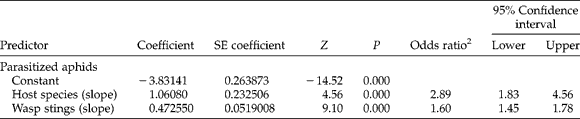
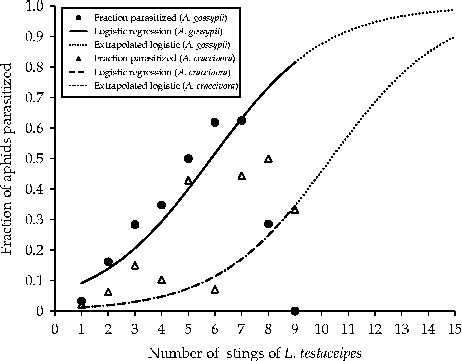
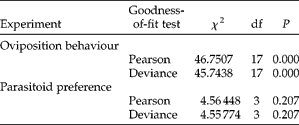
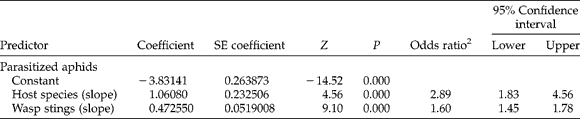
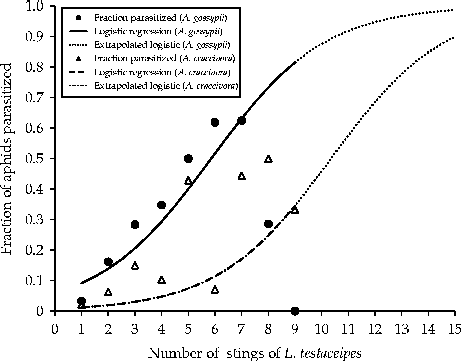
Lysiphlebus testaceipes never oviposited in L. erysimi, but readily attacked and parasitized A. gossypii and A. craccivora (Table 1). The binary logistic regression lines provided a good description of the effect of the aphid host species and the number of stings given by the wasp L. testaceipes to its hosts on oviposition (Tables 2 and 4; Fig. 1). The proportion of aphids with parasitoid larvae increased steadily with the wasp's attacks, the probability for parasitism to be successful with increasing stings being higher in A. gossypii. We predicted that the increase of stabbings to 15 stings more probably on stronger (older/larger) aphids had proportions of 0.99 and 0.90 of parasitized aphids for A. gossypii and A. craccivora, respectively (Fig. 1). There was evidence that both the aphid host species as a factor and the stings of the wasp as a continuous explanatory variable were significantly different from zero for the response investigated (Tables 2 and 4), showing that the two variables affected the oviposition of L. testaceipes. However, there was no interaction between these two effects.
Lysiphlebus testaceipes attacks on Aphis craccivora, Aphis gossypii and Lipaphis erysimi, and oviposition, parasitism and superparasitism recorded out of 450 aphids per aphid species

Binary logistic regression of two aphid host species (Aphis craccivora and Aphis gossypii) and stabbing stings of Lysiphlebus testaceipes on parasitized aphids1 (n=900)
1 Binary logistic regression models with replicate included as an additional factor did not lead to qualitatively different results, and the data were pooled.
2 Odds ratio means the estimated probability for parasitism to be successful/unsuccessful for A. gossypii compared with A. craccivora, and for each increase of stings given by the wasp prior to oviposition.
Parasitism rate of Lysiphlebus testaceipes on Aphis gossypii and Aphis craccivora (in the Petri dish) as a function of stabbing stings of the wasp prior to oviposition. Analysis by binary logistic regression, using the number of stings given by the parasitoid to its hosts: 0, 1, 2, 3, 4, 5, 6, 7, 8 and 9 stings (Table 2).
Parasitoid preference
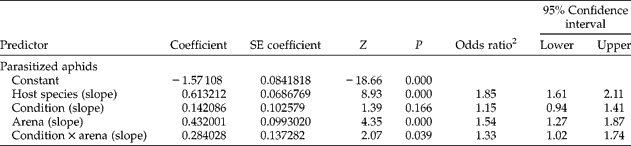
The binary logistic regression also provided a good description of the effect of the aphid host species, the experimental condition (choice and no-choice), the experimental arena (Petri dish and cage) and the interaction condition × arena on parasitized aphids in A. gossypii and A. craccivora (Tables 3 and 4). There was evidence that all the factors were significantly different from zero for the response investigated, except for the effect of the experimental condition (choice and no-choice) (Tables 3 and 4). This shows that there was no difference between the choice and no-choice tests with respect to parasitism potential by L. testaceipes. There was, however, an interaction between the experimental condition (choice and no-choice) and the experimental arena (Petri dish and cage), showing that the influence of one of these factors on the fraction of aphids parasitized depends on the level of the other factor (Table 3).
Binary logistic regression of two aphid host species (Aphis craccivora and Aphis gossypii), two experimental conditions (choice and no-choice) and two experimental arenas (Petri dish and cage) on aphids parasitized by Lysiphlebus testaceipes 1 (n=4313)
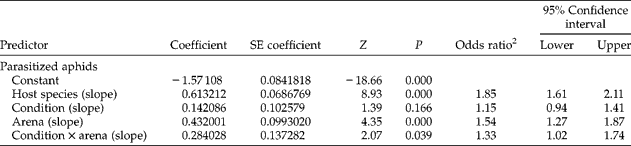
1 Binary logistic regression models with replicate included as an additional factor did not lead to qualitatively different results, and the data were pooled.
2 Odds ratio means the estimated probability for parasitism to be successful/unsuccessful for A. gossypii versus A. craccivora, under the no-choice test versus the choice test, in Petri dish versus cage as the experimental arena and for the interaction between the experimental condition and the experimental arena.
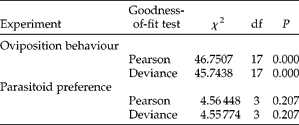
Results of goodness-of-fit tests related to the results of binary logistic regressions in Table 2 (parasitoid oviposition behaviour) and Table 3 (parasitoid preference)
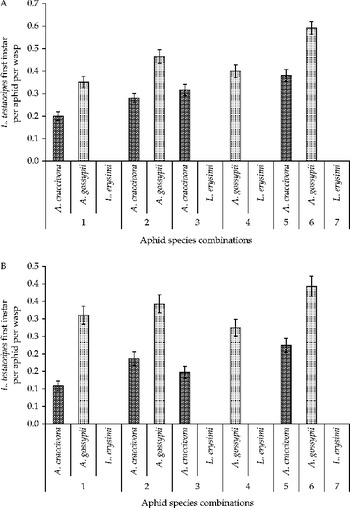
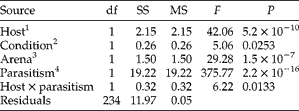
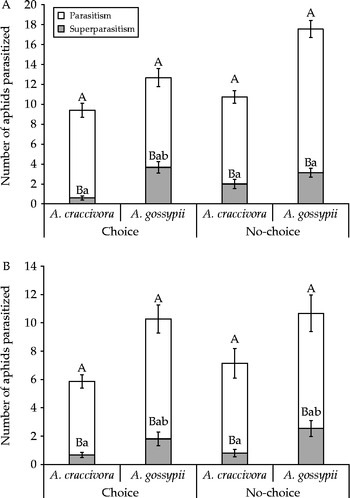
In both choice and no-choice experiments, L. erysimi never hosted L. testaceipes (Fig. 2A and B). No parasitoid larvae were found after the dissection of L. erysimi from all trials in Petri dishes or in cages. Lysiphlebus testaceipes, on the other hand, oviposited in both A. craccivora and A. gossypii in the experiments involving both Petri dishes and cages. In the no-choice experiments in Petri dishes, the mean number of L. testaceipes larvae was higher in A. gossypii than in any other aphid species with 0.59 ± 0.03 and 0.38 ± 0.03 for A. gossypii and A. craccivora, respectively (Fig. 2A). The same trends were also observed in the case of the choice experiments with a lower number of parasitoid larvae, relatively speaking, when compared with the no-choice test in Petri dishes (Fig. 2A) or in cages (Fig. 2B). In the cage experiments, the number of L. testaceipes larvae was significantly low compared with the experiments in Petri dishes (Tables 3 and 4; Fig. 2A and B). However, superparasitism was observed in both aphid host species in both Petri dishes and cages and was significantly lower than parasitism in all cases (Table 5; Fig. 3A and B). In general, superparasitism was usually significantly frequent in A. gossypii compared with A. craccivora, except in the case of the no-choice condition in the Petri dish where the two aphid host species were equally superparasitized (Fig. 3A and B). The interaction between the aphid host species and the level of parasitism (parasitism and superparasitism) was significant, showing that the number of aphids parasitized to a level of parasitism depends on the species of host attacked by the wasp (Table 5).
Mean number ( ± 1 SE) of parasitoid first instar in the three aphid species under (1, 2, 3 and 4) the choice and (5, 6 and 7) no-choice conditions per female Lysiphlebus testaceipes in (A) the Petri dish and in (B) the cage as experimental arenas. A. gossypii, Aphis gossypii and A. craccivora, Aphis craccivora.

ANOVA results related to the number of aphid hosts parasitized and superparasitized by Lysiphlebus testaceipes (Fig. 3)
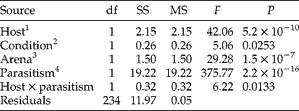
1 Two aphid host species: Aphis craccivora and Aphis gossypii.
2 Two experimental conditions: choice and no-choice.
3 Two experimental arenas: Petri dish and cage.
4 Two parasitism levels: parasitism (aphids with one parasitoid larva) and superparasitism (more than one larva). SS, sum of squares; MS, mean squares.
Mean number ( ± 1 SE) of aphids parasitized and superparasitized by Lysiphlebus testaceipes in Aphis craccivora and Aphis gossypii under the choice and no-choice conditions in (A) the Petri dish and in (B) the cage. Mean values followed by different capital letters are significantly different between the parasitized and superparasitized aphids within each host species, and those followed by the same small letters are not significantly different among the superparasitized aphids of A. craccivora and A. gossypii under each experimental condition (choice and no-choice), at the 5% level.

Discussion
Lysiphlebus testaceipes has a large host range (Pike et al., Reference Pike, Starý, Miller, Graf, Allison, Boydston and Miller2000; Starý et al., Reference Starý, Lumbierre and Pons2004). According to Mackauer et al. (Reference Mackauer, Michaud and Völkl1996), host choice is based on three steps: host recognition (change in the female's behaviour), host evaluation (by antennation and ovipositor probing) and host acceptance (oviposition). During probing with the ovipositor, aphidiine females may evaluate chemical cues in the aphid's haemocoel (Mackauer et al., Reference Mackauer, Michaud and Völkl1996; Rehman and Powell, Reference Rehman and Powell2010). Lysiphlebus testaceipes has an average oviposition time of 1.4 s (Marullo, Reference Marullo1987; Gross, Reference Gross1993; Völkl and Mackauer, Reference Völkl and Mackauer2000), which makes it difficult to observe whether a female is probing or ovipositing. It was observed in this study that L. erysimi was quickly recognized and rejected by naive L. testaceipes. Similarly, parasitism by Binodoxys communis Gahan (Hymenoptera: Braconidae) was not detected in L. erysimi by Desneux et al. (Reference Desneux, Barta, Hoelmer, Hopper and Heimpel2009). This partly suggests that some physical characteristics might lead to the recognition of the non-aphid host L. erysimi by the two foraging parasitoids. The indifference of L. testaceipes to L. erysimi may also presume the absence of an attractant in this aphid species. Grasswitz and Paine (Reference Grasswitz and Paine1992) showed how kairomonal activity may make L. testaceipes attractive to one of its non-aphid hosts (Acythosiphum pisum (Harris)). This demonstrated the role of aphid secretion in the olfactory recognition of a host by a parasitoid. An aphid may be unsuitable because the species is physiologically incompatible (Carver and Sullivan, Reference Carver, Sullivan, Niemczyk and Dixon1988), for instance due to the deficiency/richness of some necessary/harmful substance or hormonal resource. The present results indicate that L. erysimi is probably nutritionally unsuitable to or physiologically incompatible with L. testaceipes. Likewise, Silva et al. (Reference Silva, Bueno and Sampaio2008) observed that the wasp did not parasitize the two Macrosiphini species Brevicoryne brassicae (L.) and L. erysimi in Brazil. Documentation on the rejection or unsuitability of L. erysimi to L. testaceipes is rather scanty.
This study shows that L. testaceipes readily attacked and successfully oviposited in A. craccivora and A. gossypii. The results reveal that L. testaceipes females may attack the same aphid host with up to nine stings before leaving. Furthermore, the increasing number of stabbing stings seems to have a positive effect on oviposition (Fig. 1). However, He et al. (Reference He, Wang and Teulon2011) suggested that increasing attack attempts and/or ovipositor probings do not result proportionally in the oviposition of the aphidiine Aphidius ervi Haliday on its aphid host Acyrthosiphon pisum (Harris).
Aphis craccivora and A. gossypii were identified as the aphid hosts of L. testaceipes in Guam by Miller et al. (Reference Miller, Pike and Starý2002). Nevertheless, little is known about the preference of L. testaceipes for these aphid species in the native distribution range of the wasp where the common hosts comprise some Aphidini including Schizaphis graminum (Rondani) and Rhopalosiphum spp. The present results show that L. testaceipes exhibited higher parasitism in A. gossypii compared with A. craccivora under both choice and no-choice conditions. In all cases, A. gossypii was the most preferred host by L. testaceipes. Aphid parasitoid preferences for various host species have been investigated previously (Tripathi and Singh, Reference Tripathi and Singh1995; Chau and Mackauer, Reference Chau and Mackauer2001; Bueno et al., Reference Bueno, Carnevale, Sampaio, Soares, Ventura, Garcia and Hemptinne2003). There are some data to show that under no-choice conditions, L. testaceipes preferred S. graminum to A. gossypii with a parasitism rate of 76 and 56%, respectively (Rodrigues and Bueno, Reference Rodrigues and Bueno2001). In the present experiments, L. testaceipes was reared on A. gossypii. This could have resulted in a higher susceptibility of A. gossypii to the wasp compared with A. craccivora. However, the preference for A. gossypii to A. craccivora is highly significant in all experiments, indicating that A. gossypii is a preferred host for L. testaceipes independent of the rearing conditions. Our results are consistent with those of Desneux et al. (Reference Desneux, Barta, Hoelmer, Hopper and Heimpel2009) who found a significant preference of the braconid B. communis to A. gossypii compared with A. craccivora, and a higher ability of A. craccivora to defend itself at a rate of 53.8% compared with A. gossypii (14%) against the wasp.
It is argued that parasitoids prefer hosts that guarantee optimum conditions for development and growth in immature stages (Godfray, Reference Godfray1994). Since all aphid instars were mixed in these experiments, a closer look on how host age/size might influence the preference of L. testaceipes is lacking. This is probably also one of the reasons why parasitism was low in some experiments. The defence mechanism in aphid insects may influence host acceptance by foraging parasitoids across aphid species, although how it does so remains to be established. Moreover, a higher aphid defence is usually presumed to minimize superparasitism (Rodrigues and Bueno, Reference Rodrigues and Bueno2001), as it was observed in A. craccivora. However, superparasitism was not consistent enough (Fig. 3A and B) to assume a shortage of host discrimination (Jones et al., Reference Jones, Giles, Berberet, Royer, Elliott and Payton2003) by L. testaceipes in any of the two aphid host species. Although encapsulation of aphidiine eggs has been reported to be rare (Hågvar and Hofsvang, Reference Hågvar and Hofsvang1991), this phenomenon may explain host defence against parasitoid offspring in aphids. Furthermore, Oliver et al. (Reference Oliver, Degnan, Burke and Moran2010) clarified that another potential source of resistance to parasitoid is aphid infection by facultative symbionts. This is in accordance with Desneux et al. (Reference Desneux, Barta, Hoelmer, Hopper and Heimpel2009) who identified the bacterial endosymbiont Hamiltonella defensa in A. craccivora. In the present study, the aphid hosts were dissected either alive or frozen 2 days after parasitization to check for L. testaceipes first-instar larvae. A control study for the emergence of parasitoid adults was lacking. In addition, we cannot totally exclude that some eggs of L. testaceipes had not hatched before dissection. However, the low number of L. testaceipes first instars observed in the cage experiments compared with the Petri dish experiments is likely to be related to the size of the arena as the number of aphids offered was the same in cages as in Petri dishes, where the wasps were confined to a small and narrow environment. Finally, it was observed that in some cages, L. testaceipes did not successfully locate the aphid hosts.
The present study shows that both A. gossypii and A. craccivora are readily attacked by L. testaceipes and that the species is a good candidate for biological control on vegetables in Benin. However, successful and sustainable use of L. testaceipes in Benin depends to a large extent on moderate pesticide use by the farmers. Further studies on intraguild predations and species interactions with other aphidophagous organisms present in the agroecosystem are also needed.
Acknowledgements
We wish to thank Franck Mensah and François Onikpo for their invaluable assistance in insect rearing. The comments by Torfinn Torp on the data analysis are greatly appreciated. The authors express their gratitude to the anonymous reviewers whose comments and suggestions significantly improved both the clarity and precision of the paper. This work was funded by the Research Council of Norway under the Bioforsk project ‘Integrated Pest Management (IPM) in UPU Horticulture in Benin’. The study was performed at the International Institute of Tropical Agriculture (IITA-Benin).