




No CrossRef data available.
Article contents
Civic Engagement and Community Heterogeneity: An Economist's Perspective
Published online by Cambridge University Press: 09 January 2004
Abstract
Now many of them [economists] are writing about neighborhood get-togethers, PTAs, Bible study classes, and the like …. This is not necessarily a good thing.—Claude S. Fischer, “Bowling Alone: What's the Score?”The authors thank the participants in the Conference on Social Connectedness and Public Activism (Harvard University), where an earlier version of this article was delivered in May 2002; Jennifer Hochschild; and four anonymous reviewers for comments. They also thank NIH grant R01 AG19637. Additionally, Dora Costa thanks NIH grants AG12658 and AG10120.
Information
- Type
- SYMPOSIUM
- Information
- Copyright
- 2003 by the American Political Science Association
Introduction
Economists do bowl with political scientists and sociologists, but in separate lanes. More than ever, economists are recognizing the importance of institutions, such as the judicial system and transparent governance, in determining economic performance.1
For example, World Bank 2002.
Alesina et al. 1999; Harris et al. 2001; Luttmer 2001; Poterba 1997; Miguel and Gugerty 2002; Goldin and Katz 1999.
The question then becomes, what produces social capital? According to one definition, social capital refers to aspects of the network structure—such as social norms and sanctions, mutual obligations, trust, and information transmission—that encourage collaboration and coordination between friends and between strangers.6
Social capital is thus embodied within society. According to another definition, it is a person's social characteristics, including the size of her Rolodex, that help her reap market and nonmarket returns from interactions with others but that cannot be evaluated without knowledge of the social structure in which she operates.7 Whether an attribute of an individual or of a society, social capital is produced by individuals' decisions about participation. An individual can increase the number and depth of his connections with others, but the value of those network connections depends upon the extent (both quality and quantity) of others' participation. Social capital therefore depends both upon individual socioeconomic and demographic characteristics and upon the characteristics of society.This article provides an overview of the mushrooming economics literature on how community attributes influence the level of civic engagement. Since 1997, at least 15 empirical papers have investigated the consequences of heterogeneity for social capital. Social capital has been measured using indicators of group participation (such as volunteer activity, organizational membership and activity, entertaining and visiting friends and relatives, and voting), indicators of the strength of network ties (trust, for example), and indicators of community commitment (such as public expenditures and loan repayment to community members). These papers cover different nations, different socialcapital measures, and even different centuries. But a common theme emerges: more-homogeneous communities foster greater levels of social-capital production. After we touch upon the literature, we synthesize our past work on volunteering and membership in the United States over the last 20 years with new findings on trust and voting. We also discuss our work on community in the U.S. military during the Civil War.
Why Does Heterogeneity Matter?
The benefits of community diversity have been studied in a variety of contexts. Jane Jacobs observes that cities with different types of industries (as opposed to completely specialized cities) should experience greater rates of growth because the transfer of ideas and learning is greater in a diverse environment.8
Morediverse cities are better insured against risk. Portfolio risk minimization hinges on diversification—that is, holding dissimilar assets. Edward Glaeser, Hedi Kallal, Jose Scheinkman, and Andrei Shleifer study economic growth in U.S. counties and report evidence supporting the Jacobs hypothesis. William Bowen and Derek Bok report that there were substantial social interactions between white and black students at elite schools and that alumni pointed to these college interactions as helping them to relate to members of different racial groups later in life. Ethnic heterogeneity provides many of our major cities with their charm and epicurean variety. Disgust with suburban sprawl is partially generated by the homogeneity of the housing stock.Diversity also imposes costs. Whether in choosing a college roommate, a residential community, or a place to pray, people tend to self-segregate. They prefer to interact with others like them because of shared interests, socialization to the same cultural norms, and greater empathy toward individuals who remind them of themselves. Members of minority groups may prefer to interact with other minority members if they fear discrimination. The coordination necessary for groups to form and to become active is easier if members speak a common language. When Harvard University began randomized assignment to undergraduate residence halls, minority resident tutors argued that this had destroyed a “supporting and nurturing community … [in which] students of color felt comfortable, academically, socially, personally.”9
Our focus is not on why people try to self-segregate, but on why they take very different actions when interacting in a “homogeneous” environment versus a “heterogeneous” one.10
We are assuming that individuals are assigned a peergroup and then we ask how the collective characteristics of this peer group affect individual choices on civic engagement.
Recent Economic Literature
Over the past five years, at least 15 different empirical economic papers have studied the consequences of community heterogeneity, and all of these studies have the same punch line: heterogeneity reduces civic engagement. In more-diverse communities, people participate less as measured by how they allocate their time, their money, their voting, and their willingness to take risks to help others. The appendix to this article provides an outline of these studies. It is arranged into three broad categories: the contemporary United States, international studies, and historical U.S studies.
U.S studies have focused on three different measures of civic engagement: group participation, state spending, and trust. Using General Social Survey data, Alesina and La Ferrara find that organizational membership is lower in metropolitan areas that feature greater racial and ethnic diversity and higher income inequality. Jacob Vigdor reports that in counties featuring higher levels of ethnic fragmentation, the rate of response to the 2000 Census form is lower, suggesting reduced willingness to provide a public good (information about oneself that determines the community's receipt of federal funds).
A second measure of civic engagement is the willingness to redistribute income. Erzo Luttmer, using data from the General Social Survey and from California ballot initiatives, finds that support for redistribution is higher when the recipients are from the same racial group. Researchers have found a similar result for support of public education. Amy Rehder Harris, William Evans, and Robert Schwab, and James Poterba, report evidence of a “Florida effect” in states' public-school expenditures. In Florida the “average” taxpayer is a white senior citizen, while the typical public school student is Hispanic. In this diverse environment, there is less support for public-school expenditures than in states where the students and the taxpayers are of the same ethnicity. Claudia Goldin and Lawrence Katz find that a similar pattern prevailed in the past—racial, ethnic, and religious diversity and income inequality predicted state educational expenditures. Data from U.S. cities, metropolitan areas, and urban counties show that the share of spending on such productive public goods as education, roads, sewers, and trash pickup is inversely related to the area's ethnic fragmentation, even after controlling for other socioeconomic and demographic characteristics.12
Not only are participation and expenditure lower in more-diverse settings, but so is trust. Self-reported levels of trust13Alesina and La Ferrara (forthcoming).
Recently, development economists have used new data sets to investigate social-capital production abroad. A distinguishing characteristic of these papers is developing new empirical proxies for the presence of social capital. Papers that examine developed countries rely heavily on membership, volunteering, and trust as proxies for social capital. While it is intuitive that such indicators are correlated with social capital, our confidence in our ability to measure social capital would be raised if we had more indicators. One of the most interesting indicators in the development literature is default rates on micro-finance loans, an important source of funds for the poor. If there is strong social capital within the group providing and receiving loans, then default is lower because altruism, peer pressure, and social sanctions enforce repayment. Dean Karlan reports evidence from Peru that cultural similarity within the community of loan recipients lowers default rates. Edward Miguel and Mary Kay Gugerty report evidence of lower school funding in communities that are more ethnically diverse—a finding similar in spirit to the U.S research on public expenditure patterns. There is also evidence that income inequality lowers civic participation and community expenditure.15
Civic Participation and Community Heterogeneity: Evidence
Heterogeneity may be measured in several ways, including race, ethnicity, income, educational or work experiences, and religion. We will focus mainly on race, ethnicity, and income. Our measures of distance are for the most part calculated for metropolitan areas and include the Gini coefficient of weekly wages for fulltime, full-year men ages 21–64, as well as fragmentation indexes for race and birthplace. Recall that the Gini coefficient measures the extent of departure from a perfectly even distribution of income, with a Gini of 0 indicating perfect equality and a Gini of 1 perfect inequality. In the case of fragmentation indexes, a value of 0 indicates complete homogeneity and a value of 1 complete heterogeneity. For example, our racial fragmentation index for each metropolitan area, i, is
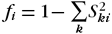
where k represents the categories (white, black, American Indian, Asian, and other) and where ski is the share of race k in metropolitan area i. Our birthplace fragmentation index is similarly constructed.
16We calculated, by metropolitan area, the fraction of individuals born in the United States, Puerto Rico, Latin America, Cuba, white English speaking nations, Scandinavia, northern Europe, southern Europe, eastern Europe, east Asia, southeast Asia, the Mideast, Africa, and other areas. Metropolitan area characteristics are estimated from the Integrated Public Use Census Samples for 1950, 1970, 1980, and 1990.
Evidence from the United States today
Our evidence for the impact of metropolitan-area heterogeneity on civic engagement comes from examining volunteering in the 1974 and 1989 Current Population Survey (CPS) and in the 1975–1998 DDB Lifestyle Survey (DDB), membership in nonchurch organizations in the 1952 and 1972 American National Election Survey (ANES) and in all organizations in the 1974–1994 General Social Survey (GSS), and trust in the 1972–1998 GSS. In addition, we examine the impact of ethnic heterogeneity among registered voters within a census tract on voter turnout. One of the benefits of group membership is that through participation, relations among individuals are transformed into positive ties—that is, into trust.17
Another benefit of group participation is, of course, its observed correlation with political participation (e.g., Verba et al. 1995).
Table 1 shows that volunteering, membership, and trust among 25- to 54-year-olds are lower in heterogeneous communities, particularly those in which wage inequality is high. An increase in the Gini coefficient of 0.058 (such as occurred between the mid-1970s and 1990) lowers the probability of volunteering in the CPS and DDB, and of organizational membership and trust in the GSS, by 0.03.18
We arrive at the figure of 0.03 by multiplying the increase in the Gini coefficient (in this case, 0.06 from the mid-1970s to 1990) by the reported slope of the regression coefficients in the table (in this case, 0.5).

We do not expect that all groups will react similarly to changes in their community. For Americans older than 64, birthplace fragmentation was the most important predictor of volunteering, membership, and trust (see Table 2). The Gini coefficient for wage income was an insignificant predictor, and racial fragmentation was a significant predictor only of volunteering in the DDB. The increase in birthplace fragmentation from the mid-1970s to 1990 predicts a decline among older Americans of 0.01 in the probability of volunteering and trust and of 0.02 in the probability of membership. For African Americans (not shown), we found smaller declines in volunteering in the CPS than for whites. While birthplace fragmentation had predictive power in explaining both the level and the trend of black volunteering rates, the Gini coefficient did not.

We explain only a small proportion of total variance, but we would expect that, since there are many traits affecting a person's level of trust or engagement that we cannot measure here. Such traits include a person's affability or altruism, both of which are not captured in these surveys. Nevertheless, the results are meaningful. The data show, overall, a relatively small decline in social capital from the 1970s to 1990—and rising heterogeneity explains these declines very well.
Community heterogeneity explains not only the level of civic engagement at a point in time, but also changes in the level of civic engagement over time. Metropolitan areas in the United States have become more fragmented by income, race, and ethnicity since the 1970s. Our measures of the Gini coefficient for full-time male workers, racial fragmentation, and fraction black increase from 1950 to 1990. Our measures of birthplace fragmentation and foreign-born fragmentation decrease from 1950 to 1970, then increase until 1990.19
Table 3 demonstrates the impact of changes in community heterogeneity on trends in social capital, controlling for demographic and socioeconomic characteristics.

Note that not all surveys show declines in social capital in identifiable metropolitan areas. The declines for people ages 25 to 54 are in volunteering in the CPS (particularly among women) and in membership and trust in the GSS. Membership declined sharply in the early 1980s relative to the 1970s (not shown), precisely mirroring the sharp increase in inequality, but then leveled. The Gini coefficient was a particularly important predictor for membership in sports, youth, church, literary, and hobby clubs, but not in professional organizations, suggesting that when interpersonal contact is high, people prefer to be with others like them. Controlling for heterogeneity explains anywhere from one-third to almost all of the declines in volunteering, membership, and trust among people ages 25 to 54. Among older Americans, both membership and trust declined, with the largest declines in membership occurring in the late 1980s, thus coinciding with increases in immigration. Only the decline in membership can be explained by heterogeneity.
Voting rates provide another measure of community participation at a point in time. Since voting is costly, but one's vote “doesn't matter,” economists wonder why everyone does not free ride. In a community with more social capital and more of a civic sense, voting rates are likely to be higher as residents do not pursue only their own narrow self-interest. The Institute of Government Studies at the University of California at Berkeley has created a database by census tract on voter turnout rates (as a fraction of registered voters) and tract demographics (based on registered voters). We use data from the 1998 primaries and the 2000 general election. Controlling for county fixed effects and the age and sex distribution of a census tract, we study whether census tracts featuring higher levels of ethnic fragmentation have lower voter turnout rates. Our ethnic fragmentation measure is based on the following categories: Latino, Jewish, Korean, Japanese, Chinese, Asian-Indian, Vietnamese, Filipino, and other.20
The data set does not contain information on the racial composition of census tracts.
Source: authors' calculations from data at swdb.berkeley.edu/data/. Sample size equals 6,891 for the 1998 primaries and 7,052 for the 2000 general election. The regressions are weighted by total number of registered voters within a census tract. Ordinary least squares regression coefficients are −0.071 and −0.141 for the 1998 primaries and the 2000 general election, respectively. Robust standard errors are 0.006 and 0.007. Adjusted R2 for the 1998 primaries is 0.561 and for the 2000 general election is 0.564.
International evidence
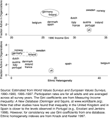
Both high income inequality and high ethnic heterogeneity predict low membership across some, though not all, western European countries (see Figure 1). The fraction of the population participating actively in a group is very high in Finland and Germany, both of which have relatively low income inequality and ethnic heterogeneity. Similarly, the fraction of the population participating actively in a group is low in the United Kingdom, which has relatively high heterogeneity of income and ethnicity. These fit our hypothesis. Sweden, despite its high level of income inequality and relatively high level of ethnic heterogeneity, has a high level of participation. Other countries, such as Belgium and Norway, fit our hypothesis along one measure of heterogeneity but not the other.

Figure 1 poses the interesting riddle of what other factors, besides community heterogeneity, help to determine civic engagement. Unfortunately, we cannot do much on this question with our few data points and the kind of evidence we have available.
Evidence from the past
Looking to the past provides us with the opportunity to study the role of heterogeneity in civic engagement in a very different environment. However, there are no large surveys on membership, volunteering, or trust. Theda Skocpol, Marshall Ganz, and Ziad Munson identified the large voluntary associations from the colonial period to the 1940s and discovered that they operated as an amalgam of national authority and local involvement, modeled on the U.S. Constitution. A unique data set on 303 Union Army infantry companies (with each company containing 100 men) allows us to study the effect of both “local” and “national” factors on civic engagement during the war as measured by the probability of desertion, absence without leave (AWOL), and arrest.22
The data were collected by Robert Fogel and are available at www.cpe.uchicago.edu. The data set contains 31,854 white enlisted men, representing roughly 1.3 percent of all whites mustered into the Union Army and 8 percent of all regiments that comprised the Union Army. The data are based upon a cluster sample (drawn at the company level) of 331 companies and 100 percent sampling within each company. Ninety-one percent of the sample consists of volunteers, with the remainder evenly divided between draftees and substitutes. A black sample of companies is currently being collected.
The Union Army data have two main advantages over survey data. One is that the measure of community is much narrower. Our measure of community is not the commonly used metropolitan area, but a company that consists of 100 men in close and constant contact. The second advantage is that our measure of participation, unlike membership in many organizations, was not “cheap talk.” Shirking in the Civil War was costly to one's comrades, but it was also expensive for individual soldiers not to shirk. One out of every five white men participating in the Civil War died, over half of them from disease. The combatants faced death, the hardships and monotony of camp life, and distance from loved ones, all for low and irregular pay. One soldier wrote, “I have cursed the day I have enlisted for what benifit [sic] will I ever drive [sic] from being a Soldier. [T]he common Soldier will not reap the Harvest of Victories but it is some other men that will gain all Praise Honor and Wealth.”23
Letter of John S. Voltz to his brother, 10 February 1865, University Libraries of Virginia Tech. Available at scholar2.lib.vt.edu/spec/voltz.
Linderman 1987, 174, 176.
McPherson 1997, 81–2.
We created community variables for each company by constructing birthplace and occupational fragmentation indexes and by estimating the coefficient of variation of age, an indicator of age diversity.27
Our birthplaces are the United States, Germany, Ireland, Great Britain, and other. Our occupations are farmer, high and low class professional or proprietor, artisan, and high and low skilled laborer.
See Costa and Kahn (forthcoming, a) for details.
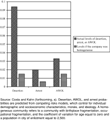
Figure 2 shows predicted desertion, arrest, and AWOL rates holding socioeconomic and demographic characteristics, ideology, and morale constant under two scenarios: one uses the true company characteristics and the other assumes complete company homogeneity. In the case of desertion, the most important variables were age and occupational diversity within the company. In the case of arrests, birthplace and occupational fragmentation were also important. Birthplace diversity and age diversity were the most important predictors of AWOL. Compared to variables such as morale and ideology, our heterogeneity measures (company socioeconomic and demographic characteristics) were more important predictors of social capital (proxied by desertion, arrest, and AWOL), even in one of the more ideological wars in our country's history.29
The same result will not necessarily hold true for black Civil War soldiers, because they may have been more committed to the cause and because, after the massacre at Fort Pillow, surrender to the enemy was not an option.

Conclusion
Economists love to measure capital stocks. Adam Smith and Karl Marx encouraged us to look at capital flows. Theodore Schultz and Gary Becker emphasized the importance of human capital. Michael Grossman and Victor Fuchs focused our attention on health capital. Robert Putnam's work has now turned our interest to social capital. Although it is harder to measure than physical, financial, human, or health capital, economists have become fascinated by social capital.
This article has documented an empirical regularity: civic engagement is lower in more-heterogeneous communities. While a large number of applied-economics papers are independently generating this finding, a number of questions remain. Ideally, we would want to study how civic engagement changes as we move people into different types of communities. But what is an individual's community? Because of data limitations, researchers are using the metropolitan area as the measure of community, not the nearest neighbors or coworkers. Even if we had narrower measures of community, we would still wonder whether being in a particular neighborhood leads to greater activity or whether those more likely to be involved picked that neighborhood. Ideally, we would want to follow individuals over time and observe their response to random exogenous shocks that change their community, such as immigration increases into a border port or European labor market integration.
If homogeneity increases civic participation, why are so many in our society pushing for diversity in the workplace and in communities? This tension reflects a classic externality problem. Social capital is an unusual commodity. No one can buy or sell it in the marketplace. It is a by-product of individuals' collective choices on how to allocate their scarce time. Volunteers compare their own private costs and benefits of donating their time; they rarely consider the long-run social benefits of having diverse groups interact—which may be economic as well as social. Firms with diverse leadership may be better positioned to take advantage of opportunities in different markets and to find skilled workers from different backgrounds. They may need to introduce heterogeneity into their workforce to find workers whose skills complement one another's.30
From society's perspective, racial and ethnic equality and equality of access may be more important values than achieving greater civic participation.Can diversity ever increase civic engagement in community organizations that cut across ethnic, racial, or income divisions? If people realize that their skills are complements, then they will seek out individuals different from themselves to work together to achieve a common goal more effectively. If a community fair will generate more revenue for the local school when there are food offerings from many cultures, instead of endless Apple Betties, then more parents will be pressured to become involved and more will agree to do so.31
A more real-world example may be a community developing many religious congregations that later engage in ecumenical exchanges.
Future research that draws on the insights of many disciplines may reveal the mechanisms through which heterogeneity lowers social capital. Social capital could thus serve as a bridge between the social sciences. Hopefully, civic engagement among socialcapital scholars will continue to rise despite the increase in intellectual community heterogeneity brought about by the entry of economists.
Appendix

References
Alesina AlbertoReza BaqirWilliam Easterly1999 Public goods and ethnic divisions Quarterly Journal of Economics 114 41,243-84Google Scholar
Alesina AlbertoEliana La Ferrara2000 Participation in heterogeneous communities Quarterly Journal of Economics 115 3847 904Google Scholar
Alesina AlbertoEliana La Ferrara2002 Who trusts others? Journal of Public Economics 85 2207-34Google Scholar
Athey SusanChris AveryPeter Zemsky2000 Mentoring and diversity American Economic Review 90 4765-86Google Scholar
Bourdieu Pierre1986 Forms of capitalHandbook of Theory and Research for the Sociology of EducationJohn G. RichardsonWestport, ConnGreenwood Press241-60
Bowen William G.Derek Bok1998 The Shape of the River: Long-Term Consequences of Considering Race in College and University AdmissionsPrincetonPrinceton University Press
Brady Henry E.Kay LehmanSchlozman Sidney Verba1995 Beyond SES: A resource model of political participation American Political Science Review 89 2271-94Google Scholar
Coleman James1990 Foundations of Social TheoryCambridgeHarvard University Press
Costa Dora L.Kahn Matthew E.Cowards and heroes: Group loyalty in the American Civil War Quarterly Journal of Economics Forthcoming, a. Available at web.mit.edu/costa/www/papers.html.
Costa Dora L.Kahn Matthew E.Understanding the American decline in social capital, 1952–1998 Kyklos Forthcoming, b. Available at web.mit.edu/costa/www/papers.html.
Dolgonos Sarah A.Lamas. Daniela J.2000 Many protested randomization, but minority groups were among the most vocal.The Harvard Crimson8 June. Available at www.thecrimson.com.
Easterly WilliamRoss Levine1997 Africa's growth tragedy: Policies and ethnic divisions Quarterly Journal of Economics 112 41,203-50Google Scholar
Ercolani Marco G.Stephen P. Jenkins1998 The polarisation of work and the distribution of income in BritainInstitute for Labour Research Working Paper No. 98/20 University of Essex
Fischer Claude S.2001 Bowling Alone: What's the score?Unpublished manuscript BerkeleyUniversity of California
Glaeser Edward L.Hedi D. KallalJose A. ScheinkmanAndrei Shleifer1992 Growth in cities Journal of Political Economy 100 61,126-52Google Scholar
Glaeser Edward L.David I. LaibsonJose A. ScheinkmanChristine L. Soutter2000 Measuring trust Quarterly Journal of Economics 115 3811-46Google Scholar
Goldin ClaudiaLawrence F. Katz1999 Human capital and social capital: The rise of secondary schooling in America, 1910 to 1940 Journal of Interdisciplinary History 29 4683 723Google Scholar
Guiso LuigiPaola SapienzaLuigi Zingales2000 The role of social capital in financial developmentNational Bureau of Economic Research Working Paper 7563
Harris Amy RehderWilliam N. EvansRobert M. Schwab2001 Education spending in an aging America Journal of Public Economics 81 3449-72Google Scholar
Jacobs Jane1969 The Economy of CitiesNew YorkVintage Books
Karlan Dean2003 Social capital and group bankingUnpublished manuscript CambridgeMassachusetts Institute of TechnologyAvailable at www.wws.princeton.edu/~dkarlan/papers.html. Accessed 10 February 2003
Knack StephenPhilip Keefer1997 Does social capital have an economic payoff? A cross-country investigation Quarterly Journal of Economics 112 41,251-88Google Scholar
La Ferrara Eliana2002 Inequality and group participation: Theory and evidence from rural Tanzania Journal of Public Economics 85 2235-73Google Scholar
La Porta RafaelFlorencio Lopez-de-SilanesAndrei ShleiferRobert W. Vishny1997 Trust in large organizations American Economic Review 87 2333-38Google Scholar
Linderman Gerald F.1987 Embattled Courage: The Experience of Combat in the American Civil WarNew YorkThe Free Press
Lindert Peter H.1996 What limits social spending? Explorations in Economic History 33 11 34Google Scholar
Luttmer Erzo F. P.2001 Group loyalty and the taste for redistribution Journal of Political Economy 109 3500-28Google Scholar
McPherson James M.1997 For Cause and Comrades: Why Men Fought in the Civil WarOxfordOxford University Press
Miguel EdwardMary Kay Gugerty2002 Ethnic diversity, social sanctions, and public goods in KenyaUnpublished manuscript BerkeleyUniversity of California
Poterba James M.1997 Demographic structure and the political economy of public education Journal of Policy Analysis and Management 16 148 66Google Scholar
Skocpol ThedaMarshall GanzZiad Munson2000 A nation of organizers: The institutional origins of civic voluntarism in the United States American Political Science Review 94 3527-46Google Scholar
Verba SidneyKay Lehman SchlozmanHenry E. Brady1995 Voice and Equality: Civic Voluntarism in American PoliticsCambridgeHarvard University Press
Vigdor Jacob L.2001 Community composition and collective action: Analyzing initial mail response to the 2000 censusUnpublished manuscript Duke University
World Bank 2002 World Development Report 2002: Building Institutions for MarketsAvailable at econ.worldbank.org/wdr. Accessed September 2002
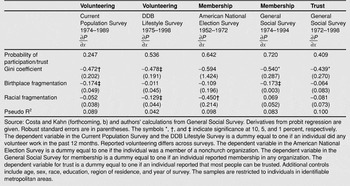
Impact of Community Heterogeneity on Probability of Participation and Trust, 25- to 54-Year-Olds
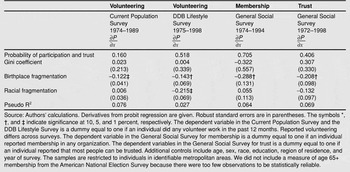
Impact of Community Heterogeneity on Probability of Participation and Trust, Age 65+
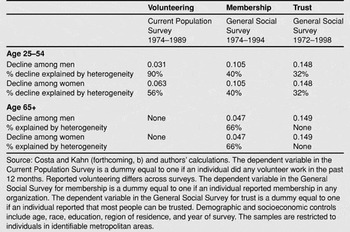
Declines in Probability of Participation, Controlling for Demographic and Socioeconomic Characteristics, and Fraction of Decline Explained by Heterogeneity
 You have
Access
- 387
- Cited by