1 Introduction
Open online volunteer projects, which mobilize hundreds (Linux) to thousands of contributors (Wikipedia, P2P platforms), are alive and well, impacting several industries and raising many issues concerning collective behaviour in the digital age. However, the Pareto distribution of contributions – meaning the provision of the public good depending on few people – has always been considered a strong limitation to the development of these communities.
This has two consequences. First, the development and management of online projects is strongly influenced by the perception of the central role of contributors. Recruiting and facilitating those who are the most able to contribute and ignoring the mere users, who are often considered as free riders,Footnote 1 becomes a priority. Hence, and this is the second consequence, there is a large body of literature dedicated to understanding the motivations of these contributors.
As a result, understanding both the contributors’ and users’ motivations and the building of incentive schemes relies on a significant underestimation of the importance of interactions, inside the community and with its institutional and technical frameworks. Contributions to, but also the intense use of such collective knowledge goods may create a personal feeling of social involvement, such as an attachment to the project and/or to the community. If this is true, social motivations created endogenously by the community may contribute to explaining the survival of the project. This hypothesis makes sense in the context of open online communities, where success depends on the ability of the platform to provide collective rules, codes, in a word norms, to foster costly effort by involved members (such as content production or even intense use) (Butler et al., Reference Butler, Sproull, Kiesler, Kraut and Weisband2007; Safner, Reference Safner2016). The hypothesis also makes sense whenever the project leaders want to prevent users from switching to alternative offers, which possibly better in terms of quality or simply more adapted to their needs (Linux versus Windows), or have them donate to maintain free access to the platform (Wikipedia). In other words, the capacity of collective projects to trigger an implicit feeling of belonging in the whole community of users and not only among contributors may be a key factor in sustainable success.
However, as Safner, Reference Safner2016, has explained, in the case of Wikipedia the importance of the rules and norms governing the cooperative provision of the common resource, nobody, to the best of our knowledge, has investigated adherence to such cooperative norms within the whole group of users of Wikipedia or of any other online community. The present paper fills this gap in the literature by showing the capacity of an online project to generate cooperative behaviours beyond the community of contributors. To achieve this, we took advantage of responses to an experimental game (the dictator game, or DG) played by a large number of Wikipedia users and contributors (N = 13,000). The main result of the game was that an equal split (50/50) was chosen by an overwhelmingly large part of our sample (66%), and we found no difference between contributors and those who are just users (but committed users) of the online encyclopaedia. This twofold result – a majority deciding on an equal split and no difference between contributors and committed users – challenges the existing literature, which suggests that cooperative motivations are correlated with voluntary contributions. It also shows that usage, attachment and time spent on Wikipedia are linked with the choice of what can be seen as a social norm: sharing according to the 50/50 rule. We suggest that this attitude is probably the outcome of participation and involvement in the community: the more people are involved, the more they choose the social norm of an equal split in the DG, because they have learned that sharing is acknowledged in the Wikipedia context, and should be the expected behaviour. In other words, they may have learned the norm.
The article is organized as follows: in section 2 we first review the literature regarding motivation, identity and norms, and then the articles dealing with the DG as an indicator of respect for a norm. In section 3 we present our method, an experiment on Wikipedia readers and contributors. In section 4 we run some econometric tests to assess the determinants of the equal split. We discuss in section 5 the consequences of the results of the tests and their limitations and direction for future research, before concluding.
2 What are social norms designed for?
Departing from the standard model of a rational and selfish individual, one strand of economic literature, in connection with social and evolutionary biologists, has suggested that prosocial behaviours have evolved to sustain cooperation, a key feature of the survival of the human species (Gächter, Reference Gächter2014; Gintis et al., Reference Gintis, Bowles, Boyd and Fehr2003; Seabright, Reference Seabright2012). Established in long-term relationships, these cooperative behaviours often become norms.
Young (Reference Young2015) has described the different mechanisms that support the existence of norms, including the need for coordination and the use of a focal point as a process to make decisions appear to be central, as discussed in the coordination games literature (Schelling Reference Schelling1980; Sugden, Reference Sugden1995). Those norms may emerge very quickly. Social pressure also supports the development of normative behaviour. As a consequence, non-compliance causes forms of dissatisfaction, such as guilt, shame, embarrassment or anxiety, and conversely compliance with a norm can produce satisfaction and pride (Elster, Reference Elster1989).
Another mechanism proposed by Young (Reference Young2015) to explain the impact of norms is signalling and symbolism; it relies on what Akerlof and Kranton (Reference Akerlof and Kranton2000) call ‘identity’. According to this vision, a norm signals membership in a particular group or community that prescribes specific attitudes. According to Bicchieri (Reference Bicchieri2002), identity tends to favour norms that characterize the group as such and distinguish its members from others. But social norms may have a broader scope, and apply to more of the population beyond the group (fairness is an example). In a nutshell, and as Young (Reference Young2015) claimed, norms are the unwritten codes and informal understandings that define what we expect from other people and what they expect from us. And those codes facilitate the functioning of projects, because, as pointed out by Commons (Reference Commons1931), they define what ‘the individual can, cannot, must, must not, may or may not do’ in this context.
The role of norm and identity in open online communities
Norms and identity have an impact on users’ participation in online communities. Zhou (Reference Zhou2011) showed that both social identity and group norms (i.e. norms and values shared inside a group) have a positive impact on user participation, while subjective norms (i.e. the effect of other's’ opinion on a particular behaviour) have not.
Using a public good game Bicchieri (Reference Bicchieri2002), in a study of the impact of communication on cooperative behaviour in an online community, showed that allowing communication dramatically increases cooperation. In a discussion on whether communication elicits identity or social norms Bicchieri argued for the latter.
This echoes the work of Greenstein et al. (Reference Greenstein, Gu and Zhu2016) in the case of Wikipedia and its contributors: on controversial topics, people tend to contribute to articles that reflect their own opinion (for instance, a Republican contributes to articles that describe ideas favoured by Republicans) – a behaviour grounded on identity – but, in the long run, the discussion among contributors to such articles becomes more and more neutral (one of the Wikipedia's five pillars) – rules and social norms emerge through interactions. In fact, it is as if the norm of neutrality emphasized by the Wikipedia Charter has emerged not from a deliberate decision of contributors intending to abide by the Charter rules, but spontaneously from multiple social interactions among contributors, mediated by the social control of the rule enforcers, the administrators of Wikipedia, who are allowed to exclude from contributing those people who sabotage this process.
In that perspective Safner (Reference Safner2016), using the framework from Hess and Ostrom (Reference Hess, Ostrom, Hess and Ostrom2006), explained how cooperation between contributors is enforced in Wikipedia by its rules of publication (the ‘five pillars’Footnote 2 ), but also by its socio-technical organization (the Wikimedia software platform), and by the social interaction as well as the administrators acting as policy makers, to use the phrasing of Hess and Ostrom (ibid.).
But mere users (non-contributors) by definition do not interact directly. Hence whenever users, in certain circumstances, behave pro-socially, this cannot be because of their interactions, but instead must be due to one of the two mechanisms described by Bicchieri (Reference Bicchieri2002): either common compliance with a social norm, namely a collective behaviour enforced by the anticipation of the persons who follow it that others will do the same, or to a feeling of attachment to this project and its identity. Many experimental games help to reveal such attitudes and decide between them. In the context of our research, we relied on the DG as a means to hint (or not) at the existence of social norms of cooperative behaviour among contributors and, possibly, users.
The dictator game to detect the existence of a norm
The DG implies that a first player, ‘the dictator’, decides to split an initial endowment between him- or herself and a second player. The second player does not make any decision, so the choice of the first player to give a non-zero amount to the second player is a non-homo-economicus rational choice. Any deviation from zero can be considered as the manifestation of a form of prosocial behaviour.
The claim that the DG is sensitive to the context has been debated. A consensus has emerged that the design of the game (changing the distribution of offers) has a strong effect on giving (Bardsley, Reference Bardsley2008; List, Reference List2007), as well as the worthiness of the recipient (Eckel and Grossman, Reference Eckel and Grossman1996), or the social distance between players (Hoffman et al., Reference Hoffman, McCabe and Smith1996). For instance, cultural differences can be considered as an expression of different social norms. Henrich et al. (Reference Henrich, Ensminger, McElreath, Barr, Barrett, Bolyanatz, Cardenas, Gurven, Gwako and Henrich2010) showed that in a sample of 15 small-scale societies, norms and institutions played a role in how fairness was perceived. Related findings appear in the meta-analysis of Tisserand et al. (Reference Tisserand, Cochard and le Gallo2015): the amount given by individuals in the DG varied across countries, and those in industrialized countries were less generous.
These results provide support for considering a statistically significant variation from zero in giving in the DG within the group, as an indicator of the influence/strength of a norm explained by the context.
But the DG may lead to any outcome besides the zero choice. Hence, any aggregation on a particular value also reveals a possible latent norm. One of the contenders for this aggregation, is the 50/50 split, which has a special role for the literature. Andreoni and Bernheim (Reference Andreoni and Bernheim2009) pointed out the importance of the equal split in different economic contexts, and emphasized its social nature. They showed that the wish to be perceived as fair by peers explained the choice of the equal split in the DG. Both Krupka and Weber (Reference Krupka and Weber2013) and Eckel et al. (Reference Eckel, Grossman, Johnson, de Oliveira, Rojas and Wilson2011) exhibited a prevalence of this norm in student populations: the former showed that the 50/50 split in the DG is perceived as ‘socially appropriate’, while according to the latter, the equal split was valued positively by students, especially those who scored highly on a social competency scale and who were more sensitive to social pressure. Ensminger (Reference Ensminger2004) showed how access to the market (labour/trade) in East Africa was associated with giving half of the endowment in the DG. In experimental designs of the DG, too, the 50/50 split generally emerges as one of the modes in the distribution of gifts.
Young (Reference Young2015, Reference Young1998) has suggested an evolutionary basis for the emergence and persistence of the 50/50 split, proving that it is an equilibrium in a game with self-reinforcing behaviour. The development of such a particular norm may be seen as a coordination problem. In line with Henrich et al. (Reference Henrich, Ensminger, McElreath, Barr, Barrett, Bolyanatz, Cardenas, Gurven, Gwako and Henrich2010), this result suggests that the need for coordination among unrelated individuals promotes the emergence of the 50/50 norm. This theoretical framework seems appropriate in the particular case of online communities, where people interact virtually, some of them anonymously, and in a very decentralized manner.
But in the context of a pure DG there is no strategic interaction and therefore choosing the 50/50 split does not respond to any strategic need for coordination. However, people may have been accustomed, in previous coordination issues, to adopt such an attitude, which could have become a kind of reflex. Cognitive psychology has long recognized the existence of cognitive reference points (see, for example, Rosch, Reference Rosch1975).
In fact, in the context of online projects, or ‘commons’, there are a lot of coordination problems among contributors, triggered by the associated editing costs – a task bringing no immediate reward to the editor. For example, who begins? In what order do editors intervene? It may be that a coordination process is set up among the editors that becomes a focal point for editing tasks of subsequent contents. Hence, contributors may have been familiar with focal points and decide that the 50/50 split in the DG is a point that reflects what they do in practice, as contributors to an online project. Hence, if an overwhelming choice of the 50/50 split is due to a focal point considered as a process to solve coordination problems (Schelling, 1960; Sugden, Reference Sugden1995), this behaviour will be particularly present within the contributors’ community.
If it is rather the signal of a more general norm of reciprocity (Andreoni and Bernheim, Reference Andreoni and Bernheim2009), guilt aversion (Battigalli and Dufwenberg, Reference Battigalli and Dufwenberg2007), or inequality aversion, for instance, owing to the political philosophy of the project, this may spread to the whole population (even if, as mentioned, the feeling of ‘community belonging’ is felt first by the contributors), and may be more dependent on the level of use, or on the importance of the project to the respondent.
To our best knowledge, nobody has tackled this issue so far. Adopting a kin methodology to ours Algan et al. (Reference Algan, Benkler, Morell and Hergueux2013) interviewed significant contributors to Wikipedia using a questionnaire and had them play four experimental games (the trust game, the dictator game, the ultimatum game and the public good game) in order to reveal their motivations. They showed that reciprocity and a preference for social image (reputation) play a strong role in explaining the volume of contributions from registered contributors and even more from the so-called ‘administrators’.Footnote 3
Likewise, when Wikipedia was blocked in mainland China, Zhang and Zhu (Reference Zhang and Zhu2011) took the opportunity to examine the contributions of non-blocked contributors (living in Taiwan, Singapore or overseas). They established that these groups reduced their contributions during and after the blocking. Their explanation was that contributors perceived that they received fewer social benefits from their work. None of these previous studies tried to evaluate the strength of the social norm of reciprocity beyond the contributors, to see whether those contributors are more prosocial than the mere users of Wikipedia, for instance.
To come back to our main issue, we have been able to test the respective value of the two rival explanations (preference for equality/reciprocity on one hand, need for coordination on the other hand) by constructing a survey addressed to the whole community (contributors and users). As a consequence, if the answers to the DG are motivated by the need for coordination, one can expect contributors to choose a focal point more easily. The distribution of gifts among simple users, on the other hand, will flatter. If prosocial attitude is the determinant for cooperation in Wikipedia, and if contributors are more prosocial, both because they are contributors and because the long practice of contribution has reinforced their prosocial attitude, their gift in the DG will be higher, on average, than that of mere users. And if there is no difference in behaviour between contributors and mere users (an assumption that may a priori defy common sense) we must look for another explanation, such as that a social norm of reciprocity is constructed through a long acquaintance with Wikipedia in users as much as in contributors.
3 Method
With a community of around 700,000 registered contributors (for the English language version) and more than 480 million visitors each month,Footnote 4 Wikipedia provides a particularly fertile field for experimentation. In February 2015, with the help of the French Wikimédia Foundation, we put a banner on the homepage of the French-language Wikipédia.Footnote 5 This banner advertised a questionnaire that asked both contributors and users how they interacted with Wikipedia, whether or not they contributed (if so how) and how much they valued the ‘free encyclopaedia’. To test the prosocial attitudes of respondents in general, we invited them to participate in a DG. It was conducted on a very large scale, as over 13,000 people completed the questionnaire. This huge sample enabled statistically relevant conclusions to be drawn on how and why people behave in a large prosocial context.
Data collection
Once the survey had been completed, respondents were invited to play a game to win a voucher. The game was a standard version of the DG: users were asked to split €10 between them and another person ‘who was assumed to have completed the survey’. After the respondents have chosen the amount they wanted to keep, a dialogue box informs them of the amount they have kept and their ‘gift’ to the other person. This step was designed to help them to understand the protocol. As we were unable to systematically pay the amounts earned by the (numerous) participants, 100 were randomly selected to win a voucher for an amount equal to twice the amount won in the DG. Respondents were informed about the draw and the number of vouchers available, but were unable to estimate the probability of being picked, as they did not know the number of people who had completed the questionnaire.
Almost 30,000 Wikipédia users started the survey and 16,879 finished it. Among those who completed it, 13,672 played the DG. In the remainder of this article, we have considered only those 13,672 respondents who completed the survey and played the DG. This data collection method has allowed us to construct a non-probability-based sample of French Wikipédia users (and contributors).
An experiment that induces cooperation
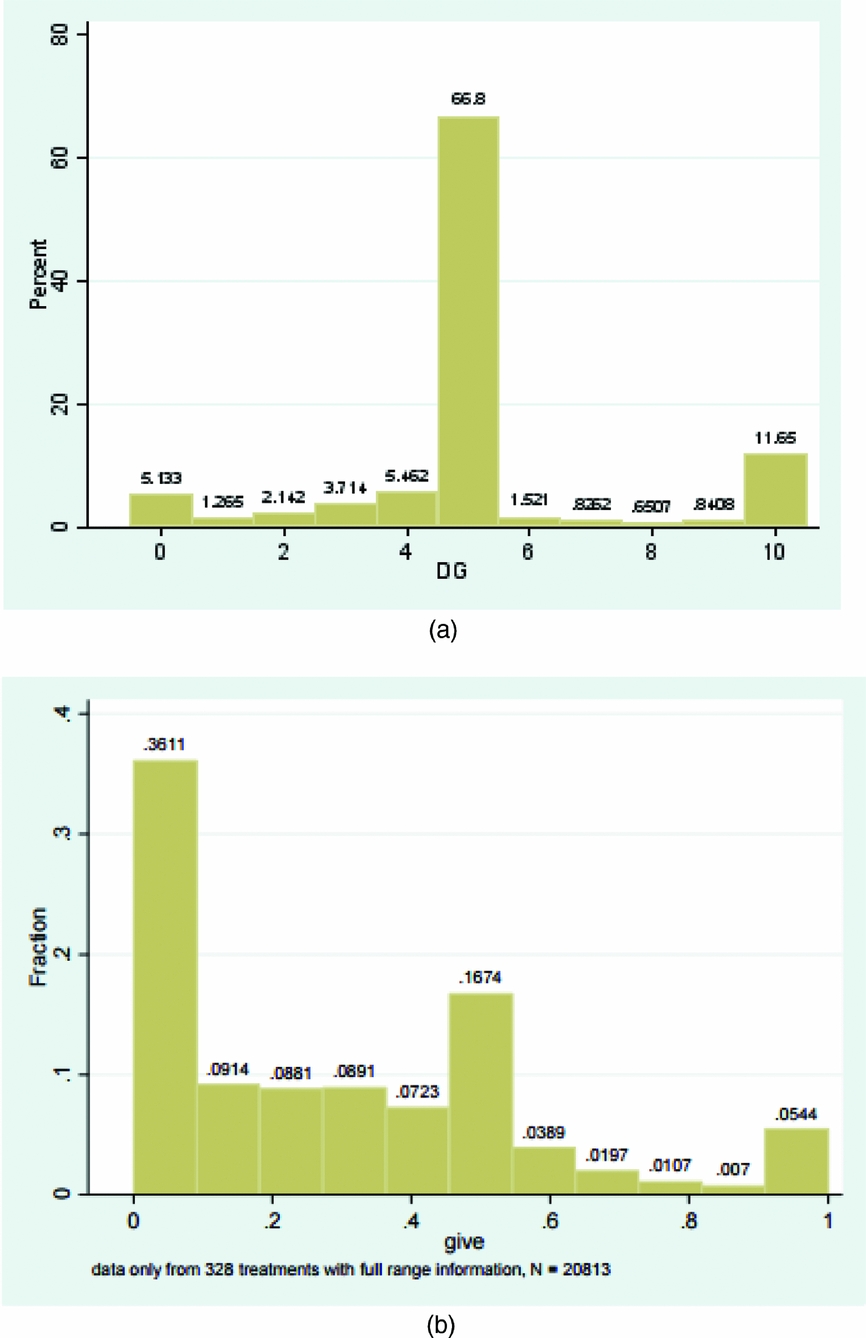
To the best of our knowledge, only a few papers have reported results on DG based on such a large experiment, especially in the context of an open online community. The drawback of this massive participation was our inability to control for the impact of the survey on the choice of the respondent. First of all, these choices may have been simply random, as the incentive to think before answering was low (as was the reward). Despite this, their distribution is not uniform, but very much centred on the 50/50 split (Figure 1a); the decisions to give 0 or 10 are also both local maxima and could also represent focal points. Note that the same local maxima appear in Engel's histogram (Figure 1b). The latter is the (constructed) addition of on 328 treatments of DGs, representing more than 20,000 observations, extracted from the experimental economics literature, and it can be considered as a general picture of giving behaviour in the DG. The relative importance of the local maximum in the two cases is different. In Engel's, the highest is the selfish solution (giving 0), while this is only the third maximum in our own histogram.
Comparison of the distribution of individual giving among Wikipédia users and in the meta-analysis by Engel, Reference Engel2011 (1a) Distribution of individual giving among Wikipédia users (N = 13,528) (1b) Distribution of individual giving in the meta-analysis by Engel, Reference Engel2011.

We can confidently claim that the answers were not random. Actually, they were, to some extent, forced by our experimental design toward cooperative answers, and possibly towards the 50/50 split. The Wikipédia users we surveyed volunteered to spend 20 minutes completing a questionnaire, and were subsequently asked to share the gains with a ‘fellow participant’ who also completed the questionnaire. This may have triggered a cooperative attitude, inducing them to elicit the 50/50 split, because, in addition to the ‘identity’ explanation (‘we belong to the same community’), which was the goal of the protocol, another obvious explanation from Eckel et al. (Reference Eckel, Grossman, Johnson, de Oliveira, Rojas and Wilson2011) was that an increase in giving is measured when the recipient ‘deserves’ it. This result is confirmed by Carpenter and Myers (Reference Carpenter and Myers2010), who asked a sample of voluntary firefighters to play a modified version of the DG. Following Eckel and Grossman (Reference Eckel and Grossman1996), they asked participants to share an initial sum with a charity of their choice. In this context, the mode was to give the whole amount to the charity. These arguments may explain the three modes in figure 1a and why the bar ‘giving nothing’ is much lower than the one observed in Engel's. But it remains to be explained why the 50/50 outcome is so dominant in our results.
The variables
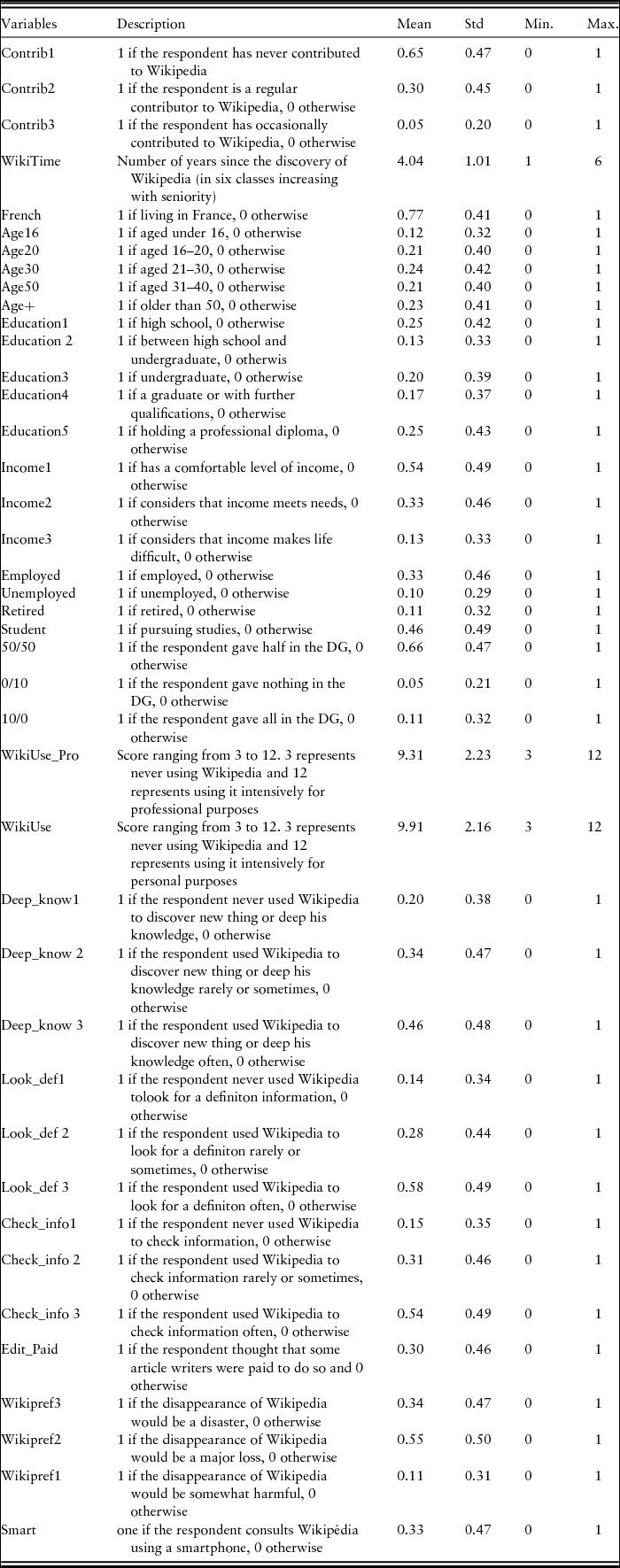
Table 1 describes all the variables.
Descriptive statistics and description of the variables

The dependent variable
As the DG result represented various social motivations, and in order to identify the specific characteristics of the 50/50 norm as a social norm, we estimated, in addition to an equal split, the likelihood of giving 0 (selfish behaviour) and 10 (altruistic behaviour).
The explanatory variables: measuring involvement in the online project
Respondents were asked whether they had ever contributed to Wikipedia, and if so, how often. This led to three levels of contributions: Contrib3 were regular contributors (as defined in Dejean and Jullien, Reference Dejean and Jullien2015) and Contrib2 were those who contributed only occasionally, while non-contributors (Contrib1) provided the reference point.
We considered three additional measures of Wikipedia patronage. The first was an indicator of Wikipedia usage intensity. We asked respondents about their level/intensity of use with regards to three types of usage, based on a scale of ‘never’, ‘rarely’, ‘sometimes’ or ‘often’. The questions asked were: ‘In the context of your personal activities (talking with friends, hobbies, etc.) do you use Wikipedia to: (1) check information; (2) look for a definition; (3) discover new things and deepen your knowledge’. For each of these answers and for each of the three levels of intensity, we designed a variable. Check_info3 (resp. Look_def3 and Deep_know3) is equal to one if the respondent used Wikipedia to check information often (resp. ‘Look for a definition’, and ‘Deepen knowledge’), Check_info2 (Resp. Look_def2 and Deep_know2) if she did it sometimes or rarely, and Check_info1 (Resp. Look_def1 and Deep_know1) if she never did it. Finally, as these three different usages could have been correlated, we aggregated the results in a score variable that is a proxy for the intensity of usage. WikiUse is a quasi-continuous variable ranging from 3 to 12, where 3 represents no use, and 12 very intensive use.
The second measure of support for Wikipedia is the variable WikiPref, which is a proxy for an attachment to Wikipedia. The question was: ‘If Wikipedia disappeared, would it be: (1) a disaster; (2) a significant loss; (3) somewhat harmful; (4) a “non-event” (no impact); (5) a good thing’. Wikipref3 indicated that the disappearance of Wikipedia would be a disaster (34% of our sample); Wikipref2 indicated that it would be a significant loss (55%); Wikipref1 indicated that it would be somewhat harmful, a non-event or a good thing (11%).
The third variable for measuring support is the number of years participants have been using Wikipedia (WikiTime), which is considered as a measure of the (possible) impact of the progressive integration of the norm of prosocial behaviour of the community, and the development of a feeling of belonging to this community. WikiTime is a continuous variable ranging from 1 to 5, increasing with seniority. The question was: ‘For how long have you used Wikipedia? (1) less than a year; (2) between 2 and 4 years; (3) between 5 and 8 years; (4) between 9 and 12 years; (5) more than 12 years’.
The control variables
We also considered other potential determinants of an equal split, notably the usual socio-demographic characteristics (see Table 1 for further details). Our survey also provided information to test the robustness of the relationship between the 50/50 choice and involvement in Wikipedia.
The respondents were asked whether they used Wikipedia for professional or personal purposes, with the hypothesis that if the use of Wikipedia was professional, people would be less committed to the project, and less influenced by its social message. This was to test the hypothesis that in ‘professional’ situations (student work or employment), the information looked at may be of less personal interest, hence the source may be of less importance. (The variable WikiUse_Pro, which mirrors WikiUse, is introduced as an estimate in Table 5.)
As described in the literature review, social norms can have a cultural origin. This explains why the giving behaviours seen in the DG differ according to the players’ country of origin (Tisserand et al., Reference Tisserand, Cochard and le Gallo2015). As our survey was promoted on the homepage of the French-language Wikipédia, all respondents were French speakers. It is thus possible that an equal split norm is driven (at least partially) by shared values or a culture or identity signal associated with the French language. To control for this potential in-group bias, we exploited the fact that not all the respondents lived in France in order to create the variable French which takes the value of one if the respondent live in France, zero otherwise (23% lived abroad: 5% in Belgium, 6% in Canada, 3% in Switzerland, 1% in Africa, etc.)
Finally we asked the respondents whether they believed that ‘some of those who edit articles in Wikipedia are paid to do it’. This assumed that this belief could be an impediment to the norm of sharing elicited in the DG. The variable Edit_paid equals one if the respondent thought that some article writers were paid to do so and zero otherwise.
4 The results
Patronage of Wikipedia induces the 50/50 split, contribution does not
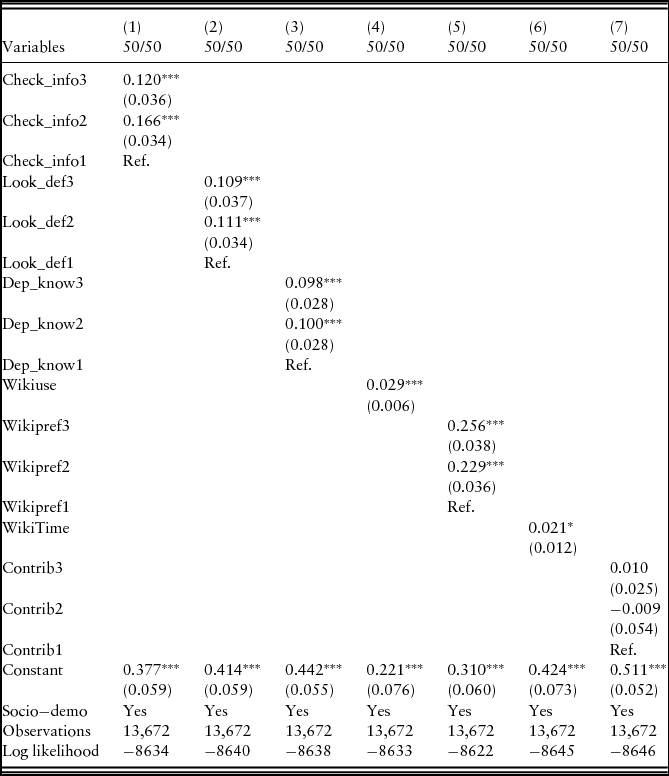
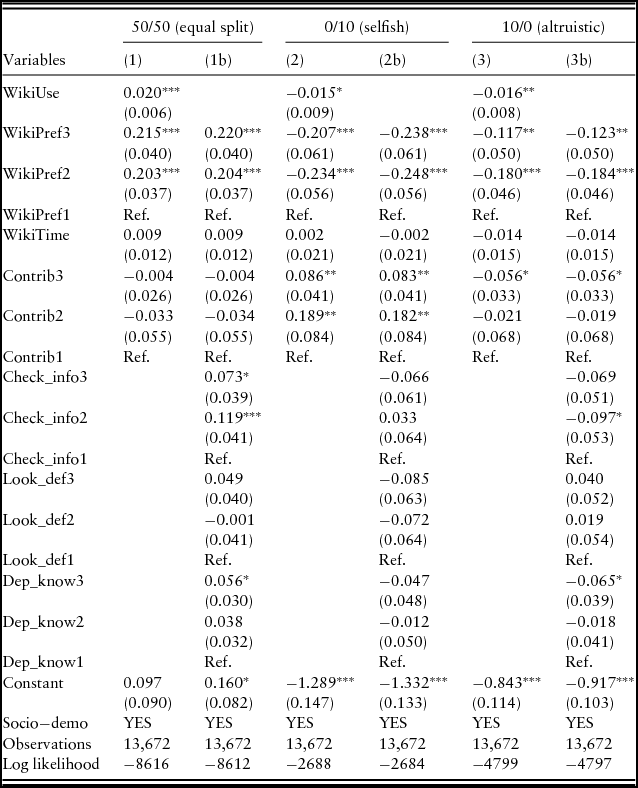
Commitment to Wikipedia is associated with equal giving. Based on probit estimation, both the intensity of use and an affirmed attachment to the platform are associated with an increase in the likelihood of choosing an equal split. This result holds for all variables shown in Table 2. On the other hand, Table 3 shows that when the model contains all the variables associated with involvement in Wikipedia, some of them cease to be significant. For instance, years of experience with Wikipedia is associated with an equal split only when this is the only independent variable (column 6 in Table 2). This means that this variable is probably collinear with covariates (e.g. with age), and other measures of patronage (WikiPref, WikiUse). In fact, both the level of attachment and the propensity to use Wikipedia in different contexts are likely to increase with time spent on the platform. The same remark applies to the different usages of Wikipedia, as only the motive for checking a piece of information (and less significantly deepening knowledge) can be associated with the choice of an equal split. The collinearity between these different usages can explain why they provide redundant information. Controlling for the potential redundancy of information by considering these usages additively with the WikiUse variable leaves the latter significantly associated with an equal split in Table 2.
Estimates of 50/50 choices in the DG

Estimates of 50/50, 0/10 and 10/0 choices in the DG

Our main result is that contributors are not associated with an equal split: they're no more committed than the other mere users. This result leads us to admit that social motivations go beyond the act of contributing (contributors represent only 1% of the users of Wikipedia), engaging all the participants, making them adhere to the project of cooperative production (a social norm), and/or building a feeling of belonging to a community (identity).
However, the most striking result is that none of the variables used to proxy attachment and patronage of Wikipedia is linked with altruistic behaviour (giving €10 and keeping 0), and some of them are even negatively associated with it (see Table 3). Less surprisingly, attachment to and patronage of Wikipedia are not linked with selfish behaviour (giving €0, keeping all).
All in all, an equal split is the only choice associated with an involvement in Wikipedia. The singularity of the 50/50 sharing choice reinforces our belief that social norms go some way to explaining prosocial motivation in open online communities.
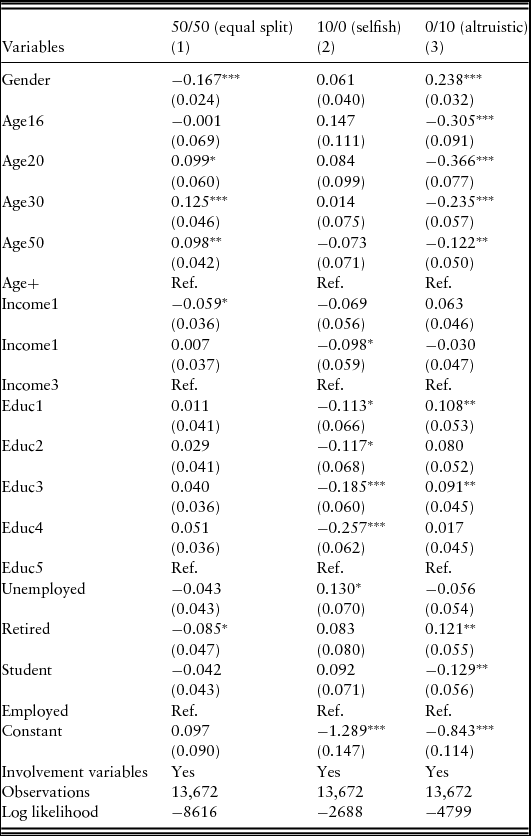
Beyond prosocial attitudes, regression coefficients associated with socio-demographic characteristics (see Table 4) are in line with the DG literature. Older and retired respondents are more altruistic (they are more prone to give €10). Students and educated respondents are associated with more opportunistic behaviour. All other things being equal, the likelihood of choosing the 50/50 split in the DG increases for females and users aged between 20 and 50. This result differs from Eckel et al. (Reference Eckel, Grossman, Johnson, de Oliveira, Rojas and Wilson2011), who found that the 50/50 norm is common among students (high school and university), and that there was no gender difference. However, it should be noted that in their study students were playing against each other, and conformity with the reference group or ‘identity’ may have played a stronger role than in our study.
Socio-demographic variables of columns (1), (2) and (3) of Table 3

Relying on the benchmark regressions in Table 3 we could derive marginal effects from these estimates. All things being equal, considering that the disappearance of Wikipedia would be a ‘disaster’ or a ‘major loss’ increases the probability of choosing an equal split by 7.8% and 7.4% respectively. Checking information often leads to a 4.3% increase in the choice of an equal split. Scoring the highest value for the variable intensity of usage (WikiUse) leads to a 7% difference in the choice of a 50/50 split, as compared with the lowest scoring for this variable. Combining a high score in WikiUse and a strong attachment to Wikipedia leads to a 15% increase in the probability of choosing an equal split.
The socio-demographic variables that have the largest impact are gender and age. Being a female can be associated with a 6.1% increase in the choice of an equal split and being under 50 years old leads to an increase of 10.5%.
To highlight the difference between those who are strongly involved in the community and those who are not, we could compute marginal effects for different values of the independent variables. For instance being a female under 30 years old and an intensive user of Wikipedia (WikiUse = 12) who considers that the disappearance of Wikipedia would be a ‘disaster’ increases the probability of choosing an equal split by 33%, as compared with a male over 30 years old who is not involved in the community (WikiUse = 3 and Wiki_pref1 = 0).
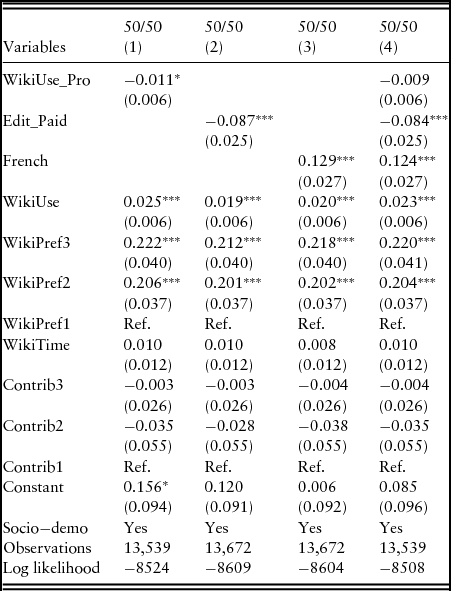
Table 5 estimates the benchmark model (i.e. Column 1 in Table 3), with additional controls for the choice of an equal split.
Estimates of equal split with additional control variables

While a personal motive for using Wikipedia is associated with an increase in the propensity to choose an equal split in the DG, this is not the case for professional usage (see Columns 1 and 4 in Table 5).
Columns 3 and 4 of Table 5 also show the result of estimates that take the cultural variable into account. As expected, living in the same country increases the propensity to choose the same social norm. However this does not alter the previous result concerning the relationship between involvement in Wikipedia and the equal split choice, which remains equally strong. Fewer people living outside France chose the 50/50 split as they felt less committed to the French cultural community.
As expected, the belief that some Wikipedians are paid to edit articles is negatively correlated with the propensity to choose an equal split. It seems obvious that a social norm based on sharing behaviour is prevented from growing whenever some anticipate that others are motivated by extrinsic financial motivations. More than just being a control variable, Edit_paid can also be considered as an indirect test of the existence of the norm, since not being paid for providing knowledge in Wikipedia is an important institutional framework in the community. Thus it is a rule that enables the norm elicited in the DG to be created or strengthened.
All these tests reinforce the conclusion that the 50/50 split is a contextual, Wikipedia-dependent behaviour.
The project has created the norm
The question of whether the preference for equal sharing already existed in the personality of Wikipédia users, or whether it is instead the support of the commons (Wikipedia) that has fostered the equal split norm, can be addressed using an instrumental variable (IV) methodology.
We considered endogenous variables related to the use of, and attachment to, Wikipedia in the following system of equations:
 $$\begin{eqnarray*}
{\it equalsplit} = \;{\alpha _1}{\rm{ }} + {\rm{ }}{\beta _1}{X_1}{\rm{ }} + {\rm{ }}{\sigma _1}Wik{i_{use}}{\rm{ }} + {\rm{ }}{\varepsilon _1}
\end{eqnarray*}$$
 $$\begin{eqnarray*}
Wik{i_{use}}\ = {\alpha _2}{\rm{ }} + {\rm{ }}{\beta _2}{X_2}{\rm{ }} + {\rm{ }}{\varepsilon _{2,}}
\end{eqnarray*}$$
where X 1 is the vector of socio-demographic explanatory variables described in Table 1. X 2 contains all the variables in X 1 plus the instrument.
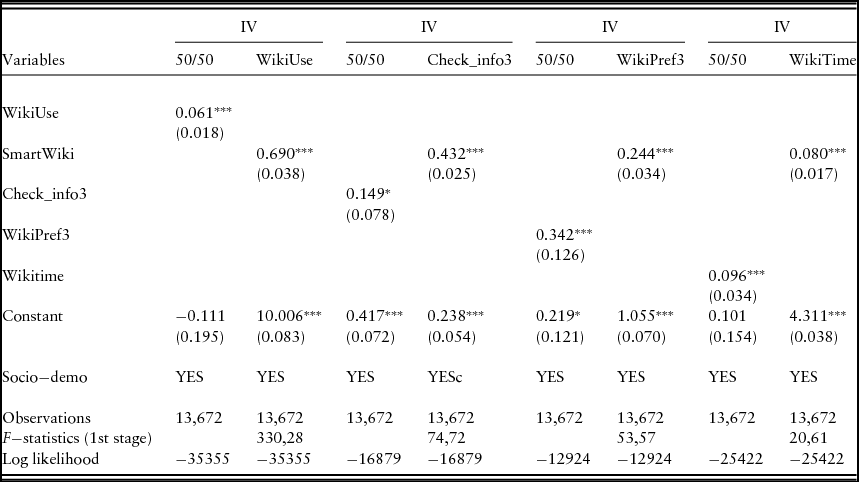
Smartwiki is the instrument. This variable takes the value of one if the respondent consults Wikipédia using a smartphone. To be consistent, the instrument should satisfy both the inclusion and exclusion conditions. Concerning the condition of inclusion, Smartwiki should be a natural regressor of the endogenous variables (preference and usage intensity). The instrument should also be correlated enough to induce large variation of the endogenous variable, since a ‘weak instrument’ (Bound et al., Reference Bound, Jaeger and Baker1995) can lead to significant inconsistencies in the estimate. To ensure that the instrument brings sufficient information, a common rule of thumb is for the F-statistic to have a value larger than 10 against the null hypothesis that the instrument is irrelevant, in the reduced form model. This is the case for all the potential endogenous variables tested in Table 6 (see the F-stat at the bottom of the table). As ε 1 is unobservable we were unable to test the independence between the instrument and the main variable of interest. However, we assumed that consulting Wikipedia from a smartphone should have no direct impact on the decision to make a 50/50 split in the DG. If this were the case, it would happen via an increase in the intensity of usage or preference for Wikipedia, satisfying the specification above.
Estimates of an equal split with the instrumental variable

The assumption made to justify the exclusion condition is that using a smartphone to read Wikipedia does not help to build the norm. The mobile version of Wikipedia, even if largely responsive, does not provide additional features as compared with desktop version. As most users engage with Wikipedia by reading it, using a smartphone for this experience is probably convenient but the reading experience is downgraded and the use of a smartphone is clearly not suitable for deep research or for contributing or interacting with others. For these reasons it seems that the very fact of using a smartphone and the mobile version of Wikipedia cannot be considered as a feature or a service that helps to comply with the norm, beyond the fact that it helps to increase the intensity of use in particular conditions (i.e. mobility).
Table 6 shows the results of the estimation of the likelihood of choosing an equal split in the DG taking the instrumental variable and considering respectively WikiUse, WikiPref Footnote 6 and WikiTime as endogenous variables. The results confirm those in Tables 2 and 3. Introducing an instrumental variable cannot prove the existence of causality. However, under the assumption that the instrument is valid, we cannot invalidate the possibility that involvement in the community creates the conditions for an equal split in the DG.
This result goes beyond the correlation between cooperative behaviour and involvement in an open online project and provides a leading piece of evidence that prosocial motivations are not only inherent in individual preferences but can also be built in the community.
5 Discussion
This paper has shown that involvement in an open online community is associated with an adherence to sharing behaviour, revealed by the choice of an equal split in the DG. Long-term users who declare a strong attachment to Wikipedia are more likely to choose the 50/50 split in the DG. Interestingly, those who contribute to the open online project are no more willing than ordinary users to adhere to the social norm, suggesting that this kind of prosocial motivation is not limited to contributors. Finally, the method of instrumental variables has been used to sustain the existence of a causal relationship between commitment to the online project and the choice of an equal split.
The mechanisms behind this choice, the norms and identity generated by the project or self-selection by the project users, have to be discussed.
The existence of a norm of reciprocity and the result of a coordination game are two competing assumptions for explaining the 50/50 choice in the DG. The fact that the social norm is shared by non-contributors means that the majority of users who adhere to this norm are not involved in a coordination process. The existence of a norm of reciprocity is thus a more plausible explanation. This motivation was highlighted in the work of Algan et al. (Reference Algan, Benkler, Morell and Hergueux2013), but only among contributors. Our result calls for a consideration of reciprocity in an extended context that includes both contributors and users. The former give their time and knowledge to write and discuss articles that readers read, while readers give their attention and provide an audience. Both are a necessary part of the community. Both contribution and attention form the foundation for the social benefits described by Zhang and Zhu (Reference Zhang and Zhu2011). This highlights the importance of non-contributors in the dynamic that leads to the provision of knowledge in the context of Wikipedia.
This result minimizes the role of social interaction as the mechanism explaining the emergence of cooperative behaviour. If social interaction were important, contributors would be more prone to share this behaviour as they are more often in contact with the others (peer appraisal is important to them) and with the project's policy makers.
Another explanation may be that being involved in Wikipedia, as either a contributor or a committed user, provides a feeling of belonging and a signal of membership, in the spirit of Akerlof and Kranton (Reference Akerlof and Kranton2000). This feeling, or ‘identity’, may lead to the consideration of others as peers. It may thus be natural to share half of a gift with a peer when possible. This attitude is reinforced by the fact that the community is large and anonymous, and there is no way to identify individuals or to tailor a gift personally. Users have in common their attachment to Wikipédia, which makes them worthy of receiving half of the pie. But this also gives them the opportunity, as donors in the DG, to signal their worthiness to their peers, as the financial incentives of the DG are low (so is the cost of signalling this identity).
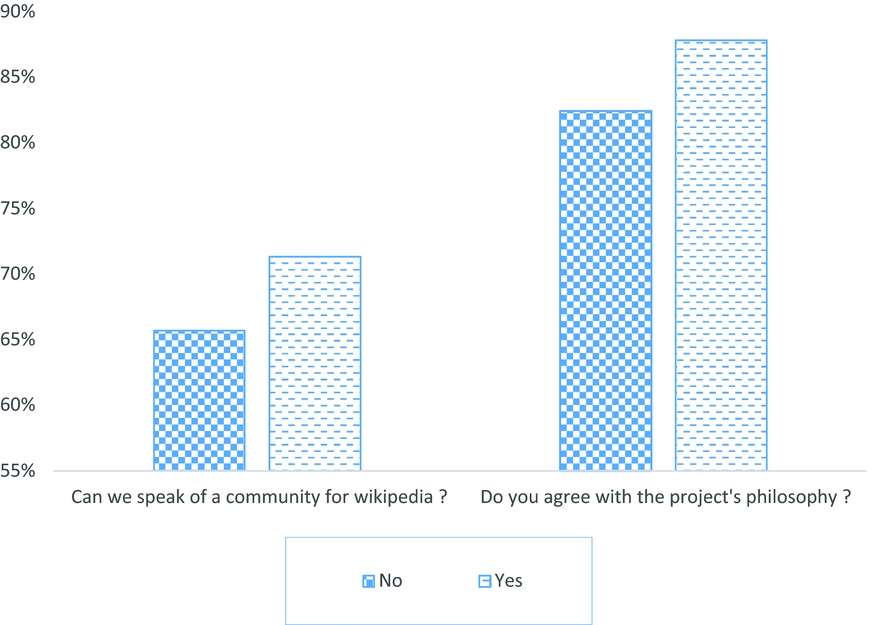
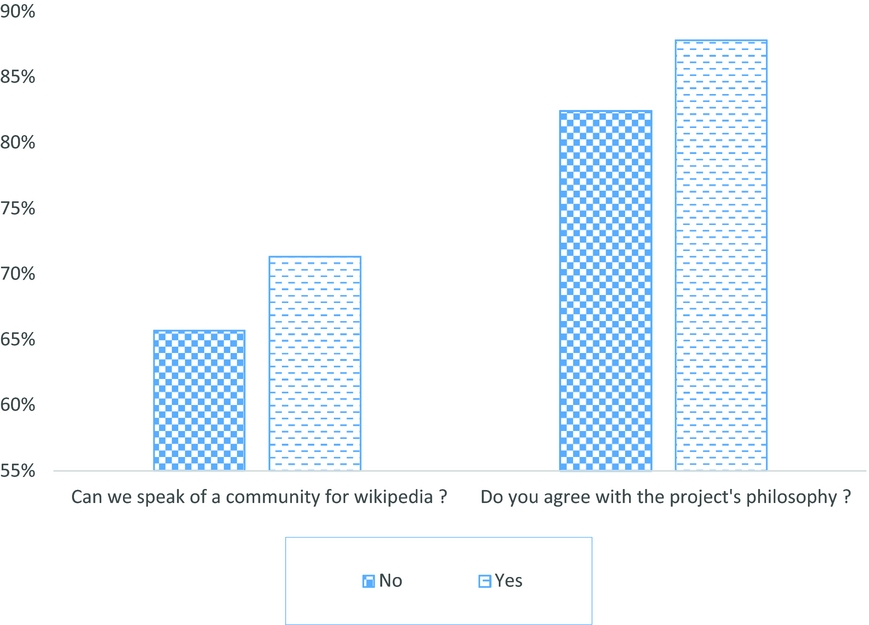
We can confidently claim that the project has developed mechanisms, including identity feelings, that trigger cooperative behaviours, elicited in the 50/50 split (Figure 2 shows that those who feel that there is a Wikipedia community, or who agree with the project's philosophy, choose an equal split more than those who don't). The socio-demographic variables seem to indicate that these behaviours probably result from broader homo reciprocans behaviours, since those who usually cooperate more (women and young people) are also those who cooperate more in our context. The project does not force cooperation, but develops mechanisms that select/enforce such a tendency. However, and to use a metaphor from physics, we do not know what is the potential, what triggers the force inducing the people to adopt a local norm: the balance between ‘identity’ and ‘social norm reminders’ is beyond the reach of this study.
Share of users who chose an equal split according to their answer to questions about their proximity with the project's philosophy.
Showing strong evidence that the prosocial attitude is endogenously determined inside the community remains challenging. We concede that the method of instrumental variable used in this article doesn't prove definitely the existence of this causality, but we would like to defend the idea that under the assumption that our instrument is valid, this is a leading piece of evidence that prosocial motivations supporting the norm may result from involvement in the community. Additional research is needed to disentangle what is due to pre-existing inclination toward prosocial attitudes and what is fostered by institutional frameworks.
Another limitation of our study is our data collection methodology. Before playing the DG, people had to complete a survey about their usage of and attachment to Wikipedia. The flipside of this methodology is that we were unable to evaluate how the answers to the DG were influenced by the survey. The protocol itself created a bias: people had already given 20 minutes of their time to complete the questionnaire, and this alone demonstrates a prosocial attitude. Our sample is thus definitely unrepresentative of the entire Wikipedia community. This bias does not alter the value of our work, however, since the aim was to look at the determinants of active Wikipedia users (contributors) and other (prosocial) users. The DG calibrated the degree of sociability of this prosocial population and tested whether it was linked to their commitment to Wikipedia. The fact that most people (who were probably less committed) did not answer the questionnaire is thus irrelevant.
The low financial incentives are probably also responsible for the low number of respondents who chose to give nothing in the DG. When a traditional DG is played in a laboratory setting, selfish behaviour is the main mode among the answers and we are unable to estimate how our protocol prevented users from making this choice.
We can also question the use of the DG to reveal a social norm, especially in the context of an open online community free of financial incentives to contribute. The advantages of using the DG are its simplicity and the fact that this game appears as a standard in the literature, and thus helps to understand its determinants and make comparisons. In the specific context of Wikipedia, we can consider that the choice to sacrifice financial resources in the DG reveals a norm that is in line with thinking that contributors are not paid (or that they sacrifice resources) to write articles, which can be confirmed by the role played by the variable Edit_Paid in Table 5. However, as prosocial behaviour takes various forms in an open online community (writing articles, fixing spelling mistakes, applying attention by reading or simply promoting the platform) original or modified versions of traditional experiments probably have to be considered. Asking the ‘dictator’ to give his or her endowment to a charity, as done by Carpenter and Myers (Reference Carpenter and Myers2010), may be another means to elicit the norm in this context. The online environment undoubtedly creates a fertile experimental field for proposing a new methodology that can reveal social norms and prosocial motivations and this should be put on the research agenda.
6 Conclusion
In this paper we have shown that a social norm has emerged from the patronage of a collective online project, Wikipedia. This norm is revealed by the choice of an equal split in the DG.
We found that there are no differences between contributors and mere (albeit committed) users of the online encyclopaedia in their behaviour in the DG. Our results show that usage, involvement and time spent on Wikipedia are responsible for the choice of this social norm of sharing. This result challenges the existing literature, which suggests that prosocial motivations are correlated with voluntary contributions. It may be that these prosocial motivations are shared among all the participants in a ‘community’, and are not unique to those who are involved in the production of knowledge. Results based on the method of instrumental variables indicate that adherence to the social norm of sharing may be endogenously determined in the open online community. This last result supports the fact that massive open online communities, via their socio-technical and institutional frameworks (Hess and Ostrom, Reference Hess, Ostrom, Hess and Ostrom2006), may trigger implicit socialization within the whole community, and not only among contributors.
Although the prosocial norm has been studied widely in the literature, it remains difficult to understand clearly what is behind adhesion to this norm. Especially in the case of Wikipedia, but also in any other massive online contributive community, further research is required to confirm the existence of this norm and its role in the provision of a shared resource. Finally, the consequences of the fact that both contributors and non-contributors share common social motivations merits further investigation, as does the development of experimental tools for doing so.
Acknowledgements
We would like to thank the two anonymous referees and the editor for their very helpful comments and suggestions. Rebecca (Beci) Clayton helped us considerably in fixing English mistakes and in being more specific – many thanks. This work has been funded by a grant from Agence Nationale de la Recherche (French NSF). The authors thank the Wikimédia Foundation France, the administrators of the French Wikipedia and the people who answered the questionnaire.