INTRODUCTION
The variety of pollutants in the aquatic environment continues to increase, necessitating means to detect and assess the impact of pollution. Particularly low concentrations of chemicals, as well as complex pollutant mixtures, are difficult to detect by applying only chemical analyses. This has generated the idea of using molecular biotic indicators (biomarkers) to unravel exposure to, and effects of, contaminants on organisms (Livingstone et al. Reference Livingstone, Förlin, George and Suthcliffe1994). However, the evaluation of biomarkers for environmental contaminants is usually done in laboratory experiments which inherently lack complex environmental interactions. Considering that biomarkers are also applied under field conditions, the artificial nature of laboratory analyses can be compensated for, as it should be with natural stressors which may influence a biomarker response.
Total hepatic glutathione-S-transferase (GST) activity has been a commonly applied biomarker for assessing different groups of pollutants for several years. The GST enzyme is an important intracellular enzyme belonging to the second stage of xenobiotic metabolism by virtue of catalysing the conjugation of the tripeptide glutathione and electrophilic substances of exogenous origin (Eaton and Bamler, Reference Eaton and Bammler1999). In contrast to a wealth of reports on the modulation of GST-activity in organisms by chemicals, only a few studies have been published dealing with the impact of parasites on GST-activity in fish – showing an increased anti-oxidant response in carp parasitized by the cestode Ptychobothrium sp. (Dautremepuits et al. Reference Dautremepuits, Betoulle and Vernet2002, Reference Dautremepuits, Betoulle and Vernet2003). Another parasite known for its significant impact on common biomarkers used in aquatic ecotoxicology is the cestode Ligula intestinalis. Due to its most striking effect, the inhibition of fish host's sexual maturation, previous work focused on biomarkers for endocrine disruption such as vitellogen in bream (Abramis brama), chub (Squalius cephalus) and roach (Rutilus rutilus) (Hecker and Karbe, Reference Hecker and Karbe2005; Schabuss et al. Reference Schabuss, Gemeiner, Gleiß, Lewis, Miller, Möstl, Schober, Tschulenk, Walter and Grillitsch2005; Hecker et al. Reference Hecker, Sanderson and Karbe2007; Geraudie et al. Reference Geraudie, Boulange-Leconte, Gerbon, Hinfrav, Brion and Minier2010; Trubiroha et al. Reference Trubiroha, Wuertz, Frank, Sures and Kloas2009, Reference Trubiroha, Kroupova, Frank, Sures and Kloas2010, Reference Trubiroha, Kroupova, Wuertz, Frank, Sures and Kloas2011). With regard to using a laboratory model to investigate host-parasite interactions under controlled conditions, three-spined stickleback (Gasterosteus aculeatus) infected with S. solidus is recommended (Barber and Scharsack, Reference Barber and Scharsack2010). An additive effect of Cd exposure and parasite infection was already demonstrated by decreased survival rates compared with uninfected fish (Pascoe and Cram, Reference Pascoe and Cram1977; Pascoe and Woodworth, Reference Pascoe and Woodworth1980). Both parasites are characterized by a 3-host life cycle involving copepods as first intermediate hosts, fish as second intermediate hosts and birds as final hosts (Dubinina, Reference Dubinina1980). The parasitic stage in the fish intermediate host, the so-called plerocercoid is located in the body cavity, usually of cyprinids for L. intestinalis and the three-spined stickleback for S. solidus. Roach (Van der Oost et al. Reference Van der Oost, Van Gastel, Worst, Hanraads, Satumalay, Van Schoten, Heida and Vermeulen1994; Machala et al. Reference Machala, Ulrich, Neca, Vykusova, Kolarova, Machova and Svobodova2000), chub (Vigano et al. Reference Vigano, Arillo, Melodia, Arlati and Monti1998; Krca et al. Reference Krca, Zaja, Calic, Terzic, Grubesic, Ahel and Smital2007; Havelkova et al. Reference Havelkova, Blahova, Kroupova, Randak, Slatinska, Leontovycova, Grabic, Pospisil and Svobodova2008) and three-spined sticklebacks (Sanchez et al. Reference Sanchez, Ait-Aissa, Palluel, Ditche and Porcher2007, Reference Sanchez, Katsiadaki, Piccini, Ditche and Porcher2008; Björkblom et al. Reference Björkblom, Högfors, Salste, Bergelin, Olsson, Katsiadaki and Wiklund2009) are recently used as sentinels for freshwater monitoring in biomarker studies. However, the knowledge of parasites as modulators of GST-activity in fish hosts is rare despite parasites being a factor commonly found in every fish population. Therefore we investigated the influence of infections with the diphyllobothridean cestodes S. solidus and L. intestinalis on GST-activity of their intermediate fish hosts G. aculeatus, R. rutilus and S. cephalus.
MATERIALS AND METHODS
Sampling design
Three different host-parasite systems were investigated (Table 1). In order to evaluate effects of parasites under controlled conditions, three-spined sticklebacks experimentally infected with S. solidus were chosen as a laboratory host-parasite system (LAB). To transfer our results into the wild, cyprinids (i.e. roach and chub) naturally infected with L. intestinalis were chosen. They were collected from 2 sites in Germany where fish are known to be infected with the respective parasites. One sampling site was located at Lake Mueggelsee (MS) (5°26′N, 13°39′E), a polymictic and eutrophic shallow lake (surface area of 7·3 km2, mean depth of 5 m) in the area southeast of Berlin which is flushed by the river Spree (Driescher et al. Reference Driescher, Behrendt, Schellenberger and Stellmacher1993). The second sampling site was at the Reservoir Listertalsperre (LTS) (51°5′38″N, 7°50′15″E), a mesotrophic dam built in 1912 (surface area of 0·79 km2, max depth of 39 m) south of Meinerzhagen. At both sampling sites L. intestinalis-infected roach were collected; additionally, chub infected with this parasite were also caught at LTS. Accordingly, this sampling design allowed us not only to compare the same host-parasite system from different independent sites but also to compare the effects of the same parasite on 2 different hosts.
Morphological parameters for host fish
Fish collection and tissue sampling
Three-spined sticklebacks (Gasterosteus aculeatus) originating from the lake Großer Plöner See were bred in the laboratory and experimentally infected with Schistocephalus solidus as described by Scharsack et al. (Reference Scharsack, Koch and Hammerschmidt2007), based on Smyth (Reference Smyth1946). After 2 weeks of acclimatization in an 80 L aquarium, 44 fish were held under constant conditions for 10 weeks in aerated tap water at a water temperature of 17°C and a photo-period of 12 h light:12 h dark. Uninfected and infected sticklebacks were maintained together in the same aquaria and fed 3 times a week with tubificids; the water was changed twice weekly.
Roach (Rutilus rutilus) were caught by electrofishing from MS during autumn 2007 and dissected within the capture day. Roach and chub (Squalius syn. Leuciscus cephalus) from the water reservoir Listertalsperre were caught by electrofishing in June 2008 and transferred to the institute laboratory in aerated tanks. Roach were held in a 200 L aquarium with aerated tap water at approximately the same water temperature as in the reservoir (22°C) until they were dissected within the next 3 days. In order to reduce variations due to catching stress, chub were held for 7 weeks in the laboratory at a photo-period of 12 h light:12 h dark before being killed and dissected. During maintenance the water was changed once a week and fish were fed 5 times a week with tubificids.
For sampling, the dissecting procedure was the same for all fish species. After anaesthetization with ethyl 3-aminobenzoate methansulfonate (MS222, Sigma) the fish were decapitated. The fish were measured (to the nearest mm) and weighed (to the nearest mg); organs and parasites were removed, weighed (to the nearest mg) and immediately frozen in liquid nitrogen. All samples were stored at −80°C until further analysis was performed.
GST analyses
Liver samples (60 mg) were homogenized with a sonicator (Sonoplus HD 2070, Bandelin, Germany) in adequate volumes of phosphate buffer (50 mm KH2PO4, 1 mm EDTA, pH 7·0) and centrifuged at 10 000 g for 10 min at 4°C. The glutathione-S-transferase-activity was evaluated using the GST Assay Kit from Sigma-Aldrich (Germany) utilizing 1-chloro-2,4 dinitrobenzene (CDNB) as substrate – as previously described by Habig et al. (Reference Habig, Pabst and Jakoby1974). The measurements were performed with the supernatant fraction kept at 25°C within 6 min using a microplate reader (Infinite M200, Tecan, Austria). The total protein concentration was determined in each supernatant fraction using the Pierce BCA Protein Assay Kit (Pierce Biotechnology, Rockford, Illinois, USA).
Data analysis and statistics
The following morphological and parasitological indices were calculated: the gonadosomatic index (GSI) as fish gonad mass/fish somatic mass×100, the condition factor (CF) as fish somatic mass×100/fish total length3, and the parasitization index (PI) as parasite mass/fish somatic mass×100. For GSI and CF, fish somatic mass was determined without parasite mass. As all data were normally distributed, pair-wise analysis was done by Student's t-test. Significance was accepted when P⩽0·05.
After confirming normality and homogeneity of variance with Kolmogorov-Smirnow test and Levene test, respectively, the differences among GST-activities were assessed using a univariate analysis of variance (ANOVA) with GST-activity as dependent factor and host sex and infection status as independent factors. For the analysis of roach data from the field the sampling site was used as an additional independent factor. When necessary, the ANOVA was followed by Student's t-test to compare the uninfected fish with the infected ones within the same sex and site.
Spearman's rank correlation coefficient was used to investigate the associations between morphological parameters/indices and GST-activity, if a sufficient number of data points was given (n>6). Accordingly, a lack of significant correlations might simply be the result of a low number of data pairs.
All statistical analyses were performed using Statistica 6.0; except the analysis of variance including the Kolmogorow-Smirnow test and the Levene test that were performed with SPSS, PASW 18.
RESULTS
Meristic parameters
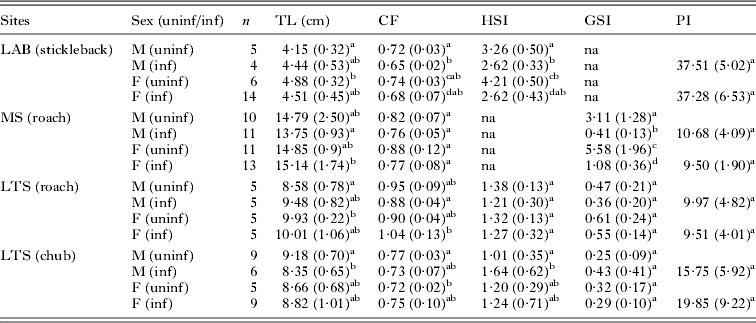
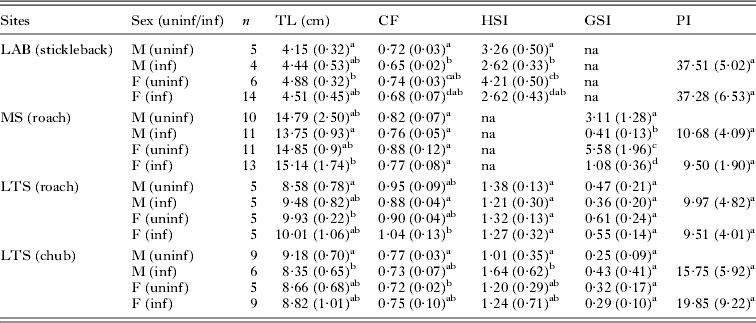
Total length, CF, HSI, GSI and PI of all fish are summarized in Table 1. Fish of each group consistently showed a similar size range; although significant differences occurred between groups. In the groups LAB and LTS, the uninfected females were significantly larger than the uninfected males; for MS this was also the case for infected fish. For LTS-chub a difference was only found between uninfected and infected males; with infected fish being significantly smaller. Roach from MS (Min/Max=10·8/19·6 cm) were significantly larger than roach from LTS (Min/Max=7·3/11·8 cm).
For sticklebacks, CF and HSI showed reduced values due to infection in both genders. Only infected male chub from LTS had a higher HSI than the uninfected males. In roach from MS a significant reduction of GSI by parasite infection in both genders occurred. Furthermore the GSI for MS females was higher than for males.
For sticklebacks, significant correlations were only found in infected females, for which CF showed a negative relationship with parasite burden (r=−0·56). For MS, negative correlations were found between CF and PI for both genders (r=−0·67 (female); −0·64 (male)), albeit the CF difference between the uninfected and infected fish of each sex was not significant. Roach from LTS showed a negative correlation between CF and HSI for infected females (r=−0·93). For uninfected male chub the CF showed significant correlations with the total length (r=0·72), whereas the CF of infected females was significantly correlated with the GSI (r=−0·67).
Sticklebacks showed the highest PI (37%), without differences between sexes. The PI was lowest for roach with approximately 10% for both sites and sexes. Chub infected with the same parasite as roach showed a PI around 17%.
Total hepatic GST-activity and correlation with morphological parameters
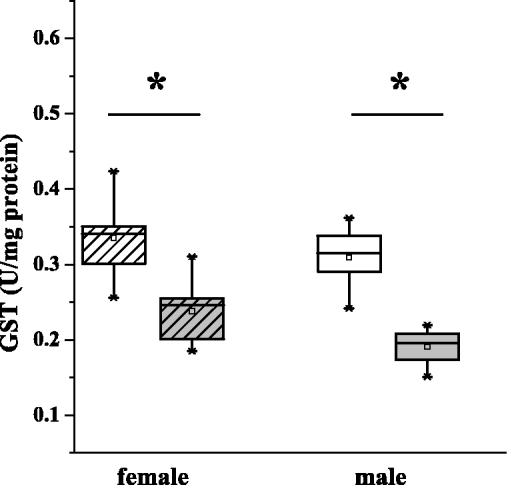
Hepatic GST-activities in sticklebacks are presented in Fig. 1. Analysis of variance indicated a slight significant effect of host sex (F=4·591; P=0·042) on stickleback's GST-activity with females showing 8–18% higher values than males. However, the effect of infection with S. solidus plerocercoids was found to be highly significant (F=39·284; P<0·001). The extent of reduction on GST-activity was the same in both host sexes (39%). The only significant correlation found for sticklebacks was a positive relationship between GST-activity and HSI in infected females (r=0·65).
GST-activity (U/mg protein) of three-spined sticklebacks differentiated by fish sex and infection status (female, striped boxes; male, empty boxes; uninfected, white boxes and S. solidus-infected, grey boxes). Stars indicate significant differences for infection status (*ANOVA; F=39·284; P<0·001). Each box represents the interquartile range (box range: 25–75% percentile; whisker range: 1–99% of values) with the empty dot showing the mean and the horizontal line showing the median. The asterisks show the minimum and maximum values of the dataset. Numbers are listed in Table 1.

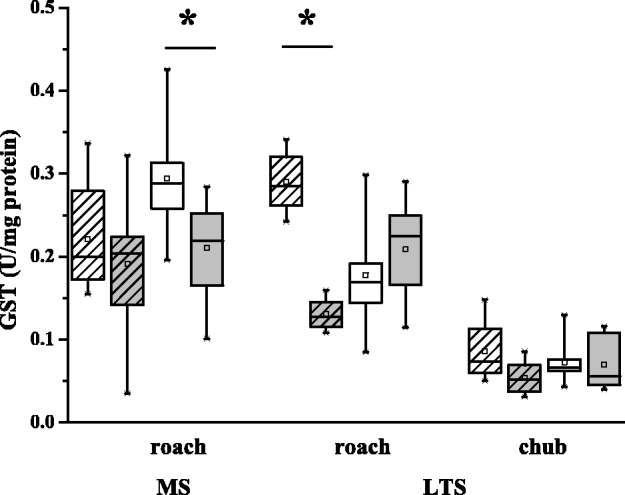
Hepatic GST-activities in roach are presented in Fig. 2. Analysis of variance indicated no effect of sampling site (F=3·253; P=0·078) or host sex (F=1·803; P=0·186). Infection with L. intestinalis was the only factor causing a significant difference in GST-activity of roach (F=12·295; P⩽0·001). The small but significant interaction between host sex and infection status (F=4·764; P⩽0·05) indicated 32% higher GST-activities for infected male roach in comparison to infected females. The differences between GST-activities within the same sex were different between sites (F=6·095; P⩽0·05), whereas the level of difference between infected females or males, respectively, was the same for both sites (F=0·477; P=0·493). Because of the significant interaction between host sex, infection status and site (F=16·434; P⩽0·001) a Student's t-test was performed between each pair of uninfected and infected roach of each sex per site, indicating that the significant reduction of GST-activity occurred at site MS only for males (25%) and at site LTS only for females (55%).
GST-activity (U/mg protein) of roach from MS and LTS and of chub from LTS; each time differentiated by sex (female, striped boxes; male, empty boxes) and infection (uninfected, white boxes; L. intestinalis-infected, grey boxes). Stars indicate significant differences between groups (P<0·05, t-test). Each box represents the interquartile range (box range: 25–75% percentile; whisker range: 1–99% of values) with the empty dot showing the mean and the horizontal line showing the median. The asterisks show the minimum and maximum values of the dataset. Numbers are listed in Table 1.

For infected females from MS, the CF was positively correlated with the GST-activity (r=0·62). For roach from LTS the only correlation between GST-activity and fish size was found for infected females (r=−0·92). At site LTS, roach were not the only fish analysed. Similar to LTS roach, the LTS chub showed a 35% reduction in GST-activity only for infected chub females. However, this difference was not significant (F=1·549; P=0·225) (Fig. 2). The GST-activity of infected chub females was significantly correlated with the GSI (r=0·75). For male chub the GST-activity showed significant correlations with the total length (r=0·73 (uninfected); 0·82 (infected)).
In summary, while the results for S. solidus revealed a significant reduction of hepatic GST-activity in both sexes of infected sticklebacks, the impact of L. intestinalis was not the same for the analysed cyprinids. For female roach and chub at LTS, reduced GST-activities were found. On the contrary, for MS roach a reduced GST-activity was detected only for infected males.
DISCUSSION
Our results confirm the previously held assumption of parasites being a natural stressor affecting biomarker response in fish. In the present study, hepatic glutathione-S-transferase (GST)-activity was reduced due to parasite infection in 3 different host-parasite systems. The experiment with laboratory bred and laboratory infected fish showed a significant reduction of GST-activity in sticklebacks maintained under controlled conditions. In addition, the comparison of similar host-parasite systems from 2 different field sites, as well as the comparison of 2 different host-parasite systems from the same site, indicates the interference of cestode plerocercoids with host GST-activity as a general effect. As fish were caught at different seasons of the year fish maturation and thus the stage of gonad development may explain part of the differences between roach caught at different sites.
Even if infected fish can be disregarded in biomarker studies due to the obvious presence of large plerocercoids, there is a wealth of parasites living in nearly every organ of the host. Parasitological studies show that under natural conditions almost every fish is infected with at least 1 parasite species (Lamková et al. Reference Lamková, Simková, Paliková, Juradjida and Lojek2007; Nachev and Sures, Reference Nachev and Sures2009). This will certainly also affect the host's physiological homeostasis and thus might change biomarker levels (Sures, Reference Sures2008). With respect to cestodes, most adult species are dwelling in the intestines of fish. This organ is usually not checked for the presence of parasites when the expression of biomarkers (e.g. in the liver) is analysed. However, Dautremepuits et al. (Reference Dautremepuits, Betoulle and Vernet2003) observed an increased GST-activity in carp parasitized by the intestinal cestode Ptychobothrium sp. when compared with uninfected fish. Because of the lack of contact between the parasite and the analysed organ, it was suggested that the observed increase in different anti-oxidant defences (liver catalase-, activities of GST and glutathione reductase) in infected carp is due to the modulation of metabolic activity by the parasite. A further possibility involves the parasite's release of molecules in order to suppress its host's oxidative response or other actions of the immune system, respectively. A broad range of enzymes and other molecules secreted by helminths is known to subvert the host immune defence in order to maintain a long-term persistence within the host (Dzik, Reference Dzik2006). Examples are given for helminths secreting GST enzymes or presenting them on their body surface to ensure parasite survival by neutralizing the toxins acting against them. For cestodes, GSTs are suggested as biochemical systems that protect the parasites against the host's immune attack (Brophy and Pritchard, Reference Brophy and Pritchard1992). Barber and Scharsack (Reference Barber and Scharsack2010) mentioned that S. solidus is apparently capable of manipulating (evading) immune traits that are specifically directed against parasite antigens. To what extent the possible secretion/presentation of parasite GST is linked with the host's GST response is not clear. As we only analysed the GST-activity, it is impossible to distinguish between a reduced enzyme synthesis and a reduced enzyme activity due to blocked binding sites. However, reduced hepatic GST-activity has also been reported for 2 other host-parasite systems. Infection with either Dicrocoelium dendriticum or Fasciola hepatica is known to reduce hepatic GST-activity in their respective final hosts (Galtier et al. Reference Galtier, Battaglia, Moré and Franc1983; Skálová et al. Reference Skálová, Krizová, Cvilink, Szotáková, Storkánová, Velík and Lamka2007). Both parasites are known to live for many years in the bile ducts of their host's liver. It was recently shown that a sigma class glutathione transferase (rFhGST-si), a recombinant form of an F. hepatica secreted molecule, modulates host immunity by suppressing responses associated with chronic inflammation (Dowling et al. Reference Dowling, Hamilton, Donnelly, La Course, Brophy, Dalton and O'Neill2010). This confirms the notion that there are additional factors influencing the observed reduction of GST-activity other than only incidental side-effects (for example liver injury or nutritional drains).
The driving force for biomarker research is their possible use to study pollution effects in animals from the field. However, all populations of aquatic organisms are usually infected with parasites (Kuris et al. Reference Kuris, Hechinger, Shaw, Whitney, Aguirre-Macedo, Boch, Dobson, Dunham, Fredensborg, Huspeni, Lorda, Mababa, Mancini, Mora, Pickering, Talhouk, Torchin and Lafferty2008). Van der Oost et al. (Reference Van der Oost, Beyer and Vermeulen2003) reviewed more than 40 papers dealing with the effects of various pollutants on GST-activity in different fish species under laboratory conditions and in the wild. By and large, the authors reported conflicting results concerning the correlation between pollution and GST-activities in fish. According to our results on GST-activity in sticklebacks, we showed that significant differences between sticklebacks were not observable before we considered infection with S. solidus. This underlines the extent of a parasite's impact on the use of biomarkers. Thus, for environmental studies, it is not only difficult to find pristine reference conditions in order to describe the expression level of a biomarker at physiological homeostasis, but it is also important to evaluate the effects of parasites on the level of biomarkers in fish and to describe biomarker levels of infected, unexposed fish. In summary, it is conceivable that even more parasites are interacting with different physiological parameters commonly used as biomarkers for pollution. Therefore it is difficult to understand why exposure studies are usually done without considering parasites, despite repeated demonstration of their effects on the physiological homeostasis of their hosts (e.g. Sures et al. Reference Sures, Lutz and Kloas2006; Sures, Reference Sures2008). The results of the present study accentuate the need for more integrative approaches to environmental pollution research, similarly raising the question as to how the two parasites manipulate their host's physiology.
ACKNOWLEDGEMENTS
This study was supported by the CEFIC via Grant EMSG 42. The authors thank M. Paster and M. Kunow for organizing and conducting the fishing surveys. We also thank M. Klopfer and M. Keppel for help with tissue sampling/analysis and proof reading. Furthermore, we are indebted to R. Leipnitz for handling infected copepods and thank H. Hansen for logistical support.