Implications
Wooden breast myopathy is a newly discovered meat quality defect in fast-growing meat type chickens that is only observed post-mortem. The animal welfare effects of wooden breast myopathy have not been studied earlier. In this study signs of wooden breast myopathy were detected in 38% of the broilers during the study. Subtle behavioral changes observed with wooden-breast-affected individuals suggest a link with poor gait of broilers. These findings raise a concern for possible animal welfare effects of wooden breast myopathy that needs to be addressed.
Introduction
Broiler meat consumption is increasing globally and the meat is produced in large and efficient plants with hybrids of uniform breeding goals. Leg weakness in fast-growing chickens grown for their meat is a common, yet unresolved animal welfare problem (Knowles et al., Reference Knowles, Kestin, Haslam, Brown, Green, Butterworth, Pope and Nicol2008). This issue has also been emphasized in a recent report of the European Parliament (Broom, Reference Broom2017). Gait score is a good predictor for broiler mobility (Caplen et al., Reference Caplen, Hothersall, Nicol, Parker, Waterman-Pearson, Weeks and Murrell2014), and walking ability is usually weaker in heavier (Sörensen et al., Reference Sörensen, Su and Kestin1999; Kestin et al., Reference Kestin, Gorden, Su and Sorensen2001) and faster growing birds (Kestin et al., Reference Kestin, Gorden, Su and Sorensen2001). Another measure for leg weakness is the willingness of birds to maintain a standing posture, as quantified by the latency to lie test (Bailie et al., Reference Bailie, Ball and O’Connell2013). Multiple risk factors for lameness have been proposed, but no clear causative mechanism for the widespread prevalence (Knowles et al., Reference Knowles, Kestin, Haslam, Brown, Green, Butterworth, Pope and Nicol2008) has been identified, nor has the issue been unraveled.
Sihvo et al. (Reference Sihvo, Immonen and Puolanne2014) describe a new myodegenerative disease in broiler and call it wooden breast (also referred to as woody breast). This breast muscle myopathy is defined as abnormal microscopic appearance in tissue samples and it is accompanied by hard consistency of the pectoralis major muscle post-mortem (Sihvo et al., Reference Sihvo, Immonen and Puolanne2014; Sihvo et al., Reference Sihvo, Lindén, Airas, Immonen, Valaja and Puolanne2017). Wooden breast myopathy possibly exhibits metabolic signs of oxidative stress (Abasht et al., Reference Abasht, Mutryn, Michalek and Lee2016) and it often appears with white striping (Sihvo et al., Reference Sihvo, Immonen and Puolanne2014), which is associated with fast growth rate (Kuttappan et al., Reference Kuttappan, Huff, Huff, Hargis, Apple, Coon and Owens2013a). The incidence of wooden breast myopathy on farms is unknown, yet white striping is estimated to affect one-tenth of broilers (Petracci et al., Reference Petracci, Mudalal, Bonfiglio and Cavani2013). Mazzoni et al. (Reference Mazzoni, Petracci, Meluzzi, Cavani, Clevanzani and Sirri2015) observed some degree of structural abnormalities in all heavy-sized broilers samples. However, there are no detectable symptoms on live birds to single out the affected individuals. The affected meat possesses no food security risk, however, the quality is inferior at least with white striping (Mudalal et al., Reference Mudalal, Babini, Cavani and Petracci2014) and that leads industry in some countries to downgrade the most valuable parts of a carcass. There is a need for further studies on signs of wooden breast in live birds and possible links with poor environment (Kuttappan et al., Reference Kuttappan, Hargis and Owens2016) and there is no knowledge whether wooden breast myopathy affects bird behavior, walking ability or welfare. It was hypothesized that myopathy would have a negative effect on mobility and thus have welfare implications for the animals. This study explored a possible link between wooden breast myopathy and mobility of birds of five commercial broiler hybrids.
Materials and methods
Animals, housing and management
The study conformed to the European Directive (2010/63) on the protection of animals used for scientific purposes and no harm was expected by the keeping, observing or killing of the animals. Therefore, an internal animal license number KEK13-006 was granted by the University of Helsinki laboratory animal center. The birds were managed according to the broiler welfare directive (2007/43/CE). Male broiler chickens (Gallus gallus) of five commercial hybrids were acquired from commercial hatcheries and housed in one experimental room simultaneously. The room consisted of 25 pens of 90 × 90 cm. Each pen contained 13 or 15 chicks of the same hybrid on day 1 after hatching. The stocking density did not exceed 37 kg/m2 during the experiment. Birds of each hybrid were housed in four to five pens.
A thin layer of fine sawdust litter was added on top of hard rubber mats. The litter was renewed every week and pens were partly cleaned daily according to the need. Broilers were inspected twice a day and injured or sick birds euthanized. Birds were fed a pelleted wheat and soy-bean-meal-based feed of 12 MJ/kg, designed to meet their nutritional requirements, ad libitum from pan feeders. Water was offered from nipple drinkers. The room had no windows and two dark phases of 4 and 2 hours each discontinued the lighting. Room temperature was 33°C for the hatchlings and 20°C toward the end of rearing.
Procedures
Two (mean 2.1) birds per pen were evaluated at ages of 22, 32, 36, 39 and 43 days. In total, 266 broilers were analyzed and the 52 remaining birds were killed at ages of 15, 19 and 50 days (data not included) and 15 birds died or were euthanized due to illnesses on other days. The post-mortem examination indicated sudden death syndrome to be the most frequent cause of death. The bird to be evaluated was chosen by always selecting the second bird clockwise from the west corner of each pen. The gait of these selected birds was evaluated using the scoring system by Kestin et al. (Reference Kestin, Knowles, Tinch and Gregory1992), where 0 indicates normal bird and 5 indicates that the bird is unable to walk. Gait was scored individually in their home pen while pen mates were herded to the other side of the pen with wire mesh. Gait was independently scored by two trained observers and mean scores were used in the analysis.
In addition, their spontaneous latency to lie (Bailie et al., Reference Bailie, Ball and O’Connell2013) was observed three times in a row in the home pen. Water has been used (Berg and Sanotra, Reference Berg and Sanotra2003) to increase the motivation to stand but here the test was completed without it. The test session started by fencing off all other birds in the pen. When the selected bird sat down it was encouraged to stand by approaching or gently touching it with a 1 m blunt plastic stick with paper clippings attached to the end to ensure visibility. As soon as the bird stood up, the stick was removed. The time interval from standing to lying was measured. The latency to lie test was repeated three times. Gait was evaluated during and after latency to lie testing.
After the mobility testing the birds were individually weighed and then killed by mechanical cervical dislocation followed by phlebotomy of the jugular veins. Immediately post-mortem, the birds were necropsied and their feet were evaluated. The presence or absence of footpad and hock dermatitis was recorded. The right pectoralis major muscle was removed. One observer scored the muscle for consistency change by manual palpation within 10 minutes post-mortem. Muscles with a focal or diffuse area of abnormally hardened muscle consistency were scored to be wooden-breast-affected. Muscles of normal consistency were scored unaffected. Breast muscle yield was given as percentage of live weight.
Activity
For behavior observation 12 pens were video recorded, including two or three pens per breed. One camera covered four pens from above, at an approximate 1.5 m distance from the floor. All the pens were recorded simultaneously on days 12, 17, 25, 34 and 42 for 1 hour (1800 to 1900 h). For individual recognition the back feathers of four birds per pen were color-marked. The selection of individuals for behavior analysis was done based on post-mortem data. One wooden-breast-affected marked bird and one unaffected marked bird from 12 pens were observed through video recordings from day 12 until killed at age 39 to 42 days. The behavior of these birds was observed continuously during two 10-minute periods from video recordings on each filming day.
Using the video films, the initiation and end of standing and lying posture was observed. In addition, number of movement bouts was observed during episodes of lying or standing. Lying was defined to begin when the body of the bird or the hocks touched the ground. Movement bouts during lying were defined to occur when a bird moved in any direction during lying while its hocks or breast touched the ground; or when it crawled or changed position rhythmically at least three times, or dustbathed. Walking bouts were defined as locomotion while in a standing position. One observer analyzed all the videos.
Statistical methods
The average gait scores of an individual bird scored by two observers were used in the analysis. The average latency to lie of the three consecutive observations was used in the analysis. To evaluate the connection of myopathy and age to gait score, latency to lie, BW and breast muscle yield, separate linear mixed-model analysis was used. Pen (N = 25) and hybrid (N = 5) were considered for random effect. Wooden breast myopathy (affected or unaffected) and bird age (five ages) were inserted as fixed factors. The interaction between age and wooden breast myopathy was tested but it was non-significant, hence omitted from the models.
Data from video recordings were analyzed separately. Total amount of lying, mean lying bout length, number of lying bouts, total number of movement bouts during lying and total number of locomotion bouts during standing were calculated for two daily observation periods for each day and for each animal. The connection between wooden breast myopathy, age, gait score, breast meat yield, lying and activity (total lying time, mean lying bout length, lying bout frequency, frequency of movement while lying and frequency of walking) was analyzed with separate linear mixed models. Age, wooden breast myopathy, gait score and breast meat yield were included in the model as fixed factors. Bird was inserted as random variable nested within pen (N = 12). Significance threshold was set at P = 0.05. Statistical analyses were conducted with SPSS version 23.
Results
Gait score and latency to lie
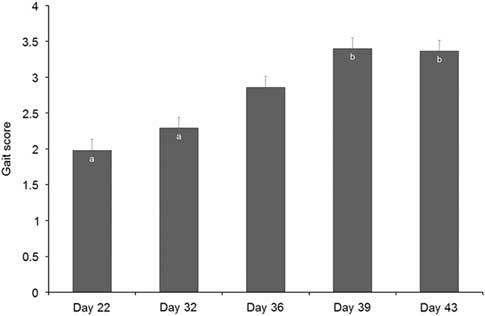
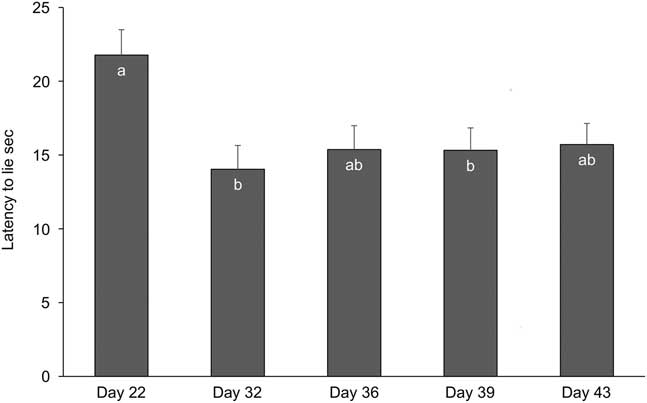
Wooden breast myopathy was detected in 100 out of 266 broilers. The gait score of birds affected by wooden breast myopathy was poorer than that of unaffected birds (Table 1). Wooden-breast-myopathy-affected birds were heavier and had higher breast muscle yield than unaffected birds (Table 1). There was an effect of age on gait score (F 4,238 = 65, P = 0.001; Figure 1), indicating impairment of gait score as the birds grew older. Age had a similar effect on latency to lie (F 4,260 = 3, P = 0.010; Figure 2). Age also had effect on weight (F 4,256 = 903, P = 0.001; Table 2) and breast muscle yield (F 4,256 = 63, P = 0.001); older birds grew heavier.
Differences between wooden breast affected and non-affected broilers in behavior and weight (mean ± SE, N = 266)

ns = not significant.
Gait score increased as broilers aged (mean, SE). (a,b) Means without common letter differ (P < 0.05; N = 266).

Latency to lie increased as broilers aged (mean, SE). (a,b) Means without common letter differ (P < 0.05; N = 266).

BW and breast muscle yield of broilers at different ages (mean ± SE, N = 266)

a,b,c,d,e Means without common letter within row differ; P < 0.05.
Lying and activity
The total sum of movements per 10 minutes while lying down was associated with wooden breast myopathy; the affected birds had fewer movements while lying down (Table 1). Total lying time, mean lying bout length, number of lying bouts or walking bout frequency were not related with the presence or absence of wooden breast myopathy. Older birds had longer total lying time per 10 minutes observation (F 4,223 = 5; P = 0.001; Table 3). Older birds also had longer, and fewer lying bouts, and fewer walking bouts compared with younger (F 4,205 = 5; P = 0.001, F 4,205 = 5; P = 0.001, F 4,223 = 18; P = 0.001; Table 3). However, the movement frequency while lying down was not affected by age.
Lying and activity of broilers at different ages during 10 minutes observation period (mean ± SE, N = 24)

a,b,c Means without common letter within row differ; P < 0.05
Birds with poorer gait score had longer total lying time; there was a 32 seconds increase in lying per 10 minutes observation time (95% confidence interval 4 to 61) with an increase of one on the gait score scale (F 1,223 = 5; P = 0.027). Birds with poorer gait score also had fewer walking bouts (slope −3 bouts, 95% confidence interval −5 to −1; F 1,223 = 7; P = 0.007). However, gait score was not linked with mean lying bout length, number of lying bouts or the movement frequency while lying down.
Birds with greatest breast muscle yield had the largest number of lying bouts; there was an increase of 0.3 bouts (95% confidence interval 0.1 to 0.5) for an increase of 1% in breast muscle yield (F 1,20 = 8; P = 0.012). Breast muscle yield was not related with total lying time, mean lying bout length, movement frequency while lying down or walking bout frequency. Macroscopic foot lesions were observed in 21 birds out of 330 at the post-mortem examination. In most birds (N = 19), the lesions consisted of mild erosions or ulcers in the skin of both hock joints (hock dermatitis), without foot pad dermatitis.
Discussion
Wooden breast myopathy detected by macroscopic inspection of post-mortem muscle was associated with a decreased ability to walk. Results on resting behavior, gait and latency to lie showed a detrimental effect of age on mobility of broilers. Earlier studies already indicated that walking ability degenerates as birds grow older (Weeks et al., Reference Weeks, Danbury, Davies, Hunt and Kestin2000; Bailie et al., Reference Bailie, Ball and O’Connell2013; Kaukonen et al., Reference Kaukonen, Norring and Valros2017); in addition, their behavioral activity dwindles and the latency to lie gets shorter (Bailie et al., Reference Bailie, Ball and O’Connell2013; Norring et al., Reference Norring, Kaukonen and Valros2016). This study further confirmed these findings of progressive immobility when birds became older as they were lying for longer episodes and had fewer bouts of walking. Lame birds use longer time resting sternally (Weeks et al., Reference Weeks, Danbury, Davies, Hunt and Kestin2000) but it is yet unknown if prolonged resting is caused by muscle weakness or pain or if prolonged resting affects breast muscle development negatively.
Results revealed that wooden-breast-affected birds had fewer movements while lying down compared with unaffected counterparts. It might be speculated that developing wooden breast myopathy may cause discomfort, manifested as motionless resting behavior. This observation calls for further studies about possible pain or discomfort involved in wooden breast myopathy that perhaps causes heightened sensitivity of breast area. The effects of wooden breast on other measures of resting behavior and activity are less clear however. Moreover, behavior of birds with high breast muscle yield was characterized by shorter periods of lying, perhaps indicating fragmentation of resting behavior. There is a need for further investigation of the behavioral effects while wooden breast myopathy is developing.
Results demonstrate that wooden breast myopathy appeared especially in heavier birds with high breast muscle yield. In agreement to this, higher breast muscle yield, weight and faster growth have been correlated with increased white striping and wooden breast (Kuttappan et al., Reference Kuttappan, Brewer, Apple, Waldroup and Owens2012; Kuttappan et al., Reference Kuttappan, Huff, Huff, Hargis, Apple, Coon and Owens2013a, Kuttappan et al., Reference Kuttappan, Owens, Coon, Hargis and Vazquez-Anon2017). Myofiber lysis, necrosis and myodegeneration have been described in association with both white striping and wooden breast myopathy (Kuttappan et al., Reference Kuttappan, Shivaprasad, Shaw, Valentine, Hargis, Clark, McKee and Owens2013b; Sihvo et al., Reference Sihvo, Immonen and Puolanne2014, Mazzoni et al., Reference Mazzoni, Petracci, Meluzzi, Cavani, Clevanzani and Sirri2015). Plasma creatine kinase is a marker of muscle damage and high values have been detected in meat type poultry (Branciari et al., Reference Branciari, Mugnai, Mammoli, Miraglia, Ranucci, Dal Bosco and Castellini2009; Wichman et al., Reference Wichman, Norring, Pastell, Algers, Pösö, Valros, Saloniemi and Hänninen2010), but the reason for the indicated muscle damage has not been clarified. Yet higher creatine kinase levels have been associated with white striping of breast muscle indicating muscle damage (Kuttappan et al., Reference Kuttappan, Huff, Huff, Hargis, Apple, Coon and Owens2013a). Current results together with histological observations by Sihvo et al. (Reference Sihvo, Immonen and Puolanne2014; Reference Sihvo, Lindén, Airas, Immonen, Valaja and Puolanne2017) suggest that damaged fibers exist in breast muscles of broilers who show no clinical signs of illness but have an overall poorer walking ability. The association of this sort of muscle damage with pain still remains to be studied.
Rather unsurprisingly, birds that had poorer gait also had longer resting times and fewer walking bouts, as already shown by Weeks et al. (Reference Weeks, Danbury, Davies, Hunt and Kestin2000). This study is also in line with Caplen et al. (Reference Caplen, Hothersall, Nicol, Parker, Waterman-Pearson, Weeks and Murrell2014) who showed that gait score predicted moving ability. Myodegenerative muscle disease, as described by Sihvo et al. (Reference Sihvo, Immonen and Puolanne2014) in pectoralis major, could be hypothesized also to affect the leg muscles, thus weakening the walking ability. Yet, it seems implausible as Sihvo et al. (Reference Sihvo, Lindén, Airas, Immonen, Valaja and Puolanne2017) found a muscle lesion comparable to wooden breast myopathy from a leg muscle of one bird only. In another scenario, leg muscles may remain unaffected while gait of clinically normal looking birds is affected by subtle sickness behavior, mediated by, for example, pain in breast muscles or elsewhere. It has been previously suggested that lameness in broiler is associated with pain (Hothersall et al., Reference Hothersall, Caplen, Parker, Nicol, Waterman-Pearson, Weeks and Murrell2016). Wooden breast myopathy manifests in larger breast muscles (Kuttappan et al., Reference Kuttappan, Owens, Coon, Hargis and Vazquez-Anon2017) making it difficult to tease apart the effects of BW, age and wooden breast myopathy. Thus, heavy weight or fast growth rate could be a common underlying factor for both wooden breast myopathy and poor gait. However, there was no statistical interaction between age and wooden breast status, indicating that the wooden-breast-affected birds had poorer gait in all age groups. Thus, even the youngest birds, still agile, demonstrated slightly poorer gait while affected with wooden breast myopathy than healthy birds did.
Current results from the modified latency to lie test, where no water was used, are on a comparable level with the latencies found by Bailie et al. (Reference Bailie, Ball and O’Connell2013), employing a similar technique with no water. However, compared with Berg and Sanotra (Reference Berg and Sanotra2003), who used a 3 cm water bath, this test resulted in much shorter latencies and was very fast to deliver. In this test most birds lied down for less than half-a-minute compared to the tests used by Weeks et al. (Reference Weeks, Knowles, Gordon, Kerr, Peyton and Tilbrook2002), Berg and Sanotra (Reference Berg and Sanotra2003) and Caplen et al. (Reference Caplen, Hothersall, Nicol, Parker, Waterman-Pearson, Weeks and Murrell2014) where birds could stand for as long as 10 to 15 minutes. Results indicate that broilers lie down faster in their pen than when tested with water and thus find water aversive and avoid lying down.
Very low rates of foot pad dermatitis reflect positive effects of very clean and dry bedding that could be achieved with regular renewal of litter. However, the presence of few cases of hock dermatitis suggests that hock skin might be very vulnerable or posture of some birds is altered. In conclusion, the majority of slaughter-aged broilers were not walking well. Wooden breast myopathy was associated with an additional impairment of gait scores, and might thus be linked to the common walking abnormalities in broilers. Findings of this study call for further investigation on effects of wooden breast myopathy on broiler welfare.
Acknowledgements
Finnish Ministry of Agriculture and Forestry is acknowledged for funding and Petra Tuunainen for her expertise with video recordings.
Declaration of interest
None.
Ethics statement
None.
Software and data repository resources
None.