Introduction
Organic agriculture relies on ecological processes, biodiversity and nutrient cycling adapted to local conditions, rather than the use of chemical inputs 1 . Because of the limited use of inputs, organic farming differs from conventional agriculture in several key ways. One of the greatest differences is the way that farmers in the two systems manage weeds. Organic weed management focuses on the integration of multiple practices to prevent weed populations from increasing and uses none of the synthetic herbicides or genetic engineering technologies used by the most conventional farmers.
Weed management by organic farmers is primarily based on ecological principles. According to USDA's organic standards 2 , organic farmers should rely primarily on crop rotation, soil and crop nutrient management, sanitation and other cultural practices that promote crop health and vigor to manage weeds. Fertility practices should favor crop growth over weed growth. Supplemental approved practices include mowing, grazing, hand weeding, mechanical cultivation, flaming and use of mulches. Although a few natural product herbicides are allowed under the organic standards, the standards require use of mechanical, physical or cultural practices be proven insufficient before any botanical, biological or allowed synthetic substance can be applied 2 .
Although such an integrated approach provides major benefits—food and soil uncontaminated by herbicide residues and a reduced pesticide load on the environment—it is not easy and comes at a cost. Organic weed management requires an understanding of crop–weed ecology, practical application of that understanding to farmingReference Liebman, Mohler and Staver 3 and considerable management skill. Moreover, because organic weed management involves interaction of biological processes with soil type and climate, a single approach is not feasible. Rather, each grower must develop a set of approaches that are specifically suited to his/her cropping system, scale of production, existing weed complex, soils and climate in a way that is flexible enough to adapt to often severely fluctuating weather conditions.
Over the past 25 years organic farmers have identified weed control as a top priority for organic farming researchReference Baker and Smith 4 , Reference Walz 5 . Weeds have been cited as a limiting factor in comparisons of organic and conventional systemsReference Clark, Horwath, Shennan, Scow, Lantini and Ferris 6 – Reference Teasdale, Coffman and Mangum 9 . Historically, most of the research on weed management has focused on herbicide technology rather than on managing weeds with low external inputsReference Wyse 10 , Reference Liebman and Davis 11 . Even when research-based approaches for organic weed management are available, implementation on farms may be difficult because farmers often have different mental models of weeds than do the experts who are conducting researchReference Jabbour, Zwickle, Gallandt, McPhee, Wilson and Doohan 12 . Research on non-chemical weed control is starting to gain ground for various reasons. This paper shows the means by which a selected group of organic farmers manage weeds, describes the specific weed problems faced by organic farmers, and identifies promising avenues for research in organic weed control.
Methods
Seven farmers and two researchers participated in a focus group at the January 2011 Northeast Organic Farmers Association of New York (NOFA-NY) Conference. The focus group identified strategies and techniques that the farmers found useful for managing weeds in field and vegetable crops, emerging weed management challenges for organic growers and promising avenues for research.
Interviews of individual farmers were also conducted to obtain the detailed information on their weed problems and weed management practices. Four of the farmers who participated in the January 2011 weed management focus group volunteered to be interviewed. Other farmers were selected to be interviewed based on referrals from agricultural professionals, including Cooperative Extension and Integrated Pest Management specialists, and by other farmers based on their observed skills and expertise in managing weeds. The farmers interviewed were located throughout upstate New York, with one located in western Massachusetts near the New York border.
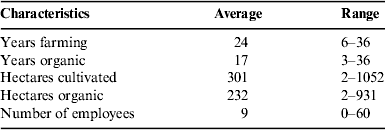
Interviews were conducted using a 34-question survey that sought information on farming history, area farmed, crops grown, weed management strategies, problem weeds, farm equipment, specific control techniques and the need for further research. One of the authors interviewed 18 organic farmers between July 2010 and August 2011 (Table 1).
Characteristics of farmers interviewed.

The farmers interviewed consisted of eight vegetable growers, five grain producers without vegetable production, three growers with both field crop and vegetable crop production and two dairy farmers who grew field crops in addition to managing pasture. The farmers interviewed tended to be farming larger landholdings than the New York average of 99 ha 13 , with diverse operation types and marketing channels. Opinions expressed in the section on results regarding the specific techniques, efficacy of the specific practices, the importance of weeds and priorities for research are those of the farmers interviewed.
Results
Farmer responses to interview questions were compiled. In some cases, farmer observations and conclusions presented below are supported by the results of controlled experiments, but in other cases, experimental corroboration is needed.
Important weed species
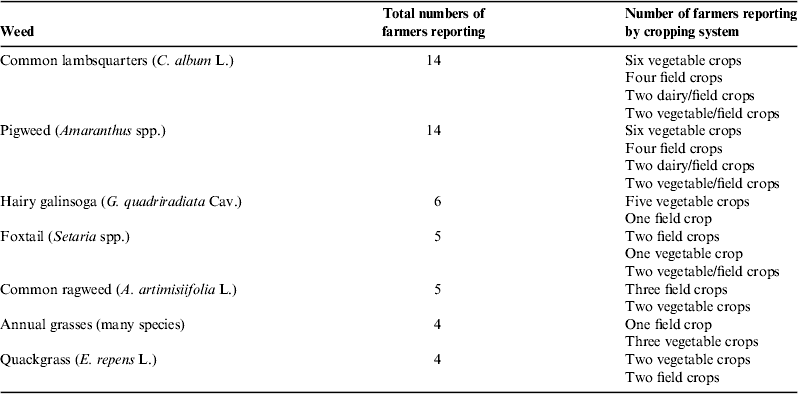
Farmers were asked which weeds they considered to be important in their management. Weed species identified as important by four or more growers and which occurred in both vegetable and field crop systems included common lambsquarters (Chenopodium album L.), pigweeds (Amaranthus spp.), foxtails (Setaria spp.), common ragweed (Ambrosia artemisiifolia L.) and quackgrass (Elymus repens L.) (Table 2). The definition of ‘important’ was left to the farmer's discretion. Bindweeds (Convolvulus arvensis L. and Calystegia sepium L.) and common cocklebur (Xanthium strumarium L.) were seen as problems only in field crop systems. Only vegetable growers reported problems with common purslane (Portulaca oleracea L.) and common chickweed (Stellaria media L.). With one exception, those who identified hairy galinsoga (Galinsoga quadriradiata Cav.) as a significant problem were vegetable producers. Two field crop growers reported that yellow nutsedge (Cyperus esculentus L.) had disappeared since their conversion to organic management. One of these growers also noted that quackgrass and bindweed were no longer problems.
Weeds identified as important by four or more of the farmers interviewed.

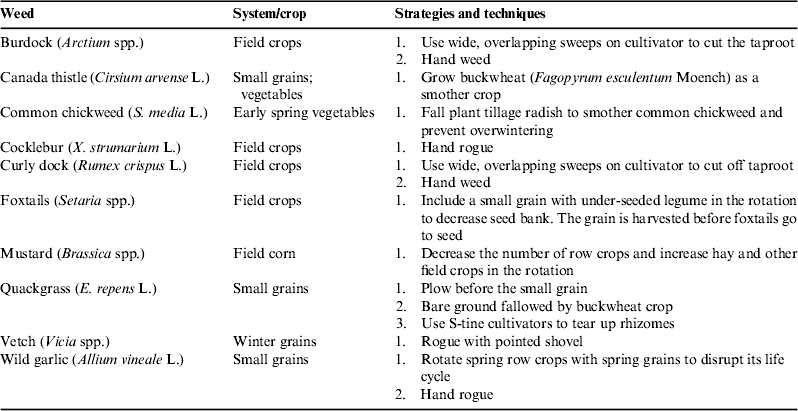
The farmers reported on the specific strategies and techniques they use to manage problem weeds (Table 3). Several of these strategies are based on the knowledge of a weed's life cycle or survival strategy, such as the use of fall-planted tillage radish to smother the winter annual common chickweed or the use of a specific cultivation tool to tear out quackgrass rhizomes.
Farmer control strategies and techniques for specific problem weeds.

Crop rotation
Although all the interviewees reported rotating annual crops, weed management was not seen as the primary benefit of the practice. Among the 11 growers surveyed who included vegetables in their rotations, eight alternated crop families to break disease cycles or alternated high fertility—and low fertility—demanding crops. The crop rotations of these particular growers were not focused on reducing weed abundance. The remaining three vegetable growers alternated hay crops or small grain/legume intercrops with row-planted vegetables, a practice that can both enhance soil quality and suppress weeds. Among field crop growers, eight of nine farmers rotated three crop types—sod crops, row crops and small grain crops—a classic weed management strategyReference Leighty 14 . Several field crop farmers mentioned the importance of limiting the number of row crops in the rotation to prevent weed problems. One farmer noted that fields with high weed density should be rotated into hay for 5 years.
Cover crops
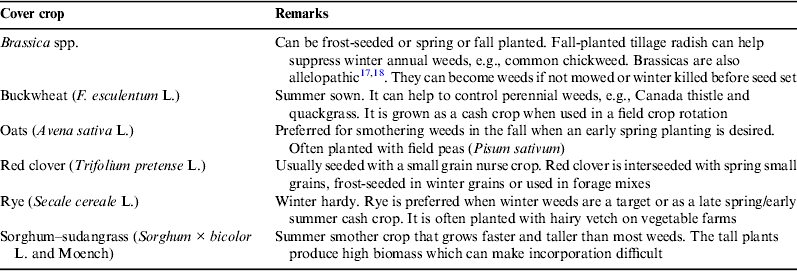
Cover crops are known to compete with weeds for needed resources and impede their growth through the secretion of allelopathic substancesReference Weston and Duke 15 – Reference Uremis, Arslan and Uludag 18 . Cover crops planted varied widely among the farmers, from a field crop grower who grows only rye as a cover crop following corn to two vegetable growers and a field crop grower who routinely grow four or more cover crop species within their crop rotation. The farmers described the weed control benefits of several cover crops (Table 4).
Cover crops identified by organic farmers as weed smother crops.

Manure use and fertility management
Farmers in the focus group noted that weed seeds can be imported to fields in manure, especially if non-composted manure is used. Farmers observed significant increases in weed density when they used uncomposted manure. Despite acknowledging the weed management benefits of composted manure, five of the vegetable growers and seven of the field crop growers reported using at least some uncomposted manure in their systems. Four vegetable growers reported using only composted manure. One grower cautioned that the benefit of using compost rather than manure can be lost if weeds are allowed to grow in or around compost piles. Several farmers also thought that compost cycled nutrients in a way that gave crops an advantage over certain weeds and improved soil structure in a way that helped tillage and cultivation. A field crop grower also noted that excessive fertilization favored weed growth over crop growth.
Variety selection
Most of the growers interviewed selected varieties for reasons other than competitiveness against weeds. Even growers who said that they chose varieties for weed management reasons indicated that weed management was not the only, or even the primary, factor governing variety selection. Of the four field crop growers who indicated that they selected varieties for weed suppression, three cited the specific traits that increase a crop's competitiveness with weeds. One grower selected corn varieties that have quick emergence and good early vigor to give the crop a head-start over the weeds. Another preferred to plant soybean varieties with bushy canopies that rapidly filled space between plants. The third grower preferentially grows a forage oat variety that has a wide leaf blade that helps in shading the ground.
Tillage
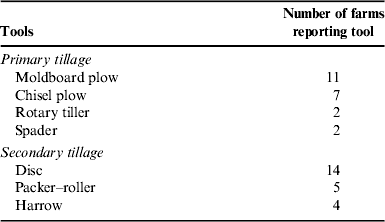
Tillage remains an important first step for weed management in organic systems. All farmers growing field crops used tillage as an important component of their weed management. Most of the farms that are in intensive vegetable production also till regularly. The only exception was a small-scale intensive vegetable farm that has permanent raised beds and has no-till equipment. Most of the farmers had a moldboard plow and disc harrow (Table 5), but chisel plows, rotary tillers and spaders are critical implements on some farms. One field crop grower developed a chisel plow with larger-than-average blades and thus was able to use less tractor time and till to a greater depth. Mechanized farms had a range of tractor sizes, from a 7 hp two-wheeled tractor to a four-wheel drive model with over 250 hp. The general rule is to use the smallest tractor needed to accomplish the task. The largest tractors are used only for primary tillage.
Tillage equipment commonly used by the farmers interviewed.

Several farmers said that moldboard plowing is the most effective way to prepare fields with severe weed infestations. However, farmers selectively plow with a moldboard because of its potential negative effects. Moldboard plows are generally seen as a cause of erosion. Farmers observed that deep plowing can bring weed seeds up to a more favorable position for establishment. Farmers said chisel plows are preferred when they desire less soil disturbance and when soil moisture and other conditions do not permit moldboard plowing.
Some farmers also used heavy discs as a primary tillage tool. Farmers who cross-disked or double-disked considered the soil to be disturbed more than when they chisel plowed, but less disturbed than when they moldboard plowed. Discs were most often used for secondary tillage following a moldboard plow.
Farmers who used raised beds considered bed shaping to be a tillage operation. If timing permits, weed seeds are allowed to germinate on the raised beds in a short fallow. Once the weed seeds have germinated, the tops of the beds are lightly tilled to kill seedlings prior to planting. Ground without a crop or cover crop was viewed as an opportunity for weed establishment. Several farmers reported that they attempted to plant as soon as possible after tillage.
Cultivation and flame weeding
After plowing and planting, most of the farmers said that they relied on one or more cultivations to enable their crops to outgrow weeds. Farmers universally considered timing essential for the effective cultivation, but when describing what aspects of timing were important, they used various descriptors and had difficulty in summarizing. They agreed that if cultivation has to be effective the soil must be dry and temperatures warm. Cultivation under wet conditions can cause soil compaction and aggravate competition from species that thrive in compacted soil. Weeds were seen as better able to recover from cultivation under cool, moist conditions.
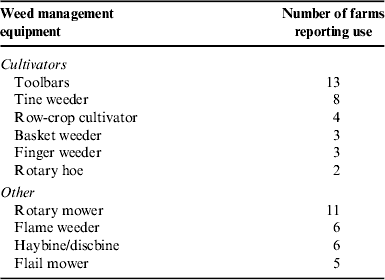
The farmers who were interviewed used different words to describe the same equipment. The responses reported in Table 6 are based on the American Society of Agricultural Engineer's standard definitions 19 . Several farmers built custom tools. Farmers often had more than one toolbar and several types of rear-, front- and belly-mounted cultivators. One vegetable farmer indicated that he preferred to have multiple toolbars that were set up early in the season rather than repeatedly reconfiguring a single toolbar. He was thus able to save labor that paid back the cost of an additional toolbar within the first season. The ability to quickly switch toolbars without a lot of adjustment during critical periods also led to more timely cultivation.
Cultivation and other weed management equipment commonly used by farmers interviewed.

Most of the farmers had tractors that were used primarily for cultivation. These cultivation tractors had 35–65 hp engines. Farmers indicated that various cultivators have both advantages and disadvantages, and most relied on multiple tools that are appropriate for various crops and specific growth stages.
Tine weeding is a popular technique among field crop growers and is used both in small grains and in row crops, such as soybeans and corn. Factors identified as important for tine weeding included timing, depth, tractor speed, shape of the tines and the angle of the tines to the ground. Tine weeders can have straight or bent tines. The more sharply bent the tine, the more aggressive the weeding action. Farmers observed that straight tines are less aggressive and are used for earlier weeding and crops that are more sensitive to physical damage. Among farmers who have more than one tine weeder, bent tines are used for more mature crops and crops that are less sensitive to physical damage. The consensus among farmers interviewed is that the initial tine weeding for corn and small grains should be timed as close to weed emergence as possible, when a few percents of crop plants have also just emerged.
As the crops grow and roots develop, they are seen as able to take more stress from tine weeding. Faster speeds and more aggressive angles are tolerated by the crops and are necessary as the weeds grow larger. However, at higher speeds the tines jump and miss weeds, and greater crop loss is also observed. Therefore, the tine angle, and gauge wheels need to be adjusted so that the tines work the soil to a greater depth. In vegetable production, basket weeders are used where the row spacing permits; they provide good control between and close to the row where.
Toolbars fitted with various cultivation tools—such as sweeps, shovels and knives—are used to penetrate the soil at a greater depth than tine weeders and kill weeds that are too large to be destroyed by tine weeders. However, these tools are seen as potentially doing more damage to the crop as well and are used only when the farmers thought that the crops are able to withstand the shock of cultivation. Most of the farmers set up their toolbar with more than one type of cultivating tool—for example, with combinations of several types or sizes of tools at various positions relative to the crop row. Such combinations take advantage of the different ways in which tools move soil and kill weeds. Toolbar set-up varied according to the size of the crop, how susceptible the crop was to cultivation damage and the skill of the operator. Several farmers mentioned that their ability to cultivate closer to the crop improved with experience over time.
Most of the farmers reported that they modified their equipments in some way. Several farmers indicated that they had fabricated shields to protect crops from cultivators. These were simple attachments that went on both sides of the row and prevented young crop plants from being buried by soil thrown by cultivator tools. A vegetable grower mounted a seeder on a cultivator to under sow a cover crop during the last cultivation. The modification made cultivation and planting of a crop possible in a single pass. Another fabricated his own basket weeder and a third made an old hay rake into a tine weeder. Two farmers said that they modified the GPS units used in their cultivating equipment.
One grower in the focus group said that the key to weed control was balancing the acceptable loss of the crop to weeds with the loss of the crop due to cultivation. Some farmers use higher than typical seeding density to allow more aggressive cultivation. For example, going across rows with a tine weeder, thins the crop to the desired density while killing more in-row weeds than is possible when running the weeder parallel with the rows. If not thinned, thicker stands also help suppress weeds by shading.
Six farmers used a flame weeder and all but one found the technique to be effective. The crops most frequently flamed were carrots pre-emergence, onions post-emergence and corn both pre- and post-emergence. Only a few crops were considered amenable to flame weeding after emergence, but at least one of the farmers used a flame weeder post-emergence on a wide range of crops with some successes and failures. As with tine weeding, effective flame weeding must be done at an early stage in weed growth. One farmer custom built a flame weeder.
Cultural weed management methods
Several vegetable farmers reported using mulches. One farmer uses plastic mulches on rows with straw mulch between the rows. Straw mulch is grown on the farm and baled. When the mulch is applied, a bale shredder is used. Another farm relies on straw mulch as a key part of its no-till permanent bed system.
Many of the farmers interviewed relied on transplants to help crops to develop ahead of weeds. Transplanted crops were observed to benefit from lower weed competition, with an advantage particularly in wet and cold years when field preparations were late. Crops that were ordinarily direct seeded were transplanted on some of the farms at certain times of the growing season. For example, one grower transplanted small seeded crops such as lettuce and leafy greens early in the growing season and then direct seeded as the soil temperature increased and soil moisture permitted cultivation. Another farmer interviewed grew the first planting of sweet corn from transplants. By doing so, she was able to establish the crop earlier and eliminate at least one cultivation pass.
Rogueing and the use of hand tools were common in vegetable crops. Farmers reported the high value of the crops and fewer mechanized production techniques available as reasons to use labor intensive methods. Most of the field crop producers did not use hand tools or rogue. However, farmers who ordinarily avoided hand tools and other labor-intensive practices noted two exceptions. Perennial weeds toxic to dairy cattle were rogued in pasture and hay fields. Field crop farmers also rogued particular weed species in crops grown for seed or food; such weeds include vetch and wild garlic in small grain crops.
Some farmers mowed weedy crops after harvest and did not till until spring. The crop residue protected the soil surface and the weed seeds were subjected to weathering and predation. Almost every farm had a story of a field that became so heavily infested with weeds that the farmer decided to mow or disc that crop without harvesting to prevent weed seed production. In such situations, the farmer made a decision that losing an entire planting was preferable to severe future weed problems. When allowing weeds to go to seed was judged to cost more than the net value of a harvested crop—a calculation that required judgment of both present and future market conditions—crops were mowed or tilled under rather than harvested. Several farmers mentioned that to prevent weed seed set they had grown ‘expensive cover crops’ after they had mowed or disked cash crops without any return. In other cases, crops intended for food or seed use were harvested early for forage to prevent weed seed production. Vegetable producers noted how high weed density slows harvest and increases the cost of post-harvest handling, in addition to causing yield loss.
The dairy farmers interviewed all considered grazing to be an important part of their weed management strategy. Those who were formerly conventional producers noted that weed communities changed dramatically when they began to use some of their cropland as pasture. Vegetable growers with livestock tended not to allow their animals to graze land where vegetables were grown. They cited concerns about fecal contamination of crops from manure, fear of soil compaction by animal hoofs and the complications caused by fences around tilled fields.
Research Priorities
Most of the farmers reported a variety of different strategies, techniques and approaches that they consider worthy of additional research. A number of topics came up repeatedly. Several farmers offered promising leads for future research in the field of organic weed management. Their suggestions reflect a small number of experienced farmers in one region. Certain topics have already been the subject of research and the farmers offering those suggestions may not have been familiar with the literature.
Soil and nutrient management
Changes in weed communities following transition were attributed to increased soil fertility and structure associated with inputs of green manure, animal manure and compost. Changes in weed composition over time were noticed as soil organic matter increased. Farmers were interested in how soil fertility practices affect weed species composition, crop–weed competition and management practices that favor crop vigor and growth.
Tillage and cultivation practices
Farmers observed that moldboard plowing and other methods of deep tillage bring weed seeds to the soil surface where they are prone to germinate. However, most considered tillage essential to the control of perennial weeds, and use moldboard plows at least occasionally. They requested research to help them better assess the pros and cons of moldboard plowing. Farmers were interested in knowing how timing, frequency and depth of primary tillage, and final seedbed preparation affect weed populations.
The decline in the number of farm equipment manufacturers, with the remaining manufacturers focused on larger scale producers was seen by some interviewees as a limitation. Farmers perceived that more research on organic weed management appears to be conducted in Europe than in North America at present. The need for development of appropriate tools, particularly for small- and mid-sized farms, was raised by several farmers.
Exposure to light, even for a fraction of a second, can trigger seeds of some weed species to germinate, and night tillage thus has potential to reduce weed establishmentReference Buhler 20 . Although farmers were aware of this research, they found applying this knowledge to their farms difficult. Farmers in the focus group expressed interest in the development of tillage and cultivation equipment that is practical to operate at night using a tractor.
Particular problem weeds
Several farmers noted specific weeds that they would like to see targeted for research. The weeds most often cited were the pigweeds, common lambsquarters, hairy galinsoga and common ragweed. The bindweeds were also mentioned as needing research. Investigation into methods for controlling cocklebur and wild garlic without hand-rogueing was also requested.
Farmers also expressed interest in ways to manipulate weed seed dormancy and germination to take advantage of the most vulnerable stage of weed life history. They thought that if weed seed dormancy mechanisms could be better elucidated, weeds might be reduced by two different strategies. One was to induce germination at times in the cropping cycle when weed seedlings can be easily killed. The other was to keep seeds dormant past their viability so they will never germinate.
Natural herbicides
Farmers who have transitioned from conventional farming and the use of herbicides within the past 5 years identified research and development of herbicides for organic production as a priority. Plant-derived herbicides already on the market—such as vinegar and clove oil—appear to have a limited efficacy and are relatively expensiveReference Brainard, Curran, Bellinder, Ngouajio, VanGessel, Haar, Lanini and Masiunas 21 . One biodynamic grower requested research into the practice of making ‘peppers’ from solutions of burned weed seeds diluted to and applied at homeopathic doses.
Flame weeding
The farmers who used flame weeding wanted to see research on how to expand its use to other crops. These farmers believe that flame weeding can be made more efficient and can provide greater control with less disturbance of soil than cultivation. They asked whether flame weeding could be made to use less energy than cultivation, given that lighter equipment can be driven at greater ground speeds. Farmers who do not use flame weeders were not as interested in seeing more research on thermal weed management but voiced interest in techniques that would reduce energy use and fuel costs.
Livestock
Farmers who had livestock indicated that weeds are less of a problem than if they were raising only crops. Conversely, farmers who did not have livestock expressed interest in integrating livestock into their system or at least sharing land in rotation with neighboring livestock farmers.
Seed crops
Farmers observed that weed management in organic seed production, particularly for smaller-seeded crops, required more rigorous weed management than crops grown for human or animal consumption. By preventing the introduction of weed seeds in their crop seed, organic farmers can prevent introduction of new weed species. Therefore, several farmers thought that weed management for organic seed crops deserved attention.
No-till without herbicides
Only one farm practiced no-till without herbicides and used a permanent bed system. In particular, the farmer had a few annuals but noted some persistent problems with perennial weeds. It had a different mix of weeds from all other farms included in the study. Mulches and crop debris not only suppressed the weeds but also had negative effects on crops in some years.
Several farmers were aware of research in rotational no-till systems without herbicidesReference Mischler, Duiker, Curran and Wilson 22 – Reference Carr, Gramig and Liebig 24 . Rotational no-till systems involve planting crops into the residue of a previous cover crop without tillage, but include tillage at other points in the crop rotation. One farmer interviewed who attempted a rotational no-till system with corn following small grains was unable to replicate the results found by researchers. He found that the season in upstate New York was too short and soils were too cold to establish a corn crop without tillage. Another farmer has experimented with planting cover crops using a no-till system but has had success only with tillage radish.
Discussion
The farmers interviewed were regarded by their peers, extension agents and other agricultural professionals as among the most skilled farmers at organic weed management. All were aware that they lacked specific knowledge and could improve their practices. The farms differed in scale, with smaller scale producers undertaking more labor- and management-intensive approaches, and larger scale farmers being more reliant on equipment. However, this is a matter of degree, with smaller farms willing to use more equipment that is appropriately scaled and larger farms willing to use cultural practices if they can effectively reduce costs.
The farmers expressed a need for more applied research in the use of basic cultivating tools. Given the lack of research and development on new cultivation equipment, and the continued decline in the number of farm equipment manufacturers and equipment sales in the USAReference Bowman 25 , 26 , farmers reported that they needed to import or modify equipment to meet their specific needs. However, getting the equipment is only the first step, since farmers may need several years to fully learn the settings and operation of a new implement.
Crop rotations that incorporate crops that vary in growth habit, life cycle, planting and harvest date, and associated tillage, cultivation and mowing practices can suppress weeds by disrupting their life cycles. Crop rotations were often selected based on other factors, such as fertility management, disease control and reduction of pest populations and were not optimized to reduce weeds. Proper planning and long-term rotations of sufficient complexity can cause an attrition of weed seeds and reduce weed populationsReference Teasdale, Coffman and Mangum 9 , Reference Ullrich, Buyer, Cavigelli, Seidel and Teasdale 27 . Moving from short, simple rotations to long-term, complex rotations offer advantages for weed management, but market conditions, management constraints, specialized equipment and the learning needed to add each crop creates a barrier to their adoption. Although interviewees frequently indicated that weed management, fertility management and soil biodiversity were linked, the mechanisms remain unclear and research does not always support the intuition expressed by organic farmersReference Hatfield, Buhler and Stewart 7 , Reference Liebman, Mohler, Liebman, Mohler and Staver 28 , Reference Mohler and Johnson 29 .
There is a clear interest and potential market for effective herbicides that comply with organic standards. However, farmers expressed skepticism that such a product will ever exist. Farmers who had used—and in some cases still use—herbicides were more interested in herbicides compliant for organic production than those who had never used herbicides. Recently transitioned farmers all had tried some of the herbicides approved for organic production. Isolation of the chemically active compounds in plants known to have allelopathic effects is one approach to developing such products.
A third difference was between farms that raise livestock and those that raise crops exclusively. Farmers in both groups were interested in practical techniques that use grazing to reduce weed density and competition without harming crops. Those who did not have animals, however, saw management challenges with raising livestock and could not see how to integrate animals into their production system without major changes to their operations. Factors other than weed management drove farmers’ decisions as to whether grazing was a practical strategy to control weeds.
Organic no-till presents a special challenge in cooler climates with shorter growing seasons, such as in New York. The outcomes seen in upstate New York were similar to what was observed in CanadaReference Légère, Shirtliffe, Vanasse and Gulden 30 . If no-till without herbicides is to be practical under such conditions, a systems approach that looks at rotations, variety selection, fertility management and innovative equipment will be needed.
Conclusions
Summary and analysis of farmer interviews and a focus group meeting show that experienced organic farmers have considerable information to share on weed management, particularly in terms of identifying essential equipment and mechanical cultivation techniques. However, most farmers had difficulty in identifying key components of their management system and explaining their practices in a step-by-step fashion that could be followed by other growers. Further in-depth group sessions on specific weed management topics could help to clarify farmer practice.
The vegetable growers were not using many of the mechanical weeding tools that could potentially save them substantial hand labor. They expressed frustration with the slow development of appropriately scaled cultivation equipment in the USA and the poor availability of European tools.
The results also suggest that most of the farmers are not using—and thus not benefiting from—the full suite of cultural weed management options. For example, a substantial literature addresses the interaction of fertility, soil management, cover crops and weed ecologyReference Liebman, Mohler and Staver 3 . However, extension materials are needed that translate scientific findings into applied principles for weed management. Access to existing scientific information may help solve some organic farmers’ problems. Many of the growers interviewed were aware of the need for a more integrated approach to weed management based on an understanding of the ecology of their farming systems. This is reflected in the diverse and lengthy list of research topics suggested by the farmers interviewed.
Acknowledgements
The research was funded by the Organic Farming Research Foundation. The authors thank Jane Sooby, Abby Seaman, Elizabeth Dyck, Brian Caldwell, Robin Bellinder and two anonymous reviewers for their helpful suggestions. The authors also thank all the organic farmers who participated in the interviews and the focus group. B. Baker completed the work while an employee of Alfred State College, Alfred, NY, USA.