Introduction
As the aging population rapidly increases, the number of individuals caring for a family member also grows; 43.5 million of adult family caregivers care for someone 50 years of age and older. More than 14 million care for someone with Alzheimer's disease or other dementia (Alzheimer's Association, 2011). Caregiving is accompanied by several challenges that place caregivers at risk for significant health and psychological problems (Schulz and Beach, Reference Schulz and Beach1999; Gallagher-Thompson et al., Reference Gallagher-Thompson, Coon, Solano, Ambler, Rabinowitz and Thompson2003; Pinquart and Sörensen, Reference Pinquart and Sörensen2007; Vitaliano et al., Reference Vitaliano, Zhang, Young, Caswell, Scanlan and Echeverria2009). The accumulating evidence on the personal, health, and social impacts of caregiving has generated a number of intervention studies aimed at reducing caregiver burden and distress (see Napoles et al., Reference Napoles, Chadiha, Eversley and Moreno-John2010 for a review). Clearly, caregiving is a public health issue of national significance, and one that will become increasingly relevant with the aging of the baby boomers (Schulz and Martire, Reference Schulz and Martire2004).
Although the older population will increase among all racial and ethnic groups, the Latino older population is expected to grow the fastest (Administration on Aging, 2013). Moreover, compared to Whites, rates of cognitive impairment and Alzheimer's disease are as high among Latinos and perhaps higher depending on Latino subgroup (Tang et al., Reference Tang1998; Haan et al., Reference Haan, Mungas, González, Ortiz, Acharya and Jagust2003; CDC, 2013). Subsequently, the number of Latino family caregivers of cognitively impaired older adults may also significantly increase. Many studies have documented the high rates of depressive symptoms found in dementia caregivers, some indicating significantly higher depressive symptoms among Latino compared to White and Black caregivers (Cox and Monk, Reference Cox and Monk1990; Schulz et al., Reference Schulz, O'Brien, Bookwala and Fleissner1995; Harwood et al., Reference Harwood, Barker, Cantillon, Loewenstein, Ownby and Duara1998; Covinsky et al., Reference Covinsky2003; Gallagher-Thompson et al., Reference Gallagher-Thompson, Coon, Solano, Ambler, Rabinowitz and Thompson2003).
Underlying stress-process models of caregiving and mental health (e.g. Pearlin et al., Reference Pearlin, Mullan, Semple and Skaff1990) is the idea that there are stressors being placed on the caregiver (e.g. length of time caregiving) that lead to caregiver appraisals of the situation which subsequently influence outcomes such as depression. Aranda and Knight's sociocultural stress and coping model suggests that cultural factors within ethnic/racial minority populations, such as acculturation level, may influence caregiver distress and health outcomes (Aranda and Knight, Reference Aranda and Knight1997; Knight and Sayegh, Reference Knight and Sayegh2010). Acculturation refers to the process of change in one group's beliefs, values, and behaviors as a result of continuous contact with the host or American culture (Aranda and Knight, Reference Aranda and Knight1997). By virtue of being a process as opposed to a static construct, acculturation is dynamic and situationally dependent (González et al., Reference González, Haan and Hinton2001). Although there have been several studies examining the relationship between acculturation and depressive symptoms in Latino non-caregiving populations (Kessler et al., Reference Kessler1994; Vega et al., Reference Vega, Kolody, Aguilar-Gaxiola, Alderete, Catalano and Caraveo-Anduaga1998; Grant et al., Reference Grant, Stinson, Dawson, Chou, Ruan and Pickering2004a; Reference Grant, Stinson, Dawson, Chou, Ruan and Pickering2004b; Alegria et al., Reference Alegria, Canino, Stinson and Grant2006; Alegria et al., Reference Alegria2008), very few have studied caregivers of cognitively impaired older adults.
Some research has found no relationship between acculturation and perceived burden or depressive symptoms in Latino dementia caregivers (Polich and Gallagher-Thompson, Reference Polich and Gallagher-Thompson1997; Harwood et al., Reference Harwood, Barker, Ownby, Bravo, Aguero and Duara2000; Shurgot and Knight, Reference Shurgot and Knight2005). More recently however, results from the Hispanic Established Populations for Epidemiological Studies of the Elderly (H-EPESE), showed that elderly Mexican American caregivers who were more acculturated had a greater risk of depressive symptoms (Hahn et al., Reference Hahn, Kim and Chiriboga2011). Conversely, findings from the non-caregiving literature have suggested that the positive relationship between acculturation and depression is not supported in older age (González et al., Reference González, Ceballos, Tarraf, West, Bowen and Vega2009; González et al., Reference González, Tarraf, Whitfield and Vega2010). For example, Latino older adults who are less acculturated, or do not speak English as well, may use fewer mental health services (Sentell et al., Reference Sentell, Shumway and Snowden2007), and therefore may have less formal support and worse mental health outcomes (González et al., Reference González, Haan and Hinton2001). It appears that the caregiving literature suggests that acculturation may be a risk factor for depressive symptoms in older adults (Hahn et al., Reference Hahn, Kim and Chiriboga2011) while the non-caregiving literature posits that acculturation might be protective (González et al., Reference González, Haan and Hinton2001; Haan et al., Reference Haan, Mungas, González, Ortiz, Acharya and Jagust2003; Grant et al., Reference Grant, Stinson, Hasin, Dawson, Chou and Anderson2004b).
A limitation of previous studies in both literatures is the assumption that the relationship between acculturation and depressive symptoms remains stable over time. Yet the effect of acculturation on health outcomes might range from negative to positive throughout one's lifetime (Vega et al., Reference Vega, Kolody, Aguilar-Gaxiola, Alderete, Catalano and Caraveo-Anduaga1998; Haan et al., Reference Haan, Mungas, González, Ortiz, Acharya and Jagust2003; Vega et al., Reference Vega, Sribney and Achara-Abrahams2003; González et al., Reference González, Ceballos, Tarraf, West, Bowen and Vega2009). Because of the disparate literature on the influence of acculturation on caregiver depressive symptoms, it is important to examine whether acculturation influences mental health in older Latinos the same way it does in younger Latinos.
Additionally, further research is needed to understand how certain caregiver and context characteristics are related to depression. Although most studies indicate women caregivers are more likely to have higher depressive symptoms than men (Harwood et al., Reference Harwood, Barker, Cantillon, Loewenstein, Ownby and Duara1998; Covinsky et al., Reference Covinsky2003; Mahoney et al., Reference Mahoney, Regan, Katona and Livingston2005; Sörensen and Pinquart, Reference Sörensen and Pinquart2005), there are a few that show no gender difference in depression (e.g. Gallicchio et al., Reference Gallicchio, Siddiqi, Langenberg and Baumgarten2002; Schulz et al., Reference Schulz2008). Studies on the effect of marital status suggest that it has no effect on depression (Markides and Farrell, Reference Markides and Farrell1985; Tennstedt et al., Reference Tennstedt, Cafferata and Sullivan1992; Covinsky et al., Reference Covinsky2003). Lastly, research indicates that longer duration of dementia caregiving is associated with better outcomes (McConaghy and Caltabiano, Reference McConaghy and Caltabiano2005; Adams, Reference Adams2006), presumably because with more time, caregivers learn to adapt to their caregiving role (Rabins et al., Reference Rabins, Fitting, Eastham and Zabora1990).
Guided by the sociocultural stress and coping model (Aranda and Knight, Reference Aranda and Knight1997), the purpose of the present study was to (1) examine the relationship between language acculturation and depressive symptoms in Latino caregivers of cognitively impaired older adults and (2) examine the moderating effect of age on the relationship between language acculturation and depression. Language was chosen as a proxy for acculturation because this measure of acculturation has been used in several similar studies of Mexican American depressive symptoms (Vega et al., Reference Vega, Kolody and Warheit1985; Garcia and Marks, Reference Garcia and Marks1989; Moscicki et al., Reference Moscicki, Locke, Rae and Boyd1989) and is consistent with previous psychometric studies showing that most of the variance in acculturation measures is explained by language use (Cuellar et al., Reference Cuellar, Arnold and Maldonado1995; Marín and Gamba, Reference Marín and Gamba1996; Padilla and Perez, Reference Padilla and Perez2003). Since low acculturation may be associated with traditional values such as familism, or strong feelings of loyalty, reciprocity, and solidarity among members of the same family, caregivers who are less acculturated might be more willing to provide for their care recipient, and consequently, to report fewer depressive symptoms (Coon et al., Reference Coon2004). Therefore, we hypothesized that less acculturated individuals would have lower depressive symptoms scores; conversely, higher acculturation would be associated with greater depressive symptoms, however, this relationship might be moderated by age. To our knowledge, no previous study has examined the acculturation-depression relationship and how it varies by age in Latino caregivers of cognitively impaired older adults.
Methods
Participants
The 94 caregivers in this study were recruited through the Sacramento Area Latino Study on Aging (SALSA), along with their cognitively impaired care recipients. SALSA was a prospective epidemiological cohort study funded by the National Institute on Aging of the prevalence and incidence of dementia among Latinos in the Sacramento area. SALSA methods are described in more detail elsewhere (Haan et al., Reference Haan, Mungas, González, Ortiz, Acharya and Jagust2003; Hinton et al., Reference Hinton, Haan, Geller and Mungas2003). Briefly, SALSA recruitment focused on counties in the Sacramento area with proportional densities of Latinos greater than 10% based on 1990 U.S. Census information and included Sacramento, Yolo, Sutter, San Joaquin, and Placer counties. The current study was an ancillary study of SALSA and focused specifically on family caregiving. To be eligible for this sub-study, caregivers had to be taking care of someone who was not institutionalized and willing to be interviewed. Caregivers were identified as a family member – either a spouse, adult child, sibling, in-law, or friend who provided the most day-to-day care for the cognitively impaired individual. Data collection for this study was conducted during the first two waves of SALSA data collection, from 1998–2000. The present study consisted of two interviews: (a) an initial in-home interview with the cognitively impaired elderly person (or a proxy) that included a standardized set of questions to identify the primary, informal caregiver, and (b) a semi-structured interview with the primary informal caregiver. All interviews were conducted in either Spanish or English by a bilingual, bicultural researcher.
Measures
The dependent variable in this study was the Center for Epidemiological Studies Depression scale (CES-D; range 0–60), a depressive symptoms measure that has high reliability and validity (Radloff, Reference Radloff1977; Roberts Reference Roberts1980) and has been extensively used in Latino populations (Guarnaccia et al., Reference Guarnaccia, Angel and Worobey1989; González et al., Reference González, Haan and Hinton2001). The CES-D consists of 20 four-point Likert- type questions with a total score ranging from 0 to 60. Demographics (gender, age, marital status – single/divorced/widowed/separated vs. married/cohabiting) and questions about the characteristics of the caregiving situation were administered to all caregivers: the caregiver's relationship to the care recipient was assessed and dichotomized as spouse versus non-spouse; length of time caregiving was originally a three-level categorical variable (more than one year, six months to one year, less than six months) and was dichotomized to less than one year versus more than one year. Caregivers were asked to rate their health status on a scale of 1–5 and this variable was later dichotomized into excellent or good versus fair or poor. Care recipient demographic data (age, gender, dementia status (cognitively impaired, no dementia vs. dementia) were also collected.
Similar to recent studies of acculturation (e.g. Lee et al., Reference Lee, Nguyen and Tsui2011), the measure of language acculturation used in the present study was language of interview – Spanish or English. Survey interview language has been proposed as a useful acculturation measure reflecting varying social, cultural, and economic factors (Lee et al., Reference Lee, Nguyen and Tsui2011). Also, it may be more robust against subjective self-ratings (e.g. “I like to listen to American music; I have a good understanding of English”). Studies that measure survey interview language have shown that Latinos who do not have sufficient capability for an English interview tend to experience more obstacles in receiving health care and have worse health status than the general population (Kikman-Liff and Mondragón, Reference Kikman-Liff and Mondragón1991; Yu et al., Reference Yu, Nyman, Kogan, Huang and Schwalberg2004).
Statistical approach
Regression diagnostics (i.e. a plot of the residuals of depressive symptoms) revealed a significant problem with heteroscedascity; therefore, a generalized linear model using a log link and Poisson distribution (also known as Poisson regression) was used (Liang and Zeger, Reference Liang and Zeger1986; Hinton et al., Reference Hinton, Haan, Geller and Mungas2003). Preliminary analyses conducted prior to the regression (i.e. examining univariate frequency distributions of the depressive symptoms score and of the key confounders, followed by crude associations, cross-tabulations, and graphs) detected potential problems with collinearity among some independent variables, namely caregiver age, caregiver spousal status, and caregiver health status. A decision was made to exclude caregiver spousal status from subsequent analyses because it permitted us to evaluate the main goal of this study: to determine the strength of the relationship between language acculturation and depressive symptoms as moderated by age. For ease of interpretation, caregiver age was centered at 60 because it seemed to be a standard reference age (González et al., Reference González, Haan and Hinton2001; Arean et al., Reference Arean2005). To examine our hypothesis that the effect of language acculturation on depressive symptoms would vary by age, an interaction term was created that was the product of the centered age variable and the language acculturation variable. The Poisson regression analysis was conducted using STATA software (STATA Corp., 2011) and the interaction graph was completed in R (R Core Team, 2013).
Results
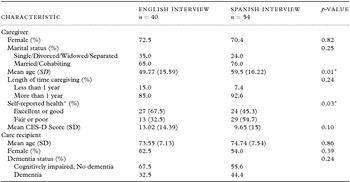
Table 1 presents the demographic characteristics of the 94 caregivers in the study by language acculturation (Spanish or English interview). As shown, Spanish speaking caregivers were older (mean age = 59.5) compared to English speaking caregivers (mean age = 49.8), t = 2.92, p < .01). English speaking caregivers were more likely to report good or excellent health (67.5%) compared to Spanish speaking caregivers (45.3%), x 2 = 4.54, p < .05. Although not the focus of this study, care recipients’ mean age was 74 (SD = 7.36). They were mostly female (57%) and the majority (61%) were cognitively impaired without dementia (vs. 39% with dementia). In the entire sample (data not shown), caregivers’ mean age was 55.4 (SD = 16.6). Most were female (71%), had spent more than one year caregiving (89%), reported their health as good or excellent (54%), spoke Spanish during the interview (57%), and were married or living with someone (71%). Caregivers had a mean depressive symptoms score of 11.1 (SD = 14.8), which indicated a low level of depressive symptoms.
Sample characteristics of caregivers (N = 94)

*p < .05. CES-D = Center for Epidemiological Studies Depression. Self-reported health missing value for one participant. Significance tests were from χ2-tests for categorical variables and t-tests for continuous variables.
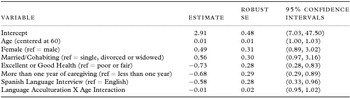
Table 2 presents the results of the regression analysis for factors related to depressive symptoms in caregivers. All variables in the model were significant predictors of depressive symptoms. For ease of interpretation, exponentiation of the coefficient terms in Table 2 were taken. For every year over age 60, depressive symptoms score increased by one percent. At age 60, Spanish speakers had 56% lower depressive symptoms scores compared to English speakers. Women had 63% higher depressive symptoms scores compared to men. Those who were married or cohabiting had 75% higher depressive symptoms scores compared to those who were single, divorced, or widowed. Those in excellent or good health had 48% lower depressive symptoms scores compared to those in poor or fair health. Those who had spent more than one year of caregiving had 51% lower depressive symptoms scores compared to those who had been caregiving for less than one year. In terms of the interaction, at age 60, Spanish speakers had lower depressive symptoms scores than predicted, controlling for all other variables.
Regression analysis of caregiver characteristics on depressive symptoms

This is a Poisson regression and log link of depression variable – Center for Epidemiological Studies Depression scale score. “SE” = standard error; “ref” = reference group. All variables significant at the 0.001 level. Interaction is significant at p < 0.05.
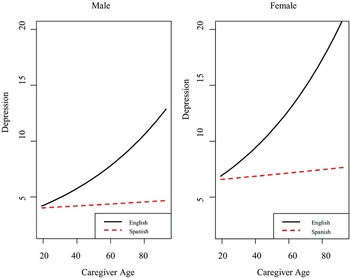
Figure 1 displays the interaction of age and language acculturation for males and females separately. These graphs show the interaction for individuals who were married or cohabiting, had good or excellent health, and who had more than one year of caregiving. As illustrated, females overall had higher depressive symptoms scores than males. At younger ages (20–40 years), acculturation is not related to depressive symptoms scores. However, for older ages (p < .05), acculturation becomes a risk factor for depressive symptoms, as English speakers had higher depressive symptoms scores than Spanish speakers. Notably, the gap between Spanish and English speakers widens across age.
The interaction of caregiver age and language acculturation on depressive symptoms for males and females. Note. Figure 1 displays the interaction of age and language acculturation for males and females separately. These graphs show the interaction for individuals who were married/cohabiting, had good or excellent health, and who had more than one year of caregiving.

Discussion
In the current study, the sociocultural stress and coping model was used as a framework for understanding how acculturation was related to depressive symptoms in Latino caregivers (Aranda and Knight, Reference Aranda and Knight1997; Knight and Sayegh, Reference Knight and Sayegh2010). We found that language acculturation is positively associated with depressive symptoms; that is, English speakers have higher depressive symptoms scores than Spanish speakers. This is consistent with results from the H-EPESE study which showed that elderly caregivers who were more acculturated had a greater risk of depressive symptoms (Hahn et al., Reference Hahn, Kim and Chiriboga2011). Hahn et al. suggested that it may be that higher level of acculturation is associated with a lowered sense of familial obligation, and possibly reduced family solidarity, and the result could be higher depressive symptoms among more acculturated caregivers. However, Hahn et al.'s study sampled only elderly caregivers. The current study builds upon findings from Hahn et al. (Reference Hahn, Kim and Chiriboga2011) by indicating that language acculturation is positively related to depressive symptoms in older caregivers, but this relationship is attenuated in younger caregivers.
As some research suggests (e.g. González et al., Reference González, Ceballos, Tarraf, West, Bowen and Vega2009), the relationship between acculturation and mental health appears to vary across one's lifespan. Younger caregivers may be in a vulnerable stage establishing their own identity and family in addition to the tasks of caregiving; therefore, there may be other factors that more heavily influence depression. Studies of Latino young adults have shown that gender and socioeconomic status were more important in predicting depression scores than acculturation level (e.g. Cuellar and Roberts, Reference Cuellar and Roberts1997; Rivera, Reference Rivera2007). For older caregivers, acculturation might mean losing important cultural values such as familism that helps them to cope with caregiving (Coon et al., Reference Coon2004).
Interestingly, in the study by Hahn et al. (Reference Hahn, Kim and Chiriboga2011), when additional analyses were run without controlling for physical health and social support, elderly caregivers who were more acculturated actually had fewer depressive symptoms. Therefore, we also ran additional analyses not controlling for health status and results indicated language acculturation was protective against depressive symptoms, especially in older caregivers; however, the interaction was not significant. Nevertheless, these analyses (that do not control for overall health status) highlight the importance of further investigations into the complex relationship of acculturation, age, and health status among Latino caregivers (Covinsky et al., Reference Covinsky2003).
Our findings diverge from some studies indicating that low acculturation is associated with a higher risk of depressive symptoms among older adults (Black et al., Reference Black, Markides and Miller1998). However, in Black et al., acculturation was measured using a modified version of the Acculturation Scale (Hazuda et al., Reference Hazuda, Haffner and Stern1988). When language of interview was examined, it was not a significant predictor of depressive symptoms. Research from Alegria et al. also indicated that the Latino paradox doesn't hold for elderly Latinos (Alegria et al., Reference Alegria, Sribney, Woo, Torres and Guarnaccia2007). There are several possible explanations for why the current study's findings showing that acculturation is associated with better mental health for older adults differ from others. One, Alegria and colleagues used different measures of acculturation and mental health. While we used language of interview as the preferred measure of acculturation, the former study used nativity and age of arrival in the U.S. Although age of arrival in the U.S. may be a better proxy for acculturation than nativity, there is also some literature indicating that language is an appropriate measure of acculturation (Garcia and Marks, Reference Garcia and Marks1989; Moscicki et al., Reference Moscicki, Locke, Rae and Boyd1989; Vega et al., Reference Vega, Kolody and Warheit1985). The dependent variable in Alegria's study was a diagnosable disorder, whereas we used the CES-D as our dependent variable. Additionally, the National Latino and Asian American Study (NLAAS) sample likely consisted of a more diverse population of Latinos, whereas most Latinos in the present study were of Mexican origin. Lastly, all of the individuals in our study were caregivers, and there are likely specific issues and stressors faced in the caregiving population that differ from the non-caregiving group. Therefore, results of this study seem to be consistent with prior studies of caregivers (e.g. Hahn et al., Reference Hahn, Kim and Chiriboga2011) but inconsistent with what has been found in the non-caregiving literature. Future research should investigate the processes for how acculturation influences depressive symptoms in Latino caregivers and non-caregivers.
Similar to other studies, being female was associated with greater depressive symptoms (Sörensen and Pinquart, Reference Sörensen and Pinquart2005). Our finding that those who had been caregiving for less than one year were more depressed is not very surprising. During the first few months after being in their new role, caregivers must adjust to a host of new demands and challenges that might make them more vulnerable to depression (Adams, Reference Adams2006). Those who have been caregiving for more than one year might have learned effective coping strategies to meet their new demands (McConaghy and Caltabiano, Reference McConaghy and Caltabiano2005). Results also indicated that those who were married or cohabiting had higher depressive symptoms compared to those who were single, divorced, or widowed. Although this is inconsistent with some studies investigating the relationship between marital status and depression, other research with Mexican Americans have found no effect of marital status on depression (Markides and Farrell, Reference Markides and Farrell1985).
The findings should be considered within the limitations of the study. First, although language of interview serves as a relatively good proxy of acculturation, the results of this study would be further strengthened by the inclusion of other acculturation measures. It may be that different acculturation measures have varying effects on depressive symptoms (Black et al., Reference Black, Markides and Miller1998). However, a recent study indicated that language was central to understanding the acculturation-health relationship among Mexican Americans (Miranda and González, Reference Miranda and González2011). Moreover, findings from Miranda and González (Reference Miranda and González2011) indicated that the three acculturation indices used in their study (language proficiency, length of time in the U.S., place of residence during formative years) all acted similarly in relation to the health outcomes studied. Nevertheless, there are several well-validated acculturation measures that future research should utilize in addition to language interview preference. Our data are cross-sectional and, therefore, we cannot infer causality among our variables or assume that acculturation increases the risk of depressive symptoms as one ages. Another limitation of this study is that the sample size is relatively small. Our study indicated potential relationships among language acculturation, age, and health status; a larger sample would have allowed us to test for a possible three-way interaction to further disentangle these effects and/or to include other covariates in our model that have been theorized to influence outcomes (e.g. frequency of care recipient behavioral problems, social support, etc). Finally, Spanish speaking caregivers in the present study were older than English speaking caregivers, potentially making it challenging to tease apart the effects of age and language acculturation. However, this is somewhat addressed by including the language acculturation by age interaction in our study. Thus, we were able to see the nuanced effects of age and language acculturation on depressive symptoms.
Despite these limitations, a strength of the current study is that, unlike many previous studies of caregivers, this sample was drawn from a relatively large population-based sample, making it more representative of the general population of Latino elderly people with cognitive impairment and their caregivers who are living in the target areas. Additionally, the current study adds to the growing literature on acculturation and mental health outcomes in Latino caregivers by examining the moderating effect of age. To our knowledge, this is the first study to examine the main and interactive influences of language acculturation and age as they relate to caregiver depressive symptoms in the Latino population. Future research should explore possible reasons for why language acculturation is a much stronger risk factor for depressive symptoms in older Latino caregivers than younger caregivers.
As mentioned earlier, there may be multiple roles that caregivers face and consistent with stress and coping models, these role strains may override the influence of acculturation (Pearlin et al., Reference Pearlin, Mullan, Semple and Skaff1990). For caregivers who are older, role strain might not be as salient, but there may be concomitant health challenges that impinge upon caregiving. It may be here that the Latino paradox is most relevant – those who are more acculturated could have more health problems, and these health problems are then associated with worse depressive symptoms. The interactive influences of age, acculturation, health, and depression as they impact Latino caregivers are important areas of study for future research. Additionally, it would be valuable to investigate what aspects of Mexican Americans’ cultural orientation might protect them from depression. An understanding of these variables could guide continued efforts towards culturally-informed caregiver interventions.
Conflict of interest
None.
Description of author's roles
Oanh Meyer analyzed the data and wrote the manuscript. Sue Geller guided data analysis. Emily He helped with data analysis and literature review. Hector González assisted with data analysis and interpretation. Ladson Hinton was involved in all phases of the study including study design, implementation, analysis, and writing. All authors reviewed drafts of the manuscript and assisted with interpretation.
Acknowledgments
This research was supported in part by NIMH T32 #MH018261, the National Center for Advancing Translational Sciences, NIH #UL1 TR 000002, and the UC Davis Alzheimer's Disease Center P30AG010129. Ladson Hinton also received support from the UC Davis Latino Aging Research Resource Center (Resource Center for Minority Aging Research) under NIH/NIA Grant P30-AG043097. Hector González received support from NIMH #MH84994. We would like to thank Laurel Beckett, PhD and Sandra Taylor, PhD for helpful comments early on in the study. We are grateful to the many participants of the Sacramento Area Latino Study on Aging (NIH/NIA R01-AG12975).