Introduction
The poultry industry is one of the biggest and rapidly growing industries world-wide. The production of poultry meat has been rising continuously at the rate of 4% annually (Khalifa et al., Reference KHALIFA, ABEDLRAHIM, ELNASRI and AHMED2013). Newcastle disease (ND) is an economically important health problem in poultry industry all around the world (Alexander and Senne, Reference ALEXANDER and SENNE2008). Newcastle disease virus (NDV) belongs to Paramyxovirus type 1 (APMV-1) which is an RNA virus from the genus Avulavirus of the family Paramyxoviridae (Mayo, Reference MAYO2002). NDV is grouped as either lentogenic, mesogenic and velogenic pathotypes based on clinical signs, virulence and mortality of infected birds (Orsi et al., Reference ORSI, DORETTO, REISCHAK, DA SILVA, SPILKI, BUZINARO and ARNS2009). ND deteriorates the quality of eggs, decreases the performance of birds and impairs growth (Yan et al., Reference YAN, DU, ZHAO, FAN, GUO, MA, WANG and ZHU2011). Lentogenic strains of NDV can produce mild respiratory infection, whereas mesogenic strains can cause low mortality and neural signs and velogenic strains can result in severe mortality. Velogenic strains may be either neurotropic velogenic NDV (NVNDV) or viscerotropic velogenic NDV (VVNDV) (Huang et al., Reference HUANG, PANDA, ELANKUMARAN, GOVINDARAJAN, ROCKEMANN and SAMAL2004; Piacenti et al., Reference PIACENTI, KING, SEAL, ZHANG and BROWN2006).
The only commercial control measure so far is vaccination, which does not always confer 100% immunity in birds. Thus, there is a need to search for complementary measures. Medicinal plants have the ability to be active in preventing a variety of infectious and non-infectious diseases. One estimate revealed that 25% of all commonly used medicines have been isolated from plants (Perera and Efferth, Reference PERERA and EFFERTH2012). Currently, there are only a few drugs available for the cure of viral diseases, including acyclovir. In order to combat viruses, research efforts have been devoted to the discovery of new antiviral natural products (Mbanga et al., Reference MBANGA, MANGOMA and SAIDI2010; Perera and Efferth, Reference PERERA and EFFERTH2012). As part of this effort, screening studies using eggs and other media in laboratory tests have been carried out to establish efficacy. In this review, we will discuss studies that have been concerned with antiviral activity of plants with specific reference to ND.
In vitro antiviral activity of medicinal plants
azadirachta indica
Azadirachta indica, a hardy plant commonly called the neem tree, belongs to Meliaceae family and is commonly found in South Asia and some parts of Africa. Literature from Ayurvedic times discuss the benefits of several parts of A. indica, including its leaves, flowers, root, bark and fruit (Schmutterer, Reference SCHMUTTERER2002; Subapriya and Nagini, 2005). There are many types of biologically active compounds in A. indica that are both structurally complex and chemically diverse (Senthil et al., Reference SENTHIL, KALAIVANI, CHUNG and MURUGAN2006). It has been reported that different parts of A. indica contain more than 140 different compounds, which are used for the treatment of bacterial and fungal diseases; however, it appears that its antiviral properties are limited to certain viruses, including fowl pox, small pox and polio as examined by virus inhibition assays (Rao et al., Reference RAO, SUKUMAR, PARAMASIVAM, KAMALAKSHI, PARASHURAMAN and SHANTHA1969). VERO cells (‘Verda Reno’ cells, which means ‘green kidney’ in Esperatno) are used as the culture for a Kamarvo strain of ND and embryonated eggs are used for ND lasota strain in nine to eleven day old chick. Results showed that methanolic extracts of neem leaves, as well as hexane and chloroform extract of the seed, possessed antiviral activity in VERO cells with an absence of apparent host cytotoxicity. Concentrations of samples ranging from 3-4 µg/egg significantly (P<0.05) inhibited NDV. In chicken embryos, inhibitory concentrations (IC50) and toxic concentrations (TC50) for A. indica were 4 µg/egg and 300 µg/egg, respectively (Wafaa et al., Reference WAFAA, HOWAIDA, HASSAN and El-SAFTY2007).
artemisia annua L.
Artemisia annua L. also known as sweet wormwood, has some antiviral activity against NDV, although data is sparse and limited to laboratory techniques. Decoction methods were used to extract the compounds of A. annua and its effect was tested in chicken embryos for inhibition of NDV(Liu and Genqiang, Reference LIU and GENQIANG2009). The results indicated inhibition of NDV proliferation in chicken embryos in the presence of these extracts.
Sudanese medicinal plants
In Sudan, methanolic extracts were obtained from different plants traditionally used to treat various illnesses, including ND in poultry. Plant extracts were tested for potential antiviral activity by culturing in vitro using the allantoic sac in developing chicken embryos. The results showed that the stem of Avicenna marina, bark of Combretum glutinsum, bark and leaves of Diospyros mespiliformis, whole aerial parts of Lavandula coronopifolia, seeds of Nigella sativa and bark of Zizyphus spina-christi had 100% haemagglutination inhibition (HI) of NDV at 100-200 µg/ml of extract concentration indicating antiviral activity (Ietidal et al., Reference IETIDAL, EL BUSHRA and MAHASIN2010).
adansonia digitata
Adansonia digitata is commonly called the African baobab tree. The antiviral potential of methanolic extracts of bark from this tree was examined using 175 specific antibody-negative embryonated chicken eggs infected with a field strain of NDV. Eight graded concentrations were generated after 24 hours exposure to NDV and then incubated for 12 hours at 37ºC to investigate mortality using both a negative and positive control with high concentrations of extract or virus, respectively. The results demonstrated that baobab root bark extracts had antiviral activity at 200 and 250 mg/ml concentrations against ND (Sulaiman et al., Reference SULAIMAN, OLADELE, SHITTU, EMIKPE, OLADOKUN and MESEKO2011).
momordica balsamina
Momordica balamina, a herbaceous plant, belongs to the Curbitacae family and is found in Northern Nigeria as a climber that grows over native huts (Bokhari and Ahmed, Reference BOKHARI and AHMED1980). Phytochemical testing of the plant revealed that it contains saponins, lectins and tannins (Akiniyi et al., Reference AKINIYI, SULTANBAWA and MNAWAKU1986). The steroids, glycosides and saponins are mostly present in seeds of M. balamina. Leaf extract appears to have a lower pharmacological effect because of the absence of flavanoids and tannins compared to fruit extracts. Alkaloids, flavonoids, saponins and tannins found in M. balamina are regarded as novel antiviral agents (Jassim and Naji, Reference JASSIM and NAJI2003). Fibroblastic cell lines from chicken embryos were used to investigate the antiviral activity of fruit and leaf extracts against ND. To evaluate its antiviral activity, three groups were tested: 1. Virus and extract before infection of cell lines; 2. Cell lines exposed to NDV before the addition of extract; and 3. Treatment of cell lines with the extract before infection with the virus. Fruit pulp and leaf extracts inhibited viral infection at concentrations of 10 mg/ml and 20 mg/ml respectively. Detailed analysis showed that extracts from this plant have the ability to prevent the attachment of virus to host cells (Chollom et al., Reference CHOLLOM, OLAWUYI, DANJUMA, NANBOL, MAKINDE, HASHIMU, ALESA, ESILONU, OGUNDEJI and KWATJEL2012a).
psidium guajava
In ovo antiviral activity of leaf extracts from Psidium guajava was assayed against NDV, and when dosed at 250 mg/ml and 200 mg/ml, completely inhibited viral growth in embryonated eggs. Embryo survival increased directly in line with extract concentrations. The increase in extract concentration was inversely proportional to the production of antibodies against NDV in hatched chicks. The results of the experiment showed that P. guajava leaf extract had antiviral potential against NDV (Chollom et al., Reference CHOLLOM, AGADA, BOT, OKOLO, DANTONG, CHOJI, ECHEONWU, BIGWAN, LOKASON and BANWAT2012b).
moringa oleifera
The effect of aqueous seed extract from Moringa oleifera against NDV was investigated by an in ovo assay. Embryo survival was directly proportional to increasing extract concentration. Increase in extract concentration was inversely proportional to the production of antibody and directly proportional to virus death against NDV (Chollom et al., Reference CHOLLOM, AGADA, GOTEP, MWANKON, DUS, BOT, NYANGO, SINGNAP, FYAKTU and OKWORI2012c).
aloe hijazensis
Leaves and roots of Aloe hijazensis are the sources of biologically active compounds which include chromones, flavonoids, anthrones and anthraquinones (Abd-Alla et al., Reference ABD-ALLA, SHAABAN, SHAABAN, ABU-GABAL, SHALABY and LAATSCH2009). Barbaloin (Aloe) and emodin (Rheum, Polygonum) have been found to possess antiviral activity (Alves et al., Reference ALVES, PÉREZ-FONS, ESTEPA and MICOL2004). Evaluation of Aloe hijazensis leaves, flowers, roots and flower peduncles against NDV using specific pathogen free (SPE) chicken embryos were carried out and it was observed that flower and leaf extracts had greater antiviral activity against NDV than those from other parts of the plant (Abd-Alla et al., Reference ABD-ALLA, ABU-GABAL, HASSAN, EL-SAFTY and SHALABY2012).
commiphora swynnertonii
Crude extracts from leaves, root and stem bark of Commiphora swynnertonii were studied against NDV using an in ovo assay. The extracts significantly (P<0.001) reduced virus titres, and, at 500 μg/ml, no viruses were detected in allantoic fluids of the resin treated group. Furthermore, results of the HI test showed very low levels of antibodies against NDV in chicks hatched from eggs treated with resin and root bark extract. From these findings it appeared that these plant materials were capable of destroying NDV before the development of the chick's immune system (Bakari et al., Reference BAKARI, MAX, MDEGELA, PHIRI and MTAMBO2013).
cladosiphon okamuranus
Cladosiphon okamuranus contains fucoidan which has been shown to exhibit antiviral effects against NDV (La Sota strain), whereby inhibition of viral replication was observed in early stages of infection, particularly 0-60 minutes post-infection. A 48% decrease in viral infection was due to reduced haemagglutinin and neuraminidase (HN) protein expression. Ribavirin was used as a control and exhibited lower antiviral activity than fucoidan and high toxicity at active doses. In fusion assays, the sulphated polysaccharide fucoidan from C. Okamuranus represented a potentially low toxic antiviral compound, although a better understanding of the mode of action of this compound is needed (Elizondo-Gonzalez et al., Reference ELIZONDO-GONZALEZ, CRUZ-SUAREZ, RICQUE-MARIE, MENDOZA-GAMBOA, RODRIGUEZ-PADILLA and TREJO-AVILA2012).
Marine algae
Thirty crude extracts from ten different marine macroalgae were tested against NDV using chicken embryo infection assays. Ulva lactuca, Caulerpa racemosa, Galaxaura elongate, Acanthophora spicifera, Liagora farinose, Cystoseira compressa, Cystoseira myrica, Hydroclathrus clathratus, Turbinaria ornate and Padina pavonia were used to determine antiviral activity (Ibraheem et al., Reference IBRAHEEM, NEVEEN, MOHAMED and KHALED2012). The results demonstrated that acetone and diethyl ether extracts from the algae were toxic to chicken embryos causing death and petechial haemorrhages all over embryo, while ethanolic extracts were not toxic at low doses. Antiviral activity was attributed to polysaccharides, which blocked viral adsorption at the cell membrane of the host cell.
In vivo antiviral activity of medicinal plants
capsicum frutescens, opuntia vulgaris and citrus limon
Capsicum frutescens (red pepper), Opuntia vulgaris (prickly pear) and Citrus limon (lemon) have been used to observe prophylactic and therapeutic efficacy against ND in domestic chickens. In Northern Tanzania, a local preparation comprising three plants, namely Opuntia vulgaris, Capsicum frutescens and Citrus limon were reported to have therapeutic efficacy against ND in commercial chickens. Trials showed that antibody response, rather than therapeutic intervention with the plant extract, was the key factor in the recovery from ND in chickens. However, these plant extracts showed a negative effect on body weights in birds with ND (Mtambo et al., Reference MTAMBO, MUSHI, KINABO, MAEDA-MACHANG'U, MWAMENGELE, YONGOLO and TEMU1999).
aloe secundiflora
Anecdotally, aloe species have been used to reduce the symptoms of a number of chicken diseases including ND in Kenya, Tanzania and Uganda. Aloe species were used in two replicate experiments to investigate their efficacy against ND in rural poultry among several communities of Tanzania. Local chickens of four months of age that were free from ND antibodies were used and then infected with NDV, half of which were treated with aloe extract. Body weight, antibody levels, clinical signs and mortality were monitored in treated and non-treated birds. Results showed that there was reduced severity of clinical signs and mortality rate in aloe treated chickens during the acute phase of infection compared with the non-treated ones. Furthermore, there was no significant (P>0.05) effect of aloe on antibody levels that could be attributed to the recovery of surviving chickens. The findings of this study suggested that Aloe secundiflora could be a potential candidate for management of ND in chickens (Waihenya et al., Reference WAIHENYA, MTAMBO and NKWENGULILA2002).
cucumis metuliferus
The fruit extract of Cucumis metuliferus contains alkaloidal components which have antiviral properties and were tested in trials chicks infected with ND. Birds infected with NDV (a control versus a group injected with C. metuliferus) were examined for signs of disease and infected organs were histopatologically examined and the time of death. The results indicated that the alkaloids of this plant were capable of reverting the negative effects of the virus in chicks. Intraperitional injection of extract reduced the clinical signs, with 600 mg/kg being more potent than 400 mg/kg (Chen et al., Reference CHEN, WANG, HU, GUO, WANG, ZHAO, FAN, GUO, YANG, SAI and XING2010).
anthocleista nobilis
Ethanolic extracts of Anthocleista nobilis were used in poultry trials for the treatment of ND. Research concluded that the biochemical values of these extracts for poultry birds fell in the normal range, which had a good indication for ND treatment after infection with NDV (Ayodele et al., Reference AYODELE, OKONKO, ODU and BANSO2012).
mangrove halophytes
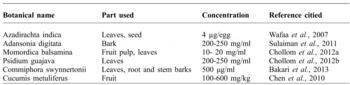
The extracts of Mangrove halophtes were analysed for their efficacy against NDV using chorioallantoic membrane cultures for determining antiviral activity, and percent HI for gross antiviral activity. The results revealed effective antiviral activity of plant extract (Pemanathan et al., Reference PEMANATHAN, KANDASAMY and HIDEKI1999). The antiviral activity of different medicinal plants with their effective concentrations is presented in Table 1.
Antiviral activity of plants, specific parts used and concentrations of extracts against NDV.

Boosting immunity
nigella sativa
A study was conducted to investigate the effect of supplementing Nigella sativa in feed on the immunity and overall performance of broiler chicken. Feed consumption, average weight gain, dressing percentage, feed efficiency, abdominal fat weight and antibody titre of ND were used as criteria of response. The results showed that birds receiving 40 g/kg of this plant in feed had significant (P<0.05) improvements in feed consumption, average weight gain, dressing percentage, feed efficiency and antibody titre, but no significant effect was observed in abdominal fat, gizzard or intestine weight and feed cost (Durrani et al., Reference DURRANI, CHAND, ZAKA, SULTAN, KHATTAK and DURRANI2007). However, this plant may provide a way of improving immunity in birds exposed to disease.
polysavone
An extract of Medicago sativa (alfalfa) called polysavone, was used to investigate immunity and abdominal fat deposition in broiler chicken. This extract had no significant (P>0.05) effect on body weight, feed intake and feed gain ratio, but decreased abdominal fat deposition at five and six weeks of age. The extract improved thymus and spleen weights at six weeks of age and weight of bursa at four and five weeks of age, compared to the control group, which were linked to an increase in immunological activity without adverse effects on broiler chicken performance (Dong et al., Reference DONG, GAO, TONG, JIA, SA and ZHANG2007).
melissa officinalis
The aqueous extract from leaves of Melissa officinalis contain tannins which have been used to protect chick cell culture and eggs from ND infection and has been shown to inhibit haemagglutination caused by NDV (Parameswari et al., Reference PARAMESWARI, MEENATCHISUNDARAM, SUBBRAJ, SUGANYA and MICHAEL2009).
momordica cochinchinensis
Extracts of Momordica cochinchinensis seeds have been used to evaluate any impact it may have on the immune response against ND in chickens. The trial data indicated that there was enhanced humoral immune response post-immunisation with ND vaccine, but no significant (P>0.05) differences were found for the cellular immune response. During the experiment, no side effects were found on growth performance in the chickens (Xiao et al., Reference XIAO, BAO and HU2009).
Astragalus polysaccharide and oxymatrine
Astragalus polysaccharides and oxymatrine were used to investigate antibody titre, lymphocyte profile and IL-2 concentration in chicken. The results showed that astragalus polysaccharides and oxymatrine synergetically improved the immune efficacy of ND vaccine (Chen et al., Reference CHEN, WANG, HU, GUO, WANG, ZHAO, FAN, GUO, YANG, SAI and XING2010).
echinacea purpurea
The ethanolic extract from Echinacea purpurea was used against an Indian NDV strain. The extract contained a high proportion of glutamic acid while serine, threonine, proline, phenylalanine, isoleucine and lysine were present in more or less equal quantities while methionine and cysteine were absent. Data showed that the use of this plant extract improved immunity and FCR with significantly (P<0.01) decreased mortality in infected birds (Fard et al., Reference FARD, FEIZI and BIJANZAD2010).
aspargus racemosus
In India, Withania somnifera and Asparagus racemosus are locally called Ashwagandha and Shatavari, respectively. The extracts from these plants were evaluated in treated feed to analyse the role of T and B cells in host defence against ND in immune-compromised (bursectomised and thymectomised) and normal boiler chicks aged one week old. Significant (P<0.05) positive effects were observed in both humoral and cell mediated immune responses of the birds. However, the bursectomised and thymectomised birds showed a decline in the antibody titre. Variation in skin thickness was significantly (P<0.05) higher among the treated groups compared to the controls which was considered to indicate immune-stimulation in the birds (Kumari et al., Reference KUMARI, TIWARY, PRASAD and GANGULY2012).
withania somnifera
Withania somnifera is a plant of Solanaceae family. Alkaloids and steroidal lactones are the main components, but withanine is the main alkaloid found in leaves and roots which is responsible for its biological activity. It has been reported that this plant increases white blood cells (WBCs) and red blood cells (RBCs) significantly in the blood (P<0.05) (Sham et al., Reference SHAM, CHITREB and PATWARDHAN2003; Manish et al., Reference MANISH, DIWANAY, GAIROLAC, SHINDE, PATKI and PATWARDHAN2004; Senthilnathan et al., Reference SENTHILNATHAN, PADMAVATHI, BANU and SAKTHISEKARAN2006). There was increased haemoglobin (Hb), WBCs, RBCs, platelet count and body weight in animals treated with W. sominfera compared to controls (Ziauddin et al., Reference ZIAUDDIN, PHANSALKAR, PATKI, DIWANAY and PATWARDHAN1996). Aqueous extract of W. somnifera added to drinking water of poultry resulted in a significant (P<0.05) increase in body weight, feed intake and there an increase in the values of packed cell volume (PCV), Hb and TLC in treated groups, but no significant (P>0.05) differences were seen for eosinophils, monocytes and lymphocytes in the treated groups compared with control. It was concluded that these extracts may be used to improve body weight, feed intake, immune status and haematological profile (Mushtaq et al., Reference MUSHTAQ, DURRANI, IMTIAZ, SADIQUE, HAFEEZ, AKHTAR and AHMAD2012) in poultry.
aloe barbedensis, trigonella foenum graecum, allium sativum, pimpinella anisum, berberis lycium
Research has reported on the immunostimulatory potentials of a combination of Aloe barbedensis, Allium sativum, Pimpinella anisum, Trigonella foenum graecum and Berberis lycium in broiler chicks at a ratio of 1:1:1:2:3 respectively. Data from the research trials showed that the infusion of these plants can be effectively used to improve broiler performance and immunity. Furthermore, it reduced the cholesterol level in broiler chicks (Raziq et al., Reference RAZIQ, KHAN, CHAND, SULTAN, MUSHTAQ, RAFIULLAH, SUHAIL and ZEB2012).
Conclusions
A wide range of medicinal plants have excellent antiviral and immune boosting activities against ND, an economically important disease of poultry industry. These plants may act as substitutes for conventionally used, synthetic drugs, which represent various hazards including drug resistance in endemic pathogen populations and drug residues in poultry meat. This may be a way to allow poultry farming with less reliance on chemical prophylactics. Regarding the scientific validation of medicinal plants for immune boosting and therapeutic activities in poultry birds, it is recommended that active product(s) from these plants should be isolated and commercialised for practical use in feed.