Implications
In recent times, the variety and quality of poultry meat products are two major concerns for the consumers. This has led to a reappraisal of the use of traditional practices such as caponization. Caponization increases fat deposition on the carcass, thus improving its organoleptic characteristics and producing a poultry meat product of special quality. The males of layer lines are discarded at birth because they do not have any use in modern poultry production. Our results show that these hybrids can be used for capon production, thus minimizing environmental losses and producing a carcass of adequate quality.
Introduction
In recent times, there has been an increase in the consumer's demand for more variety and quality of poultry meat products, which has led to a reappraisal of the use of traditional practices such as caponization (Tor et al., Reference Tor, Estany, Villalba, Molina and Cubilo2002). Capon production is quite common in small farms around the world but capon meat, as a commercial product, survives only in countries where it had been established in traditional meals such as Italy, France and Spain.
A capon is described as the male fowl surgically castrated before reaching sexual maturity and slaughtered at a minimum age of 140 days. Meanwhile, after castration, the capon must be fattened for at least 77 days according to EC Regulation 543 (European Union, 2008). In practice, capons are slaughtered around 6 months of age.
The long fattening duration that is necessary for capon production de facto excludes the use of fast-growing genotypes of chickens as these hybrids express heart failure conditions and leg problems at much smaller ages. A recent report has shown that even the use of medium growing hybrids under standard commercial diets produced very heavy carcasses in ages >5 months (Symeon et al., Reference Symeon, Mantis, Bizelis, Kominakis and Rogdakis2010). Therefore, it seems that the use of slow-growing genotypes is the most appropriate for this particular production system.
Several reports from Spain (Tor et al., Reference Tor, Estany, Villalba, Molina and Cubilo2002; Muriel Duran, Reference Muriel Duran2004; Miguel et al., Reference Miguel, Ciria, Asenjo and Calvo2008) have explored the use of native Spanish slow-growing breeds (such as Castellana Negra and Extremena Azul) in capon production. Such a practice may be of particular interest in terms of local poultry production and breed conservation, but it could not claim wide application worldwide. In contrast, males of a layer line, which also comply with the slow-growing pattern, are widely available and they possess very small purchase prices as they are not used in any other sector of poultry production. Therefore, males of a layer line appear to be strong candidates for capon meat production.
Caponization results in increased overall fatness in terms of abdominal (Cason et al., Reference Cason, Fletcher and Burke1988), subcutaneous and intramuscular fat (IMF; Hsieh et al., Reference Hsieh, Chen and Chiou2001). The increased overall fatness in capons modifies meat quality characteristics as well (Symeon et al., Reference Symeon, Mantis, Bizelis, Kominakis and Rogdakis2010). Moreover, it enhances flavor, texture and meat juiciness when compared with intact cockerels (Chen et al., Reference Chen, Chi and Chiou2005).
The aim of this study was to explore the potential of males of a layer line as subjects for capon meat production, in terms of growth, livability, carcass and meat quality under a semi-intensive farming system.
Material and methods
Animal management and experimental design
The experiment was conducted in the experimental facilities of the Faculty of Animal Science and Aquaculture of the Agricultural University of Athens. Two hundred and fifty males of a layer line (Lohmann Silver, Lohmann Tierzucht) were purchased from a local hatchery (day 0). On arrival, the birds were wing-marked, weighed and randomly assigned to solid floored pens with wheat straw bedding, in groups of 25 birds per pen (200 × 100 cm, five pens per group). The experimental groups consisted of 125 intact males and 125 capons. Duration of the experiment was 34 weeks.
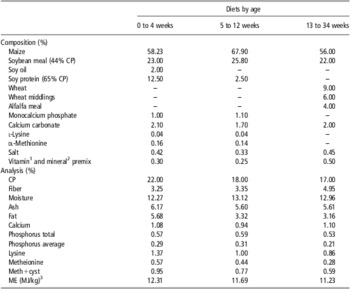
The lighting program was as follows: 24 h of light for the first 2 days, 23L–1D from day 3 until the 3rd week of age, 18L–6D from the 4th until the 8th week and 16L–8D until the end of the experiment. Ambient temperature was gradually decreased from 32°C on arrival day to 20°C on day 30 and was then kept within the range of 18°C to 20°C throughout the experiment. Food and water consumption was ad libitum. The birds were fed standard commercial diets in crumbles. Three types of diets were used with respect to their age. The composition and analysis of the experimental diets are presented in Table 1.
Composition and calculated analysis of the experimental diets by age

Meth = metheionine; cyst = cystine; ME = metabolizable energy.
1The vitamin premix supplied per kilogram of diet: vitamin A, 12 000 IU; vitamin D3, 3200 ICU; vitamin E, 60 mg; vitamin K3, 7 mg; vitamin B1, 2 mg; vitamin B2, 6 mg; vitamin B6, 5 mg; vitamin B12, 0.03 mg; biotin, 0.1 mg; folic acid, 1 mg; pantothenic acid, 12 mg; choline, 400 mg.
2The mineral premix supplied per kilogram of diet: Cu (CuSO4·5H2O, 25.45% Cu), 12 mg; Mn (MnSO4·H2O, 32.49% Mn), 120 mg; Zn (ZnO, 80.35% Zn), 56 mg; Fe (FeSO4·7H2O, 20.09% Fe), 40 mg; I (KI, 76.45% I), 1 mg; Se (NaSeO3, 45.56% Se), 0.16 mg; Co (CoSO4·7H2O, 20.97% Co), 0.2 mg.
3ME was calculated with Sibbald's equation (Larbier and Leclercq, Reference Larbier and Leclercq1994).
Caponization was performed at 45 ± 2 days of age. The birds that were randomly selected for surgery were deprived of feed and water for 24 and 12 h, respectively, before the caponization. Anesthesia was performed using Xylazine (Rompun, Bayer HealthCare, Germany) and Ketamine (Ketaset, Fort Dodge, USA) in doses of 1.5 and 23 mg/kg live weight, respectively. The mean (±s.e.) live weight of the males was 615 ± 18 g. After the removal of the feathers and the disinfection of the skin with povidone iodine 10% (Betadine solution, Mundipharma, Switzerland), a 1.5-cm incision was made between the two last ribs with a scalpel. A rib spreader was inserted and the testicles were removed. After the surgery, the birds were allowed to recover from anesthesia in a separate pen. Feed and water enriched with a multivitamin supplement (Gerostress, Gerolymatos, Kryoneri, Greece) was offered immediately after recovery for ad libitum intake. The next day, they were allocated to their respective pens.
Excluding two birds that died 3 days after the surgery and 10 birds that were identified by the color and size of the combs as slips (incomplete caponized chickens), at ∼10 weeks of age, and they were removed from the experiment, mortality rates for the capons group were 0% until the end of the experiment. On the contrary, in the intact males group, 12 birds died after the 18th week of age because of intense fighting behavior inside the group. Thirty birds per group were slaughtered at three ages for the evaluation of carcass and meat quality characteristics (10 per group per slaughter). The weight data of any bird that died or was slaughtered before the end of the experiment were removed from further analyses. Data from 60 intact males and 60 capons were used for weights’ analyses. Finally, the birds that remained after the end of the experiment were used for undergraduate teaching purposes.
The experiment was approved by the Bioethical Committee of the Agricultural University of Athens under the guidelines of ‘Council Directive 86/609/EEC regarding the protection of animals used for experimental and other scientific purposes’.
Slaughter procedure
Three slaughters were performed at the 26th, 30th and 34th week of age. First slaughter age was selected as the standard for capon production, whereas the next two were performed in order to study the range of the age-dependent effects of caponization such as lipid accumulation. The birds were fastened 16 h before slaughter. In each slaughter, ten chickens per group were randomly selected (two birds per pen). They were electrically stunned (120 V/50 Hz for 5 s), killed by decapitation and left to bleed for ∼1 min. Afterwards, they were passed through a warm scalding vessel (60oC for 2 min), a plucker (2 min) and were manually eviscerated. After primary cooling on air for ∼1 h, they were stored at 4°C overnight.
Measurements
Live weight was recorded individually every week until the 10th week of age and twice per month thereafter. Feed intake was monitored weekly per pen throughout the experiment. Cold carcass weight and carcass yield, as well as edible viscera weights (heart, liver, gizzard and fat pad), were measured at slaughter. Twenty-four hours after slaughter, the carcasses were cut into parts (leg, wing, breast and rest of the carcass according to EC reg. 543; European Union, 2008) and each part was weighed separately. The breast was separated from the back at the shoulder and along the junction of the vertebral and sternal ribs. The wings were separated from the carcass at the shoulder. The legs (including the thigh and the drumstick) were separated from the carcass by cutting through the iliofemoral joint. The left leg was divided into drumstick and thigh at the tibiofemoral joint. The breast, left drumstick and left thigh were dissected into meat, skin plus any visible fat and bone, and their wet weights were recorded. The bones that were weighed were the femur from the thigh, the tibia and the fibula from the drumstick and the sternum along with the sternal ribs from the breast.
All meat quality measurements were performed on the Pectoralis major muscle. pH24 was measured using a Sentron 1001 pH system model (Roden, The Netherlands), with the electrode inserted into the muscle, 24 h post mortem. Meat color was measured on the external surface of the muscle, after skin removal, using a Miniscan XE chromameter (Hunterlab, Reston, USA) set on the L, a*, b* system. L is representing brightness, a* the red color's intensity and b* the yellow color's intensity. For cooking loss measurements, the muscle was weighed and placed in a plastic bag. It was then cooked in a water bath at 85oC for 30 min. After the cooking procedure, it was left under tap water for 15 min and then left to cool in room temperature. Cooking loss was estimated as the percentage of the weight of the cooked samples with respect to the raw ones. Shear force was evaluated as described by Cason et al. (Reference Cason, Lyon and Papa1997). Briefly, two 1.9 mm wide strips were cut from the center of the muscle parallel to muscle fibers. Samples were cut perpendicularly to the fiber direction using a Zwick Testing Machine Model Z2.5/TN1S (Zwick GmbH & Co, Ulm, Germany) equipped with a Warner–Bratzler blade. Peak force values in N/mm2 were recorded. IMF was measured using chloroform (Carlo Erba Reactifs – SDS, Val De Reuil, France) : methanol (Merck, Darmstadt, Germany) 2 : 1 (v/v) solution and a cold extraction procedure according to the method of Folch et al. (Reference Folch, Lees and Sloane Stanley1957).
Statistical analysis
Live weights and feed intake data were submitted to a two-way ANOVA fitting the group and age, including the interaction, as the fixed factors. Carcass composition weights and meat quality data were submitted to a multivariate ANOVA (MANOVA) fitting the group and age as the fixed factors, as well as the interaction. Results of ANOVA and MANOVA analyses are presented as least squares means. Bonferroni's adjustment for P-values was employed during multiple comparisons of means. All analyses were performed by SAS (2008).
Results
Live weights and feed intake
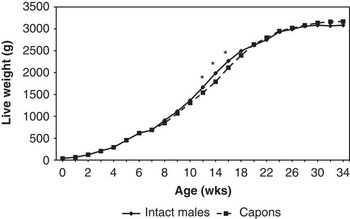
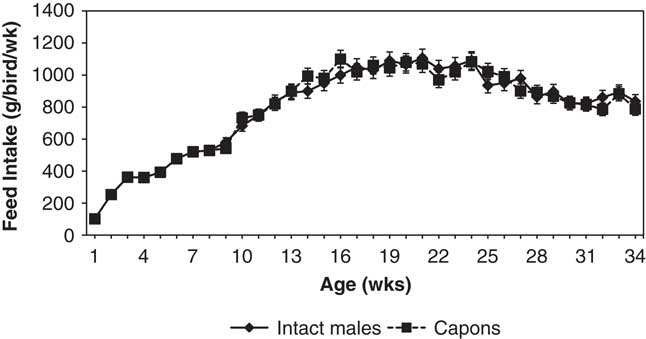
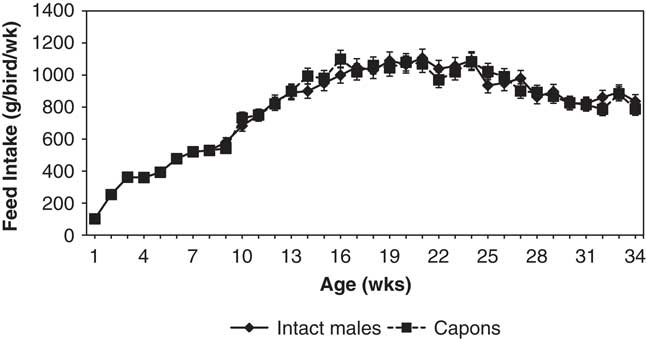
Live weights of intact males and capons from 0 to 34 weeks of age are presented in Figure 1. Intact males were heavier than capons from the 12th until the 16th week of age (P < 0.05). No other significant differences in live weight between the two groups were observed. Feed intake (Figure 2) and feed conversion ratio (FCR: kg feed/kg live weight) were not different between groups. FCR was 5.6 ± 0.4 from 0 to 24 weeks of age (standard age at slaughter for capons) and 7.6 ± 0.5 from 0 to 34 weeks of age.
Least square means of live weight ± s.e. of intact males and capons from 0 to 34 weeks of age. (The asterisk denotes a statistically significant difference between means −P < 0.05, s.e. lines are present but not visible because of scale range.)

Least square means of feed intake ± s.e. of intact males and capons from 1 to 34 weeks of age.
Carcass composition
Caponization did not affect cold carcass weight, which was 3019 ± 32 g and 2959 ± 30 g for capons and intact males, respectively. On the contrary, capons had lower carcass yield (%) compared with intact males (69.5 ± 0.3 to 72.7 ± 0.3).
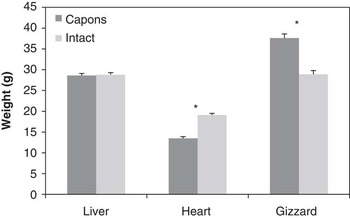
Figure 3 presents the comparison of edible viscera weights between capons and intact males. Caponization reduced heart and increased gizzard weight (P < 0.05), whereas liver weight was not affected. Moreover, capons had a much greater fat pad in contrast to intact males (102.6 to 6.0 g – the numbers represent medians).
Comparison of edible viscera weights (g) of capons and intact males. (The asterisk denotes a statistically significant difference between means −P < 0.05.)

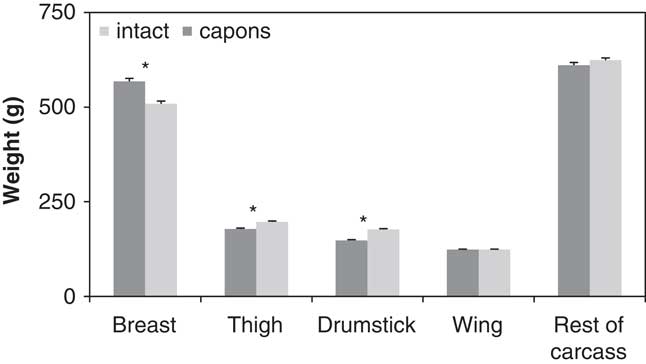
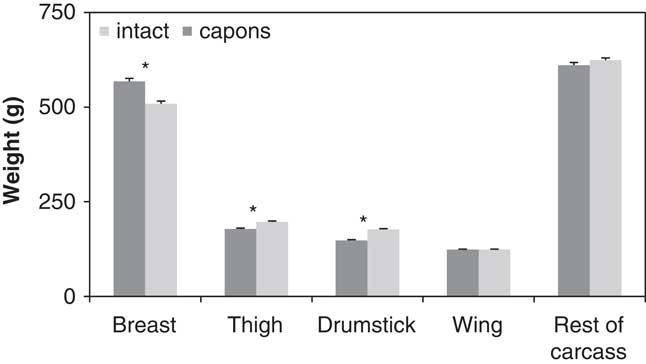
The comparison of carcass parts’ weights is presented in Figure 4. Capons displayed heavier breasts than intact males, whereas the exact opposite result was observed for the thigh and the drumstick (P < 0.05). The wing and the rest of the carcass weights were not different between groups. Nevertheless, a significant interaction between age and treatment was observed for the rest of the carcass. Its weight for the capons group at 26, 30 and 34 weeks of age was 574 ± 14, 626 ± 10 and 634 ± 10 g, respectively. The relevant weights for the intact males group were 636 ± 11, 629 ± 11 and 607 ± 10 g. The fat in the rest of the carcass was trimmed and weighed separately, and the results confirmed that this was the cause for that significant interaction (for capons 85 ± 8, 118 ± 6 and 134 ± 6 at 26, 30 and 34 weeks; for intact males 102 ± 6, 109 ± 6 and 98 ± 6, respectively).
Comparison of carcass parts weights (g) of capons and intact males. (The asterisk denotes a statistically significant difference between means −P < 0.05.)
Commercial parts dissection
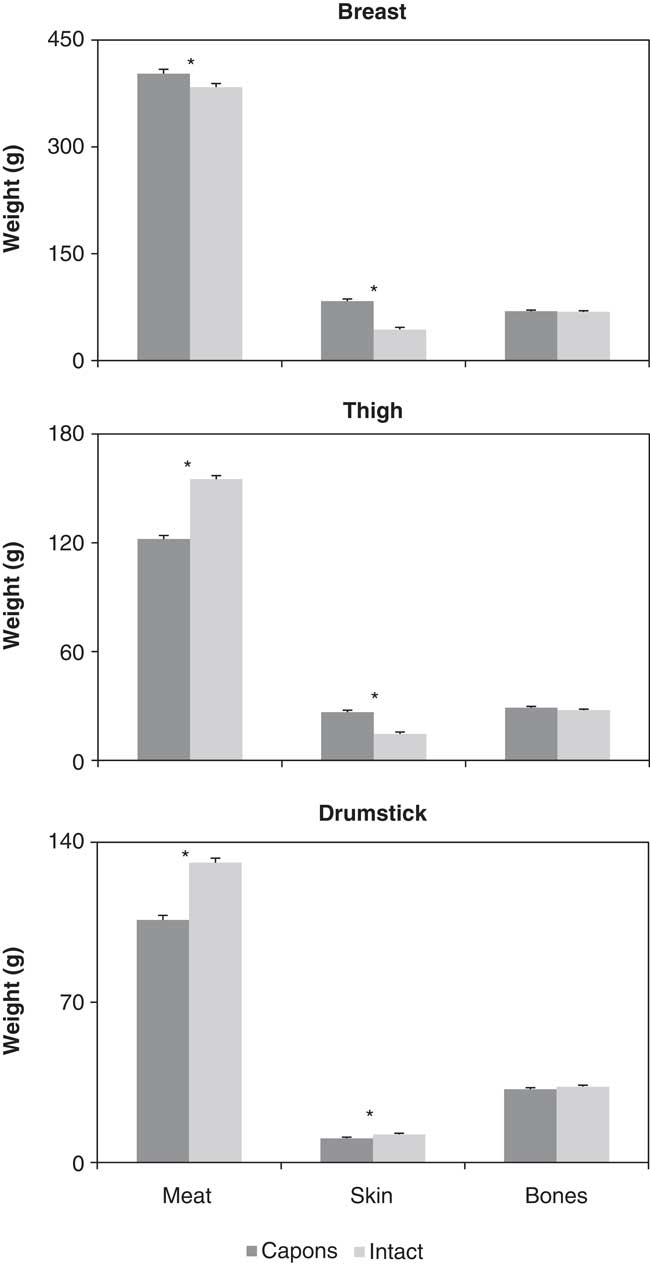
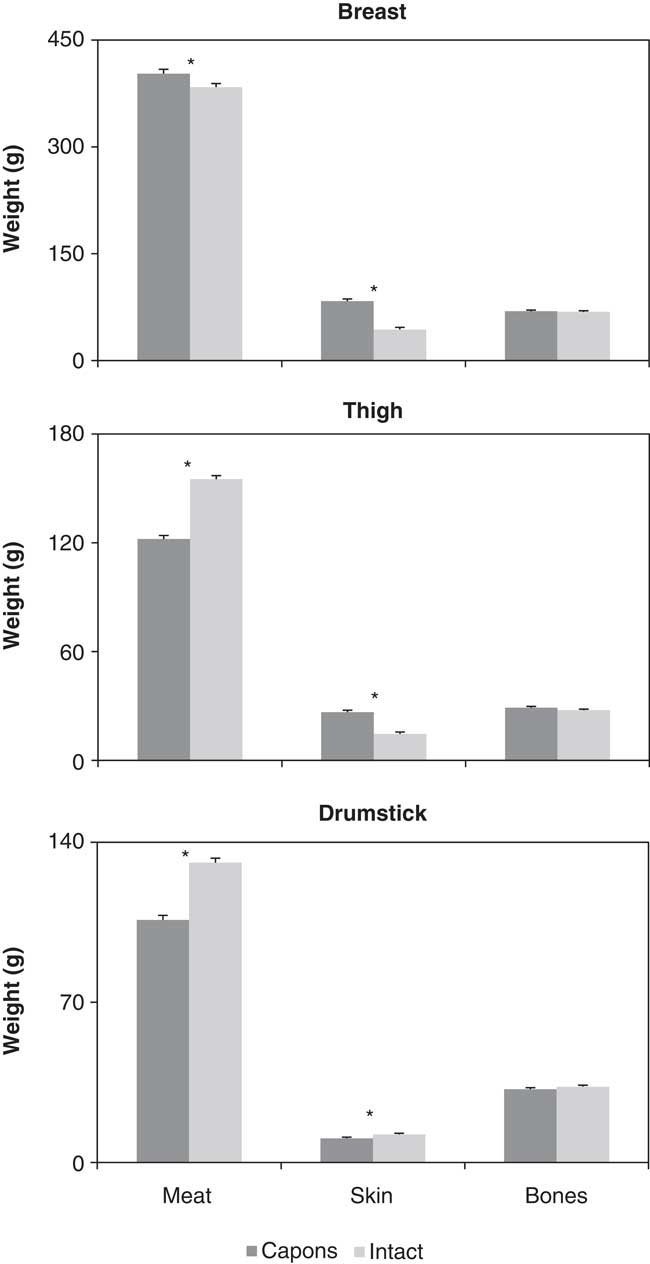
Figure 5 presents the comparison of the commercial parts dissection between capons and intact males. In none of the commercial parts the bone weight was affected by the testectomy. On the contrary, caponization resulted in increased and decreased meat weight in the breast and the leg (thigh and drumstick), respectively (P < 0.05). Moreover, capons had heavier skin fat in the breast and the thigh, with the exact opposite result being observed in the drumstick.
Comparison of meat, skin and bone weights (g) per commercial part (breast, thigh and drumstick) between capons and intact males. (The asterisk denotes a statistically significant difference between means −P < 0.05.)
Fat percentages
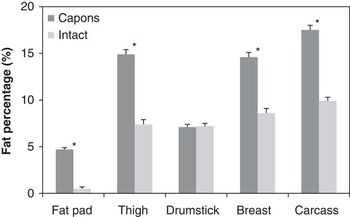
The comparison of fat (skin plus any visible fat) proportions in the carcass and the commercial parts is presented in Figure 6. Caponization increased fat proportions in the commercial parts and the carcass (P < 0.05), with the exception of the drumstick.
Comparison of fat percentages in the commercial parts and the carcass between capons and intact males. (The asterisk denotes a statistically significant difference between means −P < 0.05.)

Meat quality
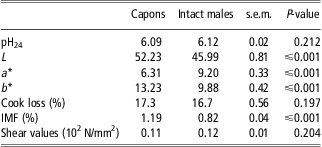
Meat quality characteristics of intact males and capons are presented in Table 2. pH24, cooking loss and shear values were not affected by the caponization. With regard to the color constituents, caponization significantly increased L and b* values and decreased a* values (P < 0.05). Finally, the IMF of the P. major muscle was found to be higher in capons in comparison to intact males.
Comparison of meat quality characteristics between capons and intact males
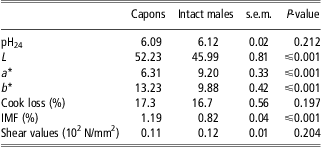
IMF = intramuscular fat.
The effect of age
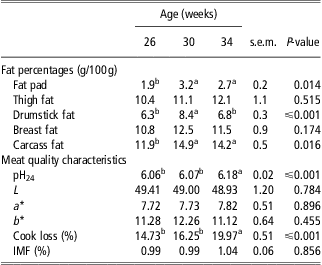
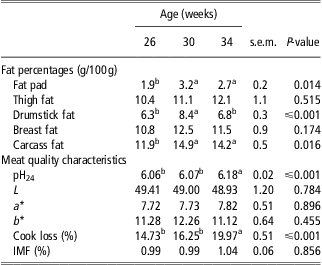
The effect of age on fat percentages and meat quality characteristics is presented in Table 3. The proportion of the fat pad and the proportion of fat in the carcass were increased with age (P < 0.05). Thigh and breast fat percentage were unaffected by age, whereas the fat in the drumstick presented its greater value at 30 weeks.
Effect of age on fat percentages and meat quality characteristics of male layers
IMF = intramuscular fat.
Means within a row bearing different superscripts differ significantly (P < 0.05).
With respect to meat quality characteristics, pH24 and cooking loss increased from 30 to 34 weeks of age, whereas no effect of age was observed for the color constituents and IMF.
Discussion
In accordance with our results, Chen et al. (Reference Chen, Chi and Chiou2005 and Reference Chen, Huang, Lee, Lin, Chang and Chen2010) reported that caponization at 12 weeks did not affect live weight of Leghorn cocks at 26 weeks of age. The same result is also reported by Muriel Duran (Reference Muriel Duran2004) and Miguel et al. (Reference Miguel, Ciria, Asenjo and Calvo2008) for two native Spanish breeds and recorded live weights until the ages of 32 and 29 weeks, respectively. On the contrary, in other reports, capons were heavier than intact males (Lin and Hsu, Reference Lin and Hsu2002; Rahman et al., Reference Rahman, Islam, Ali, Khondaker and Hossain2004; Chen et al., Reference Chen, Hsieh and Chiou2006). The diversity of these results could be attributed mainly to the variation of the breeds used in these studies.
Caponization had no effect on feed intake, as also found by Chen et al. (Reference Chen, Huang, Lee, Lin, Chang and Chen2010). In addition, the absence of any significant effect of caponization on FCR is also reported by Mast et al. (Reference Mast, Jordan and Macneil1981) and Chen et al. (Reference Chen, Chi and Chiou2005). FCR of the groups was high, implying that the feed cost constitutes the major cost component of capon production. Such increased costs could be compensated by appropriate feed composition, feeding techniques and premium market prices, but a detailed economic analysis is needed to address these matters, which was not a purpose of this study.
The caponization-induced reduction of carcass yield should be attributed to the fat pad weight, which was removed from the carcasses before they were weighed for carcass yield evaluation. This is also the common practice in the commercial abattoirs where the excessive fat stored in the fat pad is discarded during processing. The difference in the fat pad weight between the capons and the intact males was remarkable and progressively increased by age (56.5 g at 26 weeks, 91.2 g at 30 weeks and 116.3 g at 34 weeks of age).
Caponization had two main effects on edible viscera weights; it lowered heart and increased fat pad weight. Both of these results are well documented. Miguel et al. (Reference Miguel, Ciria, Asenjo and Calvo2008), Chen et al. (Reference Chen, Huang, Lee, Lin, Chang and Chen2010) and Symeon et al. (Reference Symeon, Mantis, Bizelis, Kominakis and Rogdakis2010) reported lower heart weight in capons in contrast to intact males. It has also been observed that male broilers have bigger hearts than their female counterparts (Thaxton, Reference Thaxton2002; Santos et al., Reference Santos, Sakomura, Freitas, Fortes and Carrilho2005; Marcato et al., Reference Marcato, Sakomura, Piva, Bonato and Freitas2006). With respect to fat pad, many authors have reported that caponization increases its weight (Snapir et al., Reference Snapir, Robinzon and Shalita1983; Cason et al., Reference Cason, Fletcher and Burke1988; Chen et al., Reference Chen, Hsieh and Chiou2006), which is greatly expected because of testectomy-induced major decrease of the testosterone levels. Testosterone is known to be responsible for the decrease of fat accumulation in the body of male chickens (Snapir et al., Reference Snapir, Robinzon and Shalita1983).
In this study, caponization did not affect liver weight, a result also reported by Miguel et al. (Reference Miguel, Ciria, Asenjo and Calvo2008). In a previous two-trial study (Symeon et al., Reference Symeon, Mantis, Bizelis, Kominakis and Rogdakis2010), we observed that caponization increased liver weight but only in the first trial. Consequently, it is not clear whether caponization significantly affects liver weight.
There is no plausible explanation for the heavier gizzard observed in capons as feed intake and composition were not different between groups. Hsu and Lin (Reference Hsu and Lin2003), as well as Miguel et al. (Reference Miguel, Ciria, Asenjo and Calvo2008), did not find any difference in gizzard weight between capons and intact males. Moreover, there is no standard effect of sex on gizzard weight supported in the literature. Some authors have reported heavier gizzards for female broilers (Santos et al., Reference Santos, Sakomura, Freitas, Fortes and Carrilho2005; Marcato et al., Reference Marcato, Sakomura, Piva, Bonato and Freitas2006), whereas others the exact opposite result (Ojedapo et al., Reference Ojedapo, Akinokun, Adedeji, Olayeni, Ameen and Amao2008). Moreover, some authors have not found a sex-related effect on gizzard weight (Hossain et al., Reference Hossain, Roy, Islam and Miah2006).
Caponization had two main effects on carcass composition; it increased and decreased breast and leg weight, respectively. It is well documented that caponization increases breast weight (Tor et al., Reference Tor, Estany, Villalba, Molina and Cubilo2002; Muriel Duran, Reference Muriel Duran2004; Miguel et al., Reference Miguel, Ciria, Asenjo and Calvo2008, Chen et al., Reference Chen, Huang, Lee, Lin, Chang and Chen2010). Muriel Duran (Reference Muriel Duran2004) suggested that, through a lack of sex hormones, caponization causes changes in the metabolism. This results in an earlier development of the breast, similar to the growth pattern seen in hens. The leg weight reduction effect is equally well documented (Tor et al., Reference Tor, Estany, Villalba, Molina and Cubilo2002; Hsu and Lin, Reference Hsu and Lin2003; Muriel Duran, Reference Muriel Duran2004). The results from the deboning process suggested that this was mainly due to the decreased muscle weight in the thigh and the drumstick. Testosterone is known to promote protein synthesis, and the caponization-induced decrease of its levels probably resulted in the lesser amount of muscles in the capons’ leg.
Wing and the rest of the carcass weight was not affected by the caponization in our study, as also reported by Miguel et al. (Reference Miguel, Ciria, Asenjo and Calvo2008) and Muriel Duran (Reference Muriel Duran2004), respectively. Other researchers have reported either increased wing weight (Hsu and Lin, Reference Hsu and Lin2003; Muriel Duran, Reference Muriel Duran2004) or decreased (Tor et al., Reference Tor, Estany, Villalba, Molina and Cubilo2002) as a result of caponization. These controversial results are probably due to the diversity of the animal material used.
In this study, we deliberately included a figure presenting the fat percentages of the commercial parts and the carcass in order to highlight the lipid accumulation caused by the caponization. It is true that fat is not generally appreciated by modern consumers because of health-related reasons. Nevertheless, it is widely expected in traditional or ‘quality’ products because of its ability to enhance sensory attributes. Moreover, in this hybrid, it improved the whole carcass image, producing a carcass closer to the broiler stereotype.
The general increase of fat deposition on the poultry carcass included the IMF of the P. major muscle as well. This result has also been reported by Tor et al. (Reference Tor, Estany, Villalba, Molina and Cubilo2002) and Miguel et al. (Reference Miguel, Ciria, Asenjo and Calvo2008). Increased IMF is generally associated with decreased shear values and thus with improved meat tenderness. Zhao et al. (Reference Zhao, Chen, Zheng, Wen and Zhang2007) reported that an increase of IMF resulted in a significant decrease of shear values in chickens. A negative correlation between IMF and shear values has also been found in pigs (Van Laack et al., Reference Van Laack, Stevens and Stalder2001) and sheep (Okeudo and Moss, Reference Okeudo and Moss2005). However, for capons, this association is not statistically confirmed in the literature, as in the present study. Mast et al. (Reference Mast, Jordan and Macneil1981) and Muriel Duran (Reference Muriel Duran2004) reported only a tendency for more tender breast meat in capons compared with intact males.
The caponization-induced increase on IMF quantity, in combination with feed composition, affected meat color. The result was a brighter, more yellow and less red meat. Hsu and Lin (Reference Hsu and Lin2003) also reported increased yellowness and decreased redness in capons’ breast meat. Moreover, Miguel et al. (Reference Miguel, Ciria, Asenjo and Calvo2008) found that caponization decreased a* values and increased the lightness of the meat. It seems that carotenoids from carotenoid-rich feeds, as corn used in the present study, can be deposited in the body fat, thus increasing yellowness of the meat (Akiba et al., Reference Akiba, Sato, Takahashi, Toyomizu, Matsushita and Komiyama2001; Toyomizu et al., Reference Toyomizu, Sato, Taroda, Kato and Akiba2001). Simultaneously, the increased lipid accumulation proportionally reduces blood vessels and therefore the redness of the meat, resulting in brighter meat.
With respect to the other quality attributes, it is well documented that caponization has no significant effects on pH24 and cooking loss (Welter, Reference Welter1976; Lin and Hsu, Reference Lin and Hsu2002; Miguel et al., Reference Miguel, Ciria, Asenjo and Calvo2008).
As expected, at greater ages, fat deposition increased as well. This was the case for the fat pad and the carcass from 26 to 30 weeks of age, but subsequently no significant difference was observed. On the contrary, age did not affect fat deposition in the thigh and the breast. In the drumstick, a greater proportion of fat was observed at 30 weeks of age.
Conclusion
Caponization of male layers, without affecting growth performance, produced a carcass with adequate commercial weight and quality. Moreover, the genotype used expressed low mortality rates and aggressiveness. Consequently, its use could be proposed, with the necessary adjustments according to local conditions, for the production of capon's meat, retailed as a product of ‘special quality’.
Of course, the utility of such an approach should be accompanied with an economical study. Surely, there would be some savings because of the zero or low cost of the animal material. On the other hand, the feeding and the labor for caponization costs would be elevated. Hopefully, the elevated costs could be counterbalanced by the premium prices that ‘special quality’ products have in the market.
Acknowledgments
George K. Symeon wishes to thank the Greek State Scholarships Foundation for its financial support during this study.