I. INTRODUCTION
The wurtzite III-nitride semiconductor, aluminum nitride (AlN), finds more and more applications in the next generation electronic and optical devices, owing to the excellent thermal conductivity, high electrical resistivity, high resistance to chemicals, wide direct band gap (6.2 eV), and transparency in the ultraviolet (UV) range. In addition, the small mismatch in thermal expansion coefficients and lattice constants with GaN makes the bulk AlN single crystal, an ideal substrate for GaN-based devices.
The Debye temperature, which indicates the effective cutoff phonon energy of a material, is a basic physical quantity but cannot be obtained directly from the experimental measurements. In general, the Debye temperature is estimated either by low-temperature specific heat or by elastic constants of materials or by the quasi-harmonic Debye model (Blanco et al., Reference Blanco, Francisco and Luaña2004). The specific heat method is to measure the heat capacity and deduce the Debye temperature according to the Debye model. As to the elastic constants method, the Debye temperature can be estimated using the Anderson method (Anderson, Reference Anderson1963) once the elastic constants are obtained through experimental measurements or theoretical calculations. The quasi-harmonic Debye model is a theoretical calculation method adopting thermodynamic equations.
Despite several methods accessible to the Debye temperature, most of the works (Kato and Hama, Reference Kato and Hama1994; Wright, Reference Wright1997; Shimada et al., Reference Shimada, Sota and Suzuki1998; Yonenaga et al., Reference Yonenaga, Shima and Sluiter2002; Saib and Bouarissa, Reference Saib and Bouarissa2006; Kazan et al., Reference Kazan, Moussaed, Nader and Masri2007; Sotnikov et al., Reference Sotnikov, Schmidt, Weihnacht, Smirnova, Chemekova and Makarov2010; Wang et al., Reference Wang, Shang, Du, Kong, Zhang, Chen, Zhao and Liu2010) focus mainly on the elastic constants, bulk moduli, or shear moduli rather than the Debye temperature, and no Debye temperatures for AlN have been further deduced. Furthermore, the data of Debye temperature for AlN obtained from different samples or based on the known calculation methods are scattered (Slack et al., Reference Slack, Tanzilli, Pohl and Vandersande1987; Nipko and Loong, Reference Nipko and Loong1998; Dodd et al., Reference Dodd, Saunders, Cankurtaran and James2001; Wang et al., Reference Wang, Ai, Chen and Cai2007, Reference Wang, Cui, Yu and Chen2008; Peng et al., Reference Peng, Chen, Fu and Cheng2008). It is worth mentioning that more precise Debye temperature can be obtained using quality samples, especially single crystals. Following Lu and Liang (Reference Lu and Liang1981), by utilizing of the method based on the X-ray powder diffraction using powder samples, the Debye temperature can also be derived. The effectiveness and reliability of this method have been confirmed in GaN (Chen et al., Reference Chen, Liang, Xu, Xu, Jiang, Yu and Lu1999) and SiC (Peng et al., Reference Peng, Lou, Jin, Wang, Wang, Wang and Chen2009). To the best of our knowledge, the Debye temperature of AlN has not been estimated by this way. In this work, we first obtained high-purity and high-crystalline AlN powder samples by grinding AlN crystal prepared through the physical vapor transport (PVT) method. Then we employed the method of the X-ray powder diffraction to obtain the Debye temperature of AlN at 298 K for the first time.
II. EXPERIMENTAL
Growths of the AlN crystal were carried out by the PVT method in an inductively heated furnace. AlN polycrystalline wafer was selected as seed. Experimental details can be found elsewhere (Zuo et al., Reference Zuo, Wang, Chen, Jin, Jiang, Bao, Guo, Sun and Wang2012). Pre-sintered source was held into a TaC crucible, which was encased by a graphite crucible. The TaC crucible is 30 mm in internal diameter and 60 mm in length. The seed–source distance was kept at 12 mm and appropriate temperature field was controlled by tailoring graphite insulating material. This temperature field made the temperature of seed about 50 °C lower than that of the source. Before heating, the growth chamber was evacuated to a vacuum of about 6.0 × 10⁻⁴ Pa, and then it was filled into high purity N2 (99.999%) of about 0.6 atm. In succession, the source materials were heated and maintained at about 2200 °C for 80 h, and then slowly cooled down to room temperature. Finally, AlN crystal boules were obtained through the aforementioned growth procedure. The AlN crystal was sliced, and then was treated by ultrasonic cleaning in anhydrous alcohol and de-ionized water for 30 min, respectively. High-quality AlN crystal was selected and grinded to fine powder. The ground AlN fine powders were sifted through a 400 mesh sieve (grain size <38 µm) before used for the X-ray powder diffraction analysis. The impurities in the AlN crystal were analyzed by Glow Discharge Mass Spectroscopy (GDMS) and Instrumental Gas Analysis (IGA). The X-ray powder diffraction analysis was performed on a Panalytical X'Pert diffractometer operated at 40 kV and 40 mA using CuKα 1 radiation at room temperature (298 K). The diffraction data were collected by step-scanning mode with steps of 0.02° (2θ). An angular range from 2θ = 20° to 135° and a measuring time of 5 s per step were applied. The Rietveld refinement was carried out using the computer program FULLPROF (Rietveld, Reference Rietveld1967, Reference Rietveld1969; Rodriguez-Carvajal, Reference Rodríguez-Carvajal1990, Reference Rodríguez-Carvajal2003).
III. RESULTS AND DISCUSSION
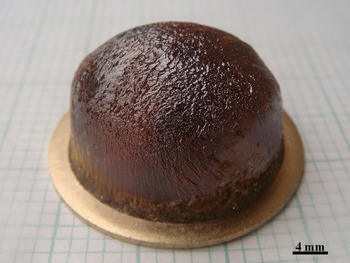
Figure 1 shows the optical photo of the typical AlN crystal boule obtained by the PVT method. The size of the AlN crystal boule is 29 mm in diameter and 18 mm in height. Because of the rough surface and selective absorption, the AlN crystal shows non-transparent and brown color. To evaluate the purity of the AlN crystal we obtained, the impurities in the AlN crystal were analyzed by GDMS and IGA methods. The concentrations of the elements that could be detected were listed in Table I. The results show that oxygen, carbon, and silicon are the primary impurities, and their concentrations are 240, 300, and 260 ppm wt, respectively. The total impurity concentrations are <1000 ppm wt, which shows our samples are high-purity AlN.
(Color online) Photo of the typical AlN crystal boule obtained by the PVT method.

Impurity concentrations of AlN crystal analyzed by IGA and GDMS.

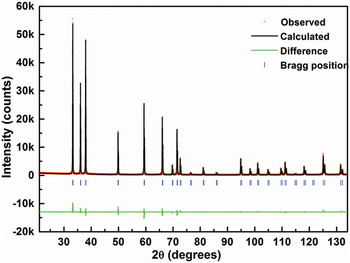
For Rietveld refinement, the initial structural model was built according to the space group of AlN P63 mc. The Al atom was set at (1/3, 2/3, 0) and the N at (1/3, 2/3, z/c), respectively. The z-parameter of the N atom was refined freely. By successively refining the parameters for the N atomic position and the isotropic temperature parameters, the isotropic Debye–Waller factors (B factors) of Al and N were converged to 0.442(12)and 0.559(33) Å2, respectively. The agreement factors converged to R p = 6.33% and R wp = 8.19%. The result of the final Rietveld refinement was plotted in Figure 2, and the final refined structural parameters and temperature factors were given in Table II.
(Color online) Rietveld refinement of the X-ray diffraction pattern of AlN. Red small points represent the experimental values, black solid line is the calculated pattern, green solid line is the difference between the experimental and calculated values, and blue vertical bars are the Bragg positions.

Final refined parameters from powder X-ray diffraction data of AlN, a = 3.111 39(1) Å, c = 4.978 43(3) Å, space group P63 mc, R p = 6.33%, R wp = 8.19%, and R exp = 3.66%.

Using the obtained temperature factors, the Debye temperature can be calculated according to the Debye approximation (Lu and Liang, Reference Lu and Liang1981). In the approximation, the temperature factor can be described as
 $$B=\displaystyle{{6h^2 T} \over {Mk\Theta _{\rm D}^2 }}\left\{{\phi \left(x \right)+\displaystyle{x \over 4}} \right\}$$
where B is the average temperature factor for Al and N, x = ΘD/T, ΘD is the Debye temperature, T is the experimental temperature, h is Planck's constant, k is Boltzmann's constant, M is the reduced atomic mass of Al and N, and ϕ(x) is the Debye integral function, which is defined as
 $$\phi \left(x \right)=\displaystyle{1 \over x}\vint_0^x {\displaystyle{y \over {e^y - 1}}} dy$$
By defining
 $$G=\displaystyle{{BMkT} \over {6h^2 }}$$
then Eq. (1) is reduced to
 $$\phi \left(x \right)+\displaystyle{x \over 4}=Gx^2$$
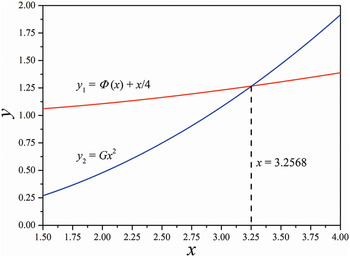
According to Eq. (3), the calculated value of G is 0.1196. Inserting G = 0.1196 into Eq. (4), and solving numerically the equation, as shown in Figure 3, we can get x = 3.2568. Then the Debye temperature can be obtained as ΦD = 971 K.
(Color online) Numerical solution for Eq. (4).

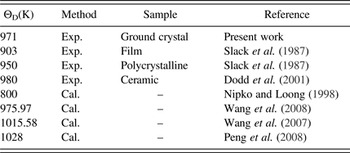
Our result together with other available experimental and theoretical calculation values of Debye temperature of AlN is summarized in Table III. As can be seen that our result of 971 K is in agreement with the results of 980 K (Dodd et al., Reference Dodd, Saunders, Cankurtaran and James2001), 975.97 K (Wang et al., Reference Wang, Cui, Yu and Chen2008), and 950 K (Slack et al., Reference Slack, Tanzilli, Pohl and Vandersande1987), but deviates from others. For the result of 903 K (Slack et al., Reference Slack, Tanzilli, Pohl and Vandersande1987), which is obtained by measuring surface acoustic velocity on the films prepared using metalorganic chemical vapor deposition (MOCVD) on sapphire, the existing stress and enhanced dislocation density because of the mismatch of lattice constants and thermal expansion coefficients between AlN and sapphire might be a source for underestimation. The result of 800 K (Nipko and Loong, Reference Nipko and Loong1998) corresponds to the Debye temperature at 0 K. The values of 1015.58 K (Wang et al., Reference Wang, Ai, Chen and Cai2007) and 1028 K (Peng et al., Reference Peng, Chen, Fu and Cheng2008) are calculated results by adopting the quasi-harmonic Debye model on the basis of the thermodynamic theory and the ideal crystal structure of AlN, which are quite close to our result.
Experimental and theoretical calculation values of Debye temperature.

By the way, we have also tried to obtain the Debye temperature by measuring the low-temperature specific heat of the AlN single-crystal samples. However, the deduced Debye temperature from the specific heat experimental result is 458.39 K, which is much lower than the reported data. The similar phenomenon was observed in measuring the Debye temperature of GaN (Song et al., Reference Song, Wu, Wang, Yuan and Chen2004). We think that the large underestimation is probably because of heat loss between the testing sample and sample holder.
IV. CONCLUSION
High-purity and -quality AlN sample were prepared by the PVT method. The Debye temperature of wurtzite AlN was determined by the Rietveld refinement method based on the room-temperature X-ray powder diffraction data. The refined lattice parameters are a = 3.111 39(1) Å, c = 4.978 43(3) Å; the refined positional parameter for N is z = 0.384 59(33) Å; and the refined temperature factors of Al and N were 0.442(12) Å2 and 0.559(33) Å2, respectively. Using these refined temperature factors, the Debye temperature has been evaluated as 971 K through the Debye approximation.
ACKNOWLEDGMENTS
This work is supported by the National Natural Science Foundation of China (grant numbers 51372267, 51210105026, and 51172270), the National Basic Research Program of China (973 Program) (grant no. 2013CB932901), and Chinese Academy of Sciences.
SUPPLEMENTARY MATERIALS AND METHODS
The supplementary material refered to in this paper can be found online at journals.cambridge.org/pdj.