1. Introduction
In engineering design, as stated by Onarheim, creativity and constraints are inevitably related.Reference Onarheim 1 According to the Oxford English Dictionary, constraints are limitations or restrictions. When designing new products, constraints are the main reason why creativity is needed and new solutions only emerge because of the identification of new constraints. But constraints are also often cited as the reason why creativity fails: in some cases, as in a mathematical problem, too many constraints can make it very hard to find a solution. So, do constraints hinder or foster creativity?
Despite a number of studies trying to identify why or which constraints can have a positive or a negative impact on creativity, previous literature provides no clear explanation for this dual link. Thus, we are left with the necessity to identify the hidden variable whose influence will determine when constraints will have a positive or a negative impact on creativity.
In this paper, we will support theoretically and empirically a new research hypothesis: the link between creativity and constraints is not determined by the type of constraints, but by the type of design model used.
To define what we mean by ‘design model’ we will consider recent developments in Design Theory, namely C-K design theory, which clarifies the distinction between two main design models:
-
(i) The innovative design model, which triggers ‘expansions’ and uses constraints to enhance creativity;
-
(ii) The rule-based design model, where constraints lead to a lock-in and to fewer innovations, or no innovation at all.Reference Hatchuel and Weil 2 , Reference Hatchuel and Weil 3
In the following we will characterize these two models using the notions and operators of C-K theory; and we will establish why they determine a positive or a negative relation between constraints and creativity. We will illustrate these mechanisms through the analysis of several product developments based on secondary sources and primary studies.
The next section is therefore a literature review, showing the undetermined relation between constraints and creativity in engineering design and our research hypothesis. We then present contemporary design theory through the framework of C-K theory, and explain how it predicts the two different impacts of constraints on creativity (see Ref. 2). After that, we present empirical material that supports these predictions: case studies in which product developments and engineering tasks face strong constraints. We conclude that the innovative design model and its associated form of reasoning should be taught and used extensively to foster the positive impact of constraints on creativity.
2. Literature Review: The Undetermined Relation between Constraints and Creativity in Engineering Design
In engineering design, we often refer to creativity as defined by Amabile: ‘creativity is the production of novel and useful ideas by an individual or small group of individuals working together.’Reference Amabile 4 She specifies that this definition is product-based, and novelty and usefulness of the product are evaluated. Creative ideas are described by Amabile as the building blocks of innovation. Therefore, we will here use creativity as the cognitive process that results in innovations. Furthermore, Amabile states that the highest level of individual creativity and highest innovation for organizations is reached in the intersection of resources, techniques and motivations. As stated by Rosso, following this construct of creativity means that constraints on resources and techniques should have a negative impact on creativity, reducing the innovative outcomes of the process.Reference Rosso 5 He furthermore states that constraints are also often described as reducing the ‘intrinsic motivation’, which also should have a negative effect on the outputs of the creative process.
Despite this, many papers in engineering design support the idea that constraints lead to innovations, insisting on the positive effect constraints have on creativity. Literature on frugal innovation,Reference Rao 6 on jugaad innovation,Reference Radjou, Prabhu, Ahuja and Roberts 7 and on resource constrained product development,Reference Sharma and Iyer 8 cites the lack of resources, an obvious type of constraint, as the main trigger for creative solutions. Authors defend that having fewer resources available forces them to disrupt existing solutions, since the lack of resources makes it impossible to adopt a regular solution. In these cases, the severity of the constraints, such as for instance dividing costs by 10 or 100, is often cited as what made them effective in triggering creativity. Keupp and Gassmann also support a positive influence of knowledge constraints in the creation of radical innovation, leading to the reuse of previously unused knowledge and to knowledge re-organization.Reference Keupp and Gassmann 9
The link between creativity and constraints in engineering design is therefore undetermined, and OnarheimReference Onarheim 1 speaks of a dual link between creativity and constraints, since constraints seem to have a positive and a negative influence according to the setting. Rosenzweig and Mazursky also show that constraints can both enhance and limit creativity.Reference Rosenzweig and Mazursky 10 According to their study, some constraints on knowledge can lead to improve innovativeness, but extreme knowledge constraints reduce the firm’s innovativeness.
2.1. Exploring the Causes of the Undetermined Link
Reasons for this dual link have been looked for in the nature of constraints. Several efforts to classify constraints and prove their contingent effects have been attempted, amongst others, by Lawson and Dorst.Reference Lawson and Dorst 11 Their classification is done according to three dimensions. The first dimension is the generator of the constraint, who can be the designer, the client, the user or legislators. The second dimension defines a constraint as being internal to the designed product or contextual. The third dimension separates between four types: functional, practical/technical, compositional or symbolic constraints. However, researchers found no evidence that the type of constraint was linked to a positive or negative influence on creativity.
Another hypothesis that has been tested without success is if being an individual or a team might be the explaining variable for the impact of constraints on the creative process. Researchers have also investigated the influence of the designer’s personality. However, OnarheimReference Onarheim 1 finds that the same designer can in one project perceive a type of constraint as enhancing his creativity, and in another project see the same type of constraint as limiting his options. Although RossoReference Rosso 5 observes that team dynamics seem to influence this link, he states the link is not direct, and that the team dynamics, which he classified as ‘enabling’ or ‘disabling’ dynamics, can evolve over time.
We can therefore state that the inconclusiveness of the existing literature reinforces the hypothesis that there may exist a hidden factor that affects the relationship between the outcomes of the creative process and constraints, as illustrated in Figure 1. This factor has not been identified so far; and previous studies seem to reject the idea that this hidden factor could be found in some typology of constraints. Our research has explored a different path. We will explain the dual link by the influence of a new type of variable, the type of design process that is used, which we call a design model.
Modeling the effect of constraints on creativity through the hypothesis of a hidden factor.

3. The Variable Impact of Constraints on Creativity: a Prediction of Design Theory
C-K design theoryReference Hatchuel and Weil 2 has been recognized as a general and rigorous theory of design reasoning. We will now establish that C-K design theory:
-
(i) predicts the dual link between constraints and creativity;
-
(ii) helps to identify two design models that determine a positive or a negative link between constraints and creativity.
3.1. Introduction to C-K Theory
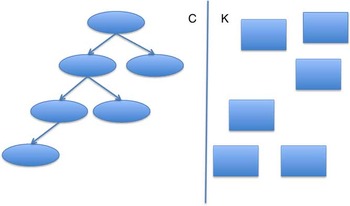
We hereby propose a quick introduction to C-K theory. In C-K theory we have two different spaces, a concept (C) space and a knowledge (K) space. The C space contains propositions that do not have a logical status, which means that they are undecidable in K, neither true nor false. The K space contains propositions with a logical status, which means that they are either true or false.Reference Hatchuel and Weil 3 The C-space is organized as a series of properties linked to an original concept in a tree-like fashion, while the K space is composed in an archipelagic way. A typical C-K representation is represented in Figure 2.
Example of C-K representation.

C-K design theory explains the specific properties of design by how the C and K space interact and expand through four different operators:
-
∙ From K to C – this interaction is called a disjunction, it creates new alternatives in C based on the properties of the K-space, creating a new concept
-
∙ From C to K – this interaction is called a conjunction, and it means that a concept has reached a state where it achieves a logical status, and therefore becomes part of the knowledge space. This operator signals a final design has been reached.
-
∙ From K to K – this interaction allows creating new knowledge from the existing knowledge, through deduction, modelling, optimization or evaluation
-
∙ From C to C – this interaction allows creating new concepts through partitioning or inclusion.
3.2. Constraints as Knowledge
Given these basic elements of C-K theory, it is easy to establish new implications of what is called ‘constraints’:
-
(a) Constraints in C-K theory are necessarily parts of the knowledge space, as they only have an impact if they are accepted as true. We will identify them as some K*. Seeing constraints as knowledge extends the classic perspective of constraints as restrictions; it tells us that any restriction also describes unknown knowledge domains. For instance, if a cost is limited to a maximum p, such proposition can also indicate that the whole set of things, services, or processes, whose cost is inferior to P is largely unknown to the designer. Thus, the constraints also act as a potential knowledge organizer preparing new K reordering.Reference Hatchuel, Weil and Le Masson 12
-
(b) Adding a new knowledge (K* in our case) in the K space can have different impacts both on the C and the K space, which directly predicts a complex influence.
-
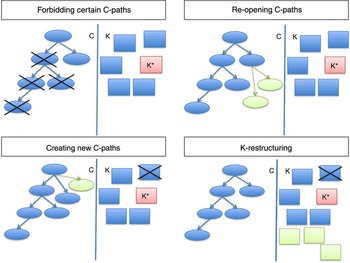
(c) In the C space, new knowledge can have three different impacts: (i) it can block a previous path, hence block a design candidate; (ii) it can create a new property, opening up a new path; and (iii) it can re-open a previously blocked or pending C path.
-
(d) In the K space, adding K* can lead to a K-restructuring, fostering the production of new knowledge or invalidating a given knowledge base, which will no longer be accepted as true.
These four types of impact are illustrated in Figure 3.
Effect of adding a new knowledge in the C and K spaces.

3.3. Defining Design Models as Enablers of Constraints’ Impacts: Rule-based Design and Innovative Design
We will now model the design reasoning when constraints are added in the C-K framework as described in two important currents inside design theories, rule-based design and innovative design. We find they have different approaches to constraints.
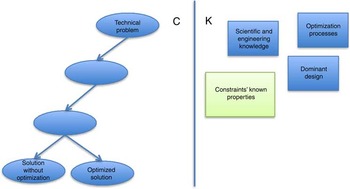
One example of rule-based design is systematic design, in which according to Pahl et al., ‘the main task of engineers is to apply their scientific and engineering knowledge to the solution of technical problems, and then to optimize those solutions within the requirements and constraints set by material, technological, economic, legal, environmental and human-related considerations.’Reference Pahl, Beitz, Bauert and Grote 13 This definition is modelled in Figure 4. Therefore constraints are seen as considerations that reduce the possible scope of solutions, since they are the borders and limitations needed to choose an optimum solution.
Modeling the approach of constraints in systematic design.

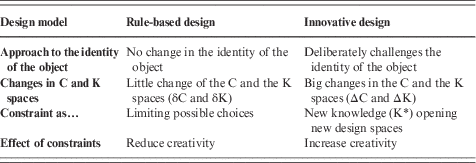
In rule-based design, efforts are often focused on exploring improvements of an existing product. The identity of the product, which is defined by the set of main properties of this product, is not challenged. So when a constraint in rule-based design forbids an important property of the product, this is limiting, since alternatives would challenge the identity of the product. In C-K theory this means only small changes in the C space (δC).
Another characteristic of rule-based design theories is that the goal is to propose solutions with a maximum reuse of existing knowledge.Reference Le Masson, Hatchuel and Weil 14 This means that any constraint that would demand an important creation of new knowledge to be overcome would also be limiting, since creating a lot of new knowledge is considered too costly. This means that there are only small changes in the K space (δK).
In innovative design theories, on the contrary, efforts are focused on challenging all the properties of the product and exploring a maximum of alternatives. As stated by Elmquist and Segrestin, in innovative design theories the identity of the product is deliberately challenged.Reference Elmquist and Segrestin 15 The introduction of new knowledge, even if it closes down a certain C-path, also leads to a challenge to other aspects of the identity of the product, and therefore opens up new paths. So this approach fosters creativity, since it forces the emergence of new knowledge and concepts once a constraint exists. When modelled in the C-K theory framework, we observe both big changes in the C and K spaces (ΔC and ΔK).
The two models and the different impacts of constraints on creativity according to the design model can therefore be summarized as in Table 1.
Identity of the object in the two design models and

We will test the proposed explanation through the study of products developed under constraints, in the next section.
4. Empirical Case Studies: How the Design Model Enables Increased Creativity through Constraints
In this section, we will describe two cases in which the authors participated in a resource constrained product development to show how the design reasoning affects the relationship between constraints and creativity. We will then model different innovative products, based on secondary sources, developed under different types of strong constraints to show that innovative design reasoning allowed fostering creativity independently of the type of constraint.
4.1. Designing a New Mobility System under Resource Constraints
In the first case, the authors had the opportunity, through intervention research from beginning of 2012 to the beginning of 2015, to accompany the development of mobility offers with a strong resource constraint.Reference Radaelli, Guerci, Cirella and Shani 16 This work took place in a public transport operator, eager to propose transport offers with radically lower costs. A research programme on ‘low cost products’ was launched inside the company, and a study of 50 different products yielded two different approaches to low cost, one following rule-based design theories and called ‘low cost adaptation’, the other one following innovative design theories, called ‘smart low cost design’.Reference Klasing Chen 17 Low cost adaptation started from an existing product and was aimed at maximizing cost reduction while minimizing customer utility reduction. Since this approach starts from an existing product, very few changes in its properties were proposed. Smart low cost design, in turn, starts from the functions to be fulfilled and a cost goal, and therefore all the properties of the product are still to be defined.
To allow the design of strong resource constrained mobility offers inside the operator, an oriented creativity workshop was organized. Participants were supplied with the two approaches to low cost and asked to develop products following them. We observed that both approaches were used, but that participants had difficulties proposing a coherent offer using rule-based design, following the ‘low cost adaptation’ strategy. This was the case since the resource constraint was too important. To preserve the identity of the object, participants were not allowed to change much in the structuring properties, which were also the main sources of cost. So the aimed cost reduction could not easily be achieved through this path. Although several small improvements were proposed, the final offer still had to have the same identity, and this strongly limited possible solutions. We saw that constraints were reducing creativity.
In the case of the ‘smart design low cost’, constraints on resources were seen as an opportunity to rethink some of the structuring properties with the highest cost. The constraint gave the actors a reason to discuss some of these properties, which in normal cases would not be challenged, and the innovative design reasoning and research for new knowledge allowed them to propose alternatives, leading to several different possible propositions, so constraints increased creativity by opening new design spaces.
4.2. Designing a New Cockpit under Certification Constraints
In the second case study, one of the authors accompanied an intervention researchReference Radaelli, Guerci, Cirella and Shani 16 inside an aeronautics system assembler during 2014, during the development of a cockpit under strong resource constraints.
The development through a rule-based design was impossible and highlighted a previously hidden constraint that blocked most innovations on the cockpit: the cockpit had to be certifiable, and this imposed a very specific set of technologies and procedures to build the cockpit. Adding a constraint on resources blocked that path. An effort was therefore made to apply innovative design reasoning, and to try to open up new paths. By using the constraints as an opportunity to discuss certification, it was possible to propose new paths, such as a re-discussion of certification or the launch of non-certified objects. The use of these two design models and their results is illustrated in Figure 5, where we can observe how the innovative design model allowed creativity to be increased.
Comparing a rule-based and an innovative design reasoning model applied to the low cost cockpit.

4.3. Designing a Wheelchair under Multiple Constraints
Another product with several types of constraints was a low-cost, all-terrain, level propelled wheelchair proposed by Winter.Reference Winter 18 This was not only a resource constrained object, but also a functionally constrained object: the chair had to be adapted to rough terrain and to tight spaces, to be repairable anywhere and to provide the user with comfortable mobility during the whole day. Following a rule-based design reasoning, the different constraints can be answered independently. Comfortable mobility during the whole day is provided by electric wheelchairs, rough terrain wheelchairs have been developed with bigger wheels and a heavier chair body, and simpler wheelchair models can be repaired more easily.
However, combining all of these constraints with a resource constraint and staying in a rule-based design model (which means not changing the main properties of a wheelchair) leads to a dead end. In this case, too many constraints do not leave any places for designers to work. However, by employing an innovative design reasoning, designers searched for new knowledge both on the context for which the chair was being developed, on the usage and on the user’s ergonomics, as well as on mechanics. This new knowledge allowed proposing new properties for the wheelchair and developing an entire new C-path. The work done is modelled in a simplified C-K in Figure 6.
Modelling the rule-based and innovative design of an all-terrain low cost wheelchair.

4.4. Designing an Infant Warmer under Multiple Constraints
A further example of innovative product build under constraints is a recurrent example when discussing jugaad or frugal innovation: Embrace, described by Radjou et al.Reference Radjou, Prabhu, Ahuja and Roberts 7 as a portable infant warmer costing less than 2% the cost of a classical incubator. This product, like the all-terrain wheelchair discussed previously, integrated multiple constraints. As described by Radjou et al.,Reference Radjou, Prabhu, Ahuja and Roberts 7 it integrated strong resource constraints; the need for portability; a constraint on the technology used, which had to work even with unreliable electrical power; and a constraint on usage, i.e. the product had to be operable without specialized training. The great number of constraints imposed here, made it impossible to propose a solution with the properties found in existing products, following rule-based design.
Through the innovative design model, however, designers were able to completely rethink the product, and to propose a sleeping-bag-like device. It is very simple to use, having only one ok/not ok indication, so it can be operated by the infant’s parents at home. This completely changed usage and customers of the product. And it relies on a different technology, a phase-change material, which does not need constant electrical power.
The infant warmer is a good opportunity to compare the impact of different constraints in an innovative design regime, since another resource-constrained infant warmer, the Lullaby, had been launched by GE some years ago.Reference Ramdorai and Herstatt 19 An innovative design approach was also used, and the constraints were faced as opportunities to explore new C-paths. However, this infant warmer did not have an as strong resource constraint (it was priced 70% cheaper than other models) and had no constraint on needing constant electrical power. Therefore, the developed warmer was still adapted to hospitals only and not for home-use. Due to the fact that this warmer did not challenge all the properties of the infant warmer, it has a smaller degree of innovativeness than Embrace, since it does not change the usage and the clients. We can therefore conclude that even following an innovative design approach, the level of innovativeness can vary. The main difference between the constraints on the two products is how far they challenge the identity of the object. In the case of Lullaby, there is no strong constraint on the technology or on the usage. Therefore the exploration led to an innovation that is less of a breakthrough than Embrace.
The launch of a further product, Lullaby Warmer Prime, this time aimed at another segment, mostly small clinics instead of hospitals, shows that the innovativeness, in the case of constraints that do not challenge the identity of the object so strongly, depends on the cognitive resources employed and the expansion in knowledge that is sought.
4.5. Main Empirical Findings: Increasing Creativity through the Innovative Design Model
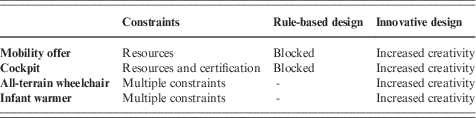
All these cases illustrate the impact constraints on a product can have on the creative process: they show how constraints can be opportunities when using an innovative design reasoning, and how they are mostly limiting in a rule-based design. Our four cases are summarized in Table 2, where we show the effects of the applied design models.
The four studied cases, the type of constraint and the effects of the two design models.

As we can observe in Table 2, constraints can be used to foster creativity through the innovative design model. We will now discuss these results in the C-K framework.
5. Discussion and Conclusion: Design Models as Strategies on Heredity and Knowledge Creation
In this article, we used the C-K theory to model the effect of constraints on creativity. We hypothesized that the dual link between constraints and creativity could be explained by a hidden variable: the design model.
Through our studied cases, both the empirical one and those based on the literature, we can conclude that constraints will block creativity when two aspects are reunited:
-
(i) C has a fixed structure, which means that we are not allowed to open paths in C that are far from the identity of the object, past design having an important influence;
-
(ii) little new knowledge (K) is created.
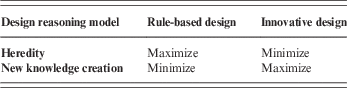
This means that the impact of constraints depend of two aspects: heredity or the importance given to past design, and the cognitive resources employed in searching for new knowledge and disjunctions from this knowledge leading to new concepts. The two design models proposed here – rule-based and innovative design – differ in these two aspects, as can be seen in Table 3.
Different approaches of heredity and new knowledge creation in the two design models.

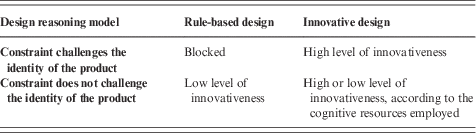
In some cases however, the constraint does not challenge heredity in rule-based design, which means that alternatives can be proposed respecting the identity of the object. In these cases, as was seen in the definition given by Pahl et al.Reference Pahl, Beitz, Bauert and Grote 13 and modelled in Figure 4, the outcome will be a product with a lower level of innovativeness.
And in the case of innovative design, constraints that challenge the identity of the product foster creativity and lead to higher innovation levels. For a constraint that does not challenge the identity of the object, the impact of the constraint depends on the cognitive resources employed. Despite the fact that creativity is fostered by the constraints in an innovative design model, when the constraint impacts properties that are less structuring for the object’s identity, there is no need to generate high levels of innovation to find a suitable answer. The degree of innovativeness therefore depends on the cognitive resources employed. If the research for new knowledge is extensive, these constraints can lead to high levels of innovation. If the research for knowledge is focused on finding a ‘quick-win’ solution, the level of innovativeness will be lower. These results are summarized in Table 4
Impact of the two design regimes according to the challenge of the constraints.

.
5.1. Further Research
Our research allowed us to show that the design model has an influence on the link between constraints and creativity in engineering design, and we therefore contribute to a gap in the literature on the explanations of the dual link between them. We furthermore found reason to believe that it is whether or not constraints challenge the identity of the product that impacts the innovativeness of the creative reasoning outcome. A limitation of our research is that it is based on only four cases and is not exhaustive, it would be enriching to follow the creative process in more cases and to verify the exactitude of the exposed link.
Furthermore, in the studied cases, we mainly studied the impact on the creative process outcome of constraints on the final product. However, constraints can also exist on the design process itself, not only on the product. Hoegl et al. evaluated the impact of financial constraints on innovation projects, and identified five different factors that can lead to inhibiting or enabling innovation project performance: a bounded creativity approach, leveraging domain relevant skills, engaging objectives, team cohesion and team potency.Reference Hoegl, Gibbert and Mazursky 20 Although we find evidence that limiting cognitive resources can have an impact on creativity in an innovative design approach, a similar study should be done on evaluating other kinds of constraints on the design process. This would fill another research gap, the impact of constraints on the design process on creativity.
Finally, one of the managerial implications of this work is showing how different design reasoning can be introduced to overcome situations in which constraints block creativity. We only studied two cases of creativity blocking coming from the rule-based design reasoning used, and in both cases using innovative design reasoning was the chosen solution. It would be interesting to add other cases to this, to verify our findings.