


Retrospective evaluations of the state of the economy shape voters’ decisions to support or reject incumbent politicians. This is desirable from the perspective of democratic accountability, as the economy provides voters with a shorthand for evaluating the performance of incumbent politicians and hence for punishing and rewarding them (Ashworth Reference Ashworth2012; Healy and Malhotra Reference Healy and Malhotra2013). Scrutinizing whether and how voters engage in economic voting is therefore important to further our understanding of a key mechanism for keeping governments in check.
After having been among the most established and successful explanations of electoral behavior, retrospective economic voting has been challenged by theories of motivated reasoning. In essence, this perspective argues and shows empirically that rather than casting their votes based on the government’s economic performance, voters typically interpret economic performance or attribute responsibility selectively based on their political preconceptions, most importantly their partisanship (Bartels Reference Bartels2002; Evans and Pickup Reference Evans and Pickup2010; Tilley and Hobolt Reference Tilley and Hobolt2011; although see Lacy and Christenson Reference Lacy and Christenson2017). This has in turn raised the question of how, if at all, voters acquire neutral economic information with which to hold governments accountable. A recently emerged strand of research suggests that voters might look to economic conditions in the local residential context when evaluating the incumbent government.
Contrary to abstract national economic aggregates (e.g., GDP or unemployment rates), which they receive in the form of mass-mediated—and politically disputed—information (Soroka Reference Soroka2006; Soroka, Stecula, and Wlezien Reference Soroka, Stecula and Wlezien2015), voters can gauge (local) economic conditions “au natural” from various direct and more subtle cues in their residential setting. Residing in local areas with lower unemployment, busier stores, and other indicators of an improving economy provides voters with a relatively unbiased signal that the economy is doing well, and that the sitting government is therefore worth reelecting (e.g., Reeves and Gimpel Reference Reeves and Gimpel2012).
This type of local economic voting might counterbalance or sometimes even dominate the importance of partisanship in shaping economic percepts (Dickerson and Ondercin Reference Dickerson and Ondercin2017), and has consequently been given considerable attention in the literature.Footnote 1 However, the findings have generally been inconclusive. For example, recent work from Hansford and Gomez (Reference Hansford and Gomez2015) and Healy and Lenz (Reference Healy and Lenz2017) has found that county-level unemployment rates, as well as the number of loan delinquencies in local areas, shape support for national incumbents in the USA. At the same time, Hill, Herron, and Lewis (Reference Hill, Herron and Lewis2010) and Wright (Reference Wright2012) find small or insignificant effects of county-level unemployment rates on support for the incumbent president (see also Hall, Yoder, and Karandikar Reference Hall, Yoder and Karandikar2017).
The increased attention paid to the role of local economic conditions in the economic voting literature parallels a resurgence in the study of effects of local residential contexts more generally in the political behavior literature (e.g., Enos Reference Enos2016; Hopkins Reference Hopkins2010). Two key insights stand out from recent studies within this line of research. First, concrete everyday exposure to different social phenomena in the immediate residential context—in neighborhoods or even more locally—is a crucial mechanism underpinning local context effects (Dinesen and Sønderskov Reference Dinesen and Sønderskov2015; Enos Reference Enos2016; Hjorth Reference Hjorthforthcoming; Moore and Reeves Reference Moore and Reevesforthcoming). Second, such local experiences are more consequential for political attitudes when they are more salient in the minds of citizens—something typically attributed to the priming influence of news media coverage, often ignited by focusing events (Davenport Reference Davenport2015; Hopkins Reference Hopkins2010; Legewie Reference Legewie2013). In other words, existing research indicates that the local context matters for political behavior, but more so when experienced very locally and when salient to its inhabitants. However, these innovations have eluded most previous studies of local economic voting, which have focused on across-the-board effects of local economic conditions measured in aggregate contextual units (though see Bisgaard, Dinesen, and Sønderskov Reference Bisgaard, Dinesen and Sønderskov2016; Healy and Lenz Reference Healy and Lenz2017; Simonovits, Kates, and Szeitl Reference Simonovits, Kates and Szeitlforthcoming). Consequently, some of these studies may have overlooked the elusive, yet important, effect of local economic conditions on incumbent support.
In this article, we incorporate these new insights from the wider context literature to the study of local economic voting. In so doing, we provide two distinct contributions. First, we offer a theoretical framework for understanding when local economic conditions matter for incumbent support. Drawing on insights from political psychology regarding voters’ limited attention span, we argue that local economic conditions, like other politically relevant considerations, must be made salient—primed—in order to influence voters’ evaluation of government performance. However, unlike national economic conditions, which are typically made salient vertically—“top-down”—by political actors through the news media (Hart Reference Hart2013), we suggest that specific features of the local economy can be primed by voters’ own interactions with the local economy. For instance, voters may become more attuned to the state of their local housing markets when buying or selling a home. This horizontal process—which we refer to as “context priming”—is an important theoretical addition not only to the study of economic voting, but to the study of political behavior in general, which has traditionally conceptualized priming exclusively in terms of top-down influences. On a substantive level, our conditional theory of local economic voting provides an explanation for why local economic conditions only sometimes factor into vote choice, and thus helps resolve the tension between positive and null findings in the existing literature.
Second, we leverage a research design and data that are close to optimal for testing the proposition that local economic conditions shape support for national governments. More specifically, we focus on local housing markets, which was a salient feature of local economies in the period under study (the housing boom and bust around the Great Recession) and therefore likely to provide a basis for local economic voting. Following recent innovations in the economic voting literature (Healy, Persson, and Snowberg Reference Healy, Persson and Snowberg2017), we use comprehensive and highly granular registry data from Denmark on both individuals and local contexts. This allows us to measure housing markets that are geographically smaller and thus make for more accurate reflections of individuals’ local experiences compared to almost all previous studies that use (much) more aggregate contextual units (for an exception, see Bisgaard, Dinesen, and Sønderskov Reference Bisgaard, Dinesen and Sønderskov2016). Furthermore, these data enable us to examine the context priming hypothesis by subsetting our analyses by individuals’ interactions with this aspect of the local economy—a behavioral indicator of its salience.
We examine the relationship between local housing market activity and incumbent government support in Denmark using two complementary empirical approaches. First, we link data on local housing prices to election results at the precinct level across four national elections, allowing us to study whether increased housing prices are followed by an increased support for parties in government in precincts (i.e., a difference-in-differences approach). Second, to test the hypothesized causal relationship more rigorously, we zoom in on individual voters’ local contexts. Specifically, we link a two-period panel survey to precise and flexible measures of survey respondents’ local housing markets.
We find the hypothesized positive relationship between local housing prices and support for governing parties at both the precinct level and the individual level. We estimate that a 50% year-on-year increase in local housing prices, equivalent to some of the largest price increases of the pre-crisis housing boom, is associated with a one to two percentage point increase in electoral support for the sitting government. Further, the effect of local housing prices is largely independent of indicators of financial self-interest in local housing markets, suggesting that the observed local economic voting is primarily driven by sociotropic motives. Supporting our context priming hypothesis, we show in the precinct level data that voters respond more strongly to local housing prices in areas where housing markets are more active and therefore likely to be more salient to voters. Similarly, at the individual level, the effect of local housing prices is much larger for voters who have recently moved or who will soon be moving—a group of voters who are plausibly more attuned to local housing markets. Taken together, the results suggest that voters respond to changes in local housing prices not because it changes their policy preferences or their own economic situation narrowly conceived, but because they rely on the state of their local housing market as a signal of their incumbent’s performance, especially when this signal is salient to them.
WHEN LOCAL ECONOMIC CONDITIONS AFFECT INCUMBENT SUPPORT
The rationale underlying retrospective economic voting is that voters reward or punish incumbents based on their economic performance. While egotropic pocketbook concerns are not absent in voters’ calculi (Healy, Persson, and Snowberg Reference Healy, Persson and Snowberg2017; Tilley, Neundorf, and Hobolt Reference Tilley, Neundorf and Hobolt2018), the primary metric for evaluating the incumbent government is the state of the national economy (Kinder and Kiewiet Reference Kinder and Kiewiet1979; Lewis-Beck and Stegmaier Reference Lewis-Beck and Stegmaier2013). This in turn raises the second-order question of how voters form perceptions of the national economy—a highly abstract concept—on which to base their evaluation of incumbents’ economic stewardship.
Recent research indicates that voters may rely on local economic conditions as a shorthand for evaluating the national economy (e.g., Reeves and Gimpel Reference Reeves and Gimpel2012) and in turn the performance of the sitting government (Healy and Lenz Reference Healy and Lenz2017; Simonovits, Kates, and Szeitl Reference Simonovits, Kates and Szeitlforthcoming). Exposure to local cues about the state of the economy may stem from both direct, personal involvement with the local economy through activities such as a job search or buying or selling a home, and more indirect casual observation of changing supermarket prices, shuttered stores, or job postings (Ansolabehere, Meredith, and Snowberg Reference Ansolabehere, Meredith and Snowberg2012). As Popkin (Reference Popkin1994, 24) notes, “[p]olitical information is acquired while making individual economic decisions and navigating daily life: shoppers learn about inflation of retail prices; home buyers find out the trends in mortgage-loan interest rates (…)” (see also Fiorina Reference Fiorina1981, 5). In short, the local context embodies information about the state of the national economy that voters might use when evaluating the incumbent government.
Here, we study voter responses to a rarely examined, yet, in our opinion, highly relevant local economic quantity: housing prices. Essential for our purposes, the trends in local housing markets are highly visible through, for example, the frequency of “for sale” signs and the turnaround time of homes for sale in the area. These subtle cues are likely to be reinforced by direct information from conversations with neighbors over selling prices and the like. We argue that rising local housing prices—similar to other positive economic indicators (e.g., decreasing unemployment)—are interpreted by voters as a sign of an improving economy, for which they reward the sitting government. When residents in a local area experience a positive shock to housing prices, their wealth increases, and, because their home becomes a more valuable collateral, so does their ability to borrow and spend. These gains dissipate beyond homeowners as increased spending leads to higher local employment, a better environment for local businesses, and more robust tax revenues that can be translated into better public services and lower tax rates (Miller, Peng, and Sklarz Reference Miller, Peng and Sklarz2011). In this way, rising local housing prices can be considered a leading indicator of economic growth and prosperity (Lettau and Ludvigson Reference Lettau and Ludvigson2004). Moreover, rising local housing prices signal to voters that they live in a desirable area that will become increasingly attractive over time from being populated by more resourceful individuals (Chetty, Hendren, and Katz Reference Chetty, Hendren and Katz2016).
While we believe there are good arguments for expecting a positive effect of rising local housing prices on incumbent support, insights from the national economic voting literature could lead to the opposite prediction. More specifically, parallel to economy-wide price increases, it could be argued that increased local housing prices is a form of inflation, and therefore signals an increased cost of living that voters punish the sitting government for (Palmer and Whitten Reference Palmer and Whitten1999). We are skeptical of this argument. Unlike most goods and services affected by a general price increases (e.g., groceries), voters do not routinely buy housing, meaning that for most people, the cost of living does not increase with rising housing prices.Footnote 2 However, while we expect increases in local housing prices to have a positive effect on support for the sitting government, the direction of the effect is ultimately an empirical question.
A number of previous studies have examined voters’ responsiveness to various local economic conditions, typically local unemployment, but in some cases supplemented by other local features such as the number of loan delinquencies (Healy and Lenz Reference Healy and Lenz2017) or gas prices (Reeves and Gimpel Reference Reeves and Gimpel2012). One set of studies examine the direct link between local economic conditions and support for incumbent politicians (e.g., Eisenberg and Ketcham Reference Eisenberg and Ketcham2004; Healy and Lenz Reference Healy and Lenz2017; Johnston and Pattie Reference Johnston and Pattie2001; Wright Reference Wright2012), while another looks at whether various features of the local economy shape voter perceptions of the national economy, which is then expected to shape voters’ assessment of the government (Anderson and Roy Reference Anderson and Roy2011; Ansolabehere, Meredith, and Snowberg Reference Ansolabehere, Meredith and Snowberg2014; Books and Prysby Reference Books and Prysby1999; Hall, Yoder, and Karandikar Reference Hall, Yoder and Karandikar2017; Reeves and Gimpel Reference Reeves and Gimpel2012). Studies from both strands of the literature yield inconsistent results finding either small or no effects of local economic conditions on a given outcome.
Common for most of the previous studies is a focus on very aggregate “local” contexts (for exceptions, see Bisgaard, Dinesen, and Sønderskov Reference Bisgaard, Dinesen and Sønderskov2016; Healy and Lenz Reference Healy and Lenz2017; Simonovits, Kates, and Szeitl Reference Simonovits, Kates and Szeitlforthcoming). Even comparatively disaggregate local contexts such as census tracts in the USA are often geographically vast and therefore at best imprecise proxies for local experiences (Dinesen and Sønderskov Reference Dinesen and Sønderskov2015; Moore and Reeves Reference Moore and Reevesforthcoming). This compromises the ability of these studies to get at the purported mechanism of experiential learning from the local context. Further, because aggregate contexts often overlap with local media markets, any effect may in fact be confounded with mass-mediated information (Books and Prysby Reference Books and Prysby1999; Reeves and Gimpel Reference Reeves and Gimpel2012; Soroka Reference Soroka2006). We bring the study of local economic voting closer to the proposed mechanism of local experiential learning by studying economic conditions, specifically housing markets, in very local contexts.
In summary, and in keeping with the existing literature, we thus expect local housing prices to factor into citizens’ retrospective evaluations of the incumbent national government. More specifically, we hypothesize:
H1 (Local economic conditions hypothesis): When local housing prices increase, individuals are more likely to support the incumbent government.
In addition to the local economic conditions hypothesis, we theorize when exactly local economic conditions matter for voters’ support for the incumbent government. Drawing on insights from political psychology, we argue that citizens factor in specific aspects of the local economy in their evaluation of the incumbent government based on how cognitively salient that aspect is to them. Specifically, we propose that the aspects of the local economy to which citizens have been exposed more frequently and more recently are more likely to figure as salient “top-of-mind” considerations (Zaller Reference Zaller1992). The concept of priming in political psychology provides an instructive parallel to our theoretical reasoning in this regard. In this literature, media coverage of particular political issues makes these issues more salient to voters, and, as a result, they carry more weight in voters’ evaluation of the incumbent government (Iyengar and Kinder Reference Iyengar and Kinder1987; Iyengar, Peters, and Kinder Reference Iyengar, Peters and Kinder1982; Krosnick Reference Krosnick1990; Krosnick and Kinder Reference Krosnick and Kinder1990). Following this line of work, we refer to the priming of local conditions as “context priming.”Footnote 3
In studying context priming, we follow in the footsteps of earlier work examining how national focusing events can prime the importance of local conditions (e.g., Hopkins Reference Hopkins2010; Legewie Reference Legewie2013). However, in contrast to this body of work, which emphasizes priming as the result of top-down processes—specifically, mass media coverage ignited by national-level developments or shocks such as terrorism—we propose that context priming may also be the result of “horizontal” micro-level processes in the form of voter’s own interactions with that particular aspect of the local economy. More specifically, we expect that more frequent and more recent interactions with a particular aspect of the local economy can serve a priming function, prompting this aspect to feature more prominently in voters’ evaluation of the incumbent government. In our case, we expect increased exposure to local housing markets to sensitize citizens to this feature of the local economy when evaluating the incumbent government.
This leads to our second hypothesis, namely that the association posited in H1 is stronger where voters are primed to focus on local housing market through more intense exposure to this aspect of the economy:
H2 (Context priming hypothesis): The association between changes in local housing prices and support for the incumbent government is stronger when individuals are more exposed to local housing market activity.
The economic voting literature has not been silent on the conditional effects of national economic voting, but has hitherto predominantly focused on the moderating influence of political institutions (Duch and Stevenson Reference Duch and Stevenson2008; Larsen Reference Larsenforthcoming; Powell Jr and Whitten Reference Powell and Whitten1993). However, a more recent set of studies suggests that the extent of economic voting does not only vary by system-level institutional features, but also by features of individuals. These studies argue that certain individuals are more attuned to the national economy, either because they are more knowledgeable in general (Vries and Giger Reference Vries and Giger2014) or because they work in a sector of the economy where continued employment is (especially) contingent on good economic conditions (Fossati Reference Fossati2014; Singer Reference Singer2011, Reference Singer2013). Here, we surmise that something similar is at work for local economic voting: more pronounced exposure to local housing markets makes individual voters more attuned to this aspect of the local economy and therefore more inclined to use it as the basis of local economic voting.
More generally, our context priming hypothesis ties into several neighboring literatures. First, as already highlighted, our study builds on and adds to the growing literature on “context effects” exploring when political behavior and attitudes are shaped by local contexts (e.g., Enos Reference Enos2016; Hopkins Reference Hopkins2010). Second, it expands the scope of priming as traditionally understood within political psychology, and shows how this conception applies to an important field within political behavior research (economic voting). Third, in broader terms our study also adds to a recently emerged strand of research in political economy highlighting the influence of the housing market on distributional preference and vote choice (Ansell Reference Ansell2014; Stubager, Lewis-Beck, and Nadeau Reference Stubager, Lewis-Beck and Nadeau2013).
Substantively, our conditional theory of local economic voting might help explain why previous studies have found inconsistent results. If the impact of local economic conditions depends on the extent of citizen interaction with the local economy as hypothesized, and if the extent and intensity of voters’ relation with different facets of the local economy—whether this is housing, unemployment or gas prices–vary significantly across time and space, then we would expect specific types of local economic voting to emerge in some situations, but not in others.
Lastly, while our hypotheses are not contingent on pinning down voters’ exact motives for responding to local economic conditions, they are relevant to consider. As noted earlier, consistent with previous work on local economic voting we interpret support for the incumbent government based on local housing prices as a reflection of voters’ appreciation of the government’s handling of the economy in their local community and in the nation as a whole (sociotropic voting) (Anderson and Roy Reference Anderson and Roy2011; Healy and Lenz Reference Healy and Lenz2017; Reeves and Gimpel Reference Reeves and Gimpel2012; Simonovits, Kates, and Szeitl Reference Simonovits, Kates and Szeitlforthcoming). Yet, local economic voting may also reflect egotropic pocketbook considerations based on voters’ expected personal gain from a thriving local economy (see also the literature on patrimonial economic voting, e.g., Lewis-Beck, Nadeau, and Foucault Reference Lewis-Beck, Nadeau and Foucault2013). Attributing specific economic motives to voters is challenging (Kramer Reference Kramer1983), but our data allow us to gain some purchase on this by examining heterogeneous effects by various individual-level indicators of self-interest (e.g., being a homeowner; for a related approach, see Healy and Lenz Reference Healy and Lenz2017; Simonovits, Kates, and Szeitl Reference Simonovits, Kates and Szeitlforthcoming), and therefore we will return to the question of motivations in our analysis.
EMPIRICAL SETTING: LOCAL HOUSING MARKETS IN DENMARK
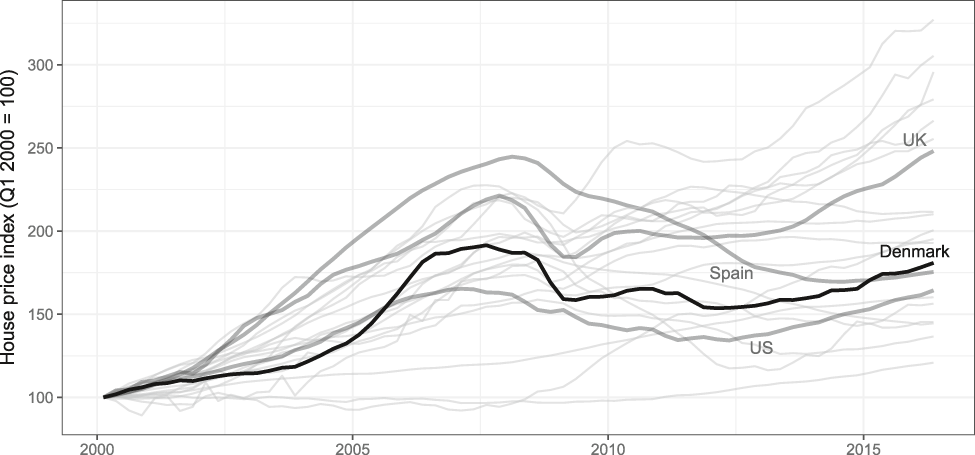
We study the effect of changes in local housing prices on support for the incumbent government in Denmark in the years surrounding the onset of the Great Recession. We focus on spatial variation in local housing markets in Denmark in this period because several features make them a plausible basis for local economic voting. First, housing markets saw a global boom followed by a bust in the period around the Great Recession—the timeframe in this study—with severe economic implications for well-being of both individual households and the overall state of the economy. Figure 1 shows the trajectory of Denmark’s housing bubble compared with other prominent international cases. Although many economies experienced large increases in real housing prices, Denmark’s housing bubble was exceptionally volatile, characterized by a late, rapid increase quickly succeeded by an equally rapid crash. Second, governments influenced the severity of the market crash to a considerable extent through housing and monetary policies (Dam et al. Reference Dam, Hvolbøl, Pedersen and Birch2011), which in turn makes housing markets a meaningful source of information about incumbent performance. Third, housing markets are not a monolithic national phenomenon, but vary substantially across geographical contexts, thereby providing voters with visible, locally specific information. These advantageous features of the Danish context are complemented by the availability of registry data (see below), which allow us to measure local housing market activity in exceptional detail. Collectively, this enables us to leverage a strong test of our hypotheses.
Trends in Real Housing Prices
Notes: Trends in real housing prices in Denmark (black line), Spain, the UK and the USA (dark gray lines) and selected other countries (light gray). Based on the international house price database maintained by the Dallas Fed. The authors acknowledge use of the dataset described in Mack and Martinez García (Reference Mack and Martínez-García2011).

Turning to the political context, the government in our period of study (2002–15) consisted of several different parties. From 2001 to 2011 the Liberal Party formed a right-wing government along with the Conservative Party, and from 2011 to 2015 the Social Democratic Party formed a left-wing government together with the Social Liberal Party and the Socialist People’s Party (the latter withdrew from the government in 2014). The fact that our study period covers governments led by parties from the center-left and center-right, respectively, is analytically advantageous as it enables us to differentiate local economic voting from other shifts in voter preferences. More specifically, because the policies exacerbating the housing bubble were introduced by the right-wing government holding office from 2001 to 2011, this renders support for the incumbent government observationally indistinguishable from voters becoming more ideologically conservative, a plausible consequence of increases in housing wealth (Ansell Reference Ansell2014), in this period. By exploiting the change in incumbency in 2011–15, we can ascertain whether changes in local housing prices affect support for any incumbent government rather than merely increased support for a right-wing government.
Previous studies have identified middling levels of economic voting in Denmark (Lewis-Beck, Stubager, and Nadeau Reference Lewis-Beck, Stubager and Nadeau2013) with effects of economic growth and unemployment being of approximately the same size as in other OECD countries (Larsen Reference Larsen2016). Some previous research has suggested that egotropic motivations are especially prevalent in Denmark (Nannestad and Paldam Reference Nannestad and Paldam1997). However, more recent research has challenged this conclusion, showing that to the extent that it is possible to disentangle the motivations underlying economic voting, sociotropic concerns dominate (Stubager et al. Reference Stubager, Botterill, Lewis-Beck and Nadeau2014).
RESEARCH DESIGN AND DATA
Methodologically, we advance the study of local economic voting by exploiting comprehensive and highly granular data on housing market transactions available in Danish public registries linked with both precinct- and individual-level panel data on national election outcomes. These data ameliorate three methodological challenges confronting previous studies of the role of local economic conditions.
First, by utilizing precise and highly local measures of housing prices drawn from public registries we address the common problem of confounding local contexts with local media markets. Distinguishing between the two influences is rarely possible due to data constraints; specifically focusing on local economic conditions in more aggregate geographical contexts, where local context and local media markets overlap (Bisgaard, Dinesen, and Sønderskov Reference Bisgaard, Dinesen and Sønderskov2016; Books and Prysby Reference Books and Prysby1999; Reeves and Gimpel Reference Reeves and Gimpel2012).
Second, and related to the previous point, measures of local economic conditions are often sample-based, which makes the estimation of conditions at lower geographical levels imprecise, thus causing attenuation bias in the estimated relationship with support for the incumbent government (Healy and Lenz Reference Healy and Lenz2017). We avoid such problems through the use of data for the full population, resulting in very precise measures of local housing prices.
Third, most previous studies have relied on cross-sectional data (e.g., Ansolabehere, Meredith, and Snowberg Reference Ansolabehere, Meredith and Snowberg2014; Books and Prysby Reference Books and Prysby1999; Reeves and Gimpel Reference Reeves and Gimpel2012). While such data are often the best at hand, they come with the risk of confounding a relationship between local housing prices and support for incumbents by structural economic differences (e.g., differences in industry composition) between local contexts. Using panel data, we can rule out confounding due to such time-invariant structural differences between local contexts by using only within-precinct/within-individual variation in local housing prices.
Some previous studies address some of these methodological challenges, but our study is, to the best of our knowledge, the first to address all of these at once. Below we present the two data sources we use to test our hypotheses.
Precinct-Level Data and Measures
We begin our analysis of the relationship between the state of local housing markets and incumbent support by looking at precinct-level election returns in Danish Parliamentary elections in 2005, 2007, 2011, and 2015. We match electoral support for parties in government in these precincts with change in the price of all house sales in the precincts’ zip code in order to examine the extent to which local housing prices and local electoral support for government parties go hand in hand.
The dependent variable in this analysis is percent of votes cast for government parties in electoral precincts. Each electoral precinct corresponds to a single polling place, which is the smallest unit at which voting returns can be observed in Danish elections. We measure this for all precincts in all four elections. There are roughly 1,400 precincts, each consisting of, on average, about 3,000 eligible voters and covering an area of 30 square kilometers.Footnote 4 Our focus on all government parties—rather than only the prime minister’s party—is motivated by research suggesting that a coalition partner might be punished electorally when it holds many important cabinet posts and prioritizes economic issues (Duch and Falcó-Gimeno Reference Duch and Falcó-Gimeno2014). This was indeed the case for both the Conservative and the Social Liberal Party, which served as coalition partners in our period of study. In particular, these parties were in control of the ministry responsible for financial regulation of the mortgage market. Further, while some researchers have found that the prime minister’s party is primarily held accountable for economic conditions (Debus, Stegmaier, and Tosun Reference Debus, Stegmaier and Tosun2014; Duch and Stevenson Reference Duch and Stevenson2008; Fisher and Hobolt Reference Fisher and Hobolt2010; although see Hjermitslev Reference Hjermitslevforthcoming), recent studies of local economic voting tend to include government coalition partners (Elinder Reference Elinder2010; Simonovits, Kates, and Szeitl Reference Simonovits, Kates and Szeitlforthcoming). However, as we show below, excluding coalition partners does not substantially alter the results.
We obtain data on the independent variable, local housing prices, from The Danish Mortgage Banks’ Federation (Realkreditforeningen), which publishes quarterly data on the average price per square meter of all sales at the zip code level, aggregated from registry data on individual sales.Footnote 5 We focus on changes in prices rather than price levels. This is motivated by the well-documented general tendency of human perceptions to be more responsive to changes in conditions than to absolute levels (Kahneman and Tversky Reference Kahneman and Tversky1979). It is also in keeping with the previous economic voting literature which, to the extent that it has looked at prices, has also focused on changes (e.g., Kramer Reference Kramer1971). At the local level, changes in housing prices will translate into shorter or longer turnaround times, as sellers and buyers try to adjust to the new prices, leaving visible traces of these changes in voters’ immediate context. More precisely, we measure changes in local housing prices as the percentage change in the price of houses sold in the quarter of a given election compared to the same quarter one year before. We choose this time frame to balance concerns that voters might not notice very short run changes, but at the same time behave relatively myopic when holding governments accountable (Healy and Lenz Reference Healy and Lenz2014). (For results using different lag specifications, see below.) We merge observations of house prices and incumbent support by assigning every polling station to the year-on-year price change in its zip code. Additional details on this assignment procedure can be found in Appendix A.
To test the context priming hypothesis, we measure local housing market activity by the number of trades in the zip code area (also based on data from The Danish Mortgage Banks’ Federation). This is premised on the assumption that a higher number of trades in the zip code area manifests itself in various visible ways, such as a higher number of “for sale” signs in the neighborhood or inhabitants moving in or out at a higher frequency, rendering local house markets more visible and ultimately more salient to voters. Because the distribution of the number of trades across zip codes is severely right-skewed, we take the natural log when applying it in our analysis.
Finally, in the statistical models we control for the unemployment rate, median income as well as growth in median income at the zip code level in order to isolate the effect of local housing markets from other features of the local economy. Like the independent variable, these are population-based measures calculated from public registries.
Individual-Level Data and Measures
Although the precinct-level data are comprehensive, our hypotheses concern individuals, and testing individual-level theories with aggregate-level data is fraught with problems of ecological inference. Hence, we also analyze individual-level data from a two-wave panel survey collected between 2002 and 2011. The first wave of the panel survey consists of respondents who participated in round 1 (2002/3), 2 (2004/5), or 4 (2008/9) of the Danish version of the European Social Survey (ESS), a nationally representative high-quality survey conducted biannually in most European countries.Footnote 6 The second wave of the panel consists of re-interviewed respondents from these three rounds. Specifically, the full sample of ESS rounds 1 and 4, and 40 percent (randomly sampled) of ESS round 2, were invited for a re-interview in the winter of 2011–12. In total, 1,743 people—equivalent to a retention rate of 47 percent—were interviewed in both waves.
From the survey, we use the following question as our dependent variable: “Which party did you vote for at the last parliamentary election?” For the analyses, we create a dummy variable indicating whether the respondent voted for a party in government at the time of the election as the dependent variable.Footnote 7
We measure the independent variable, local housing prices, using data from the national Danish population registers, which are linked to the survey via anonymized civil registration numbers. The registers contain very detailed information about all individuals legally residing in Denmark, including the exact geographical location of their residence, the price of any real estate they sell, and a range of other sociodemographic characteristics (Thygesen et al. Reference Thygesen, Daasnes, Thaulow and Brønnum-Hansen2011). Importantly for our purposes, the registers make it possible to calculate the distance between the residence of each of the survey participants and all other individuals in Denmark, and therefore, by implication, the distance to all individuals who are selling their home. We measure local housing markets in three different ways and thereby address concerns related to the modifiable area unit problem (MAUP)—a thorny issue within contextual research in general—by examining whether our findings are tied to a particular geographic aggregation of housing prices. First, and similar to the precinct-level data, we use the respondents’ zip code area, comparing housing sold within the same zip code a year apart. Second, we look at the prices of the 20 or 40 units of housing sold closest to the respondents own home, comparing the prices of housing sold in the immediate proximity of the respondent to that of housing sold one year earlier. Third, we look at the price of housing sold within a fixed radius of 1,000 or 1,500 meters of the respondent. These latter ways of defining the respondents’ residential contexts have the benefit of being centered on the respondent, alleviating the problem that the context of a respondent living far from the centroid of one zip code might be better represented by an adjoining zip code. Note also that these latter two operationalizations of residential context differ in important ways: whereas the first method takes the number of sales as fixed, but varies the geographical dispersion of these sales, the second method holds geographical dispersion fixed, but varies the number of sales.Footnote 8
More specifically, our independent variable is again year-over-year changes in housing prices in the residential context of the respondent. We measure the change by comparing the price of housing sold in the quarter prior to the data collection and the price of housing sold in the same quarter a year earlier. Unlike for the precinct-level data, we do not have data on prices per square meter. This makes the individual-level housing price change variable more sensitive to random variation in the types of housing put up for sale in the two time periods we compare. As such, year-to-year changes in prices may partly reflect that larger or better houses were put up for sale in a given year. To take this and other structural differences in the type of housing put up for sale into account, we divide the sales price of each unit of housing by its public valuation before calculating the year-over-year change.Footnote 9
Lastly, for evaluating the context priming hypothesis, we develop a measure of individual-level exposure to the local housing market. Using data from the public registries, we measure whether a given respondent moved within six months before or after being surveyed (taking the value of one if respondents move within this period of time and zero otherwise). Recent or soon-to-be movers are by definition exposed to local housing markets, and as such, this indicator constitutes an ideal behavioral measure of salience of this aspect of the local economy. Using a behavioral measure, we bypass well-known problems of conflating various aspects of issue importance associated with using traditional survey-based “most important problem” measures (Wlezien Reference Wlezien2005).
We also include a number of additional variables in the analysis for statistical control, interaction analyses, and placebo tests. We present these as we use them in the analysis.
PRECINCT-LEVEL EVIDENCE
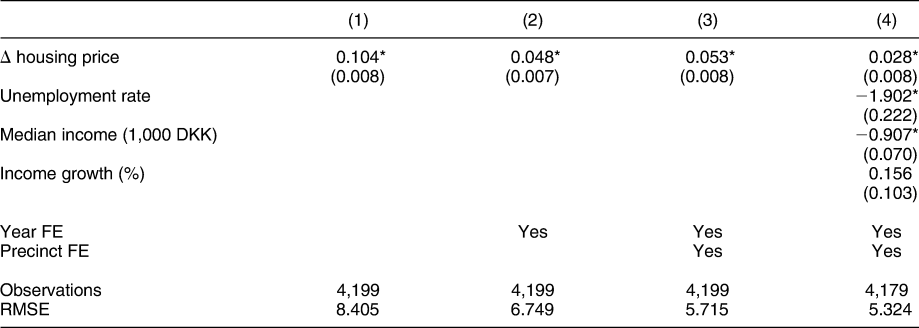
Table 1 evaluates the local economic conditions hypothesis—that voters reward (punish) the incumbent government for increases (decreases) in local housing prices—by means of a set of linear regression models. The table presents the estimated effect of year-over-year changes in local housing prices on electoral support for the parties in government. To account for serial within-precinct autocorrelation, all models are estimated using standard errors clustered at the precinct level. Model 1 is a simple linear regression of electoral support on changes in housing prices. Model 2 includes year fixed effects, holding trends in incumbent support and rates of housing price change constant. Model 3 adds precinct fixed effects to this specification, thus constituting a difference-in-differences model that evaluates whether incumbent support increases more in precincts where housing prices increase more. In Model 4, we add the zip-code-level unemployment rate, median income, and median income growth as covariates, thereby controlling for overall trends in the precincts’ economic situation. In line with previous literature (e.g., Kramer Reference Kramer1971), we include median income and the unemployment rate as levels; however, as we show below, the results are robust to including the variables as changes.
Estimated Effects of Housing Prices on Electoral Support for Governing Parties

Standard errors in parentheses.
*p < 0.05.
Across the four models, we observe a statistically significant positive relationship between changes in housing prices and support for the incumbent. In other words, consistent with the local economic conditions hypothesis, a larger fraction of the electorate casts their vote for governing parties in precincts where housing prices are increasing more.
Unsurprisingly, the effect of housing prices is larger in the less restrictive models. The effect is reduced from 0.10 to 0.05 when introducing the time and precinct fixed effects, and drops additionally to 0.03 when introducing the economic controls. This highlights the strength of using a difference-in-differences approach and controlling for detailed information about other aspects of the local economy, as this evidently picks up important sources of confounding. In substantive terms, a coefficient of 0.03 implies that when the price of housing sold in a precinct’s zip code area increases by two standard deviations (equal to an increase of around 29 percentage points) electoral support for governing parties increases by roughly 0.8 percentage points. This is a modest but non-negligible effect. While it is hard to make straightforward comparisons to existing work because results have been so inconsistent, this effect is on the small side compared to the estimates in Healy and Lenz (Reference Healy and Lenz2017). They find that moving from the 0.1st to the 99.9th percentile in local economic conditions (i.e., wage growth and loan delinquencies) increases incumbent support between seven and nine percentage points. A comparable change in our housing price variable increases incumbent support with 3 percentage points.
Focusing on the remaining variables in Model 4, we find that the local unemployment rate is significantly negatively related to incumbent support, consistent with the local economic conditions hypothesis. This suggests that different aspects of the local economy matter independently of each other, rather than reflecting the same underlying economic conditions. Although not statistically significant, income growth is positively associated with incumbent support as we would expect from a local economic voting perspective. More unexpectedly, median local income is significantly negatively related to incumbent support. While this indicator has not been used in the existing literature, we would expect median local income to signify economic improvement and therefore expect a positive relationship. Future work might scrutinize this variable in more detail.
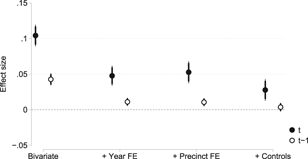
Despite a rigorous control strategy, a potential threat to our results is that the effect of local housing markets on support for incumbents is a reflection of some unrelated trend predating changes in housing prices—i.e., that governing parties were already becoming more/less popular in places where housing prices eventually increase/decrease. To address the plausibility of this parallel trends assumption, we estimate the same type of models as in Table 1 using support for the governing parties at the previous election as the dependent variable (i.e., a lagged dependent variable). A significant relationship between prior support for incumbents and subsequent rises in housing prices would indicate that the parallel trends assumption is violated. We plot the estimated effects of housing prices on the lagged dependent variable as well as on the actual dependent variable in Figure 2. The figure shows a significant effect of housing prices on the lagged dependent variable in the less restrictive models. However, in the final and most restrictive model, the estimated effect of housing prices on lagged incumbent support is 0.005—less than a sixth of the effect estimate for subsequent support—and statistically insignificant. This indicates that pre-treatment trends in treated and non-treated units are likely parallel.
Effects of Housing Prices on Support for Governing Party at the Present Election (t) and the Last Election (t-1)
Notes: Estimates with 90 and 95% confidence intervals.

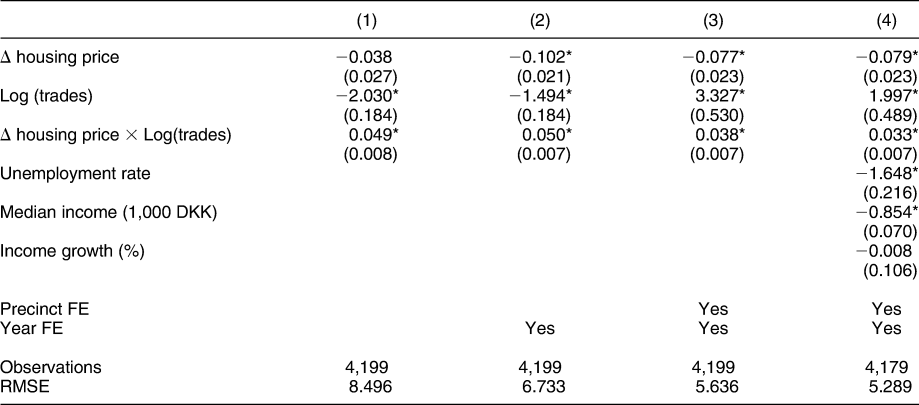
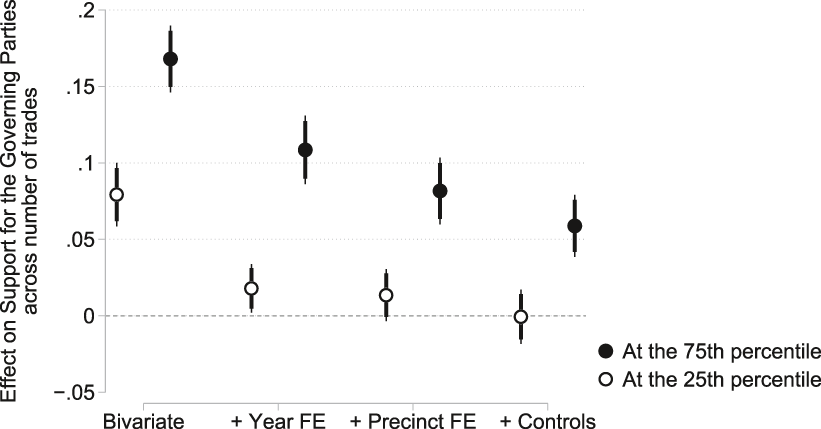
We proceed to evaluate the context priming hypothesis, testing whether the relationship between changes in local housing prices and incumbent support is contingent on local housing market activity. Table 2 reports a set of models similar to those presented in Table 1, but with changes in housing prices interacted with the (logged) number of trades in the preceding quarter as an indicator of housing market activity. Consistent with the context priming hypothesis, we observe a statistically significant positive interaction between local housing prices and housing market activity in all models. That is, local housing prices are more strongly related to incumbent support in areas with higher levels of housing market activity.
Estimated Effects of Housing Price Across Number of Trades

Standard errors in parentheses.
*p < 0.05.
Since interaction models can be difficult to interpret based on reported coefficients alone, we visualize the result in Figure 3. For each model specification, the figure shows the predicted effect of local housing prices on incumbent support for zip code area economic activity corresponding to the 25th and 75th percentile. Focusing on the most restrictive model, the most notable result is that there is essentially no effect of local housing prices at the bottom 25th percentile of local housing market activity, while the effect is about twice the size of the average effect (i.e., 0.06) at the 75th percentile. The latter corresponds to electoral support for governing parties increasing by roughly 1.6 percentage points in a precinct where housing prices increase by two standard deviations. Interestingly, the effect at the 75th percentile is roughly in line with the findings in Healy and Lenz (Reference Healy and Lenz2017) described above. We thus find clear support for the context priming hypothesis. In localities where the local housing market is more active, and thus ostensibly more salient to voters, housing prices feature more prominently in the evaluation of incumbents.
Marginal Effects of Housing Prices Across Levels of Market Activity
Notes: Estimates with 90 and 95% confidence intervals. Marginal effects of housing prices derived at the 25th and 75th percentile of Log(trades).

We made no specific prediction about whether context priming of local housing markets would lessen the effect of other economic conditions. However, if voter attention is limited, then this seems plausible. (It is also a common assertion in the broader priming literature, see for instance Krosnick and Kinder Reference Krosnick and Kinder1990.) In Appendix I we examine whether this is the case by interacting our measure of local housing market activity with the unemployment rate. Interestingly, we do find that the effect of local unemployment is significantly reduced when the local housing market is more active, and thus more salient to voters, which provides tentative evidence for one further implication of context priming.
Auxiliary Analyses and Robustness Checks
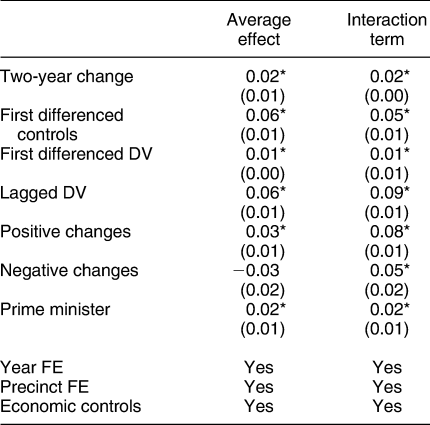
Table 3 presents a series of robustness checks of the results presented above. For these analyses, we only report the estimated average effect of housing prices and the interaction between the (logged) number of trades and housing prices. The full models are reported in Appendix E.
Robustness of the Average Effect and the Interaction Term

See Appendix E for the full models.
*p < 0.05.
First, we examine whether the chosen time lag, i.e., year-over-year changes, affects the results. To do so, we re-estimate the most restrictive model from Tables 1 and 2 using the change in housing prices over two years rather than just one. Using this measure of more long-run changes in housing prices does not make a big difference, although, as can be seen in the first row of Table 3, the estimated effects are smaller than when using the year-over-year changes. This squares with previous work showing that voters are, by and large, myopic when it comes to relating economic indicators to incumbent support (Healy and Lenz Reference Healy and Lenz2014; Healy and Malhotra Reference Healy and Malhotra2009).Footnote 10
By examining changes in local housing prices rather than levels, while controlling for the level of income and the level of unemployment, we may fail to capture important aspects of economic change in the precinct, which could in turn confound the effect of changes in housing prices. To examine whether this is the case, we re-estimate the most restrictive models using first-differenced (FD) versions of the income and unemployment variables. As can be seen in the second row of Table 3, this does not alter the main conclusion. In fact, the estimated effects of local housing prices double in size in this specification. We also estimate a set of complete change models using a first-differenced dependent variable (reported in the third row of Table 3). While somewhat smaller, the effect of housing prices remains statistically significant in the differenced model.
To test if voters respond symmetrically to increases and decreases in local housing prices (see Soroka Reference Soroka2006), we split the local housing price variable in two, creating one variable measuring the size of positive changes with negative changes set to zero, and another one measuring the size of negative changes with positive changes set to zero. We report the result of these analyses in the fifth and sixth row of Table 3. We find no evidence of negativity bias: the effect of negative changes and positive changes are both roughly 0.03 in absolute numbers. In other words, voters do not only punish governing politicians when local housing prices drop, but also reward them when they increase. This contrasts with earlier studies finding that voters respond more strongly to negative economic changes (e.g., Bloom and Price Reference Bloom and Price1975; Headrick and Lanoue Reference Headrick and Lanoue1991; Soroka Reference Soroka2014).Footnote 11
We also look at whether our results depend on the inclusion of support for government coalition partners by restricting our dependent variable to support for the prime minister’s party. As evidenced in the seventh row of Table 3, the estimated average and interaction effect remains statistically significant, although the estimate is slightly smaller.
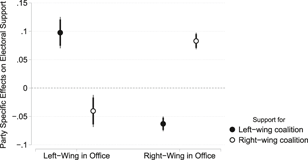
Another potential concern is whether the effect is politically symmetric. As housing prices in an area increase, the wealth of the voters living in this area also increases on average. This might plausibly lead them to increasingly support right-wing over left-wing parties (Ansell Reference Ansell2014). This problem is especially acute in our data, as the government parties in power in the majority of our study period (from 2001 to 2011) were right-wing, which could mask voters’ ideological reorientation toward right-wing parties in this period as local economic voting. To address this, we estimate models predicting support for the left-wing government coalition (Social Democrats and the Social Liberal Party) and the right-wing government coalition (Liberal Party and Conservative Party) separately (see Appendix D in the supplementary materials for a full specification of the model). Figure 4 presents the key estimates from this model. As shown, increasing housing prices have a positive estimated effect on electoral support for both right-wing and left-wing incumbent government parties. Our findings can thus not be explained by increased housing wealth causing a conservative shift in the electorate.
The Marginal Effect of Housing Prices on Electoral Support for Either the Left-Wing or the Right-Wing Government Coalition Conditional on Which Coalition is in Office.
Notes: Estimates with 90 and 95% confidence intervals. See Appendix D for the model underlying this figure.

A concern related to our test of the context priming hypothesis is that the constitutive terms of our interaction model—housing prices and market activity—measure the same underlying phenomenon, thereby complicating the interpretation of the interaction term. However, as we show in Appendix H, the two are in fact very weakly correlated (r = 0.1), implying that they essentially vary independently of one another. Another concern is that the number of trades is a proxy for population size. To explore this, we added an interaction between housing prices and logged number of eligible voters in the precinct to Model 4 in Table 2. As we report in Appendix I, we find no significant interaction between housing prices and population size, whereas the interaction between housing prices and the number of trades remains statistically significant and of the same approximate size. This suggests that our results are driven by variation in market activity rather than market size.
Finally, one might suspect that the interaction term testing the context priming hypothesis is nonlinear. Using the binning estimator presented in Hainmueller, Mummolo, and Xu (Reference Hainmueller, Mummolo and Xuforthcoming), we find some evidence of this (see Appendix H), as the effect of housing prices only seems to materialize in the upper tercile of the moderator. Yet, even when relaxing the linearity constraint on the moderator, the observed relationship is consistent with the context priming hypothesis.
In sum, we find clear evidence for both the local economic conditions hypothesis and the context priming hypothesis in the precinct-level data. We now proceed to testing the hypotheses using the individual-level data.
INDIVIDUAL-LEVEL EVIDENCE
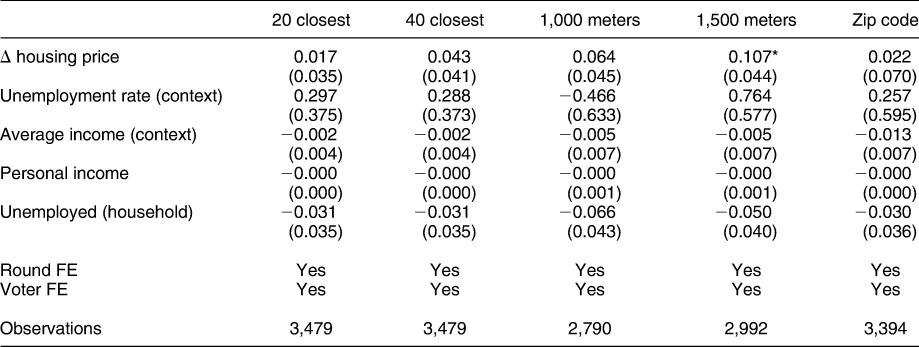
Table 4 reports results from a set of linear probability models, estimating the probability of voting for a party in government as a function of changes in local housing prices. We include individual (respondent) fixed effects, and fixed effects for the survey round in which the respondent initially participated (ESS rounds 1, 2, or 4). All models include controls for the average income and unemployment rate in the respondent’s residential context, as well as indicators of the respondent’s own income and whether someone in the household is unemployed. Like in the precinct-level analyses, we include these controls to isolate the effect of local housing markets from trends in overall economic circumstances. However, unlike for the precinct-level data, we can now control for trends in both the respondent’s personal economy and for the economy of her larger local context. In effect, we use a similar identification strategy as for the precinct-level data: a difference-in-differences model that controls for trends in economic conditions. To account for serial within-individual autocorrelation, all models are estimated using standard errors clustered at the individual level.
Linear Regression of Voting for Governing Party

Standard errors in parentheses.
*p < 0.05.
All models include the same set of variables, but differ in how the contextual variables are defined. In column one, we present a model where housing price change is calculated based on the 20 sales closest to each respondent, and where the other contextual variables—average income and unemployment rate—are measured within a 500-meter radius of each respondent. In column two we use the 40 closest sales, but leave the remaining variables measured as in column one. In columns three and four, we define all contextual variables (housing prices, unemployment rate, and average income) as based on 1,000 and 1,500 meter radii around the respondent. Finally, in column five, we define all contextual variables at the level of zip code areas.
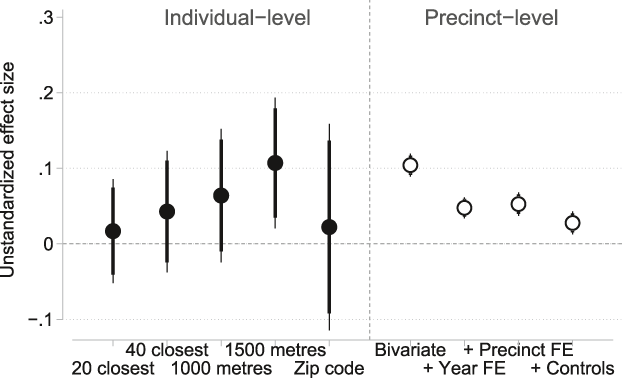
The estimated effect of changes in local housing prices is positive across the different models, although the size of the coefficient varies somewhat, ranging from 0.02 to 0.11. The effect is only statistically significantly different from zero in the specification measuring sales within 1,500 meters of the respondent. In substantive terms, this implies that with an increase in housing prices of two standard deviations, the probability of voting for the incumbent increases with between 0.6 and 4.9 percentage points, depending on how the contextual variables are defined.
While we only observe a statistically significant relationship between changes in housing prices and voting for the incumbent in one out of five models, it is important to highlight that the estimated relationships are consistent with what we found in the precinct-level data. To illustrate this, Figure 5 plots the estimated effect of housing prices for the individual-level data in Table 4 and for the precinct-level data in Table 1.

As is evident from the figure, the effect sizes are similar across the two levels of analysis. If anything, the estimated effects appear slightly larger for the individual-level data. This tentatively suggests that the estimated coefficients do not represent a true null effect, but rather an imprecisely estimated one. One plausible reason for this imprecision is measurement error in the dependent variable as voter recall is known to be erroneously reported (e.g., Bernstein, Chadha, and Montjoy Reference Bernstein, Chadha and Montjoy2001). In sum, we find mixed support for the local economic conditions hypothesis in the individual-level data, as the effect of housing prices is statistically insignificant in most specifications, but comparable in sign and magnitude to the precinct-level results.
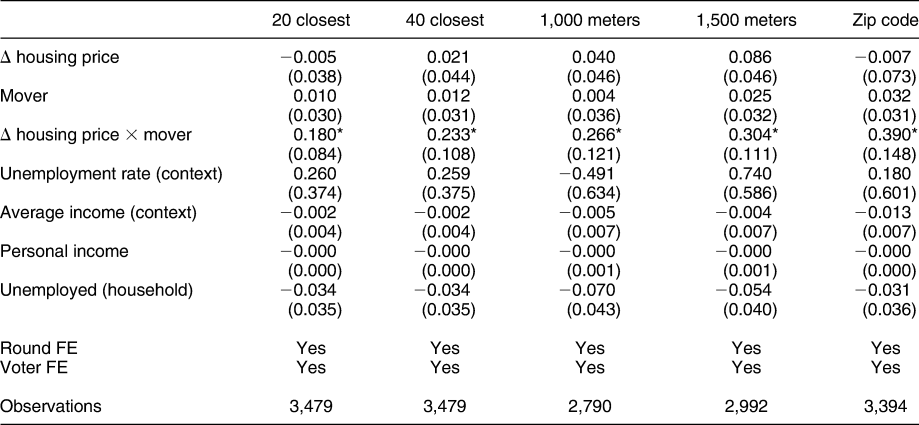
Next, we test the context priming hypothesis. As explained above, we test this hypothesis by looking at whether changes in local housing prices influence vote choice of recent or soon-to-be movers more strongly. We thus interpret moving as a behavioral indicator of exposure to the local housing market and, by extension, an indication of how salient this aspect of the local economy is when voters evaluate the incumbent government. Table 5 presents a set of individual-level models that regress an interaction between local housing price changes and an indicator for being a mover on government support. These models include respondent fixed effects and the same economic controls as above. The estimated interaction effect is statistically significant and positive in all specifications (p < 0.05), thus showing that movers are in fact significantly more responsive to changes in local housing prices.
Linear Regression of Voting for Governing Party

Standard errors in parentheses.
*p < 0.05.
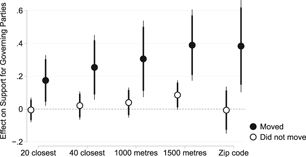
Figure 6 presents marginal effects for movers and non-movers derived from the models in Table 5. As shown, local housing prices have a large significant (p < 0.05) estimated effects for movers and a negligible effect—often essentially no effect—for non-movers. For movers, the effect of changes in housing prices is estimated to be between 0.2 and 0.4 depending on the model. Because of sampling variability, we cannot determine whether the effect is larger at any particular level of aggregation. However, given potential concerns about the MAUP, it is reassuring that we find the same overall pattern across these different levels of aggregation. In substantive terms, the model estimates imply that an increase in housing prices of two standard deviations increases the probability of voting for the incumbent by between 11 and 18 percentage points. This is more than even the largest effects identified in the previous literature on local economic voting (Healy and Lenz Reference Healy and Lenz2017), suggesting that when an individual is attuned to a certain aspect of their local economy, this plays a crucial role in their decision to support the national government.
Effects of Changes in Housing Prices for “Those Who Move and Those Who Do Not”
Notes: Estimates with 90 and 95% confidence intervals.

Overall, these results strongly support the context priming hypothesis by showing that changes in local housing prices play a larger role in incumbent evaluations among individuals, who have interacted more with their local housing market.
Auxiliary Analyses and Robustness Checks
We again probe our main results in a number of auxiliary analyses (see Appendix G for details on the analyses discussed in this section). First, while in the interest of simplicity we use linear probability models in our main analysis, we show that the results are virtually identical when estimated using conditional logistic regression models.
Following the party-specific analysis for the precinct-level data, which explored whether voters’ responses to local economic conditions had an ideological bent, we look at whether changes in local housing prices affect voters’ self-placement on an eleven-point ideological scale (left to right). The estimated effects are generally small, statistically insignificant, and negative, suggesting that, if anything, voters become more left-wing as housing prices increase. This runs counter to the notion that voters respond to increases in local housing prices by becoming more conservative.
We also redo our analysis using support for the prime minister’s party, rather than all government parties, as the dependent variable. This yields results substantively similar to those reported using the full government, although, similar to what we found in the precinct-level data, the effects of local housing prices are slightly reduced and less precisely estimated.
Finally, we try to include more individual-level controls that are standard in voting models, specifically education and ideological self-placement. This has no substantive bearing on the results, although some estimates of the effect of housing prices increase.
Taken together, consistent with our hypotheses, the individual-level analyses suggest that voters’ decision to support the sitting government is partly based on changes in local housing prices (the local economic conditions hypothesis), and even more so for those individuals particularly attuned to the housing market (the context priming hypothesis).
Why Do Local Economic Conditions Influence Incumbent Support?
As highlighted in the theory section, voters may reward governments for increasing local housing prices based on (at least) two different motives. For one, increasing housing prices may be taken as a cue of a booming national or local economy, which voters could want to reward the government for (sociotropic motivations). In line with the existing literature, this motive has served as our point of departure in interpreting the results. However, increasing local housing prices may also be seen as an indicator of personal gain, since increases in the price of local housing is strongly correlated with increases in the price of one’s own home, which voters might want to reward the government for (egotropic motivations).
As long acknowledged in the economic voting literature, it is hard to distinguish definitively between the two motivations, as they are intricately intertwined (Healy, Persson, and Snowberg Reference Healy, Persson and Snowberg2017; Kramer Reference Kramer1983; Tilley, Neundorf, and Hobolt Reference Tilley, Neundorf and Hobolt2018). Yet, our detailed register data enable us to go some way in identifying potential egotropic motivations by examining effects of local housing markets on incumbent support among subsets of individuals who have a stronger self-interest in local housing prices. If stronger effects emerge for these individuals, it speaks in favor of voters being animated by egotropic motives. These analyses are discussed below, and reported in full detail in the Appendix.
First, we tried including a measure of homeownership in the model. Homeowners arguably have a higher personal stake in rising local housing prices than renters. Therefore, if pocketbook considerations are the driving motive, we would expect the effect to be attenuated when controlling for homeownership, which might be more prevalent in areas with rising housing prices. Further, by adding an interaction between homeownership and local housing prices, we examine more directly whether homeowners react more strongly to the local housing market as an egotropic motivation would imply. We report these analyses in Tables G.3 and G.4 in the Appendix. When controlling for homeownership in the additive models, the estimated effect of changes in local housing prices on incumbent support is substantively similar to those reported in Table 4. In the interactive models, homeowners appear to punish or reward incumbents somewhat more than those who do not own their home although this difference is not significant or consistent across specifications.
Second, to parse out personal financial stakes further, we examine how the effect of local housing prices vary by moving patterns in and out of the local market. The rationale is the following: those selling their home, but staying within the same market cannot profit from local housing increases, because they are acquiring a home in the same area. Therefore, if egotropic motivations dominate, we would expect a less pronounced effect of local housing prices for those moving within the same local context. To assess this, we separate the mover variable used above into two variables: movers within the same context (defined by zip code; see discussion of this in Appendix M) and movers to another context. We then repeat the analysis of the context priming hypothesis substituting the moving indicator with the dummies for moving within or moving between local contexts. Table M.1 in the Appendix shows that we observe a stronger effect for “within-movers” than for those moving between different local contexts. This runs counter to the pocketbook perspective. As the local housing market would plausibly be even more salient to those staying within the same local area, this finding may also be taken as further support for the context priming hypothesis.Footnote 12
Taken together, the above analyses suggest that voters primarily act on local cues of a strong economy independently of their own financial stake in the housing market. This parallels recent findings for other local economic conditions in the USA (Healy and Lenz Reference Healy and Lenz2017) and in Hungary (Simonovits, Kates, and Szeitl Reference Simonovits, Kates and Szeitlforthcoming). In line with the existing literature, we cautiously take this as evidence of sociotropic motivations being the primary, if not only, motivation underlying local economic voting.
DISCUSSION AND CONCLUSION
Following the lead of previous efforts, this article has examined the phenomenon of local economic voting. We have proposed and empirically tested two hypotheses. First, the local economic conditions hypothesis, stating that local economic conditions affect support for incumbent governments. Second, the context priming hypothesis, stating that the effect of local economic conditions on incumbent support is more pronounced when they are more salient to voters in their local context. We tested the hypotheses using registry data on local housing markets from Denmark merged with precinct-level and individual-level panel data. In short, we find support for both hypotheses. Local economic voting based on the fate of local housing markets does occur, and more prominently so when this aspect of the local economy is more salient to voters from their everyday exposure to it.
While we believe that our data are very well suited for testing the proposed hypotheses and constitute a clear improvement over previous related studies in several regards, a number of caveats are warranted. First, our data are observational and in the absence of fully or quasi-experimental variation in housing prices, we cannot be sure that the estimated effects are not confounded by unobserved heterogeneity. Building on this study, one promising avenue for future research is therefore to identify settings with plausibly exogenous variation in local housing prices (e.g., Jerzak and Libgober Reference Jerzak and Libgober2016). Second, while our overall result regarding the existence of local economic voting confirms findings from other countries (in more aggregate local contexts), we cannot know whether the extent to which our novel finding travels to other contexts—that is, whether our theory of context priming generalizes. A priori, we have no reasons to expect this finding to be idiosyncratic to Denmark, but this remains an empirical question. Third, our study period surrounding the global housing market surge and collapse also raises questions of generalizability. This period endows us with ample variation in our independent variable, but this volatility may have rendered local housing markets particularly salient and therefore especially politically consequential during this period. At the same time, housing has become an increasingly important component of voters’ financial assets in Western countries over time (Ansell Reference Ansell2014), which speaks in favor of a continued—and maybe even increased—salience and political consequentiality of local housing markets. Beyond this, it is hard to say anything definitive about generalizability. However, in terms of identifying an effect in non-crisis times, it is reassuring that positive changes in local housing prices have the same effect as negative changes (see Table 3).
Our results carry several implications for the literature on economic voting in particular as well as research on political behavior more broadly. Most obviously, with regard to the former, our study adds to the evidence for local economic voting. Consistent with some existing studies, we find modest but non-negligible average effects of local economic conditions on support for the incumbent government (Healy and Malhotra Reference Healy and Malhotra2013). However, we do so using data from highly localized contexts rather than more aggregate contextual units, where local experiences may be confounded by other factors. This speaks to the fruitfulness of studying how cues of economic performance experienced very locally may influence incumbent support and other politically relevant attitudes and beliefs (e.g., Burnett and Kogan Reference Burnett and Kogan2017).
We have focused on local housing markets, but our theoretical arguments concern the importance of local economic conditions more generally. As noted, we also find a significant (negative) effect of local unemployment on support for incumbents in the precinct-level data, which shows that the local economy is a multifaceted phenomenon. This suggests that examining which aspects of the local economy shape electoral support for the sitting government at a given point in time—and the potential interplay between them—is a worthwhile next step in the analysis of local economic voting. This may also provide further leverage in refining our context priming hypothesis. One implication of classical theories of priming is that once one set of concerns become salient, others fade (Krosnick and Kinder Reference Krosnick and Kinder1990). Similarly, we may expect that when one aspect of the local economic context takes center stage due to voters’ exposure to it, other aspects of the local economy diminish in importance. The precinct-level data reveal a pattern consistent with this conjecture. Whereas local housing prices become much more important for support for the incumbent government in contexts with highly active housing markets, the effect of local unemployment drops somewhat in these contexts. We believe future work could fruitfully test this conjecture to advance our understanding of when certain aspects of the local economy matter for local economic voting.
In relation to the priming literature within political psychology, our results indicate that priming does not only happen as the result of elite messaging, but may also stem from personal involvement with a specific aspect of society, in our case local housing markets. Exploring other “horizontal” sources of priming of predispositions or personal experiences would provide an important complement to the heavy focus on elite-driven “top down” media influences presently characterizing the priming literature.
What does voters’ use of local housing markets as a shorthand for evaluating national incumbents tell us about the nature of voters’ motives and democratic accountability? As noted, in the individual-level data we find that local economic voting occurs largely independently of voters’ personal stake in the housing market. This in turn suggests that local economic voting primarily reflects sociotropic rather than egotropic motives. Our findings provide less guidance as to whether local economic voting is an effective heuristic for holding national politicians accountable. On the one hand, using local economic conditions, such as housing prices, to inform voting can be seen as an easy way for voters to reward or punish the national government for the progress or hardship they experience in their local environment. Yet, on the other hand, such local developments may be weak signals of overall government performance.
Relatedly, our findings suggest that local economic voting is adaptive rather than static. Voters do not seem transfixed by certain parts of their local economy, such as unemployment or housing prices. Instead, context priming means that they will focus on the parts of the economy to which they are currently exposed. It is unclear whether this bodes well or ill for electoral accountability. On the one hand, context priming undoubtedly means that voters will often get a very selective and unreliable impression of local economic conditions. For instance, two voters who live in the same local context might arrive at drastically different impression of their local economy depending on whether they are engaged in a job search or a search for a new house. On the other hand, it is clearly positive that voters flexibly reorient their attention toward new facets of the economy, such as the housing market, as these facets become relevant to their own lives. If they did not, incumbents would not have any electoral incentive to direct their attention to new parts of the economy.
SUPPLEMENTARY MATERIAL
To view supplementary material for this article, please visit https://doi.org/10.1017/S0003055419000029.
Replication materials can be found on Dataverse at: https://doi.org/10.7910/DVN/EKZQSZ.




Comments
No Comments have been published for this article.