



No CrossRef data available.
Article contents
Dependency Revisited: International Markets, Business Cycles, and Social Spending in the Developing World
Published online by Cambridge University Press: 24 April 2006
Abstract
While increased exposure to the global economy is associated with increased welfare effort in the Organization for Economic Cooperation and Development (OECD), the opposite holds in the developing world. These differences are typically explained with reference to domestic politics. Tradables, unions, and the like in the developing world are assumed to have less power or interests divergent to those in the OECD—interests that militate against social spending. I claim that such arguments can be complemented with a recognition that developed and developing nations have distinct patterns of integration into global markets. While income shocks associated with international markets are quite modest in the OECD, they are profound in developing nations. In the OECD, governments can respond to those shocks by borrowing on capital markets and spending countercyclically on social programs. No such opportunity exists for most governments in the developing world, most of which have limited access to capital markets in tough times, more significant incentives to balance budgets, and as a result cut social spending at the times it is most needed. Thus, while internationally inspired volatility and income shocks seem not to threaten the underpinnings of the welfare state in rich nations, it undercuts the capacity of governments in the developing world to smooth consumption (and particularly consumption by the poor) across the business cycle.The author would like to thank Steph Haggard, Kristin Bakke, Wongi Choe, Tim Jones, and seminar participants at Duke University, Penn State University, Washington University, MIT, and the University of New Mexico for their helpful comments. Nancy Brune, Mark Hallerberg and Rolf Strauch, and Nita Rudra were very generous in providing their capital account, OECD fiscal, and potential labor power data, respectively.
Information
- Type
- Research Article
- Information
- Copyright
- © 2006 The IO Foundation and Cambridge University Press
Much of the research from the past decade on the consequences of globalization has focused on either the macroeconomic convergence associated with integrating markets or the welfare state implications of globalization. In both areas of study, empirical analyses have focused overwhelmingly on Organization for Economic Cooperation and Development (OECD) cases. To the degree that researchers of the developing world have researched the political economy of open markets, they have done so largely in the context of a market reform literature that emphasizes the importance of domestic factors such as legislative bargaining, party system fragmentation, executive independence, federalism, and the like in shaping the adoption of promarket development strategies. Only recently has research begun to investigate the specific effects of international markets per se on policy in the developing world. While the findings from these studies are quite distinct from those on wealthy nations, explanations continue to emphasize the importance of domestic factors. This research complements the domestic-level explanations with a return to dependency theory's emphasis on the constraints associated with the functioning of international markets.
The divergent findings on the relationship between exposure to international markets and domestic politics is clearest when it comes to social spending. One of the most consistent findings in the political economy literature of the past twenty-five years is that increased trade dependence is associated with greater welfare effort in the global North. Despite disagreements on the precise causal mechanisms and debates over methodological issues,1
Whether the cause is deindustrialization (Iversen and Cusack 2000) or the compensation effect (Cameron 1978; and Garrett 1998) is irrelevant here.
See Swank 2002; and Garrett and Mitchell 2001.
Empirical research on the developing world tells a very different story. In most large-N, cross-national studies on the relationship between globalization and welfare effort or government size, trade dependence has a significant and negative effect.4
See Kaufman and Segura-Ubiergo 2001; and Rudra 2002. Note that in a study that spans the developing and developed worlds, Rodrik finds a positive association between trade and social spending. See Rodrik 1997, 59. It is unclear, however, if increased openness contributes to more social spending in the developing world as he does not run analyses on a sample of developing nations alone. In models that include developing and OECD nations, Rodrik notes that the coefficients on social security and welfare are much smaller than in an OECD-only sample. In another large-N study, Garrett 2001 finds a positive relationship between trade and total government spending, but each of the dummies for developing regions is negative and statistically significant. Neither study estimates models that bear on my hypotheses.
In this article, I complement the emphasis on domestic factors by placing them in international context. In discussing the incentives of governments and actors in tradable sectors, I emphasize the importance of fiscal constraints rooted in distinct patterns of integration into global markets. While national income shocks associated with international markets are quite modest in the global North, they are profound in developing nations. In the global North, governments can respond to those shocks by borrowing on capital markets and spending countercyclically on social programs. No such opportunity exists for most governments in the developing world that have limited access to capital markets in tough times, more significant incentives to balance budgets, and tradable sectors that are sensitive to currency fluctuations. As a result, these governments cut social spending at exactly the times it is most needed. Thus while internationally inspired income shocks do not threaten the underpinnings of the welfare state in rich nations, it undercuts the capacity of governments in the developing world to smooth consumption (particularly consumption by the poor) across the business cycle.
More specifically, I argue that exposure to international markets affects social spending by increasing the volatility of domestic economies and inspiring procyclical fiscal responses to downturns that imply cuts in social spending. I also hypothesize that business cycles affect the policy preferences of actors in the tradable sectors, who are inclined to favor balanced budgets over countercyclical social spending during economic downturns. This argument, along with a series of resulting hypotheses, provides an account as to how the structure of dependence on international markets affects domestic social policy. In emphasizing the importance of the divergent positions of wealthy and developing nations vis-à-vis international markets, this research hearkens back to some of the insights of dependency theorists, such as Cardoso and Faletto and Evans, and follows in the footsteps of more recent political economists, such as Mosley and Kouparitsas, who suggest that developing nations are much more constrained by global markets than their wealthy counterparts.5
I expand on that research by theorizing and empirically verifying a direct relationship between trade openness and social policy.This article proceeds in six sections. In the first section, I review the theoretical arguments and evidence on the relationship between social spending and economic openness. In the second, I develop my argument, assess its relationship to the existing literature, and derive a series of hypotheses. In the third, I examine business cycles in the developing world with specific reference to their roots in exposure to international markets. In the fourth section, I show how this economic volatility affects fiscal policy and social spending in Latin America and compare it with the Organization for Economic Cooperation and Development (OECD). In the fifth section, I conduct a cross-sectional time-series analysis of the effect of the business cycle and international market integration on social spending levels and priorities in twelve Latin American nations between the mid-1970s and the mid-1990s. I conclude with a return to general theoretical and policy issues.
Globalization and Social Spending: Two Divergent Accounts
The bulk of evidence on the OECD suggests that increased trade and capital mobility have done little to erase the rich array of domestic political economies across nations. With specific reference to social spending, Cameron, Garrett, Rodrik, and others have shown a strong, positive relationship between trade dependence and welfare effort.6
See Cameron 1978; Garrett 1998; and Rodrik 1997. The chief exception is Burgoon 2001, who finds that increased trade dependence has a negative effect on retirement spending and general social spending.
See Swank 2002; and Garrett and Mitchell 2001.
Mediating factors include electoral systems (Iversen and Soskice 2002), democracy (Adserà and Boix 2002), and the strength and organization of the labor movement (Garrett 1998).
What is striking is how uniformly the conventional wisdom vis-à-vis emerging market nations reflects more pessimistic evaluations of globalization's effect on public policy.11
The large-N empirical evidence, though sparse, is broadly supportive of the pessimistic outlook. Several recent studies show a negative relationship between trade and social spending.12See Kaufman and Segura-Ubiergo 2001; and Rudra 2002.
In most cases, researchers emphasize differences in domestic politics to explain the difference between OECD and developing nations. Rudra, for instance, suggests that “the difference in welfare-state outcomes is due to a wide disparity in the bargaining power of labor in developed and developing countries.”15
Rudra 2002, 436.
Wibbels and Arce 2003, 132.
Garrett and Mitchell 2001. The UN Conference on Trade and Development (UNCTAD) echoes these sentiments, suggesting that the “increased diversity in economic performance of developing countries in the current global downturn reflects differences in their domestic conditions.” UNCTAD 2003, 6.
Such research has contributed much to one's understanding of the domestic politics shaping national responses to international markets in the developing world. Less research, however, has explored the ways in which international factors shape the economic environment in which domestic actors operate. I argue that national-level explanations should be complemented by recognition of the ways in which relationships with the global economy condition macroeconomic performance and the interests of key domestic actors. In emphasizing national politics, recent research adheres to ongoing intellectual trends in the study of the political economy of developing nations. Such is particularly true of the market reform literature that seeks to explain the degree to which nations have embraced free market models of development. The distribution of social costs and benefits of the market reform process,19
the organization of business communities,20 the strength of oppositional forces such as unions,21 the nature of regimes,22 the bureaucratic capacity of the state,23 and institutional factors ranging from party systems24 to federalism25 are all important domestic-level factors researchers identify as influencing economic policy. The ways in which the international environment shapes the context in which these domestic institutions operate, however, remains mostly unexplored.The Argument and Hypotheses
I argue that the findings on the relationship between trade dependence and welfare effort result, in part, from a dependent position in the global economy and the ways in which that position shapes the interests of key domestic actors. More specifically, exposure to global markets inspires severe business cycles and prevents governments from engaging in countercyclical spending to smooth consumption during recessions. Given the need to fiscally retrench in the face of recessions, governments face tradable sectors whose long-term interest in social spending conflicts with their short-term interest in fiscal balance. Both the harshness of business cycles and the limited capacity to spend countercyclically are rooted in the dependent position of developing nations in the international economy. This does not mean that domestic factors (be they the interests of actors in the tradables sector, regime type, or union strength) are irrelevant, only that they are shaped by international constraints. Indeed, once broad macroeconomic limitations are accounted for, I expect that domestic political preferences in the developing world will more closely resemble those in the OECD than extant research suggests.
My argument relies on three links between international markets and the social policies of governments. First, increased exposure to international markets subjects developing nations to profound business cycles. Such business cycles will vary in depth with dependence on exports in volatile sectors (such as raw materials) and external finance. Second, those output shocks, in turn, induce sharply procyclical fiscal policy during bad economic times. This latter phenomenon results in large part from governments' limited ability to borrow from international markets during negative output shocks. Third and finally, the association between deficits and real exchange rate volatility forces policy trade-offs on domestic tradables such that they prefer cuts in social spending during recessions. When combined with the political weakness of the poor, the preferences of tradables encourage governments to retrench social spending as a means to balance budgets. The net result of these interrelated phenomena is that the position of most developing nations in the global economy militates in favor of social spending cuts during periods of economic distress.
Traditionally, one of the most important tools for combating the business cycle has been fiscal policy and social spending in particular. Since most revenue sources available to governments are income-elastic, economists have long been concerned that fiscal policy will magnify business cycles. In particular, procyclical taxing and spending threaten to exacerbate downturns by disrupting employment and the provision of public services. The impact of such swings might be particularly severe for a society's poorest and most vulnerable citizens if social spending is reduced at times when it is most needed. Musgrave, in his classic work on public finance, summarizes the prevailing view that government has an obligation to fiscal stabilization: “A free economy, if uncontrolled, tends toward more or less drastic fluctuations in prices and employment; and apart from relatively short-term swings, maladjustments of a secular sort may arise toward unemployment or inflation. Public policy must assume a stabilizing function in order to hold within tolerable limits departures from high employment and price stability.”26
Musgrave 1959, 22.
In 1990 the World Bank echoed these concerns with special attention to the impact of spending cuts on the poor: “Adjustment may mean a long-term setback for the poor if it undermines the resources that enable them to work as small-scale producers and laborers. Health and education … are some of the investments that should not be allowed to deteriorate.”27
World Bank 1990, 116.
Even if one rejects the Keynsian notion of demand management in a world of rational expectations among market actors, a far-sighted welfare-maximizing government should nevertheless conduct countercyclical policy if it acts according to the “permanent income hypothesis.” Such behavior would imply setting government consumption levels according to long-term income expectations rather than yearly fluctuations, thereby minimizing distortions associated with frequent changes in taxation and expenditures. A large empirical literature has determined that whatever their motivations, central governments in wealthy countries behave in this fashion, borrowing and saving so as to smooth the short-term shocks of the business cycle.29
Redistributive spending, such as that on unemployment transfers and other welfare programs, is particularly countercyclical (meaning spending goes up as the business cycle goes down).A number of factors make this quintessentially Keynesian response to recessions problematic in developing nations. First and probably most important is the size of the fiscal shocks associated with traumatic business cycles inspired in part by terms of trade shocks and dependence on volatile external finance. Given this economic instability, income smoothing would require either significant borrowing during economic downturns or epic surpluses during good times. In the face of strong political pressure and the real need for spending in developing nations, huge surpluses are unlikely.30
Heavy borrowing is also problematic given developing nations' precarious access to financial markets.31See IMF 2003.
Fiscal shocks are exacerbated by revenue sources that tend to be sensitive to the business cycle. See Talvi and Végh 2000. In contrast to the modestly income elastic tax systems in the OECD, developing nations tend to rely on consumption taxes.
H1: Fiscal policy will be profoundly procyclical in the developing world.
Given these internationally inspired macroeconomic constraints, domestic political considerations should influence the degree to which different portions of public spending respond most directly to the business cycle. Indeed, income shocks are one of the main sources of time variation in government outlays, and it is during recessions that fiscal politics are at their most conflictual. Given the need to cut spending during recessions, I expect politicians to find social spending an attractive target for retrenchment. In contrast to many wealthy nations, where the constituency for social spending of various kinds is quite strong,33
poor constituencies across much of the developing world are weak.34 As such, politicians are likely to see it as a politically expedient source of savings in tough economic times. Here, however, it becomes important to distinguish between two types of social spending. While spending on human capital (health and education, for instance) tends to be truly redistributive in favor of the poor and has a relatively unorganized constituency, social security spending tends to be regressive and has a small, highly organized constituency in the developing world.35See CEPAL 1999; and Huber et al. 2004. The relationship between the two types of spending across Latin America since 1970 is −0.58.
H2: Spending on human capital will respond more procyclically to the business cycle than social security spending.
Focusing on the specific relationship between economic openness and social spending, I hypothesize that the distinct characteristics of these two social spending categories will have implications for how key political actors perceive them and thus how aggressively they will be retrenched in response to the business cycle. A substantial literature has suggested that increased economic openness should be associated with increased demand on the part of workers and capital alike for the kinds of social policies that promote competitiveness and cushion volatility associated with the international economy.37
See Cameron 1978; and Rodrik 1997 and 1999.
Polling data provides some support for this claim. The most recent Latinobarometer regional poll asks individuals whether or not the market is the best means for development. See Lagos 2004. The bivariate relationship between a nation's weighted human capital spending and a positive assessment of the market is 0.34. The relationship between weighted social security spending and assessment of the market is −0.35.
A number of additional factors suggest that tradable interests in particular will prefer cuts in social security to those in human capital. First, social security systems add to the wage bill, are associated with obstacles to labor market flexibility, and have become expensive. In countries such as Argentina39
and Brazil,40 deficits in retirement systems were the most proximate cause of recent fiscal crises. Second, in contrast to spending on social security in the developing world, that on health and education generate widespread positive social externalities, more productive workers, and increase firm profitability.41See CEPAL 2000; and Huber et al. 2004.
Ibid.
Although Kaufman and Nelson note that there is little evidence that the business community as a whole expresses preferences on these issues,44
there is some qualitative evidence with regards to tradables in a number of contexts. Mexican exporters, for instance, are currently bemoaning that nation's failure to move into higher value-added, human capital–reliant production in the face of low-wage competition from China,45“The Sucking Sound from the East,” The Economist, 24 July 2003, 35.
“The Attraction That Is Southern China,” New York Times, 5 November 2003, W6.
Universidad de Lima 2003, 5. The poll emphasized the large businesses most likely to engage in trade.
See CEPAL 1999; and Galiani and Sanguinetti 2003.
H3: Trade openness will be associated with reductions in social security spending and protection for spending on human capital.
Finally, I hypothesize that the interests of actors in the tradable sector are shaped by the macroeconomic environment. More specifically, the desire for more competitive employees in the long-run can conflict with the short-term need for fiscal austerity. To the degree that large deficits are associated with exchange rate volatility, actors in the tradable sector are likely to favor retrenchment even in areas, such as health and education, that have widely recognized benefits. Aside from the fact that external shocks are themselves associated with real exchange rate volatility,49
this is likely so because to the degree deficits are financed by monetary expansion, they will affect the real exchange rate. Relatedly, looming deficits can encourage capital flight to the degree that they are perceived as inconsistent with market discipline. As Gavin and others explain with regards to the contractionary expenditure retrenchments in Argentina and Mexico during the 1995 peso crisis, “Aggressive fiscal adjustment was a crucial signal of continued commitment to sound policies, and in the absence of this adjustment there was a real danger that capital flight by already nervous international and domestic investors would have intensified, further deepening the economic crisis.”50Gavin et al. 1996, 17.
Servén 2002, 212.
While one might expect exporters to benefit from devaluation, the empirical literature indicates that devaluations are strongly contractionary in developing nations because they raise the domestic currency real value of external liabilities and dry up access to international credit.
H4: Tradable openness will be associated with social spending cuts of all kinds during negative output shocks.
The implications for social spending and equity considerations in the developing world are, of course, not promising. Latin American nations, for instance, not only have 25 percent more recessions than OECD nations, but those recessions are typically twice as long and four times as deep.53
IDB 1995, 192.
International Markets and the Business Cycle in the Developing World
The severity of business cycles in many developing nations is intimately tied to their position in the global economy. Though the precise characteristics of each national economy are unique, evidence suggests that increased exposure to international markets exacerbates swings in the business cycle in many developing nations in two key ways. First, developing nations tend to specialize in a small handful of exports (oftentimes agricultural and raw material goods), the international prices of which tend to be volatile.54
See Borensztein and Reinhart 1994; IDB 1995; and de Ferranti et al. 2000. Borensztein and Reinhart find that more than 50 percent of the fluctuations in commodity prices since the early 1970s are because of demand factors in northern economies.
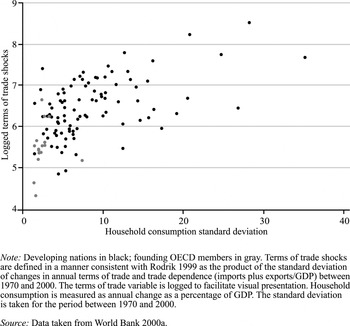
Private consumption is superior to GDP growth as a measure as most households in developing nations are unable to borrow to smooth consumption during recessions.

The relationship between logged terms of trade shocks and the volatility of household consumption, 1970–2000
Second, thanks to shallow domestic credit markets, many developing nations are heavily reliant on volatile international financial markets.59
The average domestic banking system in the OECD provided credit amounting to 91 percent of GDP between 1970 and 2000; the figure in the developing world was 41 percent (World Bank 2000a).
Several features of this reliance are likely to exacerbate business cycles in the developing world. Considerable research has shown that while domestic factors do have an impact on access to external finance, the flow of capital to developing nations is largely determined by developments in wealthy economies.60
See IMF 2003; and Gavin, Hausmann, and Leiderman 1995.
The opposite is the case in wealthy nations where interest rates and growth rates are negatively related.
Calvo, Izquierdo, and Mejía 2004 note that sudden stops in access to credit markets tend to occur in bunches and in countries exhibiting a variety of underlying fundamentals.
Kaminsky, Reinhart, and Végh 2004. They note that sovereign credit ratings are unrelated to the business cycle in OECD countries.
Interest rate spreads between the sovereign debt instruments of major Latin American nations and world interest rates, for instance, varied between 5 and 35 percent over the course of the 1990s. See de Ferranti et al. 2000, 48.
Kaminsky and Reinhart 2002, 456. During the Asian financial crisis, for instance, bond spreads increased by 560 basis points in Asia, 901 basis points in Latin America, and 2006 points in the transition economies of Eastern Europe and the former Soviet Union.
IMF 2003, 96.
Kaminsky, Reinhart, and Végh (2004, 222–23) note that credit worthiness is unrelated to the business cycle in OECD countries but the two are closely related in middle income countries.
The regional responses to the Asian financial crisis are again instructive. In Asian, Latin American, and transition economies, interest rates increased by 5.5 percent, 5 percent, and 13.4 percent, respectively. Group of 7 (G7) interest rates went down by .04 percent. See Kaminsky and Reinhart 2002, 456.
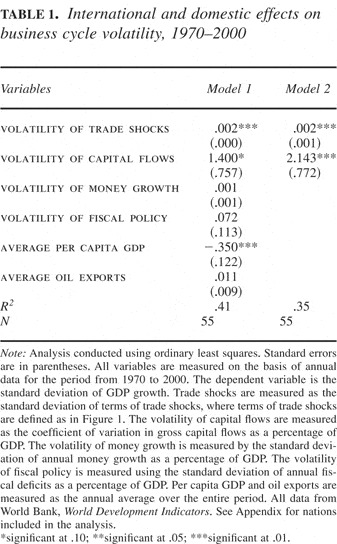
Given reliance on external finance and larger terms of trade shocks, it is not surprising that output volatility is significantly higher in developing countries than industrial nations. Unfortunately, limitations on data availability prohibit the estimation of precise models to assess the impact of international markets on business cycles for a large sample of developing nations.75
The degree to which the constraints of the international economy are felt through terms of trade shocks and limited access to debt financing depends on a nation's degree of export diversification, the goods it exports and imports, as well as the depth and breadth of domestic financial markets. Ideally, it would be possible to estimate the effect of international economic shocks on business cycles and the subsequent impact of business cycles on social spending. Since all of this data is available for only a small handful of nations, existing econometric evidence is based on relatively small samples on which I cannot expand.
See de Ferranti et al. 2000, annex 1, 68–69, for details.
International and domestic effects on business cycle volatility, 1970–2000

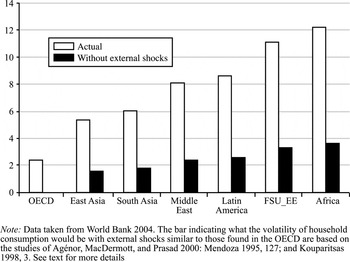
Given the limitations of this analysis (particularly endogeneity concerns) imposed by data shortcomings, Figure 2 presents additional supporting evidence. The figure shows the standard deviation of annual changes in private consumption by region of the world. The least volatile (and most economically diversified) region in the developing world is East Asia, which is 2.5 times more volatile than the OECD. The most volatile is Sub-Saharan Africa, at nearly six times that of wealthy nations. A small body of econometric research on the causes of this volatility using high-quality data for a small number of developing nations suggests that exogenous international economic factors cause between 56 and 70 percent of it.77
See Agénor, McDermott, and Prasad 2000; Mendoza 1995: 127; and Kouparitsas 1998, 3. The actual figures reported are 56 percent by Mendoza and 70 percent by Kouparitsas. Agénor, McDermott, and Prasad, 263, fn. 13, do not report a figure for their entire sample but indicate that their findings are consistent with those of Kouparitsas.

Volatility of household consumption, 1970–2000 (standard deviation of annual percentage change)
It is worth noting that macroeconomic volatility has a direct effect on poverty rates. Irrespective of the business cycle's effect on social spending, the poor are least able to shield their incomes and assets, more likely to forego education, and least likely to have access to consumption smoothing credit in the face of pronounced economic downturns.79
The Inter-American Development Bank estimates that were output shocks in Latin America similar in scale to those in the OECD, 25 percent of the region's poor would be pulled out of poverty.80IDB 1995, 190.
The Business Cycle, Budgets, and Social Spending
The challenge for policymakers in the developing world is not only that their economies are three to six times more volatile than in wealthy countries, but the constraints that they face in dealing with that volatility are more severe. Consistent with the discussion above, I hypothesize that fiscal policy in the developing world is likely to be procyclical. A number of factors underpin this expectation, including limited government access to capital markets during downturns,81
revenue sources that are volatile, the associated lack of automatic fiscal stabilizers, and the large size of the fiscal shocks associated with the severity of business cycles.82 The net result of these factors should be that public spending fails to smooth consumption across the business cycle and that the lack of an organized constituency will make spending on education and health a particularly attractive target for cuts.In this and the following section, the empirical focus is on Latin America. Though spotlighting the region reduces the generalizability of the findings to the rest of the developing world, it does have several advantages. First, Latin American nations were the first to make significant moves toward free markets in the aftermath of the 1982 debt crisis. As such, findings for this region may serve as an indicator of where other developing nations are headed. Second, the nations across the region vary tremendously in their levels of trade dependence. Trade dependence in 2000 varied from a low of just above 21 percent in Argentina to more than 90 percent in Costa Rica and Honduras.83
Data from the World Bank 2000a.
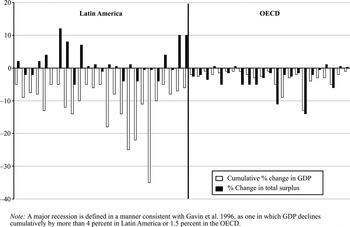
Figure 3 provides a general indication of the degree to which fiscal policy in Latin America is pronouncedly procyclical when compared to OECD nations. Deficits and recessions move in concert in the OECD, which suggests that governments are responding to downturns by increasing borrowing. This borrowing helps finance the increased social expenditures associated with automatic stabilizers—because more people qualify for various social programs during recessions, spending on them automatically increases. In Latin America, on the other hand, deficits and recessions are either unrelated or move in opposite directions. Far from borrowing to finance countercyclical spending, many governments in the region actually move toward surplus. Given that revenues decline during negative output shocks across the region, this relationship between deficits and recessions indicates that significant expenditure cuts take place when public finance axioms suggest that the opposite should happen.

Responses to major recessions, 1970–95
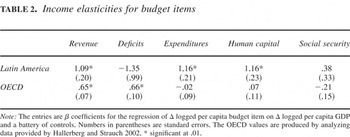
Table 2 below provides a more direct test of Hypotheses 1 and 2, that fiscal policy in Latin America is procyclical and that human capital spending will be more procyclical than social security spending. To provide a general picture of the cyclical characteristics of budgets in Latin America, I have gathered yearly inflation-adjusted per capita data on revenues, deficits, total expenditures, the two types of social spending discussed above, and gross domestic product (GDP) for the twelve nations in the region for which the disaggregated social spending data is available between the mid-1970s and mid-1990s.84
The nations included in the analysis are Argentina, Bolivia, Brazil, Chile, Colombia, Costa Rica, Dominican Republic, Mexico, Peru, Paraguay, Uruguay, and Venezuela.
Income elasticities for budget items

The most straightforward way to examine cyclicality is to simply regress fiscal variables on national income. Because of unit roots in both income and fiscal data, I use first differences of the logged real per capita data.85
The models also include country fixed effects and a number of standard controls. Because the controls are not theoretically interesting and have little impact on the findings, I leave their discussion for below. I also examined models including year fixed effects, which could be important to the degree that they control for common external shocks to all countries of the region. Their inclusion did not alter the basic findings.
I use data provided by Hallerberg and Strauch 2002 and supplemented with OECD 2004 social spending data.
The results are quite supportive of both hypotheses. As expected, the first column reveals that revenues in Latin America are profoundly procyclical: a 1 percent contraction in GDP per capita results in a similar decrease in revenues. In this respect, the OECD behaves somewhat similarly, though the scale of the procyclicality is less, with revenues decreasing up to 65 percent of any downturn in the business cycle. The similarities end there, however. Consistent with Figure 3 above and the expectation that governments should borrow to finance cycle-smoothing expenditures during recessions, OECD nations have a strong, positive relationship between the business cycle and deficits. The opposite appears to be the case in Latin America. Though the coefficient falls somewhat short of significance, it suggests that nations across the region move strongly toward surplus during recessions. Consistent with the expectation that governments are unable to fiscally smooth, their movement toward surplus exceeds by 35 percent any downward shift in the economy. Likewise, total expenditures are strongly procyclical across the region while they are acyclical in the OECD.
Social spending also behaves as hypothesized but contrary to the OECD experience. To operationalize investments in human capital (as opposed to social security), I add education and health care spending. Spending on human capital moves in concert with the business cycle—indeed, the elasticity of 1.16 implies a very procyclical response. The implications for the poor are dire, because times of economic distress are associated with cuts in the type of spending most likely to reach them. In contrast, social security spending across Latin America is acyclical—the positive coefficient is not significant. Consistent with the theoretical story outlined above, it seems that the highly organized, narrow interests associated with social security are able to defend their budgetary priorities in Latin American contexts. OECD expenditures on both human capital and social security, on the other hand, are acyclical, while other research has shown that welfare spending is strongly countercyclical.87
Hallerberg and Strauch 2002. Traditional welfare programs as understood in the OECD welfare state literature are trivial in most of the developing world, yet even those small programs are highly procyclical. See Hicks and Wodon 2000.
Income Shocks, Trade, and Social Spending
To date, most of the research on budget cyclicality has been highly technocratic. Researchers have few systematic political explanations for the variation in the responsiveness of fiscal policy to the budget cycle. That said, research has begun to find that a number of political factors mediate the relationship between income shocks and fiscal policy.88
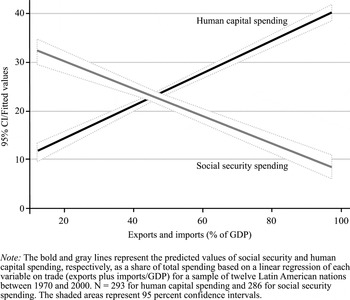
Most such research, however, is concerned with fiscal policy aggregates (total taxing, spending, and deficits) rather than the specific implications of the business cycle for social spending and is focused overwhelmingly on OECD nations.Consistent with testing Hypotheses 3 and 4, this section examines the relationship between the macroeconomic environment, trade openness, and social spending. As suggested above, focusing on up- and downsides of the business cycle has a number of advantages. Most importantly, fiscal shocks underscore the importance of policy trade-offs, because politicians are forced to make hard choices among competing priorities just as contending constituencies mobilize to defend their preferred policy outcome. Consistent with the social preferences and the behavior of actors in the tradables sector of wealthy nations, I expect citizens, and those in tradables in particular, in developing nations to recognize that there is a strong positive association among investments in human capital, productivity, profits, and wages. Indeed, Figure 4 provides preliminary evidence that trade openness has divergent effects on the two big categories of social spending. The graph shows the predicted values of human capital and social security spending derived from simple bivariate regressions of the spending categories on the size of the tradable sector. The results are suggestive, with human capital spending increasing as trade dependence mounts and social spending doing the opposite.

Predicted value of human capital and social security spending as a function of trade openness in Latin America.
Recognition that this relationship holds in the long term, however, will conflict with tradables' interest in a stable currency. In contexts of negative output shocks, tradables are likely to prefer cuts in social spending as a means to limit the exchange rate volatility often associated with deficits in the developing world. In other words, the interests of tradables vis-à-vis social spending are conditioned by the income shocks associated with the business cycle. To measure income shocks, I follow standard practice in the economics literature by subtracting trend from real GDP, where trend GDP is calculated using a Hodrick-Prescott filter.89
See Agénor, McDermott, and Prasad 2000 for a discussion of detrending techniques.
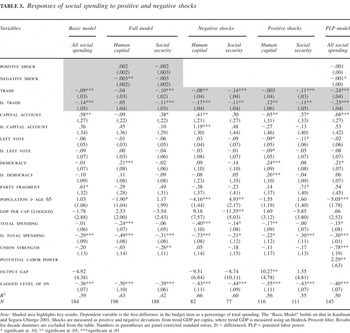
Responses of social spending to positive and negative shocks

The most relevant independent variable in the models is that for trade, measured in the customary manner, which should take on a positive coefficient for human capital spending during economic expansions and a negative one during recessions.91
The measure is imports + exports as a share of GDP.
The population, per capita income, and output gap data are from the World Bank 2000a. Total public-sector spending is from the IMF's Government Finance Statistics, various years. The output gap is measured as the difference between changes in real per capita income and changes in trend per capita income as calculated using an Hodrick-Prescott filter.
The data is taken from Garrett, Brune, Guisinger, and Sorens 2001, who create a 9-point scale for annual capital account openness on the basis of the IMF's Annual Report on Exchange Arrangements and Exchange Restrictions. Capital account openness increases as the scale increases.
Remmer 2002. The measure is the share of the vote received by leftist parties as defined in Coppedge n.d.
See Adserà and Boix 2002; and Brown and Hunter 1999. Data from the Polity IV data set, Marshall and Jaggers 2005.
The measure is the percentage of the total labor force that is unionized. See Roberts and Wibbels 1999 for measurement details.
Note that the time-specific dummies are for the decades of the 1970s and 1980s, which is consistent with Kaufman and Segura-Ubiergo 2001.
Given the analytical importance of policy trade-offs and budgetary choices in times of stress, the dependent variables are defined as social spending (total, human capital, or social security spending) as a percentage of total spending.99
Data from the IMF, Government Finance Statistics, various years.
The results do not change if logged per capita spending is used in place of social spending as a percentage of total spending. The correlation between the two variables is 0.85.
Kaufman and Segura-Ubiergo 2001. Both first-difference and level variables are included when there is reason to believe that long-term trends and short-term changes might have substantively different impacts.

where Y is social spending as a share of total spending in country i at time t; X is a vector of independent variables described above; and α and ω are country and year dummies, respectively. The dependent variable and most independent variables are measured as yearly changes (Δ). The latter are also introduced in lagged level (t−1). I estimate all models using ordinary least squares (OLS) with panel-corrected standard errors.103
The results, presented in Table 3, provide solid support for Hypotheses 3 and 4. For the sake of clarity, I will focus on those independent variables that involve tests of the hypotheses. I have highlighted the relevant cells in the table. Despite slight differences with their model,104
The slight differences are as follows. First, I use a continuous measure of leftist party strength rather than a dummy variable for popular governments. Second, I have added unionization and party system fragmentation measures. Third, I have dropped their exchange rate measure, which has little impact on any of their findings.
The only difference in the findings is that the coefficient on differenced capital account openness falls below significance in my model.
Moving on to column (2), the full model disaggregates social spending into its two largest components and includes the measures for positive and negative output shocks. The results show human capital spending to be strongly procyclical, particularly with regards to negative output shocks. The coefficient suggests that a $100 per capita (approximately one standard deviation) negative shock to the economy results in a 0.3 percent cut in the share of total spending dedicated to human capital. Lest these small percentages seem underwhelming, in a country such as Mexico they translate into an annual cut of $208 million in response to the negative shock. Social security, on the other hand, is entirely acyclical.
Extremely interesting are the results that bear on trade openness and the interests of the tradables sector. As the results from the full model make clear, once positive and negative output shocks are taken into account and social spending is disaggregated, there is no negative association between trade exposure and human capital investment—the coefficient is insignificant in both levels and differences. Consistent with Hypothesis 3, however, increased trade openness has a strong, significant, and negative effect on social security spending in both the short and long term. The interpretation of the lagged trade coefficient is slightly complicated by the error-correction modeling approach,106
The impact of trade is calculated by dividing the regression coefficient by the coefficient of the lagged dependent variable and multiplying it by the discussed increase in trade dependence. See Kaufman and Segura-Ubiergo 2001, appendix 2.
Differentiating between positive and negative shocks tells a similar story on the relationship between tradable interests and social spending, with higher and increasing trade dependence resulting in relative cuts in social security spending in both good and bad times. The cuts range from 5.2 percent during positive shocks to 6.4 percent during negative shocks as long-term trade dependence increases by 20 percent. In both cases, social security cuts are exacerbated by short-term increases in trade dependence. To put these numbers in context, the average country in the sample spends 25 percent of the budget on social security; a 20 percent increase in long-term trade dependence would cut that to somewhere below 20 percent of the budget. Human capital expenditures, on the other hand, behave quite differently vis-à-vis trade dependence. Negative output shocks are closely associated with cuts in these types of social spending—the same 20 percent increase in trade discussed above results in a relative cut in human capital expenditures by 3.8 percent. This finding is entirely consistent with the expectation that concerns with currency stability will swamp any interest on the part of tradables in human capital investments. The evidence on the upside of the business cycle tells a different story—the coefficient on differenced trade is positive and significant for spending on human capital. In this case, a 5 percent short-term increase in trade dependence results in a 0.6 percent increase in the budget share devoted to human capital.107
The long-term impact, of course, will depend on whether such an increase in trade dependence becomes permanent.
The results on the control variables also yield a number of interesting findings. Although the findings with regards to capital account openness are somewhat inconsistent, they suggest that in the long-term more open capital accounts are associated with increased total social, human capital and social security spending under various conditions.109
The exception is in the positive shock model, where more open capital accounts have a significant, negative relationship with human capital spending.
Quinn 1997, 572.
Finally, the last column of Table 3 introduces a different measure of labor strength to explore a recently published argument by Rudra.114
In that research, she finds a strong positive relationship between “potential labor power” (PLP) and social spending. Given the negative finding on my indicator of union strength, this apparent conflict is worth exploring. A close look at the two measures makes clear that there is no real conflict and that the two measures are getting at different aspects of labor strength. While PLP measures key features of labor market conditions, my unionization measure more directly assesses the organizational capacity of labor itself. Indeed, the two measures are correlated at a scant 0.17. As such, I enter the two variables simultaneously in a model for total social spending. Note first that the introduction of PLP does not change the story with regards to the relationship between trade openness and overall social spending.115Nor does the introduction of PLP alter my fundamental findings if social spending is disaggregated into human capital and social security spending.
All told, these findings present a compelling picture. When social spending is disaggregated into its two component parts, it seems that tradables have distinct interests vis-à-vis human capital and social security spending. While employees and managers in tradables both have reason to support productivity-improving spending on education and health, the opposite holds for social security. At the same time, however, the vulnerability of tradable sectors to exchange rate volatility in the developing world imposes a tighter constraint than in the developed world. As a result, tradables prefer short-term cuts to human capital when downturns in the business cycle threaten budget balance and currency stability. These findings contradict those for OECD countries. In separate, unreported analyses that estimate similar models for “core” countries, spending on human capital is entirely impervious to the business cycle.116
Results available from the author.
Conclusions
The study of developing nations' political economies over the past two decades has emphasized the importance of domestic politics. Consistent with this tendency, the embryonic work on the relationship between globalization and social policy in the developing world has suggested that the negative relationship between globalization and social spending results from features of domestic politics. This research complements that stress on domestic politics by emphasizing the role of international markets in shaping macroeconomic contexts and the interests of domestic actors. In short, the international economy affects social spending in developing nations in three ways. First, increased trade exposure and foreign capital dependence contribute to significant business cycles. Second, sharp business cycles contribute to procyclical social spending by virtue of developing nations' limited access to international credit markets during economic downturns. Third and finally, the severity of the business cycle combined with a limited capacity to finance deficits accentuates the policy trade-offs of domestic actors in the tradables sector. While those actors are likely to favor spending on human capital in a manner consistent with evidence on the OECD, the threat to exchange rate stability during fiscal downturns encourages them to choose expenditure cuts over countercyclical social spending. In those countries where exposure to the global economy has gone hand in hand with economic diversification (a handful of East Asian cases), welfare states have continued to grow. In most cases, however, globalization has exacerbated the volatility that complicates countercyclical social spending.
Two big messages emerge from the results. First, it is important to think carefully about the international constraints that shape domestic politics. Political economy research on developing nations often implies a strong relationship between international factors and domestic politics, but the precise mechanisms are rarely explicit. Indeed, it is the failure to root analyses of the international economy in rigorous theoretical and empirical models that contributed to the turn away from dependency-type arguments. That the case, the theory, and evidence provided here echo Stallings's admonishment to rediscover the international explanations that were tossed aside as part of the marginalization of dependency theory.117
In doing so, this research is consistent with a trend in economics (particularly work on international financial markets) that uses contemporary micro- and macroeconomic tools to explore the sharp international constraints on policymakers in developing nations. Exploring the causal links between exposure to the international economy and domestic decision making is exactly what researchers of globalization in the OECD have been doing for the past two decades. The temptation to take the explanations developed there and apply them to the developing world, however, can blind researchers to the broader constraints imposed by sharply divergent relationships with the global economy.Second, it is also important to recognize that the interests of domestic actors vis-à-vis social spending are likely to be contingent on internationally inspired economic circumstances. In the models above, several of the domestic-level variables are significant. Yet, as emphasized with respect to the interests of tradables, the preferences of those actors are likely to be mediated by international economic constraints. Interests associated with trade are likely to oppose expensive, narrowly distributed social security systems, while being in favor of social spending that is more broadly distributed. Under tight macroeconomic conditions, however, tradables are likely to have a dominant interest in fiscal retrenchment at the expense of spending on human capital. Certainly more work needs to be done in understanding the relationship between the structure of dependence on the international economy and the policy priorities of a broad range of social actors in the developing world. Indeed, it would be tremendously useful to have more systematic data on the preferences of tradables than the qualitative and occasionally indirect evidence provided here. Tradables aside, given the centrality of union strength to much research on welfare states and nations' transitions to free market policies, future work should also aim to both collect the necessary data to expand the analysis above to a broader swath of the developing world and think systematically about the ways in which union density, labor market conditions, and partisan relations interact with global economic forces to shape policy outcomes.
The findings above also have important policy implications, particularly for the design of fiscal stabilization strategies. A couple of practical reforms could help limit the procyclicality of spending. First, governments should further develop their capacities to tax less income elastic sources. Most attractive in this regard are property taxes. Even income taxes, though also problematic, are less income elastic than the consumption taxes on which many nations have become very dependent. Second, given the cyclicality of revenues, governments should attempt to increase savings during upswings in the business cycle. OECD research shows that national governments respond to positive output shocks by increasing spending at a slower rate than revenues—this allows for savings that can be used during recessions. Latin American governments, in contrast, respond to increased revenues by increasing spending in lock-step, thus eliminating the potential for saving. The simplicity of these policy recommendations, however, belies their political complexity. Increasing property taxes on politically influential rural sectors and income taxes on the wealthy are notoriously difficult in a region that has struggled for 200 years to improve revenue collection. Likewise, saving during periods of strong growth is hard in a context where public spending of many sorts is too low and political pressures are high.
It would be easy to suggest, as the IMF and Inter-American Development Bank do, that nations should focus on limiting the economic volatility that they can control, namely, that induced by public policy (as opposed to international markets). Unfortunately, fiscal policy itself is quite volatile exactly because of the nature of many nations' position in the global economy. Though the nature of reliance on the global economy varies across developing nations, many nations, being price takers on international markets, reliant on a small number of exports, and dependent on external finance, are subject to a tremendously volatile macroeconomic environment. Given the demands of international markets, governments face strong incentives to balance their budget during downturns, which of course induces fiscal policy volatility. Thus rational politicians operating in response to rational international markets will cut social expenditures and exacerbate poverty during recessions, despite widespread recognition of the long-term negative social, economic, and political effects of doing so.
The implications for human well-being are not promising. Currently, 50.7 percent of Latin America's population lives in poverty; 25 percent of its citizens live in extreme poverty.118
The United Nations (UN) Comisión Económica Para América Latina (CEPAL) reports that “the most recent poverty and indigence estimates available … [show] that the region's poverty levels have not decreased since 1997.”119 My argument suggests that the explanation for the stagnation is in part a result of social spending cuts associated with the international economic volatility that began with the East Asian financial crisis and continued with the global economic recession of recent years—factors external to most of the region's policy levers. That social security spending in Latin America is less subject to internationally inspired cyclical shocks is not terribly encouraging because its benefits are regressive. In contrast, spending on health and education (itself plagued with problems) is progressive. In fact, social spending of this sort is one of two major factors influencing poverty levels across the region (the other is changing relative prices).120Forty-two percent of such spending is received by the poor. See CEPAL 2000.
Finally, these findings underscore the warning of former IMF managing director Jacques de Larosiére, who suggested that “the extent to which adjustment is compatible with growth and with an improvement in living standards depends in large part on what form that adjustment takes…. Adjustment that pays attention to the health, nutrition and educational requirements of the most vulnerable groups is going to protect the human condition better than adjustment which ignores them. This means that authorities will have to be concerned, not only with if they close the fiscal deficit but also with how they do so.”121
Cornia, Jolly, and Stewart 1987, 2. Emphasis in the original.
Appendix
Nations included in the analysis reported in Table 1: Argentina, Australia, Bangladesh, Barbados, Belgium, Botswana, Brazil, Burkina Faso, Burundi, Cameroon, Canada, Chile, Colombia, Costa Rica, Cyprus, Denmark, Dominican Republic, Ecuador, Egypt, Fiji, Ghana, Hungary, India, Iran, Israel, Jamaica, Japan, Jordan, Kenya, South Korea, Lesotho, Madagascar, Malawi, Mauritius, Mexico, Morocco, New Zealand, Norway, Pakistan, Panama, Paraguay, Peru, Philippines, Sierra Leone, Singapore, South Africa, Sri Lanka, Syria, Thailand, Tunisia, Turkey, Uganda, U.S., Uruguay, Venezuela, Zimbabwe.
References
REFERENCES
Adserà, Alícia, and
Carles Boix.
2002.
Trade, Democracy, and the Size of the Public Sector: The Political
Underpinnings of Openness.
International Organization
56 (2):229–62.Google Scholar
Agénor, Pierre-Richard,
C. John McDermott, and
Eswar Prasad.
2000.
Macroeconomic Fluctuations in Developing Countries: Some Stylized
Facts.
World Bank Economic Review
14 (2):251–85.Google Scholar
Ahmed, Shaghil.
2003.
Sources of Economic Fluctuations in Latin America and Implications
for Choice of Exchange Rate Regimes.
Journal of Development Economics
72 (1):181–202.Google Scholar
Albuquerque, Rui,
Norman Loayza, and
Luis Servén.
2003.
World Market Integration Through the Lens of Foreign Direct
Investors.
Policy Research Working Paper 3060.
Washington, D.C.:
World Bank.
Beck, Nathaniel, and
Jonathan N. Katz.
1995.
What to Do (and Not to Do) with Time-Series Cross-Section
Data.
American Political Science Review
89 (3):634–47.Google Scholar
Boix, Carles.
1998.
Political Parties, Growth, and Equality: Conservative and Social
Democratic Economic Strategies in the World Economy.
Cambridge:
Cambridge University Press.
Borensztein, Eduardo, and
Carmen Reinhart.
1994.
The Macroeconomic Determinants of Commodity Prices.
International Monetary Fund Staff Papers
41 (2):236–62.Google Scholar
Brown, David, and
Wendy Hunter.
1999.
Democracy and Social Spending in Latin America,
1980–92.
American Political Science Review
93 (4):779–90.Google Scholar
Burgoon, Brian.
2001.
Globalization and Welfare Compensation: Disentangling the Ties that
Bind.
International Organization
55 (3):509–51.Google Scholar
Calvo, Guillermo,
Alejandro Izquierdo, and
Luis-Fernando Mejía.
2004.
On the Empirics of Sudden Stops: The Relevance of Balance-Sheet
Effects.
NBER Working Paper 10520.
Cambridge, Mass.:
National Bureau of Economic Research.
Cameron, David.
1978.
The Expansion of the Public Economy: A Comparative Analysis.
American Political Science Review
72 (4):1243–61.Google Scholar
Cardoso, Fernando Henrique, and
Enzo Faletto.
1979.
Dependency and Development in Latin America.
Berkeley:
University of California Press.
Comisión Económica Para América Latina
(CEPAL).
1999.
Social Panorama of Latin America, 1998–99.
Santiago, Chile:
CEPAL.
Comisión Económica Para América Latina
(CEPAL).
2000.
Social Panorama of Latin America, 1999–2000.
Santiago, Chile:
CEPAL.
Comisión Económica Para América Latina
(CEPAL).
2003.
Social Panorama of Latin America, 2002–2003.
Santiago, Chile:
CEPAL.
Coppedge, Michael.
N.d.
Latin American Party Systems Database.
Unpublished data set,
University of Notre Dame,
South Bend, Ind. Available at 〈http://www.nd.edu/∼mcoppedg/crd/datalaps.htm〉.
Accessed 23 January 2006.
Cornia, Giovanni,
Richard Jolly, and
Frances Stewart, eds.
1987.
Adjustment with a Human Face.
Oxford:
Clarendon Press.
de Ferranti, David,
Guillermo Perry,
Indermit Gill, and
Luis Servén.
2000.
Securing Our Future in a Global Economy.
Washington, D.C.:
World Bank.
Dornbusch, Rudiger, and
Sebastian Edwards.
1991.
The Macroeconomics of Populism in Latin America.
Chicago:
University of Chicago Press.
Evans, Peter.
1979.
Dependent Development: The Alliance of Multinational, State, and
Local Capital in Brazil.
Princeton, N.J.:
Princeton University Press.
Galiani, Sebastian, and
Pablo Sanguinetti.
2003.
The Impact of Trade Liberalization on Wage Inequality: Evidence from
Argentina.
Journal of Development Economics
72 (2):497–513.Google Scholar
Garrett, Geoffrey.
1998.
Partisan Politics in the Global Economy.
Cambridge:
Cambridge University Press.
Garrett, Geoffrey.
2001.
Globalization and Government Spending Around the World.
Studies in Comparative International Development
35 (4):3–29.Google Scholar
Garrett, Geoffrey,
Nancy Brune,
Alexandra Guisinger, and
Jason Sorens.
2001.
The Political Economy of Capital Account Liberalization.
Working paper.
Los Angeles:
University of California Department of Political Science.
Garrett, Geoffrey, and
Deborah Mitchell.
2001.
Globalization, Government Spending and Taxation in the OECD.
European Journal of Political Research
39 (2):145–77.Google Scholar
Gavin, Michael,
Ricardo Hausmann, and
Leonardo Leiderman.
1995.
The Macroeconomics of Capital Flows to Latin America: Experience and
Policy Issues.
Working Paper 310.
New York:
Inter-American Development Bank.
Gavin, Michael,
Ricardo Hausmann,
Roberto Perotti, and
Ernesto Talvi.
1996.
Managing Fiscal Policy in Latin America and the Caribbean:
Volatility, Procyclicality, and Limited Creditworthiness.
Working Paper 326.
New York:
Inter-American Development Bank.
Gibson, Edward, and
Ernesto Calvo.
2000.
Federalism and Low-Maintenance Constituencies: Territorial
Dimensions of Economic Reform in Argentina.
Studies in Comparative International Development
35 (3):32–55.Google Scholar
Greene, William.
2003.
Econometric Analysis.
5th ed.
Upper Saddle River, N.J.:
Prentice Hall.
Haggard, Stephan, and
Robert R. Kaufman.
1995.
The Political Economy of Democratic Transitions.
Princeton, N.J.:
Princeton University Press.
Hallerberg, Mark, and
Rolf Strauch.
2002.
On the Cyclicality of Public Finances in Europe.
Empirica
29:183–207.Google Scholar
Hicks, Norman, and
Quentin Wodon.
2000.
Economic Shocks, Safety Nets, and Fiscal Constraints: Social
Protection in Latin America.
Unpublished manuscript.
Washington, D.C.,
World Bank.
Huber, Evelyne,
Francois Nielsen,
Jenny Pribble, and
John Stephens.
2004.
Social Spending and Inequality in Latin America and the
Caribbean.
Paper presented at the Annual Meeting of the Society for the
Advancement of Socio-Economics, Washington, D.C., July.
Inter-American Development Bank (IDB).
1995.
Economic and Social Progress in Latin America: Overcoming
Volatility.
Washington, D.C.:
IDB.
Inter-American Development Bank (IDB).
2005.
Poverty and Equity Data. Available at 〈http://www.iadb.org/sds/doc/ApendtableA5.pdf〉.
Accessed 23 January 2006.
International Monetary Fund (IMF).
Various years.
Government Finance Statistics.
Washington, D.C.:
IMF.
International Monetary Fund (IMF).
Various years.
Annual Report on Exchange Arrangements and Exchange
Restrictions.
Washington, D.C.:
IMF.
International Monetary Fund (IMF).
2003.
Global Financial Stability Report.
Washington, D.C.:
IMF.
Iversen, Torben, and
Thomas R. Cusack.
2000.
The Causes of Welfare State Expansion: Deindustrialization or
Globalization?
World Politics
52 (3):313–49.Google Scholar
Iversen, Torben, and
David Soskice.
2002.
Electoral Systems and the Politics of Coalitions: Why Some
Democracies Redistribute More than Others.
Paper presented at the Annual Meeting of the American Political
Science Association, Boston, August–September.
Kaminsky, Graciela, and
Carmen Reinhart.
2002.
Financial Markets in Times of Stress.
Journal of Development Economics
69 (2):451–70.Google Scholar
Kaminsky, Graciela,
Carmen Reinhart, and
Carlos Végh.
2004.
When It Rains, It Pours: Procyclical Capital Flows and Macroeconomic
Policies.
Working Paper 10780.
Cambridge, Mass.:
National Bureau of Economic Research.
Kaufman, Robert, and
Joan Nelson, eds.
2004.
Crucial Needs, Weak Incentives: Social Sector Reform,
Democratization, and Globalization in Latin America.
Baltimore:
Johns Hopkins University Press.
Kaufman, Robert, and
Alex Segura-Ubiergo.
2001.
Globalization, Domestic Politics and Social Spending in Latin
America: A Time-Series Cross-Section Analysis, 1973–97.
World Politics
53 (4):553–87.Google Scholar
Kingstone, Peter R.
1999.
Crafting Coalitions for Reform: Business Preferences, Political
Institutions, and Neoliberal Reform in Brazil.
University Park:
Pennsylvania State University Press.
Kitschelt, Herbert,
Peter Lange,
Gary Marks, and
John D. Stephens, eds.
1999.
Continuity and Change in Contemporary Capitalism.
Cambridge:
Cambridge University Press.
Kouparitsas, Michael.
1998.
North-South Business Cycles.
Federal Reserve Bank of Chicago Working Paper.
Chicago:
Federal Reserve Bank of Chicago.
Lagos, Marta.
2004.
Latinobarometer Poll, 2004—Summary Report.
Santiago, Chile.
Levitsky, Steven, and
Lucan Way.
1998.
Between a Shock and a Hard Place: The Dynamics of Labor-Backed
Adjustment in Poland and Argentina.
Comparative Politics
30:171–92.Google Scholar
Lindert, Peter.
2001.
Voice and Growth: Was Churchill Right?
Working Paper 9749.
Cambridge, Mass.:
National Bureau of Economic Research.
Mares, Isabela.
2003.
The Sources of Business Interest in Social Insurance: Sectoral vs.
National Difference.
World Politics
55:229–58.Google Scholar
Marshall, Monty, and
Keith Jaggers.
2005.
Polity IV Project: Political Regime Characteristics and Transitions,
1800–2003.
College Park, Md.:
Integrated Network for Societal Conflict Research.
Country Reports available at 〈http://www.cidcm.umd.edu/inscr/polity/report.htm〉.
Accessed 23 January 2006.
Mendoza, Enrique.
1995.
The Terms of Trade, the Real Exchange Rate, and Economic
Fluctuations.
International Economic Review
36 (1):101–37.Google Scholar
Mesa-Lago, Carmelo.
1994.
Changing Social Security in Latin America: Toward Alleviating the
Social Costs of Economic Reform.
Boulder, Colo.:
Lynne Rienner.
Mosley, Layna.
2003.
Global Capital and National Governments.
New York:
Cambridge University Press.
Musgrave, Richard.
1959.
The Theory of Public Finance: A Study of Public Economy.
New York:
McGraw-Hill.
Mussa, Michael.
2002.
Argentina and the Fund: From Triumph to Tragedy.
Washington, D.C.:
Institute for International Economics.
Nelson, Joan.
1992.
Poverty, Equity, and the Politics of Adjustment. In
The Politics of Economic Adjustment, edited by
Stephan Haggard and
Robert Kaufman,
221–69.
Princeton, N.J.:
Princeton University Press.
Organization for Economic Cooperation and Development
(OECD).
2004.
Social Expenditure database (SOCX), 1980–2001.
Paris:
OECD. Available at 〈http://www.oecd.org/document/2/0,2340,en_2649_34635_31612994_1_1_1_1,00.html〉.
Accessed 23 January 2006.
Pierson, Paul.
1994.
Dismantling the Welfare State? Reagan, Thatcher, and the Politics of
Retrenchment.
New York:
Cambridge University Press.
Quinn, Dennis.
1997.
The Correlates of Change in International Financial
Regulation.
American Political Science Review
91 (3):531–51.Google Scholar
Remmer, Karen.
2002.
The Politics of Economic Policy and Performance in Latin
America.
Journal of Public Policy
22 (7):29–59.Google Scholar
Roberts, Kenneth, and
Erik Wibbels.
1999.
Party Systems and Electoral Volatility in Latin America: A Test of
Economic, Institutional and Structural Explanations.
American Political Science Review
93 (3):575–90.Google Scholar
Rodrik, Dani.
1997.
Has Globalization Gone Too Far?
Washington, D.C.:
Institute for International Economics.
Rodrik, Dani.
1999.
Where Did All the Growth Go? External Shocks, Social Conflict, and
Growth Collapses.
Journal of Economic Growth
4 (4):385–412.Google Scholar
Rudra, Nita.
2002.
Globalization and the Decline of the Welfare State in Less-Developed
Countries.
International Organization.
56 (2):411–45.Google Scholar
Samuels, David.
2003.
Fiscal Straightjacket: The Political Economy of Macroeconomic Reform
in Brazil, 1995–2002.
Journal of Latin American Studies
35 (3):1–25.Google Scholar
Servén, Luis.
2002.
Real Exchange Rate Uncertainty and Investment in Developing
Countries.
Policy Research Working Paper 2823.
Washington, D.C.:
World Bank.
Skidmore, Thomas E.
1977.
The Politics of Economic Stabilization in Postwar Latin
America. In
Authoritarianism and Corporatism in Latin America, edited by
James M. Malloy,
149–90.
Pittsburgh:
University of Pittsburgh Press.
Stallings, Barbara.
1992.
International Influence on Economic Policy: Debt, Stabilization,
and Structural Reform. In
The Politics of Economic Adjustment: International Constraints,
Distributive Conflicts, and the State, edited by
Stephan Haggard and
Robert R. Kaufman,
41–88.
Princeton, N.J.:
Princeton University Press.
Swank, Duane.
2002.
Global Capital, Political Institutions, and Policy Change in
Developed Welfare States.
New York:
Cambridge University Press.
Talvi, Ernesto, and
Carlos Végh.
2000.
Tax Base Variability and Procyclical Fiscal Policy.
NBER Working Paper 7499.
Cambridge, Mass.:
National Bureau of Economic Research.
Tornell, Aaron, and
Philip Lane.
1999.
The Voracity Effect.
American Economic Review
89:22–46.Google Scholar
United Nations Conference on Trade and Development
(UNCTAD).
2003.
Trade and Development Report, 2003: Capital Accumulation, Growth and
Structural Change. Available at 〈www.unctad.org〉.
Accessed 6 October 2003.
Universidad de Lima.
2003.
“Perúmetro 6: Situación Económia y
Empresarial del Perú: Opinión de los Líderes
Empresariales.” Available at 〈http://www.ulima.edu.pe/webulima.nsf/default/4BE58345536EB3BC05256E630017BCED/$file/bemp4.pdf〉.
Accessed 23 January 2006.
Waterbury, John.
1993.
Exposed to Innumerable Delusions: Public Enterprise and State Power
in Egypt, India, Mexico, and Turkey.
Cambridge:
Cambridge University Press.
Wibbels, Erik, and
Moisés Arce.
2003.
Globalization, Taxation, and Burden-Shifting in Latin
America.
International Organization
57 (1):111–36.Google Scholar
World Bank.
1990.
World Development Report 1990: Poverty.
Washington, D.C.:
World Bank.
World Bank.
2000a.
World Development Indicators.
CD-ROM.
Washington, D.C.:
World Bank.
World Bank.
2000b.
World Development Report 2000: Attacking Poverty.
Washington, D.C.:
World Bank.
World Bank.
2004.
World Development Indicators.
CD-ROM.
Washington, D.C.:
World Bank.
The relationship between logged terms of trade shocks and the volatility of household consumption, 1970–2000
International and domestic effects on business cycle volatility, 1970–2000
Volatility of household consumption, 1970–2000 (standard deviation of annual percentage change)
Responses to major recessions, 1970–95
Income elasticities for budget items
Predicted value of human capital and social security spending as a function of trade openness in Latin America.
Responses of social spending to positive and negative shocks
 You have
Access
- 158
- Cited by