Introduction
The UK experiences a much lower rate of penetrating neck trauma compared with North America and South Africa.Reference Siau, Moore, Ahmed, Lee and Tostevin 1 This probably accounts for the paucity of national guidance on the management of this type of trauma. However, an increase in interpersonal, urban and gang violence has led to an increase in the number of patients presenting to the accident and emergency department (A&E) with penetrating neck trauma.Reference Siau, Moore, Ahmed, Lee and Tostevin 1 , Reference Harris, Olding, Lacey, Bentley, Schulte and Lewis 2 In England and Wales in the year (to June) 2012, there were almost 30 000 offences recorded that involved a knife or sharp instrument. 3 Furthermore, it is estimated that 10 per cent of all trauma patients have a penetrating neck injury.Reference Mahmoodie, Sanei, Moazeni-Bistgani and Namgar 4
Whilst relatively uncommon in comparison to other mechanisms of injury, the potential morbidity of penetrating neck trauma is apparent, given the high density of vital structures confined to a relatively small and poorly protected area.Reference Mahmoodie, Sanei, Moazeni-Bistgani and Namgar 4 Overall mortality rates for penetrating neck trauma are estimated at between 3 and 6 per cent, most commonly as a result of injury to vascular structures and exsanguination.Reference Burgess, Dale, Almeyda and Corbridge 5 – Reference Brennan, Lopez, Gibbons, Hayes, Faulkner and Dorlac 7
The management of penetrating neck trauma is highly variable, being influenced by region and local experience.Reference Siau, Moore, Ahmed, Lee and Tostevin 1 , Reference Harris, Olding, Lacey, Bentley, Schulte and Lewis 2 , Reference Burgess, Dale, Almeyda and Corbridge 5 The development of modern medical, anaesthetic and surgical practice, along with military experience (most recently in Iraq and Afghanistan), has resulted in improved patient outcomes and more effective management.Reference Brennan 6 , Reference Daniel, de Regloix and Kaiser 8 For example, literature on pre-hospital care of penetrating neck trauma suggests that the use of a rigid neck collar may actually have a detrimental effect on management. The neck collar has the potential to mask expanding haematomas or evolving airway compromise.Reference Brywczynski, Barrett, Lyon and Cotton 9 Furthermore, it hampers airway stabilisation.
In the last three decades, there has been a slow shift towards conservative management of penetrating neck injuries in selected patients.Reference Burgess, Dale, Almeyda and Corbridge 5 , Reference Thoma, Navsaria, Edu and Nicol 10 The concept that all neck injuries that breach the platysma should be explored no longer holds true. This practice originally developed from battlefield data when the mechanism of injury was likely to be from a high velocity object such as shrapnel or a bullet.Reference Beebe and DeBakey 11 In North America, there are a greater proportion of high velocity penetrating neck injuries from gunshot wounds, leading to a greater rate of surgical exploration because of the increased propensity to cause major injury.Reference Demetriades, Theodorou, Cornwell, Berne, Asensio and Belzberg 12 – Reference Jarvik, Philips, Schwab, Schwartz and Grossman 14 This is primarily because of the unpredictable path and effects of a rapidly moving bullet inside the body.Reference Thoma, Navsaria, Edu and Nicol 10 The UK experiences more low velocity penetrating neck trauma such as stabbing injuries, and management is therefore different. The literature shows multiple reports of negative findings for neck explorations, sometimes over 50 per cent.Reference Harris, Olding, Lacey, Bentley, Schulte and Lewis 2 , Reference Saletta, Lowe, Lim, Thornton, Delk and Moss 13 – Reference Wood, Fabian and Mangiante 19
Burgess et al. published an evidence-based review of how such low velocity penetrating neck trauma should be managed.Reference Burgess, Dale, Almeyda and Corbridge 5 According to these authors, urgent surgical exploration is required for: urgent airway injury, including airway compromise, massive subcutaneous emphysema and air bubbling through the wound; or signs of major vascular injury, including profuse active bleeding, refractory shock, rapidly expanding haematoma and evolving stroke.
We have compared our experience with the protocol established by Burgess to formulate an algorithm for best practice.
Materials and methods
Based in Liverpool, Aintree University Hospital services a local population of around 330 000, and offers specialist care expertise to a further 1.2 million people.
A retrospective review was conducted of all adult patients with penetrating neck trauma treated at Aintree University Hospital between January 2007 and 2013. Patients were identified through medical coding and an electronic medical records review. Sixty-three cases were identified for inclusion in the study. The hospital does not treat patients aged less than 16 years and therefore this population was excluded. Patients presented to a variety of specialties, such as ENT, maxillofacial surgery and general surgery, and were all included for analysis.
The data collected included patient demographics, the nature of the injury and how it was subsequently managed by the admitting team. These data were compared to the evidence-based guidelines proposed by Burgess et al.Reference Burgess, Dale, Almeyda and Corbridge 5
Results
There were 63 patients with penetrating neck trauma during the 6-year period; the median age at the time of injury was 33 years (range, 17–81 years) (Figure 1).
Age distribution of neck trauma patients. Incidence peaks in patients aged 17 to 36 years.

The incidence of penetrating neck trauma from 2007 to 2013 fell from 2008 onwards (Figure 2). This is in keeping with statistics provided by the Office for National Statistics, which show that the number of reported incidents in which firearms or sharp objects were used has been falling steadily since 2008. 20 The number of patients subjected to open exploration has also fallen since 2007 (Figure 3).
Trend of penetrating neck trauma cases managed per year. There seems to be a steady number following a drop in cases in 2009.

Trend of penetrating neck trauma cases explored under general anaesthesia between 2007 and 2013. The proportion of cases explored seems to have reduced over the study period.

Seasonal variance was observed: November and December generally accounted for a much greater proportion of penetrating neck trauma cases compared to the rest of the year, with a fall during July to September (Figure 4). Higher numbers of cases presented on Saturdays and Mondays.
Trend of penetrating neck trauma cases presenting each month between 2007 and 2013. There is a dip in the summer season, with a steady number of cases distributed throughout the rest of the year.

Injuries
The mechanism of injury was most often a knife or blade, accounting for 33 of the 63 cases. Seventeen of these 33 patients (52 per cent) were self-harm or suicide attempts.
Some patients had both single and multiple zone injuries, but the majority had injuries in zone II (between the cricoid and the angle of the mandible), as shown in other published articles.Reference Mahmoodie, Sanei, Moazeni-Bistgani and Namgar 4 , Reference Biffl, Moore, Rehse, Offner, Franciose and Burch 16 , Reference Wood, Fabian and Mangiante 19
Twenty-nine patients (46 per cent) had suspected injury to their upper aerodigestive tract or major vessels; however, the majority had a minor injury to superficial tissues.
Flexible diagnostic nasendoscopy
Patients were managed by A&E doctors, maxillofacial surgeons, general surgeons and ENT surgeons, which may account for diagnostic nasendoscopy being used in only 50 per cent of cases. Minor injuries were mostly treated by A&E doctors and general surgeons, and nasendoscopy was probably not indicated.
Neck exploration
Twenty-two patients (35 per cent) underwent open exploration under general anaesthesia (GA); the remainder had wound repair under local anaesthetic, followed by observation for 24 to 48 hours.
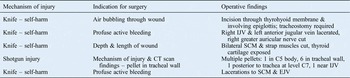
Five of the patients who underwent open exploration had significant injuries (Table I). However, 17 of these 22 patients (77 per cent) had no significant injury; of note, 6 cases had no breach of the platysma. One patient underwent a concurrent laparotomy. In another patient, a 3.5 cm glass foreign body was removed from the neck.
Justification for exploration under GA was supported by Burgess' guidelines in only nine of our cases.Reference Burgess, Dale, Almeyda and Corbridge 5 Of these nine patients, three had profuse bleeding, two a large haematoma (it was unclear whether it was expanding or not), two had airway compromise and two underwent exploration because of the mechanism of trauma (large sword and close range shotgun injury).
Pharyngoesophageal injury
Eight patients (12.5 per cent) had features suggesting pharyngoesophageal injury. Six of these patients underwent a contrast swallow study and one proceeded directly to pharyngoesophagoscopy; two underwent panendoscopy in the operating theatre without a contrast swallow study, but they also had signs of airway compromise or profuse bleeding requiring urgent exploration.
Airway compromise
Only 2 of the 63 patients (3 per cent) had evidence of airway compromise, both inflicted with knives. One patient required a tracheostomy and the other had subcutaneous emphysema that was treated conservatively.
Discussion
Penetrating neck trauma in the UK is most often low velocity, and is more commonly inflicted with knives or blades. High velocity trauma from firearms is relatively uncommon in the UK because of firearms legislation. This is reflected in our experience, as only 5 per cent of injuries were the result of firearm trauma.
The Office for National Statistics' figures show a decline in reported offences with firearms or knives, 20 and this is mirrored in our findings. This suggests that the police force's initiatives are effective in reducing gun and knife crime.
It is noteworthy that a significant proportion (27 per cent) of all injuries in our series were a result of deliberate self-harm or attempted suicide. Although the suicide rate in the UK has reduced over the last two decades, the actual numbers have remained about the same because of an increasing population. 21
The observation that penetrating neck trauma presented less frequently from June to September may be associated with the end of the football season, combined with a lower UK population in the summer months as foreign travel increases. The increased incidence of admissions on a Saturday often followed a football match, although we acknowledge that there are other confounding factors. Mondays (classified as after midnight on Sunday) also showed a peak in admissions; we are told that the local population prefer to go out on a Sunday evening.
The most significant development in recent years has been the change in management of penetrating neck trauma from open exploration to a more conservative approach.Reference Burgess, Dale, Almeyda and Corbridge 5 In our series, 22 patients (35 per cent) underwent open exploration under general anaesthesia. The proportion of patients treated conservatively increased significantly from 2010, in keeping with changes described in the literature (Figure 3). None of the patients who were managed conservatively required delayed surgical exploration.
If we are to be critical of our own local management, 17 of the 22 patients (77 per cent) who underwent open surgery had no significant injury, and surgery could perhaps have been avoided. If we apply Burgess' guidelines to our group, 13 of the 22 cases (59 per cent) did not require surgical exploration, and 4 did not even have a breach of the platysma. This finding is likely to be commonplace throughout the UK, and reflects the need for a universally accepted algorithm for managing this group of patients. It is also essential that A&E departments have suitably equipped examination rooms with good lighting to facilitate adequate wound assessment.
Burgess' guidelines echo the ‘no zone’ approach advocated by Shiroff et al. in 2013, in which neck zone differentiation is eliminated from management.Reference Shiroff, Gale, Martin, Marchalik, Petrov and Ahmed 22 With the increasing accuracy of computed tomography (CT) angiography to diagnose injury to vital structures, along with careful clinical assessment, safely triaging patients for intervention or observation is becoming remarkably precise. This essentially eliminates the need to classify the injury into zones in order to risk-stratify patients and divert them along a pathway of unnecessary investigations and operations.
Vascular injury
Major vascular injury requires immediate exploration. However, imaging of the vessels is suggested when the clinical features are less conclusive and the patient is stable.Reference Burgess, Dale, Almeyda and Corbridge 5 , Reference Demetriades, Theodorou, Cornwell, Berne, Asensio and Belzberg 12 , Reference Jarvik, Philips, Schwab, Schwartz and Grossman 14 Only 12 patients in our series underwent imaging to assess vascular injury. Most patients had CT angiography, which has now replaced angiography as the imaging modality of choice; this avoids the risks of an invasive procedure.Reference Shiroff, Gale, Martin, Marchalik, Petrov and Ahmed 22 , Reference Munera, Soto and Nunez 23 Triaging penetrating neck trauma according to the level of injury is no longer required, as discussed previously.
Pharyngeal trauma
Suspected injury to the pharynx or oesophagus should be investigated with a water-soluble contrast agent before proceeding with operative intervention.Reference Madiba and Muckart 24 If the patient is unstable or taken to the operating theatre for other reasons, pharyngoesophagoscopy should be considered. All eight of our patients who had suspected pharyngoesophageal injury were managed appropriately, according to Burgess' guidelines.Reference Burgess, Dale, Almeyda and Corbridge 5
External exploration
The absence of ‘hard clinical signs' of vascular or pharyngoesophageal injury has been reported as being a reliable indicator that a significant injury does not exist. It is recommended that the patient be observed for 24 to 48 hours, and a soft-tissue lateral X-ray of the neck should be considered.Reference Harris, Olding, Lacey, Bentley, Schulte and Lewis 2 , Reference Burgess, Dale, Almeyda and Corbridge 5 , Reference Demetriades, Theodorou, Cornwell, Berne, Asensio and Belzberg 12 Within our series, external exploration of the neck was justified in only 9 (41 per cent) of the 22 patients who underwent this exploration, if applying the guidelines proposed by Burgess et al. However, the majority of these cases presented in the early years of the study period, reflecting an older management strategy that favoured operative exploration of injuries which penetrated the platysma.
Clinical team
Our data show that a range of specialties manage patients presenting with penetrating neck trauma. The less severely injured patients are managed by A&E specialists, without any specialist ENT involvement. Many referrals go directly to maxillofacial and general surgeons, especially if there are other co-existing injuries, such as fractured facial bones or abdominal wounds. This highlights the fact that management is multidisciplinary and strongly supports an argument for developing a universally accepted management protocol within the hospital.
-
• Penetrating neck trauma is relatively uncommon in the UK, but its potential for serious injury is significant
-
• There has been a shift towards conservative management of penetrating neck trauma in selected cases
-
• This study revealed a unique pattern of penetrating neck trauma admissions to Liverpool
-
• The findings also highlight the high incidence of deliberate self-harm, which needs to be addressed prior to patient discharge
-
• Over the last decade, the number of penetrating neck trauma cases in the Liverpool trauma centre has declined
-
• Over the study period, a ‘no zone’ management approach has been successfully adopted
Limitations
We were frustrated at times by the collection of data from the hospital records, and we acknowledge that this is a common flaw in any retrospective clinical study. There is a definite need to improve documentation within the clinical records and the reason for exploration should always be clearly recorded.
Conclusion
The clinical management of penetrating neck trauma has changed to a more conservative approach. However, the need for operative intervention in patients with penetration of the aerodigestive tract or a major vascular injury should be based on clinical features; these have been shown to be reliable indicators prior to open exploration.
The number of specialties that look after penetrating neck trauma patients requires that an institutional protocol or guideline be developed. This could be developed as a multispecialty advisory document on a national basis. This would assist with the consistency of utilising diagnostic procedures such as flexible nasendoscopy, plain soft-tissue radiographs of the neck, contrast swallow studies and CT angiography.
Positive findings of the 22 general anaesthesia wound explorations

IJV = internal jugular vein; SCM = sternocleidomastoid muscle; CT = computed tomography; C = cervical vertebra; EJV = external jugular vein
Acknowledgement
We would like to thank the hospital audit department for their assistance in this work.