Introduction
Molybdenum mineralisation is not generally common in volcanic environments, however, in the fumaroles of some volcanoes, Mo minerals have been reported (Zelenski et al., Reference Zelenski, Zubkova, Pekov, Polekhovsky and Pushcharovsky2012 and references therein). Very rich molybdenum mineralisation of fumarolic origin occurs in deposits of the active, high-temperature reducing-type fumaroles at the Kudriavy volcano (Iturup, Kurily Islands, Russia) in which molybdenite, typically Re-enriched, is abundant. In the upper zones of the fumarole systems at Kudriavy, in contact with atmospheric air, oxides and oxysalts of Mo4+ and Mo6+ form, namely tugarinovite MoO2, molybdite MoO3, ilsemannite (Mo6+,Mo4+)3O8·nH2O, powellite CaMoO4 and Mo-enriched scheelite Ca(W,Mo)O4 (Bykova et al., Reference Bykova, Znamenskii, Kovalenker, Marsii and Baturin1995; Chaplygin, Reference Chaplygin2009). Similar, though not so abundant, molybdenum mineralisation has been described from fumaroles of the Iwodake volcano, Satsuma-Iwojima, Kyushu, Japan; molybdenite, tugarinovite, molybdite and so-called ‘molybdenum blue’ (ilsemannite?) occur there (Nitta et al., Reference Nitta, Kimata, Hoshino, Echigo, Hamasaki, Shinohara, Nishida, Hatta and Shimizu2006). Diverse molybdenum mineralisation was discovered in exhalations of active oxidising-type fumaroles at the Tolbachik volcano, Kamchatka peninsula, Russia, though only oxysalt minerals with Mo6+ occur there. The minerals with species-defining Mo are represented by members of the vergasovaite Cu3O(MoO4)(SO4) – cupromolybdite Cu3O(MoO4)2 isomorphous series (Bykova et al., Reference Bykova, Berlepsch, Kartashov, Brugger, Armbruster and Criddle1998; Zelenski et al., Reference Zelenski, Zubkova, Pekov, Polekhovsky and Pushcharovsky2012), rhabdoborite-(Mo) Mg12Mo6+1.33O6(BO3)6F2 (Pekov et al., Reference Pekov, Zubkova, Koshlyakova, Belakovskiy, Agakhanov, Vigasina, Britvin, Sidorov and Pushcharovsky2020b), powellite, wulfenite PbMoO4 and the new mineral species natromolybdite Na2MoO4·2H2O described in the present paper. In addition, Mo6+ substitutes for V5+ or W6+ in some sublimate Cu vanadates (pseudolyonsite, lyonsite, starovaite, yaroshevskite and dokuchaevite contain up to several wt.% MoO3), in rhabdoborite-(V) Mg12(V5+,W6+,Mo6+)1.33O6{(BO3)6-x(PO4)xF2-x}, rhabdoborite-(W) Mg12(W6+,Mo6+)1.33O6(BO3)6F2 (Pekov et al., Reference Pekov, Zubkova and Pushcharovsky2018b, Reference Pekov, Zubkova, Koshlyakova, Belakovskiy, Agakhanov, Vigasina, Britvin, Sidorov and Pushcharovsky2020b, Reference Pekov, Zubkova, Yapaskurt, Koshlyakova, Turchkova, Sidorov and Pushcharovsky2020c), and in scheelite formed in Tolbachik fumaroles.
Natromolybdite (Cyrillic: натромолибдит) is named for the chemical composition. Both the new mineral and its name have been approved by the Commission on New Minerals, Nomenclature and Classification of the International Mineralogical Association (IMA2022–130, Pekov et al., Reference Pekov, Britvin, Koshlyakova, Agakhanov, Belakovskiy, Chukanov, Ksenofontov and Zhegunov2023). The IMA-accepted symbol is Nmyb. A fragment of the holotype specimen is deposited in the systematic collection of the Fersman Mineralogical Museum, Moscow with the catalogue number 98146.
Occurrence and general appearance
Natromolybdite occurs at the active Arsenatnaya fumarole located at the summit of the Second scoria cone of the Northern Breakthrough of the Great Tolbachik Fissure Eruption at the Tolbachik volcano. This scoria cone is a monogenetic volcano formed in 1975. Many fumaroles belonging to the oxidising type, including several richly mineralised ones, are still active here (Vergasova and Filatov, Reference Vergasova and Filatov2016; Pekov et al., Reference Pekov, Agakhanov, Zubkova, Koshlyakova, Shchipalkina, Sandalov, Yapaskurt, Turchkova and Sidorov2020a and references therein). Arsenatnaya is the largest fumarole at the Second scoria cone of the Northern Breakthrough of the Great Tolbachik Fissure Eruption. It is an outstanding mineralogical occurrence because of its great mineral diversity and uniqueness: more than 200 mineral species have been reliably identified here, including 72 new minerals. Detailed mineralogical descriptions of the Arsenatnaya fumarole were reported by Pekov et al. (Reference Pekov, Koshlyakova, Zubkova, Lykova, Britvin, Yapaskurt, Agakhanov, Shchipalkina, Turchkova and Sidorov2018a) and Shchipalkina et al. (Reference Shchipalkina, Pekov, Koshlyakova, Britvin, Zubkova, Varlamov and Sidorov2020).
Natromolybdite was found very sparingly in specimens collected by us in July 2022 from a pocket located ∼0.7 m below the day surface. The temperature measured when collected in this pocket using a chromel-alumel thermocouple was ∼100°C. The minerals intimately associated with natromolybdite are halite, sylvite, aphthitalite (including its Cr6+-bearing variety), belomarinaite, powellite, and an insufficiently studied potassium molybdate; earlier sublimate minerals in this assemblage are hematite, sanidine, tilasite, johillerite, bradaczekite, badalovite, arsmirandite, wrightite, arsenatrotitanite, dmisokolovite, litidionite, rutile and cristobalite.
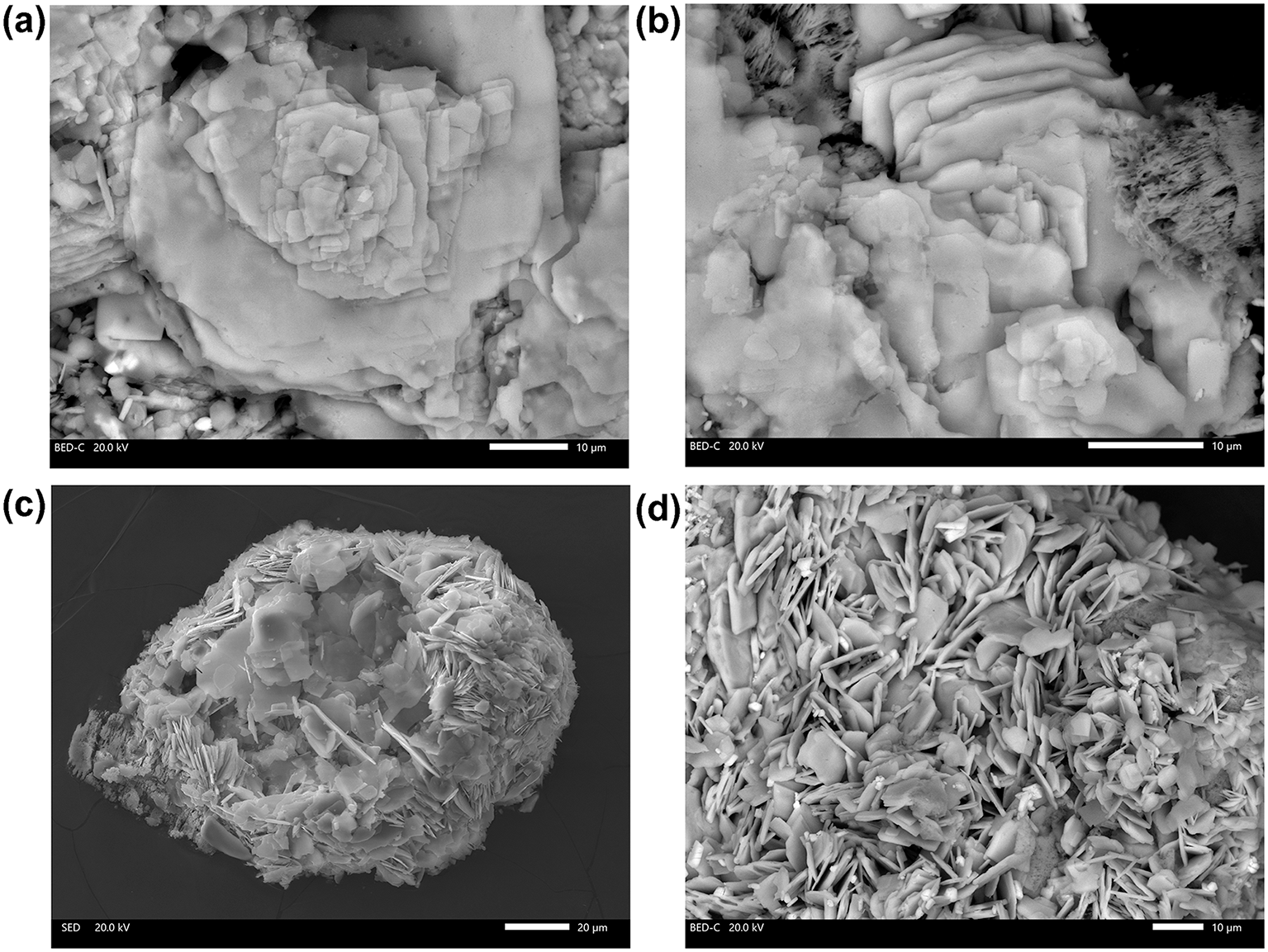
Natromolybdite occurs as rectangular, octagonal or rhomb-like lamellar to thin-tabular (probably flattened on [001]) crystals up to 40 μm across and up to 3 μm thick. By analogy with synthetic Na2MoO4·2H2O (see below), we assume that the major crystal form is the pinacoid {001}; lateral faces were not indexed. Natromolybdite crystals are usually crude, split and form near-parallel, sometimes pile-like or rose-like, aggregates (Figs 1a–c). Some small (up to 15 μm across) crystals are well-shaped (Fig. 1d). Natromolybdite crystal crusts (Figs 1c,d) up to 0.2 mm across overgrow aggregates of aphthitalite, belomarinaite, halite or sylvite.
We suggest that natromolybdite was deposited directly from the gas phase as a volcanic sublimate in the temperature range of 100–200°C. As our previous data show, the minerals containing OH groups or/and H2O molecules form in Tolbachik fumaroles at temperatures not higher than 200°C whereas from hotter gas only H-free minerals crystallise (Pekov et al., Reference Pekov, Zubkova and Pushcharovsky2018b).
Morphology of natromolybdite crystals and aggregates: (a) aggregate of split rhomb-like thin-tabular crystals on a crust of tiny cubic halite crystals; (b) near-parallel and rose-like aggregates of thin-tabular crystals on cellular aphthitalite crust; (c) crust of lamellar crystals which almost completely covers crude hexagonal thick-tabular aphthitalite crystal; and (d) crust of well-shaped lamellar crystals on halite. SEM images (a, b, d – BSE mode, c – SE mode). Field-of-view widths are (µm): (a) 76, (b) 49, (c) 178, (d) 114.

Physical properties and optical data
Natromolybdite is transparent, colourless, with white streak and vitreous lustre. It is brittle. Cleavage or parting could not be observed because the crystals are so thin that the examination of these properties, even under the scanning electron microscope, is difficult; however, the synthetic analogue of natromolybdite demonstrates perfect (001) cleavage, so we assume that the mineral will also have (001) cleavage (for more detail see Discussion). The fracture across a crystal is uneven (observed under the scanning electron microscope). The density calculated using the empirical formula and unit-cell volume found from the powder X-ray diffraction (XRD) data is 2.573 g/cm3.
Due to the tiny size of perfect crystals of natromolybdite (Fig. 1d) and split character of larger crystals (Figs 1a–c), the optical data were obtained for its synthetic analogue (see below). Synthetic Na2MoO4·2H2O is optically biaxial (+), α = 1.575(2), β = 1.576(2), γ = 1.598(3) (589 nm); 2V (meas.) = 20(10)° (visually estimated by the curvature of isogyre) and 2V (calc.) = 24°. The dispersion of optical axes is very strong, r < v and orientation is Z = c. In transmitted plane-polarised light, the synthetic analogue of natromolybdite is colourless and non-pleochroic.
Infrared spectroscopy
Due to the scarcity of available natural material, the infrared (IR) spectrum was obtained from the synthetic analogue of natromolybdite. The sample of synthetic Na2MoO4·2H2O was powdered, mixed with anhydrous KBr, pelletised, and analysed using an ALPHA FTIR spectrometer (Bruker Optics) at a resolution of 4 cm–1. A total of 16 scans were collected. The IR spectrum of similar pellet of pure KBr was used as a reference.
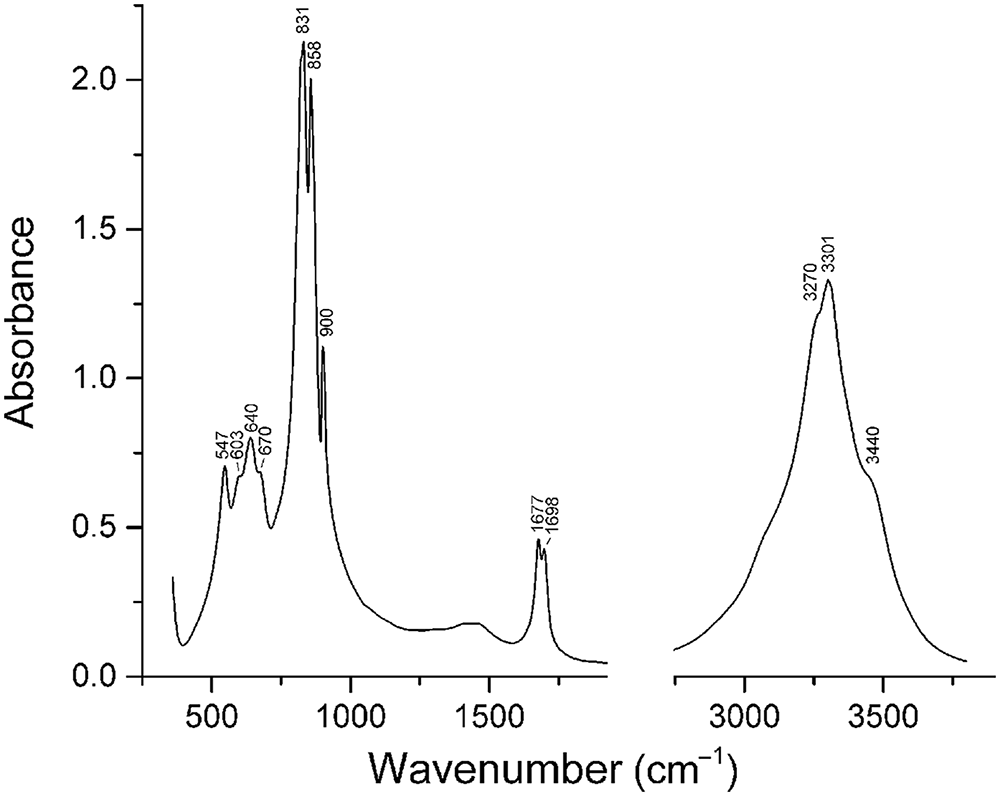
The IR spectrum of synthetic Na2MoO4·2H2O (Fig. 2) contains strong bands in the ranges of O–H stretching vibrations (3000–4000 cm–1), H–O–H bending vibrations of H2O molecules (at 1677 and 1698 cm–1), stretching (800–900 cm–1) and bending (500–700 cm–1) modes of the (MoO4)2– group. Weak absorption in the range 1300–1500 cm–1 may correspond to numerous overlapping bands of combination (Mo–O stretching and O–Mo–O bending) modes. Two bands of nondegenerate H–O–H bending modes correspond to two non-equivalent H2O molecules, in accordance with the structural data for synthetic orthorhombic Na2MoO4·2H2O (Matsumoto et al., Reference Matsumoto, Kobayashi and Sasaki1975; Capitelli et al., Reference Capitelli, Selim and Mukherjea2006).
The correlation between O–H stretching frequencies in IR spectra of minerals and O···O distances (in Å) for hydrogen bonds obtained from structural data is expressed by the equation (Libowitzky, Reference Libowitzky1999): ν (cm–1) = 3592 – 304·109·exp[–d(O···O)/0.1321]. Thus, the bands at 3440 and 3301 cm–1 correspond to the O···O distances of 2.83 and 2.74 Å. These values are close to the O···O distances of 2.828, 2.827 and 2.790 Å obtained from the crystal structure refinement (Capitelli et al., Reference Capitelli, Selim and Mukherjea2006).
The shoulder at 3270 cm–1 may be a result of Fourier resonance with the overtone of H–O–H bending vibrations.
The IR spectrum of synthetic analogue of natromolybdite, Na2MoO4·2H2O.

Chemical data
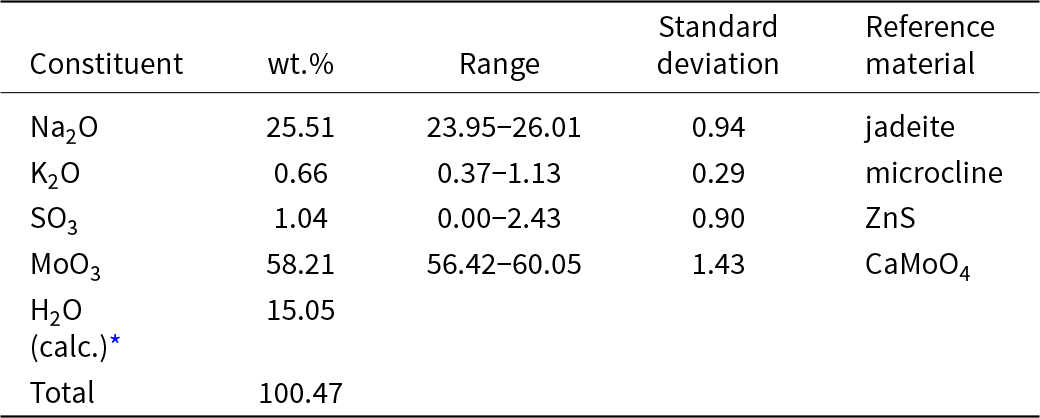
The chemical composition of natromolybdite was studied by electron microprobe using a Jeol JSM-6480LV scanning electron microscope (SEM) equipped with an INCA-Wave 500 wavelength-dispersive spectrometer (WDS) and a Jeol IT-500 SEM equipped with an X-Max-50 energy-dispersive spectrometer (EDS), both in the Laboratory of Analytical Techniques of High Spatial Resolution, Dept. of Petrology, Lomonosov Moscow State University. The operating conditions (WDS/EDS) were: an acceleration voltage 20/20 kV, a beam current 10/1 nA, and the electron beam diameter 3/1 μm. The obtained results are very similar. Special attention was paid to possible overlap of analytical lines of Mo (Lα) and S (Kα) in the ED spectrum. Chemical data (in wt.%, averaged for 5 spot analyses) are given in Table 1. The contents of other elements with atomic numbers higher than C are below detection limits. H2O was not analysed because of paucity of material. The IR spectrum of synthetic analogue of natromolybdite (Fig. 2) shows the presence of H2O.
Chemical composition of natromolybdite

* The content of H2O is calculated by stoichiometry, for two H2O molecules per formula unit, by analogy with synthetic Na2MoO4·2H2O.
The empirical formula of natromolybdite, calculated on the basis of 6 oxygen atoms per formula unit, including 2 oxygen atoms belonging to H2O molecules, is (Na1.971K0.034)Σ2.005(Mo0.968S0.031)Σ0.999O4·2H2O. The idealised formula is Na2MoO4·2H2O which requires Na2O 25.62, MoO3 59.48, H2O 14.90, total 100.00 wt.%.
The Gladstone-Dale compatibility index (Mandarino, Reference Mandarino1981) based on the optical data of the synthetic analogue of natromolybdite is 0.054 (good).
Natromolybdite should readily dissolve in water at room temperature, as tested on its synthetic analogue.
X-ray crystallography
Attempts to obtain single-crystal XRD data for natromolybdite were unsuccessful due to small size and low quality of crystals. However, the powder XRD data undoubtedly show that the mineral is a natural analogue of the well-known synthetic sodium molybdate dihydrate, Na2MoO4·2H2O, whose crystal structure has been reported in several publications (Atovmyan and D’yachenko, 1969; Mitra and Verma, Reference Atovmyan and O.A1969; Matsumoto et al., Reference Matsumoto, Kobayashi and Sasaki1975; Capitelli et al., Reference Capitelli, Selim and Mukherjea2006; Dominic Fortes, Reference Dominic Fortes2015). In all cited works, the orthorhombic space group Pbca (in the standard setting with c > b > a) and very similar unit-cell parameters were obtained for this compound.
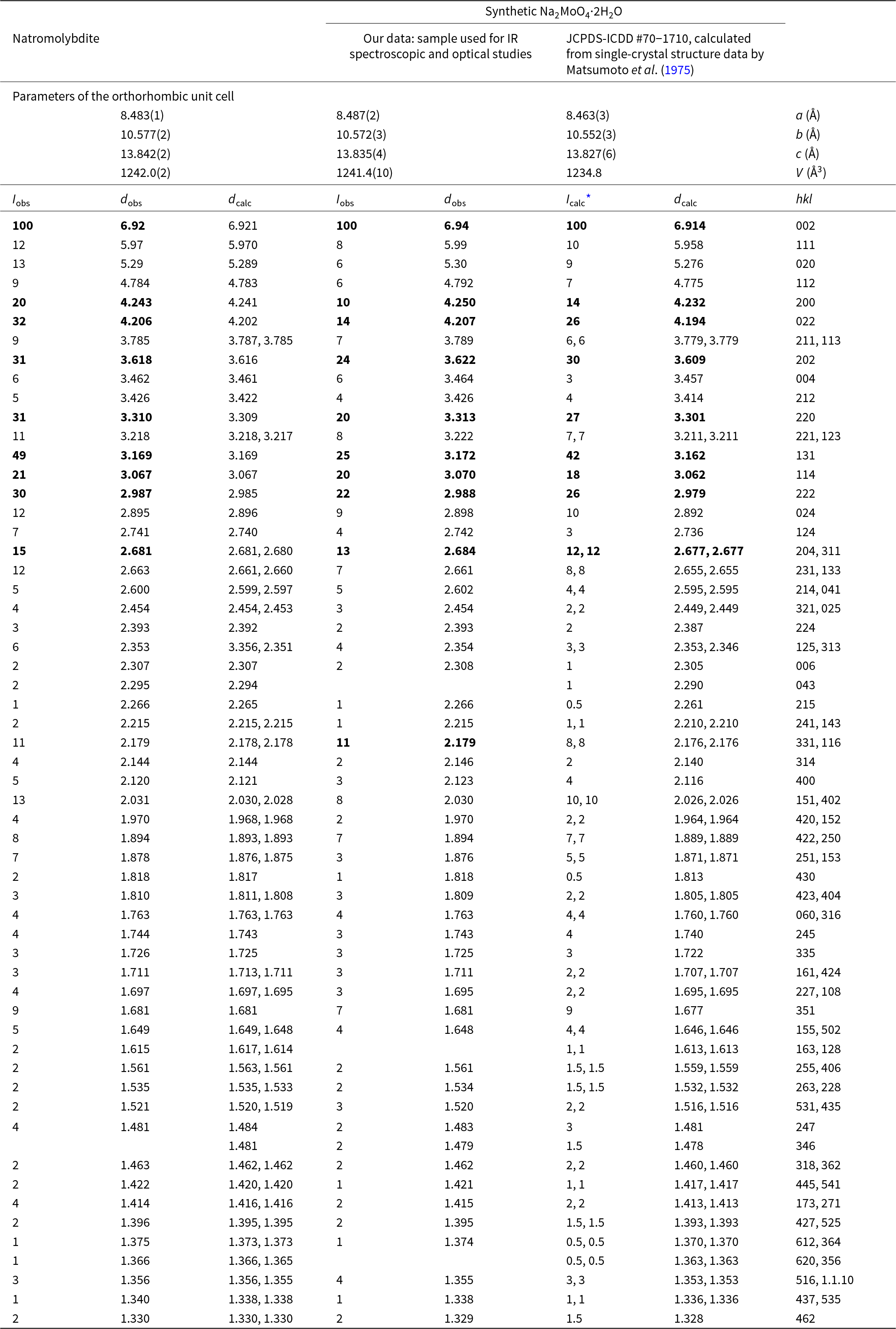
Powder XRD data for natromolybdite (Table 2) were collected in Debye-Scherrer geometry by means of a Rigaku RAXIS Rapid II diffractometer equipped with curved (semi-cylindrical) imaging plate detector (r = 127.4 mm), using CoKα radiation (λ = 1.79021 Å) generated by a rotating anode (40 kV, 15 μA) with microfocus optics; exposure time was 15 min. The imaging plate was calibrated against a NIST Si standard. The image-to-profile data processing was performed using osc2xrd software (Britvin et al., Reference Britvin, Dolivo-Dobrovolsky and Krzhizhanovskaya2017). Parameters of the orthorhombic unit cell of natromolybdite calculated based on the data for synthetic Na2MoO4·2H2O (Table 2) are: a = 8.483(1), b = 10.577(2), c = 13.842(2) Å, V = 1242.0(2) Å3 and Z = 8. The space group Pbca (#61) is accepted by analogy with synthetic Na2MoO4·2H2O. Systematic absences in the powder XRD pattern of natromolybdite agree with this space group.
Powder X-ray diffraction data (d in Å, I in %) and unit-cell parameters of natromolybdite and its synthetic analogue Na2MoO4·2H2O

* For the calculated pattern, only reflections with intensities ≥ 0.5 are given; the strongest reflections are marked in boldtype.
Discussion
Natromolybdite is the first natural sodium molybdate without other species-defining cations and the first mineral of the Na2MoO4·2H2O structure type.
In spite of the absence of single-crystal XRD data and directly measured H2O content in natromolybdite, there are no doubts that this mineral is a natural analogue of synthetic sodium molybdate dihydrate, Na2MoO4·2H2O, a compound well-known and studied in detail due to wide use in agriculture, pigment industry, metallurgy and medicine (Capitelli et al., Reference Capitelli, Selim and Mukherjea2006). The only slight chemical difference between natural and synthetic samples is in the presence of minor K and S admixtures in natromolybdite (Table 1), i.e. synthetic Na2MoO4·2H2O is a full analogue of the end-member natromolybdite. Measured and calculated powder XRD patterns of synthetic Na2MoO4·2H2O (e.g. JCPDS-ICDD, #34-0076) are very close to the powder XRD pattern of natromolybdite (Table 2).
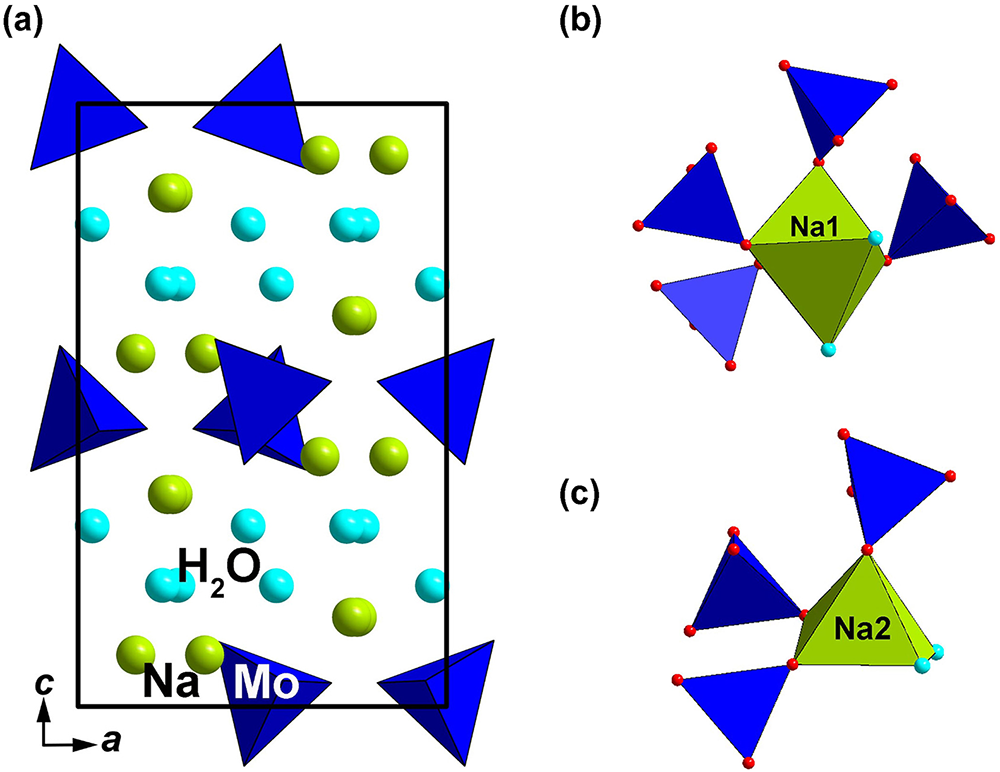
The crystal structure of Na2MoO4·2H2O has a quasi-layered character (Atovmyan and D’yachenko, Reference Atovmyan and O.A1969; Matsumoto et al., Reference Matsumoto, Kobayashi and Sasaki1975; Capitelli et al., Reference Capitelli, Selim and Mukherjea2006). It can be described as built of (001) layers of slightly elongate tetrahedral (MoO4)2– groups and Na+ cations. These layers are connected via (001) layers of H2O molecules (Fig. 3a). Two crystallographically non-equivalent Na cations have different coordination: the Na1 site is octahedrally coordinated by four O atoms participating in MoO4 tetrahedra and two O atoms of H2O molecules (Fig. 3b) whereas Na2 has square-pyramidal coordination by three oxygen atoms of Mo-centred tetrahedra and two O atoms of water molecules (Fig. 3c).
The crystal structure of synthetic Na2MoO4·2H2O with MoO4 groups shown as blue tetrahedra (a) and Na-centred polyhedra linked with MoO4 tetrahedra in it (b, c): drawn based on the data by Matsumoto et al. (Reference Matsumoto, Kobayashi and Sasaki1975). Light blue balls in (b) and (c) are O atoms belonging to H2O molecules. The unit cell is outlined in (a).

We used electron microprobe and powder XRD to analyse the reagent-grade chemical labelled as sodium molybdate dihydrate, commercially available from the Sigma-Aldrich company, and found it to be identical to both the structurally studied Na2MoO4·2H2O and natromolybdite (Table 2). This synthetic Na2MoO4·2H2O was used for our spectroscopic and optical studies. The transparent colourless crystals (up to 3 mm in size) of the studied synthetic Na2MoO4·2H2O are tabular and some of them are very similar in shape to natromolybdite crystals shown in Fig. 1a. Synthetic crystals have perfect cleavage parallel to the plane in which the crystal is flattened. Taking into account the quasi-layered character of the structure, with layers of H2O molecules between the Na–MoO4 layers which alternate along the c axis (see the text above and Fig. 3), we suspected that the cleavage plane is (001), and the pinacoid {001} is the major form of flattened crystals of synthetic Na2MoO4·2H2O. This assumption was confirmed by the direct determination of crystal orientation using a Rigaku-Oxford diffraction XtaLAB Synergy-S single-crystal diffractometer. Based on the morphological similarity of synthetic and natural crystals, we believe that natromolybdite crystals (Fig. 1) are also flattened on [001] and thus the pinacoid {001} is the major form.
Acknowledgements
We are grateful to M. Akasaka, P. Leverett and an anonymous reviewer for valuable comments. The mineralogical study was conducted under the state assignment of Lomonosov Moscow State University (state task No. 121061600049-4). The powder XRD investigation was carried out at the Center for X-Ray Diffraction Research of the Science Park of St. Petersburg State University within the framework of project 125021702335-5. The IR spectroscopy study was performed in accordance with the state task, registration number 124013100858-3.
Competing interests
The authors declare none.