1 Introduction
References to t-to-r in the literature are sparse, though most readers will have come across this phenomenon in volume 2 of Wells’ Accents of English. Here, Wells (Reference Wells1982: 370) refers to t-to-r as ‘a widespread but stigmatised connected-speech process in the middle and far northFootnote 2 [which] involves the use of /r/ instead of /t/ in phrases such as shut up [ʃʊɹ ʊp], get off [ɡɛɹ ɒf]’. On the basis of this description Wells formulates the t-to-r rule as:
(1) t→ r /[short V] __#V
This rewrite rule specifies that when word-final /t/ is followed by a vowel-initial word and preceded by a short vowel, the /t/ will be replaced by /r/. Wells comments that h-dropping feeds t-to-r (e.g. not having [nɒɹ avɪn]) and, additionally, that the process operates ‘very occasionally’ within the word as in what's the matter [maɹə]. He speculates that historically this was probably a tapping process /t/→ [ɾ] which may then have been reinterpreted ‘by the use of the prevailing /r/ variant, [ɹ]. . .’(Wells Reference Wells1982: 370). This comment is neither supported nor developed. However, it is interesting, not least in that it suggests that this Northern English process is closely related to tapping found for example in dialects of contemporary American, Australian, and Irish English.
Although Wells does not provide any detailed information for the subvarieties found in the middle and far north, two northern varieties have enjoyed a certain amount of coverage in the more recent literature: Tyneside (Carr Reference Carr1991; Docherty, Foulkes, Milroy, Milroy & Walshaw 1997) and Liverpool (Honeybone Reference Honeybone2001; Sangster Reference Sangster2001; Watson Reference Watson2002). All these accounts suggest that t-to-r is still essentially a connected speech process whereby /t/ is replaced predominantly by [ɹ], but also by [ɾ]. However, they also reveal that Wells’ characterisation is far too general and does not account for the phenomenon as it is manifested in either Tyneside or Liverpool. As we shall see in section 2, these studies reveal that t-to-r is lexically restricted and this suggests that t-to-r in some, if not all, contemporary northern varieties is a remnant of a once productive process. Other northern varieties, including West Yorkshire (WY), have received very little attention. Lodge (Reference Lodge1984) provides evidence of t-to-r in Stockport (Greater Manchester). Petyt (Reference Petyt1985) refers very briefly to t-to-r being an intervocalic process which interacts with glottalling in his sociolinguistic study of a number of variables in West Yorkshire. Petyt is primarily concerned with the glottal stop and only gives two examples of what he refers to as ‘a sort of linking r’ (Petyt Reference Petyt1985: 151).
- (2)
(a) get out [ɡɛɹ aʊt]
(b) ‘they say [ɡɒʔ ə] whereas I would say [ɡɒɹ ə]’ (Petyt Reference Petyt1985: 151–3)
One of the aims of this article is to provide a more detailed account of t-to-r in WY which can be related to the Tyneside and Liverpool data. This will help researchers to track this Northern English phenomenon and develop a more comprehensive picture of it. However, the article will not only look at the status of t-to-r in contemporary WY, it will also consider nineteenth-century sources in an attempt to discover what the process might have been when it was fully productive. I shall argue that contemporary t-to-r is the remnant of a once productive process, something akin to contemporary American flap/tap.Footnote 3 I shall set out to demonstrate that the contemporary WY phenomenon poses some interesting challenges for contemporary phonological theory, but that Usage-Based Phonology offers a potential solution. I will develop an account of the loss of t-to-r which hinges on the interaction of this process with that of glottalling, by which I mean glottal replacement. Specifically, I shall claim that as glottalling started to develop in West Yorkshire speech during the course of the twentieth century, it hastened the fossilisation of the nineteenth-century t-to-r process. Key to both the demise of t-to-r, in the face of the emergent glottalling process, and its residue in a small group of words is frequency of use (Blevins Reference Blevins2004; Bybee Reference Bybee2001, etc.; Hume Reference Hume2004; Haspelmath Reference Haspelmath2006; Pierrehumbert Reference Pierrehumbert2001a, Reference Pierrehumbert2001b, amongst many others).
The article will be structured as follows. Section 2 will begin with a closer look at t-to-r in Tyneside and Liverpool and then present contemporary data from West Yorkshire. Once the WY picture is set out and compared with these other northern varieties, section 3 will look at some WY data from the nineteenth century. Section 4 will consider the claim that whilst t-to-r may well have been the main lenition process in nineteenth-century WY, its demise was brought about by the main twentieth-century lenition: glottalling. This section will look at the development of glottalling and suggest that frequency of use lies at the heart of its development and t-to-r's demise. Section 5 will then briefly consider why t-to-r is problematic for contemporary phonological theories such as Lexical Phonology and Optimality Theory, neither of which can account for the phenomenon without recourse to ad hoc machinery. Finally, the article concludes with a potential solution suggested by Bybee's Usage-Based Phonology.
2 t-to-r in Northern English
This section will begin with a sketch of Tyneside and Liverpool t-to-r, since these are the most studied varieties. This will also serve to establish some of the issues raised by t-to-r. Contemporary WY data will then be set out and discussed in relation to Wells’ characterisation and the issues raised by the Tyneside and Liverpool data.
2.1 Tyneside
Carr (Reference Carr1991) looks at the interaction of the glottalisation of /p, t, k,/ with t-to-r (which he calls weakening) in Tyneside English. He claims that both processes are metrically sensitive, but describes glottalisation as an ‘across the board rule’. More specifically, providing /p, t, k/ are foot internal, they will be glottalised. It is irrelevant whether the foot is in a morphologically simple word (e.g. stupid, winter), a morphologically complex word (fitter, clipper), or has been formed postlexically (e.g. clip her wings, chant it). Other examples of across the board rules include aspiration and flapping.Footnote 4 Carr claims that weakening only occurs in feet that have been formed postlexically. This means that t-weakening can occur in fit (h)er, but not fitter. Foot formation for fitter occurs within the lexicon and for this reason it does not undergo weakening. In contrast, since foot structure is built postlexically for fit her, it can weaken. The Elsewhere Condition is invoked since weakening applies to a subset of forms that glottalise. Hence the claim is that weakening applies first, followed by glottalisation.
Weakening is described as a neutralisation phenomenon because [ɹ] is the typical result of weakening and the predominant r-type within the variety. However, Carr notes that a tapped realisation is also possible. Carr observes weakening in:
- (3)
(a) Words belonging to nonlexical categories
not: not a chance, not altogether
but: but he wouldn't
what: what a night, what is he doing, what about Jim
that (as complementiser or determiner): I knew that he would, eat that egg
in verbs:
(i) Monosyllabic: put: put it down, put in front, met him, hit him, get away, get up, got a light, I thought I had, fit her
(ii) Bisyllabic, with stress on the second syllable: allot it, delete it, incite it,
excite her
(b) there is no weakening when the last syllable is not stressed:
*edit it, *elicit it, *interpret it
(Carr Reference Carr1991: 46)
Carr's conclusion is that weakening is largely restricted to verbs plus some nonlexical words and that it is not found in nouns, adjectives, or prepositions (1991: 47). Carr notes that weakening ‘now appears to be operating word internally’ in better, matter, and Beethoven, and claims that these forms are all lexicalised (1991: 52).
Docherty et al. (Reference Docherty, Foulkes, Milroy, Milroy and Walshaw1997) carried out an extensive survey of glottalisation vs t-to-r, and concluded that Carr does not adequately capture the distributional relationship between the two in that they are not in complementary distribution. Indeed, fit her was found to be subject to either glottalisation or weakening, contrary to Carr's claim that this permits weakening only. They also take up the comments about word-internal weakening and note that it occurs very occasionally in e.g. bottom, matter, and putting (1997: 291). Docherty et al. (1997: 289) found that there was ‘a substantial quantitative difference in incidence, so that some environments may be described as preferential sites for one process or the other’. They conclude that ‘a lexical conditioning factor is involved in weakening. . .since a small number of lexical items such as got, lot, put constantly recur with [ɹ]’ (1997: 292). But they observe that get up and put it down, for example, are much more likely to exhibit weakening than fit her.
2.2 Liverpool
Honeybone (Reference Honeybone2001) is primarily concerned with the processes of stop frication/affrication in Liverpool, so t-to-r does not receive extensive coverage. He also mentions a /t/→ [h] phenomenon which is highly restricted in that it occurs prepausally/utterance final and, even so, only in a very small group of words: but, that, it, what (Honeybone Reference Honeybone2001: 239). Honeybone's comments suggest that the examples he provides do not constitute an exhaustive list, but rather a representative one. When describing t-to-r in Liverpool, Honeybone comments that this is restricted to [stressed short v__#v] and ‘this rhotacism typically affects final segments in only a small set of words, not unlike those’ referred to for /t/→ [h]. Watson (Reference Watson2002: 200) goes somewhat further and claims that ‘/t/ can be realised as [r], only in environments which promote /t/→ [h]’. He argues that /t/-to-[h] can occur in the following:
(4) what, that, it, at, but, lot, get, got (Watson Reference Watson2002: 199)
Watson describes these words as monosyllabic function words and argues that get and got are the odd ones out here in that they are not straightforwardly function words, ‘they can, in some sentences, behave in a similar way’. However, Watson also has data which suggest that when in utterance-final/prepausal position and preceded by [ɨ], certain polysyllabic words can also exhibit t→ h: climate, pilot, maggot, budget, gadget, target, and aggregate (Watson Reference Watson2002: 199–200). When these words are followed by vowels, they may exhibit [ɾ].
So, there does appear to be some variation between t-to-r in Tyneside and Liverpool in that it appears to be somewhat more extensive in Liverpool given the possibility of a tap in word such as pilot, gadget, etc. However, these characterisations suggest that Wells’ description is far too general. This is not a productive process in the usual sense of the word, rather it is highly restricted in both northern varieties considered so far. It does appear to be a largely connected speech process and it appears to be predominantly represented by [ɹ], though [ɾ] is also possible. With these characterisations of Tyneside and Liverpool in mind, section 2.3 will examine contemporary West Yorkshire data.
2.3 West Yorkshire
The data presented below come from a small number of conversations between speakers from Morley (South Leeds) which ranged from half an hour to an hour and a half in duration, recorded in 2006. This data set has been supplemented by examples taken from fieldwork started in 1990.Footnote 5 Quantitative sociophonetic work in the spirit of Docherty et al. (Reference Docherty, Foulkes, Milroy, Milroy and Walshaw1997) has not been carried out, since this article seeks to track the phonology of the phenomenon and leaves any study of the interaction between the phonology and sociolinguistic factors (e.g. gender, age, and class) to further work. Consider the following, which are representative of the most typical t-to-r occurrences:
(5) get it written and get it off [ɡɛɹ ɪʔ ɹɪʔ
 ɡɛɹ ɪʔ ɒf]
I don't know what I was doing [wɒɹ a wə duɪn]
I've got her a birthday card [av ɡɒɹ əɹ ə]
but it used to do it to the ginger cat [bʊɹ ɪʔ juːs tə du ɪʔ təʔ dʒɪndʒə kaʔ]
can buy something and put it in [pʊɹ ɪʔ ɪn]
the water was so freezing that I only stayed in for five minutes [ðəɹ a]
if they like to think that, let them [lɛɹ əm]
I've forgot her name now [af fəɡɒɹ ə neːm naʊ]

The data in (6) can be used to claim that h-dropping ‘feeds’ t-to-r, though this requires further comment. For many WY speakers, the variety is arguably better described as h-less,Footnote 6 so any comment about h-dropping interacting with t-to-r is misleading.
(6) and I let her come [ən a ˈlɛɹ ə ˈkʊm]
but he's the skater [bʊɹ ˈiːz ðə ˈskeːtə]Footnote 7
you want to get him in [ˈɡɛɹ ɪm ɪn]
Word-internal t-to-r is more common than Wells suggests, though the example that Wells uses (cf. matter) is perhaps the rarest form of all in WY. It is far more usual to find t-to-r in the present participles for putting and getting (forgetting is likely), and better also exhibits t-to-r as in:
(7) I was just getting up [a wɒ dʒʊs ɡɛɹɪn ʊp]
putting her jacket on [pʊɹɪn ə dʒakɪt ɒn]
you'd better go [jəd bɛɹə ɡoː]
I'd better put a hood on [bɛɹə pʊʔ ʔʊd ɒn]
These data demonstrate that the most common words to exhibit t-to-r are but, get, got, put, what, that, and let. Within this group a further distinction can be made in that but, get, got, and put are more likely to exhibit t-to-r than what, that, and let. T-to-r typically manifests as [ɹ], though [ɾ] is also found. A further manifestation of the process is voicing to [d]; this seems particularly common with but. Further work is required to complete the phonetic detail here.
T-to-r is still found in shut up [ʃʊɹ ʊp] and although this is the most common instance of shut + V-initial word, it does occur with other V-initial words, though this is extremely rare. The well-known northern farewell ta ta typically exhibits [taɹa]. Forget/forgot, bet, and not cannot be excluded from this list and although lot may still exhibit the phenomenon, it is by no means as certain as all the data items mentioned so far.Footnote 8
On the basis of these data, together with data from fieldwork spanning the past seventeen years, the items can be divided into four groups: (1) regular t-to-r exhibitors, (2) not so common t-to-r exhibitors, (3) rare/uncertain, and (4) t-to-r not possible. It should be clear from the discussion above that forms such as but, put, get, got fall into category (1); shut up, forget/forgot, and not fall into category (2). However, there is also a grey area where it seems likely that t-to-r should be possible, but there is little or no evidence to support or reject this. When I first began working on this phenomenon in the early nineties, lot would have been placed in the definite category, alongside put and get. No instances of lot were produced when these data were being gathered, and it is not entirely clear whether lot should be classified in category (3) or even in category (4).Footnote 9Bet is another example of a marginal case. Although no instances were found when the specific data for this article were collected, I have recently observed I bet I've got [a bɛɹ av ɡɒʔ] and I bet he'll only [a bɛɹ iːl oːnlɪ] from one of the speakers represented above. Given the presence of t-to-r in better, these examples are not surprising. It is probably best classified in category (2), though (3) may be more appropriate. Finally, there are words which are claimed to exhibit t-to-r in other varieties, but which do not appear to participate in WY: it, sit, fit, cut, set, wet. These words are therefore classified in category (4).
Putting and getting provide the most common instances of word-internal t-to-r and are therefore classified as category (1). Better can be classified as category (2), since it exhibits t-to-r but, unsurprisingly, it is not as common as putting and getting. Matter, as in what's the matter, was a difficult word to judge back in 1990, but did still occur with [ɹ] then and would have been classified as category (2/3). I have no recent examples to support its continued existence and will classify it as category (3). Since the present participles form the most common cases, forgetting, letting, shutting, and betting might also be expected to exhibit t-to-r. Only one of the four is certain: forgetting category (2). I suspect that letting may still do so too (category (2/3?)). Betting [bɛɹɪn] and shutting [ʃʊɹɪn] also have no recent examples, but throughout the past seventeen years of monitoring this process these forms have always seemed distinctly odd and I have no instances to support them as possibilities category (4?).Footnote 10 With this in mind, how does t-to-r in WY compare with that in Tyneside and Liverpool?
2.4 Comparison of West Yorkshire t-to-r with Tyneside and Liverpool
A number of points arise from Carr (Reference Carr1991), Docherty et al. (Reference Docherty, Foulkes, Milroy, Milroy and Walshaw1997), Honeybone (Reference Honeybone2001), and Watson (Reference Watson2002) of which two will be considered below: t-to-r appears to be lexically restricted and t-to-r occurs foot internally.
Although this study does not provide a quantitative analysis of the type found in Docherty et al. (Reference Docherty, Foulkes, Milroy, Milroy and Walshaw1997), category (1) items for WY correspond to the data items found to be most common in Tyneside. Indeed Patrick Honeybone (p.c.) believes that category (1) items are likely to be the core set for all contemporary northern varieties. However, there is no sense in which t-to-r in monosyllabic words is restricted to function words. Put, let, bet, and shut are not function words, and although Watson comments that get/got can arguably be an auxiliary, there are many cases in the examples set out above where get is clearly not an auxiliary. Indeed, the examples provided above give only one instance of get functioning as an auxiliary; in all other cases, get/got is the main verb. In section 5 below, I will argue that there is a connection between these words, but not the one that has been suggested in the literature.
The process in West Yorkshire certainly looks like a connected speech process, but is found word internally far more frequently than Wells suggests. Carr (Reference Carr1991) states that t-to-r in Tyneside is a foot-internal process. Although this is predominantly true in WY, it is not always the case. Several examples where t-to-r is not foot internal have been found. Two examples are illustrated in (8) below.
(8) Have you put an energy bulb in? [av jə pʊɹ ˈɛnədʒɪ bʊlb ɪn]
but he's the skater [bʊɹ ˈiːz ðə ˈskeːtə]
One reason why WY t-to-r may not be sensitive to foot structure is that it is no longer a productive process.
So far, we have established how t-to-r manifests itself in WY and how this compares with other contemporary varieties of Northern English. The WY data suggest that contemporary t-to-r is the remnant of a sound change and so this is the next issue to be considered: what did t-to-r look like when it was a fully productive process? The nineteenth-century literature does contain descriptions of its existence and so two sources will be examined in section 3: Ellis (Reference Ellis1889) and Wright (Reference Wright1892).
3 Nineteenth-century West Yorkshire data
3.1 Ellis
Ellis (Reference Ellis1889) states that his goal is to record either current dialect uses or forms that have been used over the past 100 years. Ellis did not collect his own data since he was not a dialect speaker and was concerned that dialect speakers would modify their speech if he were to approach them. To overcome this, he employed researchers to gather his data for him. For example, he employed Leeds-born C. Clough Robinson to gather information on Leeds, and J. Wright supplied information on Windhill (which was classified under Bradford). At this time, Yorkshire was divided into Ridings and the West Riding, which incorporates West Yorkshire, was described as part of the North Midland area. This included Huddersfield, Halifax, Keighley, Bradford, Leeds, and Dewsbury, which are nowadays all classified as West Yorkshire, and Sheffield, Barnsley, and Rotherham, which are now classified as South Yorkshire.
Ellis comments that ‘on comparing the varieties for Bradford and Leeds, the differences are scarcely perceptible’ (Ellis Reference Ellis1889: 395), and also notes the ‘minute differences between Leeds and Wakefield’ (Ellis Reference Ellis1889: 401). He says that Dewsbury is the most distinct variety of the group. He provides selections of transcription set out according to nine varieties so that they can be very easily compared. It is typically the case that variation concerns vowels, or words, and more rarely consonantal differences.
With this background in mind, we can now consider Ellis’ comments on t-to-r. Quoting C. Clough Robinson, Ellis states that both ‘t, d preceding a vowel and after a short vowel becomes very vulgarly (r)’ (Ellis Reference Ellis1889: 395). In (9) below I have set out his data:
(9)
at, sat, chat, what, spat, cat, hat [past of hit]
ad, glad, swaddy [soldier], bad, shadow,
dad, mad, et [past of eat], let, get, met, wet, set
wed, led, bled, sled [slipper]
it, hit, sit, flit, split, little, bit, hiddy [to hide]
smiddy [smith], did, bid,
ot [hot], got, cot, spot, od [hold], sod, not, modern
but, foot, shut, glutton, mutty [calf], mud [might]
good, stood, huddle, budding, sud [should]
(Ellis Reference Ellis1889: 400)
As data sets go, this is not particularly helpful and we should be careful not to assume that this is strictly accurate. However, we can assume that Ellis has captured a generalisation: that both /t/ and /d/ become [r] when preceded by a short vowel. Furthermore, we can assume that this generalisation reflects a productive lenition process in WY phonology during the nineteenth century.
3.2 Wright
Wright published his Dialect of Windhill in 1892 and in this he presents a much more complete study of this particular West Yorkshire variety. In it he states that ‘the t in all verbal forms ending in t preceded by a short vowel, appears as r when the next word begins with a vowel’ (Wright Reference Wright1892: 87) and he exemplifies this with:
(10)
[a miːt ɪm ɪvrɪ deə] I meet him every day
[a mɛr ɪm ɪvrɪ deə] I met him every day
[ɡɛt mə wʊn] get me one
[ɡɛɹ ʊp] get up
(1892: 88)
In the first example in (10), t-to-r is prevented because the vowel to the immediate left of /t/ is long. This contrasts with the second example where the short vowel left requirement is satisfied and t-to-r is exhibited. In addition to these examples, Wright lists the following: gar ‘got’, ir ‘to hit’, ler ‘to let’, pur ‘to put’, sar ‘sat’, ser ‘to set’, sir ‘to sit’, ∫ur ‘to shut’. He notes that t-to-r is found in present participle forms such as [ɡɛrɪn] getting. Almost as an afterthought he notes that the pronoun what does it too. Wright's description is much closer to the description given for contemporary WY above, but, with some notable exceptions which will be discussed below, this is clearly a more general process.
Ellis and Wright's comments prompt two questions: can we rely on historical sources such as these? If they are regarded as valuable, what can we make of the discrepancy between the two?
3.3 Are historical sources reliable?
Jones (Reference Jones2002) asks this question about Ellis’ work in his discussion of definite article reduction in Sheffield. He notes that although Ellis has been subjected to a great deal of criticism in the past, more recently, some respected linguists have praised his work. According to Jones (Reference Jones2002: 332), Trudgill regards Ellis’ Norfolk data as being ‘more reliable than the SED’. (See Jones Reference Jones2002 for a full discussion of why Ellis and researcher T. Hallam should be regarded as a useful and reliable source.)
In what follows I shall argue that Joseph Wright should be regarded as a reliable source of historical information. First of all, Wright was born in 1855 in Thackley near Bradford (E. Wright 1924: 5). He did not enjoy a privileged upbringing, and his background was such that one would not have expected him to become Professor of Philology at Oxford. During his early childhood, he spent many periods in the workhouse. He began work at the age of 6 (ibid.: 12). At the age of 7 he began to work for Titus Salt (born in Morley) and started to attend the school provided by Salt for his workers. A child attending this school would have left school at the age of 13, but Wright's family circumstances forced him to leave after a much shorter time. Although E. Wright does not record when Wright left school, she quotes him as saying
When I left school. . .I knew very little more than when I first went. I knew the alphabet, and had a smattering of elementary arithmetic, and I could recite,. . .Reading and writing, for me, were as remote as any of the sciences. (ibid.: 15)
Wright taught himself to read and write, inspired by listening to men reading reports of the Franco-Prussian war (ibid.: 19). E. Wright records a spell at night school for ‘working lads’ (ibid.: 20), though she notes that he did not attend for long. Since Wright and his mother were the breadwinners, and supported themselves and three other boys, it must have been tremendously difficult to combine full-time strenuous work with study. However, this is precisely what Wright did. He started to learn French at night school, followed by German. Wright eventually went to Germany and studied there for six years (ibid.: 54) before taking up a post at Oxford, where he was to became Professor of Philology. He dedicated his life to the study of accents and dialects and, like Ellis and Sweet, regarded the use of an accurate and transferable transcription system as vital to his work (ibid.: 135). His dedication to the study of accent and dialect culminated in the dialect dictionary (ibid.: 96).Footnote 11 His Dialect of Windhill is described as ‘the first grammar of its kind in England: a scientific study of a living dialect intended to be useful to philologists’ (ibid.: 73). E. Wright describes him as being very proud of his own Yorkshire dialect and he can be regarded as one of the founders of the Yorkshire Dialect Society. So here is a man who was not only an eminent philologist and a proponent of accurate and transferable transcription, but was a native speaker of a nineteenth-century West Yorkshire accent. Given his background, his pride in the Yorkshire dialect and the direction his life's work took, Wright's work should be taken extremely seriously.Footnote 12
In sum then, both Wright and Ellis are arguably valuable data sources for contemporary linguists. We should always be cautious about the specifics though and, indeed, there are discrepancies between the two which will be considered in the next section. However, as already pointed out, we should assume that what they present is a generalisation and as such their work is very valuable. So how can the difference between the two be reconciled?
3.4 Reconciling Ellis and Wright
One possibility is that this discrepancy reflects a difference between Leeds and Bradford pronunciation. However, this contradicts Ellis’ comment that ‘the differences are scarcely perceptible’ (Ellis Reference Ellis1889: 395). Alternatively, Ellis’ comments on t-to-r may reflect an earlier stage of WY phonology. Although the former was published in 1889 and the latter in 1892, it does not follow that both reflect WY in the late nineteenth century.Footnote 13 We need to bear in mind that Wright was focusing on one variety and Ellis’ work is looking at all varieties. Ellis’ opening comments lend some support to this suggestion that the work refers either to contemporary speech or to speech of the past 100 years. I suspect that Ellis’ notes on /t/ and /d/ to [r] reflect a much earlier state of affairs and that Wright's notes refer to the situation in the late nineteenth century. In other words, the two sources might be taken to suggest that this was once a much more general process, which was not lexically restricted and not simply restricted to /t/. This gains support from the fact that contemporary varieties of English exhibit a process whereby /t/ and /d/ tap, e.g. General American. Hence Ellis’ pattern matches patterns found in contemporary varieties. It does not require a huge leap of faith to assume that in the early nineteenth century a tapping system was operative in WY and presumably in the whole of the north of England.Footnote 14 I have referred to it here as a tapping system, since all the data presented in this article suggest one major difference between contemporary American systems and the WY system: the former has no vowel quantity restriction, the latter does. In what follows I shall not be concerned with relating the two systems; I shall leave this to further work. Nor shall I be concerned with the alleged loss of d-to-r (but see Broadbent in prep. for some discussion of why d-to-r might have disappeared first when the process started to disintegrate). In what follows, deliberations will be restricted to the period from the late 1890s to the present day (in other words, from a period when t-to-r was arguably an already reduced process, but still productive, i.e. affecting /t/ only, but productively).
3.5 How productive was t-to-r in the late nineteenth century?
This comment about productivity requires some investigation, since Wright tells us that ‘[t]he t in all verbal forms ending in t preceded by a short vowel, appears as r when the next word begins with a vowel’ (Wright Reference Wright1892: 87). Had the process already become lexically restricted? The answer may be yes. Carr (Reference Carr1991) certainly assumes that Wright is flagging up a lexically restricted process. However, although Wright notes t-to-r in verbal forms and what, we have seen that in contemporary West Yorkshire, ta ta, that, better, lot, matter, not, and but also exhibit t-to-r, so why is there no mention of any of these words in Wright? First of all, as already highlighted, both sources are recording a generalisation. However, but is one of the most frequent forms to exhibit t-to-r in contemporary WY and yet it is not included in Wright's comments about t-to-r. Wright comments that but was pronounced [bəd]. This is still a pronunciation in contemporary West Yorkshire, and is arguably a form of t-to-r realisation. On the basis of this, I would assume that t-to-r did apply to but in nineteenth-century WY speech.
From Wright's discussion it would appear that many of the other words that one might expect to exhibit t-to-r could not do so for other reasons. Wright tells us that not was pronounced [nət] or [nt]. Wright (Reference Wright1892: 75) states that the latter form was common and the former rare. Since the latter is a clitic and lacks the short vowel left, it could not have undergone t-to-r. It is not surprising that Wright does not include this in his list.
He states that this and these are typically followed by here [iə(r)] and that and them by there. As in:
(11)
[a kaːnt ɛɪt ðat ðiə mɛɪt] I can't eat that there meat.
[ðɛm ðɪər aplz kɒst tʊpms] Them there apples cost twopence.
(1892: 124)
If that was typically followed by there, it would have been prevented from exhibiting t-to-r. Presumably, other collocations gained frequency prior to this process ceasing to be productive and that allowed that to participate. Once again, t-to-r must have been productive.
According to Wright it had a strong and weak form: [it] and [t]. Wright's examples suggest that the weak form cliticised with some other word:
(12)
[ʃə θɛŋkt əz fə tpeənz wid teən wɪt]
She thanked us for the pains we had taken with it.
(Modern-day pronunciation of with it would be [wij ɪʔ])
[wɪtə lɛn mət] Wilt thou lend me it?
[kan tə diut bi ðisɛn] Can you do it by yourself?
[wɛn təʔ rɛdɪ wɪl sɛnd ðət] When thou art ready we'll send thee it.
(1892: 117)
Arguably, it does not participate in t-to-r because it is typically just /t/ which cliticises with other words in order to be pronounced. This must have been sufficient to prevent it from taking part and, presumably, this did not become substantially different until t-to-r had ceased to be productive.Footnote 15 These examples should be sufficient to illustrate the point that there are various system-internal reasons why certain words do not appear to have exhibited t-to-r at the time that Wright is writing.
To conclude this section, Wright's evidence may be taken to suggest that the decline of this process had already begun. However, it indicates that the process was still productive and there is evidence to suggest that a number of words which we might have expected to exhibit [r] did not do so typically because they were not used in an appropriate phonetic context: they did not arise prevocalically. So, at the end of the nineteenth century, t-to-r was still a productive process in WY. Is there any evidence to suggest what might have caused the process to decline so dramatically over the course of the twentieth century to the fossilised state found at the turn of the twenty-first century? In the following section I will present evidence that a different type of lenition process caused the fossilisation of t-to-r. I shall set out to demonstrate that frequency of use was at the heart of this demise, but also was responsible for preserving t-to-r in the restricted lexical set which exhibits t-to-r today.
4 Glottalling: t-to-r's nemesis?
Many researchers mention in passing that glottalling has undoubtedly come in to English over the course of the twentieth century, but they rarely support this assertion with their own work or references to others. Trudgill (Reference Trudgill1974) does present a case for this having happened in Norwich and Sullivan (Reference Sullivan1992) also looks at the increase of glottalling in Exeter. Petyt (Reference Petyt1985) suggests that glottalling has come into WY speech (see also Broadbent, in prep.).
4.1 Glottalling in Britain
Andrésen (Reference Andrésen1968) presents a history of glottalling from the mid nineteenth century onwards. He rejects some potential references found in seventeenth-century writing, because they could be attributed to spelling errors. Rather, he accepts cases where sufficient descriptions are given that allow an interpretation of either pre-glottalisation or of glottal replacement. According to Andrésen (Reference Andrésen1968: 12), Alexander Melville Bell gives the first convincing reference to the ‘glottal catch’ for west Scotland in the mid nineteenth century. However, Bell's ‘glottal catch’ refers to pre-glottalisation. It is clear from Andrésen's survey of references that pre-glottalisation is identified in Scotland first and it is here that the first references to glottal replacement are found too. According to Andrésen, it is not until Sweet (1908) that we start to get explicit references to glottals in England:
In some North English and Scotch dialects (such as that of Glasgow) the glottal stop occurs as a substitute for the ordinary mouth-stops, as in the Glasgow pronunciation of wa!ər.Footnote 16 (Sweet 1908, cited by Andrésen Reference Andrésen1968: 15)
This provides a tantalising reference to Northern English without any specific detail. Daniel Jones (1909) refers to glottal replacement in Scottish and London. However, it is Jespersen (1909) who makes specific reference to a northern variety:
After a vowel it is found pretty often in the North of England and in Scotland, especially among the uneducated, but by no means exclusively among dialect speakers; the same person sometimes has it in words which he or she pronounces without it a moment afterwards; it seems to be instrumental in giving emphasis to a word. It is only found immediately before [p,t,k], the onglide to which it makes inaudible. (Jespersen 1909, cited by Andrésen Reference Andrésen1968: 16)
Jespersen refers to glottalisation of word-final /p, t, k/ in Sheffield. Whilst pre-glottalisation is attested in Sheffield, Jespersen comments that glottalisation in Edinburgh takes the form of full replacement (1909, cited by Andrésen Reference Andrésen1968: 16).
Based on all these sources, Andrésen (Reference Andrésen1968: 18) concludes that glottalling started out in west Scotland and had spread to east Scotland by 1889. At this point it took the form of pre-glottalisation. This spread to the north of England by 1908, the midlands and London by 1909, and Kent by 1913. As Andrésen says, it is unclear whether it spread from Scotland downwards, or whether it began to develop in a number of places in England at much the same time.Footnote 17 What is evident from these historical sources is that pre-glottalisation appears to precede replacement. It may then coexist with replacement or remain as the predominant form.Footnote 18
It is interesting and, I would suggest, revealing that Wright (Reference Wright1892) makes no mention of the glottal catch in his Dialect of Windhill. However, in The English Dialect Grammar (1905), he comments that the glottal catch has replaced /t/ in words like little, battle, kettle, water, better, butter, and Saturday. He notes that this has happened in Edinburgh, Lothian, and Westmorland. The lack of any reference to Yorkshire though is revealing. Based on what we know about Wright, if the glottal catch had been present, presumably he would have recorded it, and yet no reference is made to the glottal catch and Yorkshire. So, this is very strong evidence that the glottal stop was not a feature of the West Yorkshire accent in the nineteenth century. It certainly looks as though pre-glottalisation may have become a feature of Yorkshire during the first decade of the twentieth century. By the end of the twentieth century, glottal replacement had succeeded pre-glottalisation and become the dominant lenition type in WY. More specifically, both Petyt (Reference Petyt1978, Reference Petyt1985) and Broadbent (in prep.) reveal that older speakers typically exhibit a much more restricted glottalling distribution than younger speakers, as I shall illustrate below. On the basis of this we might pursue the following hypothesis: t-to-r was the dominant lenition process operative in WY in the nineteenth century. However, by the end of that century, it was already a reduced version in that it had arguably once also applied to /d/. Pre-glottalisation was the onset of contemporary glottalling and this form presumably coexisted with t-to-r. When glottal replacement proper began to become established, t-to-r ceased to be the dominant lenition process. In the following section, I shall look at glottalling distributions and set out how glottalling may have come to replace t-to-r.
4.2 A sketch of glottallingFootnote 19 distributions
The work of Leslie (Reference Leslie1983, Reference Leslie1989) has done much to demonstrate some of the different glottalling distributions found in the UK. These distributions are set down in contrast to the General American system described in Kahn (Reference Kahn1976). The latter system is focused upon in works by Harris & Kaye (Reference Harris and Kaye1990) and Harris (Reference Harris1994). Since the latter distribution is not found in West Yorkshire, the focus will be placed on Leslie's distributions. The first distribution was identified initially for Dundee and was labelled wide distribution. This can be illustrated by the data in (13)
- (13)
(a) wáter, bétter, bútter, wínter, shélter, etc.
(b) Atlántic, àutomátic, mílitant, còntinéntal, sèntiméntal, etc.
(c) sýntàx, latèx, nítràte, cóntèst (n.)Footnote 20
(d) *fist, *lift, *act, etc.
(e) *àrtíste, *attáck, *contést (vb), etc.Footnote 21
Wide-distribution glottalling is possible in (13a–c) because the stress preceding the /t/ is greater than that following. It is not possible in (13d) when preceded by an obstruent, or when the stress is greater after the /t/ than before it (13e). This distribution differs from the General American distribution in that sonorant consonants can precede a /t/ which glottals. So, for example, winter and shelter can all exhibit glottalling in this system. In the American-type system, glottalling can only occur if the l vocalises, or the nasal is lost (see Harris Reference Harris1994).
Wide distribution is also found in younger WY speakers (see Petyt Reference Petyt1985; Broadbent in prep). A second, much more restricted distribution was identified in WY in older speakers and this was described as narrow glottalling (Leslie Reference Leslie1983). Of all the examples presented in (13) above, glottalling is only found in coda position: militant, continental, sentimental (followed by syllabic l), nitrate. In Atlantic glottalling is not possible for the second /t/: [aʔlantɪk] *[aʔlanʔɪk]. Here are some additional data to make coda glottalling clear:
(14) Atlas, Putney, Watson
paint the, paint a, that dog, that is. . .
The cat sat on the mat.
Typically, this means that glottalling will occur between words, though it is irrelevant whether the next word begins with a vowel or a consonant.
Leslie (Reference Leslie1989) notes that there are more restricted distributions than narrow glottalling. In the most restricted distribution, glottalling is only permitted when coda-final and followed by a consonant and so virtually every example given so far is not permissible except examples such as paint the and that dog. The argument is that in such cases glottalling lacks perceptual salience (Leslie Reference Leslie1989). This is not true when a vowel follows, and glottalling is highly salient in such cases.
Based on Andrésen's (1968) discussion and the sources therein, the evidence suggests that glottalling first appeared in the form of pre-glottalisation which then developed into glottal replacement. Petyt (Reference Petyt1978) in a discussion of secondary contraction notes that the use of these word-final glottal stops is less likely before a vowel-initial word than a consonant-initial word. Broadbent (in prep.) reveals that older speakers (70+) were less likely to glottal if a vowel-initial word followed. The younger the speaker, the more likely they were to glottal with a vowel following. So if glottal replacement first arises in the most restricted distributionFootnote 22 and assuming the left environment is [+sonorant] this would mean that glottal replacement would be possible when preceded by a short vowel (e.g. tha[ʔ] dog), a long vowel (e.g. about [əba:ʔ] ten minutes), a diphthong (e.g boot [buɪʔ] needs repairing) or a consonant (e.g. ben[ʔ] double). If this most restricted glottalling distribution came first, then presumably glottalling would become more frequent than t-to-r since both processes were restricted by the following phonetic context (right environment), but only t-to-r was restricted to the left.Footnote 23 Once glottalling started to occur before a vowel-initial word, glottalling would then have no right restriction and, in comparison to t-to-r, no left restriction. At this point the frequency of glottalling would increase dramatically and replace t-to-r as the dominant lenition process in WY.
So far then, we have considered the extent to which t-to-r is exhibited in contemporary West Yorkshire speech. Historical evidence suggests that this was once a fully productive process that affected not only /t/, but also /d/. It would appear that in the late nineteenth century, this was the dominant lenition process in WY and glottalisation/glottal replacement played no part in the variety. Early in the twentieth century, glottalisation began to emerge but, at least in the early stages, had little or no effect on t-to-r. In this section, I have claimed that when glottal replacement began to emerge it was restricted to __#C environments, but even in this extremely restricted form, it would have rapidly gained greater frequency of use than t-to-r, precisely because t-to-r is restricted to one very specific environment. The second claim made in this section is that once glottal replacement had no restricted right environment, i.e. once __#C or __#V were permissible, frequency of use would have greatly outnumbered t-to-r.
To conclude the article, we should now consider how contemporary phonological theory can handle the interesting case of WY t-to-r. In the following section, I will set out the problems encountered by Lexical Phonology (LP) and Optimality Theory (OT) and then consider an approach which incorporates frequency of use.
5 Contemporary phonological theory meets t-to-r
5.1 Lexical Phonology and Optimality Theory
Nineteenth-century WY t-to-r presents little challenge for either a derivational approach such as Lexical Phonology or a constraint based approach such as Optimality Theory. Both can account for reduction of the process from /t, d/ to [r] to just /t/. For LP this would amount to a modification of the rule to apply strictly to /t/. For OT constraint reranking would be required. Both can account for the advent of glottalling. For LP this would require the addition of a new phonological rule, whereas for OT further constraint reranking would be necessary. Regardless of approach, the ordering of rules or constraints would also be able to account for glottalling becoming the dominant process in that the ordering would result in far fewer t-to-r cases surfacing. The problem of interest in this article is, however, a problem for both approaches: although contemporary WY t-to-r appears to be a fully productive postlexical process, it is restricted to a small set of words. LP is designed to account for exceptions, but they are lexical in nature. T-to-r is problematic for LP precisely because it bears all the hallmarks of a postlexical process with exceptions.
This is also a problem for OT. Kirchner (Reference Kirchner1998, Reference Kirchner2004) argues that lenition of whatever sort is captured by the interaction of LAZY and Preserve[feature] constraints, and we will take a Kirchner-type approach in order to illustrate the issues facing OT. LAZY is a measure of articulatory effort and the claim is that the smaller the articulatory effort the more likely LAZY is to be satisfied. In a system where lenition is not prevalent, LAZY would be ranked low down in the hierarchy so it would have no effect. If the system manifested a fully productive t-to-r process, and in the absence of any other lenition type, presumably t-to-r could be handled by the crucial ranking of Preserve[coronal], Preserve[–sonorant] and LAZY. In nineteenth-century WY lenition the most important feature to preserve seems to have been [coronal], since the data we have looked at suggests [t] (no lenition) or [r] (lenition). Therefore Preserve[coronal] »LAZY»Preserve[–sonorant]. Ignoring all other considerations for the moment, consider the following tableau:
(15)

We should perhaps modify LAZY to include the context of lenition: LAZY [short vowel__V]. Now candidate (c) would be the preferred output, because it would preserve coronal and satisfy LAZY. The candidate [pʊt] would be the only alternative since it would satisfy the most highly ranked constraint Preserve [coronal], even if it did violate LAZY. If Preserve[coronal] dominates LAZY and Preserve[−sonorant] then the [pʊʔ] would never surface. This first approximation would appear to be an appropriate ranking for the nineteenth-century grammar.
In a system where both glottalling and t-to-r were present, LAZY must have been promoted above the Preserve[feature] constraints, i.e. LAZY » Preserve [coronal], preserve [−sonorant]. Presumably, the Preserve[feature] constraints would not be crucially ranked. However, the constraints would have to guarantee the preservation of [coronal] before a vowel but the preservation of [−sonorant] before a consonant. This would capture a period when restricted glottalling and a productive t-to-r process were evident in the variety.
(16)
The problem arises when t-to-r becomes lexically restricted. At the core of the problem for OT is Freedom of Analysis: that GEN will operate blindly on the input and produce a set of candidates that will be evaluated in EVAL. Since GEN will produce [pʊɹ] as one of the candidates for put, it must presumably produce [kʊɹ] and [sɪɹ] as candidates for cut and sit respectively. Why would a constraint ranking rule out the latter forms but permit [pʊɹ]? There is a way round this for OT. If, following Krämer (Reference Krämer2006), we assume that the words that still exhibit t-to-r are lexically marked and that this mark ties them to a constraint, we could link /pʊt/ with Preserve[coronal]. All other forms will not be subject to this constraint and so Preserve[–sonorant] will be the constraint to satisfy and glottal stop will result.
- (17)
(a)
(b)
Krämer (p.c.) has indicated that such a solution is not ideal but there are a number of cases where it does appear to be motivated.Footnote 24 Of course, such a mechanism could equally be adopted within an LP framework. If it is, then LP can also account for the restricted nature of t-to-r. If one is happy to adopt lexical marking, then one can account for t-to-r past and present. The final approach considered here presents an alternative which allows us to dispense with lexical marking.
5.2 Usage-Based Phonology
Increasingly over recent years, many phonologists have argued that frequency of use is an important factor that should inform any phonological account. If a structure occurs frequently, then the probability that it will occur, rather than some other structure, forms part of the speaker's linguistic experience. Pierrehumbert (Reference Pierrehumbert2001a) points out that language acquisition must involve some encoding of probability and argues that throughout life speakers are able to update probability based on their experience. Bybee (Reference Bybee and Hopper2001, Reference Bybee2002b), Blevins (Reference Blevins2004), and Hume (Reference Hume2004), amongst others, argue that frequency of use contributes to language change. Pierrehumbert (Reference Pierrehumbert2001a) discusses a number of approaches which try to build frequency and probability of occurrence into their model. She is careful to draw a distinction between reductionist approaches such as the Parallel Distributed Processing approach of Rumelhart & McClelland (Reference Rumelhart and McClelland1986) for example, and nonreductionist approaches such as Usage-Based Phonology. Nonreductionist approaches allow for creativity and acknowledge the genetic blueprint. In other words, nonreductionist approaches can be seen as a blend of neural networks and structuralism; though unlike structuralism, there is a heavy emphasis on function. Pierrehumbert (Reference Pierrehumbert2001a) notes that nonreductionist approaches have two things in common: networks and cognitive maps, but there is no unified theory and no one has yet developed a mechanism to link the two common elements. This final section will tentatively explore the way in which a usage-based account of t-to-r may shed some light on the restricted nature of this process. The discussion will be based essentially on Bybee (Reference Bybee and Hopper2001, Reference Bybee2002a, Reference Bybee2002b, Reference Bybee2006).
Bybee (Reference Bybee and Hopper2001: 1) claims that
the frequency with which individual words or sequences of words are used and the frequency with which certain patterns recur in a language affects the nature of mental representation and in some cases the actual phonetic shape of words.
Much of her discussion concerns the precise nature of the stored unit: is it the morpheme, word or phrase? She takes the view that individual morphemes are not stored but that chunks comprising frequent collocations are stored. Examples of stored collocations include auxiliary verb + negative e.g. don't, can't, etc., and forms such as I don't know and last year (Bybee Reference Bybee2006). She assumes that if a word or phrase is repeated regularly, then this will make the lexical representation of that word or phrase stronger. A strong lexical representation will be more easily accessed and novel forms will be easier to pronounce if they closely match a form with lexical strength. So a novel form may undergo lenition if that form closely resembles a form which regularly exhibits the lenition in question. If it does not closely resemble a form with lexical strength, it is unlikely to exhibit the lenition phenomenon.
Bybee (Reference Bybee and Hopper2001, etc.) employs an exemplar-based approach to model Usage-Based Phonology. According to Pierrehumbert (Reference Pierrehumbert2001b), the exemplar model was originally employed as a model of perception. On such an approach all perceived utterances are stored and instances of the same phenomenon form exemplar clouds/clusters. However, it is not just phonetic information that is stored: information about the phonetic context, morphological context, and social context, etc. are also stored. Bybee (Reference Bybee and Hopper2001: 52) suggests that an exemplar model allows one to say that frequently used tokens will have lexical strength, whereas relatively infrequent tokens will quickly be lost from the memory. Since exemplar clouds/clusters encode all the information perceived, they will also over time accommodate change (Bybee Reference Bybee2003; Pierrehumbert Reference Pierrehumbert2001b).
Bybee (Reference Bybee and Hopper2001: 7) states that
generalisations over forms are not separate from the stored representation of forms but emerge directly from them. In Langacker's terms, there is no ‘rule/list separation’. Generalisations over forms are expressed as relations among forms based on phonetic and/or semantic similarities. New forms can be produced by reference to existing forms, but most multimorphemic words are stored whole in the lexicon.Footnote 25
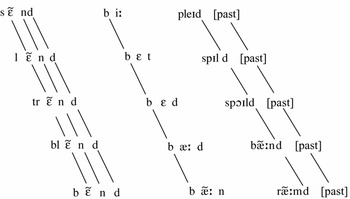
Bybee (Reference Bybee and Hopper2001: 23) assumes that generalisations arise from these exemplar clouds/clusters. Generalisations are reflected by schemas and the following illustrate three rather different types of generalisation:
- (18)
(a) [
nd] is a possible syllable rhyme: [$__[nd$](b) [b] is a possible syllable onset (in effect, [b] is a phoneme): [$b__]
(c) [[VERB]d]Past Tense. (Bybee Reference Bybee2001: 22)
She suggests that these types of generalisations are represented in the schemas set out in figure 1.
Examples of generalisations represented as schemas taken from Bybee (Reference Bybee2001) 1. Lexical connections for [ nd] in send, lend, trend, blend, bend 2. Lexical connections for [b] in bee, bet, bed, bad, ban 3. Phonological and semantic connections for the past in played, spilled, spoiled, banned, rammed (Bybee Reference Bybee2001: 22–3)

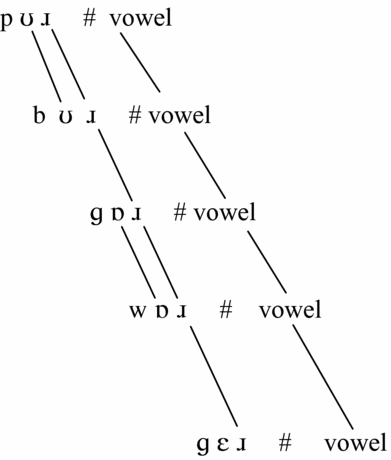
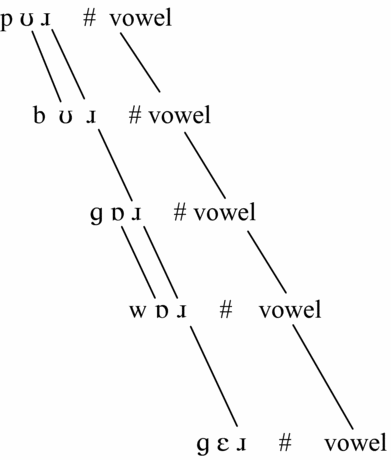
With these important considerations in mind, what can a Bybee-type approach contribute to our understanding of t-to-r? First of all, this model does provide a way of establishing a connection between the words that exhibit t-to-r. In essence we can see that the words that still exhibit t-to-r are connected by phonological shape and by frequency of use. There are two respects in which the phonological shape connection holds. First of all, and nontrivially, the words are connected by virtue of the fact that they exhibit [r]. This information will be connected and the schema derivable from it will approximate to the schema set out in figure 2.
Schema for some of the most common t-to-r exhibitors
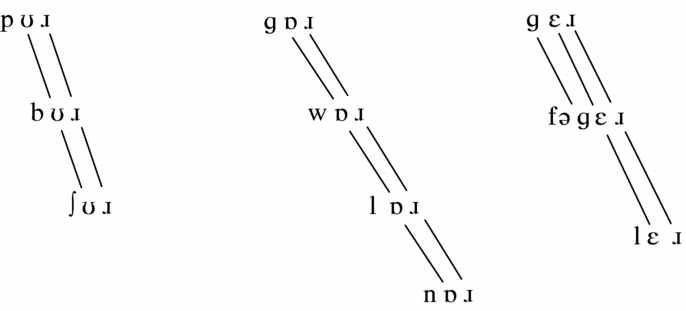
In addition to this, most of the words fall into three shape groups: 1. put, but, and shut; 2. get, forget, and let; 3. got, forgot, what, not, and ?lot. Within each subgroup the words are related by phonological shape: [ʊɹ], [ɛɹ], and [ɒɹ] respectively. The schemas set out in figure 3 capture this relationship.
Schemas denoting the three shape groups [ʊɹ], [ɒɹ], and [ɛɹ]
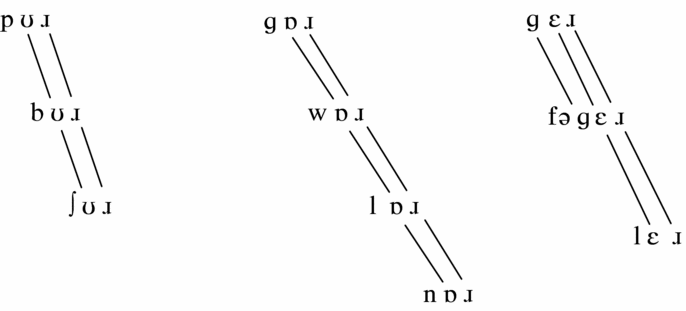
Only one form constitutes a regular exception to this: that. If matter still exhibits [r], then it would constitute a second exception. However, that is connected to the other words simply by virtue of the fact that it exhibits t-to-r. Within each subgroup, there is at least one particularly strong participant; where strength is measured in terms of frequency: put, but, got, what, and get. On the basis of this it seems reasonable to claim that there are strong connections between these words and the presence of frequent exemplars may well help to keep this fossilised process productive for just such words.
Those forms that have present participles will be connected to those participles and the participles will also be connected to one another. See figure 4 below.
Schema representing the connections between base and participle forms

However, consider the data in (19) which expand on the data set out in (5) above. These data show that certain collocations are more likely than others.
- (19)
(a) __# it
get it written and get it off [ɡɛɹ ɪʔ ɹɪʔ
ɡɛɹ ɪʔ ɒf]but it was lovely tasted [bʊɹ ɪʔ wɒ lʊvlɪ teːstəd]
but it was because [bʊɹ ɪʔ wɒ bɪkɒs]
but it was when [bʊɹ ɪʔ wə wɛn]
but it used to do it to the ginger cat [bʊɹ ɪʔ juːs tə du ɪʔ təʔ dʒɪndʒə kaʔ]
can buy something and put it in [pʊɹ ɪʔ ɪn]
well, I put it on one day [pʊɹ ɪʔ ɒn]
I think I did put it on [pʊɹ ɪʔ ɒn]
who ought to put it in the dustbin [pʊɹ ɪʔ ɪʔ dʊsbɪn]
I don't know what it was [a doːʔ noː wɒɹ ɪʔ wɒ]
(b) __#I
but I said to . . . . [bʊɾ a sɛʔ]
but I brought (the) wrong paper [bʊɹ a bɹɔːʔ ɹɒŋ peːpə]
but I mean he was harmless enough [bʊɹ a miːn]
but I have given [bʊɹ aɪ av ɡɪv
]but I was glad [bʊɹ aɪ wə ɡlad]
I don't know what I was doing [wɒɹ a wə duɪn]
I felt so guilty that I hadn't washed kitchen floor [ðəɹ aɪ ad
ʔ]the water was so freezing that I only stayed in for five minutes [ðəɹ a]
what I bought [wɒɹ a bɔːt]
do you know what I mean? [wɒɹ a miːn]
(c) __#her
I've forgot her name now [af fəɡɒɹ ə neːm naʊ]
I've got her a birthday card [av ɡɒɹ əɹ ə]
And I let her come [ən a lɛɹ ə kʊm]
To get her hands washed [tə ɡɛɹ əɹ andz wɒʃt]
(d) __#he
doing what he wanted [wɒɹ ɪ wɒntəd]
he knows what he's talking about [wɒɹ iːs tɔːkɪn əbaːʔ]
but he's the skater [bʊɹ iːz ðə skeːtə]
but he's been like . . . (false start) [bʊɹ iːz]
(e) __#them
I couldn't get them right [a kʊnʔ ɡɛɹ əm ɹaɪʔ]
if they like to think that, let them [lɛɹ əm]
(f) __#him
you want to get him in [ɡɛɹ ɪm ɪn]
(g) __#up
shut up [ʃʊɹ ʊp]
(h) __#a
I've got a very good sister-in-law [av ɡɒɹ ə vɛɹɪ ɡʊʔ sɪstəɹɪnlɔː]
we've got a plant delivered [wɪv ɡɒɹ ə planʔ]
Mr B got a Lexus [ɡɒɹ ə lɛksəs]
These examples illustrate that the words exhibiting t-to-r are commonly followed by it, I, him, her, he, a, and them. On the basis of the data collected for this article, it seems that the most frequent word post t-to-r is it. However, the following examples show that these are not the only collocations, that t-to-r can occur just so long as a vowel-initial word follows and that vowel-initial word need not be a common one:
(20) it's quarter past 11 when they get here [wɛn ðə ɡɛɹ ɪə]
have you put an energy bulb in? [av jə pʊɹ ɛnədʒɪ bʊlb ɪn]
I bet this woman would've got out of it [ɡɒɹ aʊt əv ɪʔ]
I said to her when I got outside [wɛn a ɡɒɹ aʊʔsaɪd]
I haven't got any much [aɪ anʔ ɡɒɹ ɛnɪ mʊtʃ]
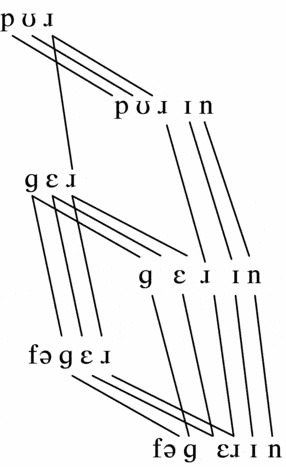
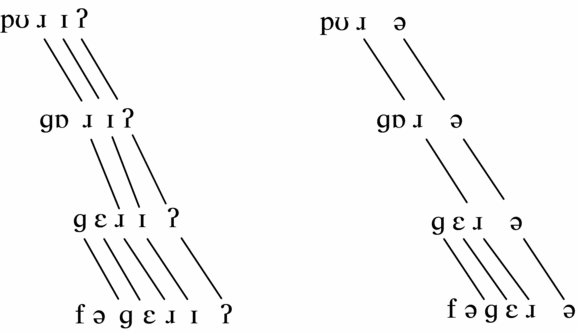
Bybee (Reference Bybee and Hopper2001, Reference Bybee2002b, etc.) assumes that frequent collocations will also be stored in the mental lexicon so the schemas given in figures 2 and 3 should now be modified to reflect these collocations, not least because these allow the [r] to reside next to a vowel-initial word. See figure 5 below. If we assume that frequent collocations are stored, then we have a way of capturing the intuition that t-to-r is essentially becoming lexicalised.
Schemas illustrating the collocations word + it, word + (h)er
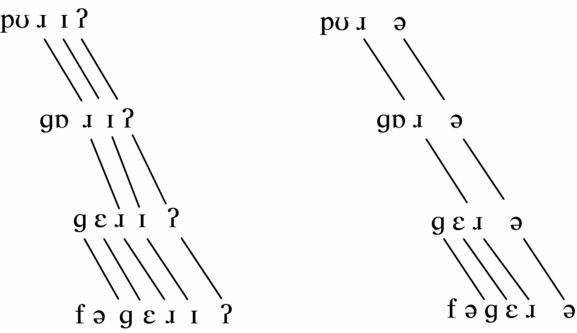
It is likely that forms such as better, ta ta, ?matter, and possibly shut up will all be lexicalised, though these forms will be connected to the other networks by virtue of the [r]. This does not allow us to account for instances where these words sit next to unusual vowel-initial words. Following Bybee, such forms will be measured against these schemas and produced accordingly. Since glottalling is currently the dominant lenition form in WY the exemplar clouds for glottalling will be extensive, regardless of the distribution type (wide/narrow glottalling). The generalisation derived from the exemplar clouds will encode the information that glottalling is an active process and that this is the generalisation which production should follow. Glottalling can be said to be dominant both in the production system and the perceptual system. Contrast this with the cases for t-to-r. T-to-r is not a productive process: only the network shored up on a daily basis of a small number of words maintains any use of t-to-r. Consequently, when speakers use language creatively, they draw upon the productive generalisations, not those that are essentially kept alive by the perceptual system. For this reason, when a WY speaker wants to say ‘Would you cut a bit more off please?’, their active system imposes a glottal; you only have access to the fossil if you are part of the fossil.Footnote 26
There is one final point to make here: Bybee (Reference Bybee and Hopper2001, etc.) claims that forms that occur frequently are more likely to undergo change than infrequent forms, but additionally that frequency will protect a form from change. At first glance, this may appear a paradoxical claim, but the t-to-r phenomenon arguably provides an excellent example of this in that as glottalling has come in over the course of the twentieth century it will have affected frequent forms such as put, but, that, get, got, what, etc. However, because these words are more frequent than e.g. fit, cut, and set, they have maintained t-to-r simply because WY speakers have had regular experience of these forms.
In conclusion, this account attempts to relate the small number of words that exhibit t-to-r in contemporary WY (and arguably northern varieties in general). One could of course argue that to do this is to attempt to account for far too much, but the recent interest in frequency of use makes it possible to say something interesting about this t-to-r set. It is frequency of use and phonological shape that ultimately relates these items and has spared them from losing t-to-r altogether. It is also frequency of use that has reduced them to this fossilised state and permitted t-to-r to be overtaken by a more general lenition type.
6 Conclusion
In this article we have considered the intriguing case of t-to-r as it is currently manifested in certain WY speakers. WY has been compared with other varieties of Northern English where the phenomenon is also found, and it would appear that WY has much in common with Tyneside and Liverpool: the core set of words which still exhibit this phenomenon. When nineteenth-century data are compared with contemporary data, it seems that t-to-r was once a more general process affecting not only /t/ but also /d/. So the historical process bears a strong resemblance to tapping, as suggested by Wells (Reference Wells1982). It is possible that by the end of the nineteenth century this process was already in decline and had become restricted solely to /t/ (see Broadbent in prep. for discussion). However, it has been argued that it was the development of glottalling in WY during the course of the twentieth century which finally caused t-to-r to become virtually obsolete. The claim is that even the most restricted glottalling distribution (i.e. restricted to __#C environments) is less restrictive than that for t-to-r, since the latter is restricted in both the left and right environment (short V__#V). Because of the relative lack of restrictions on the left, glottalling would quickly acquire a greater frequency of occurrence than t-to-r. Once glottalling was free to occur __#C/V, the frequency of glottalling would so significantly outweigh t-to-r that this would be sufficient to cause the process to become fossilised. T-to-r remains in a small group of words because these words are used frequently by WY speakers and because they share phonological shape. As a result, these forms can maintain lexical strength and it is only because they have lexical strength that they continue to exist.