Beginning at the first stages of development, as early as conception, females and males are differentially susceptible to exposure to adversity, including adverse childhood experiences (ACEs), prenatal stress, and unstable environments. Reference Assini-Meytin, Fix, Green, Nair and Letourneau1–Reference Ullsperger, Nigg and Nikolas7 These sexually dimorphic responses to early life adversity (ELA) are reflected in mental health trajectories across the lifespan, and a comprehensive understanding of these differences is imperative for tailored approaches to prevention and intervention. Among those neurobiological disorders that may be patterned by exposure to ELA in sex-specific ways is attention deficit/hyperactivity disorder (ADHD). Broadly, exposure to ELA is associated with elevated risk of ADHD, Reference Bauer, Fairchild and Hammerton8–Reference Walker, Walker, Brown, Buttross and Sarver22 and these associations may be sex dependent. Reference Fuller-Thomson and Lewis23,Reference Hunt, Slack and Berger24 Due to the pervasive and cumulative effects of ADHD symptoms beginning in early childhood with challenges in school performance and cascading into poor employment outcomes, Reference Arnold, Hodgkins, Kahle, Madhoo and Kewley25–Reference Pelham, Page, Altszuler, Gnagy, Molina and Pelham28 it is important to understand early, modifiable risk factors to maximize healthy development.
ADHD development and risk factors
ADHD symptoms, including inattention, impulsivity, and/or hyperactivity, increase family stress and interfere with children’s participation in important tasks, such as academic readiness and achievement. Reference Arnold, Hodgkins, Kahle, Madhoo and Kewley25,Reference Daley and Birchwood29 The average age of an ADHD diagnosis is six years; Reference Visser, Danielson and Bitsko30 however, there are a number of early risk factors, including genetic heritability, prenatal substance exposure; maternal pre-and postnatal mental health problems; lower parental education; and male sex. Reference Kim, Kim and Lee31–Reference Sauver, Barbaresi, Katusic, Colligan, Weaver and Jacobsen33 Among the most robust environmental contributions to the development of ADHD is ELA, including parental divorce or incarceration, traumatic experiences, and significant negative life events. It is well-established in several large, longitudinal, nationally representative US samples that the likelihood of a later ADHD diagnosis increases incrementally with the number of ACEs experienced. Reference Bomysoad and Francis9,Reference Crouch, Radcliff, Bennett, Brown and Hung12,Reference McKelvey, Edge, Mesman, Whiteside-Mansell and Bradley18–Reference Uddin, Alharbi and Uddin20,Reference Walker, Walker, Brown, Buttross and Sarver22 Children with four or more ACEs are approximately four times as likely to receive an ADHD diagnosis, while children with three ACEs had approximately three times higher likelihood of a diagnosis, compared to those with no reported ACEs. Reference Bomysoad and Francis9,Reference Brown, Brown, Briggs, Germán, Belamarich and Oyeku10,Reference Crouch, Radcliff, Bennett, Brown and Hung12 Similar results hold true for children in urban and rural areas of the US, of Native American descent in the US, and in South America and China. Reference Bauer, Fairchild and Hammerton8,Reference Chen11,Reference Jimenez, Wade, Lin, Morrow and Reichman14–Reference Lewis, McKelvey, Zhang, Moix and Whiteside-Mansell17,Reference Hunt, Slack and Berger24 These consistent, cross-cultural findings reveal a strong link between ELA and elevated likelihood of meeting criteria for ADHD diagnosis later in life.
Associations between ELA and ADHD are complex, such that the nature of the ACEs experienced (e.g., household or neighborhood instability versus maltreatment) may differentially influence the likelihood of developing ADHD. Children with ADHD are more likely to have experienced “household ACEs,” defined as socioeconomic hardship or divorce, parental mental illness, or incarceration of a caregiver, than their typically developing peers. Reference Brown, Brown, Briggs, Germán, Belamarich and Oyeku10,Reference Crouch, Radcliff, Bennett, Brown and Hung12,Reference Hunt, Slack and Berger24,Reference Alford, Riggins and Cowan34 There is also emerging evidence for sex differences in the dimension of ELA that most strongly predicts ADHD diagnosis. Reference Hunt, Slack and Berger24 For example, a large Canadian nationally representative study established that witnessing domestic violence predicted ADHD in females but not males, whereas experience of physical and sexual abuse predicted ADHD in both sexes. Reference Fuller-Thomson and Lewis23
Beyond ACEs, aspects of the family environment are also associated with ADHD. Specifically, household chaos Reference Wirth, Reinelt, Gawrilow, Schwenck, Freitag and Rauch35 and inconsistent discipline Reference Hawes, Dadds, Frost and Russell3,Reference Ullsperger, Nigg and Nikolas7,Reference Ellis and Nigg36 have been linked to ADHD symptom severity. Some studies have even found associations between routines and ADHD diagnoses; further, in children with ADHD, family routines are associated with more complex ADHD presentation in the form of higher externalizing and internalizing behaviors. Reference Wirth, Reinelt, Gawrilow, Schwenck, Freitag and Rauch35,Reference McRae, Stoppelbein, O’Kelley, Fite and Smith37–Reference Hatherly, Stienwandt, Salisbury, Roos and Fisher39 Thus, the stress-and adversity-related developmental origins of ADHD extend well beyond the boundaries of exposure to traditional ACEs.
Childhood exposure to unpredictability
Together, the evidence described above supports the hypothesis that early life adversity, broadly defined to include exposure to ACEs, toxic stress, and inconsistent environments, may have an important role in predicting ADHD. Due to the associations between inconsistent discipline and ADHD, it is possible that unpredictability in childhood, which refers to inconsistencies in family routines, behavioral expectations, and parental reactions, could further explain variability in ADHD symptoms. Experiences of unpredictability in childhood robustly portend later mental health symptoms. Reference Glynn, Stern and Howland40 Exposure to unpredictability in childhood is also strongly linked to aspects of executive functioning that are also implicated in ADHD, such as decreased effortful control and self-regulation across ages. Reference Davis and Glynn41–Reference Holmberg, Kataja and Davis43 Additionally, unpredictability, in combination with genetic and other risk factors, may increase the likelihood of developing ADHD symptoms. Due to the distractibility and inattention inherent in ADHD and the known associations between unpredictability and mental health outcomes, Reference Aran, Swales and Bailey44–Reference Spadoni, Vinograd and Cuccurazzu46 it seems likely that an unpredictable early environment would exacerbate this symptom profile. These findings provide indirect evidence for potential associations between childhood unpredictability (e.g., lack of routines, parental emotional lability) and ADHD symptoms.
Purpose and hypothesis
Given the clear evidence for associations between ELA and later ADHD and developing evidence that unpredictable childhood experiences are linked to poor effortful control/executive function, the purpose of the present investigation was to examine associations between unpredictability in early life and later ADHD symptoms. We hypothesized that greater exposure to unpredictability would be associated with elevated ADHD symptoms and that the pattern of associations would be different for males and females. Additional analyses were conducted to determine whether findings hold true beyond other measures of ELA (e.g., ACEs) and maternal ADHD symptoms.
Method
Participants
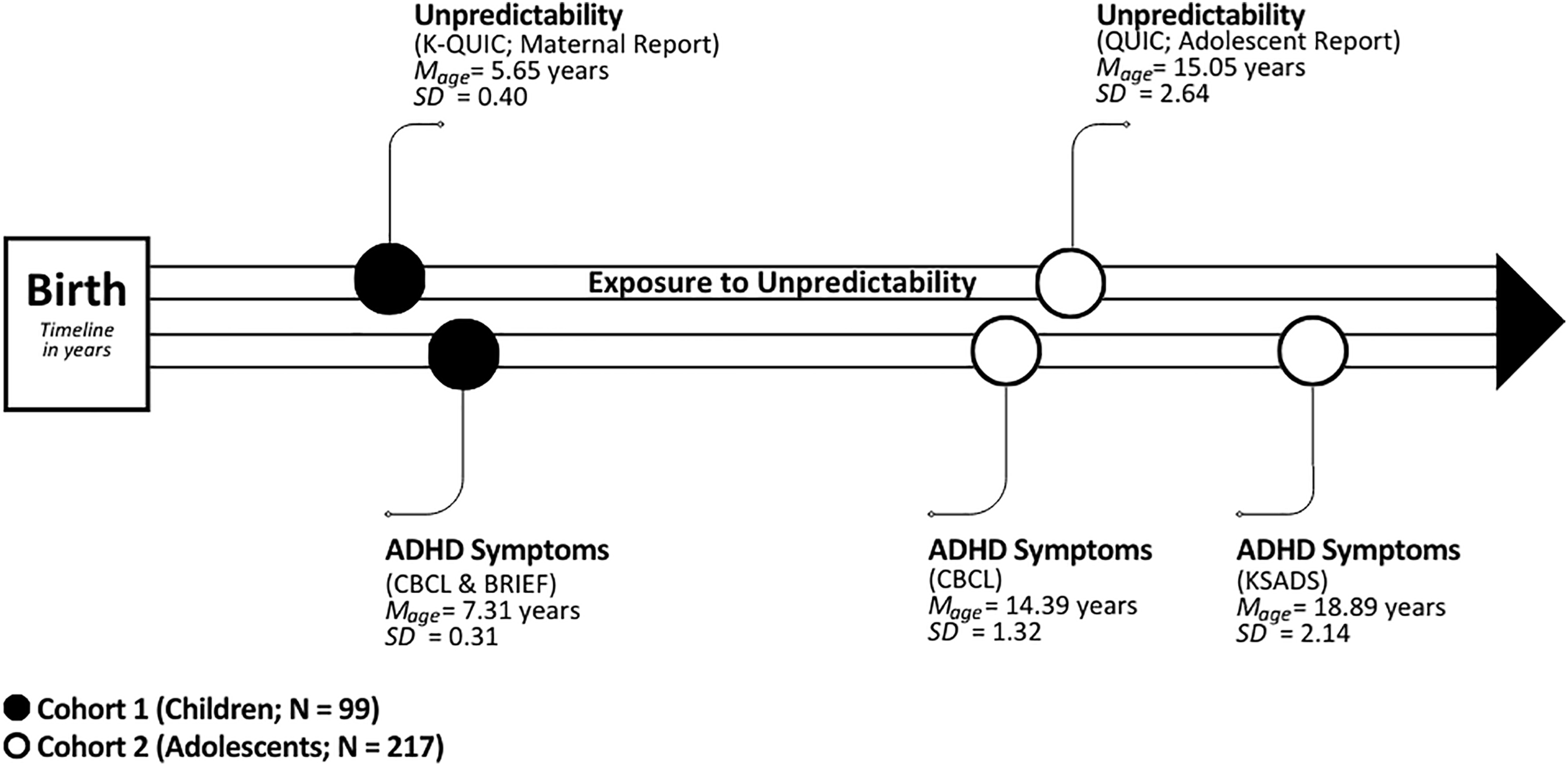
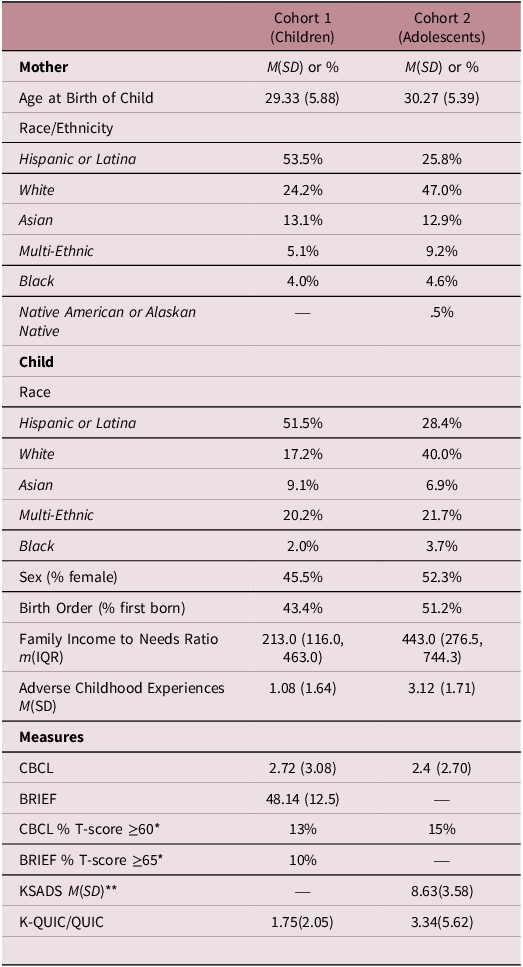
Participants included mother–child dyads from two prospective longitudinal cohorts followed since early gestation. ADHD symptoms were assessed once in childhood in Cohort 1 (M age = 7.3 years; N = 99) and twice in both middle and late adolescence in Cohort 2 (M ages = 14.4 and 18.9 years; N = 217). Refer to Fig. 1 for an overview of data collection procedures. Participants in both cohorts were recruited during their first trimester of pregnancy and were from obstetric clinics in Southern California. Reference Glynn, Howland and Sandman47 Inclusion criteria for both cohorts were (a) mother over the age of 18; (b) English speaking; and (c) singleton pregnancy. Exclusion criteria were (a) smoking, drug or alcohol use; (b) uterine or cervical abnormalities. Both cohorts were community samples recruited approximately 15 years apart. Youth in both cohorts were included in this study if they had ADHD symptom data available from the relevant laboratory visit(s). Further, children were excluded from the analyses if they were taking ADHD medication at the time of data collection (Cohort 1 n = 3; Cohort 2 n = 6). For information on demographics of both Cohorts, refer to Table 1.
Overview of data collection.
Note: BRIEF = Behavior Rating Inventory of Executive Function, Second Edition Global Executive Composite; CBCL ADH = Child Behavior Checklist Attention Deficit/Hyperactivity; K-QUIC = Kiddie Questionnaire of Unpredictability in Childhood; QUIC = Questionnaire of Unpredictability in Childhood.

Participant demographics and descriptives

Table 1. Long description
The table compares demographics and descriptives of two cohorts of mother-child dyads. It has 15 rows and 4 columns. The columns are labeled ‘Cohort 1 (Children)’ and ‘Cohort 2 (Adolescents)’, with sub-columns for ‘Mother’ and ‘Child’. Row 1: Age at Birth of Child, Cohort 1: 29.33 (5.88), Cohort 2: 30.27 (5.39). Row 2: Race/Ethnicity, Hispanic or Latina, Cohort 1: 53.5 percent, Cohort 2: 25.8 percent. Row 3: White, Cohort 1: 24.2 percent, Cohort 2: 47.0 percent. Row 4: Asian, Cohort 1: 13.1 percent, Cohort 2: 12.9 percent. Row 5: Multi-Ethnic, Cohort 1: 5.1 percent, Cohort 2: 9.2 percent. Row 6: Black, Cohort 1: 4.0 percent, Cohort 2: 4.6 percent. Row 7: Native American or Alaskan Native, Cohort 1: not applicable, Cohort 2: 0.5 percent. Row 8: Child Race, Hispanic or Latina, Cohort 1: 51.5 percent, Cohort 2: 28.4 percent. Row 9: White, Cohort 1: 17.2 percent, Cohort 2: 40.0 percent. Row 10: Asian, Cohort 1: 9.1 percent, Cohort 2: 6.9 percent. Row 11: Multi-Ethnic, Cohort 1: 20.2 percent, Cohort 2: 21.7 percent. Row 12: Black, Cohort 1: 2.0 percent, Cohort 2: 3.7 percent. Row 13: Sex (percent female), Cohort 1: 45.5 percent, Cohort 2: 52.3 percent. Row 14: Birth Order (percent first born), Cohort 1: 43.4 percent, Cohort 2: 51.2 percent. Row 15: Family Income to Needs Ratio (IQR), Cohort 1: 213.0 (116.0, 463.0), Cohort 2: 443.0 (276.5, 744.3). Row 16: Adverse Childhood Experiences, Cohort 1: 1.08 (1.64), Cohort 2: 3.12 (1.71). Row 17: Measures, CBCL, Cohort 1: 2.72 (3.08), Cohort 2: 2.4 (2.70). Row 18: BRIEF, Cohort 1: 48.14 (12.5), Cohort 2: not applicable. Row 19: CBCL percent T-score greater than or equal to 60, Cohort 1: 13 percent, Cohort 2: 15 percent. Row 20: BRIEF percent T-score greater than or equal to 65, Cohort 1: 10 percent, Cohort 2: not applicable. Row 21: KSADS, Cohort 1: not applicable, Cohort 2: 8.63 (3.58). Row 22: K-QUIC, Cohort 1: 1.75 (2.05), Cohort 2: 3.34 (5.62).
CBCL = Child Behavior Checklist; BRIEF = Behavior Rating Inventory of Executive Function Global Executive Composite; KSADS = Kiddie Schedules for Affective Disorders and Schizophrenia; K-QUIC = Kiddie Questionnaire of Unpredictability in Childhood; QUIC = Questionnaire of Unpredictability in Childhood.
* Commonly accepted cutoffs for likelihood of ADHD on each scale.
** KSADS scores reported as a mean and standard deviation, as only the initial screening questions were collected.
Measures
Unpredictable childhood experiences
Developmentally appropriate versions of the Questionnaire of Unpredictability in Childhood (QUIC) Reference Glynn, Stern and Howland40 were administered. The self-report version of the QUIC, used with the adolescent cohort (Cohort 2), is a validated 38-item instrument assessing unpredictability in the household. Items include, “I had a bedtime routine (e.g., my parents tucked me in, my parents read me a book, I took a bath),” and “My parents had a stable relationship with each other.” The Kiddie QUIC (K-QUIC, the parent-report version) Reference Glynn, Stern and Howland48 was administered to parents of those in the child cohort (Cohort 1). The K-QUIC includes the 17 items from the QUIC that are relevant to younger children’s experiences. The QUIC shows strong internal consistency (α = 0.89) as well as test–retest reliability (r = 0.92). Reference Glynn, Stern and Howland40 The QUIC also demonstrates convergent validity with prospective, observational measures of unpredictability in infancy, such as unpredictable maternal sensory signals (r = 0.23) and unpredictability of maternal mood (r = 0.17), as well as predictive validity for risk of depression (r = 0.42), anhedonia (r = 0.37), and anxiety (r = 0.43). Reference Glynn, Stern and Howland40,Reference Davis and Glynn41,Reference Hunt, Vinograd and Glynn45,Reference Spadoni, Vinograd and Cuccurazzu46
ADHD symptoms
The ADH Problems raw scores were computed based on the parent-reported Child Behavior Checklist (CBCL) Reference Achenbach and Rescorla49 at M age = 7.31 years (SD = 0.31) in children (Cohort 1) and M age = 14.39 years (SD = 1.32) in adolescents (Cohort 2). Items on the ADH subscale emphasize restlessness, ability to sit still, and ability to maintain attention. The convergent validity (r = 0.71) for the CBCL 6–18 ADH scale is strong. Reference Achenbach and Rescorla49 The ADH subscale on the CBCL has excellent test–retest reliability (r = 0.93) and internal consistency (α = 0.84) Reference Achenbach and Rescorla49 . Analyses using these raw scores were age-adjusted to account for maturation-related changes in symptom presentation.
The Behavior Rating Inventory of Executive Function, Second Edition Global Executive Composite (BRIEF) is a parent-report measure, and the sex-specific T-score was used to measure executive dysfunction associated with ADHD in children (Cohort 1) at M age = 7.31 years (SD = 0.31). Reference Gioia, Isquith, Guy and Kenworthy50 The BRIEF is an overall score consisting of the following subscales: Initiate, Working Memory, Plan/Organize, and Emotional Control. This scale includes items such as “is fidgety” and “has a short attention span.” The BRIEF has high internal consistency (α = 0.76–0.97) and test–retest reliability (r = 0.88). Reference Hendrickson and McCrimmon51
The Kiddie Schedules for Affective Disorders and Schizophrenia ADHD screener (KSADS; adolescent [Cohort 2] self-report at M age = 18.89 years, SD = 2.14) is a 4-item questionnaire validated to assess ADHD in 6-18-year-olds. In contrast to traditional dichotomous diagnostic scoring from the ADHD questions on the KSADS, we used dimensional scoring of the four ADHD screener items to capture the breadth and heterogeneity of ADHD symptom presentation across the sample. The total scores were computed as a sum of current ratings on each of the ADHD screener items, with a possible range of 4–20. Examples of items assessing ADHD symptom profiles include, “has there ever been a time when you had trouble paying attention in school?” and “was there ever a time when little distractions would make it very hard for you to keep your mind on what you were doing?”
Adverse childhood experiences (ACEs)
Unpredictability is an understudied ACE with a growing body of evidence that its impact is distinct from that of other ACEs. Reference Glynn, Stern and Howland40 Thus, we included measures of ACEs in each cohort in sensitivity analyses to determine the unique associations between unpredictability and ADHD outcomes beyond the effects of other ACEs.
The Pediatric ACEs and Related Life-Events Screener (PEARLS) Reference Koita, Long and Hessler52 was used to assess ACEs experienced to date at M age = 5.65 years (SD = 0.40) in children (Cohort 1). The PEARLS is a 17-item screening tool on which parents report events their child had experienced, such as various forms of abuse, neglect, neighborhood violence, and separation from caregivers.
In adolescents (Cohort 2), the Coddington Life Events scale (CLE) Reference Coddington53,Reference Coddington54 was used to assess ACEs experienced to date at M age = 14.39 years (SD = 1.32). The CLE is a 38-item index of major, stressful child life events, such as the death of a parent, moving to a new home, or serious illness requiring hospitalization, as reported by parents.
Maternal ADHD (Cohort 1)
The Adult ADHD Self-Report Scale Screener (ASRS) Reference Kessler, Adler, Gruber, Sarawate, Spencer and Van Brunt55 was used to measure maternal ADHD symptoms at child age M age = 7.31 years (SD = 0.31) in Cohort 1. The ASRS was used for sensitivity analyses to probe the degree to which heritability of ADHD affects associations between unpredictability in the home and child ADHD symptoms. The ASRS contains six questions regarding frequency of ADHD symptoms from never to very often. For the purposes of these analyses, responses on these questions were collapsed into dichotomized scoring with variable thresholds per item, Reference Kessler, Adler and Ames56 yielding a total possible range of 0-6. With regard to predictive validity, the ASRS has an AUC of 0.82 for a clinical diagnosis of ADHD. Reference Kessler, Adler, Gruber, Sarawate, Spencer and Van Brunt55
Data analysis
All analyses were conducted with IBM SPSS Statistics version 28.0. First, we tested for sex differences in ADHD symptom scores using independent samples t-tests. Then, partial correlations were computed to examine associations between unpredictability and ADHD characteristics (these analyses were adjusted for child age at assessment, with the exception of analyses that included t-scores). We next conducted sensitivity analyses by examining whether any associations between unpredictability and ADHD could be explained by ACEs (both Cohorts) or maternal ADHD profiles (data only available for children). Finally, we examined whether child sex moderated the associations between unpredictability and ADHD symptoms using multivariate linear regression models. Continuous predictor variables were mean centered.
Results
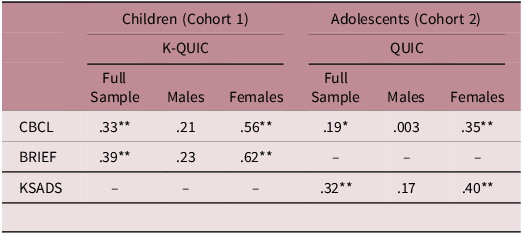
There were no sex differences in mean scores on the ADHD symptom outcome measures (see Appendix A). As shown in Table 2, among the children (Cohort 1), exposure to more early life unpredictability was associated with higher levels of ADHD symptoms measured both with the CBCL (partial r [95] = 0.33, p < 0.001) and the BRIEF (partial r [93] = 0.39, p < 0.001). Similarly, greater early life unpredictability was associated with higher ADHD symptom levels when measured with the CBCL (partial r [192] = 0.19, p =0.01) and the KSADS (partial r [171] = 0.32, p < 0.001) among the adolescents (Cohort 2).
Partial correlations between unpredictability and ADHD symptoms

Table 2. Long description
The table presents partial correlations between unpredictability and ADHD symptoms in two cohorts: children (Cohort 1) and adolescents (Cohort 2). It has four rows and six columns. The columns are labeled as follows: Children (Cohort 1) Full Sample, Males, Females, Adolescents (Cohort 2) Full Sample, Males, Females. The row labels are CBCL, BRIEF, and KSADS. Row 1: CBCL, 0.33, 0.21, 0.56, 0.19, 0.003, 0.35. Row 2: BRIEF, 0.39, 0.23, 0.62, -, -, -. Row 3: KSADS, -, -, -, 0.32, 0.17, 0.40. The table shows the correlation values for different measures of ADHD symptoms in relation to early life unpredictability.
* p <.05; **p <.01; Note: CBCL correlations adjusted for youth age.
Sensitivity analyses in children (Cohort 1) demonstrated that the associations between the K-QUIC and the CBCL (partial r [90] = 0.30, p =0.003) and the K-QUIC and the BRIEF (partial r [89] = 0.33, p =0.002) remained statistically significant, even after adjusting for maternal ADHD profiles and child ACEs. In Cohort 2, adjusting for CLE scores also did not substantively alter the association between the QUIC and KSADS (partial r [168] = 0.35, p < 0.001) and only slightly decreased the association between the QUIC and CBCL (partial r [149] = 0.13, p =0.12).
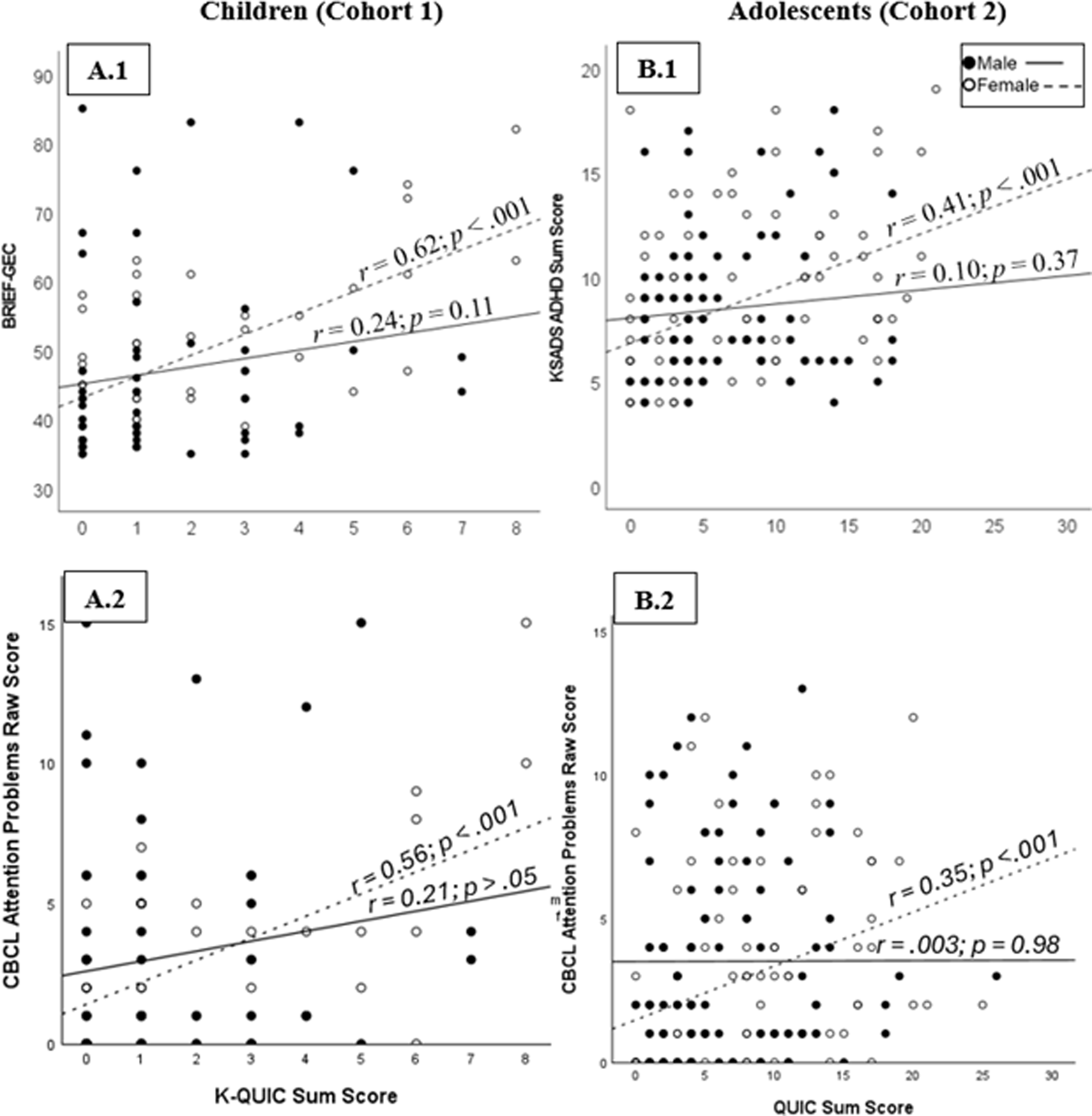
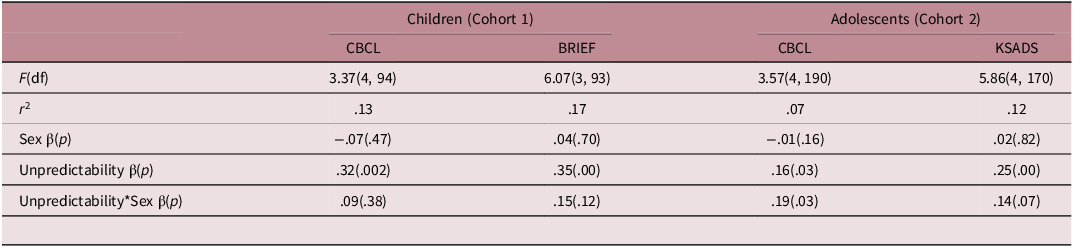
Figure 2 and Table 2 clearly illustrate that the relations between unpredictability and ADHD symptoms were stronger among females than among males. These observations were supported by interactions between sex and unpredictability in Cohort 2 (β = 0.14−0.19) in regression models; however, neither interaction effect met criteria for statistical significance in Cohort 1 (See Table 3).
Simple slopes analysis of the sex-dependent associations between unpredictability and ADHD symptoms in children (A.1 and A.2) and adolescents (B.1 and B.2).
Note: BRIEF = Behavior Rating Inventory of Executive Function, Second Edition Global Executive Composite; CBCL ADH = Child Behavior Checklist Attention Deficit/Hyperactivity; K-QUIC = Kiddie Questionnaire of Unpredictability in Childhood; QUIC = Questionnaire of Unpredictability in Childhood.

Figure 2. Long description
Panel A.1: A scatter plot shows the relationship between K-QUIC Sum Score and BREF-GEC for children. The x-axis represents K-QUIC Sum Score, and the y-axis represents BREF-GEC. The plot includes data points for males and females, with trend lines indicating correlations. For males, the correlation is r = 0.62 with p < .001, and for females, the correlation is r = 0.24 with p = 0.11. Panel A.2: Another scatter plot shows the relationship between K-QUIC Sum Score and CBCL Attention Problems Raw Score for children. The x-axis represents K-QUIC Sum Score, and the y-axis represents CBCL Attention Problems Raw Score. The plot includes data points for males and females, with trend lines indicating correlations. For males, the correlation is r = 0.56 with p < .001, and for females, the correlation is r = 0.21 with p > .05. Panel B.1: A scatter plot shows the relationship between QUIC Sum Score and KSADS ADHD Sum Score for adolescents. The x-axis represents QUIC Sum Score, and the y-axis represents KSADS ADHD Sum Score. The plot includes data points for males and females, with trend lines indicating correlations. For males, the correlation is r = 0.41 with p < .001, and for females, the correlation is r = 0.10 with p = 0.37. Panel B.2: Another scatter plot shows the relationship between QUIC Sum Score and CBCL Attention Problems Raw Score for adolescents. The x-axis represents QUIC Sum Score, and the y-axis represents CBCL Attention Problems Raw Score. The plot includes data points for males and females, with trend lines indicating correlations. For males, the correlation is r = 0.35 with p < .001, and for females, the correlation is r = 0.003 with p = 0.98.
Linear regression models for moderation analysis

Table 3. Long description
A table comparing linear regression models for moderation analysis across two cohorts: Children (Cohort 1) and Adolescents (Cohort 2). The table has 5 rows and 6 columns. Column headers are F(df), r squared, Sex beta(p), Unpredictability beta(p), and Unpredictability*Sex beta(p). Row labels are Children (Cohort 1) CBCL, Children (Cohort 1) BRIEF, Adolescents (Cohort 2) CBCL, and Adolescents (Cohort 2) KSADS. Row 1: F(df): 3.37(4, 94), 6.07(3, 93), 3.57(4, 190), 5.86(4, 170). Row 2: r squared: 0.13, 0.17, 0.07, 0.12. Row 3: Sex beta(p): -0.07(0.47), 0.04(0.70), -0.01(0.16), 0.02(0.82). Row 4: Unpredictability beta(p): 0.32(0.002), 0.35(0.00), 0.16(0.03), 0.25(0.00). Row 5: Unpredictability*Sex beta(p): 0.09(0.38), 0.15(0.12), 0.19(0.03), 0.14(0.07).
CBCL analyses were adjusted for youth age.
CBCL = Child Behavior Checklist; BRIEF = Behavior Rating Inventory of Executive Function, Second Edition Global Executive Composite; KSADS = Kiddie Schedules for Affective Disorders and Schizophrenia.
Discussion
The sexually dimorphic responses to ELA are well-established in the study of mental health trajectories, and a comprehensive understanding of these differences is vital to inform prevention and intervention. The results of this study demonstrated that greater exposure to unpredictability in childhood was associated with elevated symptoms of ADHD during both childhood and adolescence. Further, these associations were sex-dependent such that they were stronger in girls than boys. These findings provide further evidence that unpredictability is related to impairment in executive function and add much-needed examination of risk factors for ADHD that are specific to girls.
The results of this study contribute to converging evidence that exposure to unpredictability early in life is associated with behavioral phenotypes related to attention and self-regulation. For example, exposure to unpredictability in childhood associates with decreased effortful control, Reference Davis, Korja and Karlsson42 which is strongly linked to ADHD symptoms. Reference Kostyrka-Allchorne, Wass, Yusuf, Rao, Bertini and Sonuga-Barke57–Reference Samyn, Roeyers and Bijttebier59 Specifically, infant exposure to unpredictability in parental sensory signals and mood are linked to effortful control across observational and parent-reported measures. Reference Davis, Korja and Karlsson42,Reference Holmberg, Kataja and Davis43
There is a striking lack of knowledge about development of ADHD in females, in part due to a diagnostic disparity between sexes. Reference Bitsko60–Reference Young, Adamo and Ásgeirsdóttir62 The present study provides a novel examination of the sexually dimorphic role of exposure to unpredictability in development of ADHD symptoms. It is possible that childhood unpredictability could differentially associate with different diagnostic subtypes of ADHD, due to known associations between unpredictability and effortful control, Reference Davis, Korja and Karlsson42,Reference Holmberg, Kataja and Davis43 which is implicated in the inattentive subtype of ADHD. The association of environmental and familial unpredictability with effortful control is also consistently stronger in females than in males, Reference Davis and Glynn41 and the associations between unpredictability and neurodevelopment are sexually dimorphic. Reference Granger, Glynn and Sandman63 Thus, the results of the present study are well-situated in existing literature that suggests sex differences in associations between unpredictability and cognitive outcomes.
Strengths and limitations
The results of this investigation must be considered in light of several limitations. First, data on paternal ADHD was not available for sensitivity analysis, though associations remained after adjusting for maternal ADHD. Second, because data were drawn from two independent studies with different objectives, the ADHD assessments differed. However, observing similar effect sizes for the associations with unpredictability with two different well-validated measures of ADHD (KSADS and CBCL) and a widely used measure of executive function (BRIEF) increases confidence that these results are not method based. Finally, despite demonstrating associations in both middle childhood and adolescence, our data preclude definitively ruling out early signs of ADHD as a contributing factor to household unpredictability.
Several strengths of the present study support its utility in understanding early risk factors for later ADHD symptoms. First, the study uses data from two independent cohorts that represent different demographic groups, generations, and stages in development: middle childhood and adolescence. This provides strong evidence that early unpredictability is related to ADHD symptoms in children, and possibly in adolescents, in a sexually dimorphic manner. Further, ADHD symptoms were measured at two timepoints several years apart in the adolescent cohort. Second, we demonstrated these associations using common ADHD measures across research and clinical practice: the CBCL, KSADS, and BRIEF. Third, both cohorts include both males and females and address a limitation of the existing literature on ADHD, which focuses primarily on boys. Furthermore, girls are often underdiagnosed with ADHD despite demonstrating related symptoms, Reference Martin61,Reference Young, Adamo and Ásgeirsdóttir62,Reference Mowlem, Agnew-Blais, Taylor and Asherson64 so dimensional measures of ADHD symptoms were used in the present study to examine associations beyond presence or lack of diagnosis. Reference Murray, Booth, Eisner, Auyeung, Murray and Ribeaud65 Fourth, we examined associations using multiple sources of information on ADHD symptoms (parent-and self-report in adolescents), and differing patterns of results between reporters underscore the importance of multiple informants when assessing ADHD symptoms. Although our two samples differed significantly in terms of racial/ethnic diversity, age, and income, both were recruited in Southern California. Thus, replication in other populations is warranted.
Implications and conclusion
This study contributes to the growing body of evidence suggesting important associations among exposure to unpredictability in childhood and later mental health outcomes. Because of the impact of ADHD symptoms on ability to engage in school, work, and family activities, understanding the early risk factors for ADHD is a major target for researchers and clinicians. This study was the first to elucidate links between unpredictability in childhood, an actionable form of early life adversity, Reference Glynn, Liu, Lucas and Davis66 and ADHD symptoms later in childhood and adolescence, especially for girls, who are largely understudied in ADHD literature. Though ADHD has not previously been studied as a potential outcome of childhood unpredictability, research supports the use of routines and habits to improve mental health, Reference Glynn, Davis, Luby, Baram and Sandman67 including time management and time processing. Reference Wennberg, Janeslätt, Kjellberg and Gustafsson68 Thus, the results are foundational for future exploration of novel ways to intervene on early risk factors for ADHD by addressing exposure to unpredictability as a malleable risk factor.
Supplementary material
The supplementary material for this article can be found at https://doi.org/10.1017/S2040174426100622.
Acknowledgements
The authors are grateful to the families who participated and to the dedicated staff at the Early Human and Lifespan Development Program. The authors are entirely responsible for the scientific content of the manuscript.
Financial support
This work was supported by the National Institutes of Health under grants [MH-096889, HD28413, NS-41298].
Competing interests
None.
Ethical standards
The authors assert that all procedures contributing to this work comply with the ethical standards of the relevant national guidelines on human experimentation (per the Office of Human Research Protections) and with the Helsinki Declaration of 1975, as revised in 2008, and has been approved by the Chapman University Institutional Review Board in compliance with the US Federal Policy for the Protection of Human Subjects.