1. Introduction
Trilobites are important elements of the Devonian macrobenthos. During Early Devonian time, the regressive Basal Pragian Event contributed to the development of shallow marine carbonate realms, which were favourable environments for trilobites. This led to an increase in their generic diversity and to a maintenance of their family diversity, with some minor changes, until early Eifelian time (Chlupáč, Reference Chlupáč1994; Crônier & VanViersen, Reference Crȏnier and Van Viersen2007).
The publications of Alberti (Reference Alberti1969, Reference Alberti1970, Reference Alberti1981, Reference Alberti1983), Chatterton et al. (Reference Chatterton, Fortey, Brett, Gibb and Kellar2006) and McKellar & Chatterton (Reference McKellar and Chatterton2009) have been major contributions to our current knowledge of North African Middle Devonian trilobites.
The present paper is a comprehensive contribution to the systematic study of the Middle Devonian phacopids and other trilobites from SW Algeria. Their discovery, including two new species assigned to Austerops salamandaroides sp. nov. and Phacops ouarouroutensis sp. nov., allows us to improve our understanding of Middle Devonian trilobite community structure and their palaeobiodiversity.
2. Geological setting and material
2.a. Local geological succession
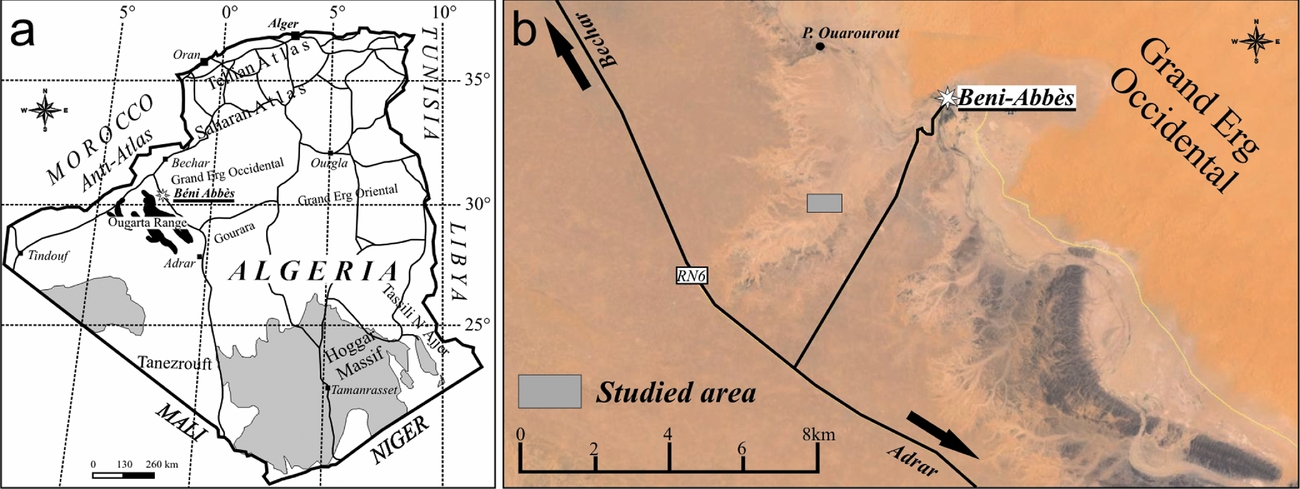
The material described in the present study comes from two sections, designated as ‘Ouarourout I’ and ‘Ouarourout II’. These sections are located in the Saoura Valley, in the eastern part of the Ougarta Basin (Algerian Sahara), about 250 km SSW of Béchar and 5 km SW of Béni Abbès (Fig. 1).
(a) Geographical location of Béni Abbès, Saoura Valley, Ougarta Basin, Algeria. (b) Location of studied sections Ouarourout I and II, a few kilometres SW of Béni Abbès.

The mounts of Ougarta or the Ougarta Range extend over 400 km in length and 200 km in width. They are elongated according to a NW–SE direction. The Ougarta Range is a folded domain linking the Moroccan Anti-Atlas to the northwest with the hills of Bled El Mass and Tanezrouft to the southeast (Fig. 1). The Ougarta Range encompasses a northern unit, known as ‘Saoura’, which is constituted by anticlines with Cambro-Ordovician outcrops and synclines with Siluro-Devonian outcrops (Menchikoff, Reference Menchikoff1933; Donzeau, Reference Donzeau and Fabre1983; Fabre, Reference Fabre2005).
The Devonian deposits were first identified in Saoura at the beginning of the twentieth century by Gautier (Reference Gautier1906). Additional comprehensive studies were refined later by Flamand (Reference Flamand1911), Menchikoff (Reference Menchikoff1930, Reference Menchikoff1936), Alimen et al. (Reference Alimen, Le Maître, Menchikoff, Petter and Poueyto1952), Le Maître (Reference Le Maître1952) and Legrand (Reference Legrand1967) among others and synthesized recently by Boumendjel et al. (Reference Boumendjel, Morzadec, Paris, Plusquellec, Brice, Copper, Gourvennec, Jahnk, Lardeux, Le Menn, Melou and Racheboeuf1997), who redefined the lithostratigraphic units of the Devonian of Saoura. Six lithostratigraphic formations were defined representing more than 1680 m in thickness, including the Chefar el Ahmar Formation. The latter was previously introduced by A. Poueyto (SN-REPAL unpub. internal report, 1965), Bastien et al. (SN-REPAL unpub. internal report, 1965) and Bastien (Reference Bastien1967) in the Marhouma area (section ‘km 30’, located 30 km to the SE of the city of Béni Abbès and 5 km away of the Marhouma oasis) and corresponds to the fifth formation from the base.
The two sections (‘Ouarourout I’ and ‘Ouarourout II’), where the studied material has been collected from, cover only a small part of the Chefar el Ahmar Formation. This interval is situated above a ‘shell level’ containing a diverse benthic fauna named by A. Ouali Mehadji (unpub. thèse de doctorat, Univ. Oran, 2004) as FBV (‘niveau à Faune Benthique Variée’), and previously named by Le Maître (Reference Le Maître1952) as ‘niveau Corraligène’. This ‘shell level’ is situated at the base of the Chefar el Ahmar Formation and is regarded as late Emsian in age on the basis of cephalopods (Göddertz, Reference Göddertz1987), corals (Plusquellec, Reference Plusquellec1997), brachiopods (A. Ouali Mehadji, unpub. thèse de doctorat, Univ. Oran, 2004) and trilobites (Khaldi et al. Reference Khaldi, Crônier, Hainaut, Abbache and Ouali Mehadji2016).
The ‘Ouarourout I’ and ‘Ouarourout II’ sections are represented by expanded alternations of decimetric to centimetric laminated greenish claystones and centimetre-thick pseudonodular limestones, ochre to reddish in colour at the base and greyish to greenish towards the top; these are sometimes tender, fossiliferous (brachiopods, trilobites, bivalves (Panenka), goniatites (work in progress by Monnet et al.) and some orthoceratids) and contain abundant tentaculitids (Dacryononarids). These alternating claystones and limestones with benthic and pelagic faunas indicate an opening to clearly marine environments. These hemipelagic deposits were accumulated on a distal platform that deepens into a subsident basin. They correspond to bioturbated biomicrites displaying a mudstone to wackestone texture. The micritic and bioclastic pseudonodules (with rare tentaculitids and ostracods) are affected by compaction-dissolution processes.
The microfauna extracted by the hot acetolysis method (Crasquin-Soleau, Vaslet & Le Nindre, Reference Crasquin-Soleau, Vaslet and Le Nindre2005) contains the ostracod species Bairdiocypris devonica (Ulrich, Reference Ulrich1891) and Bufina ?subovalis (Swartz & Oriel, Reference Swartz and Oriel1948) (dét. S. Maillet; Ouarourout I, S4), indicating an early Eifelian age in agreement with previous studies (J. Le Fèvre, unpub. thèse de 3e cycle, Société Nationale des Pétroles d'Aquitaine, Direction Exploitation et Production, Centre de Recherches de Pau, 1963; Maillet et al. Reference Maillet, Tanjaoui-Arif, Milhau, Nicollin and Ouali Mehadji2013). Dacryoconarid tentaculitids (Nowakia cf. sulcata) also support an Eifelian age for the described fauna.
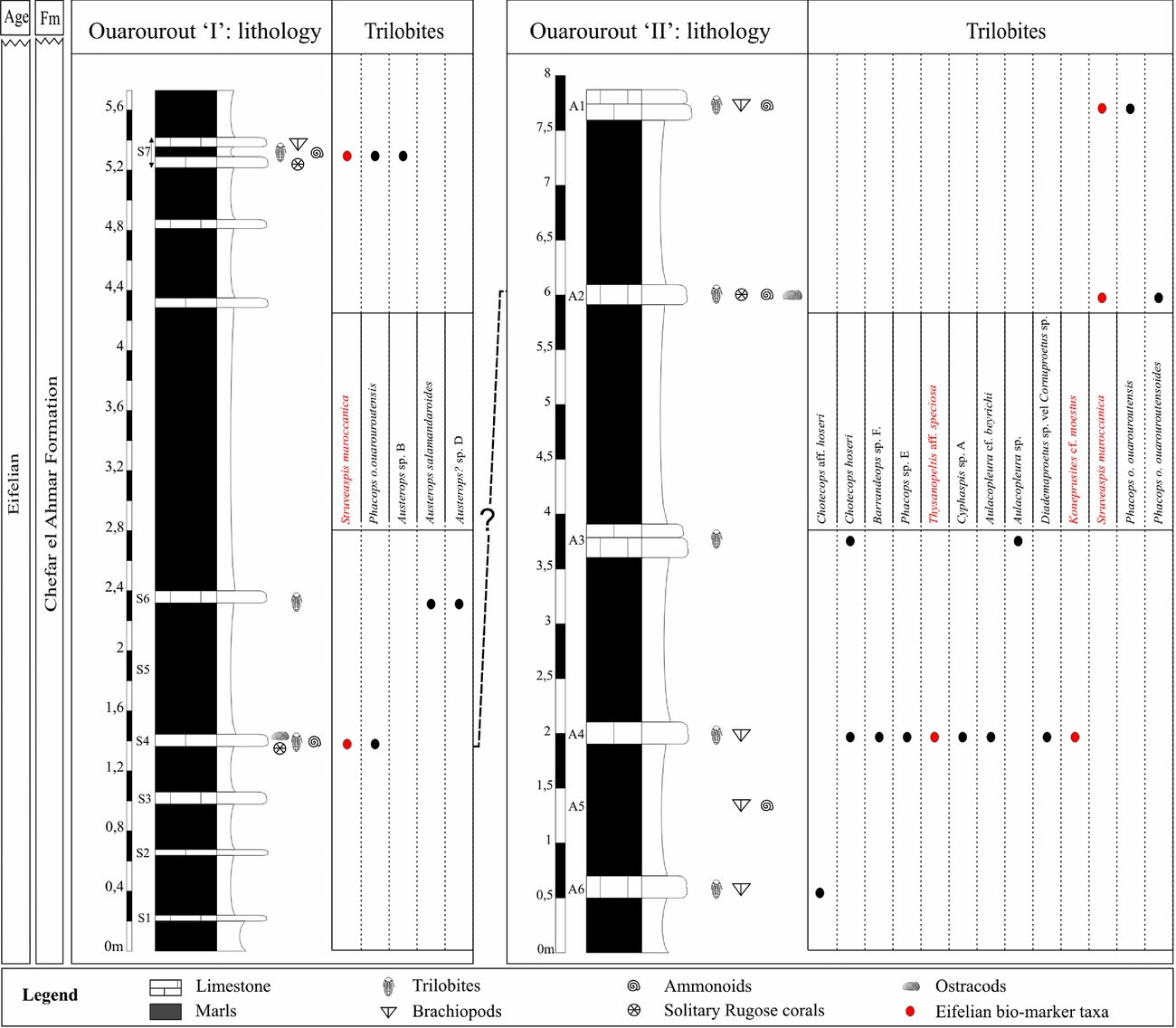
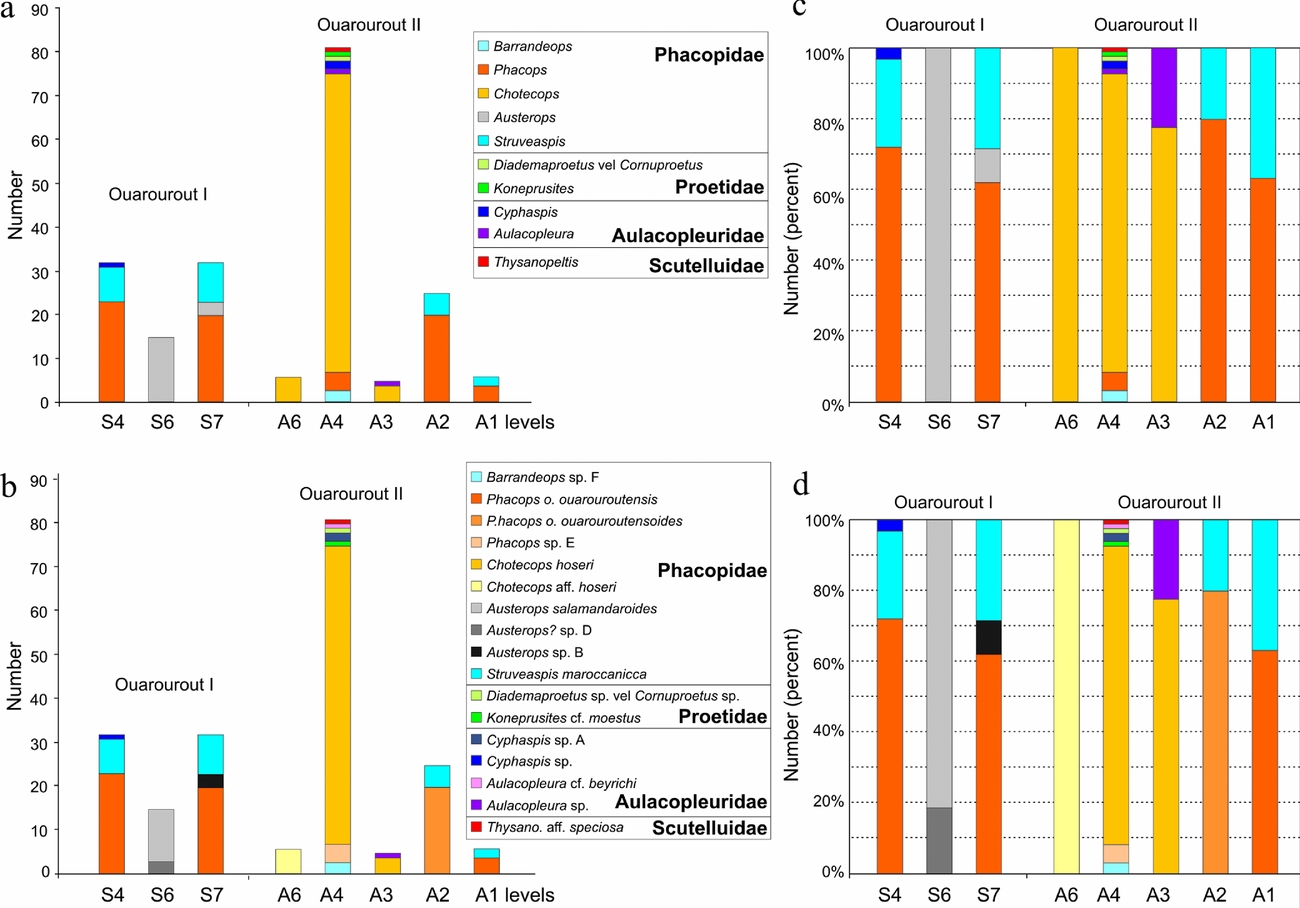
The ‘Ouarourout I’ section is 5.6 m thick and it is represented by eight major carbonate beds, including three trilobite-bearing levels (S4, S6, S7), intercalated with marls (Fig. 2). The ‘Ouarourout II’ section is 8 m thick and contains five major carbonate beds, including five trilobite-bearing levels (A6, A4, A3, A2 and A1), intercalated also with marls (Fig. 2).
Lithostratigraphic column of the Chefar el Ahmar Formation and stratigraphical location of studied trilobites (from Ouarourout I and II sections). In this area, the structure is folded and faulted, with many overlapped layers. The thickness between the marker level ‘FBV’ and the base of Ouarourout I and II sections is about 80 to 100 m. The distance is about 1.5 km. GPS coordinates for Ouarourout I section: 30°04′52.27″N – 02°14′28.92″W; for Ouarourout II section: 30°04′23.79″N – 02°13′54.82″W.

2.b. Trilobite fauna
Recently, two comprehensive studies on Early and Late Devonian phacopids from southwestern Algeria were carried out respectively by Crônier et al. (Reference Crȏnier, Malti, François, Benyoucef and Brice2013) and Khaldi et al. (Reference Khaldi, Crônier, Hainaut, Abbache and Ouali Mehadji2016). In contrast with the Early Devonian, and especially the late Emsian period, which is characterized by a diversified trilobite fauna (Le Maître, Reference Le Maître1952; Morzadec, Reference Morzadec1997; Khaldi et al. Reference Khaldi, Crônier, Hainaut, Abbache and Ouali Mehadji2016) that includes numerous common genera between North Africa and Europe, the previously reported Middle Devonian fauna from Algeria is composed of only one new phacopid subspecies, Struveaspis maroccanica ougartensis from Marhouma (described and illustrated by Alberti, Reference Alberti1981). According to Morzadec (Reference Morzadec1992), the scarcity of trilobites after late Emsian time (a few unidentified phacopids, see Morzadec in Boumendjel et al. Reference Boumendjel, Morzadec, Paris, Plusquellec, Brice, Copper, Gourvennec, Jahnk, Lardeux, Le Menn, Melou and Racheboeuf1997) could be linked to the development of more open environments, as this is suggested by the goniatite-bearing carbonate facies.
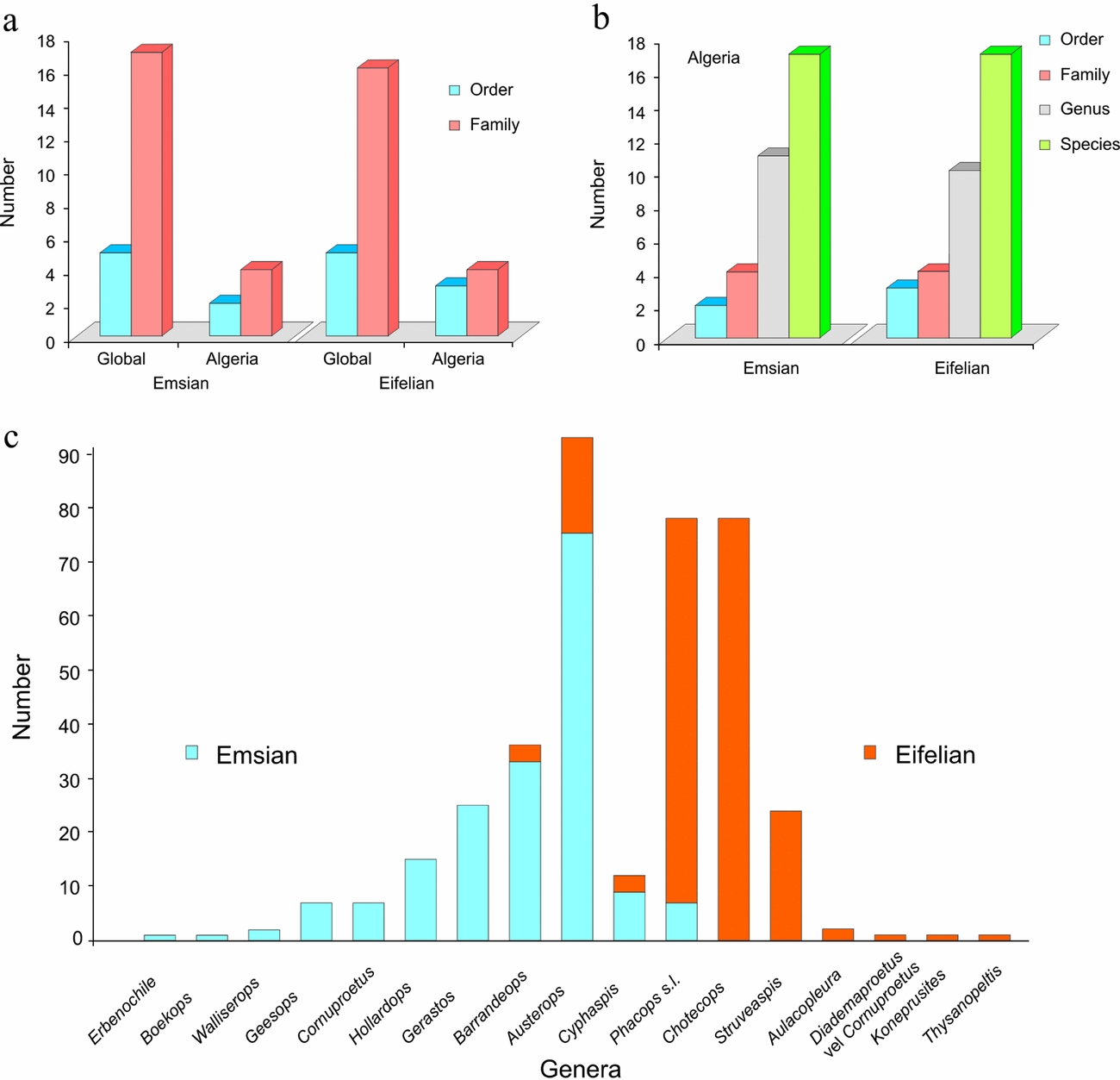
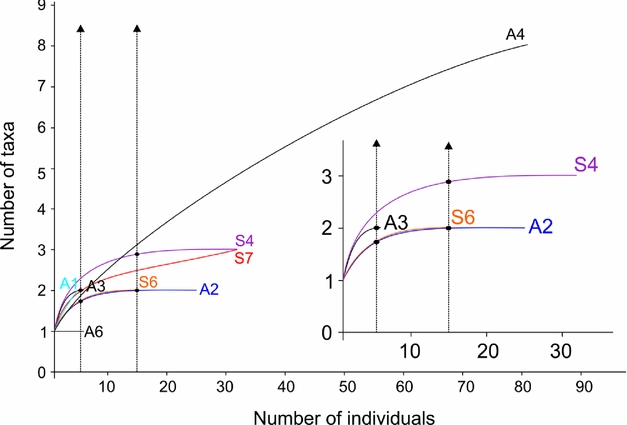
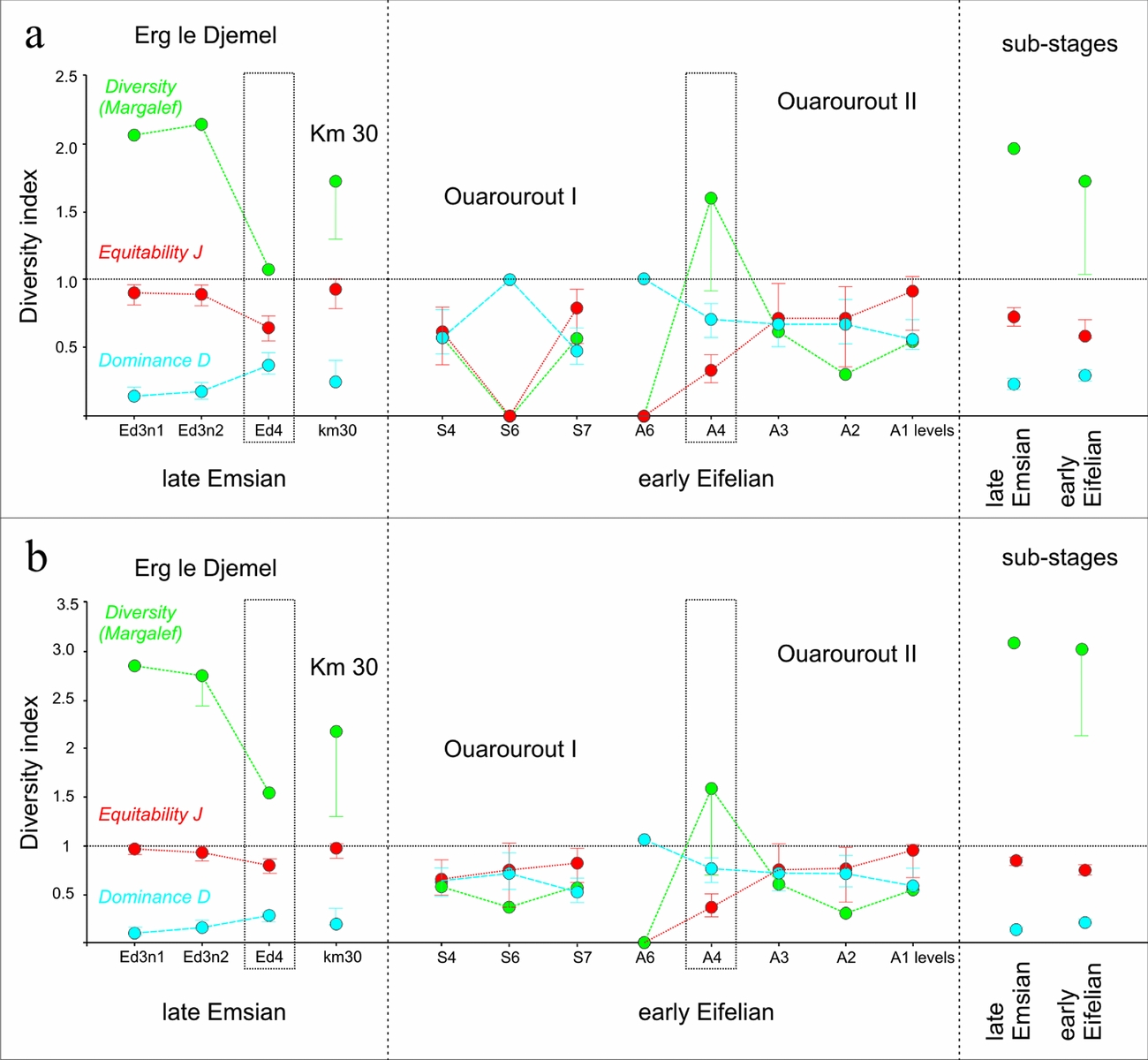
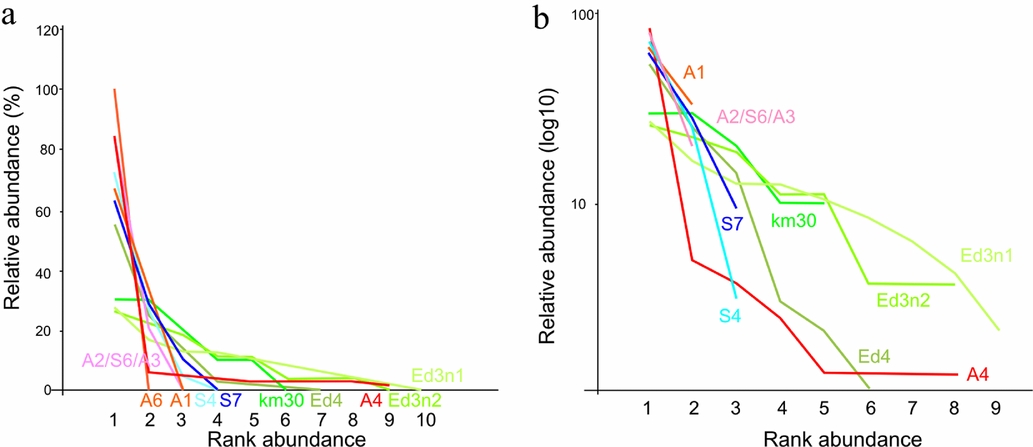
However, following further sampling, the phacopid remains are in fact more abundant and well preserved (see Section 3 below), as observed in other areas from the northern peri-Gondwanan margin, such as Morocco (Richter & Richter, Reference Richter and Richter1943; Alberti, Reference Alberti1969, Reference Alberti1970, Reference Alberti1981, Reference Alberti1983; Chatterton et al. Reference Chatterton, Fortey, Brett, Gibb and Kellar2006; McKellar & Chatterton, Reference McKellar and Chatterton2009), but they remain relatively low in diversity as macrofaunal constituents in Algeria, in contrast to their global diversity (see ‘biodiversity’ Section 5). The specimens are mostly complete and enrolled. The studied trilobites with their stratigraphic occurrence are listed in Figure 2.
The material described and figured herein is housed at the University of Mascara, Algeria (collection MU-G-Sr.Tr.A6, A4-A1, S4, S6-S7).
3. Systematic palaeontology (C. Crônier)
Morphological terminology follows Chlupàč (Reference Chlupáč1977) and Crônier, Bignon & François (Reference Crȏnier, Bignon and François2011) for phacopids, and Whittington et al. (Reference Whittington, Chatterton, Speyer, Fortey, Owens, Chang, Dean, Jell, Laurie, Palmer, Repina, Rushton, Shergold, Clarkson, Wilmot and Kelly1997) for proetids. Some abbreviations have been used: ‘exsag.’ for exsagittal, ‘sag.’ for sagittal, ‘tr.’ for transverse, ‘L0-L1’ for occipital and preoccipital lobes, ‘S0-S3’ for glabellar furrows, ‘abax.’ for abaxially, ‘adax.’ for adaxially, and ‘α, β, γ, Ɛ’ for different salient points along the course of the facial suture in proetids.
Order PHACOPIDA Salter, Reference Salter1864
Family Phacopidae Hawle & Corda, Reference Hawle and Corda1847
Subfamily Phacopidellinae Delo, Reference Delo1935
Genus Struveaspis Alberti, Reference Alberti1966
Type species. Phacops micromma Roemer, Reference Roemer1852: lower Mid Devonian; Lerbach in the Harz Mts, Germany.
Assigned species. Struveaspis micromma micromma (Roemer, Reference Roemer1852): Emsian to Eifelian, Harz, Rheinisches Schiefergebirge, Barrandian area, Moravia, Pyrenees, Morocco, Algeria; S. micromma eomicromma Alberti, Reference Alberti2000: upper Emsian, Rheinisches Schiefergebirge, Franconia, Barrandian area; S. fugitiva (Barrande, Reference Barrande1872): Eifelian, Barrandian area, Carnic Alps; S. maroccanica maroccanica Alberti, Reference Alberti1970: Eifelian, Morocco, Algeria; S. bignoni Corbacho, Reference Corbacho2014: Eifelian, Morocco.
Remarks. Struveaspis differs from Phacopidella Reed (Reference Reed1905) in the cephalic convexity forming one compact arch convex dorsally in frontal view, very weak glabellar furrows S2 and S3 (without depression around S3), a preoccipital ring fused with the occipital ring, an angular glabellar outline anteriorly, and small eyes situated on the anterior part of the cephalon. Struveaspis shares the configuration of the pygidium with Phacopidella but differs by a segmentation of the lobes, weaker in Struveaspis than in Phacopidella.
Struveaspis resembles Denckmannites Wedekind (Reference Wedekind1911) by its cephalon. However, Denckmannites differs in having a broadly arcuate glabellar outline anteriorly, a preoccipital ring with a non-reduced and differentiated median part, delimited lateral preoccipital lobes, and a clearly segmented pygidium with sharp axial and pleural furrows.
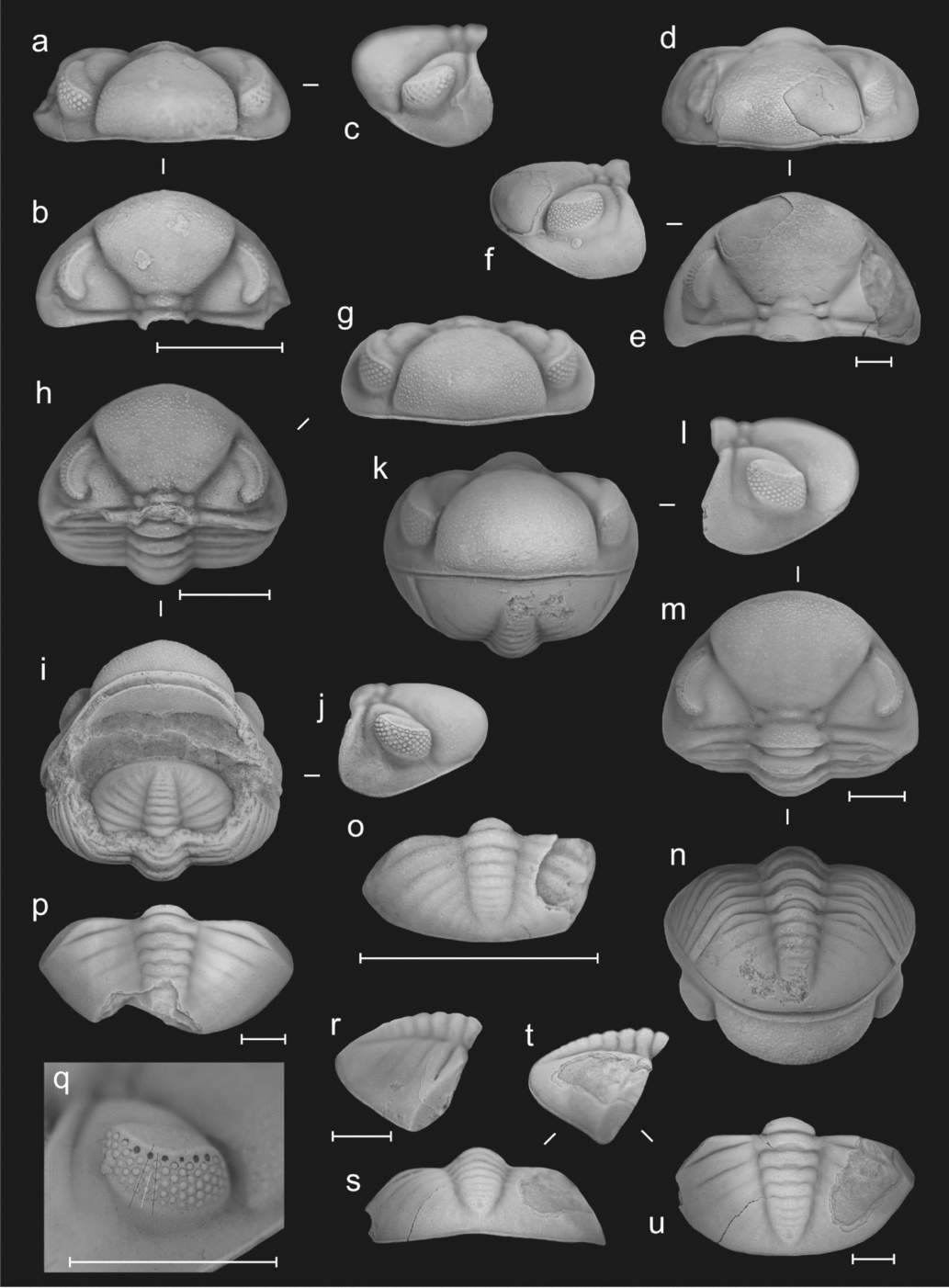
Struveaspis maroccanica Alberti, Reference Alberti1970
Figure 3a–l
See Chlupáč (Reference Chlupáč1977) for previous synonymies.
-
1977 Struveaspis maroccanica Alberti, Reference Alberti1970; Chlupáč, pp. 112–14, text-fig. 22c, pl. 30, figs 1–17.
-
1981 Struveaspis maroccanica maroccanica Alberti, Reference Alberti1970; Alberti, p. 50.
-
1981 Struveaspis maroccanica ougartensis n. ssp. Alberti, p. 50, pl. 6, figs 64–65.
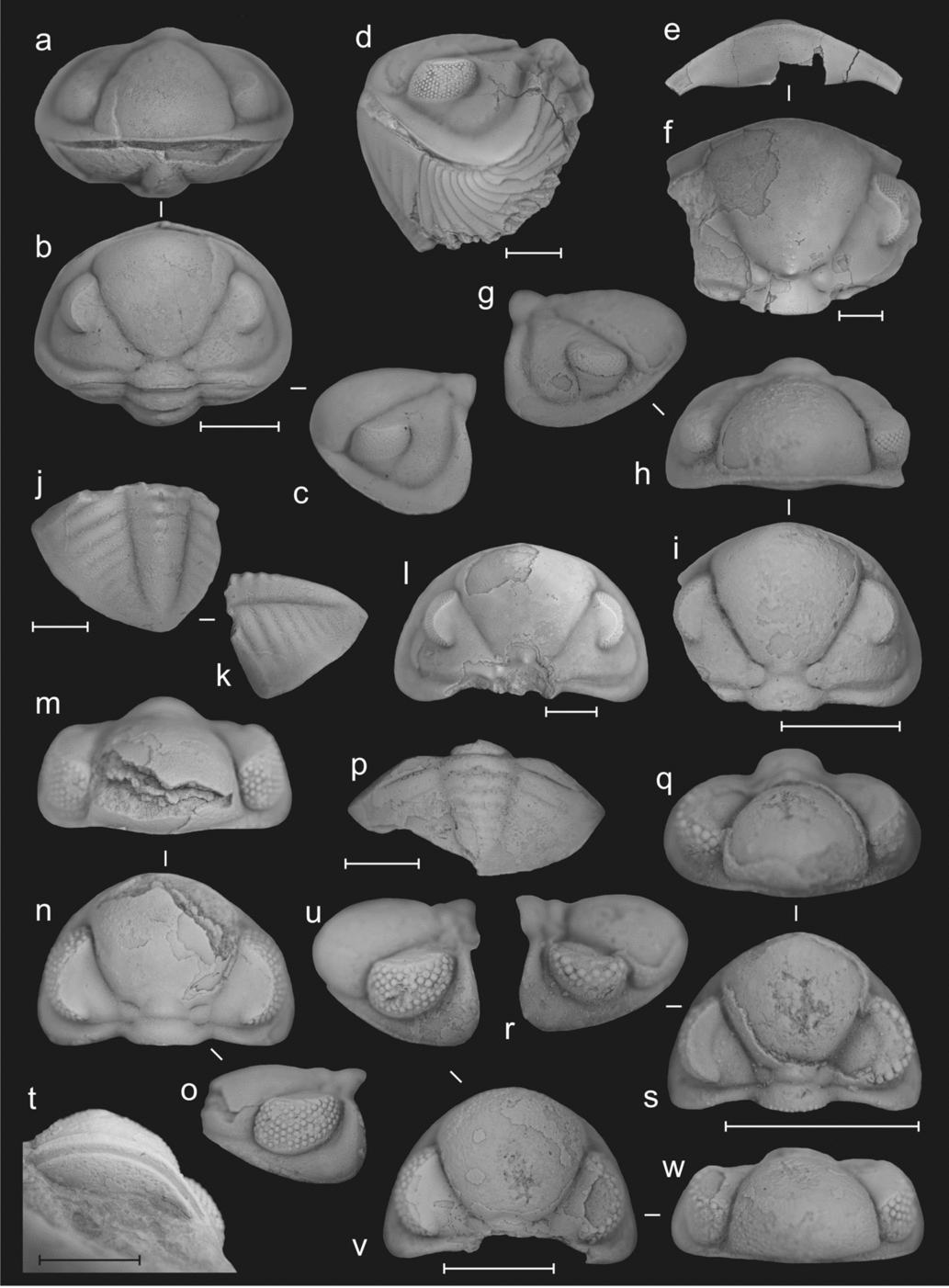
Phacopid trilobites from the Chefar el Ahmar Formation, Mid Devonian, lower Eifelian, Saoura Valley, Algeria. (a–c) Struveaspis maroccanica Alberti, Reference Alberti1970, Ouarourout I section, S7, MU-G-Sr.Tr.S7/Ph003: cephalon in frontal, dorsal and lateral views; (d) S. maroccanica Alberti, Reference Alberti1970, Ouarourout I section, S7, MU-G-Sr.Tr.S7/Ph024: lateral view of a fragmented enrolled exoskeleton; (e, f) S. maroccanica Alberti, Reference Alberti1970, Ouarourout I section, S7, MU-G-Sr.Tr.S7/Ph004: fragmented cephalon in ventral and dorsal (showing minute granules) views; (g–i) S. maroccanica Alberti, Reference Alberti1970, Ouarourout I section, S4, MU-G-Sr.Tr.S4/Ph065: cephalon in lateral, frontal and dorsal views; (j, k) S. maroccanica Alberti, Reference Alberti1970, Ouarourout II section, A2, MU-G-Sr.Tr.A2/Ph157: pygidium in dorsal (showing coarse median nodes) and lateral views; (l) S. maroccanica Alberti, Reference Alberti1970, Ouarourout I section, S4, MU-G-Sr.Tr.S4/Ph150: cephalon in dorsal view. (m–o) Austerops salamandaroides sp. nov., Ouarourout I section, S6, MU-G-Sr.Tr.S6/Ph177, holotype: cephalon in frontal, dorsal and lateral views; (p) A. salamandaroides sp. nov., Ouarourout I section, S6, MU-G-Sr.Tr.S6/Ph178: pygidium in dorsal view; (q–s) A. salamandaroides sp. nov., Ouarourout I section, S6, MU-G-Sr.Tr.S6/Ph186: cephalon in frontal, lateral and dorsal views; (t) A. salamandaroides sp. nov., Ouarourout I section, S6, MU-G-Sr.Tr.S6/Ph187: cephalon in ventral view; (u–w) A. salamandaroides sp. nov., Ouarourout I section, S6, MU-G-Sr.Tr.S6/Ph176: cephalon in lateral, dorsal and frontal views. Scale bars: 3 mm.

Type material. Cephalon CGMTA331 (Service de la Carte Géologique du Maroc, Rabat, Morocco), from the Pinacites jugleri ammonoid horizon (Nowakia (Dimitriella) sulcata sulcata dacryoconarid Zone, and/or early costatus conodont Zone), lower Eifelian, 2 km ESE of Tiliouine, Morocco.
Studied material. Thirteen cephala, one pygidium and three enrolled exoskeletons more or less eroded from the Chefar el Ahmar Formation (lower Eifelian) of the Ouarourout I section (six cephala and three exoskeletons from S7 and seven cephala and one pygidia from S4) and five cephala and two pygidia of the Ouarourout II section (four cephala and one pygidium from A2 and one cephala and one pygidium from A1); Saoura Valley, Ougarta Basin, Algeria.
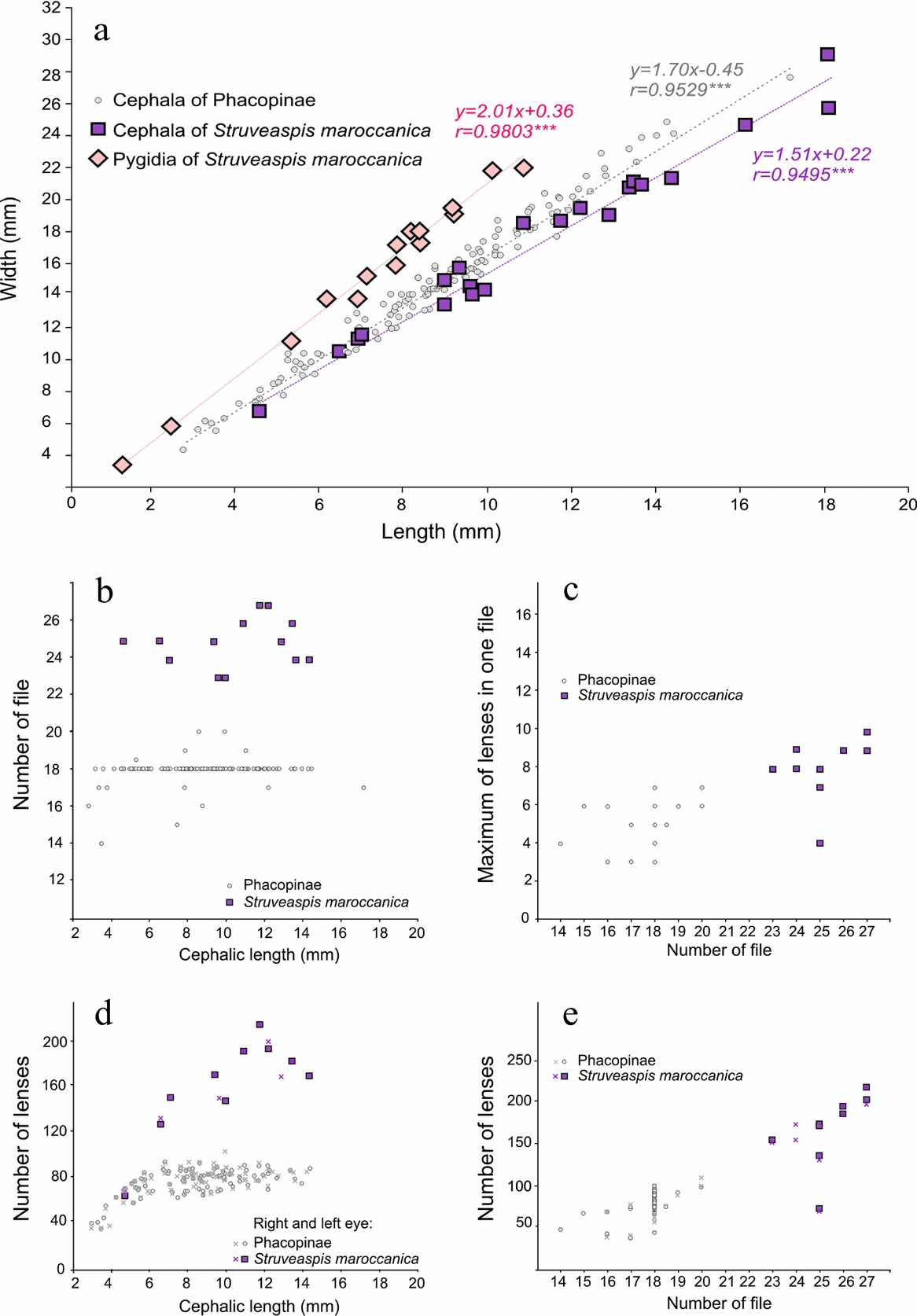
Diagnosis (modified after Reference Chlupáč Chlupáč, 1977 ). Kidney-shaped visual surface, steeply inclined; 19–27 dorsoventral files of lenses with up to 8–9 (sometimes 10) lenses in one file; eye length exceeding by half the total length (exsag.) of the genal field; long, curved abaxially and clearly differentiated palpebral lobes. Pygidium clearly segmented with three distinct anterior ribs.
Remarks. Alberti (Reference Alberti1981) discriminated two subspecies of Struveaspis maroccanica: maroccanica and ougartensis according to tenuous features. The main difference lies in the relative proportion of the cephalon: Struveaspis maroccanica maroccanica being wider (tr.) than S. m. ougartensis. This difference may be due to taphonomic process. We prefer to consider here only one species: Struveaspis maroccanica.
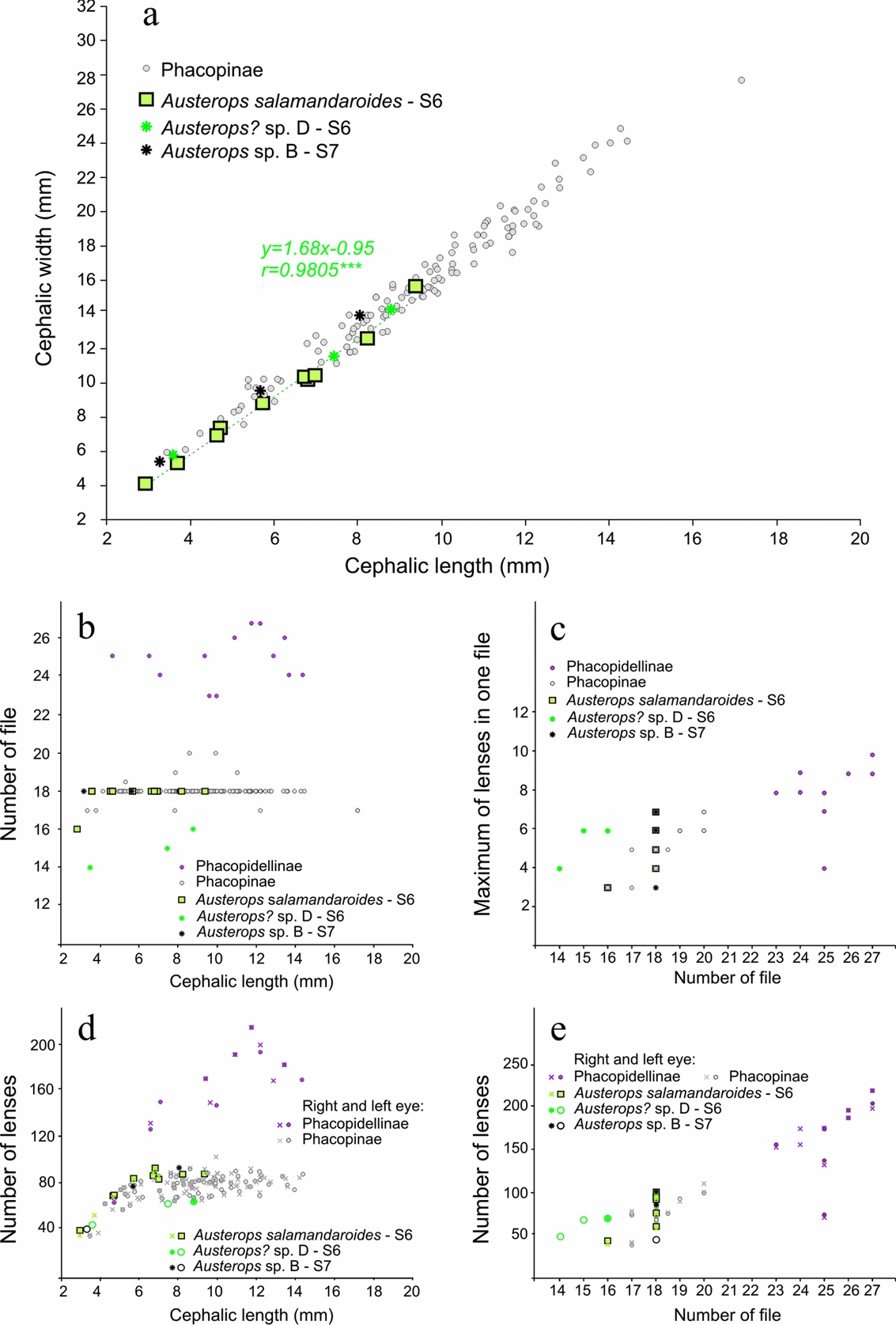
The Algerian specimens show the main morphological features of Struveaspis maroccanica from Morocco: a reniform visual surface, large and flattened lateral preoccipital lobes, S1 connected with S0 medially, and a clearly segmented pygidium with at least three distinct ribs anteriorly. Some specimens retaining a well-preserved visual surface show 128–216 lenses, 23–27 (often 25) dorsoventral files with a maximum of 8–9 (sometimes 10) lenses per file. For comparison, Barrandian specimens (see Chlupáč, Reference Chlupáč1977, p. 113) show 120–160 lenses, only 19–23 dorsoventral files with up to 7–8 (sometimes 9) lenses in one file. The smallest specimen of 4.7 mm long (sag.) has 25 dorsoventral files of lenses with only a maximum of 4 lenses per file. Its genal angles are less oriented backwards than for the oldest specimens. As in Barrandian specimens, the number of files and lenses seems not to be related to the size of the specimens and rather shows a great variability for specimens equal in size (Fig. 8). Moreover, some well-preserved specimens show minute spaced granules and are rather coarser towards the middle posterior part of the glabella and the occipital ring. Additionally, the first anterior pygidial rings seem to show a median coarse node.
Struveaspis maroccanica differs from S. fugitiva and S. micromma that are also encountered in North Africa. Struveaspis fugitiva and S. micromma have smaller visual surfaces: S. micromma with 30–50 lenses and 8 dorsoventral files; S. fugitiva with 70–95 lenses and 12–16 dorsoventral files. Moreover, the pygidial segmentation is weak in Struveaspis fugitiva, S. micromma and S. bignoni while it is more pronounced in S. maroccanica with at least three distinct clear ribs.
Occurrence. Lower Eifelian; Barrandian area, Morocco (Central: Tiliouine; Eastern: Tafilalet), Algeria (Saoura Valley: Ouarourout).
Subfamily Phacopinae Hawle & Corda, Reference Hawle and Corda1847
Genus Austerops McKellar & Chatterton, Reference McKellar and Chatterton2009
Type species. Austerops kermiti McKellar & Chatterton, Reference McKellar and Chatterton2009: Eifelian, Morocco.
Additional species. Austerops salamandar McKellar & Chatterton, Reference McKellar and Chatterton2009: Eifelian, Morocco; A. speculator speculator (Alberti, Reference Alberti1970): upper Emsian, Eifelian, Algeria, Morocco; A. speculator punctatus McKellar & Chatterton, Reference McKellar and Chatterton2009: Eifelian, Morocco; A. legrandi Khaldi et al. Reference Khaldi, Crônier, Hainaut, Abbache and Ouali Mehadji2016: upper Emsian, Algeria; A. menchikoffi (Le Maître, Reference Le Maître1952): upper Emsian, Algeria, Morocco.
Remarks. Austerops was erected by McKellar & Chatterton (Reference McKellar and Chatterton2009) for a group of Moroccan phacopids with subdued and sparse tubercles, a faint palpebral furrow, and prominent and continuous terrace lines upon the cephalic doublure.
Austerops salamandaroides sp. nov.
Figure 3m–w
Derivatio nominis. Named after the resemblance to Austerops salamandar from the Eifelian of Morocco.
Holotype. Cephalon, MU-G-Sr.Tr.S6/Ph177.
Paratypes. Three cephala and one pygidium: S6/Ph176, S6/Ph186, S6/Ph187, S6/Ph178.
Locus typicus. Ouarourout I section, Saoura Valley, Ougarta Basin, Algeria.
Stratum typicum. Chefar el Ahmar Formation, bed S6, between two beds with Struveaspis maroccanica, lower Eifelian, Mid Devonian.
Studied material. Seven cephala, one pygidium and probably four poorly preserved cephala from the Chefar el Ahmar Formation (Eifelian) of the Ouarourout I section (all from S6); Saoura Valley, Ougarta Basin, Algeria.
Diagnosis. Cephalon narrow; glabella with a wide base; low divergent axial furrows; L1 slightly inflated with subquadrate and not inflated lateral lobes; visual complex with a maximum of seven lenses per file. Pygidial axis short and rather wide, composed of five distinct rings; pygidial pleural field with three clear ribs. Fine subdued tubercles on glabella becoming slightly scaly anteriorly and denser.
Description. Cephalon: Length/width ratio about 0.67. Dorsal view: Glabellar ratio of width at L1/maximum width of frontal lobe c. 0.59. Glabella bounded by axial furrows that are shallow adjacent to L1, deeper between S1 and the front of the palpebral furrow, low divergent forwards (52°) and deflected adaxially at the front of the eye, with slightly ‘alate’ (i.e. expanded) anterolateral angles. Frontal lobe overhanging slightly a distinct preglabellar furrow. S2 and S3 poorly defined. S1 discontinuous medially and curved more strongly forwards than S0 in its adaxial curvature, and becoming deep in its distal portions. L1 shorter (sag.) than L0 (more than half L0 length), with a wide (tr.) median portion relative to its total width. Median portion of L1 slightly inflated, with few subdued tubercles. L1 with subquadrate, not inflated lateral lobes, and not differentiated from its median part. S0 distinct and almost transverse in its middle portion. L0 rather short (tr.) with no defined lateral lobes. Reniform visual surface with 18 dorsoventral files of lenses and a maximum of 7 lenses per file, with smaller lenses in the anterior median part. Interlensar sclera thickened only dorsally. Palpebral furrow not distinct. Exsagittal length of the postocular genal field less than half length of the posterior border. Postocular area not swollen. Cheek barely swollen. Lateral view: Glabella rounded anteriorly. Outline of L1 curved. L0 as high as glabella at its maximum convexity. Anterior border rather short, ridge-like barely projecting forwards, and sloping posteroventrally. Marginulation incomplete and extending from the anterolateral border up to about opposite the midlength of the eye. Posterior border furrow deep and narrow. Lateral border almost effaced. Subocular area absent at the front of the eye, narrow and concave towards the back. Posterolateral border furrow discontinuous. Posterolateral border widening at the genal angle. Frontal view: Glabellar outline subcircular with lateral sides slightly flattened obliquely. Palpebral area as high as palpebral lobe. Ventral view: Vincular furrow deep, wide (sag.), curved and parallel to preglabellar furrow. Posterior band of the cephalic doublure long (sag.) with a hypostomal suture rather transverse medially. Thorax: Unknown. Pygidium: rather long, with five well-defined rings, two other rings (plus terminal piece) not clearly defined, and three deep pleural furrows. Pygidial axis short and rather wide. Pseudo-articulating half rings indicated by a distinct embayment in the posterior edge of the anterior rings. Ornamentation: Glabella covered with fine subdued tubercles of heterogeneous size, becoming slightly scaly tubercles and denser on the anterior part of the frontal lobe. Posterolateral borders with fine subdued tubercles of heterogeneous size becoming slightly scaly tubercules in the marginal area. Palpebral lobe with few pits. Anterior band of the cephalic doublure with short scaly ridges, posterior band with short scaly ridges. Few tubercles restricted to the pygidial axis. Presence of pits not obvious.
Remarks. Among the Eifelian species belonging to the genus Austerops, the Algerian specimens are somewhat different from A. salamandar in having a narrower cephalon, a relatively shorter (tr.) occipital ring, a shorter (sag.) ridge-like anterior border projecting slightly forwards (anterior border flattened and sloping posteroventrally in A. salamandar), and slightly scaly tubercles on the anterior part of the frontal lobe (minute terrace-like tubercles in A. salamandar).
Austerops kermiti differs from A. salamandaroides sp. nov. in having a wider (tr.) occipital ring, more lenses per vertical file (nine in A. kermiti against seven in A. salamandaroides sp. nov.), a longer anterior border that is flattened and sloping posteroventrally, and relatively long terrace ridges on the anterior face of composite lobe.
Austerops legrandi differs from A. salamandaroides sp. nov. in having a wider base of the glabella, more divergent axial furrows (moderate) and less deflected adaxially at the front of the eye, and a non-inflated median portion of L1.
Occurrence: Lower Eifelian; Algeria (Saoura Valley: Ouarourout).
Austerops sp. B
Figure 4r–x
Studied material. Three poorly preserved cephala of small to medium size from the Chefar el Ahmar Formation (Eifelian) of the Ouarourout I section (from S7); Saoura Valley, Ougarta Basin, Algeria.
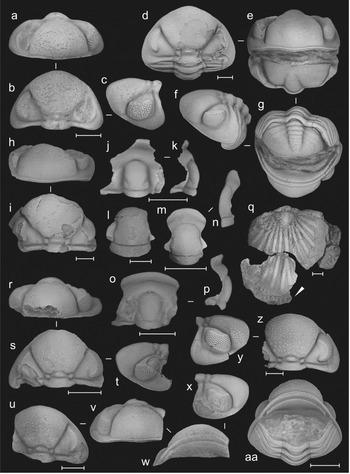
Trilobites from the Chefar el Ahmar Formation, Mid Devonian, lower Eifelian, Saoura Valley, Algeria. (a–c) Austerops? sp. D, Ouarourout I section, S6, MU-G-Sr.Tr.S6/Ph173: cephalon in frontal, dorsal and lateral views. (d–g) Chotecops aff. hoseri (Hawle & Corda, Reference Hawle and Corda1847), Ouarourout II section, level A6, MU-G-Sr.Tr.A6/Ph008: enrolled exoskeleton in dorsal, frontal, lateral and ventral views; (h, i) Chotecops aff. hoseri (Hawle & Corda, Reference Hawle and Corda1847), Ouarourout II section, A6, MU-G-Sr.Tr.A6/Ph013: cephalon in frontal and dorsal views. (j, k) Aulacopleura cf. beyrichi (Novák, Reference Novák1890), Ouarourout II section, A4, MU-G-Sr.Tr.A4/Pr145: cranidium in dorsal and lateral views. (l) Diademaproetus sp. vel Cornuproetus sp., Ouarourout II section, A4, MU-G-Sr.Tr.A4/Pr143: fragmented cranidium in dorsal view. (m, n) Koneprusites cf. moestus (Barrande, Reference Barrande1852), Ouarourout II section, A4, MU-G-Sr.Tr.A4/Pr141: cranidium in dorsal and lateral views. (o, p) Aulacopleura sp., Ouarourout II section A3, MU-G-Sr.Tr.A3/Pr182: cranidium in dorsal and lateral views. (q) Thysanopeltis aff. speciosa Hawle & Corda, Reference Hawle and Corda1847, Ouarourout II section, A4, MU-G-Sr.Tr.A4/Co189: pygidium in dorsal view. (r–t) Austerops sp. B, Ouarourout I section, S7, MU-G-Sr.Tr.S7/Ph027: cephalon in frontal, dorsal and lateral views; (u–x) Austerops sp. B, Ouarourout I section, S7, MU-G-Sr.Tr.S7/Ph020: cephalon in dorsal, frontal, ventral and lateral views. (y, z) Phacops ouarouroutensis ouarouroutensis ssp. nov., Ouarourout I section, S4, MU-G-Sr.Tr.S4/Ph054: cephalon in lateral and dorsal views, with 20 dorsoventral files of lenses; (aa) Phacops o. ouarouroutensis ssp. nov., Ouarourout I section, S7, MU-G-Sr.Tr.S7/Ph038: cephalon in ventral view. Scale bars: 3 mm.

Description. Cephalon: Length/width ratio c. 0.60. Dorsal view: Glabellar ratio of width at L1/maximum width of frontal lobe c. 0.49. Glabella bounded by deep axial furrows that are slightly divergent forwards (59°), with subangular anterolateral angles. Frontal lobe overhanging slightly the preglabellar furrow. S2 and S3 poorly defined. S1 continuous and curved more strongly forwards than S0 in its adaxial curvature, and becoming deeper in its distal portions. L1 shorter (sag.) than L0 (more than half the L0 length) and with a wide (tr.) median portion relative to its total width. Median portion of L1 inflated. L1 with subcircular, inflated lateral lobes separated from its median part by a distinct exsagittal furrow. S0 well marked and almost transverse in its middle portion. L0 rather wide (tr.) with lateral lobes poorly defined. Reniform visual surface with 18 dorsoventral files of lenses and a maximum of 6–7 lenses per file. Interlensar sclera only thickened dorsally. Palpebral furrow weak. Exsagittal length of the postocular genal field more than the half length to almost equal the length of the posterior border. Postocular genal field not swollen. Cheek moderately swollen. Lateral view: Glabella rounded anteriorly. Outline of L1 curved. L0 as high as the glabella at its maximum convexity. Anterior border short, ridge-like barely projecting forwards, and sloping posteroventrally. Posterior border furrow deep and narrow. Lateral border furrow distinct anteriorly and shallower posteriorly. Posterolateral border furrow shallow and unsharp. Posterolateral border widening at the rounded genal angle. Marginulation extending backwards. Subocular librigenal field relatively narrow and almost concave at the back of the eye, showing no pad, and absent at the front of the eye. Frontal view: Glabellar outline subcircular with lateral sides slightly flattened obliquely. Palpebral area higher than the palpebral lobe. Ventral view: Vincular furrow deep, wide (sag.), curved and parallel to preglabellar furrow. Posterior band of the cephalic doublure long (sag.) with a hypostomal suture apparently rather transverse medially. Thorax: Unknown. Pygidium: Unknown. Ornamentation: Cephalon covered with fine to distinct tubercles, becoming slightly scaly anteriorly in the medium-sized specimens, absent on the palpebral area and the preoccipital and occipital lateral lobes, subdued and sparse on the palpebral lobe. Lateral border with fine granulation anteriorly. Palpebral area and palpebral lobe with sparse pitting but not obvious. Anterior band of the cephalic doublure with short scaly ridges and pitting; posterior band with short scaly ridges also.
Remarks. These poorly preserved cephala are somewhat similar to Austerops in having a weak palpebral furrow, a shallow lateral border furrow, a thickened interlensar sclera only dorsally, 18 dorsoventral files of lenses and no subocular pad. These specimens differ from Austerops? sp. D (see below) in having a higher number of dorsoventral files of lenses (18 versus 15–16) and inflated preoccipital lateral lobes. Additional material is necessary to give a definitive attribution.
Austerops? sp. D
Figure 4a–c
Studied material. Three poorly preserved cephala from the Chefar el Ahmar Formation (Eifelian) of the Ouarourout I section (from S6 with Austerops salamandaroides sp. nov.); Saoura Valley, Ougarta Basin, Algeria.
Description. Cephalon: Length/width ratio c. 0.63. Dorsal view: Glabellar ratio of width at L1/maximum width of frontal lobe c. 0.50. Glabella bounded by axial furrows that are shallow adjacent to L1 and deeper between S1 and the front of the palpebral furrow, deflected adaxially at the front of the eye and moderately divergent forwards (65°), and with slightly ‘alate’ anterolateral angles. Frontal lobe overhanging slightly a distinct preglabellar furrow. Glabellar furrows not preserved. L1 shorter (sag.) than L0 (more than half the L0 length) and with a wide (tr.) median portion relative to its total width. Median portion of L1 probably inflated. L1 with subquadrate, not inflated lateral lobes, and not differentiated from its median part. L0 rather wide (tr.) with no defined lateral lobes. Reniform visual surface with 15–16 dorsoventral files of lenses and a maximum of 6 lenses per file (64–66 lenses in total). Interlensar sclera thickened only dorsally. Palpebral furrow not preserved. Minute granules present at the base of the visual surface. Exsagittal length of the postocular genal field, not swollen, barely less than the half length of the posterior border. Lateral view: Glabella rounded anteriorly. Outline of L1 curved. L0 as high as the glabella at its maximum convexity. Anterior border badly preserved. Posterior border furrow deep and narrow. Lateral border furrow rather almost effaced. Subocular librigenal field absent at the front of eye and, narrow and concave towards the back, showing no pad. Posterolateral border furrow continuous. Genal angle rather rounded and without node. Frontal view: Glabellar outline subcircular with lateral sides slightly flattened obliquely. Palpebral area higher than palpebral lobe. Ventral view: Not visible. Thorax: Unknown. Pygidium: Unknown. Ornamentation: Cephalon covered with dense, distinct, fine tubercles. Lateral border with rather prominent, moderately dense granules.
Remarks. These poorly preserved cephala are somewhat similar to Austerops in having a shallow lateral border furrow, fine tubercles on the glabella, a thickened interlensar sclera only dorsally and no subocular pad. Other features that characterize the genus such as 18 dorsoventral files of lenses, and subdued and sparse tubercles on the composite lobe, are missing. Moreover, Austerops? sp. D shares also some morphological features with A. menchikoffi from the upper Emsian of the Saoura Valley: similar cephalic ratios; moderate divergent axial furrows. Nevertheless, Austerops menchikoffi differs in having slightly inflated preoccipital lateral lobes separated from the median part of L1 by a weak exsaggital furrow, and especially a higher number of dorsoventral files of lenses (18). Additional material is necessary to give a definitive attribution.
Genus Chotecops (Chlupáč, Reference Chlupáč1971)
Type species. Phacops (Chotecops) auspex Chlupáč, Reference Chlupáč1971: Choteč Limestones, lower Eifelian; Hlubočepy, in Praha vicinity, Czech Republic.
Additional species. Chotecops chlupaci, Sandford, Reference Sandford2005: upper Pragian, Victoria, Australia; C. ferdinandi (Kayser, Reference Kayser1880): Emsian, Rhenish Slate Mountains, Germany; C. opitzi Struve, Reference Struve1985: Emsian, Rhenish Slate Mountains, Germany; C. sterzeli Struve, Reference Struve1985: Emsian, Rhenish Slate Mountains, Germany; C. successor (Haas, Reference Haas1968): upper Emsian, Turkey; C. despujolsi (Richter & Richter, Reference Richter and Richter1943): Mid Devonian, Morocco; C. glabrens (Chlupáč, Reference Chlupáč1977): lower Mid Devonian, Barrandian area; C. hoseri (Hawle & Corda, Reference Hawle and Corda1847): Eifelian, Barrandian area; C. occidomaurus (Alberti, Reference Alberti1981): Eifelian (Nowakia sulcata tentaculite Zone), Tiliouine, Central Morocco; C. zizensis (Alberti, Reference Alberti1983): lower Eifelian (Nowakia sulcata sulcata tentaculite Zone), Hamar Laghdad, SE Morocco; C. sollei Struve in Flick & Struve, Reference Flick and Struve1984: upper Emsian or lower Eifelian, Rhenish Slate Mountains, Germany; C. hassiacus (Herrmann, Reference Herrmann1911): Givetian, Rhenish Slate Mountains, Germany; C. latissimus (Holzapfel, Reference Holzapfel1895): Givetian, Rhenish Slate Mountains, Germany; C. spectabilis (Meischner, Reference Meischner1965): Givetian, Kellerwald Mts.; C. koeneni (Holzapfel, Reference Holzapfel1895): mid Givetian, Rhenish Slate Mountains, Germany; C. zofiae Chlupáč, Reference Chlupáč1993: Givetian/Frasnian boundary, Holy Cross Mountains, Poland; C.? breviceps Barrande, Reference Barrande1846: Mid Devonian, Barrandian area; C.? erfoudensis Richter & Richter, Reference Richter and Richter1943: Upper Devonian, Morocco; C.? hyla (Holzapfel, Reference Holzapfel1895): Givetian, Rhenish Slate Mountains, Germany; C.? supradevonicus (Frech, Reference Frech1887): Mid Devonian (?), Southern France.
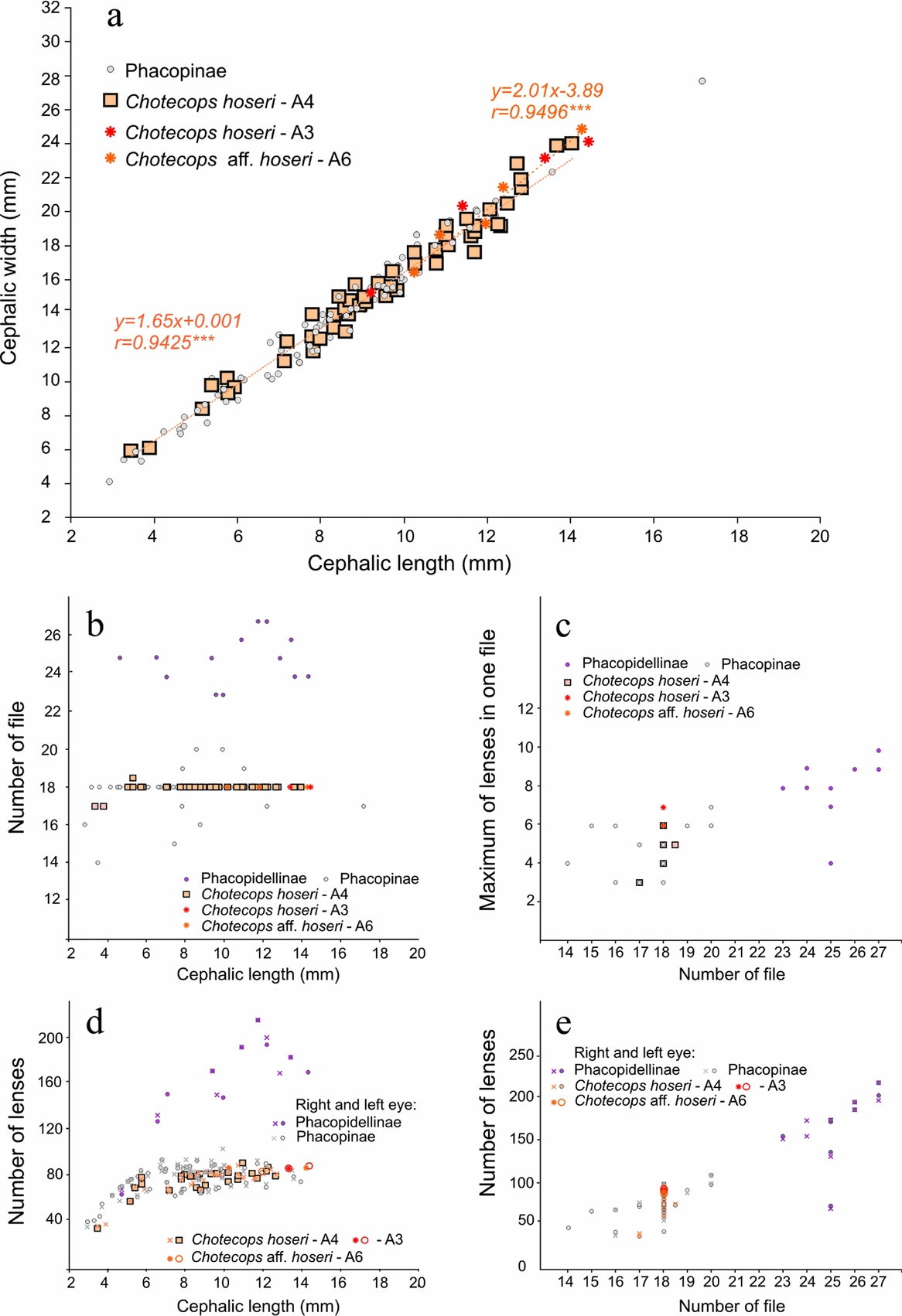
Remarks. Chotecops was erected by Chlupáč (Reference Chlupáč1971) for a group of phacopids with a relatively flat glabella, subdued tuberculation on the glabella, a raised preoccipital ring with flat L1, a relatively flat palpebral area and palpebral lobes, and a weakly segmented pygidium with rather shallow pleural furrows and pleural ribs remaining much lower. The concept of Chotecops was completed by Struve (in Flick & Struve, Reference Flick and Struve1984) by additional characters including a broadly rounded cephalic and pygidial outline, a rather long postocular area (greater length than 0.2 times eye length), the relative height of the librigenae and visual surface (ratio 0.5–1.0), and generally 18 dorsoventral files of lenses with a maximum of 6 lenses per file. Basse (Reference Basse2006, p. 80) followed Struve's (Reference Struve1972, Reference Struve1995) concept and confirmed the distinction between Chotecops and the closely related Arduennops Struve, Reference Struve1972 that is characterized by a glabellar ornamentation not as fine and a visual complex backwards shifted. Otherwise, according to Feist et al. (Reference Feist, McNamara, Crȏnier and Lerosey-Aubril2009), Mid Devonian representatives of Chotecops also have a strongly vaulted posterior genae with weak palpebral furrows, poorly differentiated lateral occipital lobes, a narrow pygidial axis and a sparse tuberculation. Campbell (Reference Campbell1977) considered Chotecops successor (Haas, Reference Haas1968) from the Emsian of Turkey as indicating an ancient derivation of Chotecops from Phacops, and Chotecops chlupaci described by Sandford (Reference Sandford2005) from the Pragian of Victoria, Australia, indicates an even older derivation. According to Feist et al. (Reference Feist, McNamara, Crȏnier and Lerosey-Aubril2009), the older Chotecops might constitute the ancestral clade of two others genera Nephranops s.s. Richter & Richter, Reference Richter and Richter1926 and Houseops Feist et al. Reference Feist, McNamara, Crȏnier and Lerosey-Aubril2009.
Chotecops hoseri (Hawle & Corda, Reference Hawle and Corda1847)
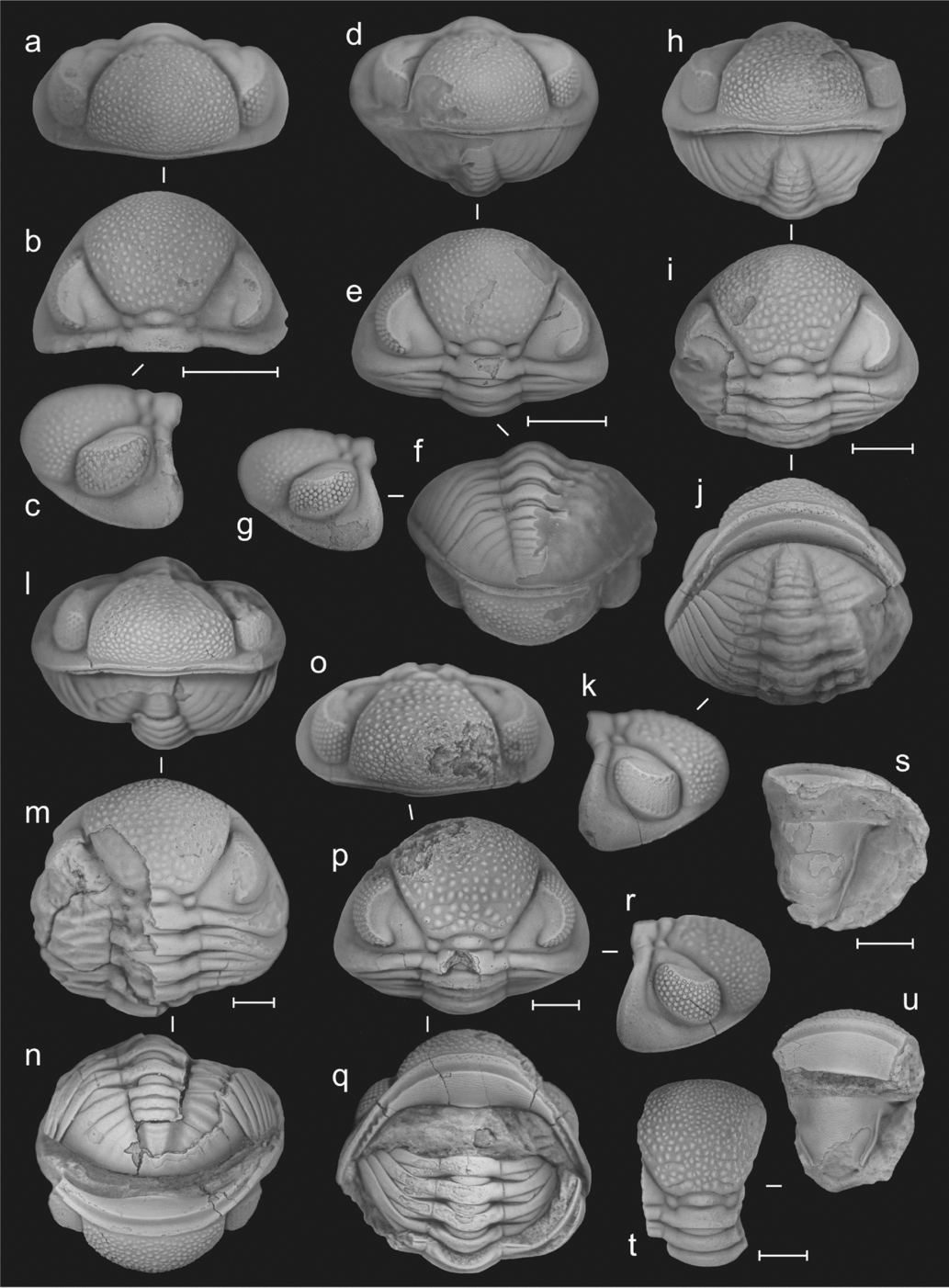
Figure 5a–u
See Chlupáč (Reference Chlupáč1977) for previous synonymies.
-
1977 Phacops (Chotecops) hoseri Hawle & Corda, Reference Hawle and Corda1847; Chlupáč, pp. 52–5, pl. 20, figs 1–23, text-fig. 9.
-
1993 Phacops (Chotecops) hoseri (Hawle & Corda, Reference Hawle and Corda1847); Chlupáč, p. 400.
-
1996 Phacops s.l. (Chotecops?) hoseri Hawle & Corda, Reference Hawle and Corda1847; Basse & Lemke, p. 39.
-
2003 Phacops (Chotecops) hoseri (Hawle & Corda, Reference Hawle and Corda1847); Chlupáč & Schraut, pp. 185–6.
-
2005 Chotecops hoseri (Hawle & Corda, Reference Hawle and Corda1847); Sandford, pp. 5, 7, 9.
Phacopid trilobites from the Chefar el Ahmar Formation, Mid Devonian, lower Eifelian, Saoura Valley, Algeria. (a–u) Chotecops hoseri Hawle & Corda, Reference Hawle and Corda1847, Ouarourout II section, A4; (a–c) MU-G-Sr.Tr.A4/Ph072: cephalon in frontal, dorsal and lateral views; (d–f) MU-G-Sr.Tr.A4/Ph135: cephalon in frontal, dorsal and lateral views; (g–j) MU-G-Sr.Tr.A4/Ph130: enrolled exoskeleton in frontal, dorsal, ventral and lateral views; (k–n) MU-G-Sr.Tr.A4/Ph123: enrolled exoskeleton in frontal, lateral, dorsal and ventral views; (o) MU-G-Sr.Tr.A4/Ph136: pygidium in dorsal view; (p) MU-G-Sr.Tr.A4/Ph116: pygidium in dorsal view; (q) MU-G-Sr.Tr.A4/Ph077: detail of right eye; (r) MU-G-Sr.Tr.A4/Ph142: pygidium in lateral view; (s–u) MU-G-Sr.Tr.A4/Ph109: pygidium in frontal, lateral and dorsal views. Scale bars: 3 mm.

Lectotype. Cephalon NM327/67 (National Museum, Prague, Czech Republic) from Acanthopyge Limestone, Choteč Formation, Eifelian, Koněprusy, Praha vicinity, Czech Republic.
Studied material. Fifty-one cephala, 15 pygidia and 2 enrolled exoskeletons from the Chefar el Ahmar Formation (Eifelian) of the Ouarourout II section (all from A4 with Thysanopeltis, and four from A3); Saoura Valley, Ougarta Basin, Algeria.
Diagnosis (after the description from Reference Chlupáč Chlupáč, 1977 ). Cephalon wide; S1 poorly impressed in its median curvature as an unsharp depression; slightly inflated, wide and granulated median portion of L1; rather flat and subquadrate lateral lobes of L1; visual surface with 18 vertical lens files and a maximum of 6 lenses per file; subocular area wide posteriorly and narrower anteriorly forming an eye socle gently concave and sloping laterally. Pygidial axis relatively long (sag.) and narrow (tr.), tapered with up to 8–9 rings plus the terminal piece; up to 5–6 low ribs defined. Granulation on glabella more spaced posteriorly and passing into short scaly granules anteriorly.
Remarks. The Algerian specimens show the main morphological features of Chotecops hoseri Hawle & Corda, Reference Hawle and Corda1847 from the Barrandian area (see Chlupáč, Reference Chlupáč1977 for detailed features).
As for the Barrandian specimens, most of them possess an anterior outline of the glabella broadly gently angular and some variability exists especially with respect to the granulation from dense and pronounced to widely spaced.
Additionally, the Algerian specimens differ slightly in having a narrower glabellar base, axial furrows of medium depth more divergent (at an angle of 70–75° compared to 60–65° for Barrandian specimens), a slightly deeper vincular furrow, and four distinct low pygidial ribs compared to 5–6 distinct for Barrandian specimens. According to Chlupáč & Schraut (Reference Chlupáč and Schraut2003) who compiled Mid Devonian trilobite stratigraphies, Chotecops hoseri is found in the Acanthopyge–Phaetonellus Assemblage (Chlupáč, Reference Chlupáč1983) associated with Thysanopeltis speciosa (trilobite), Pinacites jugleri (goniatite) and Nowakia sulcata (tentaculite).
Chotecops hoseri shares the main morphological features with C. occidomaurus (Alberti, Reference Alberti1981) from the Eifelian of Tiliouine (Central Morocco) such as 18 dorsoventral files of lenses with a maximum of 6 lenses per file. Chotecops occidomaurus differs in having a distinct and continuous posterolateral border furrow, and a coarser and denser granulation present even at the posterolateral border.
Chotecops zizensis (Alberti, Reference Alberti1983) from the lower Eifelian of Hamar Laghdad (SE Morocco) is closely related in having a lowered visual surface, with 18 dorsoventral files of lenses and a maximum 6 lenses per file, roughly the same exsaggital length of the postocular field, and strongly divergent axial furrows (70°). However, Chotecops zizensis differs in having a denser and coarser granulation throughout the cephalon and flattened lateral preoccipital lobes.
Chotecops despujolsi (Richter & Richter, Reference Richter and Richter1943) from the Mid Devonian of Morocco (Mreisset) seems to be also closely related with its shallow posterolateral border furrow, a finely spaced granulation except on the glabella, and a low visual surface with 18 dorsoventral files of lenses but it differs in having 5 lenses per file, a longer (exsag.) eye close to the posterior border furrow, coarser granules on the glabella and a more stretched genal angle.
Occurrence: Eifelian; Barrandian area, Algeria (Saoura Valley: Ouarourout).
Chotecops aff. hoseri (Hawle & Corda, Reference Hawle and Corda1847)
Figure 4d–i
Studied material. Five cephala and one pygidium from the Chefar el Ahmar Formation (Eifelian) of the Ouarourout II section (from A6); Saoura Valley, Ougarta Basin, Algeria.
Remarks. Chotecops aff. hoseri seems to be slightly different from C. hoseri sensu stricto. Chotecops aff. hoseri shares with C. hoseri s.s. the cephalic ornamentation (fine tubercles on the composite lobe, scale-like granules on the anterior of the frontal lobe, and dominant pitting on the lateral border), a visual surface with the same number of dorsoventral files of lenses and six lenses per file but differs from C. hoseri s.s. in having a narrower cephalon, an interlensar sclera only slightly thickened dorsally, a genal angle well elongated with numerous pits, and a more pentagonal and sharpened frontal lobe.
Genus Barrandeops McKellar & Chatterton, Reference McKellar and Chatterton2009
Type species. Barrandeops forteyi McKellar & Chatterton, Reference McKellar and Chatterton2009: upper Emsian, Morocco.
Additional species. Barrandeops granulops (Chatterton et al. Reference Chatterton, Fortey, Brett, Gibb and Kellar2006): upper Emsian, Morocco; B. lebesus (Chatterton et al. Reference Chatterton, Fortey, Brett, Gibb and Kellar2006): Eifelian, Morocco; B. ovatus McKellar & Chatterton, Reference McKellar and Chatterton2009: upper Emsian, Morocco; B. chattertoni Khaldi et al. Reference Khaldi, Crônier, Hainaut, Abbache and Ouali Mehadji2016: upper Emsian, Algeria; Barrandeops campbelli (Alberti, Reference Alberti1983): lower Eifelian, Morocco.
Remarks. Barrandeops was erected by McKellar & Chatterton (Reference McKellar and Chatterton2009) for a group of tuberculated Moroccan phacopids without pitting on the palpebral lobe and palpebral area. Another tuberculated species Barrandeops campbelli (Alberti, Reference Alberti1983) from the lower Eifelian seems to have these features and has been included here in this genus.
Barrandeops sp. F
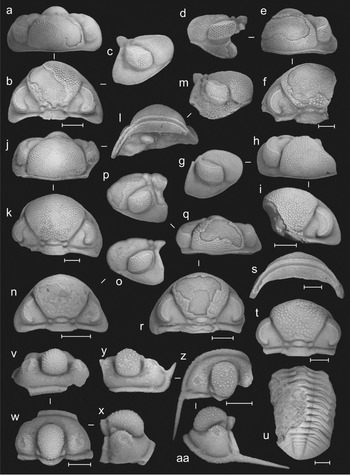
Figure 7j–m
Studied material. Three cephala from the Chefar el Ahmar Formation (Eifelian) of the Ouarourout II section (all from A4); Saoura Valley, Ougarta Basin, Algeria.
Phacopid trilobites from the Chefar el Ahmar Formation, Mid Devonian, lower Eifelian, Saoura Valley, Algeria. (a–u) Phacops ouarouroutensis ouarouroutensis ssp. nov., Ouarourout I section; (a–c) S7, MU-G-Sr.Tr.S7/Ph032: cephalon in frontal, dorsal and lateral views; (d–g) S4, MU-G-Sr.Tr.S4/Ph064: enrolled exoskeleton in frontal, dorsal, ventral and lateral views; (h–k) S7, holotype, MU-G-Sr.Tr.S7/Ph001: enrolled exoskeleton in frontal, dorsal, ventral and lateral views; (l–n) S7, MU-G-Sr.Tr.S7/Ph036: enrolled exoskeleton in frontal, dorsal and ventral views; (o–r) S4, MU-G-Sr.Tr.S4/P050: enrolled exoskeleton in frontal, dorsal, ventral and lateral views; (s) S7, MU-G-Sr.Tr.S7/Ph031: hypostome in dorsal view; (t–u) S7, MU-G-Sr.Tr.S7/Ph026: fragmented cephalon in dorsal and ventral (showing hypostome) views. Scale bars: 3 mm.

Trilobites from the Chefar el Ahmar Formation, Mid Devonian, lower Eifelian, Saoura Valley, Algeria. (a–c) Phacops sp. E, Ouarourout II section, A4, MU-G-Sr.Tr.A4/Ph124: cephalon in frontal, dorsal and lateral views, with 20 dorsoventral files of lenses; (d–f) Phacops sp. E, Ouarourout II section, A4, MU-G-Sr.Tr.A4/Ph074: cephalon in lateral, frontal and dorsal views, with 18 dorsoventral files of lenses; (g–i) Phacops sp. E, Ouarourout II section, A4, MU-G-Sr.Tr.A4/Ph119: cephalon in lateral, frontal and dorsal views, with 18 dorsoventral files of lenses. (j–m) Barrandeops sp. F, Ouarourout II section, A4, MU-G-Sr.Tr.A4/Ph111: cephalon in frontal, dorsal, ventral and lateral views, with 17 dorsoventral files of lenses. (n, o) Phacops ouarouroutensis ouarouroutensoides ssp. nov., Ouarourout II section, A2, MU-G-Sr.Tr.A2/Ph156: cephalon in dorsal and lateral views; (p–r) Phacops o. ouarouroutensoides ssp. nov., Ouarourout II section, A2, holotype, MU-G-Sr.Tr.A2/Ph165: cephalon in lateral, frontal and dorsal views; (s) Phacops o. ouarouroutensoides ssp. nov., Ouarourout II section, A2, MU-G-Sr.Tr.A2/Ph155: cephalon in ventral view; (t) Phacops o. ouarouroutensoides ssp. nov., Ouarourout II section, A2, MU-G-Sr.Tr.A2/Ph166: cephalon in dorsal view; (u) Phacops o. ouarouroutensoides ssp. nov., Ouarourout II section, A2, MU-G-Sr.Tr.A2/Ph163: thoracopygidium in dorsal view. (v–x) Cyphaspis sp. A Chatterton et al. (Reference Chatterton, Fortey, Brett, Gibb and Kellar2006), Ouarourout II section, A4, MU-G-Sr.Tr.A4/Pr144: cephalon in frontal, dorsal, and lateral views; (y–aa) Cyphaspis sp. A Chatterton et al. (Reference Chatterton, Fortey, Brett, Gibb and Kellar2006), Ouarourout II section, A4, MU-G-Sr.Tr.A4/Pr098: cephalon in frontal, dorsal and lateral views. Scale bars: 3 mm.

Description. Cephalon: Length/width ratio c. 0.64. Dorsal view: Glabellar ratio of width at L1/maximum width of frontal lobe c. 0.49. Glabella bounded by deep axial furrows that are moderately divergent forwards (65–70°), with broadly rounded anterolateral angles. Frontal lobe overhanging slightly a deep preglabellar furrow. Glabellar furrows poorly defined. L1 shorter (sag.) than L0 (more than half the L0 length) and with a wide (tr.) inflated median portion relative to its total width. L1 with subcircular, granulated and inflated lateral lobes, separated from the median part of L1 by a strong exsagittal furrow. L0 rather wide (tr.) with lateral lobes poorly defined. Reniform visual surface with 17 dorsoventral files of lenses and a maximum of 5 lenses per file (70–74 lenses in total). Interlensar sclera thickened only dorsally. Palpebral furrow deep. Fine granules present at the base of the visual surface. Exsagittal length of the postocular genal field half to more than half the length of the posterior border. Postocular genal field not inflated; no pad. Lateral view: Glabella rounded anteriorly. Outline of L1 curved. L0 as high as glabella at its maximum convexity. Anterior border short, ridge-like rather projecting forwards. Marginulation present but damaged. Posterior border furrow deep and narrow. Lateral border furrow rather narrow anteriorly and widening towards the back as an expanded furrow. Subocular area barely depressed with a few small tubercles. Posterolateral border furrow continuous but shallow. Genal angle damaged. Frontal view: Glabellar outline subcircular with lateral sides strongly flattened subvertically. Palpebral area as high as palpebral lobe. Ventral view: Vincular furrow deep, wide (sag.), barely curved and parallel to the preglabellar furrow. Posterior band of the cephalic doublure long (sag.) with a hypostomal suture transverse medially. Thorax: Unknown. Pygidium: Unknown. Ornamentation: Cephalon covered with distinct, dense tubercles with a few interspersed granules. No pitting. Scaly ridges medially on the posterior band of the cephalic doublure.
Remarks. Barrandeops sp. F differs from B. granulops from the upper Emsian of Morocco and Algeria. Barrandeops granulops has two more dorsoventral files of lenses (with 4–5 lenses per file), a stockier glabella anteriorly, no tubercular subocular pad, and a shorter postocular area (exsag.).
Barrandeops sp. F differs from B. lebesus from the Eifelian of Morocco. Barrandeops lebesus has two more dorsoventral files of lenses (with a maximum of 6 lenses per file), a wider and rather smooth subocular area, and a narrower (tr.) cephalon.
Barrandeops sp. F differs also from B. ovatus from the upper Emsian (possibly lower Eifelian) of Morocco. Barrandeops ovatus has two more dorsoventral files of lenses (with 5 sometimes 6 lenses per file), a coarser cephalic granulation, and S2 and S3 more marked.
Barrandeops sp. F seems to share with B. campbelli from the lower Eifelian of Morocco similar cephalic/glabellar ratios, moderately divergent axial furrows and a subocular area with a few coarse granules. However, Barrandeops campbelli seems to have a wider (tr.) base of the glabella, a shorter (tr.) occipital ring, 2–3 more dorsoventral files of lenses (with a maximum of 6, maybe 7 lenses per file), a coarser tuberculation, a narrow postocular pad and a weak subocular pad.
Barrandeops sp. F shows morphological features of Phacops saberensis saberensis (Morzadec, Reference Morzadec1969) from the Emsian of Spain: axial furrows moderately divergent (65–70°), 17 dorsoventral files of lenses with 5 lenses per file, fine granules at the base of the eye and a coarse granulation (glabella, L1, palpebral lobe, palpebral area, posterolateral borders, postocular and subocular areas). Nevertheless, these Algerian specimens differs from the Spanish specimens in having a narrower base of the glabella and a wider occipital ring, slightly less dense coarse granules on the entire composite lobe, and lacking a strong postocular pad.
Barrandeops sp. F differs from Phacops saberensis torkozensis Reference SchrautSchraut, 2000a from the upper Emsian of Morocco in having a wider subocular area and a finer granulated L1.
Barrandeops sp. F shares with Phacops turco praecedens Haas, Reference Haas1968 (pl. 30, fig. 6, non fig. 7) from the Eifelian of Turkey similar cephalic/glabellar ratios, granules at the base of the eye and a coarse granulation (glabella, L1, palpebral lobe, palpebral area, posterolateral borders, postocular and subocular pads). However, Phacops turco praecedens differs in having a wider base of the glabella, highly divergent axial furrows (74°), one more dorsoventral file of lenses, a longer (exsag.) visual surface and a shorter (exsag.) postocular area.
Occurrence. Lower Eifelian; Algeria (Saoura Valley).
Genus Phacops Emmrich, Reference Emmrich1839
Type species. Calymene latifrons Bronn, Reference Bronn1825: Mid Devonian, Eifel, Germany.
Remarks. The synonymy of the genus is very extensive. After the original definition by Emmrich (Reference Emmrich1839), the most significant works are those of Barrande (Reference Barrande1852), Wedekind (Reference Wedekind1911), Richter & Richter (Reference Richter and Richter1926), Delo (Reference Delo1935), Campbell (Reference Campbell1967), Chlupáč (Reference Chlupáč1977) and McKellar & Chatterton (Reference McKellar and Chatterton2009). The earlier authors already noticed the heterogeneity of the genus Phacops. Because of this heterogeneity, the understanding of the taxonomic status of the species is uneven and the justification of treating phacopine groups as sufficiently different for a valid attribution of generic or subgeneric taxonomic status remains problematic (McKellar & Chatterton, Reference McKellar and Chatterton2009; Crônier, Bignon & François, Reference Crȏnier, Bignon and François2011). Otherwise, Basse (Reference Basse2006, p. 67) followed Struve's (Reference Struve1970, Reference Struve1972) concept and recognized two groups of taxa among the genus Phacops s.s.: one group of Phacops werneri and another group of Phacops latifrons. Later, Struve (Reference Struve1995) erected them into two subgenera Phacops (Cultrops) by its original designation (replacement name Struvephacops Ghobadi Pour, Reference Ghobadi Pour2015) for the group of Phacops werneri characterized by the presence of a marginulation at the anterior margin of the frontal lobe and Phacops (Phacops) for the group of Phacops latifrons characterized by the absence of marginulation at the anterior margin of the frontal lobe. Like Basse, we consider that it remains difficult to distinguish these two groups. Awaiting better-preserved material that might confirm this distinction, we consider Struve's grouping ‘Phacops s.l.’.
Phacops ouarouroutensis sp. nov.
Phacops ouarouroutensis ouarouroutensis ssp. nov.
Figures 4y–aa, 6a–u
Derivatio nominis. Named after the Ouarourout locality.
Holotype. Complete enrolled individual, MU-G-Sr.Tr.S7/Ph001.
Paratypes. Five individuals from S7: S7/Ph026, S7/Ph031, S7/Ph032, S7/Ph036, S7/Ph038, and three individuals from S4: S4/Ph050, S4/Ph054, S4/Ph064.
Locus typicus. Ouarourout I section, Saoura Valley, Ougarta Basin, Algeria.
Stratum typicum. Chefar el Ahmar Formation with Struveaspis maroccanica, lower Eifelian, Mid Devonian.
Studied material. Thirty-three cephala (16 from S7 and 17 from S4), six enrolled exoskeletons (four from S7 and two from S4), and four pygidia partially eroded (from S4) from the Chefar el Ahmar Formation (lower Eifelian) of the Ouarourout I section; four cephala from the Chefar el Ahmar Formation (lower Eifelian) of the Ouarourout II section (A1); Saoura Valley, Ougarta Basin, Algeria.
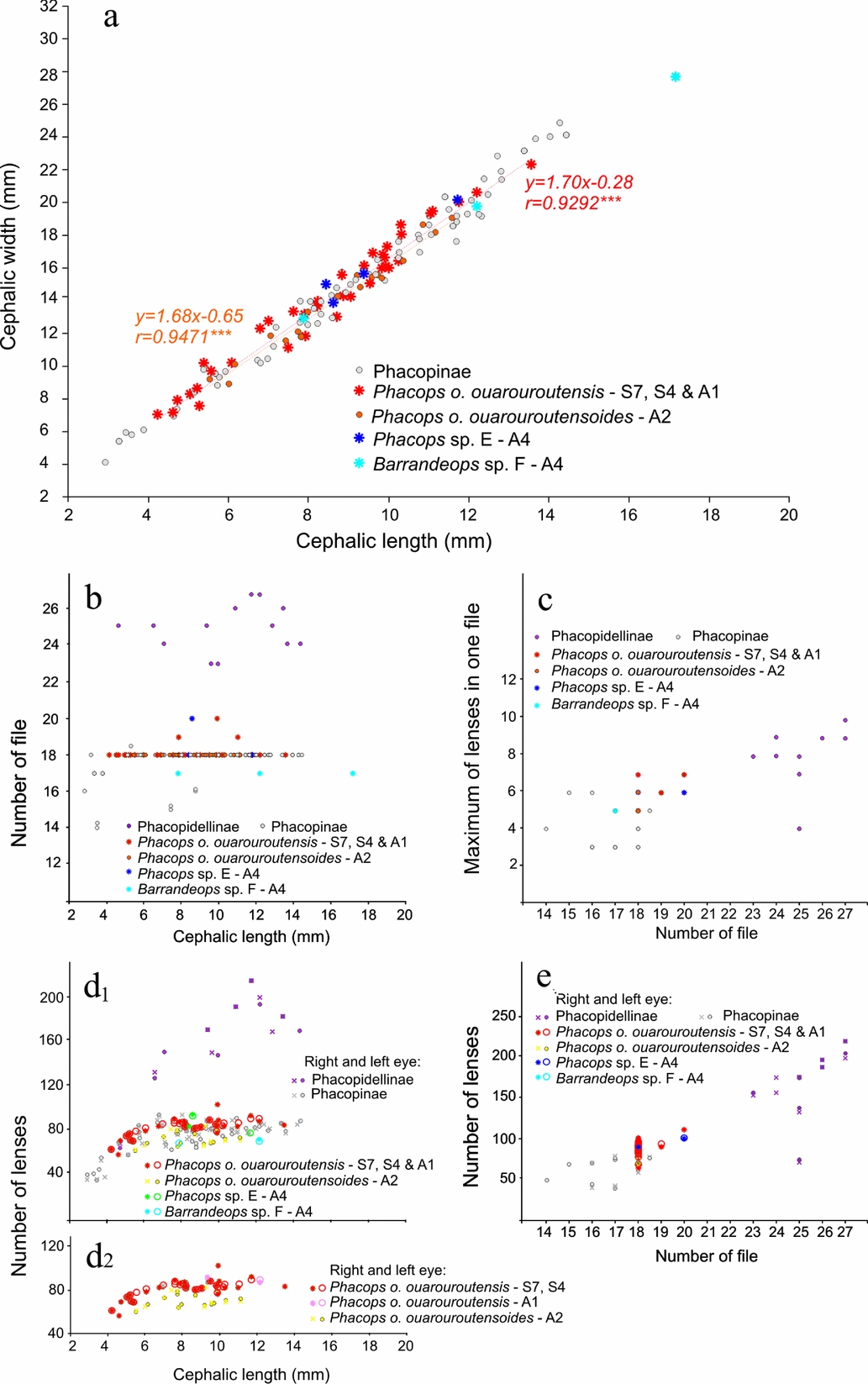
Diagnosis. Cephalon narrow; glabella with a wide base; deep and moderately divergent axial furrows; S2 and S3 distinct; L1 swollen as a pad, without tubercles; visual complex with 18 vertical lens files (sometimes 19–20) and a maximum of 7 lenses per file (often 6); interlensar sclera thickened dorsally; palpebral furrow distinct. Pygidial axis short and wide, composed of 6–7 clear rings plus terminal piece; pygidial pleural field with five clear ribs. Dense coarse pustular tubercles on cephalon without superimposed granules, becoming scale-like anteriorly. Pitting on all exoskeleton.
Description. Cephalon: Length/width ratio c. 0.62. Dorsal view: Glabellar ratio of width at L1/maximum width of frontal lobe c. 0.54. Glabella bounded by deep and moderately narrow axial furrows that are moderately divergent forwards (60°), with subangular anterolateral angles. Frontal lobe overhanging slightly a distinct preglabellar furrow. S2 and S3 relatively well developed. S1 continuous and curved more strongly forwards than S0 in its adaxial curvature, and becoming deeper in its distal portions. L1 shorter (sag.) than L0 (more than half L0 length), with a wide (tr.) median portion relative to its total width. Median portion of L1 strongly inflated as a pad, without tubercles but a few pits. L1 with subcircular, well-defined and inflated lateral lobes separated from its median part by a distinct exsagittal furrow. S0 well marked and almost transverse in its middle portion. L0 rather wide (tr.) with very poorly defined lateral lobes. Reniform visual surface with 18 dorsoventral files of lenses (exceptionally 19–20) and a maximum of 7 lenses per file (often 6, sometimes 5), with smaller lenses in the anterior median part. Interlensar sclera thickened only dorsally. Palpebral furrow distinct but shallower on its median course. Exsagittal length of the postocular genal field half to more than half the length of the posterior border. Postocular genal field not swollen, lacking ornamentation. Cheek moderately swollen with pits. Lateral view: Glabella rounded anteriorly. Outline of L1 curved. L0 as high as glabella at its maximum convexity. Anterior border rather short, ridge-like slightly projecting forwards, and sloping posteroventrally. Marginulation extending from the anterolateral border up to the genal angle. Posterior border furrow deep and narrow. Lateral border furrow rather narrow anteriorly and widening backwards as an expanded furrow. Eye socle rather narrow, smooth and well defined. Subocular area depressed, lacking ornamentation. Posterolateral furrow shallow but continuous. Posterolateral border widening at the genal angle. No subocular and postocular pads. Frontal view: Glabellar outline subcircular with lateral sides slightly flattened obliquely. Palpebral area slightly higher than the palpebral lobe. Ventral view: Vincular furrow deep, wide (sag.), curved and parallel to preglabellar furrow. Posterior band of the cephalic doublure long (sag.) with a hypostomal suture slightly turned ventrally and convex backwards medially. Thorax: Axial rings slightly convex with poorly defined lateral lobes. Axial furrows distinct. Anterior pleural band narrower (exsag.) than the posterior pleural band. Pleural furrows deep. Pygidium: rather wide, with 6–7 well-defined rings, and five deep pleural furrows. Pygidial axis short and rather wide. Pseudo-articulating half rings indicated by a distinct embayment in the posterior edge of the rings. Ornamentation: Glabella covered with dense and coarse subdued tubercles of heterogeneous size without superimposed granules, becoming scaly tubercles on the anterior part of the frontal lobe. Palpebral lobe with barely visible small tubercles. Posterolateral borders with slightly scaly small tubercles and pits. Pitting developed on the whole exoskeleton and at the base of the visual surface. Anterior band of the cephalic doublure with scaly ridges and pits; posterior band with short ridges medially and longer laterally.
Remarks. The Algerian specimens attributed to Phacops ouarouroutensis ouarouroutensis ssp. nov., with a size range from 4.20 to 13.58 mm long (sag.), show some intraspecific variability: smallest individuals with less coarse and less scaly tubercles on the anterior part of the frontal lobe. One individual exhibits (Ph54-S4) up to 20 dorsoventral files of lenses and a maximum of 7 lenses per file (with 170 lenses).
Phacops o. ouarouroutensis ssp. nov. shares with Phacops araw McKellar & Chatterton, Reference McKellar and Chatterton2009, from the Eifelian of Morocco, the pits on the exoskeleton and at the base of the eye, and the number of dorsoventral files of lenses (18, rarely 19–20). However, Phacops o. ouarouroutensis ssp. nov. differs in having a slightly coarser glabellar tuberculation, a barely visible ornamentation on the genae and the posterolateral borders, slightly less marked scaly tubercles on the anterior part of the frontal lobe, no subocular pad, only a smooth subocular area, a well-defined intercalating ring, no intersclera ventrally and a thinner intersclera dorsally.
Phacops o. ouarouroutensis ssp. nov. shares with the group of Phacops werneri, encountered from the upper Emsian to the lower Eifelian of Germany (figured in Basse, Reference Basse2006), a rather similar cephalic tuberculation and pitting. Nevertheless, the group of Phacops werneri exhibits a strong postocular pad, a row of strong granules at the base of the eye and a few less files of lenses.
Phacops o. ouarouroutensis ssp. nov. shares with Austerops speculator punctatus McKellar & Chatterton, Reference McKellar and Chatterton2009, from the Eifelian of Morocco, a similar cephalic outline, the pervasive pitting, the marginulation, the same number of dorsoventral files of lenses (18), smooth subocular (sloping) and postocular (subtle pad) areas, and a similar pygidial configuration with strong interannular rings. Phacops o. ouarouroutensis ssp. nov. differs in having a well-defined intercalating ring, an eye with less lenses per file (5–7 files in P. o. ouarouroutensis ssp. nov. compared to 8 in A. s. punctatus), denser and coarser tubercles on the glabella, coarser scaly tubercles on the anterior part of the frontal lobe (no terrace lines) and no distinct granules on the pygidial rings.
Phacops o. ouarouroutensis ssp. nov. shares with Geesops schlotheimi (Bronn, Reference Bronn1825), from the Eifelian of Germany, a similar glabellar tuberculation and pits on the genal angle. Geesops schlotheimi differs in having a prominent median preoccipital tubercle on a well-defined intercalating ring, a wider subocular area, a more elongated and curved genal angle, and a row of ‘spinose’ tubercles on the posterior border and on the posterior part of L0.
Phacops o. ouarouroutensis ssp. nov. shares with Morocops struvei (Reference SchrautSchraut, 2000b ), from the Eifelian of Morocco, a rather similar cephalic tuberculation in holaspid forms, and no subocular pad. Nevertheless, Morocops struvei, with 18 files and a maximum of 6 lenses per file, exhibits a wider subocular area, an intercalating ring with prominent median preoccipital tubercles, and better defined and convex preoccipital lateral lobes.
Occurrence: Lower Eifelian; Algeria (Saoura Valley: Ouarourout).
Phacops ouarouroutensis ouarouroutensoides ssp. nov.
Figure 7p–u
Derivatio nominis. Named after the resemblance to Phacops o. ouarouroutensis ssp. nov.
Holotype. Cephalon, MU-G-Sr.Tr.A2/Ph165.
Paratypes. Four individuals: A2/Ph155, A2/Ph156, A2/Ph166, A2/Ph163.
Locus typicus. Ouarourout II section, Saoura Valley, Ougarta Basin, Algeria.
Stratum typicum. Chefar el Ahmar Formation with Struveaspis maroccanica, lower Eifelian, Mid Devonian.
Studied material. Eighteen poorly preserved cephala and two pygidia from the Chefar el Ahmar Formation (lower Eifelian) of the Ouarourout II section (from A2 with Struveaspis maroccanica); Saoura Valley, Ougarta Basin, Algeria.
Remarks. These specimens differs only from Phacops o. ouarouroutensis ssp. nov. in having, for a similar size, a less important number of lenses (around 84 on average for P. o. ouarouroutensis ssp. nov. versus 74 for P. o. ouarouroutensoides ssp. nov.). This could correspond to an inter-populational variability.
Phacops sp. E
Figure 7a–i
Studied material. Four poorly preserved cephala from the Chefar el Ahmar Formation (lower Eifelian) of the Ouarourout II section (from A4 with Chotecops hoseri and Barrandeops sp. F); Saoura Valley, Ougarta Basin, Algeria.
Description. Cephalon: Length/width ratio c. 0.62. Dorsal view: Glabellar ratio of width at L1/maximum width of frontal lobe c. 0.50. Glabella bounded by deep axial furrows that are shallower adjacent to L1 and deeper between S1 and the front of the palpebral furrow, deflected adaxially at the front of the eye and moderately divergent forwards (66°), and with rather subangular anterolateral angles. Frontal lobe overhanging slightly a distinct preglabellar furrow. S2 and S3 indicated by a break in sculpture. S1 slightly less impressed medially and curved anteriorly. S0 less impressed medially and almost transverse in its median portion. L1 shorter (sag.) than L0 (more than half the L0 length) and with a wide (tr.) median portion relative to its total width. Median portion of L1 inflated. L1 with subcircular, inflated preoccipital lateral lobes, and separated by deep exsaggital furrows (abax. and adax.). L0 wide (tr.) with poorly defined lateral lobes. Reniform visual surface with 18–20 dorsoventral files of lenses and a maximum of 5–6 lenses per file (80–97 lenses in total). Interlensar sclera thickened dorsally and barely ventrally. Palpebral area inflated. Palpebral furrow distinct. Exsagittal length of the postocular genal field, not swollen, lacking ornamentation, slightly more than half the length of the posterior border. Lateral view: Glabella rounded anteriorly. Outline of L1 curved. L0 as high as the glabella at its maximum convexity. Anterior border rather short, ridge-like slightly projecting forwards. Marginulation with small ridges extending from the anterolateral border up to the genal angle. Posterior border furrow deep and narrow. Lateral border furrow rather narrow anteriorly and widening backwards as an expanded furrow. Eye socle rather narrow, smooth and well defined. Subocular area depressed, lacking ornamentation. Posterolateral border furrow continuous but unsharp. Posterolateral border broadened at the genal angle without node. No subocular and postocular pads. Frontal view: Glabellar outline subcircular with lateral sides slightly flattened obliquely. Palpebral area as high as the palpebral lobe. Ventral view: Vincular furrow deep, wide (sag.), curved and parallel to preglabellar furrow. Posterior band of the cephalic doublure long (sag.). Thorax: Unknown. Pygidium: Unknown. Ornamentation: Cephalon covered with dense and distinct tubercles (glabella, fixigenae, median part of L1), passing into barely scaly tubercles very anteriorly on the glabella, smaller on L0 (median part), the palpebral lobe and the posterior border. A few pits may be present on the lateral border, but not obvious.
Remarks. These Algerian specimens differ from other taxa from A4. They differs from Barrandeops sp. F in having more files of lenses, a subocular area more depressed and without small granules, and no fine granules at the base of the visual surface. They differ from Phacops ouarouroutensis sp. nov. in having smaller tubercles on the whole exoskeleton, and no pitting on the entire exoskeleton. They differ from Chotecops hoseri in having a postocular area shorter (exsag.), a subocular area more depressed, and a palpebral lobe more reduced and lowered.
The Algerian specimens show similar morphological features to some representatives of the genus Pedinopariops (Pedinopariops). Thus, they show some morphological features of Pedinopariops (Pedinopariops) insequens (Chlupáč, Reference Chlupáč1977) from the Emsian/Eifelian of the Barrandian area: a narrow cephalon; an inflated glabella bounded by deep axial furrows moderately divergent forwards; the median portion of the L1 inflated, wide and tuberculated; subcircular and inflated preoccipital lobes of L1; a reniform visual surface with 18–20 dorsoventral files of lenses and with up to 5–6 lenses per file; a distinct palpebral furrow; a marginulation with small ridges; and a similar ornamentation. The Algerian specimens differ slightly in having in the posterolateral part of the genal field no gently inflated subtriangular area well differentiated from the border with granulation or fine tubercles. Additional material is necessary to give a definitive attribution.
These Algerian specimens also share some morphological features with Pedinopariops (Pedinopariops) richterianus (Struve, Reference Struve1970) from the Eifelian of Eifel, Germany, in having a distinct palpebral furrow, rather similar subocular and postocular areas and the number of dorsoventral files of lenses (18). But they differ in having fewer lenses in each file (up to 5–6 lenses in Phacops sp. E versus 7–8 in P. (P.) richterianus).
Order PROETIDA Fortey & Owens, Reference Fortey and Owens1975
Family Aulacopleuridae Angelin, Reference Angelin1854
Subfamily Otarioninae Richter & Richter, Reference Richter and Richter1926
Genus Cyphaspis Burmeister, Reference Burmeister1843
Type species. Phacops ceratophthalmus Goldfuss, Reference Goldfuss1843: Eifelian, Gerolstein in Germany.
Remarks. Adrain & Chatterton (Reference Adrain and Chatterton1996) provided an emended diagnosis and integrated 20 species in this genus. Four new species from Morocco were added by Chatterton et al. (Reference Chatterton, Fortey, Brett, Gibb and Kellar2006) including only one from the Eifelian (Cyphaspis sp. A), and two additional species from the upper Emsian of Algeria were reported by Khaldi et al. (Reference Khaldi, Crônier, Hainaut, Abbache and Ouali Mehadji2016).
Occurrence. Wenlock to Givetian; France, England, Czech Republic, Germany, Austria, Poland, Morocco, NW Canada, Australia.
Cyphaspis sp. A
Figure 7v–aa
Studied material. Only two fragmented cephala from the Chefar el Ahmar Formation (lower Eifelian) of the Ouarourout II section (A4 with Thysanopeltis); Saoura Valley, Ougarta Basin, Algeria.
Remarks. These two cephala show morphological features of Cyphaspis new species A described by Chatterton et al. (Reference Chatterton, Fortey, Brett, Gibb and Kellar2006) from Morocco (Jbel el Zguilma): tubercles heterogeneous in size present on the fixigena opposite the eyes, on the glabella, and on the rather large L1 lobes, a row of sparse rather small tubercles sub-parallel across the preglabellar field, and relatively long genal spines. Unfortunately, owing to poor preservation, the presence of the (spinose) node on the occipital ring is not confirmed. The thoracopygon is not yet found.
Moreover, another cephalon of Cyphaspis has also been reported in S4 from the Chefar el Ahmar Formation (lower Eifelian) of the Ouarourout I section, Saoura Valley, Ougarta Basin, Algeria. Owing to its poor preservation (mainly eroded), its specific assignment is impossible.
Genus Aulacopleura Hawle & Corda, Reference Hawle and Corda1847
Type species. Arethusa koninckii Barrande, Reference Barrande1846: Wenlock, Liteň Formation, Bohemia, Czech Republic.
Remarks. Adrain & Chatterton (Reference Adrain and Chatterton1995) provided a diagnosis and a comprehensive listing of species with discussion.
Occurrence. Llandovery to Eifelian; France, England, Czech Republic, Germany, Morocco, Algeria, NW Canada.
Aulacopleura cf. beyrichi (Novák, Reference Novák1890)
Figure 4j–k
See Alberti (Reference Alberti1969) for previous synonymies.
-
1969 Aulacopleura (Paraaulacopleura) beyrichi Novák, Reference Novák1890; Alberti, pp. 393–4, pl. 36, figs 12–13.
-
1970 Aulacopleura (Paraaulacopleura) beyrichi Novák, Reference Novák1890; Alberti, p. 83, pl. 9, fig. 15.
-
1981 Aulacopleura (Paraaulacopleura) beyrichi Novák, Reference Novák1890; Alberti, p. 43.
Lectotype. Cephalothorax IPMHBE/Bi39 from the Günteröder Limestone, upper Eifelian, Bicken, Germany.
Studied material. One fragmented and poorly preserved cranidium from the Chefar el Ahmar Formation (lower Eifelian) of the Ouarourout II section (A4 with Thysanopeltis); Saoura Valley, Ougarta Basin, Algeria.
Remarks. The lectotype of the species beyrichi (Novák, Reference Novák1890) from Germany is poorly known (see Alberti, Reference Alberti1969, pl. 36, fig. 12). As revised by Adrain & Chatterton (Reference Adrain and Chatterton1995), this specimen has a sagittal profile (see Alberti, Reference Alberti1970, pl. 9, fig. 15) indicative of the genus Aulacopleura. Alberti (Reference Alberti1969, Reference Alberti1970, Reference Alberti1981) reported this species from the Eifelian of Morocco.
Our Algerian single cranidium may be assigned to Aulacopleura cf. beyrichi (Novák, Reference Novák1890) but its alteration prevents a safe assignment. The outline of the glabella and the long pre-glabella field are indicative of Aulacopleura.
Description. Cranidium with length (sag.) c. 81% width (tr.) across palpebral lobes, dorsally convex in sagittal profile with an independently inflated glabella; preglabellar field moderately long (sag.), more than anterior border, with length (sag.) c. 20% cranidial length (sag.), lacking sculpture, with a gently inflated area immediately in front of the preglabellar furrow and sloping anteriorly steeply to a shallow anterior border furrow; anterior border with length (sag.) c. 15% cranidial length (sag.), rather short and convex anteriorly to form a rounded rim with ridges, and lacking sculpture dorsally; subrectangular thimble-shaped glabella with sagittal length (including L0) reaching 73% maximum of width (tr.) across rear of L1, with a few small scattered tubercles; axial furrows rather broad and deep, deflected barely in course laterally around L1, and curving sharply into much narrower preglabellar furrow; S0 about the same breadth and depth as preglabellar furrow, deeper behind L1 and deflected barely posteriorly around posterior L1; L1 teardrop-shaped, of medium size, with length (exsag.) reaching 28% of glabellar (including L0) length (sag.), barely inflated, with a few small scattered tubercles, not fully isolated by an S1 along a course shallower posteriorly and slightly deeper and wider distally near contact with the axial furrow; median width (tr.) without lateral lobes of L1 c. 67% across rear of L1; L0 with length (sag.) reaching 12.8% of cranidial length (sag.), with a median node set slightly posterior to half the length (sag.); interocular fixigena wide (tr.) and sloped; fixigena smooth; posterior border short (exsag.) proximally, about almost doubled in length (exsag.) distally to fulcrum; posterior border furrow with slightly sinuous course, turned slightly posteriorly at fulcrum.
Aulacopleura sp.
Figure 4o–p
Studied material. One fragmented and poorly preserved cranidium from the Chefar el Ahmar Formation (lower Eifelian) of the Ouarourout II section (A3); Saoura Valley, Ougarta Basin, Algeria.
Remarks. The single cranidium may be assigned to an otarionine specimen (Aulacopleura) but its alteration prevents an accurate assignment.
Description. Cranidium dorsally convex in sagittal profile with an independently inflated glabella; anterior sections of facial sutures moderately to strongly divergent; preglabellar field moderately long (sag.), more than anterior border; preglabellar field length (sag.) c. 23% cranidial length (sag.); preglabellar field with numerous subdued small tubercles, with a gently inflated area immediately in front of preglabellar furrow and sloping anteriorly steeply to a rather shallow anterior border furrow drawing a slight open inverted ‘V’; anterior border with length (sag.) c. 17% cranidial length (sag.), rather convex anteriorly to form a rounded rim with ridges, lacking sculpture dorsally; thimble-shaped glabella with sagittal length (including L0) reaching 75% maximum width (tr.) across rear of L1, with a few heterogeneous scattered tubercles; axial furrows rather narrow and shallow, deflected just in course laterally around L1, and curving sharply into preglabellar furrow; S0 about same breadth and depth as preglabellar furrow, deflected posteriorly around posterior L1; L1 triangular shaped, of medium size, slightly inflated, with length (exsag.) reaching 35% of glabellar (including L0) length (sag.), with an acute anterior extremity, with a few small to moderate-sized scattered tubercles, fully isolated by S1 along course slightly wider distally near contact with axial furrow; L0 with length (sag.) reaching 14% of cranidial length (sag.), with a median node set slightly posterior to half the length (sag.); posterior border short (exsag.) proximally, almost doubled in length (exsag.) distally to fulcrum; posterior border furrow rather wide and shallowing at junction with axial furrows, with slightly sinuous course, turned slightly posteriorly at fulcrum.
Family PROETIDAE Salter Reference Salter1864
Subfamily Cornuproetinae Richter, Richter & Struve in Moore, Reference Moore1959
Genus Diademaproetus Alberti, Reference Alberti1964
Type species. Proetus holzapfeli Novák, Reference Novák1890: Eifelian, Germany.
Additional species. Diademaproetus praecursor (Alberti, Reference Alberti1969): upper Emsian, Morocco; D. antatlasius (Alberti, Reference Alberti1969): upper Eifelian, Morocco; D. menzeni Kowalski, Reference Kowalski1975: Eifelian, Germany; D. mohamedi Chatterton et al. Reference Chatterton, Fortey, Brett, Gibb and Kellar2006: lower Eifelian, Morocco.
Remarks. Among cornuproetines present in the Eifelian of North Africa, Diademaproetus and Cornuproetus are closely related and overlap in stratigraphical and geographical ranges. Chatterton et al. (Reference Chatterton, Fortey, Brett, Gibb and Kellar2006) discussed Diademaporetus and allies. Until now, only one subspecies of Cornuproetus has been reported from the upper Emsian of Algeria by Alberti (Reference Alberti1981) and Khaldi et al. (Reference Khaldi, Crônier, Hainaut, Abbache and Ouali Mehadji2016).
Occurrence. Upper Emsian to upper Eifelian; Germany, Morocco, Algeria?
Diademaproetus sp. vel Cornuproetus sp.
Figure 4l
Studied material. Only one fragmented cranidium from the Chefar el Ahmar Formation (lower Eifelian) of the Ouarourout II section (A4 with Thysanopeltis); Saoura Valley, Ougarta Basin, Algeria.
Remarks. Owing to the absence of the preglabellar field, the though probable assignment to Diademaproetus cannot be assured with confidence. This fragmented cranidium could be tentatively assigned to Diademaproetus mohamedi described by Chatterton et al. (Reference Chatterton, Fortey, Brett, Gibb and Kellar2006) from Morocco (Jbel el Zguilma) owing to its relative proportions and ornamentation of its glabella: sculpture of fine, anastomosing, scale-like and forwards-arched terrace ridges; only a few forwards tubercles and scattered backwards tubercles; a small furrow sub-parallel to S1, subdividing the anterior margin of the occipital ring into subsidiary occipital lobes and a median part. Unfortunately, owing to poor preservation, the cephalic border, the epiborder furrow and the preglabellar field are not observable. An assignment to Cornuproetus cornutus (Goldfuss, Reference Goldfuss1843) could be also possible.
Genus Koneprusites Přibyl, Reference Přibyl1964
Type species. Proetus moestus Barrande, Reference Barrande1852: Eifelian, Acanthopyge Limestone, Czech Republic.
Additional species. Koneprusites bickenensis Alberti, Reference Alberti1967: Eifelian, Germany; K. insons (Barrande, Reference Barrande1852): Eifelian, Czech Republic; K. moestiformis Šnajdr, Reference Šnajdr1980: lower Eifelian, Czech Republic; K. saharae (Alberti, Reference Alberti1969): upper Eifelian, Morocco; K. africus (Alberti, Reference Alberti1970): upper Eifelian, Morocco; and with caution K. siuerlandensis Basse & Lemke, Reference Basse and Lemke1996: mid Givetian, Germany; K. sp. A Basse & Lemke, Reference Basse and Lemke1996: upper Emsian; Morocco.
Occurrence. Upper Emsian?, Eifelian, mid Givetian?; Czech Republic, Germany, Morocco, Algeria.
Koneprusites cf. moestus (Barrande, Reference Barrande1852)
Figure 4m, n
See Šnajdr (Reference Šnajdr1980) for synonymies.
1980 Koneprusites moestus (Barrande, Reference Barrande1852); Šnajdr, pp. 242–3, pl. LI, figs 1–13, text-fig. 68.
Studied material. One cranidium from the Chefar el Ahmar Formation (lower Eifelian) of the Ouarourout II section (A4 with Thysanopeltis); Saoura Valley, Ougarta Basin, Algeria.
Remarks. The assignment of the well-preserved cranidium to Koneprusites Přibyl, Reference Přibyl1964 is beyond any doubt. The single cranidium is close to K. moestus (Barrande, Reference Barrande1852) sharing the slightly truncated frontal lobe of the glabella.
Description. Cranidium elongated with length (sag.) about 75% width (tr.) across palpebral lobes, and arched in lateral view; glabella thimble-shaped, slightly constricted opposite γ, moderately vaulted and sloping without break in preglabellar field anteriorly, with sagittal length (including L0) reaching 76% of maximum width (tr.) across its maximum width (tr.); dorsal furrows narrow and sharp; no glabellar furrows discernable; occipital furrow narrow and sharp, deflected barely posteriorly around posterior L1, bent anteriorly in abaxial parts, and transverse medially; occipital ring slightly enlarged anteromedially, with length (sag.) reaching 15.6% of cranidial length (sag.), with a median node set slightly posteromedially; preglabellar field moderately long (sag.) with length (sag.) c. 11% cranidial length (sag.), lacking sculpture, with a gently concave area sloping to the anterior border furrow; anterior border with length (sag.) c. 15% cranidial length (sag.), rather long, flat and upraised, with a ridged rim, lacking sculpture dorsally; anterior border furrow shallow and blunt; palpebral lobes rather small, gently curved abaxially, and sloping towards dorsal furrows; fixigena smooth. Facial suture with an anterior section curved between α and γ, divergent between β and γ divergent at c. 21° to sagittal axis and barely curved, approaching dorsal furrow at γ (rounded) and at Ɛ (slightly arcuate); posterior section not preserved. Ornamentation: Numerous granules on the preglabellar field, L0; granules to small tubercles on glabella and becoming coarser backwards and medially.
Koneprusites moestus is also encountered with Thysanopeltis speciosa Hawle & Corda, Reference Hawle and Corda1847 in the Czech Republic (Acanthopyge Limestones).
Order CORYNEXOCHIDA Kobayashi, Reference Kobayashi1935
Family Scutelluidae Richter & Richter, Reference Richter and Richter1955
Genus Thysanopeltis Hawle & Corda, Reference Hawle and Corda1847
Type species. Thysanopeltis speciosa Hawle & Corda, Reference Hawle and Corda1847: Choteč Limestone, Mid Devonian of Bohemia, Czech Republic.
Additional species. T. laciniata (Sandberger, Reference Sandberger1891): Eifelian, Germany; T. speciosa austromaura Alberti, Reference Alberti1981: lower Eifelian, Morocco.
Remarks. For Holloway & Lane (Reference Holloway and Lane2012), the concept of Scutelluidae matches with Scutelluinae sensu Whittington (Reference Whittington1999, p. 421), and they regard the taxon as a family rather than a subfamily because of its wide range of morphological diversity, possibly including several phylogenetic lineages. Scutelluids provided with pygidial border spines such as Thysanopeltis and Thysanopeltella occur from the basal Eifelian in Morocco and in Europe, and they constitute an important index for the lower Eifelian.
Thysanopeltis aff. speciosa Hawle & Corda, Reference Hawle and Corda1847
Figure 4q
See Alberti (Reference Alberti2000) for complementary synonymies.
-
1847 Thysanopeltis speciosa Hawle & Corda, p. 118, pl. 6, fig. 64a–b.
-
1952 Thysanopeltis speciosa Hawle & Corda, Reference Hawle and Corda1847; Le Maître, pp. 147–8.
-
1960 Thysanopeltis speciosa Hawle & Corda, Reference Hawle and Corda1847; Šnajdr, pp. 157–62, table 48, pl. 29, figs 4–8, pl. 30, figs 1–14, pl. 31, figs 1–4.
-
1966 Scutellum (Thysanopeltis) speciosum (Hawle & Corda, Reference Hawle and Corda1847); Selwood, p. 204, fig. 3d.
-
2000 Thysanopeltis speciosa Hawle & Corda, Reference Hawle and Corda1847; Alberti, pp. 545–6, pl. 2, fig. 2.
-
2006 Thysanopeltis aff. Thysanopeltis speciosa Hawle & Corda, Reference Hawle and Corda1847; Chatterton, Fortey, Brett, Gibb & McKellar, p. 56, fig. 38.7–38.8.
Studied material. Only one poorly preserved pygidium from the Chefar el Ahmar Formation (lower Eifelian) of the Ouarourout II section (A4); Saoura Valley, Ougarta Basin, Algeria.
Remarks. This poorly preserved pygidium can be tentatively assigned to Thysanopeltis aff. Thysanopeltis speciosa owing to its spinose pygidial border in the absence of complete and better-preserved specimens.
4. Inter- and intraspecific variability in phacopids
4.a. Method
The discontinuous post-embryonic growth by successive moults results in size distributions often clustered into stage groupings (Dodd & Stanton, Reference Dodd and Stanton1990). These size distributions allow growth to be described using relatively simple numerical models. A univariate or bivariate plot of size distribution within a sample would be expected to show a discontinuous growth curve, individuals being pooled into distinct dimensional classes. Some distribution sizes show no evidence of stage peaks because of growth rates, recruitment rates and overlap in size between instars (Sheldon, Reference Sheldon1988). In order to establish such a size series in the different Algerian species of phacopids, we have constructed bivariate plots by using the cephalic width as a function of the cephalic length (Figs 8a, 9a, 10a, 11a). Moreover, in order to follow the morphological evolution of the eye, the number of dorsoventral files as a function of the cephalic length has been plotted on bivariate diagrams (Figs 8b, 9b, 10b, 11b) and, in the same way the number of lenses as a function of the cephalic length (Figs 8d, 9d, 10d, 11d). Additionally, the maximum number of lenses in one file and the number of lenses have been plotted on bivariate diagrams as a function of the number of files (Figs 8c, e, 9c, e, 10c, e, 11c, e). Dimensions, especially the length and width of cephala in dorsal view, were obtained using an optical image analyser (TPSdig v.2.17; Rohlf, Reference Rohlf2013).
Bivariate plot using the width (in mm) as a function of the length (in mm) of (a) cephala and pygidia of Struveaspis maroccanica Alberti, Reference Alberti1970; (b) bivariate plot using the number of files as a function of the cephalic length (in mm); (c) bivariate plot using the maximum number of lenses in one file as a function of the number of files; (d) bivariate plot using the number of lenses as a function of the cephalic length (in mm); (e) bivariate plot using the number of lenses as a function of the number of files in Struveaspis maroccanica Alberti, Reference Alberti1970.

Bivariate plot using the cephalic width (in mm) as a function of the cephalic length (in mm) of three species of Austerops McKellar & Chatterton, Reference McKellar and Chatterton2009; (b) bivariate plot using the number of files as a function of the cephalic length (in mm); (c) bivariate plot using the maximum number of lenses in one file as a function of the number of files; (d) bivariate plot using the number of lenses as a function of the cephalic length (in mm); (e) bivariate plot using the number of lenses as a function of the number of files in three species of Austerops McKellar & Chatterton, Reference McKellar and Chatterton2009.

Bivariate plot using the cephalic width (in mm) as a function of the cephalic length (in mm) of Chotecops hoseri (Hawle & Corda, Reference Hawle and Corda1847) and C. aff. hoseri; (b) bivariate plot using the number of files as a function of the cephalic length (in mm); (c) bivariate plot using the maximum number of lenses in one file as a function of the number of files; (d) bivariate plot using the number of lenses as a function of the cephalic length (in mm); (e) bivariate plot using the number of lenses as a function of the number of files in Chotecops hoseri (Hawle & Corda, Reference Hawle and Corda1847) and C. aff. hoseri.

Bivariate plot using the cephalic width (in mm) as a function of the cephalic length (in mm) of four taxa of Phacops Emmrich, Reference Emmrich1839 and Barrandeops McKellar & Chatterton, Reference McKellar and Chatterton2009; (b) bivariate plot using the number of files as a function of the cephalic length (in mm); (c) bivariate plot using the maximum number of lenses in one file as a function of the number of files; (d) bivariate plot using the number of lenses as a function of the cephalic length (in mm); (e) bivariate plot using the number of lenses as a function of the number of files in four taxa of Phacops Emmrich, Reference Emmrich1839 and Barrandeops McKellar & Chatterton, Reference McKellar and Chatterton2009.

4.b. Results
4.b.1. Size distribution during ontogeny
The length/width plot of cephala (Figs 8a, 9a, 10a, 11a) shows no distinct grouping, i.e. no distinct instars. The growth series is essentially represented by the holaspid period where no feature allows distinguishing instars.
In addition, the relative proportions of each taxon represented by sufficient material remain constant (linear regression: y = ax+b; cephala: correlation coefficient r = 0.9495, probability value p < 0.001*** (significant at p < 0.05) for S. maroccanica; r = 0.9805, p < 0.001*** for A. salamandaroides sp. nov.; r = 0.9425, p < 0.001*** for C. hoseri; r = 0.9292, p < 0.001*** for P. o. ouarouroutensis ssp. nov.; r = 0.9471, p < 0.001*** for P. o. ouarouroutensoides ssp. nov.) whatever the degree of development of individuals (Figs 8a, 9a, 10a, 11a). Moreover, the correlation is positive with width varying proportionally with length. Overall, the studied phacopids present the same evolution in size. Otherwise, Struveaspis maroccanica (phacopidelline) is characterized by proportions which differ from those of phacopines: for a given length, the individuals of Struveaspis maroccanica are narrower (Fig. 8a).
The specimens assigned to other phacopine taxa are represented by only a few individuals. Thus, Chotecops aff. hoseri is represented in our study by six individuals comprising five medium- to large-sized cephala; Austerops? sp. D by three small- to medium-sized cephala; Austerops sp. B also by three small- to medium-sized cephala; Phacops sp. E by four medium-sized cephala; and Barrandeops sp. F by three medium- to large-sized cephala.
4.b.2. Dorsoventral file distribution
The scatter diagram of the number of lenses versus the cephalic length shows that during growth, there is a trend to increase the number of files (Figs 8d, 9d, 10d, 11d). This is obvious in Struveaspis maroccanica (Fig. 8d), in Austerops salamandaroides sp. nov. (Fig. 9d), in Chotecops hoseri (Fig. 10d) and in Phacops ouarouroutensis sp. nov. (Fig. 11d) for which there are enough specimens with a relatively important size range.
Additionally, some species are recognizable according to their own file number: Struveaspis maroccanica is characterized by a higher number of files, greatly variable (from 23 to 27), independent of the cephalic size (Fig. 8b, c, e). Austerops salamandaroides sp. nov. commonly has 18 dorsoventral files; only the youngest individual has 16 files (Fig. 9b, c, e). Austerops sp. B also shows 18 dorsoventral files (Fig. 9b, c, e). Chotecops hoseri also commonly displays 18 dorsoventral files; only the two youngest individuals have 17 files; moreover, one rather small individual has 18 complete files and an additional incomplete file (see Figs 5q, 10b, c, e). Chotecops aff. hoseri, represented by only five large-sized cephala, also has 18 dorsoventral files. Phacops ouarouroutensis sp. nov. commonly has 18 dorsoventral files; only three medium-sized individuals have 19 and 20 files (Fig. 11b, c, e). As Phacops ouarouroutensis sp. nov., Phacops sp. E has 18 or 20 files (Fig. 11b, c, e). Barrandeops sp. F and Austerops? sp. D differ substantially by their reduced number of dorsoventral files: respectively, 17 for Barrandeops sp. F (Fig. 11b, c, e) and 14–16 for Austerops? sp. D, even if it is represented by three small- to medium-sized cephala (Fig. 9b, c, e).
For comparison, in Struveaspis maroccanica, the minimum number of lenses is 66, the maximum number is 216, and at the maximum height of the eye, vertical files of eight or nine lenses alternate. In Austerops salamandaroides sp. nov., the minimum number of lenses is 36, the maximum number is 97, and at the maximum height of the eye, vertical files of six or seven lenses alternate; likewise, for a similar size, in Austerops sp. B, the minimum number of lenses is 41, the maximum number is 97, and at the maximum height of the eye, vertical files of six or seven lenses alternate; for a similar size, in Austerops? sp. D, the minimum number of lenses is 45, the maximum number is 66, and at the maximum height of the eye, vertical files of six lenses alternate. In Chotecops hoseri, the minimum number of lenses is 35, the maximum number is 94, and at the maximum height of the eye, vertical files of five or six lenses alternate; in Phacops o. ouarouroutensis ssp. nov., the minimum number of lenses is 59, the maximum number is 107, and at the maximum height of the eye, vertical files of six or seven lenses alternate; while in P. o. ouarouroutensoides ssp. nov., the minimum number of lenses is 63, the maximum number is only 86, and at the maximum height of the eye, vertical files of five or six lenses alternate.
To sum up, during ontogeny, there is an addition of lenses (less evident with files) for phacopidelline and phacopine taxa. Taxa with more files also have more lenses. Phacopidelline and phacopine taxa can be distinguished according to their number of files and lenses, independently of their variability.
5. Biodiversity analysis
5.a. Method
As in the previous study on Lower Devonian (Emsian) trilobites from Algeria (see Khaldi et al. Reference Khaldi, Crônier, Hainaut, Abbache and Ouali Mehadji2016), the current palaeobiodiversity study is based on a counting of specimens for each taxon identified in each studied sample and their relative abundance. Additionally, to evaluate the palaeobiodiversity components, several ecological indices (Harper, Reference Harper1999; Hammer & Harper, Reference Hammer and Harper2006) have been used.
In order to evaluate the taxonomic diversity in trilobites from the two studied sections, all the complete and disarticulated sclerites were identified and numbered. The following indices were then used: Species richness (Dtot), Diversity (MR-index), Dominance (D-index) and Equitability (E-index).
Species richness corresponds to the number of taxa, i.e. species: Dtot = S. The reliability of this index being highly dependent on the sample size, this index can be completed by a rarefaction analysis (Krebs, Reference Krebs1989). This last method compares the taxonomic diversity in samples of different sizes, estimates the number of expected taxa for any smaller sample size (Adrain, Westrop & Chatterton, Reference Adrain, Westrop and Chatterton2000; Hammer & Harper, Reference Hammer and Harper2006; Balseiro, Waisfeld & Buatois, Reference Balseiro, Waisfeld and Buatois2010), and allows comparison of the curve slopes for a reduced amount of individuals identical for all samples, thus putting forward the relative biodiversity between them. Moreover, another component of the biodiversity has been used in this study, i.e. the rank abundance curve (Whittaker, Reference Whittaker1965) with relative abundance versus abundance rank. This rank abundance curve is used by ecologists to display the relative abundance and to depict both richness and evenness (Magurran, Reference Magurran2004).
Diversity measures are usually standardized against the sample size. The Shannon-Weaver index H (Shannon & Weaver, Reference Shannon and Weaver1949) takes into account the individual number as well as the number of taxa; it considers the relative abundance of each taxon and gives weight to rare species. This index varies from 0 for a sample with only one single taxon to high values for samples with many taxa. H = −Σ(ni/n) ln(ni/n), with ni the number of individuals of the taxon i. Margalef's richness index MR (Margalef, Reference Margalef1958) minimizes the sample size effect on estimating biodiversity. The higher the Margalef value, the greater the sample is diverse. MR = (S-1)/ln(n), with S the number of species and n the number of individuals.
Dominance measures based on relative abundance show high values for assemblages with a few common elements, and low values when species are more or less evenly represented. Dominance D = Σ(ni/n)². The index varies from 0 (taxa equally represented) to 1 (one dominant taxon).
Measures of equitability are usually the opposite of dominance. Equitability J = (−Σ(ni/n) ln(ni/n)) / lnS) considers the uniformity of the distribution of individuals among the taxa present. This index varies from 0 to 1, reaching its maximum value when taxa are fairly represented with a similar number of individuals.
Analyses were performed with the use of PAST v2.17 software (Hammer, Harper & Ryan, Reference Hammer, Harper and Ryan2001).
5.b. Results
5.b.1. Paleobiodiversity
In the Saoura Valley, the palaeobiodiversity of Eifelian trilobites is not particularly high, as compared to the global record. Only three orders Phacopida, Proetida and Corynexochida have been reported in this study (Figs 12a, b, 13a, b). However, the Eifelian appears to be slightly richer than the Emsian, which is characterized by only two orders Phacopida and Proetida, as this is reported by Khaldi et al. (Reference Khaldi, Crônier, Hainaut, Abbache and Ouali Mehadji2016). Only four families occur: Phacopidae (Phacopida), which is well represented with five genera; Proetidae and Aulacopleuridae (Proetida) and Scutelluidae (Corynexochida), which are represented by only a few taxa. For comparison, trilobite palaeobiodiversity from the Emsian (according to data from Khaldi et al. Reference Khaldi, Crônier, Hainaut, Abbache and Ouali Mehadji2016) and the Eifelian (this study) at global and regional scales (Saoura Valley) is given in Figure 12a, b. Trilobites seem to be relatively low in diversity as macrofaunal constituents in the Emsian and the Eifelian of the Saoura Valley, in contrast to their global diversity (Fig. 12a). At global scale, the Basal Pragian eustatic sea level rise (House, Reference House2002) and the climate warming (Vacek, Reference Vacek2011) has probably contributed to the widening of shallow marine carbonate realms favourable for the development of trilobite communities. This has led to the maintenance of the family level diversity, which lasted with some minor changes until early Eifelian time. At a regional scale, the marine transgression was generalized throughout the occidental Saharan platform (from the Tassili to Tindouf Basin and from Taoudenni to Ben Zireg towards the north) at the beginning of late Emsian time with, as a result, a switch to carbonate sedimentation (Ouali Mehadji et al. Reference Ouali Mehadji, Elmi, Racheboeuf and Mekahli2004, Reference Ouali Mehadji, Atif, Bouterfa, Nicollin and Besseghier2011). At that time, benthic organisms such as trilobites seem to be less diversified.
(a) Total occurrences of trilobite orders and families at the global scale (modified from Feist, Reference Feist1991; Chlupáč, Reference Chlupáč1994) and in the Saoura Valley; (b) total occurrences of trilobite orders, families, genera and species in the Saoura Valley for the upper Emsian (data from Khaldi et al. Reference Khaldi, Crônier, Hainaut, Abbache and Ouali Mehadji2016) and the lower Eifelian (this study); (c) number of individuals for each genus in the Saoura Valley for the upper Emsian (data from Khaldi et al. Reference Khaldi, Crônier, Hainaut, Abbache and Ouali Mehadji2016) and the lower Eifelian (this study).

It is worth noting that the studies related to Algerian trilobites are fewer compared to the nearby localities from Morocco. Although the Devonian carbonates of Algeria may contain well-preserved fossils, the difficult access to outcrops does not facilitate palaeontological studies; as a consequence, geological investigations of Devonian sequences are often of purely economic interest in Algeria.
New samples from the Saoura Valley corroborate the occurrence of Struveaspis, a phacopid (Fig. 13a, b) as mentioned by Alberti (Reference Alberti1981), and Thysanopeltis, a scutelluid (Fig. 13a, b) as mentioned by Le Maître (Reference Le Maître1952). Phacopidae are represented in the Saoura Valley by five genera, i.e. Struveaspis, Austerops, Chotecops, Barrandeops and Phacops s.l., encountered also in the Mid Devonian of Morocco (Alberti, Reference Alberti1970, Reference Alberti1981, Reference Alberti1983; Chatterton et al. Reference Chatterton, Fortey, Brett, Gibb and Kellar2006; McKellar & Chatterton, Reference McKellar and Chatterton2009). Among these genera, Barrandeops, Austerops and Phacops s.l. are encountered both in the Emsian and the Eifelian (Fig. 12c); while Chotecops and Struveaspis are encountered only in the Eifelian (Fig. 12c). Proetidae are represented by Diademaproetus vel Cornuproetus and Koneprusites, Aulacopleuridae by Cyphaspis and Aulacopleura, and Scutelluidae by Thysanopeltis (Fig. 13), five genera also encountered in Morocco (Alberti, Reference Alberti1970; Chatterton et al. Reference Chatterton, Fortey, Brett, Gibb and Kellar2006).
(a) Number of individuals for each genus in each sampled Algerian level from the lower Eifelian; (b) number of individuals for each species in each sampled Algerian level from the lower Eifelian; (c) number of individuals in per cent for each genus in each sampled Algerian level from the lower Eifelian; (d) number of individuals in per cent for each species in each sampled Algerian level from the lower Eifelian.

In detail, diversity at genus and species levels appears to be higher in the Ouarourout II section, and especially in the A4 level (Fig. 13). Nevertheless, taxa are not all equally well represented in each level (Fig. 14). Rarefaction analysis shows that some levels are under-sampled and a higher number of individuals seems to be necessary for a good representation of some taxa. Thus, taken as an example, for an equivalent number of individuals (i.e. 15), S6 and A2 are less diversified than S4. For only five individuals, A3 seems to be more diversified than A2 or S6 (Fig. 14). However, the three curves (A4, A1 and S7) intersect the others and they do not allow comparisons (Fig. 14). The main problem here lies in the comparison of diversity and evenness between stratigraphical levels that range from few individuals to almost a hundred individuals and that their relative abundance is rather similar, regardless of the absolute abundance or density. Additional studies and fieldwork are required to revise and complete the list of Mid Devonian trilobites (as Lower Devonian) in the Saoura Valley.
Rarefaction curves for each studied Algerian level. S4, S6, S7: levels from the Ouarourout I section; A6, A4, A3, A2, A1: levels from the Ouarourout II section. Arrows indicate the comparative individual number for levels of the same size (5 for A2/S6 v. A3; 15 for A2/S6 v. S4).

5.b.2. Ecological structure
In the Saoura Valley, the palaeoecological parameters have allowed recognition of different assemblage types on the basis of the relative abundance and diversity of the trilobite macrofauna. Regarding the late Emsian (see Khaldi et al. Reference Khaldi, Crônier, Hainaut, Abbache and Ouali Mehadji2016, fig. 15), the Ed4 biota is dominated by two abundant and opportunistic species and could represent a ‘pioneer’ community; by contrast, other biotas (Ed3n1, Ed3n2 and ‘km 30’) are characterized by a relatively moderate diversity and evenness, with no dominant species, and could represent ‘equilibrium’ communities. With respect to the early Eifelian (this study; Fig. 15), among the different levels, only the A4 biota is relatively diversified (8 species for 81 individuals) but with one dominant species, i.e. Chotecops hoseri (84%) and a low evenness. The other biotas are more or less similar and they are characterized by a low diversity (two or three taxa only) dominated by one or two fairly represented taxa. These communities could represent some restrictive conditions (owing to abiotic or biotic factors).
Comparison of three diversity indices in (a) the genera, and (b) the species in four levels from the upper Emsian (data from Khaldi et al. Reference Khaldi, Crônier, Hainaut, Abbache and Ouali Mehadji2016), eight levels from the lower Eifelian (this study), and in the upper Emsian v. lower Eifelian.

In addition, the rank abundance curves confirm that a small number of taxa are dominant (i.e. abundant) in several levels, and the remaining taxa are rare (Fig. 16). Thus, A4 is dominated by a single taxon on eight, A2/S6/A3 and A1 are dominated by a single taxon on two, S4 and S7 are dominated by two species on three. The steep slope indicates low evenness as the high-ranking taxa have much higher abundances than the low-ranking taxa. While a low slope indicates high evenness as the abundances of different taxa are similar as seen in Ed3n1, Ed3n2 and km 30 (date from Khaldi et al. Reference Khaldi, Crônier, Hainaut, Abbache and Ouali Mehadji2016) that are almost in equal proportions with a greater richness underlined by a higher number of ranked taxa (Fig. 15).
Relative abundance in (a) per cent and (b) log10 according to the rank abundance of each Algerian level where the most abundant taxa is given rank 1, the second most abundant is 2 and so on. S4, S6, S7: levels from the Ouarourout I section; A6, A4, A3, A2, A1: levels from the Ouarourout II section; Km30, Ed3n1, Ed3n2, Ed4: levels from the Saoura Valley (data from Khaldi et al. Reference Khaldi, Crônier, Hainaut, Abbache and Ouali Mehadji2016).

Trilobites are found in micritic carbonate levels with goniatites, accumulated in the distal parts of a carbonate platform. These levels are intercalated by clayey-marly beds rich in brachiopods. Even if the diversity proxies are representative of communities from which they are sampled, at a low sample size these diversity proxies may suggest an incorrect ordering of relative diversity among the total community comprising others groups. Furthermore, the taxa abundance may change over time because of abiotic or biotic factors such as predation, resource availability, etc. Additionally, we cannot exclude that some levels do not represent an in situ assemblage, i.e. a palaeocommunity where taxa are associated partly because they have similar environmental tolerance and partly because they interact with each other (Brenchley & Harper, Reference Brenchley and Harper1998).
6. Conclusions
The discovery of new trilobite taxa and the improved understanding of previously known taxa from the Mid Devonian of Algeria allow drawing of the following conclusions. On the basis of our material, it has been possible to identify new oculated species among the numerous ones already known from Morocco. At both generic and specific levels, the Algerian faunule may be regarded as relatively diversified without marked original features and closely related to Moroccan taxa, owing to the presence of the species Struveaspis maroccanica and Thysanopeltis aff. speciosa.
The biometric analysis of phacopids appears to be complementary to their systematic and descriptive study because it enables us to quantify and understand the variability of individuals. More particularly, it enabled us to show that the new species, Phacops ouarouroutensis, is represented by two populations based on the number of lenses in the visual complex.
New samples from the Saoura Valley corroborate the occurrence of Phacopida, Proetida or Corynexochida in northern Africa as mentioned by Le Maître (Reference Le Maître1952), Alberti (Reference Alberti1970, Reference Alberti1981) or Chatterton et al. (Reference Chatterton, Fortey, Brett, Gibb and Kellar2006). Mid Devonian strata are characterized by abundant Phacopidae. Although the diversity of genera and species preserved in the Ouarourout II section (A4) appears to be better than in the Ouarourout I section, additional fieldwork is required to obtain a more representative picture of Devonian trilobite biodiversity, community structure and interspecific variability from the Saoura Valley.
Moreover, two types of assemblages were recognized from the lower Eifelian: an A4-biota relatively diversified (8 species for 81 individuals), dominated by Chotecops hoseri (84%); and other biotas characterized by a low diversity and dominated by one or two taxa barely represented.
Finally, at a global scale, the lower Eifelian fauna of the Saoura Valley is more or less comparable to the one recovered from the upper Emsian, which is characterized by a relatively moderate diversity and evenness with barely dominant taxa. The lower Eifelian fauna is slightly less diverse than the upper Emsian one, and characterized by slightly higher dominance and lower evenness.
Acknowledgements
This paper is a contribution to UMR 8198 EvoEcoPaleo-CNRS and UMR 6282 Biogéosciences-CNRS. Our work benefitted from constructive remarks provided by M. Basse (Germany), T. Danelian (France), R. Feist (France) and M. Ghobadi Pour (Iran).