Virtual reality has emerged as one of the most revolutionary innovations implemented in the medical field in the last two decades, offering the introduction of new modalities for education, procedure planning, and more recently, as a distraction model for pain and anxiety management during different interventions. Reference Ahern, Dean and Stoddard1–Reference Ayoub and Pulijala3
Despite distraction models could be considered an unfamiliar term, this term was introduced in the late 1990s by McCaffery et al. as a non-pharmacological approach for pain management, showing how sensorial perception can be reduced when attention is driven away from unpleasant stimuli. Reference Chris Pasero4 Among all these proposed distraction models, virtual reality offers a suitable combination of visual, auditory, kinesthetic, and (somehow) emotional stimuli, fitting as one of the most potent methods to block painful perceptions. Reference Glanz, Rizzo and Graap5–Reference Rutter, Dahlquist and Weiss7
So far, the application of virtual reality as a distraction model has been reported during different medical interventions such as burn care in children and adults, physical therapy after significant trauma, administration of chemotherapy, and other surgical interventions, showing the effectiveness of this modality to reduce pain and the perception of obnoxious stimuli during a varied set of procedures. Reference Ahern, Dean and Stoddard1,Reference Maskey, Rodgers and Ingham8–Reference Tse, Ng and Chung11
Recently, the use of virtual reality during awake surgical interventions was reported by Hoxhallari et al., who showed how the implementation of this model improves the overall patients’ experience during and after hand surgery without increasing the rate of complications. Reference Hoxhallari, Behr and Bradshaw12 Thus far, some concerns about expenses or equipment limitations to implement virtual reality have been addressed; however, given the era of multiple technological innovations, different types of equipment and available free online resources increase the feasibility of using this modality in different clinical settings. Reference Glanz, Rizzo and Graap5,Reference Hajesmaeel Gohari, Gozali and Niakan Kalhori13–Reference Glegg and Levac15
Over the last year, we have used this technology in patients during awake cardiac catheterisation. Given the wide range of benefits reported with this technology, we want to report our experience using virtual reality as a distraction model during diagnostic cardiac catheterisation and how this impacts patients’ perception and procedure metrics.
Case presentation
Between November 2019 and July 2020, a total of five cases of three different patients, a 14-year-old boy, a 15-year-old boy, and a 15-year-old girl, were selected to evaluate the application of virtual reality as a distraction method during their procedures. Baseline procedure description, radiation metrics, and anaesthesia protocols for their virtual reality and non-virtual reality interventions were collected.
Procedure details
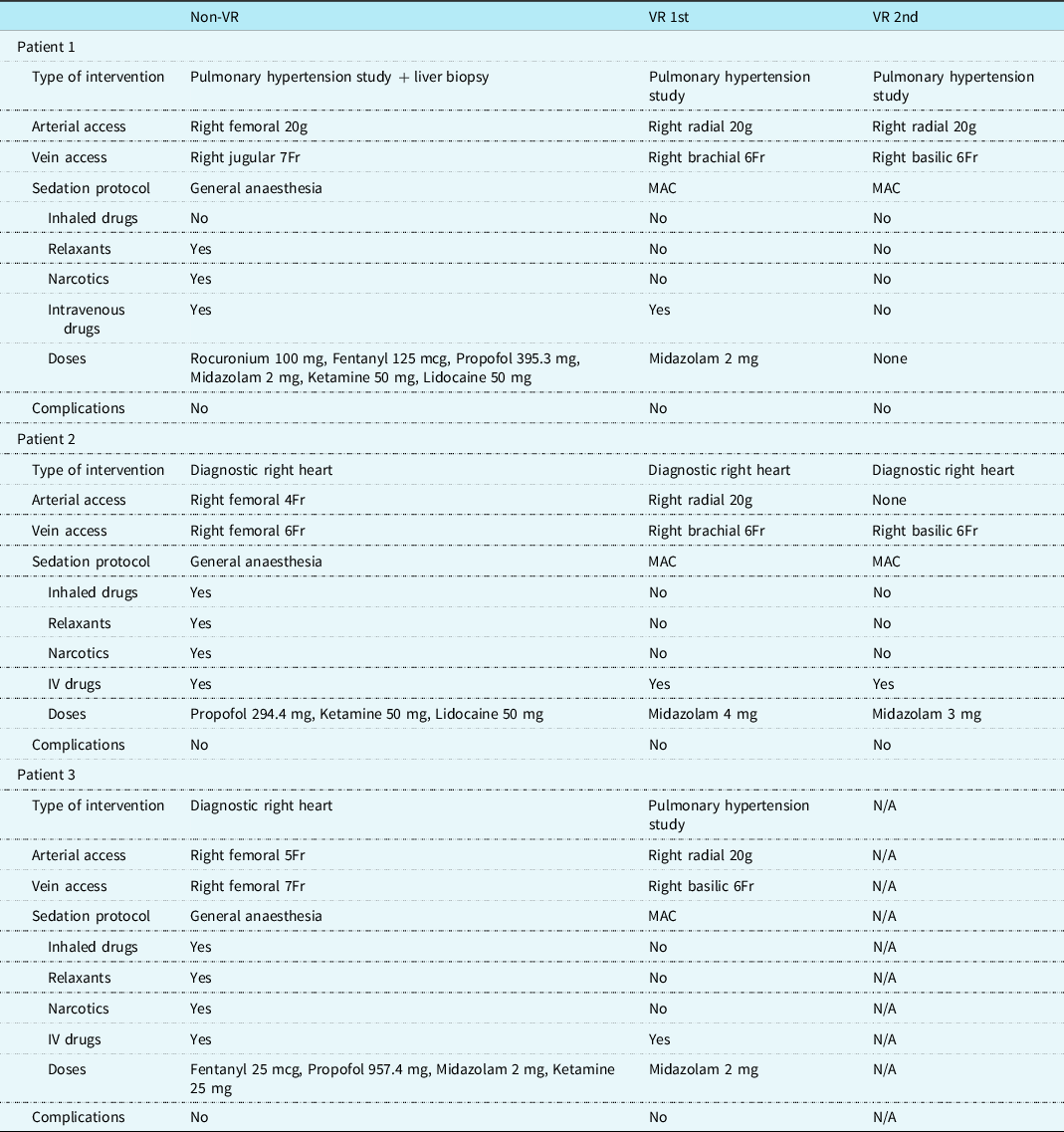
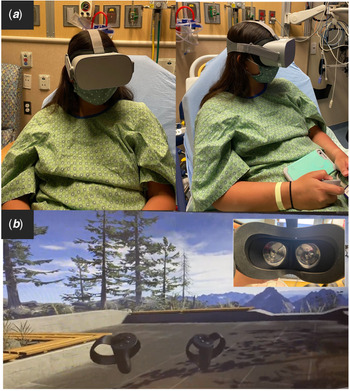
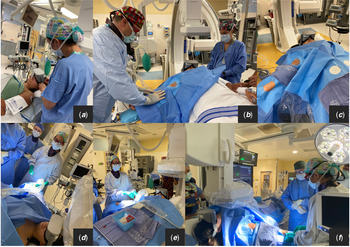
All procedural characteristics are summarised in Table 1. During these cases, Oculus Go Standalone Virtual Reality Headset (Oculus, Irvine, California, United States of America) was placed on the patient before the intervention, and he/she chose a pre-recorded environment or an interactive movie from the equipment. Different languages were available depending on the environment selected (Figs 1 and 2).
Procedural characteristics

IV = intravenous, MAC = monitored anaesthesia care.
Pre-procedure setting. During this period, instructions for use and vision calibration are given by the Child Life Team. ( a ). Familiarisation with the use of the VR console. ( b ). Virtual environment (home view of the virtual reality headset) view which also includes movies and are the preferred option as does not require movement.

VR configuration and use during the procedure. ( a ). VR is placed when the patient is already on the table. ( b ). Simulation is started, the control is usually held by the patient with their left hand which can be used under the drapes. The patient is prepped and draped in the usual sterile fashion. ( c ). The site for access is prepped, VR system does not interfere with this process. ( d–e ) Vascular access is obtained, during this period an active communication with the patient is maintained. ( f ). Diagnostic procedure is performed.

During the interventions when virtual reality was used, the sedation protocol was limited to local anaesthesia and low-dose intravenous drug (midazolam). For patient 1, only local anaesthesia in the access site was used during the second cardiac catheterisation using virtual reality. During their previous non-virtual reality cardiac catheterisations, the application of a combined protocol for general anaesthesia, using a combination of inhaled drugs, relaxants, narcotics, and IV drugs, was described in all patients. The type and dosing for anaesthetic drugs are detailed in Table 1 for each case.
Related to vascular access, during the cases when virtual reality was utilised, access was obtained in the basilic/brachial vein and the radial artery preferentially. Compared to previous non-virtual reality cases, when femoral artery and femoral vein were described as the access sites. No issues obtaining vascular access during virtual reality cases were reported for any of our cases.
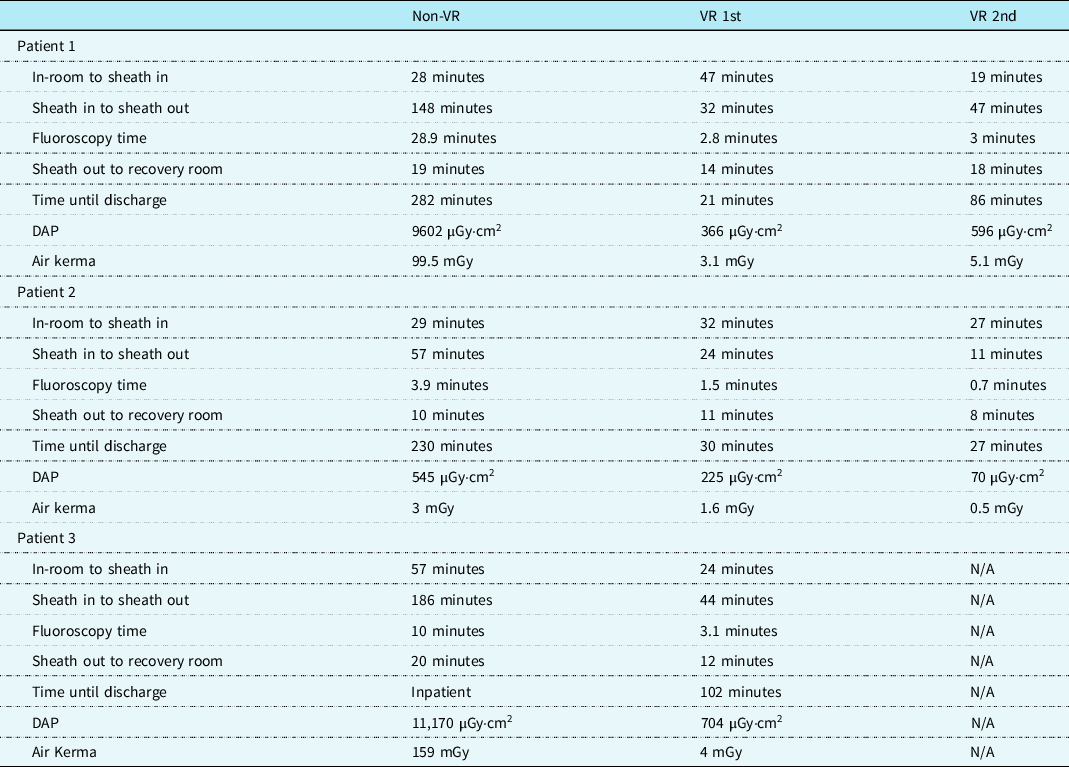
There was no increase in procedural times (sheath-in to sheath-out time), fluoroscopic times, and radiation metrics in the cases when virtual reality was used for distraction, compared to their previous non-virtual reality cardiac catheterisation; all these values are summarised in Table 2.
Baseline characteristics

DAP = dose area product.
Clinical experience
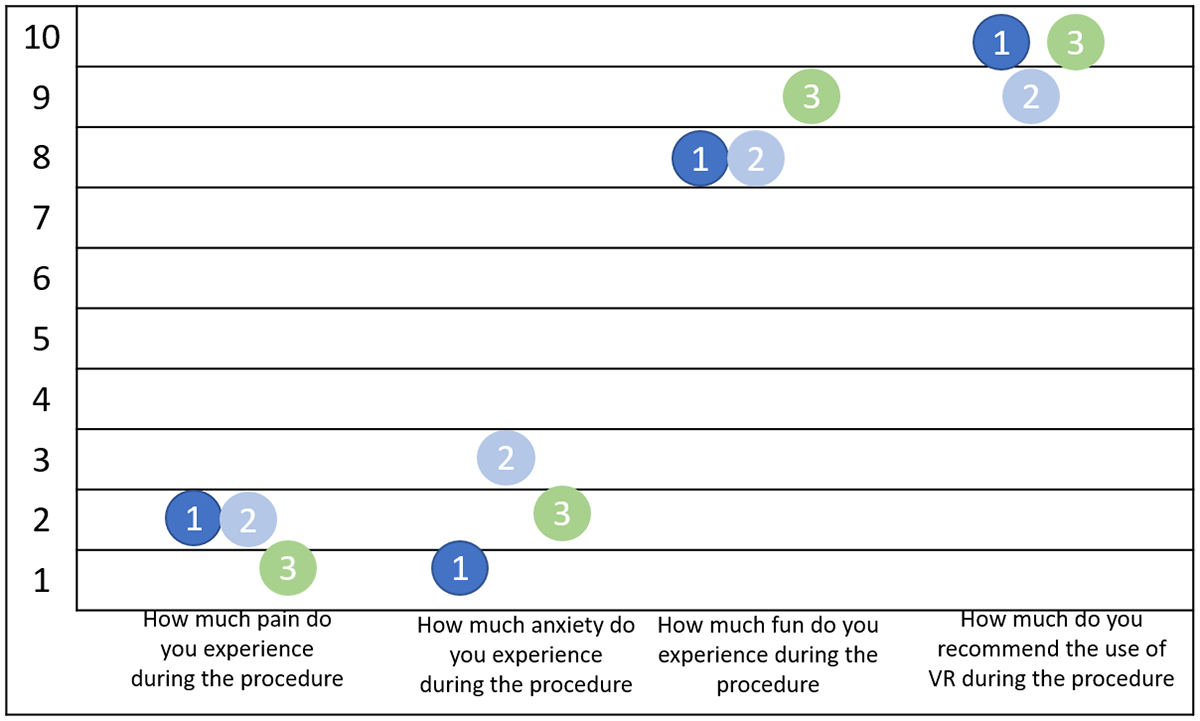
Related to the clinical experience of virtual reality during the procedure, when patients were asked about pain during and after the procedure, the three reported 2 or less on a scale of 10 (10 meaning severe pain). The anxiety experienced during the procedure was described as less than 3 for all patients (10 meaning severe anxiety). The fun experienced during this intervention was described as an 8 or 9 out of 10 (10 meaning the most entertaining/fun), and when they were asked about how likely they would recommend this to other patients, all of them answer ≥9 (10 meaning very likely). These results are summarised in Figure 3.
Patients’ experience when VR was applied. Showing pain, anxiety, fun, and how much they recommended this type of distraction model for other patients.

Given that patients 1 and 2 underwent cardiac catheterisation twice using virtual reality, their answers remained constant during the second experience, and they were excited about using this modality again during their last intervention.
Nausea, dizziness, or other cybersickness symptoms were not reported on these patients during or after the intervention.
Discussion
In this case series of three patients using Virtual Reality as a distraction modality during cardiac catheterisations, we evaluated patients’ experience, anaesthesia protocol, procedure, and radiation metrics when this approach was used during awake diagnostic procedures. In all patients, the use of virtual reality improves the overall experience of patients, reducing anxiety and pain associated with the intervention. Also, when the cases in which virtual reality was used for distraction were compared to their previous non-virtual reality cardiac catheterisations, we found a lower dose of anaesthetic drugs and lower levels of anxiety.
We also noted shorter procedure times and lower radiation metrics; however, we think this was unrelated to the use of virtual reality in these cases, but most importantly, there was no increase in these parameters. The time interval from case completion to discharge was much shorter with patients that used virtual reality for distraction, related to the absence of post-anaesthesia observation and no flat time required after brachial/basilic vein and radial artery access.
Our findings show that the virtual reality system helps to reduce the anxiety and discomfort of patients undergoing awake interventions, reducing in this way, one of the limiting factors to set up these type of procedures successfully; especially considering that during previous experiences in our centre, when other distraction modalities were offered, most of patients refused to undergo awake procedures given the anxiety associated with the process. In other words, the application of virtual reality in different clinical settings fits as a useful tool to facilitate the acceptance of minimalist therapeutic options, which could be applied without anaesthesia, increasing the convenience and safety of these procedures.
During the use of this modality at our centre, despite patients were into a simulation, we noticed a more significant interaction with them, suggesting that they were more aware of their environment without being afraid of the circumstances. Interestingly, unlike our experience with patients in other modalities of distraction, patients using virtual reality answered our questions during the intervention without any difficulty, showing that regardless of common concerns about the interaction between doctors and patients when virtual reality is used, in our patients, this approach did not affect the communication process.
These interactions benefits in patients undergoing awake interventions have been previously reported in other clinical settings. For example, Hoxhallari et al. reported similar findings when they used virtual reality in patients during awake surgery of the hand, improving the interaction with their patients in this modality compared to other distraction techniques, facilitating the comprehension of medical indications to evaluate specific hand movements during the surgical intervention. Reference Hoxhallari, Behr and Bradshaw12 Similarly, Bernard et al. reported how the use of virtual reality during awake craniotomies, which is an entirely different clinical scenario, this modality facilitates the communication between the patient and the team performing the procedure, improving the overall communication experience. Reference Bernard, Lemée, Aubin, Ter Minassian and Menei9
Another typical concern about the use of this technology is the addition of resources and the extra time needed to prepare the equipment for each patient; however, in our patients, the time to place the device was in most cases shorter than the time used to perform anaesthesia induction, and given the software offers an intuitive interface, no previous training was required for patients before the intervention, needing just a couple of minutes for calibration and explanation of basic instruction.
We did not observe any interactions between the virtual reality and the X-ray systems; no imaging artefact or interaction was noticed, different from the reported in the previous description when the system interferes with the radiologic assessment during the procedure. Reference Bernard, Lemée, Aubin, Ter Minassian and Menei9
Nevertheless, there were some initial challenges during the application of the head-mounted virtual reality devices, mostly related to the interaction with the equipment used for oxygen therapy, finding different incompatibilities between the shape of the virtual reality device and the mask used during the intervention, being unfortunately in some cases, the reason why some patients were excluded from using the virtual reality technology. This was more common in smaller patients. For teenagers, the standard mask to deliver additional oxygen and inhaled nitric oxide could fit in place without any issues.
Based on our observations, virtual reality represents a novel and powerful tool to be used as a distraction model during percutaneous cardiac interventions, improving the overall patients’ experience and allowing to achieve the reduction of anaesthesia and recovery time without risking the effectiveness and safety of the procedure.
Limitations
Given the nature of this report and our sample size, potential confounders such as vascular access or age were not standardised, limiting our ability to report the real impact of these factors over the efficacy of virtual reality as a distraction modality.
Acknowledgements
The authors thank the Cardiac Anesthesia team at Children’s Hospital Colorado, Megan Fisher, and the entire Child Life team at Children’s Hospital Colorado for supporting this effort.
Financial support
This research received no specific grant from any funding agency, commercial, or not-for-profit sectors.
Conflicts of interest
The authors have no conflict of interest to report.
Ethical standard
All procedures performed in studies involving human participants were in accordance with the ethical standards of the institutional and/or national research committee and with the 1964 Helsinki Declaration and its later amendments or comparable ethical standards.
Informed consent was obtained from all individual participants involved in the study.