Introduction
There is a growing need for cost reduction and high productivity in high-precision machining of hard materials, especially for use in the automobile, aerospace, medical, and electronics equipment manufacturing industries. Accordingly, much harder, tougher, and more durable cutting tool materials than currently available are required.
Conventional sintered polycrystalline diamond (PCD) and polycrystalline cubic boron nitride (PcBN) are widely used as superhard tool materials for cutting nonferrous materials and ferrous metals, respectively. They are made by sintering diamond or cubic boron nitride (cBN) powder with binder materials such as cobalt, TiN, and more at high pressure and high temperature (HPHT) of 5–6 GPa and 1300–1500°C. However, binder materials remaining in the diamond or cBN grain boundaries significantly affect the mechanical properties and thermal stability of the sintered compact.
To meet market needs, the hardness of PCD and PcBN needs to be increased by reducing the amount of binder materials and the strength needs to be improved by refining the grains. The ideal ultimate target material is a nanopolycrystalline body in which nano-sized grains of diamond or cBN are directly and tightly bound to one another without any binder. Such a binderless nanopolycrystalline material cannot be created by merely extending conventional technologies. Innovative new processes need to be developed.
We succeeded in creating such innovative superhard nanopolycrystalline diamond Reference Sumiya1–Reference Harano, Satoh and Sumiya3 and nanopolycrystalline cBN Reference Sumiya, Uesaka and Satoh4–Reference Sumiya, Harano and Ishida6 by developing a new ultra-HPHT technology and a new processing technology that involves direct conversion sintering under ultra-HPHT conditions, enabling commercial production. The materials have been in practical use such as in cutting tools and wear-resistant tools. This article reviews the development of these practical new superhard materials, as well as their features and applications.
Development of innovative binderless sintering process
It is difficult to tightly sinter powdered diamond and cBN without using a binder (solid-phase sintering) even at ultra-HPHT conditions, because the diamond and cBN particles are extremely hard and rigid. All commercially available PCD and PcBN are currently produced using binder materials. Single-phase polycrystalline diamond Reference Bundy7–Reference Dubrovinskaia, Dubrovinsky, Crichton, Langenhorst and Richter11 and cBN Reference Bundy and Wentorf12–Reference Dubrovinskaia, Solozhenko, Miyajima, Dmitriev, Kurakevych and Dubrovinsky16 consisting of fine grains bonded directly have been experimentally prepared by the direct conversion method. Reference Bundy7–Reference Dubrovinskaia, Solozhenko, Miyajima, Dmitriev, Kurakevych and Dubrovinsky16 In this method, the normal-pressure phase of carbon (graphite) or hexagonal boron nitride (hBN) is directly converted to the high-pressure phase of diamond or cBN under HPHT conditions, and the high-pressure phase is sintered simultaneously. However, the properties and performance of experimentally synthesized polycrystals have not been sufficiently clarified. In addition, these experimental processes require ultra-HPHT conditions two to three times greater than those used in conventional processes, leading to higher costs and lower mass productivity. For these reasons, these experimental processes have not been put to practical use.
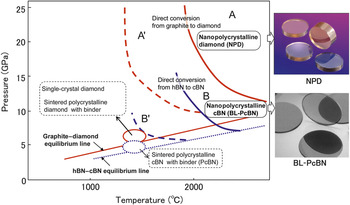
We have developed a new ultrahigh HPHT mass-production technology and succeeded in expanding the industrially usable pressure and temperature ranges to 8–20 GPa and 2000–2500°C from the conventional regimes of 5–6 GPa and 1300–1500°C, respectively. In addition, we investigated the optimum HPHT conditions for direct conversion from graphite and hBN to the high-pressure phases. The synthesis regions that we obtained from experiments are shown in Figure 1 . Reference Sumiya1 The conversion of each starting material to the high-pressure phase from the normal-pressure phase begins in the regions above the dotted lines (region A′ for diamond and B′ for cBN) in the figure, and the conversion to cubic crystal forms is completed in the regions to the upper right of the solid line (region A for diamond and B for cBN). The pressure conditions required for the completion of conversion are 15 GPa or higher for diamond and 8 GPa or higher for cBN. The temperature conditions are 2100°C or higher for both diamond and cBN, corresponding to the energy for activating the diffusion of their atoms. Reference Sumiya1,Reference Sumiya, Uesaka and Satoh4,Reference Sumiya17
Synthesis regions of nanopolycrystalline diamond (NPD, region A) and cBN (BL-PcBN [binderless nanopolycrystalline boron nitride], region B). Reference Sumiya1

Considering the phase-transition mechanisms of both nanopolycrystalline diamond and cBN, diffusion process phase transition and nondiffusion (martensitic) process phase transition compete with each other. Reference Sumiya1,Reference Sumiya17 The phase-transition pathway of each starting material changes depending on the crystallinity (degree of crystallization) and particle size of the starting materials and the HPHT conditions. When the degree of crystallization of the starting materials is high and the synthesis pressure increases, nondiffusive transition becomes dominant in a low-temperature range. In that case, a metastable phase such as hexagonal diamond or wurtzite boron nitride (wBN) is formed. The metastable phases convert to cubic phases of diamond and cBN when the temperature exceeds 2100°C. Conversely, when the degree of crystallization of the starting materials is low, diffusive transition becomes dominant. Reference Sumiya, Harano and Ishida6,Reference Sumiya, Yusa, Inoue, Ofuji and Irifune18
In regions A and B in Figure 1, pure polycrystalline diamond and cBN are obtained without any secondary phases. However, the microstructures and properties of the synthesized materials change significantly depending on the state of the starting material (purity, crystallinity, and crystallite size) and the HPHT synthesis conditions (pressurization and heating process conditions and conversion sintering temperature). Therefore, in order to obtain densely structured polycrystalline materials having the desired high hardness and toughness, these influential factors should be appropriately optimized and properly controlled.
Microstructure
The polycrystalline diamond and cBN synthesized at 2100–2200°C under conditions A and B shown in Figure 1 consist of fine grains with size of several tens of nanometers. When nongraphitic or low-crystalline graphite or hBN is used as a starting material, a polycrystalline body consisting of a perfectly converted high-pressure phase can be obtained even under the lower temperature conditions in regions A′ and B′. Reference Sumiya, Yusa, Inoue, Ofuji and Irifune18 In this case, if a polycrystalline body is synthesized at a temperature of 2000°C or below, its grain size can be made as small as 10 nm or less. However, its hardness decreases due to insufficient sintering. Reference Sumiya, Harano and Ishida6,Reference Sumiya and Irifune19,Reference Sumiya, Harano and Ishida20 On the other hand, when the synthesis temperature exceeds approximately 2300°C, the diffusion velocity of atoms increases and the grains of both the diamond and cBN begin to grow regardless of the starting materials. Reference Sumiya, Harano and Ishida6,Reference Sumiya and Irifune19 The grain growth leads to a less intertwined linear grain boundary, reducing the grain-boundary bonding strength and lowering the hardness and toughness of the synthesized polycrystalline bodies. Reference Sumiya, Uesaka and Satoh4,Reference Sumiya, Harano and Ishida6
A lamellar structure remains depending on the crystallinity of the starting material and the pressurization/heating conditions. Reference Sumiya, Irifune, Kurio, Sakamoto and Inoue21,Reference Ishida and Sumiya22 The suitable existence of the lamellar structure improves the strength of the materials. Reference Sumiya and Irifune19,Reference Harano, Arimoto, Ishida and Sumiya23 The extent of the remaining lamellar structure depends on the selection of the previously described factors. To improve the mechanical properties of the synthesized polycrystalline bodies such that they are ideal for cutting-tool applications, it is indispensable to appropriately control and optimize the influential factors.
Mechanical properties
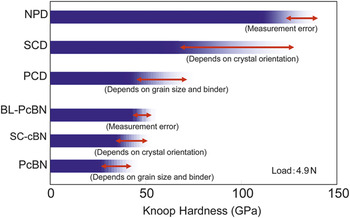
We prepared nanopolycrystalline diamond (NPD) and cBN (BL-PcBN, or binderless nanopolycrystalline boron nitride) by precisely controlling the grain size and sinterability, while optimizing and controlling the starting material and synthesis conditions. Figure 2 Reference Sumiya and Irifune24 shows the Knoop hardness values of NPD and BL-PcBN, which are far higher than those of conventional PCD and PcBN containing a binder.
Knoop hardness values of nanopolycrystalline diamond (NPD) and cBN (BL-PcBN). Reference Sumiya and Irifune24 Note: single-crystal diamond, SCD; polycrystalline diamond, PCD; single-crystal cubic boron nitride, SC-cBN; binderless nanopolycrystalline boron nitride, BL-PcBN.

The hardness of the single crystal varies widely depending on the crystallographic orientation. In contrast, NPD and BL-PcBN do not show hardness anisotropy and their hardness is higher than the mean hardness of their single crystals. In addition, NPD and BL-PcBN maintain a high hardness even when exposed to high temperatures. Reference Sumiya1,Reference Sumiya and Harano2,Reference Sumiya, Uesaka and Satoh4 In particular, the hardness of NPD above 800°C is nearly two times that of a single crystal. Reference Sumiya1,Reference Sumiya and Harano2
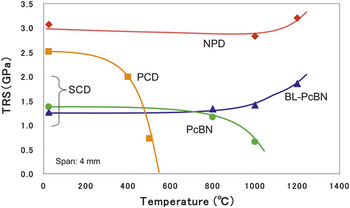
The transverse rupture strength (TRS) of NPD and BL-cBN is also higher than the values for conventional PCD and PcBN at high temperatures, as shown in Figure 3 . Reference Sumiya1,Reference Sumiya and Harano2 Notably, their TRS increased slightly at high temperatures above 1000°C, while the TRS of conventional PCD and PcBN dropped sharply at around 500°C and 800°C, respectively, due to the influence of the binder material.
Transverse rupture strength (TRS) of nanopolycrystalline diamond (NPD) and cBN (BL-PcBN). Reference Sumiya and Harano2 Note: binderless nanopolycrystalline boron nitride, BL-PcBN; single-crystal diamond, SCD; polycrystalline diamond, PCD.

Polycrystalline materials usually show accelerated failure due to intergranular slip or cracking; thus, the hardness of polycrystals is usually lower than that of single crystals. However, when the intergranular bond is extremely strong, transgranular fracture dominates over intergranular fracture. In this special case, plastic deformation and crack propagation generated in each grain are suppressed by the strong grain boundaries. As a result, such polycrystals exhibit mechanical properties superior to those of single crystals. Due to the optimization of the starting materials and synthesis conditions, NPD and BL-cBN have extremely high grain-boundary strength, making transgranular fracture dominant. Reference Sumiya, Uesaka and Satoh4,Reference Sumiya and Irifune19 These nanopolycrystals demonstrate higher hardness and TRS than their single crystals. In addition, microtransgranular plastic deformation that occurs in each grain at high temperatures suppressed the concentration of stress at crack edges. Through this effect, the hardness and TRS of NPD and BL-PcBN are kept higher, even at high temperatures.
These phenomena can be observed only when the grain-boundary strength is extremely high and transgranular fracture is dominant. Reference Sumiya and Harano2,Reference Sumiya, Uesaka and Satoh4 The crystal lattices of each grain in high-strength NPD and BL-PcBN are strongly intertwined with one another in a complex fashion, leading to transgranular fracture becoming dominant. Reference Sumiya and Harano2,Reference Sumiya, Uesaka and Satoh4,Reference Sumiya and Irifune19 In contrast, when the degree of sintering is degraded due to inappropriate synthesis conditions or when grain growth occurs, grain-boundary strength decreases and intergranular fracture becomes dominant. Thus, it is important to control and optimize the influential factors previously mentioned—the state of the starting material (purity, crystallinity, and crystallite size) and the HPHT synthesis conditions.
Applications of NPD
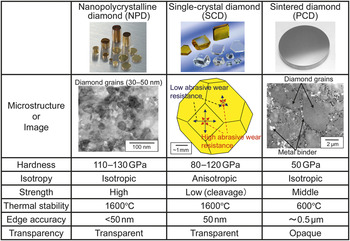
NPD synthesized using an appropriately selected and adjusted starting material under optimized synthesis conditions is remarkably hard and tough. The characteristics of the NPD are summarized in Figure 4 , and compared with those of conventional diamond. NPD is free from cleavage fracture and anisotropy in mechanical properties that are characteristic of a single crystal. NPD is also superior in wear resistance and thermal stability compared to conventional sintered diamond (PCD) containing a binder. Reference Sumiya1,Reference Sumiya and Harano2 In addition, the particles forming NPD are as fine as several tens of nanometers, allowing high-strength and high-precision sharp cutting edges to be formed. These salient properties make NPD a promising material for use in cutting tools and wear-resistant tools.
Characteristics of nanopolycrystalline diamond and conventional diamonds (single-crystal diamond and sintered diamond).

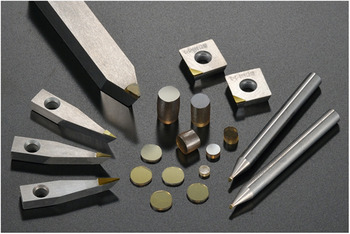
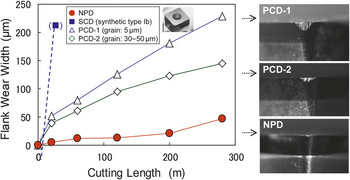
Using this NPD, we fabricated the cutting tools shown in Figure 5 , Reference Sumiya, Harano and Murakami25 and systematically evaluated their cutting performance on various workpieces such as cemented carbide alloys, Al-Si alloy, and ceramics using different cutting methods, including lathe-turning, planar cutting, fly-cutting, and milling. Reference Harano, Satoh and Sumiya3,Reference Sumiya, Harano and Murakami25 In all tests, NPD tools demonstrated far better cutting performance than PCD or SCD tools. Reference Harano, Satoh and Sumiya3,Reference Sumiya, Harano and Murakami25 For example, the test results for turning a cemented carbide alloy with insert tools is shown in Figure 6 . It was found that the NPD tool did not show any notable fracture, while the SCD tool was chipped due to cleavage at the initial cutting stage and the PCD tools exhibited advanced wear due to the degradation of PCD resulting from the dropping of diamond grains and the catalytic action of the Co binder.
Nanopolycrystalline diamonds and cutting tools prepared from them. Reference Sumiya, Harano and Murakami25

Results of cutting tests on cemented carbide with a nanopolycrystalline diamond (NPD) tool. Workpiece: cemented carbide (WC [tungsten carbide]-7% Co), grain size 2 µm. Cutting conditions: speed: 20 m/min, depth: 0.05 mm, feed speed: 0.1 mm/rev, wet. Reference Sumiya1 Note: single-crystal diamond, SCD; polycrystalline diamond, PCD.

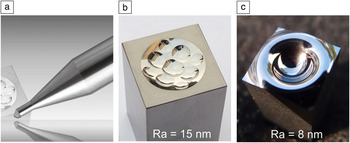
Figure 7 shows examples of the cutting tests on cemented carbide dies for optical component applications, which were finished efficiently and precisely with an NPD ball-nosed end mill. These cutting tests confirmed that NPD ball-nosed end mills ensure high-quality finished surfaces equivalent to polish-finished (mirror-finished) surfaces on cemented carbide, which has been impossible to achieve by cutting processes.
Ball-nosed end mill tool prepared from nanopolycrystalline diamond (NPD) and examples of cemented carbide die cutting with the NPD tool. (a) NPD ball-nosed end mill (R 0.5 mm). (b) Super-fine cemented carbide die after high-efficiency cutting (rotational speed: 40,000 rpm, feed speed: 800 mm/min, cutting depth: 0.005 mm). (c) Ultrafine cemented carbide die after high-precision cutting (rotation speed: 40,000 rpm, feed speed: 120 mm/min, cutting depth: 0.003 mm). Note: Ra, arithmetic average roughness of surface.

Applications of BL-PcBN
BL-PcBN produced by appropriately optimizing and controlling the starting material and synthesis conditions has high hardness (Figure 2) and high strength (Figure 3), surpassing those of conventional sintered cBN (PcBN) and single-crystal cBN, and maintains high hardness and TRS, even at high temperatures. Reference Sumiya, Uesaka and Satoh4,Reference Sumiya17 Therefore, BL-PcBN is also highly promising for cutting-tool applications, especially for high-speed, high-efficiency, high-accuracy cutting of ferrous materials. We confirmed such high performance in a test for high-speed (velocity =1500–3000 m/min) intermittent cutting of gray cast iron. Reference Uesaka, Sumiya, Itozaki, Shiraishi, Tomita and Nakai5 The BL-PcBN cutting tool seldom generated thermal cracks and cut the workpieces continuously for a sufficiently long time, while conventional sintered cBN (PcBN) cutting tools became chipped at the edges at the initial cutting stage. Reference Uesaka, Sumiya, Itozaki, Shiraishi, Tomita and Nakai5 We also carried out cutting tests on high-hardness hardened steel with a ball-nosed end mill made of BL-PcBN, confirming that the BL-PcBN tool can produce high-quality cut surfaces having an arithmetic average roughness, Ra, of 20 nm or better. Reference Sumiya, Harano and Ishida6,Reference Harano, Arimoto, Ishida and Sumiya23 This result indicates that hardened steels can be machined with mirror-finish surfaces (Ra < 20 nm) by cutting using a BL-cBN tool.
Summary
We have produced innovative and practical superhard nanopolycrystalline diamond (NPD) and cBN (BL-PcBN) by applying direct conversion sintering under ultra-HPHT. The key points of the production technology are the systematic construction of the ultrahigh mass-production HPHT process and the appropriate optimization and proper control of the starting material and HPHT synthesis conditions.
NPD and BL-PcBN consist of fine grains with size of several tens of nanometers without any secondary phases or binder materials that greatly affect the mechanical properties and thermal stability. Therefore, they have considerably high hardness, strength, and thermal stability, far surpassing those of single crystals and conventional sintered compacts.
These characteristics suggest potential applications of these novel superhard materials as innovative cutting tools and wear-resistance tools. A number of practical cutting tests demonstrated that the NPD and BL-PcBN cut much better than conventional PCD and PcBN. Reference Harano, Satoh and Sumiya3,Reference Uesaka, Sumiya, Itozaki, Shiraishi, Tomita and Nakai5,Reference Sumiya, Harano and Ishida6,Reference Harano, Arimoto, Ishida and Sumiya23,Reference Sumiya, Harano and Murakami25 NPD is highly promising for high-precision and high-efficiency cutting tools for nonferrous metals, hard ceramics, or cemented carbide, while BL-PcBN is promising for cutting tools for ferrous materials.
Acknowledgments
Thanks to K. Harano for collaboration from the early stages of this work. I also thank T. Sato, K. Arimoto, and Y. Ishida for technical assistance with the experiments.

Hitoshi Sumiya is Fellow, chief engineer, and senior manager of the Advanced Materials Laboratory at Sumitomo Electric Industries, Ltd., Japan. He is also a visiting professor at the Center for Science and Technology under Extreme Conditions at Osaka University, Japan. He received his PhD degree in engineering from Osaka University. His current interests focus on the research and development of high-pressure high-temperature (HPHT) synthesis of diamond, cBN and related materials, and their applications, and include high-quality single-crystal diamond via temperature gradient method under HPHT and single-phase (binderless) nanopolycrystalline diamond and nanopolycrystalline cBN via direct conversion sintering under ultra-HPHT. Sumiya can be reached by email at sumiya@sei.co.jp.