Introduction
The red palm weevil, Rhynchophorus ferrugineus Olivier (Coleoptera: Curculionidae), is an economically important tissue-boring pest of palms worldwide (EPPO, 2008, 2009, 2010). The weevil was first described in India as a serious pest of coconut (Lefroy, Reference Lefroy1906; Nirula, Reference Nirula1956) and date palms (Buxton, Reference Buxton1918). At the present time, this insect has been reported as a pest of 26 palm species belonging to 16 different genera (Malumphy & Moran, Reference Malumphy and Moran2009). In the Mediterranean basin, where this species spread slowly during the mid-1990s and very quickly starting in 2004, R. ferrugineus has become the major pest of palms, especially Phoenix canariensis hort. ex. Chabaud, which is extremely sensitive to its attack (Dembilio et al., Reference Dembilio, Jacas and Llácer2009).
Adult R. ferrugineus are large rusty-brown weevils about 3 cm long with a characteristic long curved rostrum. They have strong wings, which enable them to undertake long flights. Female weevils lay their eggs singly at the base of the fronds in separate holes, which are often close to each other, made with their rostrum. The creamy-yellow eggs (approx. 2.5 mm long) are laid close to the surface of these wounds. Subsequently, females produce a secretion that seals the wound and protects the eggs.
Temperature is the main abiotic factor influencing the biology, ecology and population dynamics of poikilothermic organisms such as arthropods, and R. ferrugineus is not an exception. The thermal requirements of R. ferrugineus developing in live P. canariensis palms have been recently established by Dembilio & Jacas (Reference Dembilio and Jacas2011). A thermal constant of 40.4 degree-days (DD) was obtained for the egg stage (lower temperature threshold, LTT, was 13.1°C). Larvae required 666.5 DD (LTT 15°C: Martín-Molina, Reference Martín-Molina2004) to complete their development; this is 40 to 160 days depending on mean temperatures (summer-autumn or winter-spring generations, respectively). Pupal development required an additional 282.5 DD (LTT 13°C: Martín-Molina, Reference Martín-Molina2004) and, therefore, could be completed in two weeks in summer but extended for several months during the rest of the year. The same authors concluded that under field conditions mean monthly temperatures below 10.3°C were lethal for neonate larvae and 4.5°C for older immature stages. Based on the strong relationship found between mean annual temperature (MAT) and the number of generations of R. ferrugineus estimated for different climatic stations in the Iberian Peninsula, these authors concluded that less than one generation per year could be expected in areas with MAT below 15°C and more than two where MAT is above 19°C. However, temperature could limit the reproduction of R. ferrugineus, not only by affecting preimaginal development, but also the oviposition behavior of adult females. Li et al. (Reference Li, Qin, Ma, Yan, Huang and Peng2010) studied the effects of temperature on the fecundity of R. ferrugineus and concluded that the optimum temperature was 28°C (239.47 eggs per female) while upper and lower thresholds occurred somewhere within the ranges 36–40°C and 16–20°C, respectively. Mean temperatures in most of the northern shore of the Mediterranean basin (AEMET, 2011) fall within the range obtained by Li et al. (Reference Li, Qin, Ma, Yan, Huang and Peng2010) for the lower oviposition threshold. Therefore, under these climatic conditions, the reproduction of R. ferrugineus could be impaired by temperature during the winter. To better understand the phenology of R. ferrugineus populations in the Mediterranean basin, the objective of the present work has been to estimate the effect of temperatures within the range 10–25°C on the reproductive parameters of R. ferrugineus.
Material and methods
Experimental insects
Adult weevils collected in the province of Valencia in traps baited with ferrugineol (the male R. ferrugineus aggregation pheromone) and plant kairomones (ethyl acetate and pieces of palm fronds) were used to initiate the stock colonies. These colonies were established in 2007 and have been periodically supplemented with the introduction of additional wild specimens. Adult weevils were reared in a controlled environment cabinet at 25±1°C, 75±5% RH and a 16 h light photoperiod in perspex cages (30×30×45 cm depth) with a density of 120–150 weevils per cage. These cages had a hole (8 cm diameter) on the upper side covered by a mesh used for manipulation of the specimens and their bottom side consisted of a 2-mm metal mesh. Cages were set on top of a tray containing a folded piece of moistened filter paper containing thin apple slices used by female weevils as oviposition substrate and by both males and females as food. Apple slices were replaced three times per week (Dembilio et al., Reference Dembilio, Jacas and Llácer2009).
Experimental design
Newly emerged (<24-h old) male and female adult R. ferrugineus obtained from our laboratory colony were caged (one couple per cage) in plastic lunchboxes (15×10×10 cm) and provided folded pieces of moistened filter paper and thin apple slices as food and oviposition substrate. A total of 108 cages were prepared. Sixty cages were transferred to an environmental chamber at a constant temperature of 25°± 0.3°C. The remaining 48 cages were moved in groups of 12 to additional environmental chambers at a constant temperature of 10°, 15°, 20° or 23°±0.3°C. In all cases, the chambers were set at a relative humidity of 85–90% and a photoperiod of 16:8 (L:D). Cages were kept under these conditions for two weeks. On day 14, the 60 pairs at 25°C were split into five groups of 12. One of them was further kept at 25°C, whereas the remaining four were transferred to 10°, 15°, 20° or 23°C. From that day and for two more weeks, cages were supplied moistened filter paper and thin apple slices that were replaced daily. During this two-week period, daily oviposition was recorded. Eggs were further transferred into petri dishes (5 cm diameter) with moistened filter paper and kept under the same environmental conditions as their mothers (for those moved from 25°C to lower temperatures at day 14) or at 25°C (for those mothers exposed to the same temperature since emergence), and egg hatching was measured.
Statistical analyses
For those pairs where at least one egg was recorded, oviposition rate, fecundity and egg hatching during the two-week period considered were subjected to analysis of variance (one-way-ANOVA; P<0.05). Egg hatching results were subjected to the angular transformation prior to the analysis to meet the requirements of ANOVA. Where appropriate, means were separated by Duncan's test (P=0.05). Results obtained at constant temperature regimes (10–25°C) were further analyzed by linear regression analysis to estimate the lower thresholds for oviposition and egg hatching. The SPSS Statistics 18.0.0 software (IBM Corporation, Somers, NY, USA) was used.
Temperature
Mean, mean minimum and mean maximum monthly air temperatures from some climatic stations representative of the Mediterranean basin countries where R. ferrugineus is established were compared with oviposition and egg hatching thresholds to determine oviposition and egg hatching periods in the selected locations. The places chosen were Almeria, Melilla and Valencia (Spain) for the period 1971–2000 (AEMET, 2011) and Adana and Istanbul (Turkey), Algiers (Algeria), Alexandria (Egypt), Athens and Iraklion (Greece), Benghazi and Tripoli (Libya), Cagliari, Palermo and Rome (Italy), Marseille, (France), Split (Croatia), and Tel-Aviv (Israel) for the period 1931–2009 (World Climate, 2011).
Results
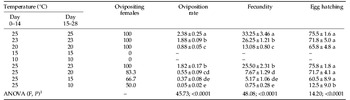
Within the temperature range considered (10–25°C), oviposition rate and fecundity increased with temperature (table 1). Highest fecundity and oviposition rate were obtained at 25°C, (33.25 eggs per female and 2.38 eggs per female and day, respectively), whereas no oviposition was observed for females kept below 15°C. Interestingly, females moved from 25° to 15°C at age 14 days could oviposit a mean of 5.17 eggs during the entire experimental period, and those moved from 25° to 10°C could lay a mean of 0.75 eggs during the first two days of exposure (fig. 1 and table 1). Compared to the fecundity obtained at 25°C, these values correspond to a reduction of 84 and 98%, respectively. These reductions are much higher than those observed at 23° and 20°C (24 and 77%, respectively).
Daily oviposition rate of 15-day-old R. ferrugineus females at five different temperatures (10°, 15°, 20°, 23° and 25°C) when exposed either to the same temperature since emergence (continuous lines) or to 25°C from adult emergence to day 14 (dashed lines)*. (–⧫–, 25–25°C; –▲–, 23–23°C; –▪–, 20–20°C; - -△- -, 25–23°C; - -□- -, 25–20°C; - -○- -, 25–15°C; - -x- -, 25–10°C).

Percentage ovipositing females, oviposition rate (eggs per female per day), fecundity (eggs per female) and egg hatching (%) of R. ferrugineus females obtained at different temperature regimes in the laboratory. Each value is the mean of 12 replicates (12 couples per temperature tested).

1 df were 6 and 83 in all cases.
Within a column, data followed by the same letter are not different (P<0.05; Duncan's test).
Egg hatching was not significantly different between 20° and 25°C and was the same irrespective of whether the mothers had been exposed to the same temperature since emergence or moved from 25°C to a lower temperature at age 14 days (table 1). The only exception was observed for females moved from 25 to 10°C. In that case, an 83.5% reduction in egg hatching was calculated.
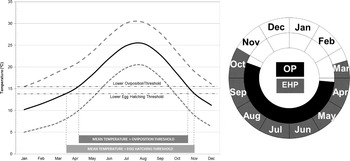
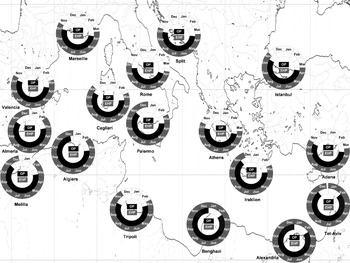
Based on the results obtained at constant temperature regimes (table 1), a threshold of 15.45°C was estimated for oviposition (table 2). Taking into account all results obtained (table 2), a slightly lower value, 13.95°C, was calculated for egg hatching. When these values were compared to mean monthly temperatures in Valencia (fig. 2) and the remaining selected locations (fig. 3), windows for oviposition and egg hatching could be established. In most of the northern shore of the basin, the oviposition period (OP) extended from early April to mid-October/early November and the egg hatching period (EHP) from mid-March to mid/late October. However, these periods were much longer in the southern shore and, although oviposition would stop during the coldest winter months, egg hatching would continue during the whole year in the southwestern shore of the basin.
Mean, mean minimum and mean maximum monthly temperatures at Valencia airport climatic station (Spain) for the period 1971–2000 (AEMET, 2011) and estimated lower thresholds for oviposition and egg hatching. The circular diagram represents oviposition and egg hatching periods (OP and EHP, respectively) at the same location ( , mean;
 , maximum;
 , minimum).

Estimated oviposition and egg hatching periods (OP and EHP, respectively) based on mean monthly temperatures at some selected climatic stations in the Mediterranean basin.

Relationship between (x) temperature and (y) oviposition rate (eggs per female and day), fecundity (eggs per female) and egg hatching (%) of R. ferrugineus females obtained at different constant temperature regimes (15°, 20°, 23° and 25°C) in the laboratory (see table 1).

df were 1, 47 in all cases.
Discussion
This study confirms that oviposition in R. ferrugineus is strongly affected by temperature and that lower temperature thresholds for oviposition and egg hatching (15.45° and 13.95°C, respectively) are very close to mean annual temperatures registered in most of the northern shore of the Mediterranean basin and clearly above mean monthly temperatures in winter in this area (fig. 2). The fact that females moved from 25° to 15°C at age 14 days could oviposit during the entire experimental period, whereas those kept at this temperature since emergence did not lay any egg may be indicative of the existence of an imaginal diapause in R. ferrugineus that deserves further studies. Li et al., (Reference Li, Qin, Ma, Yan, Huang and Peng2010) obtained no oviposition for females exposed to a constant temperature of 16°C and established the lower temperature threshold for oviposition at 16.48°C. This temperature is almost 1°C higher than that found in our study. In their studies, Li et al. (Reference Li, Qin, Ma, Yan, Huang and Peng2010) used a stock colony established with individuals collected in Wenchang (China). This city is located at a latitude of 19°32′N, which is almost half the mean latitude of the Mediterranean basin (around 40°N), and has a tropical monsoon climate with an mean annual temperature of 23.6°C. Local adaptation of the weevil to prevalent environmental conditions in Wenchang and Valencia (with a mean annual temperature of 17.2°C) could at least partly explain the differences observed. Furthermore, El-Mergawy et al. (Reference El-Mergawy, Al Ajlan, Abdallah, Nasr and Silvain2011) demonstrated, using RAPD-PCR, that populations found in Mediterranean countries (Egypt, Spain, France) have a different origin from those found in Asia (Arabic Peninsula, Iran, Pakistan). These differences could also account for the relatively higher cold hardiness exhibited by the insects used in our assays compared to those from China.
Egg hatching values in the range 15°–25°C (table 1) are similar to those reported in other studies (Kaakeh, Reference Kaakeh2005; Li et al., Reference Li, Qin, Ma, Yan, Huang and Peng2010; Dembilio & Jacas, Reference Dembilio and Jacas2011). Furthermore, the lower temperature threshold (LTT), 13.95°C, is very close to 13.1°C, which was the LTT obtained in a previous study by Dembilio & Jacas (Reference Dembilio and Jacas2011). However, this value is again much lower than that reported by Li et al. (Reference Li, Qin, Ma, Yan, Huang and Peng2010), who set this threshold at 18.28°C. The same reasons as before could explain the differences found, which are much higher in this case than when comparing oviposition thresholds.
Comparison of the temperature thresholds obtained in this study with mean temperatures in the Mediterranean basin clearly shows that oviposition can be seriously impaired between early November and mid-March in most countries within this area. Furthermore, because the window for oviposition is shorter than that for successful egg hatching (fig. 2), the occurrence of new infestations under these environmental conditions is quite unlikely from November until March, especially in the northern shore of the basin. A difference of 2° to 6°C between the outer atmospheric temperature and that inside infested palms has been reported in Egypt in winter and summer, respectively (Salama et al., Reference Salama, Zaki and Abdel-Razek2009). Therefore, higher temperatures inside infested palms could not so severely limit mating, oviposition and egg hatching in already infested palms. However, even under these conditions, because immature mortality at this time is highest and the development rate of R. ferrugineus declines with decreasing autumn-winter temperatures (Dembilio & Jacas, Reference Dembilio and Jacas2011), the final effect of winter temperatures on the population dynamics of R. ferrugineus could be a synchronization of the whole population, that would peak in spring, as it is observed in Valencia (Dembilio & Jacas, Reference Dembilio and Jacas2011) as well as in other areas in the Mediterranean basin (Abbas, Reference Abbas, Ciancio and Mukerji2010). Our results could also explain the decreased infestations occurring after the winter months in the Middle East on date palm (Abraham et al., Reference Abraham, Al-Shuaibi, Falerio, Abozuhairah and Vidyasagar1998).
The results obtained should help in refining existing IPM strategies against this pest in different regions under a Mediterranean climate. Because wounds, such as those produced when pruning, emit volatiles that attract adult R. ferrugineus, pruning can increase the likelihood of a new infestation. Based on our results, pruning, as well as any other management practice producing wounds, should be best performed in winter, when oviposition is greatly reduced and both egg and immature mortality are highest (Dembilio & Jacas, Reference Dembilio and Jacas2011). However, even during this season, all wounds should be immediately protected with a tree wound seal preferably in combination with an appropriate insecticide. Similarly, the frequency of preventative treatments against the weevil (either chemical or biological) could decrease during the winter, thus reducing the non-target effects of these biocides on the environment and, especially, on humans.
Acknowledgements
The authors thank M. Piquer (IVIA) and M.A. Ruiz (IFAPA) for their help during the assays. This research was partially funded by the Spanish Ministerio de Ciencia e Innovación (project TRT2006-00016-C07-05) and the Valencian Conselleria d'Agricultura, Pesca i Alimentació (project IVIA-5611). Ó. Dembilio was recipient of a predoctoral grant from IVIA.