1. Introduction
Since 1960, Western governments have transferred roughly $5 trillion dollars of aid to the developing world (Easterly and Williamson, Reference Easterly and Williamson2011). Yet, despite these efforts, recipient countries remain impoverished. Growing evidence suggests aid has been ineffective at stimulating widespread economic growth.Footnote 1 Aid agencies remain opaque and do little to monitor and measure the impact of their efforts (Easterly, Reference Easterly2006; Easterly and Williamson, Reference Easterly and Williamson2011). In some cases, efforts to help the poor have even ended up doing more harm than good (Coyne and Ryan, Reference Coyne and Ryan2009; Coyne and Williamson, Reference Coyne and Williamson2015).
Administering humanitarian relief faces similar problems. Governments lack the knowledge and incentives to solve economic calculation problems and direct resources to where they are needed most (Sobel and Leeson, Reference Sobel and Leeson2007). State-led aid efforts to disaster stricken cities can increase corruption among recipient governments (Leeson and Sobel, Reference Leeson and Sobel2008; Yamamura, Reference Yamamura2014); create moral hazard (Shughart, Reference Shughart2006; Sobel and Leeson, Reference Sobel and Leeson2006); encourage rent-seeking and free-riding (Shughart, Reference Shughart2011); and introduce serious agency problems that can lead to low quality services (Henderson and Lee, Reference Henderson and Lee2011). For these reasons, government is limited in its capacity to be effective and can create harmful unintended consequences (Chamlee-Wright and Storr, Reference Chamlee-Wright and Storr2010; Coyne, Reference Coyne2013; Skarbek, Reference Skarbek2010).
Failures of state-led aid efforts are perhaps the most tragic manifestations in contemporary political economy of what Buchanan (Reference Buchanan1975) termed the Samaritan's Dilemma (Gibson et al., Reference Gibson, Andersson and Shivakumar2005; Pedersen, Reference Pedersen2001). Our desires as humans to aid others can undermine the recipients’ incentives to engage in productive activities. The predicament is a dilemma because without mitigating rules, norms, or constraints, undesirable outcomes result from reasoned behavior on the part of both agents. The demonstrated preference of Western governments to continue to give aid, independent of results, conforms to the general dominant strategy of the Samaritan player.
This paper examines the institutional design principles useful for mitigating Samaritan's Dilemmas in administering aid by private associations. Recent studies of bottom-up community resilience after disasters focus on the role of shared strategies and perceptions in determining cooperative efforts (Chamlee-Wright, Reference Chamlee-Wright2010; Chamlee-Wright and Storr, Reference Chamlee-Wright and Storr2009; Reference Chamlee-Wright and Storr2011). Constitutional rules can play an important role in shaping these strategies by embedding norms into general rules. However, much of the literature on constitutional choice typically focuses on rules as the outcomes of bargaining through collective action (North and Weingast, Reference North and Weingast1989) or as a matter or analytical social choice processes (Buchanan and Tullock, Reference Buchanan and Tullock1962; Rawls, Reference Rawls2009). These literatures are primarily concerned with public constitutions and are less concerned with the role of entrepreneurs who actively seek to influence the substance of rules at inception in private spheres (Buchanan, Reference Buchanan1965; Ostrom, Reference Ostrom2005).Footnote 2 This study is the first to examine the Samaritan's Dilemma from a private constitutional perspective. I argue that agents with a stake in the social dilemma can engage in entrepreneurship over constitutional rules for administering aid. In doing so, ethical norms held by group members both inform and constrain rule selection.
To examine these claims, I use a case study analysis of the Chicago Relief and Aid Society, a private association established to administer aid in urban Chicago between 1854 and 1887. I focus on their role in the recovery efforts following the Chicago Fire of 1871. Using the case study approach is most appropriate for four reasons. First, the research question involves understanding how the norms and values of the members influence the rules selected. A detailed case study allows us to identify how participants think about both the problem situation and the way the rules address the needs demanded by the situation (Ostrom and Basurto, Reference Ostrom and Basurto2011; Small, Reference Small2009). Second, we are interested in looking at cases of large-scale aid efforts by private organizations that are comparable to state-led aid. The Chicago Fire was one of the worst natural disasters in U.S. history (Vigdor, Reference Vigdor2008). The Society supplied general aid to the community before, during, and after the disaster, and thus we can examine how it functioned in response to a comparable crisis. A case study approach is necessary for examining how context shapes the strategies employed by actors within complex systems beyond the state-market dichotomy (Boettke et al., Reference Boettke, Palagashvili and Lemke2013; Ostrom, Reference Ostrom2010a). Third, archival evidence from the Chicago Relief and Aid Society allows for analysis of their written constitution. Historical source materials then provide the means to evaluate the group's performance and determine the relationship between the rules in form and rules in use. There are obvious limitations regarding the availability of data to adjudicate exactly how well the CRAS adhered to its constitutional rules in practice. For instance, there is no way to construct the counterfactual of who may have qualified for assistance but was denied. Nevertheless, the detail of the archival evidence and historical accounts are sufficient to construct an analytical narrative of the Society's aid practices. Finally, while econometric methods can quantify the relative importance of constitutional factors and may assess the period over which constitutions matter, they have difficulties in dealing with non-linear interactions among constitutional and cultural details (Tarko, Reference Tarko2015).Footnote 3 Thus, a case study approach is most useful for understanding the relationship between the values held by group members, the rules they designed, and the way the rules worked in practice.
The primary contribution of this paper is to show how private associations can design constitutional rules particularly suited for mitigating Samaritan's Dilemmas. The approach follows Ostrom (Reference Ostrom2005) and Aligica and Tarko's (Reference Aligica and Tarko2013) framework, focusing on how values are imparted into rules by entrepreneurs making judgements over the problem situation and possible means of supplying aid. However, the novelty of this case study is the correspondence between the theoretical design principles identified in game theory and the actual structure and implementation of the private constitution. By examining how one set of institutions grapples with the aid dilemma at the private constitutional level, I conclude with several implications for why state-led efforts do not seem capable of replicating this process.
2. Implementing strategic courage in private associations
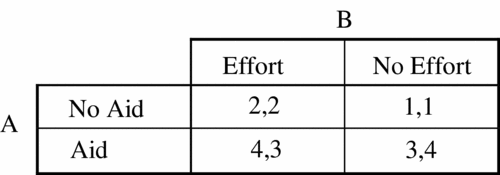
Figure 1 captures the Samaritan's Dilemma in a simple two-player game (Buchanan, Reference Buchanan1975). Player A is the Samaritan and player B is the aid recipient. The numbers in the cells are utility payoffs for the two players. The left-hand numbers indicate Player A's payoffs and the right-hand numbers indicate Player B's payoffs. Note that Player A will choose to give aid regardless of whether he knows he is part of a strategic game or not. Player B is not in the same position. His choice of action directly depends on what A does. If Player A withholds aid, B will exert effort. If Player A does give, however, he will withhold effort. Moreover, if Player B knows A's preferences, he will always choose to shirk.
The Samaritan's Dilemma

The game has one Nash equilibrium outcome in the southeast quadrant. Without additional assumptions or exogenous rules to bind the players to a set of strategies, the Samaritan (Player A) will transfer resources to the other each round, without the recipient contributing effort to increasing overall welfare.Footnote 4 Strategies for successfully mitigating the effects of the Samaritan's Dilemma require ‘strategic courage’ – the purposive self-imposition of constraints on action that ‘alter the beliefs and actions of others in a direction favorable to the decision maker’ (Schmidtchen, Reference Schmidtchen, Brennan, Kliemt and Tollison2002: 471).
Implementing strategic courage requires three conditions (Schmidtchen, Reference Schmidtchen, Brennan, Kliemt and Tollison2002). First, potential Samaritans must explicitly acknowledge the strategic relationship between donor and recipient. Second, they have to choose rules that account for the welfare of agents in both the short-run and the long run. Doing so requires more than passive play on the part of Samaritans. Strategic courage entails adopting rules that constrain Samaritans from responding to their own preferences to help on a one-off basis (Buchanan, Reference Buchanan1975: 177; Schmidtchen, Reference Schmidtchen, Brennan, Kliemt and Tollison2002: 471). Third, a commitment device is necessary to bind agents ex ante to strategies that will prove successful over time.Footnote 5 Third-party enforcement can prevent the Samaritans’ short-term preferences from dominating long-term interests. Because Samaritans have a dominant strategy to give regardless of the outcome, they will only adopt rules to constrain this preference if there is recognition of the gains from doing so and an incentive to adhere to the rules once established.
Private associations and constitutional entrepreneurship
What types of institutional arrangements are better suited to mitigating the problems of strategic interaction between Samaritan and recipient? Constitutions establish general rules that constrain future behavior of agents in the face of uncertainty. These limitations allow members to conserve on their scarce capacity to monitor the organization because it is less costly to observe deviations from general rules than it is to calculate the sum of net benefits from specific actions (Sutter, Reference Sutter1998). In this manner, they can provide a useful framework to guide behavior when crises occur. Yet public and private constitutions differ in three important respects: owners of private associations are residual claimants of their efforts, private organizations face competition, and individuals self-select into private groups (Leeson, Reference Leeson2011). These differences mean public constitutions are less likely to remain self-enforcing under the pressures of time and place imposed by Samaritan's Dilemmas. We will consider each of these three factors.
First, private organizations have residual claimants on the products of the association. Depending on the nature and context of the organization, residual claimancy ranges from weak in cases where the association functions more like cooperatives (Skarbek, Reference Skarbek2011) to strong where the association distributes profits (Stringham, Reference Stringham2003). Even when the residuals of members’ efforts are not monetary profits, closely held corporate structures mean that the group bears responsibility and reward for the actions it undertakes. The owners and directors of private associations earn esteem and reputation from their efforts at achieving club goals (Pettit and Brennan, Reference Brennan and Pettit2004). This allows associations to attract members and donors to their cause. Owners create private associations to advance their own interests and they succeed when they fulfill the mandate they set out to achieve. In order to achieve their ends however, owners and their agents have an interest in establishing effective rules for governing their internal organization. Without such rules, directors must exercise more costly and less reliable means of ensuring the success of their own enterprise.
Compliance with the constitutional rules governing the association helps owners to capitalize the value of the associations’ efforts. Constitutions supply a mission statement of the association and are frequently staffed by motivated agents who subscribe to the mission. This matching economizes on the need for additional mechanisms to mitigate principle-agency problems within the organization (Besley and Ghatak, Reference Besley and Ghatak2003). Moreover, donations themselves can serve as an important external mechanism for the mitigation of principle agent problems. Glaeser and Shleifer (Reference Glaeser and Shleifer2001) show that even in the absence of tax advantages, unrestricted donations flow to non-profits rather than for-profit firms because donations have significant influence on the decisions of the non-profit entrepreneurs. If owners or agents deviate from the mission and mandate of the constitution, the association will be less likely to attract donors, and will eventually lose reputation, esteem, and membership.
Second, private associations compete with other organizations, firms, and governments to provide governance services (Leeson, Reference Leeson2011; Skarbek, Reference Skarbek2011). Private associations do not have a monopoly on the provision of their services. As a result, they require effective governance mechanisms to enable success. Failure to meet goals in a competitive environment where donors choose which organizations to give to, and how much, will ultimately result in the inability of the organization to continue.
Third, individuals choose to join associations voluntarily and self-select into these governance arrangements. Being assortative by nature, private associations tend to consist of people who share the same goals and accept the terms of the rules under which their actions will be bound (Leeson, Reference Leeson2011; Ostrom, Reference Ostrom2010a). Otherwise, owners, directors, agents, members, and donors can leave or withdraw their support. Furthermore, voluntary sorting allows associations to discover relevant economies of scale in production and the specifics of their production function involved with supplying particular services (Ostrom, Reference Ostrom2010b). Where associations are functionally specific, such as suppliers of particular goods after disaster, the costs of exiting associations that do not comply with one's preferences are lower than exit from private associations where competencies are more tightly bundled.
These three key features make the constitutions of private associations self-enforcing and therefore relatively more effective than the public counterparts (Leeson, Reference Leeson2011). Yet each feature alone does not create the conditions for establishing rules to prevent predation and enhance social cohesion. First, broad residual claimancy does not ensure the types of associations that form will be socially desirable. Violent religious extremist groups fit this criterion and utilize organizational advantages to produce club goods (Iannaccone and Berman, Reference Iannaccone and Berman2006). Second, selective association alone does not create the conditions for establishing rules to prevent predation and enhance social cohesion. As Smith et al. (Reference Smith, Skarbek and Wilson2012) show in the lab, ‘[s]ociality appears to be the key for a group to recognize the dilemma, and the emergence of a leader from within the group serves the vital role of encouraging participants to establish their own rules of order’ (Reference Smith, Skarbek and Wilson2012: 27). Third, competition among groups, arguably the strongest of these three mechanisms, cannot alone generate the substantive content of private associations. In other words, entrepreneurship over the types of rules seems to play a key role in determining how these three features of private constitutions manifest.
3. Ethics in private constitutional entrepreneurship
Private associations face many of the same incentive problems that public institutions face in non-profit activity. Both lack the ability to engage in profit and loss calculation, are vulnerable to mission creep, and face challenges of internally structuring the bureaucracy. Being voluntarily assortative, competitive, and having residual claimancy, however, means the rule structures that private associations adopt are more likely to be self-enforcing (Leeson, Reference Leeson2011; Ostrom et al., Reference Ostrom, Walker and Gardner1992). This means they will tend to stable, but says nothing of the substance of these constitutional rules. The form and content of the rules adopted will be shaped by entrepreneurs where opportunities exist to shape the rules of the game at the constitutional stage (Martin and Thomas, Reference Martin and Thomas2013; Thomas and Thomas, Reference Thomas and Thomas2014). Identifying institutional entrepreneurs as the source of the constitutional rules allows for the examination of ‘any systematic effects of the identity and specific circumstances of the entrepreneur on the types of rules that are likely to emerge’ (Martin and Thomas, Reference Martin and Thomas2013: 3).
Private constitutions will likely be more stable but experience wider variance in the substantive content of the rules. As a result, it is important to understand the process by which rule adoption and implementation may actually work in voluntary society to mitigate Samaritans’ Dilemmas. This section examines the case of the Chicago Relief and Aid Society, a private association of individuals formed with the explicit task of administering general aid to urban Chicago residents. Leveraging organizational assets and constitutional rules, the Society was remarkably successful in meeting the needs of the community after the fire of 1871 destroyed the city (Skarbek, Reference Skarbek2014).Footnote 6 I begin with a brief overview of the Chicago Relief and Aid Society and the landscape in which it operated to show why it is plausible that the constitutional rules the Society adopted were in fact self-enforcing. Next, we examine the Society's constitutional rules, both in form and in use, in light of the three criteria necessary for mitigating the Samaritan's Dilemma.
The Chicago relief and aid society
In 1850, the Chicago Relief and Aid Society (CRAS) was formed ‘in response to a lack of public responsibility to the poor: the Cook County commissioners, citing lack of funds, had discontinued all “outdoor” [non-institutional] relief [except medical] in 1848’ (Nelson, Reference Nelson1966). The Society operated periodically in response to shortfalls in public provision by the county, and in 1857 the State grated it formal charter, charging it as ‘a permanent, efficient, and practical mode of administering and distributing the private charities of the city of Chicago’ (Nelson, Reference Nelson1966, pg. 49–50). The Society's activities remained on a small scale until 1867 when the association began to take on a larger role in the community (Brown, Reference Brown1941: 176; Nelson, Reference Nelson1966: 52).
The CRAS existed amongst a wide array of charitable, social, and mutual aid associations. Before the 1871 fire, the Society was among many voluntary associations, fraternal societies and charitable institutions operating in Chicago during the period.Footnote 7 These groups were exceptionally diverse in the purposes they served and the composition of their memberships. Fraternal societies such as the Knights of Pythias, Ancient Order of Good Fellows, the Independent Order of Sons of Malta, and B’nai B’rith supplied mutual aid to their members. The latter organization, for example, had 584 members living in Chicago in 1871, and they could draw on a national network of over 25,000 members, 2,500 of which lived in the tri-state area (Andreas, Reference Andreas1884a). Some associations were selective based on ethnicity such the Society for the Protection and Aid of German Immigrants, and most mutual aid societies were composed generally of members of the working class population (Andreas, Reference Andreas1884a).
Amongst this diverse landscape of associations, the CRAS was distinct in aiming at general aid for members of the community that has fallen on hard times and needed temporary assistance. Unlike many aid organizations, the CRAS did not serve as insurance or provide mutual assistance for members. The Society specifically ‘conceived of the community in the broadest sense’, and were explicit that ‘the boundaries of class, ethnicity, and religion. . .were not to play any role in the agency's administration of benevolence’ (Sawislak, Reference Sawislak1995: 89). Members believed that in domestic emergency, ‘charity, judiciously and opportunely administered, will in many instances rescue [community members] from permanent pauperism and save the family from being broken up’ (CRAS, 1874: 122). As such, the Society was a mission-driven organization that was not exclusive in membership. The bylaws stipulated that ‘[a]ny person may become a member of this Association by signing the By-Laws and paying an initiation fee of five dollars’ (CRAS, 1874: 128).
In sum, the Society operated amongst many other voluntary associations engaged in similar non-profit and aid related activities. The operations of the association were sustained through voluntary donations made to Society members ‘of well-known character and influence’ who were ‘designated and requested to canvass for money subscriptions, and other donations’ (CRAS, 1874: 129). Both members and beneficiaries of the association were self-selecting and there were low barriers to entry and exit.
Recognition of the Samaritan's dilemma
The founders and subsequent board members of the CRAS were a group of community elites, who shared beliefs in individualistic ethics (Sawislak, Reference Sawislak1995: 88). The Society constructed itself as an independent organization of prominent members of the community motivated to improve the lot of those who needed temporary assistance, yet committed to the idea that unconditional aid was morally disastrous. Directors adopted this view based on the ‘deeply held belief in the power of any able-bodied person, ultimately, to help themselves’ (Sawislak, Reference Sawislak1995, p. 89). More importantly for our purposes, board members and directors were quite conscious of the dilemma of giving aid. In the words of director Ezra McCagg, supplying aid to ‘anyone who could help themselves’ was ‘in the highest degree harmful to the person aided and to society at large’ (quoted in Sawislak, Reference Sawislak1995: 88).
Historian Karen Sawislak, describes the CRAS as ‘internally at war between a form of humanitarianism and conservative impulses’ leading to a mandate whereby ‘the Society incorporated a seeming schizophrenia of purpose: the agency existed to give, but its directors remained ever fearful of the harm that their giving might do’ (Reference Sawislak1995: 90). The first formal rule of the Chicago Relief and Aid Society's constitutional charter reflects this mission:
‘The object of this Society is to aid such of the poor as through sickness or other misfortune require temporary assistance. The permanently dependent are not regarded as proper subjects, because if they should be relieved, the entire funds of the association would soon be exhausted in the support of a permanent list’.
This primary statement of purpose is significant in that it is a clear recognition of the strategic interdependency of the behavior between Samaritans and recipients in the aid context. Continuous aid can undermine the incentives of the recipients to engage in the types of productive activity the Samaritans seek to encourage. By formalizing this concern in the associations’ mission and first constitutional rule, the CRAS conditioned its practice of charity on an ethic of individual responsibility that made explicit the concern for possible negative long-run consequences of aid.
Choice of aid rationing rules
With the explicit recognition of strategic interdependence of behavior between aid administrators and recipients, the original CRAS constitutional document included eleven other rules aimed to structure the governance of aid distributions.Footnote 8 In the midst of the relief effort following the Chicago Fire of 1871, directors codified a practice that began in the days following the fire as their thirteenth constitutional rule (see Appendix). In total, these rules were general in applicability, designed to guard against the potential for free-riding in the distribution of aid to community members, and intended to mitigate the potential for moral hazard to result from aid distributions. Each rule was consistent with the underlying ethics informing the organization and the guiding principle to attempt to align the short-run and long-run incentives of both Samaritans and recipients.
The Society held strong views concerning who merited aid, but they did not base their criteria on race, ethnicity, social class, or religion. Deserving poor included the elderly and infirm, those injured or in need of temporary assistance, widows, children, and families for whom the primary caregiver was absent. Able-bodied, working age males were not regarded as proper subjects for relief. The CRAS exercised due process of consideration to any applicant and ‘regarded [each] as entitled to charity until a careful examination proves the contrary’ (Rule 2, Appendix). Healthy males requesting aid fell under the stipulations provided by rules seven and thirteen, and were ‘furnished employment directly by the Superintendent, or sent to reliable employment agents, with whom the Society cooperates’ (Rule 7, Rule 13 Appendix). This was consistent with their commitment to only providing temporary assistance, and relief would be ‘discontinued to those who manifest a purpose to depend on alms rather than their own exertions for support’ (Rule 5, CRAS, 1871). These rules established general criteria for who qualified for assistance and how the Society would treat applicants.
Other rules within the Society's constitution aimed at defining and enforcing the scope of the Society's activities so as not to incentivize people outside the community to free ride on the organizations resources. Rule six states, ‘Destitute persons sent from other cities should be referred to the County Agent, to be sent to their former residence. Should we undertake the support of such persons it would be offering a premium to other cities to send their poor to us to be supported’ (Rule 6, Appendix). In everyday operation, this typically meant preventing drifters from making claims on community resources (Andreas, Reference Andreas1884a). After the fire, the immigrants entering the city typically had little trouble finding work. For those that did not find employment, they would not be capable of meeting the requirements for community verification for assistance from the CRAS.Footnote 9
As for members of the community receiving significant benefits from other charitable institutions, rule eight stipulated ‘[a]pplicants having claims on other charities are to furnished with a card directing them to the same’ (Rule 7, Appendix). This rule was most important during normal operations, as the Society was aiming to help only those who were not covered by other mutual aid arrangements and required temporary assistance. After the fire, ‘the Relief and Aid Society transformed itself into a social welfare giant’ (Sawislak, Reference Sawislak1995: 92). Of the nearly $4.5 million [1871] dollars donated to the city, nearly half of Chicago's pre-fire population would receive some benefit from the CRAS. In many cases, the Society utilized pre-existing networks of independent voluntary societies to delegate responsibility and to limit duplication of services.
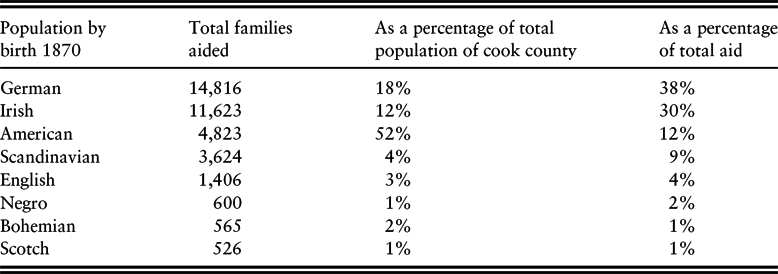
Examining the distribution of relief, aid clearly went to those populations most affected by the fire. Table 1 shows the distribution of total aid by population in relation to the pre-fire demographics. German and Irish immigrant populations constituted the majority of residents living in the most heavily burnt out North Division. German immigrants were the largest ethnic concentration, 18% of the pre-fire urban population, yet they received 38% of the total aid distributed. Similarly, Irish populations comprised 12% of the pre-fire population and received 30% of aid. Minority populations primarily residing in other areas of the city affected by the fire were aided, but the aid given was more closely calibrated to the damage they suffered. For example, African American residents made up 1% of the city population before the fire and primarily resided in the South of the city. In total, they received 2% of the aid administered by the Chicago Relief and Aid Society. African American historian Reed (Reference Reed2005: 187), reports that ‘[t]he African American community suffered, but in regard to physical damage, it suffered disproportionately less than the rest of the city.’ Only the native-born population, whose residential patterns were less clustered in the areas destroyed by fire, received less aid proportionate to their pre-fire populations. Historical editorials and press include accounts of disgruntled applicants and rude treatment on the part of officers of the Society, but there is little evidence to suggest systematic neglect or gross duplication of services (Andreas, Reference Andreas1884b; Sawislak, Reference Sawislak1995). Consistent with this pattern are the findings of an investigation by the Chicago City Council in 1875 that ‘found no evidence of partiality or prejudice on account of nationality of religion’ and concluded, ‘the whole business had been faithfully and wisely administered’ (CRAS, 1875: 6; also Brown, Reference Brown1941: 119). In sum, ‘[a] profoundly individualistic ethos suffused the standards set by a largely self-made entrepreneurial elite’ and informed their efforts both in establishing rules to govern aid as well as the actual practice of administering relief (Sawislak, Reference Sawislak1995: 91). To understand how these rules worked in practice, we now turn to examine their rules in operation.
Demographics of aid after Chicago fire of 1871

Source: Andreas (Reference Andreas1884b: 613).
Community verification and enforcement
Chicago Relief and Aid Society workers awarded aid to applicants based on a system of community authentication and third party decision making. Volunteers and workers would read applicants’ claims and determine how well they fit the pre-existing criteria in light of recommendations by the applicant's peers and associates.Footnote 10 Anyone applying for aid would need to put forward their reputation and have these claims verified by other people in their neighborhood. To see the mechanisms at work, we will consider how the Society screened labor and processed claims for resources, housing, transportation, and supplies.
The CRAS constitution aimed to distinguish between proper recipients of aid and able-bodied men. Rules seven and thirteen pledged to help the latter by assisting them in finding employment. Evidence suggests that the Society actively pursued this commitment using community enforcement to validate claims. After the fire of 1871, the superintendent of operations announced, ‘[a]ny man, single woman, or boy, able to work and unemployed at this time, is so from choice and not from necessity’ (CRAS, 1874: 158). The CRAS helped to establish a labor exchange in the center of the burnt district, where people in need of labor could find those seeking employment. Superintendents assigned to districts throughout the city sent all able-bodied men who applied for aid to the labor exchange and issued them a ticket. Once at the labor exchange, the recipient could find work from what was on offer. The ticket issued to him ‘became a certificate of character’ (CRAS, 1874: 272). If he found labor, he handed back the ticket at the exchange and it was returned to the superintendent that issued it. If the ticket was not presented at the exchange, and thus not returned to the Superintendent, ‘it was pre-emptive evidence that the bearer preferred to eat the bread of idleness rather than work’ (CRAS, 1874: 272). If the recipient returned for aid, the district superintendent would reject his claim. On the other hand, if having obtained work – of which returning the ticket was evidence – he asked again for relief, the CRAS would inquire into his situation. ‘This check upon imposition served its purpose admirably, though it was no more than common justice to say that to shirk work and live upon charity by preference was the exception and not the rule among the laboring people of Chicago’ (CRAS, 1874: 273).
With the exodus from the city immediately after the fire, the labor supply was greatly reduced while demand for both skilled and unskilled labor increased dramatically. Not only was there a great deal of work available, the wages for even unskilled labor increased dramatically during the months following the disaster.Footnote 11 Even as rebuilding was well underway, most wages stayed equal or slightly above the pre-fire rates (Sawislack, Reference Sawislak1995: 183). According to historians, it was precisely this means of aid by the CRAS that ‘gave voice to prevailing ideologies. . .[and] signaled the Society's intense commitment to the promotion of working-class self-support. This set of values, joined with the truism that anyone who wanted work could in fact find a job, lay beneath all agency policy’ (Sawislak, Reference Sawislak1995: 93).
Rule six of the constitution in practice also concerned the operation of railway transportation after disaster. In the first two weeks following the 1871 fire, the Society worked with the railroads to extend free passes to all that sought to leave downtown Chicago or travel back-and-forth. The strategy was remarkably effective in the immediacy of the fire, allowing people to leave the city, find family, and means of accommodation.Footnote 12 After two weeks, the Society moved to a policy of rationing the passes they subsidized to the ‘aged, sick, and feeble, to women and children, and to large families’ (CRAS, 1874: 20). The practice was a consistent application of the criterion for qualifying for aid and the idea that ‘there [was] employment enough in Chicago for all who were willing to work’ (CRAS, 1874: 20).
One challenge facing the relief effort was housing the homeless populations and re-establishing rightful claims to property where nothing but ashes stood in place of homes. At the time, ‘Chicago was one of the few American cities with high rates of working class home ownership’ (Sawislak, Reference Sawislak1995: 310). The fire destroyed the country office where land titles were recorded, leaving little official record of much of the burnt out property. As such, aiding those under the mandate of the CRAS also meant, in part, helping to restore legitimacy to previous homeowners. For moral and practical reasons, the Society built two types of basic homes: one for families of three persons and a slightly larger model for families of more than three persons, whom either owned or rented their homes prior to the fire. The Society then built larger barracks to house renters and tenement dwellers that did not have claim to ownership before the fire.
The majority of applicants were working class families who received the raw materials from the CRAS and constructed the homes themselves. For widows, the elderly or the infirm, homes were built for the applicants by the volunteers of the committee. Each house came complete with a stove, crockery, utensils, table, chairs, bed frame, and bedding. To verify property claims, the CRAS relied on personal references and sent volunteers from the neighborhood to investigate questionable requests.
Lawrence Saddler, for example, applied for materials to construct a temporary building in place of the home he lost in the fire. His application notes his employment as a skilled tailor, his family of six, and his property claim. Along with the application, Saddler included letters of support from a local merchant attesting to Saddler as ‘an honest, upright man and worthy of credit and confidence’ and his local pastor (CRAS Saddler Correspondence, 1872a, 1872b, 1872c, 1872d). These testimonies verified his claims by drawing on local knowledge of community members. A volunteer from Saddler's neighborhood thus approved his application. Historical accounts and archival evidence support the idea that the system of community testimony and verification was effective at detecting cases of fraud. Sawislak (Reference Sawislak1995) is critical of the CRAS precisely because they were discerning in aid disbursements according to the criteria of the organization. Moreover, records show people attempting to forge letters of support only to have members of the Society visit the property and conclude they were lying (CRAS Moran Correspondence 1872e, 1872f, 1872g, 1872h).
The results were directly visible to residents. Within one month 5,226 single-family homes were constructed to house at least 30,000 people. By 1873, the CRAS had provisioned for just over 8,000 single-family homes. An editorial published in the Chicago Tribune less than a month after the fire heralded the CRAS housing policy: ‘With this plan, 30,000 people, hitherto householders, will still be in their own homes, surrounded by the sacred and conservative elements of family, of independence, of respectability, and of individual responsibility which are so immense a moral force in the community’ (Chicago Tribune, November 3, 1871; also quoted in Sawislak, Reference Sawislak1995: 95).
The strongest evidence of the Society abiding by their rules in practice involves their role as residual claimants to the donations given to the association and the actions undertaken in this capacity. As early as four months after the fire, the president and chairman of executive committee of the RAS issued the following statement to the press:
‘The continued donations since our last report, together with the twenty days of mild weather in January, enable us to say that the resources of the Chicago Relief and Aid Society will meet the wants of the present winter. By resources we mean not only what we have actually received, but various sums of which we have been advised. . . .We regard it as a duty to make this announcement the earliest day that it could be made with reasonable assurance of its correctness. We can also say that there will be enough to make temporary provision for our charitable institutions whose resources were cut-off by the fire’ (Chicago Tribune, February 1, 1872).
For a private organization reliant on donations and in the midst of a large-scale relief effort, a public declaration for people to stop sending money appears counterintuitive. The residual claimancy of the organization helps to explain what otherwise looks like irrational behavior. The members of the Society not only retained the donations received but this was legitimate only as far as they abided by their constitutional mandate. The expressed purpose of the CRAS was to provide general, temporary aid. To supply more assistance than what was necessary to get people back in homes and at work would constitute a violation of their mission. Thus this dual mandate to supply aid, but only temporarily, required that publicly they did not ask for more than needed and not spend more than necessary to accomplish their goals.
To this end, six months after the fire the CRAS removed 800 families from its weekly aid rations (Sawislak, Reference Sawislak1995: 117). Politically, this was widely unpopular. The Cook County board of Commissioners issued a public statement condemning the Society and claiming they held ‘a sum exceeding a million dollars’ while taking action that was ‘not in keeping with the object of the fund’ (Cook County Board of Commissioners, 1872). The Board of Commissioners introduced a resolution to attempt to confiscate the donations held by the Society. Yet, by the CRAS ruled these families were entitled to aid after the fire, but not to ongoing relief for fear of abetting ‘permanent pauperism’. The Society responded to the allegations by publicly reminding the city of the rights and responsibilities conferred to the organization by their corporate charter. The charter legally barred the organization from relinquishing the donations the city and mandated they account for every cent received and spent by the organization (Sawislak, Reference Sawislak1995: 119). Publicly available accounts for the organization confirmed they only held a balance of $600,000 at the time and the corporate status of the organization muted the Board of Commissioners efforts to confiscate the donations. When the CRAS closed the books to the ‘Special Relief Period’ 18 months after the fire, the organization had more than a $500,000 surplus.
From 1867 to 1870, the Chicago Relief and Aid Society aided between 1,363–1,560 families per year, dispersing an average of $23 to $27 dollars of aid per family (CRAS, 1874; Nelson, Reference Nelson1966: 55). In the aftermath of the fire, operations increased to serve nearly 40,000 families with an average aid package amounting to $96.50 of aid per family. By mid-1873, 86.5% fewer families were receiving relief from the Society, having found employment and the wherewithal to support their families (Andreas Reference Andreas1884b; Skarbek, Reference Skarbek2014: 166 and 171). The Chicago Relief and Aid Society scaled back their efforts and returned to a much smaller level of operation similar to their pre-fire efforts. The organization continued to operate in accordance with their constitution up through 1884, aiding the needy though temporary assistance.
In documenting comparative long-term recovery of major cities hit by large-scale natural disasters, Vigdor (Reference Vigdor2008) cites Chicago after the 1871 fire as a primary example of a city that effectively rebounded. By 1880, the urban environment was completely anew, not only with ‘homes for the 100,000 [previously homeless] inhabitants, it had also welcomed 200,000 new residents, bringing its total population to more than half a million’ (Vigdor, Reference Vigdor2008: 136). Chicago rapidly returned to its pre-fire population growth trajectory of a booming commercial city.
By establishing mechanisms for monitoring and enforcement that utilized a wide cross section of the population, the Society could take advantage of third-party information to ration aid disbursements. Members and directors who were Samaritan's put in place a system whereby individuals disbursements decisions were not of their discretion but of those with local knowledge of circumstance. With claims to property and resources monitored by fellow community members, the process of dispersing aid was a credible enforcement strategy relying on local knowledge of circumstance.
4. Conclusion
This analysis offers three general implications for the problem of administering aid. First, private associations have an incentive to supply governance when they hold assets that stand to appreciate as a result of supplying that governance. The Chicago Relief and Aid Society were comprised of members of the community who had personal and business interests tied to the city (Skarbek, Reference Skarbek2014). Members enhanced their reputation by supplying community relief consistent with prevailing ideological norms about aid. After the fire destroyed their commercial businesses, taking control of administering a large-scale relief effort was consistent with their organizational mandate, personal reputational capital, and private commercial business interests. However, in order for the incentive to supply governance to lead better aid practices, Samaritans have to have a real stake in the outcomes for the aid recipients. This will vary with context, but often means a more localized scale of aid efforts and a closer relationship between aid givers and receivers. Both of these implications challenge prevailing aid practices amongst Western governments and multilateral aid organizations.
Second, the private corporate charter of the Chicago Relief and Aid Society was the institutional means by which the organization was able to adopt a relatively self-enforcing constitutional structure. This institutional form meant the association was local to the community, privately managed, and had to operate with the voluntary consent of donors, members, and recipients. These characteristics afforded the organization the ability to experiment with rules consistent with their normative views about aid at the constitutional level. The corporate charter required members to be residual claimants on the efforts of the organization, both protecting donations from local government appropriation and providing an incentive for aid allocation in accordance with the rules. Furthermore, the charter introduced a mandate for transparency in the aid process that allowed the CRAS to operate with greater community legitimacy and accountability. These features are attenuated or absent in state-led efforts, and thus deserve greater attention as potential sources of institutional robustness (Pennington, Reference Pennington2010; Reference Pennington2013).
Third, the ethics informing the constitutional rules may matter less in specifying the exact content of the rules, and more in restricting a feasible set and defining the space in which entrepreneurs may discover both compatible rules and mechanisms for implementing aid practices. In the case study above, a crucial step at the constitutional level was the explicit recognition of the potential strategic interdependence between Samaritan and recipient. This identification was feasible because of prevailing ideological views concerning charity and aid. The mechanisms adopted to mitigate this dilemma were then discovered within the context of the problem situation. Approaching the relationship between ethics and rules in this way complements findings that suggest culture may have a causal effect on economic development (Tabellini, Reference Tabellini2010), but through an indirect channel of shaping people's ideas of what constitutes prudent, beneficent, and just means of structuring aid and exchange relationships (Easterly, Reference Easterly2014; McCloskey, Reference McCloskey2010).
Acknowledgments
The author wishes to thank David Skarbek, Daniel Sutter, and two anonymous referees for helpful comments. The generous support from the Center for the History of Political Economy at Duke University (2011–2012) is gratefully acknowledged.
Appendix: Constitution of the Chicago Relief and Aid Society
Rule 1. The object of this Society is to aid such of the poor as through sickness or other misfortune require temporary assistance. The permanently dependent are not regarded as proper subjects, because if they should be relieved, the entire funds of the association would soon be exhausted in the support of a permanent list.
Rule 2. Each applicant for relief is regarded as entitled to charity until a careful examination proves the contrary.
Rule 3. Relief is only to be given after a personal investigation of each case by visitation and inquiry by the Superintendent or authorized visitor.
Rule 4. Necessary articles in small quantities to be given, and only in proportion to immediate need.
Rule 5. Relief to be discontinued to those who manifest a purpose to depend on alms rather than their own exertions for support.
Rule 6. Destitute persons sent from other cities should be referred to the County Agent, to be sent to their former residence. Should we undertake the support of such persons it would be offering a premium to other cities to send their poor to us to be supported.
Rule 7. Able-bodied men are not regarded as proper subjects for relief, but will be furnished employment directly by the Superintendent, or sent to reliable employment agents, which whom the Society cooperates.
Rule 8. Applicants having claims on other charities are to furnished with a card directing them to the same.
Rule 9. It is an absolute condition of relief by this Society that all persons receiving aid are not to ask alms or assistance of the pubic, either on the street, at residences, or places of business.
Rule 10. No loans shall be made from the funds of the Society.
Rule 11. As a rule, relief to be administered in supplies rather than money.
Rule 12. Subscribers to the funds of the Society are entitled to send persons applying to them for relief to the rooms of the Society, and will be furnished with cards for that purpose.
Rule 13. In all cases where families or personal have been aided by this Society through a winter, on account of want of employment, and are by us offered situation either in the city or country, adapted to their condition in life, with aid to reach such situations, which they refuse to accept, no further relief shall be extended to them.