Milk is a major nutritional source and milk proteins provide indispensable amino acids which are necessary for new protein synthesis and may also have health-promoting roles (Haschke et al., Reference Haschke, Haiden and Thakkar2017). Ovine milk contains higher concentrations of major nutrients than goat or cow milk (Park et al., Reference Park, Juárez, Ramos and Haenlein2007). Its physicochemical and nutritional properties are conducive to potentiually be regarded as a functional food (Balthazar et al., Reference Balthazar, Pimentel, Ferrão, Almada, Santillo, Albenzio, Mollakhalili, Mortazavian, Nascimento, Silva, Freitas, Sant Ana, Granato and Cruz2017). Milk proteins are generally classified into three main groups: casein, milk fat globule membrane protein and whey protein (Cao et al., Reference Cao, Song, Yang, Yang, Ye, Tao, Liu, Wu and Yue2017; Li et al., Reference Li, Li, Cao, Han, Kong and Yue2020). Whey proteins are relatively low abundance but can have diverse biological activities, potentially displaying anti-inflammatory, immunity enhancing, anti-oxidative and tumorigenesis inhibiting activities (Chatterton et al., Reference Chatterton, Nguyen, Bering and Sangildm2013; Corrochano et al., Reference Corrochano, Buckin, Kelly and Giblin2018).
In recent years, increasing studies have characterized low abundance proteins by different quantitative proteomic techniques. The research by Yang et al. (Reference Yang, Bu, Zhao, Sun, Wang and Zhou2013) showed significant differences in milk proteomic patterns among different species (cow, yak, buffalo, goat, and camel) based on the isobaric tag for relative and absolute quantification (iTRAQ) techniques. Through LC-MS/Q-TOF technique, 99 significantly differentially expressed low-abundant proteins were discovered in Kashmiri and Jersey cattle (Bhat et al., Reference Bhat, Ahmad, Ibeagha-Awemu, Mobashir, Dar, Mumtaz, Shah, Dar, Shabir, Bhat and Ganai2020). Quantitative differences in whey proteins among buffalo breeds were studied by a TMT proteomic approach (Li et al., Reference Li, Li, Zeng, Liu, Yang and Ren2018). The differences in the milk proteome profile have been attributed not only to species but also to breeds. However, recent studies have shown that the important factors known to affect milk composition, including diet, animal health, parity, environment, management practices and stage of lactation, may influence breed differences (Christian et al., Reference Christian, Grainger, Sutherland, Mayes, Hannah and Kefford1999; Auldist et al., Reference Auldist, Johnston, White, Fitzsimons and Boland2004; Boehmer et al., Reference Boehmer, Ward, Peters, Shefcheck, McFarland and Bannerman2010; Tacoma et al., Reference Tacoma, Fields, Ebenstein, Lam and Greenwood2016; Mol et al., Reference Mol, Kannegundla, Dey, Gopalakrishnan, Dammalli, Kumar, Patil, Basavaraju, Rao, Ramesha and Prasad2018; Sun et al., Reference Sun, Wang, Sun and Guo2020). The importance of properly controlled studies is evident, and in the research reported here different breeds of sheep were fed at one place under the same management practices and with the same diet.
Small-tailed Han (STH) is an indigenous breed of sheep found in the Inner Mongolia Plateau region of China, characterized with a large body frame, prolificacy, disease resistance and hardiness. the breed is well adapted to the cold and dry climate of the Inner Mongolia Plateau, but its dairy potetnial remains to be studied. DairyMeade (DM) sheep are a dairy breed, which was derived in New Zealand from progressive crossing and long-term breeding using New Zealand native Coopworth sheep and Border Leicester sheep (a small amount) as the female parent, and East Friesian sheep as the male parent. The breed is adapted to year-round grazing in New Zealand and exhibits a lactation normalized to 180–230 d. The milk yield of primiparous DairyMeade ewes varies from 150 to 250 l, increasing to between 350 and 600 l in multiparous animals.
The present study aimed to comprehensively characterize and compare the proteome profile of low abundant whey proteins in STH and DM ovine milk at mid lactation (on days 90 after lambing) by tandem mass tag (TMT) & LC-MS/MS technique. The ewes were maintained at one place and under the same management practices in order to reveal the physiological differences in milk traits between the two breeds and thereby provide a theoretical basis for dairy sheep breeding.
Materials and methods
All procedures involving animals were approved by the Ethical Principles for the Use of Animals for Scientific Purposes of the Inner Mongolia University of China. All experiments were performed according to Chinese laws and Institutional guidelines.
A detailed Materials and Methods section describing the animals and their husbandry and all sampling and analytical procedures is provided in the online Supplementary File Materials and Methods. The basic experimental approach is described here.
Experimental animals and sampling
At 90 d after lambing (mid lactation period), 4 ewes of STH and DM sheep with similar body size of each group were selected. The milk samples were aseptically collected before feeding in the morning, then placed in liquid nitrogen and immediately transported to the laboratory for further analysis.
Preparation of whey protein
The collected milk samples were prepared by centrifugation, filtration and ultracentrifugation. After ultra-isolation, the supernatant containing whey protein was collected.
Protein digestion and tandem mass tag labeling
Briefly, the proteins were digested with trypsin and then the peptide mixture of each sample was labeled with TMT reagent according to the manufacturer's instructions (Thermo Fisher Scientific).
Liquid chromatography-tandem mass spectrometry (LC-MS/MS) analysis
TMT labeled peptides were fractionated by RP chromatography using the Agilent 1260 infinity II HPLC.
Data analysis
The high resolution mass spectrometer Q Exactive plus (Thermo Fisher Scientific) was used for TMT quantitative proteomics analysis. Proteome Discoverer 2.1 (Thermo Fisher Scientific) software was used to convert the original map files (.raw files) and analysis.
All identified proteins were classified using the online Database for Annotation, Visualization and Integrated Discovery (http://www.uniprot.org), Gene Ontology (GO) annotations and Kyoto Encyclopedia of Genes and Genomes (KEGG) pathways.
Results
Proteome profiling of ovine milk
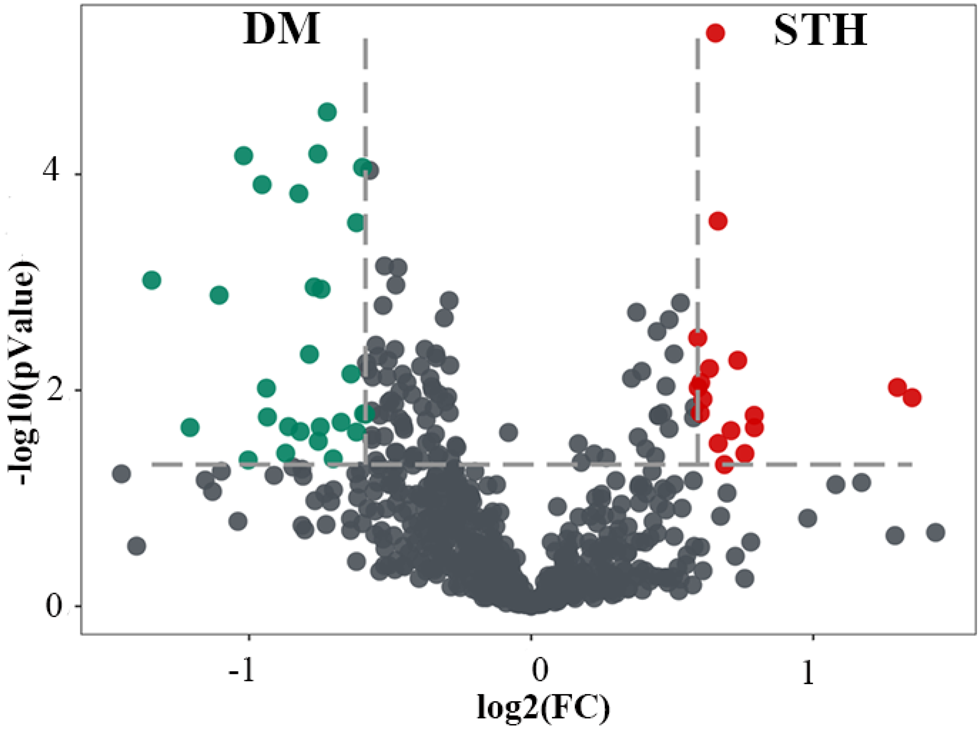
The low-abundant whey proteins in ovine milk were identified by TMT proteomic technology. A total of 657 whey proteins were identified in STH and DM ovine milk, and 431 of them were annotated (online Supplementary Table S2). A total of 46 low-abundant proteins were significantly differentially expressed between the two breeds, of which 17 and 29 proteins were significantly upregulated in STH and DM ovine milk, respectively. Differential expression was based on the criteria of a difference of at least 1.5-fold, and P < 0.05, respectively (Fig. 1 and online Supplementary Table S3). The five most upregulated whey proteins in STH ovine milk were LOC101110099, SCGB2A2, RBP1, SLC39A8 and ABCG2. LOC101110855, ANPEP, S100A2, FCGBP and APOA2 were the five most upregulated whey proteins in DM ovine milk (online Supplementary Table S3).
Volcano plot of differentially expressed proteins between Small-tailed Han and Dairy Meade milk. Red points indicate more abundant proteins in Small-tailed Han; green points indicate more abundant proteins in DairyMeade.

Functional analysis of the identified significantly upregulated whey proteins
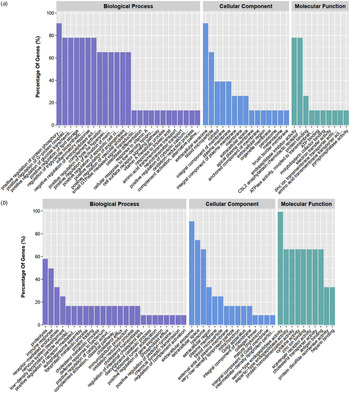
Functions of the significantly upregulated whey proteins were annotated with Gene Ontology (GO) and classified according to biological process, cellular component and molecular function (Fig. 2 and online Supplementary Table S4). Those identified in STH milk were primarily involved in the biological process of positive regulation of inflammatory response, regulation of triglyceride biosynthetic process and complement activation, the cellular component of blood microparticle and extracellular exosome and the molecular function of C5L2 anaphylatoxin chemotactic receptor binding and endopeptidase inhibitor activity. On the other hand, three prominent molecular functions of significantly upregulated whey proteins in DM milk were serine-type endopeptidase activity, aspartic-type endopeptidase activity and cytokine activity. The prevalent biological processes with the most proteins were proteolysis, immune response and receptor-mediated endocytosis. Others were involved in lipoprotein metabolic process, positive regulation of catalytic activity and protein folding. Whey proteins in DM were highly enriched in cellular component of extracellular exosome, extracellular space and lysosome.
Classification of differentially expressed proteins in Small-tailed Han and Dairy Meade milk determined by gene ontology annotation. Protein classes (upregulated proteins only) in (a) Small-tailed Han and (b) DairyMeade.

Pathway enrichment of significantly upregulated proteins
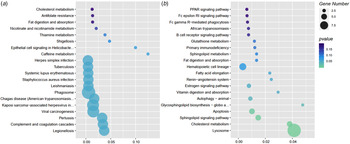
The significantly upregulated whey proteins in STH and DM sheep were enriched to 23 and 13 pathways at uncorrected P < 0.05, respectively (online Supplementary Table S5). Most disease-related pathways (pertussis, Kaposi sarcoma-associated herpesvirus infection, Staphylococcus aureus infection, systemic lupus erythematosus and tuberculosis) were significantly enriched by significantly upregulated proteins in STH. In addition, a high portion of them were also involved in phagosome, complement and coagulation cascades (Fig. 3 and online Supplementary Table S5). Previous studies indicated that the complement and coagulation cascades play an important role in maintaining the balance of the coagulation–fibrinolytic system and in activating innate immunity (Keragala et al., Reference Keragala, Draxler, McQuilten and Medcalf2018; Sun et al., Reference Sun, Wang, Sun and Guo2020). A high number of proteins in DM whey were mainly enriched to lysosome, cholesterol metabolism, sphingolipid signaling pathway and hematopoietic cell lineage. However, the pathway enrichment of DM whey proteins have not been fully annotated.
Enriched pathways of upregulated proteins in ovine milk of (a) Small-tailed Han and (b) DairyMeade breeds.

Discussion
In the current study, TMT proteomic approach combined with LC-MS/MS technology was used to identify and quantify the proteome of STH and DM ovine milk. A total of 655 whey proteins were identified in DM and STH ovine milk, of which 46 were identified to be significantly differentially expressed between the two breeds, comprising 17 and 29 proteins that were significantly upregulated in STH and DM, respectively. Previous ovine milk proteomic studies employed different method strategies. In Zhang et al.'s (Reference Zhang, Li, Qin, Li and Yue2020) research, 310 ovine whey proteins were identified during postnatal development using an iTRAQ method. Minh et al. (Reference Minh, Manya, Elizabeth, Stewart and Peter2015) identified 483 proteins in sheep whey using 1D-PAGE coupled with LCMS/MS. In a sheep colostrum proteomic analysis study, 343 proteins were identified using similar stragety (Scumaci et al., Reference Scumaci, Trimboli, Dell'Aquia, Concolino, Pappaianni, Tamme, Vignola, Luciani, Morelli, Cuda, Boari and Britti2015). Our study further enriched the proteomic characterisation of ovine whey using TMT quantitative proteomics method.
The differences in the expression of low abundant proteins between the breeds might confer differential benefits to their milk traits. For example, xanthine dehydrogenase (XDH), a typical complex molybdenum-containing protein, was upregualted in STH sheep. this enzyme has been studied extensively for more than 110 years (Nishino, Reference Nishino1994) and plays a role in diverse applications, such as biological remediation and drug treatment of heterocyclic compounds foods and environment. Of these, XDH/XOD produces ribavirin, which is an anti-viral drug retrieved on the World Health Organization's List of Essential Medicines (Wang et al., Reference Wang, Zhang and Xing2016). Previous studies have found that ribavirin mainly protects infected cells from dying (Carrillo-Bustamante et al., Reference Carrillo-Bustamante, Nguyen, Oestereich, Günther, Guedj and Graw2017).
As for DM breed, the function of the upregulated S100 Calcium Binding Protein A2 (S100A2) appears to be related to the proliferation and terminal differentiation of the mammary gland (Sergio and Ceballos, Reference Sergio and Ceballos2014). A previous study showed that it enhances the activity of the Wnt/β-catenin signaling pathway by increasing intracellular β-catenin/TCF4 activity, while the Wnt signaling pathway is implicated in multiple stages of mammary development and plays critical roles in regulating mammary stem cells (Turashvili et al., Reference Turashvili, Bouchal, Burkadze and Kolar2007; Incassati et al., Reference Incassati, Chandramouli, Eelkema and Cowin2010; Yu et al., Reference Yu, Verheyen and Zeng2016; Bhat et al., Reference Bhat, Ahmad, Ibeagha-Awemu, Mobashir, Dar, Mumtaz, Shah, Dar, Shabir, Bhat and Ganai2020). It has been shown that the mammary gland is mainly composed of epithelial cells and stromal cells. The main structure of mammary gland is composed of the proliferation of mammary epithelial tissue and the morphogenesis of ductal branch. The interaction between epithelium and stroma takes a significant role in mammary development and the morphogenesis of ductal branches (Inman et al., Reference Inman, Robertson, Mott and Bissell2015; Speroni et al., Reference Speroni, Schaeberle, Sonnenschein and Soto2018). AE Binding Protein 1 (AEBP1), a protein with multiple biological functions, primarily promotes mammary epithelial cell hyperplasia and orchestrates the stromal−epithelial interactions (Zhang et al., Reference Zhang, Reidy, Bogachev, Hall, Majdalawieh and Ro2011; Holloway et al., Reference Holloway, Bogachev, Bharadwaj, McCluskey, Majdalawieh, Zhang and Ro2012). It was also upregulated in the DM breed. Apolipoprotein E is a plasma protein that serves as a ligand for low density lipoprotein receptors. Through its interaction with these receptors, it mainly participates in the transport of cholesterol among various cells of the body from sites of synthesis or absorption to sites of utilization or excretion. Cholesterol can be used by the cells for biosynthetic processes, including membrane repair or cell proliferation (Marais, Reference Marais2019). Apolipoprotein B (APOB), which is synthesized by the liver, mainly locates on the surface of low density lipoprotein (LDL), involves in microsomal triglyceride transporters (Walldius et al., Reference Walldius, Jungner, Holme, Aastveit, Kolar and Steiner2001; Li et al., Reference Li, Li, Cao, Han, Kong and Yue2020). APOB is a key component in lipid metabolism and plays an important role in the dynamic equilibrium of cholesterol (Wang et al., Reference Wang, Li, Ma, Yang, Ma, Li, Liu and Chen2018). xxx Relatively higher amount of apolipoprotein B and apolipoprotein E in DM whey protein may function to regulate lipid metabolism, and this may be related to the lower fat content of DM milk.
In conclusion, we characterized the whey proteins of STH and DM ovine milk and provided a new insight in milk composition and biological function. Immune-related proteins and disease-related proteins were more highly expressed in STH milk, while the presence of S100A2 and AEBP1 at higher aboundance in DM milk may have a beneficial effect on mammary gland development and milk yield.
Supplementary material
The supplementary material for this article can be found at https://doi.org/10.1017/S002202992100073X.
Acknowledgements
This work was funded by the Independent project of The State Key Laboratory of Reproductive Regulation and Breeding of Grassland Livestock of Inner Mongolia University of China (SKL-IT-201811), the National Natural Science Foundation of China (3216200030) and the Major Science and Technology project of Inner Mongolia Autonomous Region of China (30900-5173910). We owe many thanks to Mengtianran Dairy Co. Ltd. (Ulanqab, Inner Mongolia autonomous region, China) for the supply of place and animals. We owe many thanks to LC-bio Co. LTD. (Hangzhou, Zhejiang, China) for the proteomic and metabolomic profiles processing.