I. INTRODUCTION
Graphene, a 1-atom-thick sheet of sp 2-bonded carbon, has attracted strong scientific and technological interest since its discovery in 2004.Reference Novoselov, Geim, Morozov, Jiang, Zhang, Dubonos, Grigorieva and Firsov1, Reference Rao, Sood, Subrahmanyam and Govindaraj2 Due to its huge surface area, excellent electric conductivity, and mechanical strength, graphene has shown great application potential in many fields.Reference Lee, Wei, Kysar and Hone3–Reference Ramanathan, Abdala, Stankovich, Dikin, Herrera-Alonso, Piner, Adamson, Schniepp, Chen and Ruoff7 Currently, the most promising methods for the large-scale production of graphene are based on the exfoliation and reduction of graphene oxide (GO) using either StaudenmaierReference Staudenmaier8 or Hummers’methods.Reference Hummers and Offeman9 In contrast to pristine graphite, GO is heavily oxygenated, with its basal plane of a network of hydrophobic polyaromatic islands of unoxidized benzene rings, along with carbonyl and carboxyl units located at the sheet edges.Reference Kim, Cote and Huang10, Reference Lerf, He, Forster and Klinowski11 These functional groups also made them more compatible with some organic polymer matrix. For example, our group has successfully developed an in situ polycondensation strategy to fabricate polyester/GO composites with well-dispersed GO sheets.Reference Liu, Chen, Chen, Wu, Zhang, Chen and Fu12 It was demonstrated that some poly(ethylene terephthalate) (PET) chains could be grafted onto GO sheets and thus notably improved the mechanical properties of PET. Cao et al.Reference Cao, Zhang, Feng and Wu13 reported GO can act as a compatibilizer for immiscible polyamide/polyphenylene oxide blends.
As we known, the water dispersity and hydrophilicity of GO have been mainly attributed to the ionizable edge COOH groups but its basal plane is essentially a network of hydrophobic polyaromatic islands of unoxidized benzene rings.Reference Cai, Piner, Stadermann, Park, Shaibat, Ishii, Yang, Velamakanni, An and Stoller14, Reference Li, Müller, Gilje, Kaner and Wallace15 Kim et al.Reference Kim, Cote, Kim, Yuan, Shull and Huang16 reported GO can behave like a molecular amphiphile or a colloidal surfactant and be regarded as an unconventional soft material. For example, it was reported that GO acts as dispersing agent to suspend otherwise insoluble carbon nanotubes in water.Reference Qiu, Yang, Gou, Yang, Ma, Wallace and Li17, Reference Zhang, Ren, Wang and Liu18 Meantime, the presence of these oxygen-functionalized groups renders GO sheets negatively charged. Their zeta potential can reach −43 mV when the pH value of the solution approaches to 10.Reference Li, Müller, Gilje, Kaner and Wallace15 Based on the superior natures of GO, several hybrid particles and their applications have been developed, such as metal oxide/graphene core–shell hybrids,Reference Yang, Feng, Ivanovici and Müllen19 peptide/graphene core–shell nanowires,Reference Han, Lee, Lee, Kim, Choi and Kim20 core–shell GO-coatedReference Gao, Majumder, Alemany, Narayanan, Ibarra, Pradhan and Ajayan21 sand, and silica/graphene sandwich structure.Reference Yang, Feng, Wang, Tang, Maier and Müllen22 However, there is no work specifically dedicated to the usage of GO as a coupling agent for fillers. This could be of more practical significant in that it can change the chemical properties of fillers and makes them more compatible with the polymer matrix.
Herein, we describe a novel strategy for the fabrication of core–shell structured hybrid graphene oxide-encapsulated silica (GO–SiO2) by coassembly between negatively charged GO and positively charged oxide nanoparticles. The process is driven by the mutual electrostatic interactions of the two species. And then, this new kind of hybrid filler was explored in the preparation of PET/GO–SiO2 composites. We found that GO can act as an effective “coupling agent” to modify silica, thus enhances the interfacial adhesion between PET and SiO2 particles.
II. EXPERIMENTAL
A. Materials
Graphite powders were purchased from Qingdao Black Dragon Graphite Co., Ltd. (Qingdao, China). Sub-micro-sized silica was purchased from Admatechs Co., Ltd. (Aichi-ken, Japan) with 500-nm average diameter and specific surface area about 9 m2/g. Potassium permanganate (KMnO4), sulfuric acid (H2SO4, 98%), hydrogen peroxide (H2O2), ethylene glycol (EG), Sb2O3, triphenyl phosphite (TPP), hydrochloric acid, phenol, tetrachloroethane and sodium nitrate (NaNO3), and sodium hydroxide (NaOH) were purchased from Kermel Chemical reagent plant (Chengdu, China); all reagents were used as received. 3-aminopropyltriethoxysilane (APS) and other reagents were obtained from commercial sources and used without purification.
B. Fabrication of GO–SiO2 hybrids
Surface modification of SiO2 with APS coupling agent was performed by the following procedure: briefly, SiO2 powder (10 g) was first added in 150 mL ethanol, premixed and then ground by planetary ball mill with zirconia balls (400 rpm, 30 min) to get well-dispersed SiO2 suspension. After the addition of another 150 mL ethanol, 0.5 mL silane coupling agent APS was added into the suspension. Then, the mixture was stirred and heated up to 60 °C for 24 h to realize grafting reaction completely. After reaction, the obtained SiO2–NH2 particles were filtered from the mixture, then washed by ethanol and deionized water five times to remove unreacted APS.
GO was prepared from natural graphite by Hummers method,Reference Yang, Zhang, Ma, Huang, Wang and Chen4 followed by ultrasonication for 2 h to produce well-dispersed GO sheets. And nonexfoliated GO sheets were removed by centrifuged (3000 rpm). Then, the GO colloid solution was diluted to a concentration of 0.15 mg/mL with additional deionized water.
GO–SiO2 hybrids were fabricated simply by mixing the aqueous suspension of SiO2–NH2 particles and GO colloidal solution. In a typical process, 300 mL SiO2–NH2 suspension (25 mg/mL) was slowly added into a 500 mL aqueous GO suspension (0.15 mg/mL) under mild magnetic stirring for 2 h. When stopped stirring, almost all the GO precipitated with SiO2–NH2 at the bottom of the beaker leaving a transparent aqueous solution. The obtained GO–SiO2 hybrids were centrifuged and washed with deionized water, then dried in a vacuum oven at 60 °C for 24 h before use.
C. Preparation of PET composites
An appropriate amount of GO–SiO2 hybrids were first mixed with EG (124 mL, 2.25 mol). Then, the suspension was poured into a homemade autoclave together with terephthalic acid (249 g, 1.5 mol), Sb2O3, and TPP (Sb2O3 as catalyst, TPP as stabilizer). Upon stirring and heating, the composites were obtained through esterification and polycondensation. Then, the composites were extruded from the reactor by compressed nitrogen and cut into pellets. For comparison, the neat PET and samples with same weight percentage of pristine SiO2 were also prepared by the identical procedure. In a convenient manner, the weight loading of filler was directly labeled in front of composites. For example, 5% PET/GO–SiO2 means PET with 5 wt% GO–SiO2 hybrids. All samples had a similar molecular weight and the intrinsic viscosity ([η]) was in the range of 0.7–0.75 dL/g, as measured by an intrinsic viscosity test.
To investigate the interactions between PET and the graphene surface, successive centrifugation/redissolution cycles were used to separate the graphene from the physically absorbed polymer.Reference Yao, Tian, Xie, Zhang, Zheng, Xu, Zhang and Cui23 The resulting solid materials, PET-grafted fillers, were washed extensively with ethanol two times and dried at 80 °C under vacuum for 24 h. The isolated filler from the PET/GO–SiO2 and PET/SiO2 was labeled as IS–GO–SiO2 and IS–SiO2, respectively.
D. Preparation of hot-pressing films from PET/GO–SiO2 composites
The cut pellets were put into the rectangle cavity of a mold (200 × 100 × 0.3 mm), then sandwiched between two iron platens and put into the hot press. The temperature of 265 °C was applied on the hot press. It was first preheated for 5 min. Then, the mold was compressed and decompressed alternatively to remove the air bubbles in the mold. Finally, 5.0 MPa of pressure was applied on the mold for 5 min and rapidly quenched by cooling water to obtain transparent sheet without crystallization. And the sheets were cut into strips for mechanical test.
E. Characterization
The intrinsic viscosity was determined at 25 °C in an Ubbelohde viscometer with the mixture of 50/50 (wt/wt) phenol/1,1,2,2-tetrachloroethane as solvent. Before the intrinsic viscosity test, the solution was filtered to remove the graphene and a small amount of insoluble components by Polytetrafluoroethylene (PTFE) microporous membrane (0.45 μm).
An Instron universal testing machine (Instron 4302, Norwood, MA) was used to evaluate the tensile properties under a crosshead speed of 50 mm/min. At least five samples were used for each measurement, and the reported stress–strain curves represent an average result.
The thermal stability was studied by thermogravimetric analysis (TGA) test, conducted at WRT-2P Shanghai Scale Factory, from 50 to 800 °C at nitrogen atmosphere with the heating of 20 °C/min.
Transmission electron microscopy (TEM; FEI Co., Hillsboro, OR) observations were carried out to examine the micromorphology of hybrids on a Tecnai F20 S-TWIN TEM under an acceleration voltage of 200 kV. The scanning electron microscopy (SEM) experiments were performed using a FEI Inspect F SEM instrument (FEI Co., Hillsboro, OR) with an acceleration voltage of 20 kV. The microscopic morphology of hybrid particles and cryogenically fractured surfaces of composites were observed.
III. RESULTS AND DISCUSSION
A. Self-assembly and morphology of GO–SiO2
It was reported that the presence of these oxygen-functionalized groups renders GO sheets negatively charged. To clarify this, zeta potential tests were taken to examine the surface charges of GO. With pH value 7, the GO had a high negatively charged surface with ζpotential value of −39.6 mV. Therefore, we believe that GO could coassemble with some positively charged materials via mutual electrostatic interaction. On the other hand, for amino-modified SiO2 particle, the grafting and the protonate effect of amino group on its surface made its surface positively charged in aqueous media. It was found that the surface charges of the silica were switched from negative (ζpotential = −25.6 mV) to positive (ζpotential = 42.2 mV) after APS modification. When the oppositely charged GO sheets and SiO2–NH2 particles met through a simple solution mixing, the electrostatic assembly might be triggered, forming the core–shell structure of GO–SiO2 hybrids afterward.
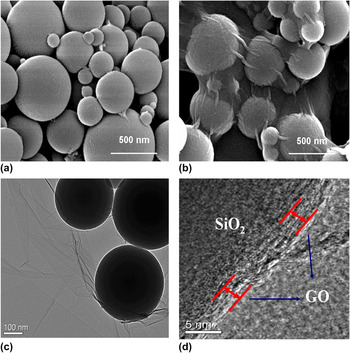
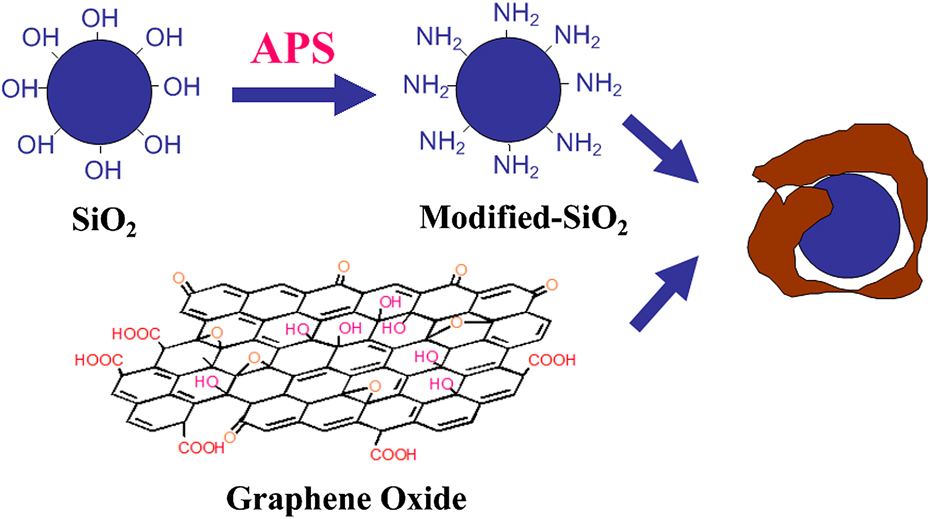
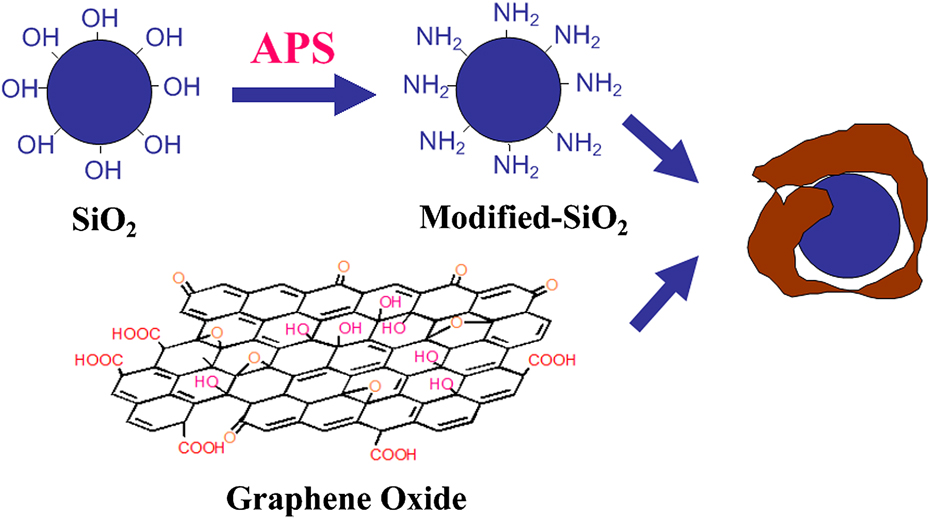
The morphology and structure of the resulting GO–SiO2 hybrids and pristine SiO2 are shown in Fig. 1. SEM image of uncoated SiO2 particles shows only smooth surfaces [Fig. 1(a)]. In contrast, the GO–SiO2 hybrids show crinkled and rough textures that are associated with the presence of flexible and ultrathin GO sheets. In most cases, the edges of individual as well as overlapping GO layers can be observed, particularly at the interface between aggregated particles, where the GO layers appear to link neighboring particles together [Fig. 1(b)]. The typical high resolution transmission electron microscopy (HRTEM) images of GO–SiO2 hybrids confirm the intimate encapsulation of the silica spheres by the extremely thin (<5 nm) flexible graphene sheets [Figs. 1(c) and 1(d)]. At this moment, it is difficult to visualize the encapsulation of individual particles or several particles by TEM images, and we believe that the sheets are large enough to encapsulate several particles. The overall fabrication procedure and the assembly mechanism are illustrated in Scheme 1. Sub-micro-sized silica microspheres are first modified by surface grafting of APS (SiO2–NH2) to render their surface positively charged, then the electrostatic attraction between GO sheet and protonated SiO2–NH2 particles is readily created to form core/shell structured hybrids through a simple solution mixing.
SEM images of the pristine SiO2 (a) created GO–SiO2 hybrids (b); (c) TEM images of GO–SiO2 hybrids, (d) High-resolution TEM (HRTEM) image of GO encapsulating silica sphere, showing core–shell structure with ultrathin GO sheets (<5 nm).

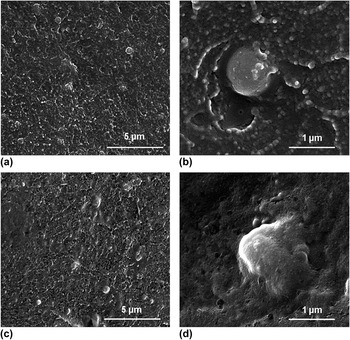
SEM images to represent the dispersion morphologies of pristine SiO2 with a content of 5 wt% (a and c); and GO–SiO2 hybrids with a content of 5 wt% (b) and (d).

B. Dispersion and interfacial interaction of core–shell structured GO–SiO2 hybrids in PET composites
Let us first check the dispersion status of pristine SiO2 and GO–SiO2 hybrids in the PET matrix and this was assessed by SEM micrographs of the fractured surface morphology of the composites (2 and 5 wt%). The hot-pressing samples were cryofractured in liquid nitrogen. As shown in the SEM images of Figs. 2(a) and 2(c), it can be identified clearly that pristine SiO2 and GO–SiO2 hybrids are individually and homogeneously dispersed in PET, and this dispersion status can be preserved even at as high as a filler content of 5 wt%. It indicates that in situ polymerization is a good strategy for achieving the homogeneous dispersion of pristine SiO2 and GO–SiO2 hybrids in PET matrix. It seems to be that the sub-micro-sized pristine SiO2 (500 nm) can be easily dispersed in the polymer matrix compared with that of nanoscale particles, and the dispersion of the silica particles within the polymer is basically unaffected by the presence of GO. It is well known that the interfacial interaction between filler and polymer is a vital factor to obtain high performance polymer/inorganic filler composites. Switching the surface feature of filler is a popular way to enhance interfacial interaction. In this work, GO–SiO2 is introduced to the PET matrix via in situ polymerization, which allows PET chains to be linked on filler, forming novel polymer grafting interface structures. Figure 2 shows the SEM images of fractured microstructure of PET/SiO2 and PET/GO–SiO2 composites with 5 wt% filler. Compared with composites filled with pristine SiO2, stronger interfaces are observed in fracture surfaces of composites filled with GO–SiO2 hybrids. For the composites filled with pristine SiO2, a few SiO2 particles with smooth surfaces left in the fracture surface [Fig. 2(b)]. However, composites filled with GO–SiO2 exhibit a rough fracture surfaces and hybrid particles are seen tight coalescent in the matrix [Fig. 2(d)], which indicates a strong interfacial interaction between GO–SiO2 hybrids and PET matrix. The two-dimensional (2D) structure of GO provides a perfect template for the formation of the grafting SiO2 layer on its surface, on one hand. And on the other hand, its abundant functional groups allow PET chains to be linked on GO sheets, forming novel polymer grafting interface structures. It is most likely that GO has been simultaneously thermally reduced into graphene during polymerization, as judged from the color change of the prepared composites. However, in this system, it is also very difficult to prove amide covalent bond formation because the content of GO is very low compared with silica. Ou et al.Reference Ou, Wang, Liu, Mu, Ren, Wang and Yang24 reported that reduced graphene oxide sheets were covalently assembled onto silicon wafers via a multistep route based on the chemical adsorption and thermal reduction of GO (200 °C, in air atmosphere). It is generally believed that high temperature is in favor of producing amido linkage between carboxylic and amine groups.Reference Mo, Zhu and Bai25
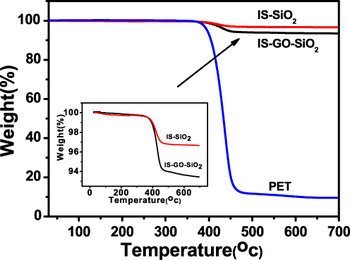
The weight loss curves for the neat PET, IS–SiO2, and IS–GO–SiO2.

The amount of PET chains remaining on the fillers can be further estimated by TGA. Figure 3 shows the weight loss curves of the neat PET, IS–SiO2, and IS–GO–SiO2. It is found that the main weight loss of neat PET takes place in a temperature range between 400 and 450 °C, and 90 wt% weight loss takes place above 500 °C. In contrast, the IS–SiO2 curve shows a little weight loss about 3.0 wt% at temperature above 500 °C, resulting from the quite little resin coated in the particle, whereas the IS–GO–SiO2 curve shows more notable decrease at temperature above 450 °C. From the weight loss of IS–GO–SiO2 around 500 °C, the amount of the resin reserved on IS–GO–SiO2 particles is about 6.2 wt% (higher than that of IS–SiO2 particles). The resin remained on the filler could be considered as the interphase, which could greatly enhance the interfacial interaction between the filler and polymer matrix. Combined with the results of SEM and TGA, it can be concluded that the 2D structure of GO provides a perfect template for the forming of the grafting layer and a stronger interaction is achieved in this GO–SiO2 hybrids filled PET compared with that in pristine SiO2 filled PET.
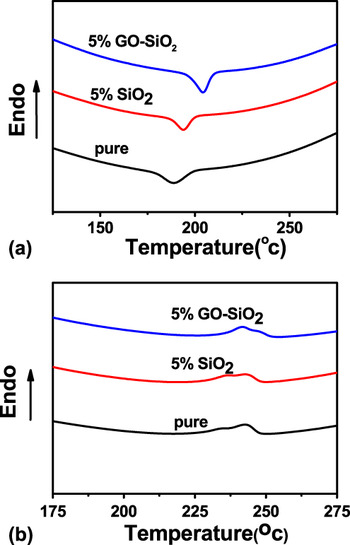
DSC curves for neat PET, PET/SiO2, and PET/GO–SiO2 composites with 5 wt% fillers: (a) the cooling scan after first heating and (b) the second heating scan.

C. Melting and crystallization behaviors
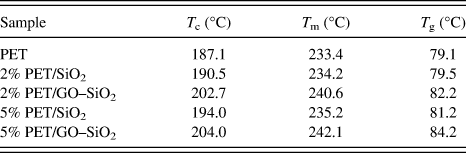
The effect of SiO2 and GO–SiO2 hybrids on the crystallization and melting behavior of PET was investigated using differential scanning calorimeter (DSC) cooling and heating experiments, respectively, as shown in Fig. 4. The corresponding melting temperatures (T m) and crystallization temperatures (T c) are listed in Table I. An interesting phenomenon is found that the incorporation of 5 wt% SiO2 particles leads to nearly 7 °C increase of T c values compared with that of neat PET resin, which is from 187.1 to 194.0 °C. For the systems loaded with the same amount of GO–SiO2 hybrids, the increase is 16 °C that is from 187.1 to 204.0 °C, which is higher than that of loaded with SiO2 particles. In other words, GO–SiO2 hybrids have more positive “nucleating effect” on the hot crystallization of PET matrix, due to the better dispersion and stronger interfacial interaction. As to the melting behavior, two melting endotherms are observed for each composite. The lower one represents the melting of imperfect or smaller crystals, and the higher one may relate to recrystallization process. The melting peak located at lower temperature becomes more distinct and increases slightly with the filler content increasing.
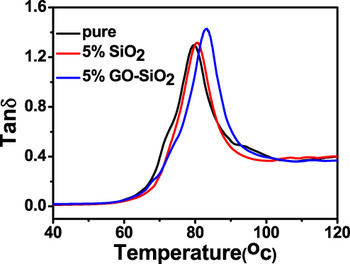
Dynamic mechanical analysis curves for the dynamic mechanical behavior of neat PET, PET/SiO2, and PET/GO–SiO2 composites with 5 wt% fillers.

Crystallization temperatures (T c), melting temperatures (T m), and glass transition temperature (T g) data.
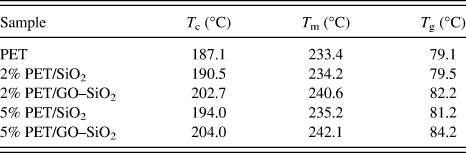
The dynamic mechanical analysis curves of the tan δ versus temperature for all samples are presented in Fig. 5. The glass transition temperature (T g) is extracted in terms of the peak temperature of tan δ ∼T curves and listed in Table I. The T g occurs at 79 °C for pure PET resin, whereas it slightly shifts to higher temperature (81 °C) for composites loaded with 5 wt% of pristine SiO2. For composites loaded with 5 wt% GO–SiO2 hybrids, the T g increases to 84 °C that is nearly 5 °C higher than that of neat PET resin, which is higher than that of composites loaded with pristine SiO2 particles. Considering the low content of GO, the increase of glass transition temperature (T g) is very large. This is another evidence that the interfacial interaction of PET/SiO2 composites is enhanced by the introducing of GO sheets.
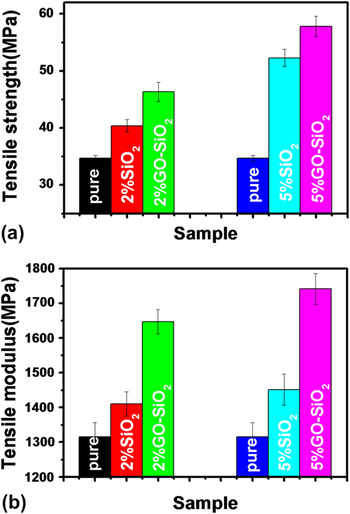
Effect of filler content on the (a) tensile strength and (b) tensile modulus of PET composites with SiO2 and GO–SiO2 hybrids.

D. Mechanical reinforcement properties of the composites
The tensile strength and initial modulus of neat PET, PET/SiO2, and PET/GO–SiO2 composites are shown in Fig. 6. Upon comparison with composites loaded with SiO2 and GO–SiO2, it is obvious that the improvement of mechanical properties of composites filled with GO–SiO2 is more significant than that of composites filled with SiO2. Comparing with the neat PET, the yield strength increased from 34.72 to 57.82 MPa for composites containing 5 wt% GO–SiO2 hybrids, while the yield strength only increases to 46.32 MPa for composites containing 5 wt% pristine SiO2 particles. Meantime, the tensile modulus of composites containing 5 wt% GO–SiO2 hybrids is up to 1741.6 MPa compared with 1647.1 MPa for composites containing 5 wt% pristine SiO2 and 1315.9 MPa for neat PET. Obviously, the mechanical enhancement achieved by using GO–SiO2 hybrid is caused by the presence of ultrathin GO shells on the silica surface. The mechanical reinforcement of PET composites filled by GO–SiO2 hybrids indicates a strong interfacial adhesion between GO–SiO2 hybrids and PET matrix as well as a sufficient load transfer from polymer to filler. It should be noted that the tensile strength and initial modulus are lower than those commercial PET with high intrinsic viscosity. Since the tensile property of PET will depend on the molecular weight of PET, the lowered tensile property in our prepared PET composites can be understood as due to the lower molecular weight compared with commercial PET with high intrinsic viscosity. Also, another reason is that the hot-pressed sheets have very low orientation and crystallinity, whereas the results reported in the literature are usually obtained either from stretched PET film or injection-molded samples.
The scheme of overall fabricating procedure of self-assembly core–shell structured GO–SiO2 hybrids.
Now, more detailed research is being undertaken by our group to prepare PET composites with the untreated silica and aminosilane-treated silica filler via in situ polymerization. Only after careful comparison between PET/GO–SiO2 hybrids and PET/SiO2–NH2 composites, the unique property of GO as a new coupling agent can be established.
IV. CONCLUSIONS
A novel core–shell structured hybrid GO–SiO2 was fabricated via an electrostatic assembly between negatively charged GO sheets and positively charged sub-micro-sized silica. As a result, GO can be covalently assembled onto the subsized silica surface. It was further demonstrated that GO acting as a special coupling agent for polymer composites and provides strong interaction with the PET, thus leading to improved mechanical performance. We believe that this work will provide a potential application of GO-encapsulated particle to achieve special performance. This new PET/GO–SiO2 hybrids composite exhibits good potential in industrial field and practical application of PET-based materials.
ACKNOWLEDGMENTS
We would like to express our great thanks to the National Natural Science Foundation of China for financial support (Grant Nos. 50903048, 21034005).